1 592 résultats
TM 796<p>MEDIEVAL ILLUMINATED MANUSCRIPT IN ITALIAN ON PAPER Northeastern Italy Veneto Venice c. 1474. Dimensions 328-332 x 230 mm. 188 folios missing at least three leaves written in brown ink in an Italian cursiva libraria script EIGHT ILLUMINATED INITIALS of seven lines one-line paraphs in red or blue<i> </i>simple two- to four-line in red or blue initials. BINDING: re-cased using original binding materials of brown half leather over bevelled wooden boards with three double bands remains of four straps present. TEXT: Italian translation of Gregory the Great's <i>Moralia in Job</i> one of the most important and widely copied texts of the Middle Ages. Though forty copies of this translation survive this volume is unusual in its incorporation of Venetian dialectal forms. All other copies are in European institutions and have not been on the market for the last century. PROVENANCE: scribal colophon on f. 190v provides a date for this manuscript's completion and helps localize its production within Italy: "Scripto per mi zuane de zane zoielier condam per simon et chi li lezeranno priegi dio per lo scriptore. MCCCCLXXIIII" Written by me Zuane de Zane jeweler once for Simon and may whoever will read it pray to God for the writer. 1474. There is no Zuane de Zane on record elsewhere as a scribe; the name itself is Venetian and evidence of the manuscript's watermark and decoration also suggest an origin in the region of Veneto and possibly Venice specifically. The manuscript was later acquired by a private European collection. CONDITION: slight tears in the lower margin of f. 25 and upper margin of ff. 37 and 160 from f. 161 to the end there is a slight loss to the upper outer corner<i> </i>slight water staining visible parchment reinforcement present prickings visible. Full description and images available. TM 796</p> Northeastern Italy, Veneto (Venice?), dated 1474
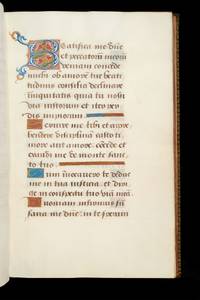
150012054Tours 1500. 19th-century blind-ruled crushed green morocco Niédrée; hinges slightly cracked at top and bottom gilt-lettered spine title all edges gilt green silk marker. <p> THIS ELEGANT TRILINGUAL PRIVATE DEVOTIONAL WAS PREPARED FOR A HIGH-RANKING FRENCH MILITARY OFFICIAL likely a participant in the Italian Wars of 1494-1512. An identical suite of prayers appears in a manuscript Morgan M.292 made for maréchal de France Pierre de Rohan-Gié 1450-1513 who campaigned in Italy with Charles VIII and Louis XII.<br /> Our anthology is centered on the faithful's plea for military success and protection against the dangers of war. The opening prayers in French are rich in chivalric imagery. Next is an uncommon extended version of the Latin Abbreviated Psalter a series of extracts from the Psalms compiled for soldiers and others unable to recite the full daily Office. The texts that follow include a Latin prayer for victory in battle the placeholder n stands in for the name of the supplicant and unusually the long pseudo-Augustinian Prayer for the Troubled in its Italian version.<br /> This last concludes the work of the first scribe who in line with the contemporary trends of luxury manuscript production at Tours adopted a peculiar rounded bâtarde. His hand's nod to the shapes of humanistic Antiqua doesn't mitigate the striking mismatch of language and script in the italian prayer.<br /> In Latin the Gospel readings on the Passion occupy the second half of the manuscript executed in a more traditional hand by a second scribe. attractive uniform decoration unifies our intriguing manuscript. In very good condition.<br /> ¶Salmon "Psautiers abrégés du moyen âge" in Analecta liturgica 1974 80; Cottier "Psautiers abrégés et prières privées durant le haut Moyen Âge" in Recherches Augustiniennes 33 2003 215-30; Avril & Reynaud Les Manuscrits à peintures en France 165 173 & 177.<br /> <br /> </p> <br /> <p>Prayer Book in French Latin and Italian. <br /> TEXTS & ILLUSTRATIONS </p> <br /> <p>I. French prayers to the Virgin: pp. 1-8<br /> p. 1 Inc. O glorieuse pure vierge pucelle Sinclair 6243; four-line illuminated initial in blue and white on red and gold ground infilled with flowers.<br /> p. 6 Inc. Je te salve tres chaste espouse Sonet 897; two-line boxed initial in gold ink on blue ground.<br /> p. 8 blank.</p> <br /> <p>II. Confession formula and Psalterium Abbreviatum: pp. 9-58<br /> p. 9 Inc. Confitebor tibi domine deus omnipotens; four-line illuminated initial in grey and and white on gold ground infilled with flowers.<br /> p. 14 blank.<br /> p. 15 Inc. Beatifica me domine et peccatorum meorum; three-line illuminated initial in blue and white on red and gold ground infilled with flowers.<br /> p. 25 Inc. Miserere mei deus secundum magnam misericordiam; two-line boxed initial in gold ink on red ground.<br /> pp. 35-36 blank.<br /> p. 37 Inc. Domine exhaudi orationem meam; two-line boxed initial in gold ink on red ground.<br /> p. 48 blank.<br /> p. 49 Inc. Domine quid multiplicati sunt; two-line boxed initial in gold ink on red ground.<br /> p. 58 blank.</p> <br /> <p>III. Latin Prayers to Jesus and the Trinity: pp. 59-70<br /> p. 59 Inc. Deus omnipotens pater filius et spiritus sanctus; two-line boxed initial in gold ink on red ground.<br /> p. 62 Inc. Iesu Nazarene respice ad meas miserias; two-line boxed initial in gold ink on red ground.<br /> p. 64 blank<br /> p. 65 Inc. Domine iesu christe qui septem verba; four-line illuminated initial in grey and white on gold ground infilled with flowers.<br /> p. 70 blank.</p> <br /> <p>IV. Pseudo-Augustine's Orazione per i Tribolati in Italian: pp. 71-84<br /> p. 71 Inc. O dulcissime signore iesu cristo vero dio; four-line illuminated initial in blue and white on red and gold ground infilled with flowers. </p> <br /> <p>V. Psalm 117: pp. 85-90<br /> p. 85 Confitemini domine quoniam bonus; three-line illuminated initial in blue and white on red and gold ground infilled with flowers and strawberries.<br /> p. 90 blank.</p> <br /> <p>VI. Gospel readings on the Passion: pp. 91-172<br /> p. 91 rubric: Dominica in ramis palmarum. Text of Matthew 26-27 begins; four-line initial in blue and white on red and gold ground infilled with flowers.<br /> p. 116 rubric: Feria tercia post ramos palmarum. Text of Mark 14-15 begins; two-line boxed initial in gold ink on red ground.<br /> p. 136 rubric: Feria quarta post ramos palmarum. Text of Luke 22-23 begins; two-line boxed initial in gold ink on red ground.<br /> p. 156 rubric: Die veneris sancta. Text of John 18-19 begins; three-line illuminated initial in blue and white on red and gold ground infilled with flowers.<br /> p. 172 blank.</p> unknown
41129Contains manuscripts of works by Anfossi Aprile Asioli Belli Beauharnais Cantone Carafa Carlini Caruso Clari Clementi Czerny Dalvimare Eichner Fioravanti Giordani Hasse Haydn Herz Isola Jommelli Kreutzer Labriola Lanza Leo Macagnani Mancinelli Mercadante Meyerbeer Morandi Pacini Paisiello Pergolesi Perugini Pratelli Raimondi Roggero Romani Ricci Rossini Sampieri Sarti Scandellari Scarlatti Schuster Tartini Traetta Tunca Tritto Verdi and Zingarelli.<br /> <br /> Provenance<br /> Predominantly from the collections of Luigi Ricci 1893-1981 Italian musician assistant conductor vocal coach and friend of Mascagni and Puccini and long-time London music antiquarian William Reeves. Of considerable research value.<br /> <br /> A detailed inventory is available upon request. unknown
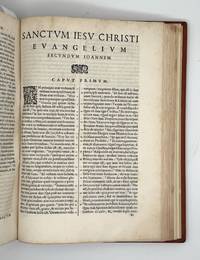
1592371810Rome: Ex Typographia Apostolica Vaticana 1592. First edition of the Clementine Bible. Edition of 500 copies. Engraved title page reading: Biblia sacra vulgatae editionis. Sixti Quinti Pont. Max. iussu recognita atque edita. Letterpress title page printed in red and black. Text in double columns. 12 1131 1 blank 23 1 blank pp. 1 vols. Folio 349 x 250 mm. Full reddish-orange levant morocco spine titled in gilt raised bands highlighted in black boards with single rule in black dated 1957 on turn-in. Fine. Leather-tipped slipcase. First edition of the Clementine Bible. Edition of 500 copies. Engraved title page reading: Biblia sacra vulgatae editionis. Sixti Quinti Pont. Max. iussu recognita atque edita. Letterpress title page printed in red and black. Text in double columns. 12 1131 1 blank 23 1 blank pp. 1 vols. Folio 349 x 250 mm. First edition of the official text of the Catholic Bible issued under sanction of Clement VIII and therefore known as the "Clementine Bible" and superseding the controversial and suppressed edition of Sixtus V of 1590. The text is preceded by Cardinal Bellarmino's preface the Decree of the Council of Trent on the canonical Scriptures and a brief by Clement VIII.<br /> <br /> "It is generally admitted that on the whole the Clementine text . is critically an improvement upon the Sixtine. . The Clementine Bible of 1592 remains to the present day the standard edition of the Roman Church" Darlow & Moule. <br /> <br /> Nice wide-margined copy of this notable edition. Brunet I 878; Darlow and Moule 6184; Adams B1101; P.M. Baumgarten Neue Kunde von alten Bibeln pp. 316-322. Provenance: W. A. Copinger bookplate; General Theological Seminary gift of Cornelius Vanderbilt and Dean Augustus Hoffman bookplates Ex Typographia Apostolica Vaticana unknown
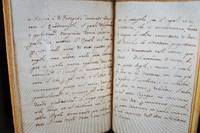
1441Italy 17th Century. <p>127 x 98 mm. 5 x 3 ¾ inches.  16 p. including final blank. Italy 17th century.                                      <br /> A handwritten guide to the drawing of the human head the most important element of any figure drawing and frequently the starting point for early modern drawing manuals. The manuscript appears to be unpublished and we have been unable to trace the text anywhere in the vast digitized corpus.</p> <br /> <p>The content is divided into five brief sections the first explaining how to draw a head in profile. Our scribe focuses on the triangle method in which the profile is anchored by three primary points: the top of the forehead cima della fronte beneath the nostrils sotto le narici and the well of the chin and the beard pozzetta del mento ò barbuccio. The author then explains how to connect these points how to form the nose place the mouth and lips draw the eye etc. Our scribe closes this section with the kind of aspirational promise endemic to manuals of this time namely that if you simple follow my instructions you’ll be able to do this easily. “without much confusion and effort†senza tante confusion et fatiche.</p> <br /> <p>The second section explains how to draw the head “in majesty†Della testa in scurcio by which the author appears to mean ‘head-on’ in such a way to convey power and authority he elsewhere refer to this position as prospetto e.g. on p. 9. Here the author likewise focuses on a simple method of drawing lines between different features of the face. The third section covers drawing the head in shadow Della testa in scurcio which the author admits is alquanto più difficle than the first two exercise and so he won’t be sticking to such geometrical rules. But then he goes on to provide a single very simple rule una regola facile assai namely to start with drawing rounded oval l’ovato cirolare and continues with guidelines that sound awfully geometric to us. The fourth section is on drawing a child’s head in profile la testa del fanciullo in profilo where he again starts with the triangle method adding other geometric principles and referencing the point of a compass. The fifth and final section is on drawing a child’s head in maestà wherein the author cites earlier discussion and further expounds on geometric advice. The author then closes with a general comment on the excellence and nobility of the art of drawing.</p> <br /> <p>The focus throughout is on lines and contours and proportions always guided by geometric rules for producing an accurate but relatively basic sketch. There is only brief passing reference to elements like “hair or other ornament according to the need and what is most pleasing†pelli or altro ornamento secondo che porfarà il bisogno e che più in piacerà . Despite the brief section on drawing the head in shadow there is nothing on rendering value or otherwise on capturing the subtleties that give a drawing depth and feeling.</p> <br /> <p>Like its spine title the Fairfax Murry catalogue calls this 17th-century and we tend to agree based on the script. While we haven’t traced our particular “bird†watermark Heathwood records a few similar marks used in the 17th century and Briquet finds many in the 16th especially in Italy.</p> <br /> <p>No less absorbing than the manuscript is a pair of 16th century Italian binding covers here preserved as doublures both heavily decorate in blind. The front doublure carries an arabesque motif and center Alexander the Great in profile. The rear appears to have been impressed with a single panel stamp also arabesque both doublures betraying the Islamic influence that characterized many Italian bindings of the period. </p> <br /> <p>Provenance: Lot 237 in the second Fairfax Murray sale his label on the inside rear board and perhaps then to Robert Tunstill his bookplate on the front fly-leaf. To us from a fellow ABAA bookseller who purchased it from a UK dealer in the 1990’s.</p> <br /> <p>Condition: Written in a cursive hand in dark brown ink on laid paper watermarked with a bird within a circle. Rebound in the late 19th century or early 20th century in cream pigskin tooled in black preserving as doublures the decorated covers of a 16h-century Italian binding described above title in gilt on spine Del disegno. Ms. Saec XVII. Following the manuscript are four additional blank leaves saved for scanning old pen trials early but the paper is different than the manuscript proper. Additionally six more modern fly leaves have been added at both front and back presumably at the time of rebind. A little loss since filled to the upper outer corner of the manuscript leaves and the four earlier blank leaves affecting just a word or two on each page; a few old pen trials over the text though it remains legible. Binding extremities lightly worn.</p> <br /> References: Catalogue of the Second Portion of the Library of C. Fairfax Murray 1918 p. 42 no. 237 “Manuscript on paper Italian hand 16 pp. repaired white morocco extra the cover of an old stamped vellum binding used as a double. 12mo. Saec. xviiâ€. Alexandra Arvilla Greist Learning to Draw Drawing to Learn: Theory and Practice in Italian Printed Drawing Books 1600-1700 PhD Dissertation UPenn 2011 p. vii “Italian printed drawing books libri da disegnare comprise an important body of evidence for our knowledge of artistic training in Italy during the early modern period. . . Intended for both professional and amateur audiences these printed sources were soon copied throughout Europe where they influenced drawing education for the next 400 yearsâ€. C. M. Briquet. Les Filigranes v. 3 # 12202- 12232 similar watermarks mostly 16th century. Edward Heawood Watermarks Mainly of the 17th and 18th Centuries 1950 # 179 183 similar watermarks 17th century. Anthony Hobson Humanists and Bookbinders 1989 p. 220-21 recording a few 16th century Italian bindings with Alexander the Great plaquettes. Thanks to Patrick Olson for help with this description. unknown
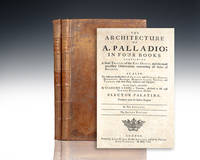
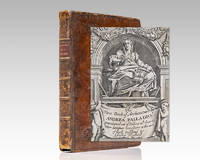
1721146284London: Printed by John Darby for the Author 1721. Rare second English edition of Leoni's English translation of Palladio's monumental work containing new typesetting but reusing the same plates from the first edition. Folio two volumes bound in full contemporary polished calf with gilt titles and ruling to the spine in six compartments within raised bands double gilt ruling and decorative stamping to the front and rear panels engraved frontispiece portrait of Palladio illustrated with 104 numbered engraved plates on 203 leaves including 15 double-page plates as well as 12 engraved in-text plates. Armorial bookplate to the pastedown of each volume. In very good condition. One of the giants of Venetian Renaissance architecture of the 16th century Andrea Palladio based his designs on the values of Greek architecture and the traditions of Roman architecture as outlined by Vitruvius. He is regarded as one of the greatest architects in the history of Western art best known for his villas in the Veneto as well as his palaces Vicenza and churches Venice all located within the Venetian Republic. His architectural theories were laid out in his treatise Quattro Libri dell Architettura The Four Books of Architecture which had a profound impact on building design throughout Europe and America. His style of architecture - a blend of Greek Roman and Renaissance art later known as Palladianism - accorded the greatest priority to maintaining symmetry perspective and overall harmony in the manner of Greco-Roman temple architecture and was widely imitated during the 17th and 18th centuries. Printed by John Darby for the Author hardcover
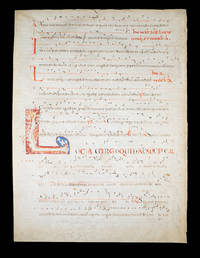
0724<p>This illuminated antiphonal leaf from 12th-century Italy likely Tuscany c. 1125–1150 preserves chants for the Feast of Saint Lucy Santa Lucia. Written in Latin in a rounded Carolingian hand the page features neumatic notation on a single red stave a transitional form of medieval musical notation. Rubrics in red uncials guide the singer while blind ruling for sixty lines ensures precise alignment of text and chant.</p><p>The centerpiece is a historiated initial "L" inhabited by a whimsical bird with red wings and yellow tail set against a red-and-blue paneled background. This inventive zoomorphic design is characteristic of Romanesque Italian illumination combining playfulness with liturgical solemnity.</p><p>The text and chant correspond to Lucia virgo quid a me petis a responsory sung at Matins for the Feast of Saint Lucy December 13th. The responsory set in Mode 7 reflects the veneration of Lucy across Italy especially in Tuscany where she was revered as a protector of sight and celebrated as one of the earliest Christian martyrs.</p><p>This fragment not only embodies the artistry of Romanesque illumination but also provides valuable evidence for the transmission of medieval chant and the devotional culture of 12th-century Italy. Its blend of bold script whimsical decoration and precise liturgical function make it a rare survival.</p><p>Provenance:<br />Italy likely Tuscany 12th century<br />Sotheby's London 25 April 1983 lot 11 two other leaves from this dispersed manuscript sold Sotheby's London 19 June 1979 lot 1<br />Private Collection USA</p><p>Literature:<br />Cantus: Database for Latin Ecclesiastical Chant cantusdatabase</p> Illuminated Antiphonal leaf on parchment
1760260692Brünn: Johann Paul Krauss 1760. Engraved title in each volume vols. II-IV reading "Unser Lieben Frauen .". 189; 2 193-390; 2 393-590; 190 pp. 8vo. Contemporary Italian binding of full brown morocco covers gilt with two outer border rolls corner-pieces and arms of Prince-Bishopric of Trent spine gilt in six compartments a.e.g. Dutch gilt endpapers. Light wear to corners else fine. In original morocco pull-off case tooled in gilt to match lined with Dutch gilt paper. Some wear and splitting to edges of box. Engraved title in each volume vols. II-IV reading "Unser Lieben Frauen .". 189; 2 193-390; 2 393-590; 190 pp. 8vo. A beautiful Italian armorial binding of the mid 18th-century similar in style to those promoted by the Salvioni firm in the original pull-off case. OCLC locates only one copy of this scarce German breviary in the Bayerische Staatsbibliothek. Johann Paul Krauss unknown
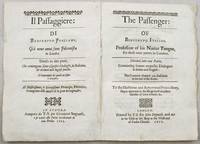
1612ST13801London: printed by Thomas. Snodham. for Iohn Stepneth and are to be sold at his shop at the west-end of Paules Church 1612. FIRST EDITION. 205 x 155 mm. 8 x 6". 18 p.l. 611 1 pp. 601-08 misnumbered 561-68 8 leaves. <br/> New unlettered limp vellum by Courtland Benson in imitation of the original binding. STC 1896; ESTC S124314. ◆Half a dozen gatherings a little browned occasional mild foxing or small rust spots additional trivial imperfections otherwise an excellent copy clean and very fresh in a pleasing new binding.<br/> <br/> This conversation manual by an Italian teacher based in London offers an intriguing glimpse into the lives and concerns of the wealthier classes in 17th century Europe. An early effort to teach language through dialogue the book is part cultural history part guide to better health and it is clear evidence of the importance of the study of Italian in Elizabethan and Jacobean England. The seven dialogues cover subjects from health to travel to servants with Italian and English text on facing pages. Many of the dialogues begin with phrases that will be familiar to all beginning language students: greeting others selecting items of clothing asking prices or directions ordering food. As the conversations progress they explore various topics that one might expect to encounter in polite society. An early morning exchange between master and servant evolves into a discussion of the importance of sleep the optimal amount of sleep for good health and the significance of dreams. A dialogue that begins with ordering meals leads to an involved colloquy about the benefits and disadvantages of fasting and abstinence; the virtues and defects of bread butter meat dairy and eggs; diet recommendations for the healthy and the sick; the best diet for each season; and the importance of a walk after dinner. Other dialogues include advice for travellers observations on the political situation and life at court and finally a discussion of that most eternally fascinating topic: love. This work is of continuing interest and value to linguists as it documents the Benevento Italian dialect which is in need of preservation. It's an extraordinarily rare book probably because it was the sort of volume subjected to hard use: in addition to ours we could trace only two copies in ABPC and RBH since 1948. printed by T[homas]. S[nodham]. for Iohn Stepneth, and are to be sold at his shop at the west-end of Paules Church unknown
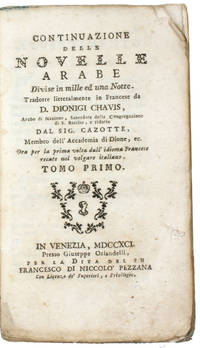
1791ABC_49342Venice: Giuseppe Orlandelli per la dita del fu Francesco di Nicolò Pezzana 1791. Near contemporary wrappers with the manuscript title on the spine. 12mo. With a small vignette built up from typographical ornaments on each title page. 4 volumes. First Italian edition of the Continuation des mille et une nuits an ambitious project to extend the Arabian Nights as translated by Antoine Galland. The Galland Manuscript the Arabic source ended at Night 282 and Galland had to supplement his work with original inventions or by translating French novels that were only orally transmitted.In the 1780s the Syrian monk Diyunisus Shawish renamed Dom Denis Chavis arrived in Paris. Short of money he decided to take advantage of the literary vogue of the moment and announced that he could prepare a more complete manuscript of the Thousand and one nights than Gallands. He proceeded to transcribe the existing corpus introducing numerous changes and expanding it with other stories from a manuscript he had brought with him from Syria. The operation proved successful: the Genevan publisher Paul Barde who was producing an impressive anthology of fairy tales entitled Cabinet des Fées commissioned Chavis to translate much of the material into French and then entrusted the text to the writer Jacques Cazotte who carefully revised it and even added stories of his own invention. The result of this singular collaboration was this beautiful Continuation first published at Geneva in 1788.Wrappers worn and chipped the edges are somewhat frayed. Otherwise in good condition.l OPAC SBN ITICCULO1E019383 7 copies; WorldCat 4 copies incl. 1 possibly only vol. 1; cf. not in Chauvin. Giuseppe Orlandelli per la dita del fu Francesco di Nicolò Pezzana, unknown
1733151582London: Printed for A. Bettesworth and C. Hitch and J. Osborn in Pater-noster-Row 1733. Finely bound eighteenth century example of Godfrey Richards' English translation of the first book in Palladio's monumental work. Octavo bound in full contemporary polished calf with a morocco spine label lettered in gilt front and rear panels decoratively stamped in blind title page printed in red and black additional engraved pictorial title page illustrated with 71 engraved plates and full-page illustrations 4 folding including a view of St. Paul's Cathedral woodcut illustrations advertisement leaf at end. Twelfth edition. Neat ownership inscriptions and small bookplate to the front free endpaper. Bookseller's ticket to the pastedown. In very good condition with the engravings very crisp and bright. One of the foremost architects of the Venetian Renaissance Andrea Palladio 1508–1580 based his designs on the principles of classical Greek architecture and the traditions of Roman building as described by Vitruvius. He is widely regarded as one of the most influential figures in the history of Western architecture particularly known for his villas in the Veneto as well as his palaces in Vicenza and churches in Venice all within the Venetian Republic. His architectural theories were codified in his treatise I Quattro Libri dell’Architettura The Four Books of Architecture which exerted a lasting influence on architectural practice across Europe and the United States. Palladio’s style later termed Palladianism combined elements of Greek Roman and Renaissance design emphasizing symmetry proportion and harmony in a manner inspired by classical temple architecture. Printed for A. Bettesworth and C. Hitch, and J. Osborn in Pater-noster-Row unknown
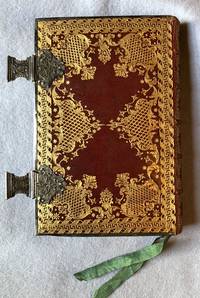
17562896Rome: Gioacchino & Giovanni Giuseppe Salvioni 1756. <p>8vo 208 x 133 mm. 24 407 1 pp. 2 parts the Office of the Dead separately titled. Printed in red and black. Engraved frontispiece and 12 full-page engravings by Arnold Van Weserhout and Jacob Frey after Joseph Passarus Giuseppe Passaro two engraved title vignettes 12 engraved tailpiece vignettes a few unsigned others by Frey after Passaro or by M. Schedi engraver 3 engraved capital initials numerous red-printed woodcut initials. Foxing occasionally severe short marginal tear to fol. Z7.<br /> Slightly later eighteenth-century Roman gold-tooled red goatskin covers with large dentelle border composed of a triple neo-classical roll-tooled outer frame enclosing six large ornaments each with a basketweave design of diagonally crossing gilt fillets framed in volutes and leafy sprigs a few tiny petal or star tools board edges protected with a probably later frame of silver or silver-plated metal discreetly nailed to the binding two elaborately chased silver fore-edge clasps and catches spine in six uniformly gold-tooled compartments gilt edges with gauffred border design pair of green ribbon page markers marbled endpapers; 20th-century black morocco felt-lined case. Provenance: with Gumuchian Catalogue XII/1930/225; Maurice Burrus bookplate purchased from Gumuchian in 1934 purchase notes at end. <br /> <br /> A striking rococo binding in fine condition on a luxuriously printed and illustrated Office of the Virgin from the official Vatican press.<br /> <br /> From the mid- to late eighteenth century the Salvioni press used one or more bookbinding workshops that produced finely gold-tooled bindings for their Vatican publications. Although often referred to as the “Salvioni bindery†this appellation is circumstantial: â€the Salvioni firm was responsible for promoting the bindings but it is not known which workshop produced them†British Library Database of Bookbindings. Some of these “Vatican†bindings incorporated variously colored or mottled leather. This example with its basketweave cartouches relies purely on tooling for its effect. An example evidently from the same workshop on a book printed at Rome in 1791 by Salomini using analogous cartouches as corner-pieces as well as a similar “spiraling†border design and some of the same leafy spray and star tools is reproduced in Legature papali no. 264.<br /> <br /> “Whereas the . more flamboyant bindings produced by the Salvioni Bindery rely frequently on polychrome enamel heightening these Vatican bindings strike a somewhat more sober note with their very fine dark-red morocco and rich gold-tooling of high quality†Martin Breslauer Catalogue 107/428.<br /> <br /> Gumuchian Catalogue de Reliures du XVe au XIXe siecle no. 225 plate 68. Cf. British Library Database of Bookbindings Shelfmark c27e18; For other “Salvioniâ€Â bindings see Miner / Walters Art Gallery The History of Bookbinding no. 523; Biblioteca Apostolica Vaticana Legature papali da Eugenio IV a Paolo VI no. 264 plate CXCIII. </p> Gioacchino & Giovanni Giuseppe Salvioni unknown
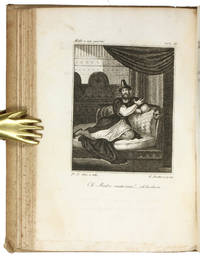
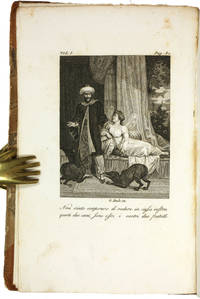
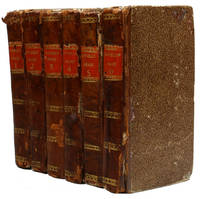
1833ABC_49352Venice: Giuseppe Antonelli 1833. Contemporary boards with a red title label and a black volume number label both lettered in gold on each spine. 16mo. With an engraved frontispiece in each of the 15 volumes. 15 volumes bound as 5. First illustrated Italian edition: a charming edition of the Heyaryek-Rouz or Thousand and One Days so-called to give the work an air of originality Chauvin IV 124. A Persian manuscript of this work was given to Francois Petit de la Croix in Isfahan in 1675 but enjoyed far fewer editions and translations than the Alf layla wa-layla. As Chauvin notes it cannot be determined whether the Thousand and one days or the Thousand and One Nights was composed first nevertheless to this day the Heyarek-Rouz is much less well-known to the Western world IV 123f. Chauvin quotes one commentator who declares the Heyarek-Rouz much more ingenious and more realistic as it sometimes includes marvels following the taste of the Oriental. The lovely frontispieces are drawn by Pietro Zandomeneghi and engraved by Giorgio Buttazzon.The bindings show signs of wear with some worming to the spines occasional light worming to the gutters blank margins. Otherwise in good condition.l Graesse IV 525; OPAC SBN ITICCUTO00988443 12 copies incl. 8 incomplete; WorldCat 1403675888 and other numbers; 1 incomplete copy also in OPAC SBN; cf. this edition not in Chauvin. Giuseppe Antonelli, hardcover
1791ABC_49348Venice: Giuseppe Orlandelli per la dita del fu Francesco di Nicolò Pezzana 1791. Contemporary half calf marbled paper sides with vellum corners a title label lettered in gold on the spine. 12mo. With a small vignette built up from typographical ornaments on the title page of each volume and with some headpieces built up from typographical ornaments. 6 volumes. Second Pezzana edition following that of 1784. That Niccolò Pezzanas company which in the meantime had been succeeded by Giuseppe Orlandelli returned to print the Arabian Nights testifies to the great favour the stories had found among readers in Venice. Also in 1791 the "Continuation of the Thousand and one nights" left its presses in a major publishing project to rediscover oriental fables.With the black ownership stamp of Ettiénne della Valle on the title page of each volume. Overall in good condition.l OPAC SBN ITICCUPUVE023925 4 copies incl. 3 incomplete; WorldCat 960425061 and other numbers for vols. 2-6 1203593861 3 copies; cf. Callegari Le edizioni veneziane delle Novelle arabe divise in mille ed una notte nel XVII secolo in Antoine Galland 1646-1715 et son journal: Actes du colloque international organise a lUniversite de Liege 16-18 fevrier 2015 a loccasion du tricentenaire de sa mort 2020 pp. 105-116 here at 108. This edition not in Chauvin. Giuseppe Orlandelli, per la dita del fu Francesco di Nicolò Pezzana, hardcover
1740ST19100aVenetiis Venice: Giambattista Pasquali 1740. FIRST EDITION. 132 x 90 mm. 5 1/4 x 3 1/2". 20 p.l. 427 5 pp. <br/> FINE CONTEMPORARY VENETIAN RED MOROCCO GILT covers with border of repeating botanical tools raised bands flanked by decorative gilt rolls green silk pastedowns all edges gilt and gauffered. HOUSED IN THE ORIGINAL PULL-OFF MARBLED CALF CASE the book and its case within a brown cloth chemise and matching slipcase. ENGRAVED THROUGHOUT with numerous floral initials 20 charming tailpieces frontispiece and 15 full-page illustrations by M. Pitteri all designed by Giambattista Piazzetta. Front flyleaves with book labels of John Saks Arthur and Charlotte Vershbow and David R. Godine. See: Boorsch "Venetian Prints and Books in the Age of Tiepolo" p. 20 and no. 98; Selby Carol E. "A Small Masterpiece from the Eighteenth Century Publishing World." Bulletin of the Detroit Institute of Arts vol. 43 no. 3/4 1964 pp. 60-63. ◆A hint of rubbing to extremities one tiny abrasion to front cover flyleaves with offsetting from binder's glue one page with tiny ink spot in margin but AN EXTREMELY FINE COPY ENTIRELY CLEAN FRESH AND BRIGHT internally in a beautifully preserved binding and case.<br/> <br/> Preserved in its original pull-off case and in superb unsophisticated condition this is a very charming prayer book engraved by a trio of talented artists that is called "a small masterpiece" in the "Bulletin of the Detroit Institute of Arts" in 1964 and described in the June 2013 Christie's catalogue of the Vershbow sale as "one of the most desirable Venetian illustrated books of the 18th century." The plates here were designed by Giovanni Battista Piazzetta 1682-1754 a painter and illustrator whom Britannica calls "one of the outstanding Venetian artists of the 18th century." Piazzetta was known for his masterful use of chiaroscuro and dynamic compositions--both of which can be seen to great effect in the present work. The engravings were executed by a close collaborator of Piazzetta Marco Alvise Pitteri 1703-86 whom Selby calls "one of the most able and popular engravers in Venice being in demand for the reproduction of works of his most distinguished contemporaries." Using his own unique blend of engraving techniques described by Boorsh as "unprecedented and unimitated" Pitteri is able to translate Piazzetta's animated compositions into a small-scale format with figures that are beautifully highlighted and seem to glow on the page. But perhaps the most impressive part of this work is the text itself. What at first glance appears to be more than 400 pages of letterpress is in fact entirely engraved--an extraordinary feat of precision and patient craftsmanship by Angela Baroni daughter of engraver Giuseppe Baroni. It seems likely that Angela learned the craft from her father but little else is known about her life. Regardless Angela's talents speak for themselves through this work. As Carol Selby tells us "Engraving a book like this one is an undertaking indeed. . . . The more than 400 pages must each have been engraved in reverse on copper plates which being almost impossible to correct allowed little margin for error. The effect is charming lively controlled but free." Thanks to the original and very pretty pull-off case this little gem has remained in outstanding condition inside and out. The volume has a distinguished provenance having belonged to collectors known for their taste and discrimination in the acquisition of a range of especially desirable books: John A. Saks who bought it from Bernard Quaritch in 1981 then Arthur and Charlotte Vershbow then David Godine who bought it at the Vershbow sale for $3000. Giambattista Pasquali unknown
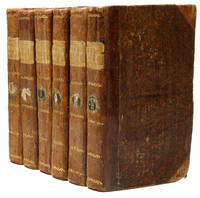
1831ABC_49344Venice: Giuseppe Antonelli 1831. Contemporary half calf with the title and volume numbers in gold on the spine. 12mo. With 26 of 27 engraved plates drawn by Pietro Zandomeneghi and engraved by Giorgio Buttazzon. 27 parts in 9 volumes. Rare first illustrated Italian edition of the Arabian Nights the first new translation after Coletis. This is one of the finest Italian editions of the Nights both for its impressive set of plates and for its translation. The editor and translator Antonio Francesco Falconetti had worked on a greatly expanded French corpus that is considered one of the most complete versions of the work: The translation entirely new is based on the latest Paris edition found for the part already made public by Galland on original texts amended and enlarged with new stories by M. Destains and then completed with the addition of a very large number of previously unpublished novellas discovered by M. Hammer which form a good third of the entire series editors preface vol. I p. XI.Overall in very good condition lacking only the frontispiece in vol. II perforation to the blank margin of vol. II p. 293.l OPAC SBN ITICCUVEA0151721 11 copies incl. 8 incomplete; cf. Chauvin IV p. 91 no. 238 second ed.; this ed. not in WorldCat. Giuseppe Antonelli, unknown
18451716491845. ALPHABET. ITALIAN CALLIGRAPHIC MANUAL. Cinquanta tavole alfabetiche. 51 ff. includes 50 engraved b&w plates. 145 x 400 mm. contemporary half-cloth over marbled boards. Bologna: Vendibile da Zecchi ca. 1845. A charming Italian alphabet with illustrations by Carlo Lenzi Giuseppe Lanzani Francesco Franceschini Victor Adam Gaetano Canuti Fillipo Camisana A Magnaron Pietro Romagnoli and Simon Midoli. Some foxing and staining throughout but nevertheless an acceptable copy of a rare book with OCLC listing Getty Huntington Newberry Harvard Texasand 3 in Europe. hardcover
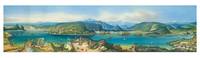
185042495Italy 1850. Gouache over faint etched line black gouache border. Period gilt and faux bois frame. A splendid panoramic view of Lake Como.<br/> <br/> Catering to the foreigners flocking to the region on The Grand Tour this hand-painted print beautifully depicts the famed picturesque lake with rich bands of blue highlighting the water and sky with the surrounding hills and mountains dotted with luxurious villas. The view looks north up the lake towards Switzerland from above Bellagio which occupies the point at which the lake divides in two. unknown
185042496Italy 1850. Watercolour over faint etched line black gouache border. Period gilt and faux bois frames. A splendid panoramic view of Lake Maggiore.<br/> <br/> Catering to the foreigners flocking to the region on The Grand Tour this hand-painted print beautifully depicts the famed picturesque lake with rich bands of blue highlighting the water and sky with the surrounding hills and mountains dotted with luxurious villas. In this view of Lake Maggiore we see from a very high vantage point the Borromean Islands: Isola Bella Isola Madre and Isola dei Pescatori with their extraordinary gardens. unknown
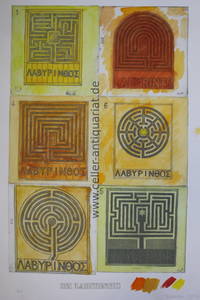
1007aaMaße 101 cm x 70 cm. Breiträndiges Exemplar. Blatt 1 von 80 numerierten Blättern. Unten rechts origina signiert "Tilson 1977". am Rand 2 Tuscheflecken. unknown
1784ABC_49347Venice: Francesco di Nicolò Pezzana 1784. Near-contemporary gold-tooled half calf marbled paper sides with a red morocco title label lettered in gold on the spine. 12mo. With a small vignette built up from typographical ornaments on each title page and some headpieces built up from typographical ornaments. 6 volumes. First edition by Pezzana a both prolific and diligent publisher of exotic tales. After Coletis first Italian edition of 1721-22 and that of Domenico Occhi between 1741 and 1743 Nicolò Pezzana was the third to issue the "Arabian Nights" in Italian: the text is the same as Coletis as is the size 12mo. From the time of their appearance the Novelle Arabe had been considered a work of literature for wide consumption and circulation . It was no coincidence that as early as 1780 the stories had been included in the group of works released from their privilege and subsequently raffled off among the less affluent members of the Guild. The printer Pietro Piotto who owned only a print shop without a bookshop was awarded the rights to the publication on 22 October; when he failed to exploit that privilege it was quickly seized by Pezzana Callegari. A very rare edition recorded in only six copies in the Italian OPAC SBN.The bindings are a little rubbed and the spines show some signs of wear around the head and foot. The work is somewhat browned throughout. Otherwise in good condition.l OPAC SBN ITICCULO1E019227 6 copies; Cf. Callegari Le edizioni veneziane delle Novelle arabe divise in mille ed una notte nel XVII secolo in Antoine Galland 1646-1715 et son journal: Actes du colloque international organise a lUniversite de Liege 16-18 fevrier 2015 a loccasion du tricentenaire de sa mort 2020 pp. 105-116 here at 108; this ed. not in Chauvin; WorldCat. Francesco di Nicolò Pezzana, unknown
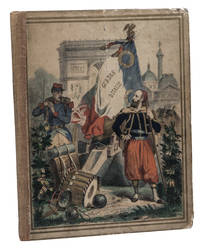
1863ABC_47223Pont-à-Mousson France 1863. Size of the whole when folded and closed: 22.5 x 18 cm. Élie Haguenthal colophon: Paul Toussaint Half red cloth and hand coloured lithographed paper sides. Lithographed folding panorama showing 8 different lithographed scenes captioned in and beneath the illustrations of the Italian War of 1859 from the French-Italian perspective.The 8 scenes 5 3-leaf scenes and 3 single leaf scenes are assembled to make a single long foldout as assembled with the text: 21.5 x 395 cm; image size 19 x ca. 310 cm coloured by a contemporary hand. 5 ll. of letterpress text and the lithographed folding panorama. Second known copy of a lithographic panorama of the Italian War of 1859 also known as the Second Italian War of Independence. This war was fought in the northwest Piedmont region of Italy pitting the Second French Empire and Savoy-Piedmont-Sardinia against the Austrian Empire and it proved crucial in the process of Italian unification. The text and following hand-coloured lithographs describe and depict eight stages of the war from the departure of French troops for Italy to their return some months later and highlighting several important battles including those at Magenta and Solferino. As a result the influence of the Austrian Empire in Italy was greatly reduced.The present work is extremely rare: we have located only one other copy at the Bibliothèque Nationale de France and it moreover differs slightly from the present one.The title-page functions as the front paste-down the text and illustration of the panorama fold out from there. The text and illustration have been printed on one side of the paper. With a French inscription in pencil at the head of the first page. The binding is somewhat foxed and browned the front board is slightly cracked the red cloth around the spine is slightly faded the back hinge is weakened some occasional staining and very slight foxing throughout. Otherwise in good condition.l Cf. WorldCat 461406796 1 copy of a later ed.: Bibliothèque Nationale de France; for the publisher Haguenthal: Dictionnaire des imprimeurs-lithographes du XIXe siècle http://elec.enc.sorbonne.fr/imprimeurs/node/25785. ABE CAT Art History hardcover
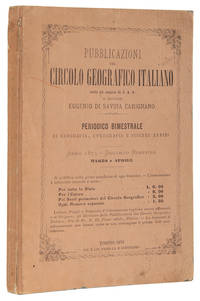
105018Torino Camilla e Bertolero 1873-74. . One volume number '2' from the Circolo Geographico Italiano biannual periodical for the years 1873 and 1874 complete in itself; 8vo 228 x 150; including a 4pp. index list of Arabic names printed in two columns in Italian and Arabic the latter is lithographed from crudely inscribed manuscript annotations and three plates one of these large folding with closed tears to edges relating to Mecca very clean and crisp condition; original printed covers slightly rubbed at extremities else a very good copy.<br /> A rare copy of an article on the architecture and history of the main Ka'aba and holy mosque in Mecca included in an Italian geographical periodical printed in 1874. The article includes a detailed history of the area and provides details from known historical accounts of the region. The article also includes three plates of Mecca including: one large folding reproduction of a tile design depicting the topographical layout and design of Mecca a detailed plan of the site of Mecca including a table of contents and a plate containing depictions of the Black Stone and ZamZam Well.<br /> Torino, Camilla e Bertolero, 1873-74. unknown
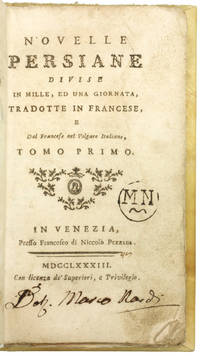
1783ABC_49353Venice: Niccolò Pezzana 1783. Later vellum with the manuscript titles and volume numbers in red on the spines. 12mo. With small vignettes built up from typographical ornaments on the title pages and some headpieces built up from typographical ornaments. 5 volumes. Extremely rare charming five-volume Italian edition of the Heyaryek-Rouz or Thousand and One Days so called to give the work an air of originality Chauvin IV 124. A Persian manuscript of this work was given to Francois Petit de la Croix in Isfahan in 1675 but enjoyed far fewer editions and translations than the Alf layla wa-layla. As Chauvin notes it cannot be determined whether the Thousand and One Days or the Thousand and One Nights was composed first nevertheless to this day the Heyarek-Rouz is much less well-known to the Western world IV 123f. Chauvin quotes one commentator who declares the Heyarek-Rouz much more ingenious and more realistic as it sometimes includes marvels following the taste of the Oriental.The present edition is printed by Niccolò Pezzana who only the following year would produce the Thousand and One Nights part of an ambitious publishing project catering to the Venetian public which at the time was rediscovering a taste for exotic fairy tales.With an owner's stamp MN on each title page and a manuscript inscription "Dot. Marco Nardi on the title page of vols. I and II. Both the inscription and the stamp belong to Dr. Marco Nardi. Further with some manuscript annotations in brown ink on the blank flyleaves. The endpapers are slightly worn some marginal worming to vol. V not affecting text some leaves are very slightly dust soiled. Otherwise in good condition.l OPAC SBN ITICCULO1E019364 3 copies incl. 2 incomplete; cf. this edition not in Chauvin; WorldCat. Niccolò Pezzana, hardcover
167310136Roma: Gio. Giacomo de Rossi 1673. First Edition Primera edición. Hardcover Tapa dura. 345x480mm. 13½x19". Roma Gio. Giacomo de Rossi 1673. En folio mayor apaisado 345 x 480mm. 2 h. con portada y dedicatoria a Luis XIV de Francia grabadas 7 láminas grabadas sin numerar y 119 láminas grabadas y numeradas. Encuadernación en holandesa del siglo XIX. Primera edición de esta obra monumental dedicada a ilustrar el friso escultórico de la Columna Trajana erigida en Roma por orden del emperador Trajano en el año 113. Está ilustrada en bajo relieve en espiral y alcanza los 30 metros de altura compuesta por 18 enormes bloques de mármol de Carrara. El friso escultórico completo mide unos 200 m y da 23 veces la vuelta a la columna. El relieve narra dos victoriosas campañas de Trajano contra los dacios: en la mitad inferior de la columna se ilustra la primera 101-102 y en la superior la segunda 105-106. El relieve estuvo completamente policromado. Pietro Bartoli interesado en la reproducción de obras de arte antiguo reprodujo el friso completo de la columna y comisionó a Bellori y a Chacón para la escribir la historia que aparece al pie de los grabados. Algunos ejemplares llevan 14 páginas de texto que no están en nuestro ejemplar. Gio. Giacomo de Rossi hardcover