Hanse, Helen (English, 20th Century).Biblio.com
8 080 résultats
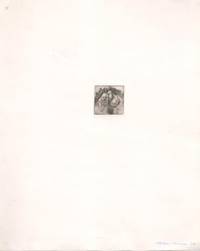
71-3350London: British Publisher circa 1984. Etching. 4 x 4 cm. image; 32.8 x 26 cm. sheet. Signed and dated ‘84 in ink. Very Good minor surface wear. London: British Publisher, circa 1984. unknown
199846939solway 1998. Softcover. VG-/na. Some rubbing & edgewear; creases; few small chips at edges/corners; some scratches & mark from old sticker on cover; some yellowing; otherwise overall clean & tight. solway paperback
1919104-3556New York: Dutton 1919. Good in the publisher's navy-blue cloth. Both the spine and the front board are stamped in gilt. vii 412pps. No dustjacket. There are a couple of short tears in the cloth at the head of the spine along with mild rubbing to the board-edges. The gilt on the spine is dulled though still legible; the gilt of the front board is brilliant. Also there is a narrow split in the binding at the title-page: the binding is nonetheless stable with all pages intact. The text is clean and bright with no previous ownership markings. Includes a Prefatory Note by the Editor Barnet J. Beyer.<br><br><b><font color=#003366> ".belongs to the class of literature immortalized by Alphonse Daudet. In it we catch the slightly ironic but good-natured tone familiar to those who have read <i>Sapho</i>; and we perceive the author applying objective psychology to life -- Parisian life. For M. Vanderem is not only Gallic but vitally Parisian. His attitude towards men and women is sophisticated; but his art is always fresh and true. He is a realist who does not disdain to make use of romance when it suits his purpose.<br> <i>'Two Banks of The Seine'</i> is an interesting story wherein the life of the Latin Quarter and that of the upper classes are brought into sharp contrast. This supplies the author with ample material suitable to his peculiar bent. He handles his material with clear vision often with delicate sympathy and never without humor. The men and women in the book are sketched with a sure pen and are put and kept in motion by a firm hand. They are made to move about briskly before us and to speak with the accents of life. Like all great novelists M. Vanderem is more interested in character and human relationships than in plot. His book is not so much a novel in the ordinary sense as a comedy of manners." -- from the Preface by the editor.</b></font><br><br> Purchase with confidence: all books gradings and descriptions are rendered the care of a genuine bibliophile. Satisfaction guaranteed or all costs you've incurred will be refunded. Thanks for your interest in Nooks Of Books. . FERNAND VANDEREM TWO BANKS OF THE SEINE LES DEUX RIVES PARIS PARISIANS FRANCE FRENCH FICTION LITERATURE CHAMBANNES PAGEOT. Catalogs: Literature & Fiction World. Dutton unknown
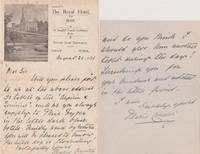
19535In the 1st letter 3-sides 8vo no place or date in the original envelope she writes "I am sure you will be pleased to hear the little dog is much better - quite lively and asking for his.biscuites but I am keeping him on his "fast".He was sick once in the night" & asks for further advice before concluding "Thank you for your kindness and interest in the little friend". In the 2nd letter she asks him to send Aspirins & Quinine ".such as you always supply to Miss Vyver.you will be pleased to know that the little dog is flourishing." 1-page 8vo on the pictorial letterhead of the Royal Hotel Ross August 21 1921. In the original envelope. unknown
84777 October 1936 and 12 March 1937; both on letterheads of 'The Warden's Lodgings New College Oxford'. Both items good on lightly-aged paper. Letter One: 4to 1 p. Begins 'The College today at its Special General Meeting did itself the honour of electing you to an Honorary Fellowship. We trust that it may not be unacceptable to you to be thus associated with our Society. There are no duties save that of wearing a surplice in Chapel on Sundays and Feasts of the Church.' He thanks Gore for his 'generous words' of the previous day. Letter Two: 4to 2 pp. He thanks him for his 'helpful letter about David' Gore's son the Conservative politician William David Ormsby-Gore 5th Baron Harlech 1918-1985 and consequently raises no objection 'to his being out of College in the Autumn' which 'may well prove to be the best thing for him'. The previous day David told Fisher 'that he was anxious to go into the House of Commons as soon as possible'. Fisher 'can see from his appreciation of Thucydides and de Tocqueville which is obviously genuine that his mind is taking a political shape.' He sees 'gleams of unusual promise about the boy' and thinks that 'As his physical strength improves and as the memories of those shocks to which you allude fade into the background . he will gain in confidence and concentration'. Characterises him as being at that time 'wayward elusive casual rather than idle decidedly <> with occasional touches of brilliance extremely sensitive and reserved' and with 'a certain distinction of nature'. He 'gave up the Hebdomadal Council' after his illness the previous year and does not know 'what is afoot about Honorary Degrees'. 7 October 1936 and 12 March 1937; both on letterheads of 'The Warden's Lodgings, New College, Oxford'. unknown
11842Both from 191 Euston Road London. 19 August 1882 and 7 July 1883. Both items in good condition on lightly-aged paper. Both of them bifoliums with mourning borders; and both in their original envelopes addressed by Marston with stamp and postmarks. ONE: 4pp. 12mo. He begins by stating that he is gratified to find that his poems please Baron. 'The only novel I wrote it is more than 20 years ago has I believe been long out of print. A comparatively short tale entitled "Family Credit" together with other sketches and essays chiefly contributed to "Household Worlds' sic was published many years gone by Messr. Ward and Lock as the 1st. Volume of a Sjhilling series and is possibly still to be had on application to them.' He would gladly send Baron a photograph but his supply is exhausted. 'Very good ones I believe are to be had of the Stereoscope Company Regent Street taken 10 years since and also late of Messrs Elliott & Fry. Baker St.' He apologises for the 'hurried scrawl': 'I am in the midst of preparations for leaving London'. TWO: 4pp. 12mo. He regrest that he cannot 'comply with Mrs. Baron's wishes': 'Years ago some valued letters of Mr. Charles Dickens & other correspondents were destroyed by the lamentable mistake of a servant and of those which remain I have given away all except those which refer to matters important to myself. - All the letters I retain of my late friend D. G. Rossetti are of the same character with the exception of one or two written during his last illness which on that account I desire to preserve.' Baron was a shameless autograph hunter and perhaps this prompts Marston to comment: 'Whenever it is known that autographs of distinguished men are to be had the possessor is immediately applied to so that at this date you will not be surprised to find that I have not one autograph in my possession which I can part with either of Dickens or Rossetti.' Regarding his own 'literary activity' he regrets to say that he has 'no volume of poems in preparation'; his health is 'too much impaired for any mental labour except of the most necessary kind'. He is 'now preparing to quit town for change of air in the hope of benefit'. Both from 191 Euston Road, London. 19 August 1882 and 7 July 1883. unknown
980527 April and 9 November 1865; on letterheads of St Anne's House Lewes Sussex. Both items in good condition on lightly-aged paper. Letter One 27 April 1865: 12mo 2 pp. Bifolium. Seventeen lines. He is sorry not to have been able to accept Flower's hospitality: 'Let us hope to meet about Whitsuntide for the pilgrimage to Firle'. He is eager for information for his 'Sussex Worthies'. 'My eldest daughter's marriage & the starting of my eldest son on his professional career cost money & every 30s. subscription will help.' Letter Two 9 November 1865: 12mo 1 p. 13 lines. He has received the 30s. He 'cannot fix the time' for a visit to Croydon being 'full of care & bustle'. He has an 'excellent working library' but cannot buy books although the 'book on Danish Antiquities is a tempting bait'. 27 April and 9 November 1865; on letterheads of St Anne's House, Lewes, Sussex. unknown
12939Letter One: on letterhead of the Gallery of Illustration 14 Regent Street London. 24 December 1863. Letter Two: 'Sat. S. C.'. Letter One: 4pp. 12mo. Bifolium. With decorative letterhead in red. Very good on lightly-aged paper. Addressed to 'My dear Old DD' and 'E. D. Davis'. He realises that Davis is in 'a precious state of mind' and will only send 'a few lines to exchange domestic greetings of kindliness & good fellowship from the circle of Balham to the Square in N'Castle - the waters of the Thames mingle with those of the Tyne'. A few words put to music follow with a lighthearted quotation from the novel 'Valentine Vox': 'Mynheer Vandunk who never got drunk - sipped brandy & water gaily "cold without" Railly!' He concludes: '"Cold Without & Warm within" Wishing you & yours all the enjoyment due at this festive demise of the old year 1863 & continued prosperity with the birth of the New Year 1864'. Postscript: 'Have you or Mrs D. been robbing Noah's Ark We'll try to consume it - the contents I mean. Not the ark or hamper. signed T G R'. The words 'Business Bad' alone on reverse of second leaf. Letter Two: 4pp. 12mo. Bifolium. Diagonal section cut away from both leaves with loss of text; otherwise good on lightly-aged paper. Addressed to 'My dear Old DD'. He begins by discussing 'a great big chesnut mare' which has been 'placed at my disposal for paying her keep': 'I don't know anything of her fencing qualities but shall find out in a day or so - al about it'. He is 'waiting till the end of the hunting season' before writing: 'I don't consider this a letter only an intermezzo or parenthesis'. He has been 'suffering from pains in the back beginning with lumbago & in the legs to such an extent that I can scarcely walk erect - Whats the remedy My Northern Esculapius - Eh' He concludes: 'When are you coming to town You'll miss all the parts if you don't come soon - We must! We shall! We Will! have one more run. And become gay. And become gay become gay to make our vitals good!!!' He ends with a few bars setting these final words to music and signs 'T'. Letter One: on letterhead of the Gallery of Illustration, 14 Regent Street [London]. 24 December 1863. Letter Two: 'Sat. S. C.' unknown
a84881928. Sheet music 4to. Signed pres copy from composer. Good. unknown
185369294Philadelphia: Isaac Leeser 1853. BIBLE IN ENGLISH; LEESER Isaac. LEESER Isaac translator. The Twenty-Four Books of the Holy Scriptures. Carefully translated according to the Masoretic Text on the Basis of the English Version after the best Jewish Authorities; and supplied with short Explanatory Notes. By Isaac Leeser. Hebrew "For it shall not be forgotten out of the mouth of his seed." Dent. xxxi 21. Philadelphia: Isaac Leeser 1853.<br> <br> Full Description:<br> <br> BIBLE IN ENGLISH. LEESER Isaac translator. The Twenty-Four Books of the Holy Scriptures. Carefully translated according to the Masoretic Text on the Basis of the English Version after the best Jewish Authorities; and supplied with short Explanatory Notes. By Isaac Leeser. Hebrew "For it shall not be forgotten out of the mouth of his seed." Dent. xxxi 21. Philadelphia: Isaac Leeser 1853.<br> <br> First edition of the first complete translation of the Old Testament by a Jewish translator into English building upon Leeser's 1845 translation of the five books of the Pentateuch translation in 1845-1846. Folio 10 3/8 x 8 3/8 inches; 275 x 212 mm.<br> <br> Original full brown morocco. Boards ruled and elaborately stamped in gilt. Spine stamped and lettered in gilt. All edges marbled. Marbled endpapers. Binding with some restoration along joints and edges. A bit of foxing mainly to the preliminaries. Some occasional light dampstaining. Overall a very good copy.<br> <br> "Having published a five-volume Pentateuch-cum-haftarot lections from the Prophets translation in 1845-1846 as well as a complete vocalized and accentuated Hebrew Bible in 1848 the first such edition published in the U.S. he proceeded from April 1852 to September 1853 to extend his translation efforts to the entire Hebrew Bible. The result was his Twenty-Four Books of the Holy Scriptures the first translation of all of Tanakh into English by a Jew complete with short explanatory notes. Leeser explained in the preface to his magnum opus that he undertook the project in order to provide Anglophone Jewry with a vernacular version of the Bible "which has not been made by the authority of churches in which they can have no confidence" pp. iii-iv. The book achieved wide popularity among English-speaking Jews and even some Gentiles especially in America and went through multiple editions." Sotheby's<br> <br> "The translation of the Bible was Leeser's great literary achievement and represented many years of patient labor and devotion to a task which he considered sacred. Leeser was not fully equipped for this work for he was no specialist in Hebrew philology nor a master if Jewish learning in general and he was quite conscious of his shortcomings but he was inspired. He says in his preface: 'I thought in all due humility that I might safely go to task confidently relying upon that superior aid which is never withheld from the inquirer after truth.' He made good use of the various German translations by Jews of the collective commentary known as the Biur vol. III sec. 81 and of other Jewish exegetic works. As a result his translation though based in style upon the King James version can be considered an independent work for the changes he produced are numerous and great. His prime concern was to supply the traditional interpretation when necessary and the retention of the Jewish spirit at times even at the expense of beauty of style. The translation went through numerous editions and until the new Jewish Publication Society version was issued in 1917 it was the only source from which many Jews not conversant with Hebrew derived their knowledge of the Bible in accordance with Jewish tradition" Waxman History of Jewish Literature 1090.<br> <br> HBS 69294.<br> <br> $12500. [Isaac Leeser] unknown
2012175708Harvard University Press. 1st. 2012. good. Hardcover. ISBN:9780674055162 xi 408 pages including bibliography; about 25 pages with marginalia & underlining; light soil to dj in new protective mylar . Harvard University Press hardcover
135745130X.Ghardcover. Good. Access codes and supplements are not guaranteed with used items. May be an ex-library book. hardcover
158068068London: Christopher Barker Printer to the Queenes Maiestie 1580. BIBLE IN ENGLISH; BARKER ChristopherHERREY Robert F. A Rare First Edition of Herrey's "Concordances"<br> <br> BIBLE IN ENGLISH. BARKER Christopher. HERREY Robert F. compiler. Tvvo right profitable and fruitfull concordances or large and ample tables alphabeticall. The first contayning the interpretation of the Hebrue Caldean Greeke and Latine wordes and names scateringly dispersed throughout the whole Bible with their common places following euery of them: and the second comprehending all such other principall words and matters as concerne the sense and meaning of the Scriptures or direct vnto any necessarie and good instruction. The further contents and vse of both the which tables for breuitie sake is expressed more a large in the preface to the reader. Collected by R.F.H. London: Christopher Barker Printer to the Queenes Maiestie. 1580.<br> <br> First Edition. One of two issues of the same year priority unknown. Our year based upon the issue points as shown by the British Library: "with The "A" of signature mark "A4" under the "t" of "the" ESTC S125409. Quarto 9 1/4 x 7 1/4 inches; 236 x 185 mm. 92 leaves. A8-L8 M4. With preface signed "Thine in the Lord Robart F. Herrey" and dated "xxii of December. An. Domini. 1578." We could find no other complete copies of this first edition of "Concordance" at auction in the past 50 years.<br> <br> Although this comes separately The Herrey "Concordance" is generally found issued with a Barker Geneva Bible starting with the date 1580. There were several printings of this "Concordance" starting in 1580 and going into the next decade however only the present copy and one other printing were issued with the two versions of the Barker Bibles of 1580. Present copy with Signatures: A-L M and with The "A" of signature mark "A4" under the "t" of "the". This version was issued with the 1580 Bible Darlow & Moule 123. Another version of the same year with Signatures: A-C D-V was issued with the 1580 Bible Darlow & Moule 124.<br> <br> Bound separately in modern full brown morocco. Covers ruled in triple blind and with a central "Cross" devise in blind on both covers. Newer endpapers. Some occasional ink small hand marginalia. Edges of leaves a bit frayed. A stain to bottom margin of leaves H2-H3. A paper repair to bottom margin of final leaf M4 not affecting text. Overall very good.<br> <br> According to Herbert and Darlow & Moule " The Concordances which form an essential part of the volume of the Bible were compiled by Robart F. Herrey who is identified with Robert Harrison the Norfolk Brownist 9d. 1585"<br> <br> Darlow & Moule 123. ESTC S125409 . Herbert 165. STC 13228b.1 .<br> <br> HBS 68068.<br> <br> $2850. Christopher Barker, Printer to the Queenes Maiestie unknown
2012Q-1610350545Linden Publishing 2012-07-16. Paperback. New. In shrink wrap. Looks like an interesting title! Linden Publishing paperback
15905TUILERIES BROCHURES ENGLISH ARCHITECTURE. London: Ludowici-Celadon 1930. 4to. Cloth. vi 200 pages. Being a reprint of the first 12 brochures first issued in 1929-1930 all deal with English architecture. With photographs and measured drawings. Very goo spine worn. unknown
9058206like new. unknown
1863356738.Gpaperback. Good. Access codes and supplements are not guaranteed with used items. May be an ex-library book. paperback
2010SONG1863356738Common Ground Publishing 2010-03-29. Illustrated. paperback. Used: Good. 6.14x0.65x9.21. Buy with confidence. Excellent Customer Service & Return policy. Common Ground Publishing paperback
ria9781863356732_inpPaperback. New. New Book; Fast Shipping from UK; Not signed; Not First Edition; Tony English wrote Tug of War for negotiation experts and others who might be interested in a fresh analytical method which draws on the literature of negotiation but delves into many other disciplines including international relations paperback
B9781863356732Paperback. New. paperback
2010x-1863356738Common Ground Publishing 2010. Paperback. New. 312 pages. 9.21x6.14x0.63 inches. Common Ground Publishing paperback
137418229X.Ghardcover. Good. Access codes and supplements are not guaranteed with used items. May be an ex-library book. hardcover
0484894005.Ghardcover. Good. Access codes and supplements are not guaranteed with used items. May be an ex-library book. hardcover
1333788223.Gpaperback. Good. Access codes and supplements are not guaranteed with used items. May be an ex-library book. paperback
24420Three from 1937 18 January 28 November and 10 December; seven from 1938 13 20 and 27 February 6 March 7 April 6 May and 13 November. All addressed from ‘P.O. Box 286. Tsingtao. China / via Siberia’. A good well-written correspondence painting a good picture of the day-to-day life of an English expatriate in the occupied city. Letters are signed ‘Malcolm’ and once ‘Mac’. Young names himself in valedictions as Celia’s brother. He does not sign with his surname which can however be deduced from the combination of postscripts signed ‘M H Y’; and Celia being named in the endorsement to one letter as ‘C. G. Young’. He is is presumably ‘Malcolm H. Young agent’ who features in the Tsingtao / Hong Kong List for 1941. Several references indicate a conventionally Christian religiosity and some connection with a church for English expatriates in the city. Ten long letters. Three from 1937 18 January 28 November and 10 December; seven from 1938 13 20 and 27 February 6 March 7 April 6 May and 13 November. A total of 30pp 4to neatly and closely written. A little aged and worn but in good overall condition. Two of the letters are incomplete; that of 10 December 1937 only consists of the first page; that of 13 November 1938 lacks the fourth page of five. The correspondence contains a deal of personal matter but the extracts that follow concentrate on the political situation on the ground. Letter One 18 January 1937 puts us straight in the action: ‘I think I last wrote to you on Sunday before last just before the Japanese came in. This took place on the Monday without incident or conflict of any kind - no one killed or injured & no shot fired. It was a tense time however all the forenoon as it was not known what would happen. From early morning Airplanes were flying all over quite low & making an noise. It was alarming but they were only making quite sure that there were no soldiers here. They dropped a few bombs in the outskirts to frighten people - & where they thought there might be soldiers - but no harm was done. / It was a day of deliverance & thankfulness when in the afternoon they marched in quietly & took possession.’ He refers to ‘many unpleasantnesses’ as ‘a new City Govt: is inaugurated - this took place yesterday just a week after the troops came in - we are glad to have the war cloud removed - that is we hope it will be - Shops have been kept close shut & the poor Chinese much frightened by their rough treatment & seizure of houses goods & people. However they also gave employment to many coolies. Even the houses of Foreigners were not exempt from intrusion but on the whole as invading armies go they have not been too bad.’ This brings us to the end of the first of the thirty pages of text. He continues the first letter with more news of the state of affairs including: ‘We had a lot of the soldiers encamped just below here in empty summer bungalows some of whom were a nuisance & our servants were alarmed; - they even intruded on ours and our neighbours premises but did no harm: and on our complaining to the Consel who took prompt action with the Japanese Military Head Quarters were soon checked. This crowd has moved on elsewhere now & I hope we shall have no more.’ He reports that ‘The Censors . are at work here in the P.O. making delay in delivery of mails’. In the second letter November 28 1937 he reports: ‘The Japanese are advancing in the N. of the province but rather hesitantly - I suppose negotiations are going on. They have huge commercial interests in Shantung - especially at Tringtao which it is to their interest to preserve. The Chinese may be using these to bargain with the enemy at our gates. It is hard to know what is happening. Meanwhile Shai is suffering terrible aftermath of war with its hungry crowds of refugees poorly clad & with sickness among them; & still the Japanese advance & Nanking is threatened is threatened.’ He has every sympathy for ‘the Chinese who have fought so bravely’ but believes it is time to make peace ‘since they cannot hope to win in the unequal struggle. Japan’s better trained & equipped armies carrying all before them. Locally the tension increases & the price of food & coal increases. The railway being if not actually interrupted so denuded of cars removed South by the Govt. that no coal trains can come from the mines.’ On 13 February 1938 he reports on ‘Work on clearing the port - blocked by departing Chinese troops with sunken ships & other obstructions - . while the demolition of buildings - destroyed by the Chinese - is progressing preparatory to re-building later. Whatever happens the Japanese are going to keep Tsingtao so the only thing is to make the best of things & as far as possible work with them - this for Chinese & Foreigners alike . I fear that the Chinese will be afraid to open up their shops much. The Japanese are opening & numbers of them returning by every steamer from Japan & Dairen. Commodities too are showing cheaper prices. Water is very short but work is in hand for repairs & they say that after 10 days there will be improvement.’ On 6 March 1938: ‘As you surmise it is still far from plain sailing both for ourselves and the original inhabitants of these regions the Chinese. The power & authority of the new masters is everywhere felt and we as well as the Chinese have to mind our Ps & Qs with them. The name and authority of the Occidental powers is not what it was - & they like to let us know it. . The Railway is not yet working fully & the harbour is still closed’. On 6 May 1938 he bemoans ‘the present disturbed state of the country which alas shows no signs of improvement. - But what would you - if the incomers win peace & order follow but naturally the people of the land oppose them in all ways with resulting chaos & danger to all. It is very sad. & fighting with heavy losses on both sides continues. . all along the Railways we are told villages on both sides have been burned down. Business of all kinds is very little except among the Japanese who appear to be very busy & are re-building their factories & doing other business - giving employment it is true to some workmen but as they are self-sufficient & very efficient they have no use for Foreign help. Chinese with money have largely departed elsehwere & those remaining will not do anything this year. - The new regime have installed a very good & quick Bus service which gives rapid & convenient transportation to & fro town’. In the last letter 13 November 1938 he complains that ‘The days are short now & “Tokyo†time is tiresome but we adjust things to some extent by altering times. For instance Early Service Holy Communion is put at 8.30 instead of 8 which helps. We were glad to be there this morning & the church room was warmed by a welcome stove fire The first time it has been required this season. There were not so many present . On Friday 11th. we went out to the British. Cemetery here at the Cenotaph the usual memorial service was held. It as a bitter day. A detachment from H.M.S. “Folkestone†now in port were present many of the men being war veterans. There were also of course the United States Service Association members with their medals.’ Three from 1937 (18 January, 28 November and 10 December); seven from 1938 (13, 20 and 27 February, 6 March, 7 April, 6 May and unknown