Mirbeau OctaveLivre Rare Book

982 résultats
1913bf57Fasquelle Eugène Reliure signée 1913 In-8, maroquin brun avec filets dorés, dos à nerfs reprenant les motifs, tranches dorées, couverture et dos conservés, reliure signée de HUSER, EDITION ORIGINALE, un des 25 exemplaires sur Japon (premier papier), à grande marge ; très bel exemplaire. Livraison a domicile (La Poste) ou en Mondial Relay sur simple demande.
30630Paris Les Editions Nationa 1934-1936 10 volumes in-4, demi-maroquin rouge coins, plats de papier peigne, dos quatre nerfs orns de filets dors; doublures et gardes de papier vert, ttes dores, non rogns, couvertures imprimes.Cette dition prface par Roland Dorgels, est abondamment illustre daquarelles et de dessins dEdy Legrand, Jean Launois, Berthold Mahn, Dignimont, Gus Bofa, reproduits en noir, en spia ou en couleurs, in texte et hors texte. Tirage limit 3.875 exemplaires numrots. Un des 500 exemplaires sur pur chiffon de Bruges.
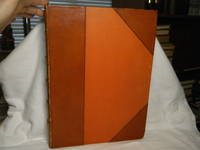
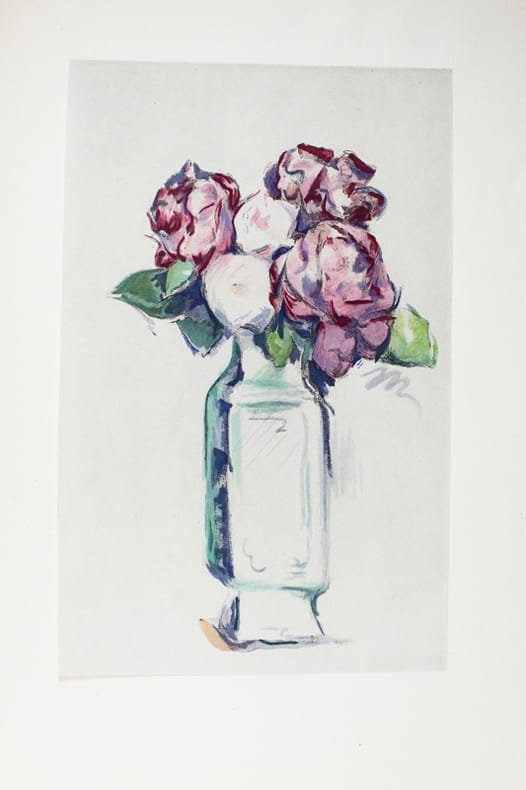
191440756Paris: Bernheim-Jeune. Very Good. 1914. Hardcover. Oversized half morocco with orange cloth marbled endpages TEG. 75 pp. 59 plates. Limited edition #250 of 600 papier a grain. There is one original frontis etching by Cezanne and 6 original lithographs from Edouard Vuillard Pierre Bonnard Maurice Denis Henri Matisse Roussel and Aristide Maillol. Binding rubbed corners lightly bumped. Very minor occasional foxing. ; Folio 13" - 23" tall . Bernheim-Jeune hardcover
191420454Paris, Bernheim-Jeune, 1914. In-folio de [2]-75-[9 pages, reliure en carton recouvert d'un papier recouvert de peinture façon palette de peintre! Dos lisse, titre doré au dos, un filet doré sur chaque plat, couvertures et dos conservés. Non rogné.
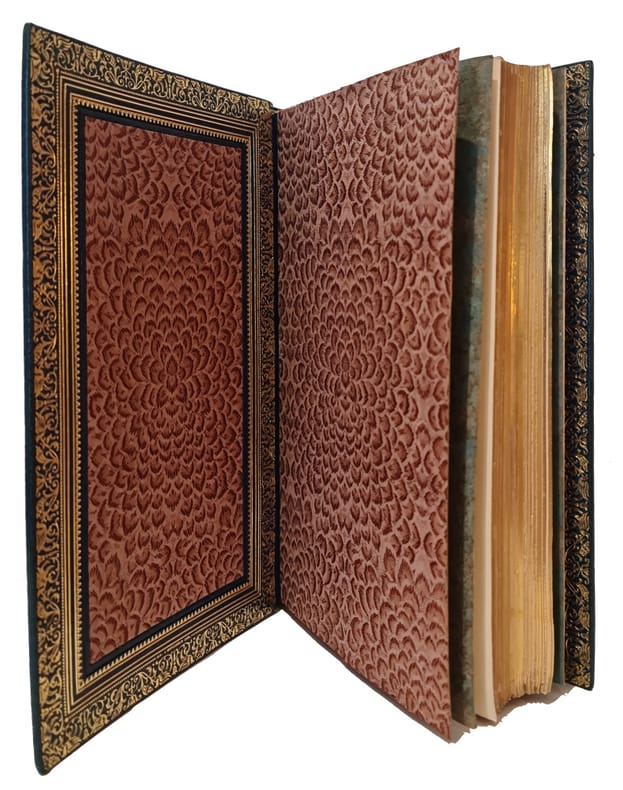
191087356Paris Charpentier 1910 1 vol. relié in-12, plein maroquin à gros grain bleu canard, dos à nerfs, large bordure intérieure de même maroquin avec frises et filets dorées en encadrements, doublures et gardes de soie moirée vieux rose à motifs floraux, doubles gardes, tranches dorées, couvertures et dos conservés (E. Maylander), X + 261 pp. Édition originale du premier livre de l’autrice (1863-1937), d'inspiration autobiographique. Inconnue jusqu’alors, cette Marguerite a poussé sur la rêche pelouse d’un orphelinat de Bourges, elle raconte sa vie de bergère et de servante à la ferme, sa première histoire d'amour contrariée et ses débuts à Paris où elle s’établit comme couturière. La préface d'Octave Mirbeau restitue le miracle d'une existence sauvée par la Littérature : comment la lecture est devenue une échappatoire à la misère, comment l'écriture a pris le pas sur la couture, et comment Marie-Claire révèle le talent de Marguerite Audoux, lui valant de recevoir à 47 ans le prix Femina.« Tout y est à sa place, les choses, les paysages, les gens. Ils sont marqués, dessinés d’un trait, du trait qu’il faut pour les rendre vivants et inoubliables ». Comme le souligne Eric Dussert dans Cachées par la forêt, c’est par la justesse de représentation du travail féminin que ce livre a pu plaire à la fois à André Gide et à Henry Poulaille. Par la suite l'écrivaine donnera trois autres romans dans cette même veine sociale, rendant hommage à la vie ordinaire et pourtant noble de personnages de condition modeste.Un des 12 exemplaires tirés sur Hollande, celui-ci hors commerce et nominatif, sans justification. Ex-libris Laurent Meeûs à sa devise "Hic liber est meus". En parfait état dans une belle reliure de Maylander. Très rare sur grand papier.
191087356Paris Charpentier 1910 1 vol. relié in-12, plein maroquin à gros grain bleu canard, dos à nerfs, large bordure intérieure de même maroquin avec frises et filets dorées en encadrements, doublures et gardes de soie moirée vieux rose à motifs floraux, doubles gardes, tranches dorées, couvertures et dos conservés (E. Maylander), X + 261 pp. Édition originale du premier livre de l’autrice (1863-1937), d'inspiration autobiographique. Inconnue jusqu’alors, cette Marguerite a poussé sur la rêche pelouse d’un orphelinat de Bourges, elle raconte sa vie de bergère et de servante à la ferme, sa première histoire d'amour contrariée et ses débuts à Paris où elle s’établit comme couturière. La préface d'Octave Mirbeau restitue le miracle d'une existence sauvée par la Littérature : comment la lecture est devenue une échappatoire à la misère, comment l'écriture a pris le pas sur la couture, et comment Marie-Claire révèle le talent de Marguerite Audoux, lui valant de recevoir à 47 ans le prix Femina.« Tout y est à sa place, les choses, les paysages, les gens. Ils sont marqués, dessinés d’un trait, du trait qu’il faut pour les rendre vivants et inoubliables ». Comme le souligne Eric Dussert dans Cachées par la forêt, c’est par la justesse de représentation du travail féminin que ce livre a pu plaire à la fois à André Gide et à Henry Poulaille. Par la suite l'écrivaine donnera trois autres romans dans cette même veine sociale, rendant hommage à la vie ordinaire et pourtant noble de personnages de condition modeste.Un des 12 exemplaires tirés sur Hollande, celui-ci hors commerce et nominatif, sans justification. Ex-libris Laurent Meeûs à sa devise "Hic liber est meus". En parfait état dans une belle reliure de Maylander. Très rare sur grand papier.
194522678Monaco, Les Documents d'Art (Paris, imprimerie de Coulouma), illustrations gravées sur cuivre par l'artiste, 1945. Fort in-4° en feuilles, sous couverture crème rempliée, chemise-étui ; [8], XVI, 189, [2] pp. , [2] ff. bl.
190480561Paris: Galerie Durand-Ruel 1904. Fine. Galerie Durand-Ruel Paris 1904 10 x 17.50 cm relié First edition of the exhibition catalogue presenting 37 works by Claude Monet at the Galerie Durand-Ruel from 9 May to 4 June 1904. During the exhibition most of the paintings were immediately purchased by American collectors. Binding in vellum-effect paper boards names of the catalogue preface writer and the painter inscribed in ink water-effect paper endpapers covers and spine preserved curious ex-libris drawn by H. P. Gassier glued to a pastedown endpaper binding signed Gonon. Preface by Octave Mirbeau. A rare and pleasant copy. Galerie Durand-Ruel hardcover
190145873Paris: Charpentier 1901. Fine. Charpentier Paris 1901 12 x 18.50 cm relié First edition on ordinary paper. Contemporary half shagreen over marbled paper boards spine with a gilt cartouche with gilt decorative motifs gilt date to foot of spine a frame of gilt fillets to covers marbled endpapers and pastedowns covers preserved top edge gilt. Handsome autograph inscription from Octave Mirbeau to Lucien Guitry : "". bonjour. mais chut. ne lisez pas ça. Avec toute mon amitié.hello but damn it don't read this With all friendship "" Tiny tears with occasional miniscule lacks not significant to head of the final few pages. Charpentier hardcover
190480561Galerie Durand-Ruel | Paris 1904 | 10 x 17.50 cm | relié
19130030821913 Paris, Bibliothèque-Charpentier, Fasquelle, 1913. Grand et fort volume in-8 (165 X 255) broché, couverture nacrée rempliée imprimée en rouge et noir ; 422 pages. Chemise demi-percaline rouge avec pièce de titre chagrin marron dans un encadrement doré, et une autre pièce de cuir identique en queue avec la mention dorée « Bibliothèque J. Borderel », étui bordé percaline rouge.
192750520Paris Laval et Bourdeaux 1927 In-4, demi-maroquin rouge fonc bandes, plats de papier marbr, dos quatre nerfs orn d'un bouddha et de deux grands fleurons mosaqus en maroquin vert, beige et brun, avec des jeux de petits points et filets dors; doublures et gardes de papier marbr, tte dore, non rogn, couverture imprime. Etui (Trinckvel).11 eaux-fortes originales hors texte et de nombreux ornements tirs en noir et en vert de Raphal Freida. Tirage limit 538 exemplaires numrots. Un des 360 exemplaires sur vlin d'Arches, enrichi d'un portrait de lauteur dessin la plume et sign par Robert Kastor (8 x 8 cm), accompagn dune citation autographe signe dOctave Mirbeau, extraite de Sbastien Roch. Agrable exemplaire dans une reliure mosaque de Maurice Trinckvel.
190145873Charpentier | Paris 1901 | 12 x 18.50 cm | relié
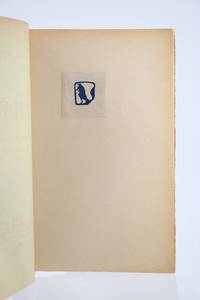
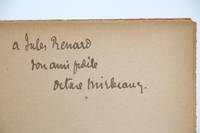
189878088Paris: Librairie Charpentier et Fasquelle 1898. Fine. Librairie Charpentier et Fasquelle Paris 1898 13 x 19 cm broché First edition with no mention of deluxe paper copies. Precious signed autograph inscription from Octave Mirbeau to his friend Jules Renard. Blue pencil mark by Jules Renard on the front cover. Our copy is further enriched with the famous bookplate of Jules Renard designed and engraved by Henri de Toulouse-Lautrec. Librairie Charpentier et Fasquelle unknown
190278085Paris: Charpentier 1902. Fine. Charpentier Paris 1902 13 x 19 cm broché First edition with no mention of deluxe paper copies. Precious signed autograph inscription from Octave Mirbeau to his friend Jules Renard. Blue pencil mark by Jules Renard on the front cover. Our copy is further enriched with Jules Renard's celebrated ex-libris designed and engraved by Henri de Toulouse-Lautrec. Charpentier unknown
192612838Paris, Javal et Bourdeaux, 1926. 1 vol. in-4. Plein maroquin rose, bandes de maroquin vert recouvrant les nerfs et se prolongeant sur les plats, repétées en bordure de plat, ornés d'un petit rectangle et quelques traits au palladium aux extrémités de ces bandes, titre et auteur au palladium au dos, date en queue, tête dorée, gardes de papier à motif doré, couvertures et dos conservés, sous étui bordé. [CREUZEVAULT].
189878088Librairie Charpentier et Fasquelle | Paris 1898 | 13 x 19 cm | broché
190278085Charpentier | Paris 1902 | 13 x 19 cm | broché
1899622111899. Fine. 1899 17.80 x 23.10 cm 2 feuillets et un quart Autograph manuscript signed by Octave Mirbeau for his article ""Au conseil municipal"" published in Le Journal on July 12 1899 90 lines in black ink on three leaves manuscript correction by the author typographical indications in blue pencil. Staining due to ink and paper. Significant of the denunciatory attitude that Mirbeau maintained in his articles this manuscript critical of the unworthy treatment of artists of genius by society is a final draft used for printing as indicated by the capital letters that delimit the paragraphs. The original leaves have been remounted on laid paper here pages from an 18th-century work Dissertatio Medica to facilitate their handling. unknown
1902613441902. Fine. 1902 18.10 x 22.90 cm 2 feuillets et un quart Autograph manuscript signed by Octave Mirbeau 99 lines in black ink on 3 leaves with manuscript corrections by the author and one correction in blue pencil by a typographer. Manuscript used for the composition and printing of the article ""Habitudes"" published on April 20 1902 in the Journal a daily newspaper launched in 1892 by Fernand Xau. The beginning of Mirbeau's career was essentially driven by journalism which allowed him to publish and earn a living despite his lack of inclination for the activity. Quickly feared for his pamphleteering activity Gustave Mirbeau distilling a biting irony stands here against injustice institutionalized by the State and society. Led by the dense and effective writing of Gustave Mirbeau this manuscript is probably a final draft as suggested by the conformity of the two texts and the rare corrections made to the original notably by the blue pencil of a typographer. On the verso of the last leaf is found an earlier version of the first lines of the article. unknown
193530282Paris Editions Nationales 1935 10 volumes in-4, demi-chagrin bleu nuit, plats de papier marbr, dos quatre nerfs orns de filets dors et portant deux pices de titre en chagrin rouge ; doublures et gardes de papier marbr, ttes dores, non rogns, couvertures imprimes.Cette dition prface par Roland Dorgels, est abondamment illustre daquarelles et de dessins dEdy Legrand, Jean Launois, Berthold Mahn, Dignimont et Gus Bofa, reproduits en noir, en spia ou en couleurs en in-texte ou en hors-texte. Exemplaire numrot sur vlin dalfa.
190411461904. Near fine. 3pp 4to. Holograph manuscript in pen in French writing on the rectos only the first two pages are filled with text the last page is trimmed with only 4 lines and Mirbeau’s signature. Creases stains smudges offsetting but cleanly written legible and very good. An article for the left-wing newspaper L’Humanité published 25/Sept/1904. The newspaper was founded only a few months earlier by SFIO leader Jean Jaures who also served as editor. In the article Mirbeau criticizes France for its refusal to intervene in the Russo-Japanese war. With biting irony he mimics the indifferent French attitude: "Let's wait two five ten twenty years if we have to. We'll keep on slaughtering each other over there. But what are we risking. Life is good our restaurants are still the best in the world. There are still the prettiest girls in the theaters of Paris." He exposes the hypocrisy of French foreign policy: "as allies not of the Russian people whose infinite sufferings like those of all peoples are of absolutely no concern to us but as allies of the czar whose glory alone is important to us let us be no less faithful czarists than the czar himself is." Drawing a powerful parallel Mirbeau connects the mounting casualties of the Russo-Japanese conflict with the Armenian massacres—which had already reached devastating proportions by 1904. A different but contemporary newspaper clipping is laid in seemingly part 2 by Mirbeau: it records a conversation with a merchant marine captain recently returned from the Far East who despite personally witnessing naval battles admits he comprehends little of the war's true nature beyond scattered disturbing details he finds too horrific to fully describe.<br /> <br /> The early 1900s particularly 1904-1905 marked a transformative period in the development of anti-imperialist critique within European leftist thought. The Russo-Japanese conflict illuminated the contradictions within Western powers' foreign policies particularly France's relationship with Tsarist Russia. The French left's growing disillusionment with the Franco-Russian alliance exemplified broader ideological shifts that would shape socialist internationalism for decades. As ordinary Russians died for imperial ambitions while French elites remained indifferent behind a facade of nationalist solidarity socialist thinkers increasingly recognized patterns linking capitalist interests to colonial violence. This period also witnessed the emergence of more sophisticated leftist analyses connecting imperial competition abroad with class exploitation at home. The juxtaposition of European indifference toward both the Russo-Japanese War casualties and the Armenian massacres demonstrated how Western powers selectively applied humanitarian concerns based on strategic interests—a critique that would become central to anti-colonial movements throughout the 20th century and presage the internationalist anti-war position that would later fracture the European left during World War I.<br /> <br /> Octave Mirbeau 1848-1917 emerged as one of France's most incisive social critics during the Belle Époque developing a literary voice defined by moral outrage and stylistic innovation that transcended conventional boundaries between journalism and literature. His artistic sensibilities were profoundly shaped by traumatic experiences—including abuse at a Jesuit school and service in the Franco-Prussian War—which fostered his lifelong commitments to anarchism pacifism and the defense of individual dignity against institutional power. Beyond his novels exposing societal hypocrisy including the controversial "Le Jardin des supplices" 1899 and "Le Journal d'une femme de chambre" 1900 Mirbeau distinguished himself as a prescient art critic who championed misunderstood avant-garde figures like Van Gogh Rodin and Monet recognizing artistic genius that his contemporaries often dismissed. His prolific output—spanning over twelve hundred works across multiple genres—consistently demonstrated his willingness to confront uncomfortable truths about violence sexuality and power that bourgeois society preferred to ignore establishing him as an intellectual forerunner to modernist aesthetic and political movements of the twentieth century. unknown
1931031774New York: Claude Kendall 1931. Book. Illus. by Jeannete Seelhoff. Very Good. Cloth. 1st Edition. 8vo - over 7¾ - 9¾" tall. Black cloth with gilt spine and 3/4 decorative paste down panel. Red and green illustrated endpapers. Translated from the French by Alvah C. Bessie forward by James Hunecker. First US English edition. Spine faded. Original dust jacket corners worn torn taped stained on rear. Bottom edges chipped. Includes three original letters in French pasted in and signed by author Octave Mirbeau 1848-1917; two to a friend and one to a publisher. Rare. Claude Kendall Hardcover
192352409Paris Editions Mornay 1923 In-8, demi-maroquin rouge, plats de papier marbr, dos nerfs; doublures et gardes de papier peigne, tte dore, non rogn, couverture illustre (Lobstein - Laurenchet).Agrable dition illustre de 81 aquarelles de Paul de Pidoll, graves sur bois et tires en couleurs, dont un sur la couverture, un frontispice, 8 pleine page, 11 in-texte, 20 en-ttes, 20 lettres ornes et 20 culs-de-lampe. Tirage limit 1.099 exemplaires numrots. Un des 35 exemplaires sur papier de Hollande, accompagns d'une suite des bois tirs en noir sur japon (plus petit tirage sur grand papier aprs un exemplaire unique sur japon ancien).
190465500Paris: Charpentier 1904. Fine. Charpentier Paris 1904 12 x 19 cm relié First edition on current paper. Binding in half red percaline smooth back adorned with a golden floret double golden net tail black titan title piece marbled paper plates preserved covers. Stamp printed from the archives of the French Comedy on the title page. Precious autograph signed by Octave Mirbeau: ""A Remy de Gourmont his friend Octave Mirbeau."" Charpentier unknown