2 159 résultats
2023__0443239878Academic Pr 2023. Paperback. New. 1st edition. 396 pages. 9.25x6.25x0.75 inches. Academic Pr paperback
Mm 155x220 Brossura editoriale di pp. 111, a cura del Comitato di coordinamento per lo studio e la promozione della prima edizione a stampa della Divina Commedia, collana diretta da Piero Lai a cura di Giovanna Alessandri e Rossana Landi. Interventi di M. Salari, A. Pieretti, Cornelia Schneider, E. M. Hannebutt-Benz, Paolo Trovato, Piero Lai, Amedeo Quondam. Opera in ottime condizioni.
319 pp.; 21 cm. Bross. edit. Buono
Mm 170x240 Collana: Pubblicazioni del 'Centro Pio Rajna', 21. Brossura editoriale con alette, pp. 520. A cura di: Emilio Russo, Claudio Gigante. Nuovo. Spedizione in 24 ore dalla conferma dell'ordine. Obiettivo del Convegno è stato indagare le radici lontane dell’unità, recuperarne i contenuti, le implicazioni, il senso di ciò che essa intende trasmettere alle generazioni di oggi e di domani. Ma proprio oggi, dopo 150 anni, si assiste allo spettacolo di vedere continuamente calpestati i suoi simboli. Ciò rappresenta non soltanto un oltraggio alla nazione e alla sua storia che pur essendo attraversata da luci e ombre, resta una grande storia ma la negazione implicita di quei valori, di quel patrimonio di cultura, di ideali, di esperienze, di conquiste che danno identità alla nazione stessa e garantiscono un senso alla vita di oggi, da arricchire e trasmettere alle nuove generazioni.
1275822630.Gpaperback. Good. Access codes and supplements are not guaranteed with used items. May be an ex-library book. paperback
74094Coll. "Les grands événements littéraires", Paris, éd. Société française d'éditions littéraires et techniques, 1931, in-12, br., 232 pp., table des matières, non coupé Très belle approche de l'œuvre des poésies lyriques de ce grand écrivain italien du 14e siècle. Pas courant Très bon état du papier; la couverture présente quelques manques au dos et des salissures sur les plats et le dos
46400190, Paris, Comptoir des Imprimeurs-Unis, 1848; in-8, cart. demi-toile verte de l'époque. 3 ff.n.ch., VIII pp., 452 pp.EDITION ORIGINALE. En 1830 l'auteur avait publié à Metz un petit choix de poèmes traduits de Pétrarque. Camille Esménard du Mazet, un ancien colonel du génie est né à Pelissanne en Provence en 1802. Après le titre on trouve un feuillet imprimé en 1850, avec une lettre adressée à l'auteur par Lamartine"" J'ai lu et j'ai retrouvé Pétrarque dans vos vers. Ils reflètent avec la clarté du cœur cette poésie de pureté et de lumière. La sympathie est le génie de la traduction, et elle a inspiré la vôtre…
184291920Paris, Paul Masgana, Libraire-éditeur 1842 Traduit par F. L. GRAMONT
In 8, pp. 13 + (1b). Marca tip. xilogr. al fr. Br. rifatta con carta d'epoca.
199826895Frankfurt am Main , Berlin , Bern , New York , Paris , Wien : Lang, 1998. 1. Aufl. 414 S. 8°, OPp, sehr schöner Zust.
44088484-nnew. unknown
44088484like new. unknown
ria9783112447291_inpHardcover. New. New Book; Fast Shipping from UK; Not signed; Not First Edition; N/A hardcover
Mm 120x185 Collana "Biblioteca popolare di coltura". Volume nella sua brossura originale, 116 pagine con illustrazioni in nero nel testo, di cui una ripiegata. Opera in buone condizioni, presenta fioriture e alcune pagine ancora intonse. Spedizione in 24 ore dalla conferma dell'ordine.
1020328533.Ghardcover. Good. Access codes and supplements are not guaranteed with used items. May be an ex-library book. hardcover
1248807138.Gpaperback. Good. Access codes and supplements are not guaranteed with used items. May be an ex-library book. paperback
In-8 (cm. 23), piena pergamena, pp. IV, 313, (3), con una incisione che riproduce il Poeta in antiporta. Al frontespizio, sopra l’epigrafe che riporta i versi manzoniani “Salve, o Divino, a cui largì natura il cor di Dante e del suo Duca il canto..” la scritta coeva “Meonio Cantore” che riprende un sintagma tratto da una poesia di Vincenzo Monti dedicata alla Marchesa Anna Malaspina della Bastia (”Meonio Cantor”). La pergamena, probabilmente ripresa da un volume più antico, riporta al dorso un titolo manoscritto parzialmente abraso e lievi tracce d’uso. Pagine leggermente ingiallite per la qualità della carta, peraltro in buono stato (good copy).
Mm 165x235 Brossura editoriale a stampa, 51 pagine. Bruciatura al piede del volume che non interessa il testo altrimenti molto ben conservato. Copia valida per lo studio. SPEDIZIONE IN 24 ORE DALLA CONFERMA DELL'ORDINE.
1842RO40248681Paul Masgana, Paris. 1842. In-12. Relié demi-cuir. Bon état, Couv. convenable, Dos à nerfs, Quelques rousseurs. 314 pages. Titre et filets dorés sur le dos. Etiquette de code sur la couverture. Quelques tampons de bibliothèque. Epidermures sur le dos. Pages de garde partiellement jaunies.. . . . Classification Dewey : 850-Littératures italienne, roumaine, rhéto-romane
46698Paris Paul Masgana, Libraire-Editeur 1842 in 12 (18x11,5) 1 volume reliure demi basane maroquinée marron dos à nerfs orné de fleurons dorés, X et 314 pages [1], petite restauration ancienne sur la marge des 2 premiers feuillets, et du dernier feuillet. Francesco Petrarca, 1304-1374. Comte Ferdinand L. de Gramont. Bon exemplaire
Colla risposta alla Novella Letteraria, che riferisco l'estratto del detto Dialogo, nel nuovo Giornale veneto sotto la direzione di M.A.R. Este, presso S.Orlandini stamp.della m.Comunità, 1740.<BR><BR> 16°, pp.100, t. cart. antico adattato con antiche scritte alle sguardie. Strappetti e piccole mancanze a qualche marg. bianco, lievi fioriture e rare macchiolina d'inch. Antica firma ex libris al front. Da p.78 la Risposta alla Novella Letteraria, con un estratto del "Dialogo intorno alla Gerusalemme liberata di T.Tasso con nuove annotazioni sopra il canto I dello stesso poema". Venezia, Geremia, 1737, che fu al centro di una dura polemica letterararia (Melzi I 292, 60). [Melzi II 342 attribuisce la Pietra del paragone a P.Vagenti di Este, e in I 54 scrive che il Vagenti fu autore anche di Brevi notzie intorno alla terra di Este.. (Este, 1743) sotto il falso nome di Antonio Angelieri].
21857Tirage argentique d’époque, 8,5 × 7,8, montée sur un carton fort. Sans date (vers 1850). Cette très curieuse photographie provient des archives de Paul Bourget : devant la maison de Pétrarque Riva degli Schiavoni, à Venise, des militaires sont assis près d’un étal de pastèques ! Une plaque sera apposée en 1904.
199316690Berkeley Santa Cruz: Foolscap Press 1993. Forty six dialogues translated by Thomas Twyne with an introduction by Lewis W. Spitz. Woodcut illustrations by Hans Weiditz in the first half of the sixteenth century. Quarter bound in red slubbed silk with printed paper sides. Printed on Lana Royal using Poliphilus Forum and Bembo types with Calligraph initials printed in red. The design printing and binding were done by Peggy Gotthold and Lawrence G. Van Velzer. Number 92 of 175 copies. Fine copy. Foolscap Press hardcover books
1993135131Berkeley / Santa Cruz CA: Foolscap Press 1993; large 4to. full leather clamshell box; 138 pages. <br /><br />Limited to 175 numbered copies. Here is a book that fairly crackles with wit and wisdom for six hundred years have not dimmed its ability to speak to our minds through the clarity of its perspective the power of its language and the vivid pertinence of its thought. Because of the genius shown in his lyrical works Francesco Petrarca 1304-1374 inspired the Renaissance in Italy. He set patterns and standards for the revival of learning and at the same time was a powerful advocate for the preservation of valuable manuscript material. From the classic models Petrarch transmitted a refinement of taste and thought and a polish and politeness of speech and style. <br /><br /> This copy is bound in a full artist-binding by Don Etherington bookbinder and former director of Conservation at both the Library of Congress and the Harry Ransom Center Austin TX. The binding is a full black and gray crushed moracco with leather onlay panels and ruling in blind. Leather spine label with title stamped in gray ink. Handmade headbands. Beautiful marbled paper makes up the pastedowns and endpapers. Stamped by the binder on the rear pastedown 'Don Etherington 2018'. The book is housed in a custom cloth-covered boards clamshell box with a leather spine label with the title stamped in gray. <br /><br /> Petrarch's original manuscript De remediis utriusque fortunae or Remedies for Both Good and Bad Fortune or Phisicke Against Fortune is a work of prose consisting of two hundred and fifty-three dialogues that he completed near the end of his life. It represents a distillation of his moral philosophy arranged as a treatise that shows how our ideas and actions help us create either true happiness or sorrow and disillusionment. Throughout this long concatenation of dialogues Petrarch counsels modesty in prosperity and courage in adversity; he warns us against putting all our hope of happiness in mundane victories here on earth; instructs us on how to deal with our "Importunate Neighbours" tells us how to cope with "Loss of Time" and what to do when we experience "A Disagreeably Wavering Mind." <br /><br /> For Foolscap Press the most difficult choice has been to select from the entire range of Petrarch's dialogues the forty-six that make up this edition. <br /><br /> Introduction by Lewis W. Spitz <br /> Lewis W. Spitz William R. Kenan Jr. University Professor Professor of history at Stanford University brings his considerable scholarship to the question of Petrarch's influence on the northern Renaissance as well as providing an overview of Petrarch's written works. Through background and example he shows why Phisicke Against Fortune is as he says "a mirror for mankind." <br /><br /> Illustrations by Hans Weiditz <br /> Hans Weiditz c.1495-c.1536 was an important member of the small group of outstanding woodcut designers of the German Renaissance whose membership included Albrect D'rer Hans Holbein and Hans Burgkmair. The fact that he was nearly alone in illustrating a great number of secular books makes him in many ways a more interesting artist than his more famous colleagues. <br /><br /> Weiditz is best known for his illustrations for "Brunfels' Herbal" which is recognized as the most important herbal of the period and the first botanical book to contain realistic and accurate illustrations. Weiditz's imagination and close observation of real life show most clearly in this herbal and in his handling of the woodcuts for the dialogues of Petrarch. In illustrating Phisicke Against Fortune Weiditz demonstrates his highly individualized style and addresses an astounding range of issues among which are: an individual's relationship to society; secular versus religious perspective; how we perceive and respond to nature and natural laws; and how we behave toward each other. <br /><br /> As an appendix to the text we have included notes on the Weiditz illustrations based on information from Walther Scheidig and translated especially for this edition from the German by Beate Reid. <br /><br /> Essay by William M. Ivins Jr. <br /> In his essay on Hans Weiditz William M. Ivins Jr. 1881-1961 former Curator of Prints at the Museum of Modern Art shares his infectious enthusiasm for the artist whose life had remained largely unappreciated until modern scholarship brought to light his great contribution to German Renaissance art. <br /><br /> Translation by Thomas Twyne <br /> The Elizabethan Age was great both for the depth of its literature and the translations into English of many foreign works. Thomas Twyne's translation of Phisicke Against Fortune from Latin into English was completed in 1579. Now newly transcribed from the Elizabethan blackletter with the spelling and punctuation standardized Twyne's translation can be clearly enjoyed. We have retained intact the particular character of the work and the marvelous flavor of the language. <br /><br /> This edition brings together for the first time Thomas Twyne's translation of Phisicke Against Fortune and Hans Weiditz's wonderful woodcut illustrations which were made for the German edition of 1532. The original German edition contained two hundred and sixty-one woodcuts illustrating all of Petrarch's dialogues. We have selected forty-six dialogues that represent the enduring wisdom of Petrarch and the impressive imagery of Hans Weiditz. <br /><br /> Limited to 175 copies each book measures 12 x 9 inches and consists of 160 pages printed letterpress on Lana Royal a mould-made paper from France. The text was set in Monotype as well as handset type using Poliphilus Bembo Italic and Forum with Calligraph Initials printed in red. 135 copies are hand-sewn and the rounded spine is covered in red Japanese cloth and is stamped in gold. Printed paper sides cover the boards. 40 copies are specially bound in quarter goatskin and red Japanese cloth and come in a slipcase covered in cloth and printed paper sides. Foolscap Press books
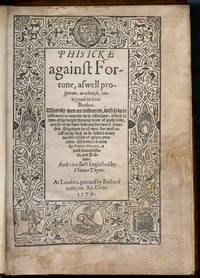
1579384London: Richard Watkyns 1579. First Edition. Very Good. Small 4to; 7 1/2 x 5 5/8 in. 190 x142 mm; pp. 4 xiv 1-152 First Booke Physicke for Fortune: 153-343 Second Booke Phisicke against Fortune vi table of contents 2. Each book with Epistolary preface by Franucis Petrarche. Translated into English from Latin by Thomas Twyne whose introduction dedicates the work to "Richard Bertie Esquier." Title within woodcut decorative border woodcut decorative initials set in gothic and latin type lacking sig.B and final blank lower corner of title torn and repaired with loss supplied first gathering lower corners repaired some dampstaining and toning throughout but sheets supple and intact. 19th century calf gilt panels from early English blind-stamped binding laid down on covers corners worn rubbed. Front pastedown with small engraved bookplate with initials "I N"<br /> <br /> Title page reads: «Physicke against Fortune as well prosperous as adverse contained in two Bookes<br /> Whereby men are instructed with lyke in differencie to remedie theyr affections aswell in tyme of the bright shyniyng sunne of prosperities as also of the foule lowiyng stonnes of adversities. Expedient for all men but most necessary for such as be subiect to any notable insult of eyther extremities. Written in Latine by Francis Petrarch a most famous Poet and Oratour. And now first Englished by Thomas Twyne.»<br /> <br /> STC 19809; ESTC S114602. This is the first edition in English of "De Remediis Utriusque Fortunae" "Remedies for Fortune Fair and Foul" written in Latin by the Humanist Francesco Petrarca 1304-1374 commonly known as Petrarch a collection of 254 dialogues mostly drawn from classical sources which seeks to instruct on moral philosophy and show how thought and deed can generate happiness on the one hand or sorrow and disillusionment on the other. It touches on a number of diverse subjects including dancing ball games gambling wrestling hunting and hawking alchemy libraries schoolmasters spectacles toothache lechery gout blindness and deafness. In a recurring theme throughout the dialogues Petrarch advises humility in prosperity and fortitude in adversity. It remained a popular book in Europe over the ages and was translated into English by the Elizabethan physician Thomas Twyne 1543-1613.<br /> <br /> "Latin work by Petrarch begun in 1354 but completed between 1360 and 1366 on how to deal with both good and bad fortune. The first of its two parts contains 122 dialogues between Ratio Gaudium and Spes and deals with how one should behave at times of good fortune; the second contains 131 dialogues between Ratio Dolor and Timor and deals with the behaviour appropriate to adverse fortune. It is a practical manual of moral philosophy and was widely read until the 17th c." Oxford Companion to Italian Literature. Richard Watkyns unknown