Montaigne, Michel deAntiquariat.de
[Bible Collection]Antiquariat.de
Large Collection of Missionary Publications in ca. 100 Languages.
199127419West Africa, India, etc., 1681-1991.
218 996 résultats
158060779Bordeaux, Simon Millanges, 1580. 8vo (111 x 159 mm). 2 parts in one volume. (8), 496 pp. (4), 656 pp. (miscounted as 650+[3]). Bound with an engraved portrait of Montaigne by Thomas de Leu, produced for the 1608 edition and here inserted as a frontispiece. Luxurious dark green morocco by Hippolyte Duru (signed and dated 1850), covers ruled in blind, spine ruled around five raised bands and lettered in gilt. Leading edges gilt; finely gilt inner dentelle. Marbled endpapers. All edges gilt.
8vo (111 x 159 mm). 2 parts in one volume. (8), 496 pp. (4), 656 pp. (miscounted as 650+[3]). Bound with an engraved portrait of Montaigne by Thomas de Leu, produced for the 1608 edition and here inserted as a frontispiece. Luxurious dark green morocco by Hippolyte Duru (signed and dated 1850), covers ruled in blind, spine ruled around five raised bands and lettered in gilt. Leading edges gilt; finely gilt inner dentelle. Marbled endpapers. All edges gilt. The first edition of one of the most important works written and published in French in the 16th century: a highly desirable example, one of the tallest seen on the market for decades. Title-page of part 1 in the second state, that of part 2 in the third state. - Montaigne's groundbreaking essays on an eclectic array of subjects - from cannibals to solitude, from sleep to sadness - constituted an entirely unique and unprecedented literary genre, and a philosophy of knowledge that was based on his own personal experience and observations, epitomizing 16th century enlightened scepticism. "The most elaborate essay, the 'Apologie de Raimond Sebonde', is second to no other modern writing in attacking fanaticism and pleading for tolerance" (PMM). "D’ébauches en corrections, de remords en précisions, Montaigne échafaude une des œuvres maîtresses de l’esprit humain" (Francis Pottiée-Sperry, En français dans le texte, no. 73). - The publishing history of this work is complex, both for the rather careless printing of the first edition, and in large part because the changes to the text between editions were considerable: Montaigne's text was by no means static but constantly evolved under the eye of the author who "considered each new edition as the last". This first edition was printed by Millanges in the spring of 1580. It is unsophisticated and rather hastily composed, as betrayed by the innumerable misprints, font and type inconsistencies, errors in page numbering and textual variants. Indeed, "the pagination of vol. ii is very irregular with so many variants that it is impossible to reconstruct an ideal pagination. Probably no two copies are the same" (Sayce & Maskell, p. 4). The first part of this copy has G2 and 2A5 missigned as 2G and A5, while 2A2 is correctly signed as Aa2 (not as Aa; see Sayce & Maskell, p. 2), and the corrected states of C8 and O8 (ibid., p. 5, note 7), as well as the letters 'gsit' accidentally printed at the foot of Gg3 (ibid., p. 6, no. 9). The irregular spacing of lines on the page - occasionally very cramped - indicates composition by form. - Copies of early editions of Montaigne's work are extremely rare. Fewer than 100 examples are estimated to exist in private and institutional collections worldwide, suggested by some to point to a small original print run of only 300 to 400 copies (Bibliotheca Desaniana, no. 8, 2011; Balsamo, p. 160). - Complete with both errata leaves at the end; "l'un de ces deux feuillets manque souvent" (Sotheby's Paris, 27 Nov. 2003: EUR 337,875). A fine, uncommonly wide-margined specimen from the library of the French historian Emmanuel Pierre Rodocanachi (1859-1934) with three bookplates to pastedown and front free endpaper. Later offered by Pierre Berès, Paris and acquired in 1948 by Jorge Ortiz Linares (1894-1965), the Bolivian ambassador to Paris, for 350,000 French Francs. PMM 95. Sayce & Maskell 1. Tchemerzine IV, 870 & VIII, 402. Brunet III, 1835. Le Petit, 99. P. Desan, "Montaigne's Essays", and J. Balsamo, "Publishing History of the Essays", in: Desan (ed.), The Oxford Handbook of Montaigne (Oxford 2016). For the portrait see Desan, Portraits à l’essai: Iconographie de Montaigne (Paris, 2006).
178957115Paris, Chez Baudouin, Imprimeur de l'Assamblée Nationale, 1789. 8vo. Bound in an exquisite later red half morocco with gilt spine. Top edge gilt. (1) f. (title-page), 8 pp. (""Déclaration des droits de l'Homme en société""), 6 pp. (""Articles de Constitution""), (1) f. (""Réponse du Roi""), (1) f. (blank). Woodcut head-pieces. Title-page slightly bowned, otherwise in excellent condition. A truly excellent copy.
Paris, Chez Baudouin, Imprimeur de l'Assamblée Nationale, 1789. 8vo. Bound in an exquisite later red half morocco with gilt spine. Top edge gilt. (1) f. (title-page), 8 pp. (""Déclaration des droits de l'Homme en société""), 6 pp. (""Articles de Constitution""), (1) f. (""Réponse du Roi""), (1) f. (blank). Woodcut head-pieces. Title-page slightly bowned, otherwise in excellent condition. A truly excellent copy.
Hamburg, Otto Meisner, 1867. 8vo. Nice contemporary black half calf with gilt spine. Minor wear to hinges and capitals, which have tiny, barely noticeable professional restorations. Inner hinges re-enforced. Contemporary owner's names (Emil Kirchner and Karl Kirchner (1887)) to front free end-paper. Contemporary book-plate to inside of front board (Ernst Ferdinand Kirchner). A very nice copy with just the slightest of occasional brownspotting. Housed in a very nice custom-made black full morocco box with gilt llettering to spine. XII, 784 pp.
175852026Paris, Durand, 1758. Large 4to. Large-paper copy bound in a beautiful contemporary full calf binding with five raised bands to richly gilt spine. Triple gilt line-borders to boards, all edges of boards gilt and inner gilt dentelles. All edges gilt. A stunning, bright, clean, and fresh copy, with minimal wear and no restorations of any kind. Presentation-inscriptions to front free end-paper and to verso of title-page (see description in note below). Large woodcut title-vignette and many smaller vignettes throughout. (4), XXII, 643, (1) pp. + 40 ff. (i.e. the original, uncorrected leaves: pp. 1-16 35-38 59-62 67-70 75-78 139-142 145-154 169-176 187-190 233-34 227-230 459-462 547-550" 603-606 + 2 extra leaves that were printed incorrectly, namely p. 160 - reset & p. 239 - different vignette).
Paris, Durand, 1758. Large 4to. Large-paper copy bound in a beautiful contemporary full calf binding with five raised bands to richly gilt spine. Triple gilt line-borders to boards, all edges of boards gilt and inner gilt dentelles. All edges gilt. A stunning, bright, clean, and fresh copy, with minimal wear and no restorations of any kind. Presentation-inscriptions to front free end-paper and to verso of title-page (see description in note below). Large woodcut title-vignette and many smaller vignettes throughout. (4), XXII, 643, (1) pp. + 40 ff. (i.e. the original, uncorrected leaves: pp. 1-16 35-38 59-62 67-70 75-78 139-142 145-154 169-176 187-190 233-34 227-230 459-462 547-550 " 603-606 + 2 extra leaves that were printed incorrectly, namely p. 160 - reset & p. 239 - different vignette).
185258600New-York, 1852. Bound in a later (ab. 1900) red full cloth binding with silver lettering to front board. A bit of wear to capitals, corners, and extremities. Front free end-paper with small repairs and strengthening. A couple of closed tears to blank outer margin of title-page (no loss and not affecting printing)Inner blank margins of the first few leaves strengthened (far from affecting text). Occasionally a few marginal notes. and underlinings. A near contemporary notice in Russian about the work has been inserted between the title-page and the preface. All in all a good copy with no major flaws. IV, (4), 62 pp.
New-York, 1852. Bound in a later (ab. 1900) red full cloth binding with silver lettering to front board. A bit of wear to capitals, corners, and extremities. Front free end-paper with small repairs and strengthening. A couple of closed tears to blank outer margin of title-page (no loss and not affecting printing)Inner blank margins of the first few leaves strengthened (far from affecting text). Occasionally a few marginal notes. and underlinings. A near contemporary notice in Russian about the work has been inserted between the title-page and the preface. All in all a good copy with no major flaws. IV, (4), 62 pp.
155357045Paris, Charles Estienne, 1553. Small 4to. Bound in a lovely 19th century red morocco binding with five raised bands and gilt ornamentations to spine. Boards with blindstamped frame-borders and gilt ornamental centre-pieces. All edges of boards gilt and inner gilt dentelles. All edges gilt. ""E. THOMAS"" discreetly printed to top of front free end-paper. Front free end-paper with woodcut armorial book-plate (Bibliotheque du Plessis Villoutreys). First and last leaves with a bit of brownspotting, otherwise very nice and clean throughout. The last three leaves with neat restorations - neatly closed tear, with no loss and a couple of small restorations to top margin (far from affecting text). (8), 148 pp. Estienne's printer's device to title-page and woodcut initials.
Paris, Charles Estienne, 1553. Small 4to. Bound in a lovely 19th century red morocco binding with five raised bands and gilt ornamentations to spine. Boards with blindstamped frame-borders and gilt ornamental centre-pieces. All edges of boards gilt and inner gilt dentelles. All edges gilt. ""E. THOMAS"" discreetly printed to top of front free end-paper. Front free end-paper with woodcut armorial book-plate (Bibliotheque du Plessis Villoutreys). First and last leaves with a bit of brownspotting, otherwise very nice and clean throughout. The last three leaves with neat restorations - neatly closed tear, with no loss and a couple of small restorations to top margin (far from affecting text). (8), 148 pp. Estienne's printer's device to title-page and woodcut initials.
60105(Venice, 1470'ies - 80'ies). 4to. 210x240 mm. In a lovely, strictly contemporary Italian binding. Original wooden boards with beveled edges. Top outer edge of front board chipped and a small split at bottom outer edge. Boards with remnants of the original leather previously partially covering boards, revealing the leather cords, and with an exposed spine revealing four strips of Medieval parchment that hold the quires together (along with a bit of restoration glue, barely noticeable). The top strip with red paint and the other three with fourteenth-century Gothic script. Original brass clasps to front board. An excellent, solid, contemporary binding. 70 ff. (f.70 blank), complete (i-v 12, vi 10), 29 lines to a page, mostly with ruling, occasionally only with frame ruling (150 x 77 mm). Vertical catchwords at the bottom of verso of the last folio of each of quire (i.e. ff. 12, 24, 36, 48, 60), surrounded by wave lines. Written in an easily legible, experienced Italian humanist miniscule. Space (sometimes with cue letters) for initials left blank. No rubrication, but majuscule lettering as headlines at new beginnings or major text divisions. Large, detailed drawing of pointing hand on f. 3, in contemporary hand. Ff. 8v and 24v with scribbled border in light brown ink around the textblocks, in an early modern hand. Another later hand, presumably a later owner, has added “Jacopi – che qui anno 1693 i Viterbo 1693” in runny ink on f. 29v. Crudely written calculations in the same hand to ff. 59v and 61r. Front pasted-down end-paper with paste stains, presumably from a previous bookplate, and with a note in 19th century German script to top. Foliation in modern pencil in top right corner throughout. F1 a bit dusty and with brownspotting. Occasional minor brownspotting. Minor damp staining to margins of last two quires, no loss and not affecting text. Otherwise generally in excellent condition. Two different watermarks in the paper: 1) a scale inside a circle (see ff. 52+57, at inner margin) – this is described in Briquet (Les filigranes…, 1923) as “Balance dens un cerele, à plateau concaves”, nr. 2474 – Venice, 1480. 2) the letter P with loop through shaft also (see ff. 64+70, at inner margin). We have not been able to identify this. The text is divided into the major setions divided mostly by Majuscule ""headlines"", and begins thus: 1) “[C]ARMINA QVI Condam studio florente peregi..."", ending (f. 9v) ""hec ubi regnant”"" 2) beginning “[P]POST HEC PAVLIS PER opticuit Atentionem..."", ending (f. 21v) ""Quo celum regitur regat”"" 3) beginning “[I]AM CANTUM illa finierat…"", ending (f. 41) ""Perdit dum videt inferos”"" 4) ""Explicit iii Incipit iiii L"", beginning “[H]EC cum Phylosophia dignitate vultus..."", ending (f. 58) ""Si dera donat”"" 5) beginning “[D]IXERUNT Orationisque cursum ad alia..."", ending (f. 69v) ""cum ante oculos agitis iudicis cuncta cernentis / GRATIAS DEO Amen”. F70 blank. Complete version of the text, with some minor word and orthographic variations in comparison to the printed standard version, and without the printed edition’s few lines in Greek. No space has been left for these and they were clearly not intended to be added later.
(Venice, 1470'ies - 80'ies). 4to. 210x240 mm. In a lovely, strictly contemporary Italian binding. Original wooden boards with beveled edges. Top outer edge of front board chipped and a small split at bottom outer edge. Boards with remnants of the original leather previously partially covering boards, revealing the leather cords, and with an exposed spine revealing four strips of Medieval parchment that hold the quires together (along with a bit of restoration glue, barely noticeable). The top strip with red paint and the other three with fourteenth-century Gothic script. Original brass clasps to front board. An excellent, solid, contemporary binding. 70 ff. (f.70 blank), complete (i-v 12, vi 10), 29 lines to a page, mostly with ruling, occasionally only with frame ruling (150 x 77 mm). Vertical catchwords at the bottom of verso of the last folio of each of quire (i.e. ff. 12, 24, 36, 48, 60), surrounded by wave lines. Written in an easily legible, experienced Italian humanist miniscule. Space (sometimes with cue letters) for initials left blank. No rubrication, but majuscule lettering as headlines at new beginnings or major text divisions. Large, detailed drawing of pointing hand on f. 3, in contemporary hand. Ff. 8v and 24v with scribbled border in light brown ink around the textblocks, in an early modern hand. Another later hand, presumably a later owner, has added “Jacopi – che qui anno 1693 i Viterbo 1693” in runny ink on f. 29v. Crudely written calculations in the same hand to ff. 59v and 61r. Front pasted-down end-paper with paste stains, presumably from a previous bookplate, and with a note in 19th century German script to top. Foliation in modern pencil in top right corner throughout. F1 a bit dusty and with brownspotting. Occasional minor brownspotting. Minor damp staining to margins of last two quires, no loss and not affecting text. Otherwise generally in excellent condition. Two different watermarks in the paper: 1) a scale inside a circle (see ff. 52+57, at inner margin) – this is described in Briquet (Les filigranes…, 1923) as “Balance dens un cerele, à plateau concaves”, nr. 2474 – Venice, 1480. 2) the letter P with loop through shaft also (see ff. 64+70, at inner margin). We have not been able to identify this. The text is divided into the major setions divided mostly by Majuscule ""headlines"", and begins thus: 1) “[C]ARMINA QVI Condam studio florente peregi..."", ending (f. 9v) ""hec ubi regnant”" " 2) beginning “[P]POST HEC PAVLIS PER opticuit Atentionem..."", ending (f. 21v) ""Quo celum regitur regat”" " 3) beginning “[I]AM CANTUM illa finierat…"", ending (f. 41) ""Perdit dum videt inferos”" " 4) ""Explicit iii Incipit iiii L"", beginning “[H]EC cum Phylosophia dignitate vultus..."", ending (f. 58) ""Si dera donat”" " 5) beginning “[D]IXERUNT Orationisque cursum ad alia..."", ending (f. 69v) ""cum ante oculos agitis iudicis cuncta cernentis / GRATIAS DEO Amen”. F70 blank. Complete version of the text, with some minor word and orthographic variations in comparison to the printed standard version, and without the printed edition’s few lines in Greek. No space has been left for these and they were clearly not intended to be added later.
199127419West Africa, India, etc., 1681-1991.
Significant collection of 333 Bibles, expositions, scriptural lessons, biblical school primers, and other extremely rare products of missionary presses. Many items unrecorded in Darlow & Moule, and several important 19th century works unrecorded in the OCLC database of worldwide libraries. The collection's main strengths lie in 19th and early 20th century publications produced for/in Africa and India (some 89 Indian and 58 African works) as well as hundreds of 20th century works in almost 80 further languages, ranging from Rarotongan to Miskito. Generally in original or period bindings and often with ownership markings of missionary societies, the collection paints a fascinating picture of missionary efforts of the 19th and 20th centuries. Highlights include an extremely rare edition of the New Testament printed in Tranquebar, South India in the Tamil language in 1758 by a Danish missionary, Bartholomaeus Ziegenbalg (this very copy fetching nearly $4000 at Sotheby's in 2000) and a wonderful color-illustrated edition of Bunyan's Pilgrim's Progress translated into the Niger-Congo (Dualla) language in 1885. - More than simply offshoots of the colonial enterprise, missionary movements set up their own presses in colonies such as Cameroon and Calcutta and began printing titles such as the present ones, usually in runs of 1000 or less. These publications often represent the first appearance of native languages in print form, shaping future efforts at graphic and textual representation of mainly spoken languages. Interestingly, many of the present volumes also represent the first language guides to several African and Indian languages, prepared by missionary presses to facilitate the conversion of natives. "Much of this activity stemmed from the importance placed by Protestants on a literate population which could read and study Scripture for themselves" (Weber, p. 2). The present collection clearly demonstrates how missionary directives, while often fueled primarily by a desire to 'save souls' and 'convert heathens', also concerned themselves with children's education (N144), health (N271), the management of schools (N261), agriculture (N65), mothercraft (N278), and language learning (e.g. N91, N161, N256). - The importance of the printing press and its products to the missionary efforts of the 19th and 20th century has rarely been directly addressed in the secondary literature. Robert E. Frykenberg's "Christianity in India: from beginnings to the present", for example, hardly touches on missionary presses at all, perhaps due to the copious and diffuse nature their printings. Yet the importance attached by contemporaries to the power of the press should not be underestimated. Writing in the The Baptist Missionary Magazine of 1840, a Mr Crocker expressed the heartfelt need for printing press in the West African colonies: "That God designs to employ the press as an important instrument in diffusing the light of truth, we have abundant evidence [...] It is true, in this country the people cannot read. But the press is required to furnish them books that they may learn to read [...] It seems desirable that boys of great promise should have the stores of English literature open to them." His petition was duly granted several years later, when the first mission press was established on the Cameroonian mainland in 1844 (cf. early examples from the "Mission Press, Western Africa" in numbers N149, N150, N130, etc). - Many of the present works were acquired from what must have been the greatest such institutional collection of its time, the library of the Baptist Mission House in London. - Of the utmost rarity are not only the early imprints of African missionary presses, but also the briefer, soft-bound pamphlets issued by these presses whose survival rate must be minimal. We find numerous examples in this collection of such pamphlets which are either unrecorded (eg N 93, N275) or recorded only in the Darlow and Moule collection at Cambridge University Library. - Detailed catalogue available upon request. Weber, Charles, International influences and Baptist mission in West Cameroon (1993); "Importance of the press to the mission", The Baptist Missionary Magazine, Vol 20, pp. 192-4 (August, 1840); cf. also e.g. Stephen Neill, A History of Christian Missions (1991).
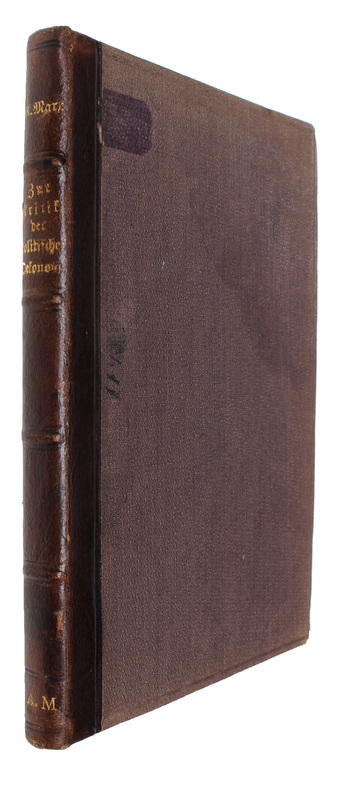
185958578Berlin, Franz Duncker, 1859. 8vo. Nice contemporary hafl calf with gilt lettering to spine. A bit of wear to extremities, markings after old label to front board and signs of vague damp staining to front board. A mostly faint damp stain to outer inner corner throrughout, but otherwise very nice. Title-page a bit dusty. Old library number (872) to front free end-paper and top of title-page and marginal pencil-annotations to a number of leaves. VIII, (2), 170 pp. Title-page with the ownership-signature of Alexander Appolonovich Manuilov to top of title-page and binding with his initials ""A. M."" in gold to the fot of spine.
Berlin, Franz Duncker, 1859. 8vo. Nice contemporary hafl calf with gilt lettering to spine. A bit of wear to extremities, markings after old label to front board and signs of vague damp staining to front board. A mostly faint damp stain to outer inner corner throrughout, but otherwise very nice. Title-page a bit dusty. Old library number (872) to front free end-paper and top of title-page and marginal pencil-annotations to a number of leaves. VIII, (2), 170 pp. Title-page with the ownership-signature of Alexander Appolonovich Manuilov to top of title-page and binding with his initials ""A. M."" in gold to the fot of spine.
184042363Paris, A. Frank, Bruxelles, C. G. Vogler, 1840. In-8 de (4) ff., 178 pp., (1) f. d'errata, demi-chagrin havane, dos à nerfs orné de fleurons dorés, tête dorée, non rogné, couverture imprimée de papier bleu clair conservée (reliure vers 1870).
52320(Wohl Niederösterreich), vor 1447. Lateinische Handschrift auf Papier. 228 Bll. (davon 7 weiß). Durchgehend von einer Hand in roter Tinte foliiert 1-216; es folgen 12 Bll. mit späterer Foliierung in Bleistift 217-228. Text von der ersten Hand fol. 1-150; fol. 157-216 und 217-227 ergänzt von zwei anderen Händen. Der erste Teil durchgehend, der zweite Teil vielfach rubriziert und mit roten Lombarden sowie Zwischenüberschriften. Rot gefärbter Ganzlederband der Zeit mit 14 Messingbuckeln, 1 von 2 ziselierten Messingschließen, und hs. Deckelschildchen ("Omelie Sanctorum"). Kl.-Folio (228 x 304 mm). In maßgefertigter Halbmaroquinkassette.
Small folio (228 x 304 mm). Latin manuscript on paper. 228 ff. (including 7 blanks). Foliated by a single hand in red ink (1-216), followed by 12 ff. with later pencil foliation (217-228). Text by the first hand fols. 1-150; fols. 157-216 and 217-227 by two additional hands. Rubrication, red Lombardic initials and red captions throughout in first part and more sparingly in the second. Contemporary red-dyed full calf with all 14 brass bosses, 1 of 2 brass clasps, and handwritten cover label ("Omelie Sanctorum"). In custom-made half morocco solander case. Fine late mediaeval sermon manuscript owned by the Viennese theologian Johann Hofmüllner of Weitra (d. 1475), with an anti-Waldensian treatise at the end. The first part contains mainly homilies for various feast days and Bible passages drawn from St Augustine and the Venerable Bede: - 1r: In vigilia ascensionis. S. Johan. In illo tempore sublevatis Ihesus oculis in celum ... Oml. bti. Aug. epi. Clarificatum a patre formam secundum sui filium ... - 150v: Ach her got hilf. Finis adest libro sit laus et gloria. Explicit iste labor ... Deo gratias Amen. - 151-156: vacant. - Followed by additional homilies by Bede, Augustine, Origin, Isidorus Hispalensis, Severinus etc: - 157r: Incipiunt omelie per circulum anni [...]. Igitur quoniam post tempus spiritualibus epulis nos reficere debemus [...]. - 216v: ... matres tulerunt quidquid et angoris extitit et doloris et ideo non [breaks off]. - The final part contains the first 21 chapters of Petrus Zwicker's "Liber contra Waldenses": 217r: Ortus et origo Waldensium haereticorum talis est ...; 227v: ... vel non commisit illud per sufficientiam poenitentiam diluit immediate [breaks off]. Transmitted in some 50 manuscripts, this treatise (erroneously attributed to Peter of Pilichdorf by its first editor, Jakob Gretser) constitutes "the single most important text on the Waldensians from the later Middle Ages" (Biller, The Waldenses, p. 237). - Provenance: several autograph ownerships by Johannes Hofmüllner: "Iste liber est Johannis Hofmulnar de weyttra" (1r), "Hic liber est Johan[n]is Hofmuln[er] de weyttra. 1447" (150r); later in the library of the Servite Order in Vienna's Rossau suburb with their 18th century engraved bookplate on the front pastedown and a smaller version thereof on the first page; handwritten shelfmark "MS 71" (olim: 21), stricken out and re-marked "CV/19" in red pencil. - The majority of the known surviving codices from Hofmüllner's private collection was acquired by the library of Seitenstetten Abbey in Lower Austria at some time during the last decades of the 15th century: a total of 17 or possibly 18 volumes. One other volume is in the Austrian National Library (Cod. 4059), while another, previously also in Seitenstetten, is now kept in The Walters Art Museum, Baltimore (Ms. W.30). How and when exactly the volumes in Seitenstetten were acquired - during Hofmüllner's lifetime, or as a bequest, or a purchase - is not known, nor how many books Hofmüllner's library originally comprised (cf. Cerny, p. 8). "We first find Hofmüllner as a scribe of manuscripts in 1437, serving as 'cooperator divinorum' in Waidhofen an der Thaya. The following year he is in Vienna, soon in the office of an octonarius at St. Stephen's Cathedral (attested in 1445) [...] He is confirmed as serving in the office of magister chori in 1448. From his books, it would seem quite obvious that Hofmüllner consciously endeavoured to keep up to date on contemporary theological literature and to expand his library continually by writing and by buying new manuscripts [...] Indeed, Johann Hofmüllner was a generous man in many ways who gave away large sums of money for pious causes" (cf. ibid., p. 27f.). - Condition: binding rubbed and slightly chafed in a few places. Two leaves (167-168) have a large, straight tear in the upper edge reaching into the text. Insignificant worming to the upper corner from fol. 157 onwards, not concerning the text. Occasional marginalia and manicules, apparently some by Hofmüllner. Altogether a very appealing codex bound in a massive, dyed binding, complete with all the original brass bosses and fittings save for the lower clasp. For Hofmüllner cf. Heimo Cerny, Beiträge zur Geschichte der Wissenschaftspflege in den Stiften Seitenstetten und Ardagger (PhD thesis, Vienna 1966). For Zwicker's treatise cf. Peter Biller, "The Anti-Waldensian Treatise Cum Dormirent Homines of 1395 and Its Author", in: The Waldenses 1170-1530 (Aldershot 2001), pp. 264-269.
184364221Paris, Dumont, 1829-1843. Large folio (44 x 28 cm), 10 issues with salmon-pink wrappers. 562 pp. altogether, lithographed throughout. Uncut in original parts, stored individually in archival portfolios.
60367Altissiodorum [Auxerre], 26. IX. 1147. Large folio (555 x 420 mm). Latin manuscript on vellum. 1 p.
165162793London, [Thomas Warren and Richard Cotes] for Andrew Crooke, 1651. Folio (202 x 294 mm). (6), 394 pp. With additional engraved title-page by Abraham Bosse and folding letterpress table. Later dark red calf-backed boards, spine in compartments and with later black leather label and black rules done to style.
Kjøbenhavn (Copenhagen), C.A. Reitzel, 1841 + 1843 + 1843 + 1843 + 1844 + 1844 + 1846 + 1846 + 1849. 8 works, in nine volumes, all in original bindings/wrappers. Please see further description below.
178165470Riga, Johann Friedrich Hartknoch, 1781. 8vo. (24), 856 pp. Engraved title vignette and a few small engraved vignettes in text. Contemporary half calf with gilt label to spine. All edges red.