Kant, Immanuel.MareMagnum

218 996 résultats
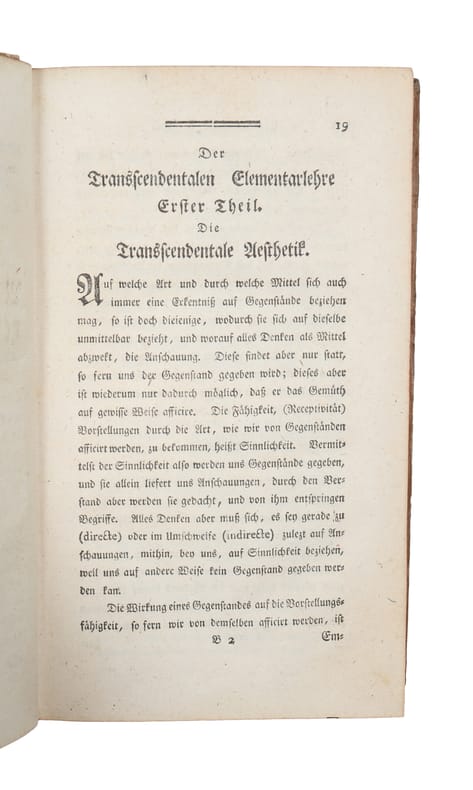
8vo (205 x 123 mm). Engraved title vignette and a few small engraved vignettes in text. Contemporary marbled paper-covered boards, flat spine with orange label lettered in gilt, edges red. Modern cloth box, orange label. One of the most influential works in the history of philosophy. In the preface to this first edition Kant explains what he means by a critique of pure reason: "I do not mean by this a critique of books and systems, but of the faculty of reason in general, in respect of all knowledge after which it may strive independently of all experience." Before Kant, it was generally held that truths of reason must be analytic, meaning that what is stated in the predicate must already be present in the subject (for example, "An intelligent man is intelligent" or "An intelligent man is a man"). In either case, the judgment is analytic because it is ascertained by analyzing the subject. It was thought that all truths of reason, or necessary truths, are of this kind: that in all of them there is a predicate that is only part of the subject of which it is asserted. If this were so, attempting to deny anything that could be known a priori (for example, "An intelligent man is not intelligent" or "An intelligent man is not a man") would involve a contradiction. It was therefore thought that the law of contradiction is sufficient to establish all a priori knowledge. "The influence of Kant is paramount in the critical method of modern philosophy. No other thinker has been able to hold with such firmness the balance between speculative and empirical ideas. His penetrating analysis of the elements involved in synthesis, and the subjective process by which these elements are realized in the individual consciousness, demonstrated the operation of 'pure reason'; and the simplicity and cogency of his arguments achieved immediate fame. Kant's achievements in other branches of philosophy were equally distinguished and fruitful [...] His methods [...] dominated western philosophical thought throughout the 19th century, as they do today" (PMM). - Provenance: Librarie Schlesinger, Vevey (bookseller's small ticket). Bookplate "HB" to front pastedown. - Some light marginal spotting, occasional light marginal browning or staining. Extremities rubbed, sides scuffed. Several underlinings or strokes to margins in thin pencil and occasionally in ink; unpaginated pp. 426-461 numbered in ink "26-61" in a contemporary hand. Warda 59. Norman 1197. PMM 226.
177260111(Presumably Yemen), 1772. 4to. Bound in a contemporary full leather binding with flap. Boards and flap with blindtooled ornamentation. Spine worn and worn through at hinges. Back board loose at top 2/3, but still attached. A bit of worming to boards and overall signs of wear to leather. Internally well preserved, with occasional light discolouration. 170 ff. with numerous additional smaller pages of notes inserted throughout, several in different colours (pink and blue). Text throughout is written in Naskh script, in a single column. Mostly written in black ink with occasional colorful highlights. Passages of core texts are overlined, generally in red but occasionally in black or green. The first text varies between approximately 18 and 33 lines per page and is occasionally written diagonally (for example, fol. 31rv) the second is consistent at 9 lines per page with considerable interlinear notes. Portions of the text are copied by the primary scribe on smaller pages, for example ff. 70r-79v, to be distinguished from the small pages of notes that were likely inserted later. The title and author of the first text are presented in attractive green and red calligraphy on f. 1r. The scribe’s name is also written in calligraphy on f. 1r and 126r, in addition to the colophon on f. 168v, but the name has been systematically erased in all three locations, for unknown reasons. According to the colophon on f. 168v, the manuscript was copied on the first Friday of Rabi? al-Thani 1186 AH, equivalent to 3 July 1772 CE. As noted above, the scribe’s name has been erased. The style of the script and decorations suggest that it was most likely copied in or near Yemen. Texts: Fol. 1r-126v: Da'ud al-Ashkashi’s supercommentary ?ashiyah ?alá Shar? al-Mara? on A?mad Dikquz’s (15th c.) commentary on A?mad ibn Mas?ud’s (13th c.) grammatical treatise Mara? al-arwa?, on Arabic morphology. Fol. 129v-168v: ?usam al-Din al-Kati’s (d. 1358/9) commentary Shar? al-Isaghuji on Athir al-Din al-Abhari’s (d. 1265) Isaghuji. Miscellaneous notes and poems appear on front and rear flyleaves, on pages between the two texts, in margins, between lines, and on small inserted pages. Many of these paratexts are in the hand of the primary scribe. The notes discuss numerous topics, but especially grammar and logic, the subjects of the two main texts. Marginal and interlinear notes generally comment on specific passages in the main text. A few notes, especially on fol. 128r, are in Turkish, attesting to Ottoman influence. The front pastedown has a short story or riddle about Muslims and nonbelievers on a ship.
(Presumably Yemen), 1772. 4to. Bound in a contemporary full leather binding with flap. Boards and flap with blindtooled ornamentation. Spine worn and worn through at hinges. Back board loose at top 2/3, but still attached. A bit of worming to boards and overall signs of wear to leather. Internally well preserved, with occasional light discolouration. 170 ff. with numerous additional smaller pages of notes inserted throughout, several in different colours (pink and blue). Text throughout is written in Naskh script, in a single column. Mostly written in black ink with occasional colorful highlights. Passages of core texts are overlined, generally in red but occasionally in black or green. The first text varies between approximately 18 and 33 lines per page and is occasionally written diagonally (for example, fol. 31rv) the second is consistent at 9 lines per page with considerable interlinear notes. Portions of the text are copied by the primary scribe on smaller pages, for example ff. 70r-79v, to be distinguished from the small pages of notes that were likely inserted later. The title and author of the first text are presented in attractive green and red calligraphy on f. 1r. The scribe’s name is also written in calligraphy on f. 1r and 126r, in addition to the colophon on f. 168v, but the name has been systematically erased in all three locations, for unknown reasons. According to the colophon on f. 168v, the manuscript was copied on the first Friday of Rabi? al-Thani 1186 AH, equivalent to 3 July 1772 CE. As noted above, the scribe’s name has been erased. The style of the script and decorations suggest that it was most likely copied in or near Yemen. Texts: Fol. 1r-126v: Da'ud al-Ashkashi’s supercommentary ?ashiyah ?alá Shar? al-Mara? on A?mad Dikquz’s (15th c.) commentary on A?mad ibn Mas?ud’s (13th c.) grammatical treatise Mara? al-arwa?, on Arabic morphology. Fol. 129v-168v: ?usam al-Din al-Kati’s (d. 1358/9) commentary Shar? al-Isaghuji on Athir al-Din al-Abhari’s (d. 1265) Isaghuji. Miscellaneous notes and poems appear on front and rear flyleaves, on pages between the two texts, in margins, between lines, and on small inserted pages. Many of these paratexts are in the hand of the primary scribe. The notes discuss numerous topics, but especially grammar and logic, the subjects of the two main texts. Marginal and interlinear notes generally comment on specific passages in the main text. A few notes, especially on fol. 128r, are in Turkish, attesting to Ottoman influence. The front pastedown has a short story or riddle about Muslims and nonbelievers on a ship.
170656962Augsburg, Johann Ulrich Krauss, [1706]. Folio (336 x 205 mm). Contemporary speckled calf over paste-boards, sides panelled with single gilt fillet, spine richly gilt with red morocco gilt lettering-piece, gilt edges. 2 parts in one volume. I: Xylographic half title, letterpress title with vignette, four-page preface with head-piece and initial, one page index of holy days, full-page allegorical engraving of the Church and 70 plates (numbered). II: Letterpress title with vignette, full-page engraving of the apostles and their symbols, and 50 plates (numbered 71-120); all the engravings finely coloured throughout with some gold heightening, all by a contemporary hand; the 120 plates show over 240 small emblems with mottoes. The plates printed on thick card paper, interleaved.
Folio (336 x 205 mm). Contemporary speckled calf over paste-boards, sides panelled with single gilt fillet, spine richly gilt with red morocco gilt lettering-piece, gilt edges. 2 parts in one volume. I: Xylographic half title, letterpress title with vignette, four-page preface with head-piece and initial, one page index of holy days, full-page allegorical engraving of the Church and 70 plates (numbered). II: Letterpress title with vignette, full-page engraving of the apostles and their symbols, and 50 plates (numbered 71-120); all the engravings finely coloured throughout with some gold heightening, all by a contemporary hand; the 120 plates show over 240 small emblems with mottoes. The plates printed on thick card paper, interleaved. First edition and a superb luxury copy of Krauss's emblematic interpretation of Biblical scenes entitled "Holy Delight of the Eye and Heart", which represents one of the high points of the Baroque period in Southern Germany. All the engravings are specially printed on thick card paper and beautifully coloured in gouache and watercolour, heightened in gold. - Johann Ulrich Krauss (1655-1719) was one of the most successful engravers and publishers at Augsburg in the latter part of the 17th century. This monumental emblem book was conceived as a suite to his famous Picture Bible or Bilderbibel (1698-1700) and follows the same illustrative formula, in which the upper portion of each plate contains an illustration of a Bible scene and the lower portion an engraved circular emblem. Each plate is devoted to a different Saint's day, and each emblem is printed within an elaborate cartouche or frame (the frames serve to emphasise the painterly aspect of these coloured scenes), itself often incorporating small medallion vignettes or emblems. In his artistic style Krauss's ornamental engravings - represented here by the varied and imaginative emblem cartouches - were widely influential in Germany, through their use as models for cabinetmakers, woodworkers and other craftsmen. In this coloured copy, those engravings with frames particularly serve to emphasise the painterly aspect of the scenes. - The artistic colouring of this copy adds expressive details and nuances of light, hue and shadow not supplied by the engravings themselves. It was likely executed, possibly under the artist's direction, either for presentation to a high-ranking patron or on commission for a wealthy customer. To avoid bleed-through of the colour the plates were specially printed on heavy, card-like paper, making this copy nearly twice as thick as ordinary copies. With its characteristic German Baroque palette of delicate pinks and blues and rich greens, enhanced by sparingly but gorgeously applied touches of gold, the colouring transforms many of the pictorial illustrations into veritable miniature paintings. - A coloured copy of Krauss's Bilderbibel, also on thick paper, is recorded (cf. Tenschert catalogue XLVIII, 98), but we can trace no other coloured copies of the present edition. In his 1933 study of the illustration of the Bilderbibel and its suites, Otto Reichl made no mention of any coloured copies. - Occasional minor marginal soiling or paper discoloration, small marginal repairs to 2 text leaves, plate 32 with small light stain, small tear to head of spine; else fine. Praz, p. 389. Landwehr, German 390. Faber du Faur, 1849. Thieme/Becker XXI, 440. Otto Reichl, Die Illustrationen in vier geistlichen Büchern des Augsburger Kupferstechers, Johann Ulrich Krauss. Studien zur deutschen Kunstgeschichte 294 (Strasbourg 1933).
183558764Paris, Gosselin, 1835-40. Lex 8vo. Bound in two excellent contemporary uniform black half calf bindings with blindstamped ornamentation and gilt lettering to spines. Only the slightest signs of wear to extremities. Some browning and brownspotting due to the paper quality, but overall in very nice condition. A few leaves in volume one with marginal markings. (4), XXIV, 365, (3) + (4), 455 pp. + folded, coloured map + (2), V, (3), 333, (1) + (4), 363 pp.
Paris, Gosselin, 1835-40. Lex 8vo. Bound in two excellent contemporary uniform black half calf bindings with blindstamped ornamentation and gilt lettering to spines. Only the slightest signs of wear to extremities. Some browning and brownspotting due to the paper quality, but overall in very nice condition. A few leaves in volume one with marginal markings. (4), XXIV, 365, (3) + (4), 455 pp. + folded, coloured map + (2), V, (3), 333, (1) + (4), 363 pp.
178161962Riga, Hartknoch, 1781. 8vo. Comtemporary - possibly the original! - beige cardboard-binding with contemporary handwritten paper title-label to spine. Spine relaid, preserving the paper-label, with front hinge neatly reastored, perfectly matching the original paper. Smaller, hardly noticeable, restorations to back hinge and upper capital. All edges coloured in red. Front free end-paper with restorations to upper outer corner. Library-stamp (Stadt-Bibliothek Homburg) to recto and verso of title-page as well as blank part of f. a2r, all with deaccession-stamps over. Internally exceptionally nice, clean, and fresh, with hardly any spotting of any kind. Overall an excellent copy. (24), 856 pp.
Riga, Hartknoch, 1781. 8vo. Very nice contemporary brown half calf with five raised bands, blindstamped ornamentation to each compartment, and blindstamped title to spine. A bit of wear to extremities, especially corners and lower capital, which has been neatly preserved with a barely noticeable dab of glue, but otherwise unrestored. Binding with with surface wear. Internally exceptionally nice. Overall a truly excellent copy. Contemporary owner's acqusition note, with price, to front free end-paper. (24), 856 pp.
62946Various places, 20th century. 116 works in 122 volumes, mostly 4to and 8vo. Includes a folder of ephemera comprising correspondence, photographs, newspaper clippings, and personal notes.
150262020Strassburg, Johann Pruss, 1502. 4to (195 x 137 mm). Bound in a beautiful 19th-century full calf binding with gilt lettering and ornamentation to spine, elaborate gilt borders to boards, inner gilt dentelles, gilt ornamentation to edges of boards. All edges gilt. Ex-libris to both front and back pasted-down end-papers and front and back free end-papers (see below). Title-page reinforced at inner margin and with loss of paper, slightly touching the woodcut illustration. Last leaf with marginal repair and a closed tear. 33 lines to a page. 24 ff. (A4, B6, C-D4, E6). Withbound are 33 blank leaves in the back. A very nice copy. 7 Woodcut illustrations in the text inspired by (but not an adaptation of) Brant's 'Das Narrenschiff'. Provenance:John William Beaumont Pease, 1st Baron Wardington (1869–1950)Christopher Henry Beaumont Pease, 2nd Baron Wardington (1924–2005)Lucy Anne Paese (1966 - )
179057178Berlin u. Libau, Lagarde und Friederich, 1790. 8vo (204 x 135 x 60 mm). Near contemporary marbled paper binding with gilt green title-label to spine. Hinges and capitals neatly restored. Old ownership-stamp to title-page. Mid-nineteenth-century Viennese bookseller's label to pasted-down back end-paper. Occasional light foxing in some margins, otherwise clean and bright. Printed on special, heavy paper, making the volume nearly double the thickness of regular copies. LVIII, 476 pp., (1) f. (errata).
London, Joannis Haviland, 1623 [later altered in manuscript to 1624]. Small folio. Bound in a lovely early 19th century full vellum binding with gilt borders to boards and gilt ornamentations and gilt title-label to spine.Lower front hinge cracked, but bindning still tight. A bit of edge wear, but overall very nice. Woodcut title-vignettes (burning heart) and woodcut initials in beginning. Text within single woodcut borders. (18), 493, (1 - errata) pp. Complete with both title-pages (no final blank). Old owner's name to title page (along with the dates 1624 and 1648), unlegible scribbles to second title-page, and ""collated e perfect"" in old hand to last leaf. A very nice and clean copy with good margins.
Berlin u. Libau, Lagarde und Friederich, 1790. 8vo (204 x 135 x 60 mm). Near contemporary marbled paper binding with gilt green title-label to spine. Hinges and capitals neatly restored. Old ownership-stamp to title-page. Mid-nineteenth-century Viennese bookseller's label to pasted-down back end-paper. Occasional light foxing in some margins, otherwise clean and bright. Printed on special, heavy paper, making the volume nearly double the thickness of regular copies. LVIII, 476 pp., (1) f. (errata).
155646837Basel, [Per Henrichum Petri, 1556 - on colophon]. An absolutely lovely copy of the exceedingly scarce first edition, first printing, of one of the most influential and important works in the history of modern thought. A work that has for a long time been overlooked due to the gross neglect of the history of Renaissance philosophy, but which has nonetheless been seminal to the development of scientific and philosophical thought from the 16th century and onwards. With a purely naturalistic and immanent view of the natural process, Pomponazzi here frees man's thought from the bounds of religion and provides modern thinkers and scientists with pure empiricism and naturalism. ""Er will das ""Wissen"" and die Stelle des ""Glaubens"" stellen"" - ""die ""dämonische"" Kausalität des Glaubens weicht der Kausalität der Wissenschaft"" (Cassirer, p. 110 + 111). 8vo. Contemporary full limp vellum, with vellum cords to hinges. Remains of vellum ties to boards. A bit of brownspotting, but all in all a lovely, completely unrestored copy in its first binding. Five large woodcut initials and large woodcut printer's device to verso of last leaf. (16), 349, (3). Adams: P-1827" Wellcome: I:5153" DSB: XI:71-74.A.H. Douglas: ""The Philosophy and Psychology of Pietro Pomponazzi"", 1910.M.L. Pine: ""Pietro Pomponazzi: Radical Philosoper of the Renaissance"", 1986.Thorndyke: ""A History of Magic and Experimental Science"", Vol. V, 1966 (4th printing)P.O. Kristeller: ""Eight Philosophers of the Italian Renaissance"", 1965.J.H. Randall, in: ""The Renaissance Philosophy of Man"", 1956 (4th impression).B.P. Copenhaver & C.B. Schmitt: ""Renaissance Philosophy"", 1992.E. Cassirer: ""Individuum und Kosmos in der Philosophie der renaissance"", 1969 (3. Aufl. - orig. 1927).See also: Kristeller: ""Renaissance Thought and its Sources"""" ""Medieval Aspects of Renaissance Learning"""" ""Renaissance Thought II, Papers on Humanism and the Arts"". ""Pomponazzi's thought and reputation were extremely influential in the centuries after his death. Even before it was printed, his treatise ""On incantations"" circulated widely in manuscript among philosophers, physicians and early modern naturalists (see Zanier 1975). Due to his mortalist theory of the soul, 17th-century ""free thinkers"" regarded Pomponazzi as one of their own, portraying him as an atheist (see Kristeller 1968"" Paganini 1985). Enlightenment thinkers of the 18th century pushed to extremes his distinction between natural reason and faith, while 19th-century positivists, such as Ernest Renan and Roberto Ardigò, saw in Pomponazzi a forerunner of their own beliefs and a champion of naturalism and empiricism."" (SEP).
Basel, [Per Henrichum Petri, 1556 - on colophon]. An absolutely lovely copy of the exceedingly scarce first edition, first printing, of one of the most influential and important works in the history of modern thought. A work that has for a long time been overlooked due to the gross neglect of the history of Renaissance philosophy, but which has nonetheless been seminal to the development of scientific and philosophical thought from the 16th century and onwards. With a purely naturalistic and immanent view of the natural process, Pomponazzi here frees man's thought from the bounds of religion and provides modern thinkers and scientists with pure empiricism and naturalism. ""Er will das ""Wissen"" and die Stelle des ""Glaubens"" stellen"" - ""die ""dämonische"" Kausalität des Glaubens weicht der Kausalität der Wissenschaft"" (Cassirer, p. 110 + 111). 8vo. Contemporary full limp vellum, with vellum cords to hinges. Remains of vellum ties to boards. A bit of brownspotting, but all in all a lovely, completely unrestored copy in its first binding. Five large woodcut initials and large woodcut printer's device to verso of last leaf. (16), 349, (3). Adams: P-1827" Wellcome: I:5153 " DSB: XI:71-74.A.H. Douglas: ""The Philosophy and Psychology of Pietro Pomponazzi"", 1910.M.L. Pine: ""Pietro Pomponazzi: Radical Philosoper of the Renaissance"", 1986.Thorndyke: ""A History of Magic and Experimental Science"", Vol. V, 1966 (4th printing)P.O. Kristeller: ""Eight Philosophers of the Italian Renaissance"", 1965.J.H. Randall, in: ""The Renaissance Philosophy of Man"", 1956 (4th impression).B.P. Copenhaver & C.B. Schmitt: ""Renaissance Philosophy"", 1992.E. Cassirer: ""Individuum und Kosmos in der Philosophie der renaissance"", 1969 (3. Aufl. - orig. 1927).See also: Kristeller: ""Renaissance Thought and its Sources""" " ""Medieval Aspects of Renaissance Learning""" " ""Renaissance Thought II, Papers on Humanism and the Arts"". ""Pomponazzi's thought and reputation were extremely influential in the centuries after his death. Even before it was printed, his treatise ""On incantations"" circulated widely in manuscript among philosophers, physicians and early modern naturalists (see Zanier 1975). Due to his mortalist theory of the soul, 17th-century ""free thinkers"" regarded Pomponazzi as one of their own, portraying him as an atheist (see Kristeller 1968" " Paganini 1985). Enlightenment thinkers of the 18th century pushed to extremes his distinction between natural reason and faith, while 19th-century positivists, such as Ernest Renan and Roberto Ardigò, saw in Pomponazzi a forerunner of their own beliefs and a champion of naturalism and empiricism."" (SEP).
188460267[Weimar, Gustaf Uszman] for E.L. Kasprowicz, Lipsk [Leipzig], 1884-[89]. Large 4to. Bound in a very nice recent red half calf with five raised bands and gilt title to spine. Title-page with repair to inner margin and with a few closed tears. Outer margin discreetly reinforced. Verso of title-page with ""1942 D. 1513"" in pencil. Last leaf also with a couple of closed/repaired tears, with minor loss of text, and reinforced in margin. Apart from the nicely restored flaws to the first and last leaf, this is an excellent, very nice and clean copy. VII, 325, (1) pp.
[Weimar, Gustaf Uszman] for E.L. Kasprowicz, Lipsk [Leipzig], 1884-[89]. Large 4to. Bound in a very nice recent brown half calf with five raised bands and gilt title to spine. Title-page with repair to inner margin and with a few closed tears. Outer margin discreetly reinforced. Verso of title-page with ""1942 D. 1513"" in pencil. Last leaf also with a couple of closed/repaired tears, with minor loss of text, and reinforced in margin. Apart from the nicely restored flaws to the first and last leaf, this is an excellent, very nice and clean copy. VII, 325, (1) pp.
188451643Breslau, Wilhelm Koebner, 1884 8vo. Contemporary paper boards. Paper labels over spine. Extremities worn, but tight and fine. A stamp to end-paper and to verso of title-page. Title-page and end-papers with light brownspotting, and some leaves with marginal markings, otherwise very nice and clean. Inscribed to front free end-paper. (10), XI, (1), 119, (1) pp.
Breslau, Wilhelm Koebner, 1884 8vo. Contemporary paper boards. Paper labels over spine. Extremities worn, but tight and fine. A stamp to end-paper and to verso of title-page. Title-page and end-papers with light brownspotting, and some leaves with marginal markings, otherwise very nice and clean. Inscribed to front free end-paper. (10), XI, (1), 119, (1) pp.
London, Hein: Seile, 1629. Folio. Contemporary full brown calf with six raised bands, gilt line-decoration and gilt title-label to spine. Triple blindstamped borders to boards. Restored at hinges, capitals and corners, with leather slightly lighter than the original calf. With the large armorial book-plate of Robert Biddulph Phillipps Esq., Logworth Herefordshire to inside of front board as well as Phillips Libarry book-plate of St. Michael's Monastery, Belmont. A few creases to the first leaves. A(1)r darkened and dusty, and last leaf of The Table slightly darkened. Overall a very good copy. Woordcut hear- and tail-pieces and large initials. Printed within lined borders. The folded map with a tear towards outer right corner, no loss. Engraved illustrated title-page (in ten compartments with figures and scenes, by Cecill) + 32, 536 (recte: 535), (10) pp. + 2 engraved plates and three large engraved maps, one folded, two double-page.
191148134[Redhill, Love & Malcolmson for His Majesty Stationery Office, 1911]. Large 8vo. Well preserved sometime machine stitched into a volume, now disbound" from the Patents Department of Manchester Free Library, with stamp in upper margin of the first page, accession date 9 September 1911. 3 pp. [1, blank] + one lithographic plate.
[Redhill, Love & Malcolmson for His Majesty Stationery Office, 1911]. Large 8vo. Well preserved sometime machine stitched into a volume, now disbound " from the Patents Department of Manchester Free Library, with stamp in upper margin of the first page, accession date 9 September 1911. 3 pp. [1, blank] + one lithographic plate.
172055807Napoli, Musca, 1720 & 1721. 4to. Bound together in one contemporary full vellum bindingwith old, faded title in ink to spine. A vertical crack to the spine, but binding fine and tight. A bit of wear to extremities. A bit soiled, but all in all good and completeley unrestored. Some quires quite browned and some quires with brownspotting. Book-plate to inside of front board (LA Law Library) and contemporary owner's signature to title-page (De Marinis). Some contemporary underlinings and marginal pointers to the first leaves. First title printed in red and black. (4), 195, (1) pp. + (4), 260 pp.
[Colophon - i.e. H(5)v:] Nuremberg, Anthonius Koberger, 21. September 1500. Folio. Bound around 1800 in a very appropropriate medieval style binding with heavy wooden boards with brass clasps and a dark painted leather spine with real raised bands and blindstamped lines. Spine with a bit of wear, but overall excellent and sturdy. Internally in very nice condition, with very little wear, very little spotting or browning and with clear and fresh imprint. A few, small, purely marginal worm holes. The woodcuts are all excellent and clear and are all with comtemporary hand-colouring mostly in red, but sometimes in yellow, occasionally in red and yellow. All larger capitals are in contemporary red hand-colouring and numerous smaller initials are touched in red. Several leaves with early or near contemporary marginal notes, mostly scholarly. Some early annotations that seem to be of more mystical character and not purely scholarly have been covered at an early date, meaning that a couple of leaves have early paper covered margins. These could presumably be removed again (as the paper strips seem to only intend to hide the annotations, which are vaguely visible from the versos, and nothing has been cut out underneath). This seems to have been the case on q(6)v, which consists mostly in woodcut illustrations. Here, the extensive, contemporary annotations, which seem to be of mystical character, with numerous signs and symbols, have been revealed again, causing just slight discolouration to the parts that had presumably been covered. Marginal paper note indicators have also been removed from several margins, causing discolouration to a small part of some blank margins on a few leaves. Front free end-paper with extensive, neat 19th century notes about the edition. The blank leaf H(6) also with neat, elaborate notes about the edition, from around 1800, in the hand of renowned Belgian bibliophile Baron Hilarion-Noël de Villenfagne d’Ingihoul (1753 - 1826), politician, historian and mayor of Liège from 1791. Final blank with elaborate, early 17th century annotations to both recto and verso (in two different hands). 304 ff. (including blanks). 14 ff. numbered (1-2), 3-4, (5-6), 5-8, (9-12) + a-z8, A-F8, G-H6, a-f8, g6. Fully complete. Illustrated throughout with magnificent woodcuts (that may or may not be by Dürer - see note below) - 7 full-page woodcuts, 10 pages comprising 51 woodcuts and text, and ca. 1 half-page woodcut.