Kircher AthanasiusMareMagnum

218 935 résultats
2 volumi in folio, pp. (20), 690; (2), 462, (38). Frontespizio inciso, ritratto dell'arciduca Leopoldo, entrambi su disegno di J.P. Schor, e 21 tavole numerate a 23, di cui 4 ripiegate. Numerose illustrazioni xilografiche, di cui tre a piena pagine. Foglio di Errata alla fine del vol. II. Legatura coeva in piena pergamena rigida con titolo su tassello al dorso. Piccolo strappo alla cuffia superiore
177133489Konstantinopel, (Astuacaturi, 1771). 2 Bde. in einem. 601, (7) SS. Mit 2 gleichen Titelholzschnitt-Bordüren, nahezu ganzseit. Holzschnitt und zahlr. figuralen Initialen. Blind- und goldgepr. Lederband der Zeit über Holzdeckeln (Schließen fehlen). 8vo.
8vo. 2 vols. in one. 601, (7) pp. With 2 identical woodcut title borders, nearly full-page woodcut, and numerous historiated initials. Contemp. blind- and giltstamped full calf over wooden boards (wants clasps). First edition of this Armenian grammar, composed by the learned Pagtasar (Balthasar) who for 50 years served as as proof-reader and copy-editor at the Astuacaturi printing office, which also published the present work. - Armenian ownership entry to flyleaf; some browning. The black oriental binding is slightly bumped at the extremeties, and the giltstamped ornamental cover decoration is largely oxydized. Extremely rare. Anassian II, 1074. Cf. Nersessian 229 (1791 ed. only). Not in Vater/Jülg.
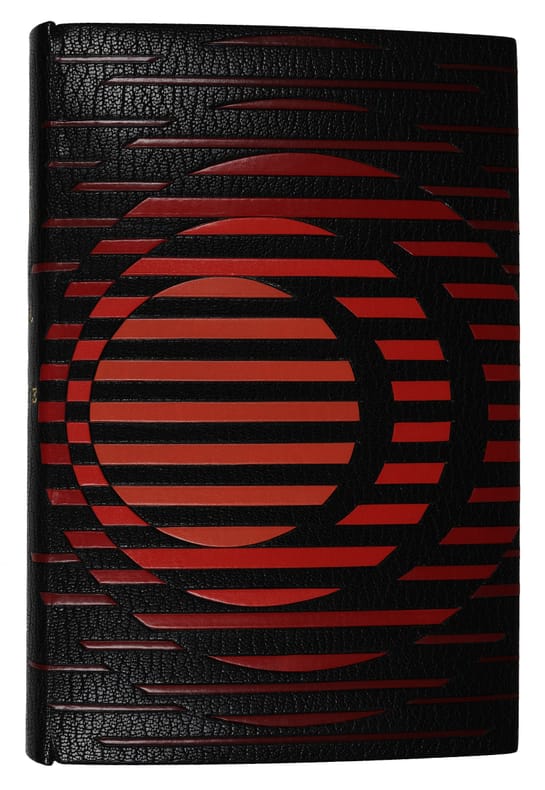
195757978(Paris), Gallimard, (1957). Bound uncut and with the original printed wrappers, aslo the backstrip, in a magnificent full black morocco binding with more than 100 calf onlays in seven different tones of red/orange, forming three hypnotizing circles on each board. Gilt title to spine, all edges gilt, and bright red suede end-papers within cream calf borders. Housed in a matching black morocco chemise with gilt title and red and grey paper covers, with suede on the inside, and a slipcase of the same paper and with black morocco edges. The binding is signed J.P. Miguet and dated 2003. One of the morocco onlays on the back board, towards the spine, has a tiny tear at the edge. Otherwise the binding is in splendid condition. Also internally, the copy is near mint. Apart from the backstrip, which has been mounted and slightly restored, it is completely clean, fresh, and crisp. Elengant, blindstamped super-exlibris to inside of front board.
London, Edward Griffin [John Haviland, Bernard Norton, and John Bill], Richard Whitaker [& John Norton], 1638. Folio. (Binding: 32x22 cm, leaves: 31,1x20,8 cm.). Contemporary full speckled calf binding with six raised bands and gilt red leather title-label to spine. Boards with blindstamped ornamental border. Scuff marks to boards and hinges worn, so bands showing. Large woodcut head- and tail-pieces, initials, printer's devices, and typographical ornaments (that have been of great significance to the Baconians in their attempts to establish Bacon as the author of the works attributed to Shakespeare). Roman and Italic lettering, and some Greek. Several neat inscriptions to front free end-papers and verso of frontispiece, in Latin, Greek, English, and German, dated 1704, 1740, and 1926, the last being a presentation-inscription for the renowned German Bacon-scholar and noted Baconian George J. Pfeiffer. Neat early 18th century inscription to top of title-page. Old description of the copy (1946) neatly pasted on to inside of front board. Vague minor damp-staining to lower margin throughout, far from affecting text, and mostly barely visible. A vague minor dampstain to margins of a few leaves at the beginning, also far from affecting text. All in all a lovely, clean and crisp copy on large paper. Full page engraved frontispiece-portrait + (14), 386 (pp. 177-78 omitted in pagination)" " (16), 475, (1) pp. Fully complete, with separate half-titles for the different works.
(Paris), Gallimard, (1957). Bound uncut and with the original printed wrappers, aslo the backstrip, in a magnificent full black morocco binding with more than 100 calf onlays in seven different tones of red/orange, forming three hypnotizing circles on each board. Gilt title to spine, all edges gilt, and bright red suede end-papers within cream calf borders. Housed in a matching black morocco chemise with gilt title and red and grey paper covers, with suede on the inside, and a slipcase of the same paper and with black morocco edges. The binding is signed J.P. Miguet and dated 2003. One of the morocco onlays on the back board, towards the spine, has a tiny tear at the edge. Otherwise the binding is in splendid condition. Also internally, the copy is near mint. Apart from the backstrip, which has been mounted and slightly restored, it is completely clean, fresh, and crisp. Elengant, blindstamped super-exlibris to inside of front board.
65279[Köln, Drucker des Salomon et Marcolphus (Ludwig von Renchen), nicht nach 1478). Fol. Mit einer rot eingemalten Initiale am Beginn. 66 nn. Bll. (ohne das erste u. letzte weiße; 40 Zeilen, Got. Type). HLdr. d. 20. Jhds. m. goldgepr. Rückentitel u. Rotschnitt.
in-4 (mm 190x139), ff. (22), CXXXXVII, (3, ''Jo. Geyleri Vita'' del Beato Renano), carattere romano e semigotico. Legatura 800esca in pelle con ai piatti pannello centrale in pelle più chiara e impressioni fogliacee in oro formanti una cornice ed un motivo centrale; titolo e fregi in oro al dorso restaurato (cerniere deboli); ricche dentelle interne, sguardie in carta marmorizzata. Quest'opera,uno dei capolavori dell'illustrazione silografica del Rinascimento tedesco, comprende la celebre figura della ''Nave dei folli'' sul foglio di titolo; nel testo altre 112 stupende silografie su due terzi di pagina (11,5 x 8,5 cm), tutte entro bordura decorativa sui due lati. Artistiche animate illustrazioni in parte già apparse nelle due edizioni di fine quattrocento (1494 e 1497) nelle quali è evidente l'influenza e la mano del giovane Albrecht Dürer. Seconda edizione latina, che comprende una prefazione di Jacob Otther, il testo della Narrenschiff di Brandt che espone i 110 diversi tipi di stolti, nella traduzione latina Stultifera navis di Jacob Locher del 1497, ed l'esteso commento in 111 sermoni di Geyler von Kaysersberg, ritenuto il Savonarola tedesco. La nave dei folli di Brandt (1457-1521, teologo conservatore tedesco) s'ispira ad un motivo frequente nell'arte medievale, segnatamente nella letteratura satirica, giocato su un bisticcio con la parola latina navis, maccheronicamente correlata alla ''navata di una chiesa''. Il tema della follia era un espediente retorico diffuso nel periodo ante-Riforma per giustificare la critica, ed in particolare da Erasmo nell' Elogio della follia, così come Martin Lutero. I buffoni di corte erano autorizzati a dire quello che volevano; sfruttando un analogo espediente letterario, Brandt poté legittimare le sue critiche alla Chiesa facendole formalmente proferire ai suoi pazzi di fantasia. Pur non appoggiando il movimento della Riforma, molte delle sue critiche alla Chiesa riflettevano temi che i riformatori avrebbero fatto propri. Professore di teologia a Basilea e Friburgo, Geiler (1445-1510) fu nomi-nato nel 1501 cappellano imperiale dall'imperatore Massimiliano, tale era la popolarità dei suoi sermoni; predicava senza sosta contro gli abusi della Chiesa. A differenza dei seguaci della Riforma, della quale invocava peraltro la neces-sità, continuò a riconoscere l'autorità della Chiesa cattolica romana. Utilizzava spesso la letteratura contem-poranea come punto di partenza per i suoi 111 sermoni, tenuti tra il marzo 1498 e l'aprile 1499, a commento della satira della Narrenschiff, denunciando gli abusi nella Chiesa mediante l'allegoria di una nave guidata da folli verso Narragonia, il paradiso degli stolti. Ogni sermone è illustrato da una xilografia raffigurante uno stolto, ad emblema del vizio specifico (ingiustizia, avarizia, indecenza, infedeltà, gola...). Sei legni appaiono due volte e 2 per tre volte; la maggior parte è attribuita ad Albrecht Dürer : ''some of the blocks are markedly angular in character, while others have the rounded manner of drawing that characterises Dürer's certainly authentic work'' (Fairfax Murray, p. 165) e ''some of the blocks are markedly angular in character, while others have the rounded manner of drawing that characterises Dürer's certainly authentic work'' (Hind, p. 331). Le rimanenti sono merito del cosiddetto Haintz-Nar-Meister, lo Gnad-Her-Meister, ed altri due anonimi artisti. Esemplare su carta forte, molto marginoso e genuino, con i legni nitidamente impressi, di edizione non censita in alcuna biblioteca italiana, che peraltro posseggono due soli esemplari di edizioni precedenti della Stultifera. Esemplare un po' corto di margini, piccolo strappo al margine bianco del titolo, leggere bruniture ai primo fogli. (In fine allegati foglietti con curiosa nota manoscritta in inglese della seconda del XIX secolo in cui vengono forniti dati sulla presente edizione).. Adams G-316; BMC STC German, p. 335; Chrisman C3.2.5b; Proctor 9995; Ritter, Catalog 1084; Brunet, II, 1575-76: ''Satire contre les moeurs du temps, et surtout contre les abus de l'Eglise romaine...Orné de gravures en bois fort jolies...''. Fairfax Murray Coll. of German Books, I, 165 (note al Brandt). Per le xilografie cfr. Boon e Scheller, Dürer, pp. 145-146; Hind, History of Woodcut, pp. 330-332..
Mirandulae, Ioannes Maciochius Bundenius, 1520 (on colophon). [Mirandola, Mazzocchi]. Small folio. Contemporary full vellum binding with handwritten title to spine. Author written in contemporary hand to lower edge. Binding professionally restored, at lower part of spine, edges of boards, and corners of back board. Free end-papers renewed. First leaf restored, with lower blank part supplied in later paper - no loss of text! This lower part was blank on both recto and verso. A bit of soiling to upper part of this leaf, as well as two old owner's inscriptions. First few leaves a bit browned, not heavily. Otherwise only light scattered browning. Some small marginal worm-holes to inner and lower blank margins, far from affecting text. All in all very fine, nice, and clean. Woodcut device to final leaf. (6), 208 ff.
149565314Basel, Johann Froben, ?M.cccc.xcv. sexto Kalendas Novembres? (d. i. 27. Oktober 1495). 8°. Mit einem fast ganzs. Textholzschnitt. 508 nn. Bll. (Bl. A1 weiß; Got. Typ., 2 u. 3 Kol., 54 Zeilen, rubriziert u. mit Initialen in Rot u. Blau), Ldr. d. 16. Jhds. a. 4 Bünden m. 8 Eckbeschlägen, 2 Mittelstücken u. 2 kl. Metallsternchen, marmor. Schnitt.
8vo. French ms. on vellum, calligraphed and illuminated by Léonie T(h)iersonnier. 88 pp. Contemporary calf on 5 raised bands with metal applications to front cover (allied coat of arms: Jacobe de Haut de Sigy and Thiersonnier). Leading edges gilt; inner dentelle richly gilt. All edges gilt, silk moirée endpapers. 2 metal clasps (slight defect to upper clasp). The present manuscript, painstakingly executed in the style of the late-mediaeval French Books of Hours, was a gift from Léonie Tiersonnier (née Ruffin) to her daughter Jeanne Clémence Guillemine Thiersonnier (1849-1936) on the occasion of her marriage to (Marie Auguste) Ambroise Jacobe de Haut de Sigy (1842-86) in the Paris church of St. Pierre de Chaillot on 6 August 1873. They were married by Théodore-Augustin Forcade (1816-85), the newly-installed Archbishop of Aix-en-Provence. A 26-page Saints' calendar (captioned "Souvenirs") is followed by an elaborately designed 56-page missal, decorated throughout by initials (some raised in gilt), line infillings, and ornamental borders.
2 ouvrages reliés en un volume in-4 (259 x 200 mm), plein maroquin rouge de l’époque, dos à 5 nerfs garni de compartiments richement fleuronnés et cloisonnés, palettes en tête et pied, 2 pièces de titre de maroquin émeraude, plats encadrés de triples filets dorés, roulette sur les coupes, dentelle intérieure, doré sur tranches. Rarissime réunion de ces deux textes majeurs du matérialisme français au XVIIIe siècle, publiés par d'Holbach à la suite l’un après l’autre en cette année 1776, dans leur édition in-4° "de luxe". 1- Edition in-4° publiée immédiatement à la suite du premier tirage; un carton présent dans celui-ci est ici intégré dans le texte. "Le premier volume développe, en trois sections, une théorie de la morale (…). Le deuxième volume s’attache à définir la pratique de la morale (…). Le troisième et dernier volume concerne les devoirs de la vie privée (…). D’Holbach récuse l'enseignement de la morale traditionnelle. Essentiellement naturaliste, prônant un lien laïque universel, l'ouvrage prolonge le 'Système de la nature' " ('D'Holbach et ses amis', 1541). (Vercruysse, éd. 2017, 1776, p. 160, A6). 2- Edition in-4° publiée immédiatement à la suite du premier tirage. L'ouvrage fondamental dans la pensée politique de d'Holbach, véritable programme politique et social qu'il destina au nouveau roi, Louis XVI, auquel le livre est dédié. D'Holbach recherche les principes et les modalités d'action d'un gouvernement soucieux de la morale et de l'utilité publique, promue par une "éthocratie", classe sociale dominante, qu'il oppose à la théocratie, l'aristocratie et l'autocratie. "D'Holbach s'est essayé à tracer un programme de réformes immédiates (…). Dans quelle mesure se flattait-il réellement d'influencer Turgot ? Il est difficile de le dire. Mais il est sûr que c'est avec un sens avisé de l'opportunité qu'il choisit cette heure, pour exposer le programme hors duquel il n'y avait plus de salut pour la monarchie" (Naville, 'D'Holbach', p. 399 sq.). (Vercruysse, éd. 2017, 1776, p. 155, A3). WorldCat recense 5 exemplaires de la ‘Morale universelle’ in-4° dans le monde et un unique de ‘l’Ethocratie’ in-4°: celui de la BnF. Quelques piqûres et petites taches éparses. Magnifique exemplaire, édition in-4° "de luxe", tirée à très petit nombre, parfaitement relié en maroquin rouge de l’époque, condition des plus rares.
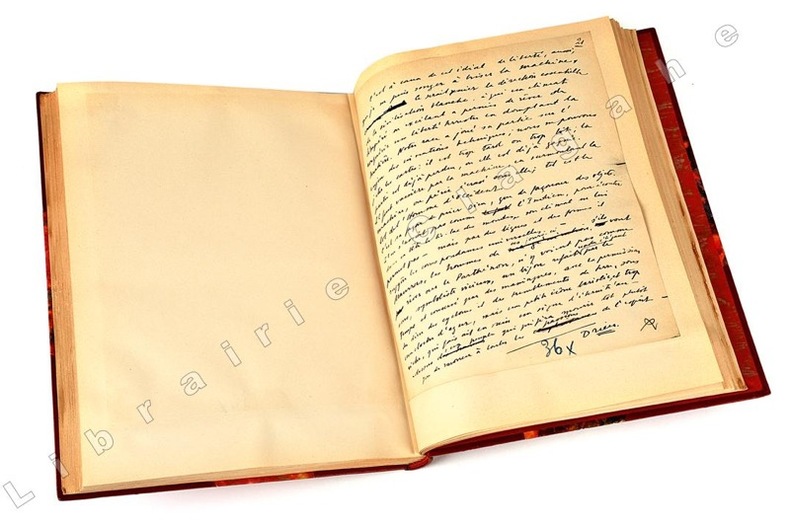
192720903[Revue: cahier politique et littéraire fondé et rédigé par Pierre Drieu La Rochelle et Emmanuel Berl-1927] ; in-4°, demi-chagrin à coins rouge vif, dos à quatre nerfs encadrant les auteurs et le titre.
187332537O. O., 1873. Französische Handschrift auf Pergament, kalligraphiert und illuminiert durch Léonie T(h)iersonnier. 88 SS. Leder-Meistereinband der Zeit auf 5 Bünden mit Metallapplikation am Deckel (Allianzwappen Jacobe de Haut de Sigy und Thiersonnier). Stehkanten- und reiche Innenkantenvergoldung. Dreiseitiger Goldschnitt, Seidenmoiréevorsätze. 2 Metallschließen (fehlt obere Hafte). 8vo.
155753970Paris, Andreas Wechel, 1557. 4to. 2 parts. (4 pp.), 5-16, 10 ff. Text in Greek and Latin. With woodcut printer's device as well as several floral headpieces and initials. Later full vellum with handwritten spine-title.
182048498Berlin, Nicolaische Buchhandlung, "1821" [but 1820]. 8vo (197 x 120 mm). (2), XXVI, 355, (1) pp. Contemporary quarter calf with red leather spine label lettered in gilt, spine gilt ruled. Marbled endpapers.
8vo (197 x 120 mm). (2), XXVI, 355, (1) pp. Contemporary quarter calf with red leather spine label lettered in gilt, spine gilt ruled. Marbled endpapers. The first edition of Hegel’s seminal work on "the sociology of the perfectly organized state" (PMM), best known in English as "Elements of the Philosophy of Right". "It turns away from the apparent chaos of the democratic advocates of individual right in favour of an overwhelming sense that liberty cannot exist apart from order, and that the vital connexion of all parts of the body politic is the source of all good" (ibid.). In spite of the year "1821" on the title page, the book was in fact printed in October 1820; Hegel had feared that censorship would delay publication for several months. - With the additional title ("Naturrecht und Staatswissenschaft im Grundrisse"). Extremities of binding very lightly rubbed. Insignificant even browning throughout; a minor tear in gutter of the half-title (p. 1, "Naturrecht und Staatswissenschaft"). Bookseller’s label (Librairie Falk fils, Bruxelles) on front pastedown. A fine copy. PMM 283. Borst 1361. Goedeke V, 11, 25, 7. Ziegenfuß I, 485. Ueberweg IV, 73ff.
Edition française par Pierre Boven, revue par l'auteur, 2 fort vol. grand in-8 reliure demi-basane noire, Librairie Payot et Cie, Lausanne, Paris, 1917 et 1919, LXII-784 pp. et 1 f. (table du volume 2 rapportée) ; XII pp., pp. 785-1762 Remarquable exemplaire dédicacé par Vilfredo Pareto à son jeune disciple français Georges-Henri Bousquet : "A M. G. H. Bousquet Témoignage d'amitié et de haute considération". Il s'agit de l'édition originale de la traduction française du Traité, publié en italien en 1916. Successeur de Léon Walras dans la chaire de Lausanne, le sociologue et économiste Vilfredo Pareto (1848-1923) reste l'un des plus fameux intellectuels de son temps. Son traité de sociologie marque une date dans la discipline, notamment dans l'étude des actions non-logiques et dans l'appréciations de ce qu'il dénomme les "résidus" : "les résidus sont des manifestations de sentiments. Les dérivations comprennent des raisonnements logiques, des sophismes, des manifestations de sentiments employées pour dériver; elles sont une manifestation du besoin de raisonner qu’éprouve l’homme. Si ce besoin n’était satisfait que par les raisonnements logico-expérimentaux, il n’y aurait pas de dérivations et à leur place, on aurait des théories logico-expérimentales. Mais le besoin de raisonnement de l’homme trouve à se satisfaire de beaucoup d’autres manières : par des raisonnements pseudo-expérimentaux par des paroles qui excitent les sentiments, par des discours vains et inconsistants; ainsi naissent les dérivations. Elles font défaut aux deux extrêmes : d’une part pour les actions instinctives, d’autre part, pour les sciences rigoureusement logico-expérimentales. On les rencontre dans les cas intermédiaires" (Traité, paragraphe 1401). L'ouvrage, en état très satisfaisant (très manipulé par G.-H. Bousquet mais bien solide, avec une fente partielle à un mors en tête et frott. en coiffe sup.) est enrichi des très nombreuses annotations du dédicataire, G.-H. Bousquet. Le professeur Georges-Henri Bousquet (1900-1978), docteur en droit en 1923 avec une thèse sur "L'évolution sociale en Hollande 1914-1922", devint un spécialiste de questions économiques, proche de Pareto et Schumpeter. Il fut également un islamisant de l'école de Goldziher et Snouck-Hugronje, professeur aux facultés d'Alger puis de Bordeaux. Il fut proche de son maître en sociologie Vilfredo Pareto, dont il servit fortement la pensée, en l'éditant et en le vulgarisant. G.-H. Bousquet entretint une correspondance avec Pareto et le visita notamment une huitaine de jours dans sa villa de Céligny (Suisse), vers Pâques 1923. Outre Pareto, G.-.H. Bousquet connut personnellement d'aussi grands noms de la pensée économique que Joseph Schumpeter (professeur à Harvard où, grâce à la fondation Rockfeller, G.-H. Bousquet fit un séjour de recherche dans les années 1933-1934.), Irving Fisher ou Albert Aupetit, le disciple de Léon Walras. Le nom du Professeur Bousquet est cité plusieurs fois par Schumpeter dans sa monumentale Histoire de l’Analyse Economique. Français
161860371Rome, 28. I. 1618. Imperial oblong folio (725 x 540 mm). Latin manuscript on vellum. 1 p. With Paul's lead bulla attached on a hemp cord.
161360369Rome, 16. XII. 1613. Imperial oblong folio (520 x 380 mm). Latin manuscript on vellum. 1 p. With Paul's lead bulla attached on a red and yellow cord.
Prima edizione, secondo e definitivo stato (Dufour “type B”). Eccezionale esemplare in legatura coeva senza alcuna sofisticazione: qualche normale segno del tempo non ne pregiudica in alcun modo l’aspetto e la solidità complessiva (alcune escoriazioni agli angoli e ai piatti; minima mancanza alla testa del dorso; principio di rottura fermato alla cerniera anteriore; urto all’angolino superiore del pietto anteriore). Ai margini esterni di alcune pagine, localizzati punti di foxing e leggere bruniture che non intaccano il testo; fascicolo A lievemente allentato; un leggero alone di umidità al margine esterno dell’antiporta e del frontespizio. Molto buoni i margini (197 x 124 mm). Con una firma dell’epoca che consente di stabilire un prezioso terminus ante quem per la legatura: al risguardo anteriore, in elegante grafia, «Em. Barbezat», con tutta probabilità un notaio di Fleurier (Neuchatel) che si occupò della vendita di un importante lotto di 220 libri nel febbraio 1886. «The basis for a legitimate political order within a framework of classical republicanism» (Books that made Europe, p. 146). «The “contract Social” remains Rousseau’s greatest work [...]. It had the most profound influence on the political thinking of generation following its publication. It was, after all, the first great emotional plea for the equality of all men in the state» (PMM, n. 207). -- La prima edizione ebbe una storia piuttosto travagliata: alcuni ripensamenti dell’autore introdussero varianti in corso di tiratura, con il risultato di complicare oltremodo la ricostruzione bibliografica. Gli studiosi che si sono occupati del caso hanno potuto ricostruire un punto di partenza — che appare quasi ‘ideale’ stante la sua rarità (non ci risulta censito in istituzioni o biblioteche private) — e un punto di arrivo, tra cui si collocano alcuni esemplari ibridi che sono il risultato del comporsi spesso casuale delle copie in tipografia. Il nostro esemplare appartiene senza dubbi allo stato definitivo, contenente tutte le correzioni d’autore (Dufour «type B»; Leigh «3rd state»), e caratterizzato dai seguenti dettagli: – frontespizio con la bella stampa della ‘Giustizia seduta con cappello’ (immagine che sostituisce, secondo la volontà di Rousseau, quella della ‘Giustizia in piedi’), privo della parte incipitaria del titolo, «Du contrat social», spostata assieme al punto e virgola finale alla carta d’occhietto; – ultimo fascicolo X (pp. 321-finis) senza la nota a piè di pagina sul «matrimonio civile in Francia», anch’essa rimossa per volontà autoriale, con il catalogo di Rey in fine e le minute varianti che, secondo la certosina ricostruzione di Leigh, configurano l’ultimo stato della composizione del testo. -- Gli interventi di Rousseau erano tutti volti ad evitare che l’opera venisse proibita dalla censura. Cosa che, nonostante tutto, accadde, costringendo l’autore a fuggire in Inghilterra e non per questo fermandone in alcun modo la diffusione, assicurata da un fiorire di edizioni pirata nel formato in 12°: gli ultimi censimenti parlano di almeno undici edizioni con data ‘1762’; e un totale di ventotto edizioni ora del 1782. Dufour, Recherches bibliographiques sur J.-J. Rousseau, n. 133; Leigh, Unsolved Problems in the Bibliography of Rousseau; Printing and the Mind of Man, 207; Books That Made Europe, p. 146; En français dans le texte, n. 162
Kjøbenhavn [Copenhagen], 1849. 8vo. Cont. full cardboard-binding of black glitted paper with single gilt lines to spine, all edges gilt (the typical gift-binding). With author and title in gold on front board. On vellum-paper. Professionally rebacked, preserving the original spine (ab. 1/3). A bit of wear to extremities, which have been expertly preserved. Very light occasional brownspotting. Endpapers spotted, due to paper-quality. 42 pp.
- Chez J. J. Lucet, Paris 1796, in-8 (13x20,5cm), (4) 123 pp., relié. - Observations sur le sentiment du beau et du sublime [Observations on the Feeling of the Beautiful and Sublime] Chez J.-J. Lucet | Paris 1796 | 8vo (13 x 20.5 cm), (4) 123 pp. | full morocco Extremely rare first edition of the first French translation of one of Kant's philosophical work and the second translation of a text by Kant, the others will only be known to the non-German speaking audience during the nineteenth century. In fact, the same year a short political text entitled Projet de paix perpétuelle appeared. Our edition is illustrated with a portrait of the author by J. Beniry, known as Dubuisson. The first edition, written in German under the title Beobachtungen über das Gefühl des Schönen und Erhabenen, was published in 1764 in Königsberg. Our copy is rebound in a full brown morocco binding that is likely Spanish from the 17th century, spine in five false bands richly decorated, boards framed with roll-tooling and a gilt dentelle as well as a third frame of scroll-work and scallops, royal coat of arms in the centre of the boards. The book contains the philosopher's first observations - who until then had only published scientific texts - on aesthetics and more particularly the sublime, a concept that will acquire all its significance in Critique du jugement (1790). This, like most of the philosopher's work, will only be translated during the nineteenth century. «Certainly before 1781, the name Kant was not totally unknown at the University of Strasbourg where some students and professors had cited him in their research or in their courses, and the work of the Berlin Academy, containing the memoires of resolute Kantism opponents, was not completely ignored in France, but it was not until the French Revolution and even the end of the Convention and the beginning of the Directory, that is to say, nearly fifteen years after the Critique de la Raison pure was published, that Kant and his work was beginning to be talked about in France.» (Jean Ferrari, L'uvre de Kant en France dans les dernières années du XVIIIème siècle in Les Études philosophiques No. 4, Kant (October-December 1981), pp. 399-411). We have not found any mention of this work being offered for public sale with the exception of Baron Talairat's copy (6 March 1877) and that of Mr d'Ansse de Villoison (3 March 1806). [FRENCH VERSION FOLLOWS] Rarissime édition originale de la première traduction française d'une uvre philosophique de Kant et seconde traduction d'un texte kantien, les autres ne seront connus du public non-germanophone qu'au cours du XIXè siècle. Notre exemplaire fut étonnamment réemboîté dans très belle reliure probablement espagnole en plein maroquin brun, dos à cinq faux nerfs richement orné, plats encadrés d'une roulette et d'une dentelle dorée ainsi que d'un troisième encadrement de feuillages et de coquilles Saint-Jacques, armes royales au centre des plats. La même année paraît également du même auteur un court texte politique intitulé Projet de paix perpétuelle. Notre édition est illustrée d'un portrait de l'auteur par J. Beniry dit Dubuisson. L'édition originale, rédigée en allemand sous le titre Beobachtungen über das Gefühl des Schönen und Erhabenen, a été publiée en 1764 à Königsberg. L'ouvrage contient les premières observations du philosophe - qui n'avait jusqu'alors publié que des textes scientifiques - sur l'esthétique et plus particulièrement le sublime, concept qui acquerra toute sa portée dans Critique du jugement (1790). Celle-ci, à l'instar du reste de l'uvre du philosophe, ne sera traduite qu'au cours du XIXè siècle. «?Certes dès avant 1781, le nom de Kant n'était pas totalement inconnu à l'Université de Strasbourg où quelques étudiants et professeurs l'avaient cité dans leurs recherches ou dans leurs cours, et les travaux de l'Académie de Berlin, contenant des mémoires d'adversaires résolus du kantisme, n'étaient pas complètement ignorés en France
170346174Rome, Typis Sacrae Congreg. de Propag. Fide, 1703. Folio (256 x 370 mm). (36), 431, (15) pp., final blank f. With printer's device to title page, woodcut headpiece and four half-page woodcuts of the Evangelists. Printed in red and black throughout. Contemporary paper boards.
162138607Ohne Ort (vermutl. Linz), ohne Drucker, 1621. Fol. Mit gest. illustr. Titel, einem emblemat. Textkupfer, 3 Textholzschnitten, 18 Kupfertafeln (von Wolfgang Kilian) u. einigen Holzschn.-Vignetten bzw. -Initialen. 6 Bll., 101 (1) S., 2 Bll. (das letzte weiß), Mod. HPgmt.