218 935 résultats
149964824Paris, Ulrich Gering und Berthold Rembolt, o. J. (um 1499). Fol. Mit Metallschnitt-Druckermarke auf dem Titel, verso mit blattgr. Textholzschnitt, 10 großen figürl. sowie zahlr. kleineren, teils figürlichen Metallschnitt-Initalen. 44 nn., 367 num., 3 nn. Bll. (Got. Typ., 2-3 Spalten, 74 Zeilen), Blindgepr. Schweinsldr. d. Zt. a. 4 Bünden über schweren Holzdeckeln mit 2 intakten Messingschließen.
149458074Straßburg, [Drucker des Jordanus von Quedlinburg; Georg Husner], 1493-1494. Fol. Tlw. rubriziert u. mit in Rot eingemalten Initialen. 210 (Bll. 200, 201 u. das letzte weiß); 256 (das letzte weiß); 136 (das letzte weiß) nn. Bll. (Got. Typ., 2 Kol., 52 Zeilen), Späterer Pgmt.-Bd. (um 1700; Rücken alt m. weißem Ldr. überzogen) auf vier Bünden m. 2 goldgepr. Rückenschildern.
151056068Augsburg, Johann Otmar für Georg Diemar, 1510. Fol. Mit 6 fast blattgr. Holzschnitten von Hans Burgkmair u. 2 großen Initialen. 210 nn. Bll., Mod. Ldr. im Stil d. Zt. m. Streicheisenlinien u. Kopfgoldschnitt.
154538532(Leipzig, Nikolaus Wolrab), 1549 (im Kollophon: 1544 bzw. 1545). Fol. Titeln in Rot u. Schwarz m. Titelholzschnitt bzw. m. breiter figürl. Holzschn.-Bordüre. Mit zahlr. Textholzschnitten von Hans Brosamer. 4 Bll., 382 num., 10 Bll. (das letzte weiß); 1 nn., 69 num., 4 nn. Bll. (das letzte weiß); 6 nn., 281 num., 7 nn. Bll.; 6 nn., 88 num., 1 nn. Bll., Blindgepr. Schweinsldr.-Bde. d. Zt. über Holzdeckeln a. 4 Bünden m. goldgepr. Rückenschild sowie blindgepr. Deckeltitel (?Postil sumer teyl und fest? bzw. ?Postil winter Teill?, dat. ?1550?) u. 2 Schließen.
65323[Köln], Conrad Winters von Homberg, [zwischen 17. März u. 20. September 1479]. 8°. 102 nn. Bll. (Got. Typ., 27 Zeilen, rubriziert u. mit einigen Initialen in Rot), Blindgepr. Ldr. d. Zt. über Holzdeckeln.
161560370Rome, 13. VIII. 1615. Imperial oblong folio (625 x 480 mm). Latin manuscript on vellum. 1 p. With Paul's lead bulla attached on a red and yellow cord.
In-4°, (80 cc), presenza di molte glosse coeve di più mani, alcune correzioni al testo, legatura in mezza pergamena moderna, due capilettera figurati. Al frontespizio nota di possesso manoscritta di William Godolphin (1635-1696), diplomatico e grande collezionista inglese. Ex libris Pagel. Dedica a Marco Antonio Colonna, firmata ex Accademia Pisana. Buone condizioni. Edizione originale dell’opera filosofico-epistemiologica di Simone Porzio, aristotelico radicale, materialista convinto, sostenitore della mortalità dell’anima. Questa è la sua più importante opera di fisica, in cui l’autore si inserisce nella disputa sul determinismo. Pensatore originale, uno dei primi grandi filosofi napoletani, profondo conoscitore dei testi in greco, Porzio fu il maggior esponente a Napoli della corrente degli ‘alessandristi’ (sostenitori della mortalità dell’anima; contro di lui scrisse Giacomo Antonio Marta), e ispiratore del pensiero di Bernardino Telesio; sosteneva la separazione di filosofia e teologia. Aristotele è accolto qui attraverso il suo interprete più famoso, Alessandro di Afrodisia (II-III sec. d.C), autore tra l’altro di uno scritto sul fato, contrario ad ogni forma di determinismo. In quest’opera Porzio definisce, approfondisce ed esamina in due libri i concetti aristotelici di materia e natura. Infine, dopo aver parlato delle cause efficienti, arriva discutere di ciò che stava diventando realmente interessante: il problema del fato e della libertà, citando Platone, Plotino, Aristotele, Crisippo. Fatum est lex nobis promulgata, instar divinae mentis. La totale libertà è negata all’essere umano, sostiene Porzio anche in due opuscoli precedenti, perché solo l’individuo che esiste in se stesso può avere completa libertà. La sua posizione si orienta verso una visione sempre più naturalistica, che riproponendo il valore centrale della visione e dell’esperienza nell’indagine dei fatti, automaticamente rinuncia alla spiegazione di questi attraverso il sacro e il miracoloso. Simone Porzio (1497-1554), filosofo napoletano, medico e professore di filosofia naturale tra le Università di Napoli e Pisa (qui per la seconda volta tra il 1545 e il ’53); a Napoli fu allievo di Agostino Nifo. E.Garin, History of Italian Philosophy, I, 362 Cesare Vasoli, Tra Aristotele, Alessandro di Afrodisia e Juan de Valdès: note su Simone Porzio, in Rivista di storia della filosofia, 4, 2001 Eva del Soldato, Simone Porzio: un aristotelico tra natura e grazia. istituto nazionale di Studi sul Rinascimento, 6, 2010 In-4 °, (80 cc), presence of many contemporary glosses by different hands, some corrections to the text, binding in modern half vellum, two figured initials. On the title page handwritten ownership note by William Godolphin (1635-1696), diplomat and great English collector. Ex libris Pagel. Dedication to Marco Antonio Colonna, by the former Accademia Pisana. Good copy. Original edition of the philosophical-epistemological work of Simone Porzio, radical Aristotelian, convinced materialist, advocate of the mortality of the soul. This is his most important work on phisics, in which the author is part of the dispute over determinism. Original thinker, one of the first great Neapolitan philosophers, profound connoisseur of Greek texts, Porzio was the greatest exponent in Naples of the current of the 'Alexandrians' (supporters of the mortality of the soul; Giacomo Antonio Marta wrote against him), and inspirer of the thought of Bernardino Telesio; he advocated the separation of philosophy and theology. Aristotle is introduced here through his most famous interpreter, Alexander of Aphrodisias (II-III century AD), author, among other things, of a writing on fate, contrary to any form of determinism. In this work, Porzio defines, deepens and examines the Aristotelian concepts of matter and nature in two books. Finally, after talking about efficient causes, he comes to discuss what was becoming really interesting: the problem of fate and freedom, quoting Plato, Plotinus, Aristotle, Chrysippus. Fatum est lex nobis promulgata, instar divinae mentis. Total freedom is denied to the human being, as Porzio stated in two previous pamphlets, because only the individual who exists in himself can have complete freedom. His position is oriented towards an increasingly naturalistic vision, which by re-proposing the central value of vision and experience in the investigation of facts, automatically renounces the explanation of these through the sacred and the miraculous. Simone Porzio (1497-1554), Neapolitan philosopher, doctor and professor of natural philosophy between the Universities of Naples and Pisa (here for the second time between 1545 and '53); in Naples he was a pupil of Agostino Nifo. E. Garin, History of Italian Philosophy, I, 362 Cesare Vasoli, Between Aristotle, Alexander of Aphrodisias and Juan de Valdès: notes on Simone Porzio, in Review of the history of philosophy, 4, 2001 Eva del Soldato, Simone Porzio: an Aristotelian between nature and grace. National Institute of Renaissance Studies, 6, 2010
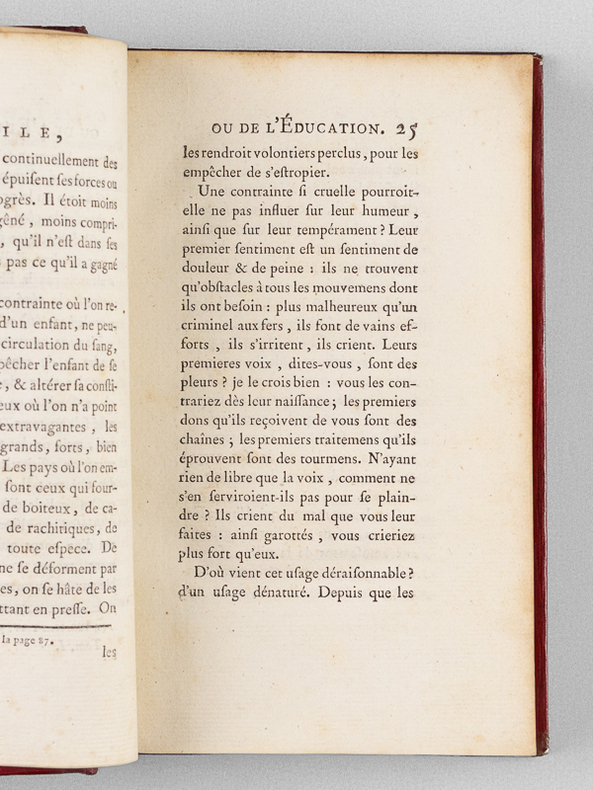
1762601594 vol. in-8 reliure début XIXe demi-maroquin à grain long (dimension : 19 x 12 cm en marges), dos lisse richement orné, initiales D.C. au dos en queue, Chez Jean Néaulme, A La Haye [ Paris ], 1762, I : 1 f. (titre), viii pp., 1 f. (Explication des figures et Fautes d'impression), 466 pp. et 2 ff. n. ch. (privilège et errata) avec deux planches hors texte ; II : 2 ff., 407 pp. avec une planche hors texte ; III : 2 ff., 384 pp. avec une planche hors texte ; IV : 2 ff., 455 pp., avec une planche hors texte
4 vol. in-8 reliure début XIXe demi-maroquin à grain long (dimension : 19 x 12 cm en marges), dos lisse richement orné, initiales D.C. au dos en queue, Chez Jean Néaulme, A La Haye [ Paris ], 1762, I : 1 f. (titre), viii pp., 1 f. (Explication des figures et Fautes d'impression), 466 pp. et 2 ff. n. ch. (privilège et errata) avec deux planches hors texte ; II : 2 ff., 407 pp. avec une planche hors texte ; III : 2 ff., 384 pp. avec une planche hors texte ; IV : 2 ff., 455 pp., avec une planche hors texte Très jolie reliure pour ce rare exemplaire de l'édition originale de l'un des plus fameux ouvrages du XVIIIe siècle. Dans son grand format in-8 publié à Paris par Duchesne, l'exemplaire est parfaitement conforme à la description fournie dans l'impressionnante bibliographie de Jo-Ann E. McEachern (édition "IA"). Notre exemplaire propose la variante signalée de la planche de Thétis, ainsi que les 4 cartons signalés dans les deux premiers tomes. La bibliographie de McEachern détaille la controverse entre l'antériorité de l'édition in-8 et de l'édition in-12, et démontre que si cette dernière fut imprimée la première, c'est bien l'édition de plus grand format qui fut publiée la première, à la requête de l'éditeur, probablement pour des raisons financières. C'est ainsi que les exemplaires distribués le 23 mai 1762 à la Maréchale de Luxembourg étaient au format in-octavo, lequel mérite ainsi le titre d'édition originale. On pourra également relever que c'est un exemplaire similaire (avec la mention "natura genitos" en épigraphe) qui fut condamnée par l'arrêt de Parlement du 9 juin 1762 à être lacérée et brûlée de la main du bourreau. Agréable exemplaire (mouill. angulaire intérieure dans les tomes 2 et 3, sans le f. blanc précédant la tables des matières du tome III, comme souvent, très bon état par ailleurs) joliment relié. Very nice binding for this rare copy of the first edition of one of the most famous works of the 18th century. In its large in-8 format published in Paris by Duchesne, this copy conforms perfectly to the description provided in the impressive bibliography by Jo-Ann E. McEachern ("IA" edition). McEachern's bibliography details the controversy between the anteriority of the in-8 edition and the in-12 edition, and shows that if the latter was printed first, it is the larger edition which was first published, at the request of the publisher, probably for financial reasons. Thus the copies distributed on May 23, 1762 to the Maréchale de Luxembourg were in octavo format, which thus deserves the title of the original edition. We can also note that it is a similar version (with the mention "natura genitos" in epigraph) which was condemned by the decree of Parliament of June 9, 1762 to be lacerated and burned by the hand of the executioner. McEachern, Emile, IA Français
- Chez Jacques Le Gras, à Paris 1664, in-4 (18x24cm), (70 p.) 448 pp. (8 p.), relié. - [The Man of René Descartes. And a treatise on the formation of the foetus by the same author]. Chez Jacques Le Gras, à Paris 1664, 4-to (18 x 24cm), (70 p.) 448 pp. (8 p.), bound. True first edition. The privilege is shared between several publishers: Charles Angot, Jacques and Nicolas Le Gras and Théodore Girard. A Latin translation had been published in Leiden in 1662 by Florent Schuyl (1619-1669), from a poor copy of the text, according to the preface by Claude Clerselier (1614-1684), who had the original Descartes manuscript. Illustrated with 49 figures of optics and anatomy by MM. de Gutschoven and de La Forge, marked "G" or "F" depending on the illustrator. Contemporary binding in full brown calf, spine with gilt panels and fleurons, gilt tooling on the edges and spine ends, mottled red edges. Skillfully restored upper spine end, joints and corners.The name of a former owner has been cut out of the title page and filled with a piece of paper, very discreet wormholes in the margin of certain leaves at the beginning and at the end of the volume, light water stain not affecting the text at the end of the volume. This Traité de l'Homme was conceived by Descartes in accordance with the precepts of his Discours de la méthode: starting from his own anatomical knowledge, he explains the different human physiological functions and the mechanical laws that govern them. The work had considerable influence on materialism during the following century, as well as on the medicine of the 18th and 19th centuries. [FRENCH VERSION FOLLOWS] Véritable édition originale dont le privilège a été partagé entre plusieurs éditeurs : Charles Angot, Jacques et Nicolas Le Gras et Théodore Girard. Une traduction latine avait été publiée à Leyde en 1662 par Florent Schuyl (1619-1669), à partir d'une mauvaise copie du texte comme le précise dans sa préface Claude Clerselier (1614-1684) qui possédait le manuscrit original de Descartes. L'ouvrage est illustré de 49 figures d'optique et d'anatomie réalisées par MM. de Gutschoven et de La Forge, marquées « G » ou « F » en fonction de l'illustrateur. Reliure de l'époque en plein veau brun, dos à cinq nerfs orné de caissons et fleurons dorés, roulette dorée sur les coupes et les coiffes, toutes tranches jaspées de rouge. Coiffe de tête, coins et mors très habilement restaurés. Le nom d'un ancien propriétaire a été découpé à la page de titre et comblé avec une pièce de papier, très discrets travaux de ver en marge de certains feuillets du début et de la fin du volume, pâles mouillures sans atteinte au texte en fin de volume. Ce Traité de l'Homme a été conçu par Descartes conformément aux préceptes de son Discours de la méthode : en partant des connaissances anatomiques qui sont les siennes, il explique les différentes fonctions physiologiques humaines et les lois mécaniques qui les régissent. L'ouvrage eut une influence considérable sur le matérialisme du siècle suivant, ainsi que sur la médecine des XVIII et XIXème siècles.
Collezione completa. Qualche fioritura, nel complesso un ottimo esemplare, a margini quasi pieni (375 x 255 mm), in legatura coeva (restauri con rinforzi in pelle alla cerniera superiore; la cerniera inferiore risulta parzialmente fessurata). Timbretto di antica provenienza «Raccolta Levino Robecchi» alla seconda carta. -- Allegato al volume il rarissimo bifoglio che annunciava la prossima uscita del periodico: stampato su carta bianca l’1 luglio 1818, conteneva il «Programma» e i «Patti dell’associazione». Il «Programma» qui non è firmato, ma nella ristampa approntata su carta azzurra in occasione dell’uscita del primo numero (con il differente titolo di «Introduzione») compare in fine la sigla P. B. (Pietro Borsieri). I «Patti dell’Associazione», invece, recano la firma di Vincenzo Ferrario, e risultano di grandissimo interesse, esplicitando, con oltre due mesi di anticipo rispetto all’uscita del primo numero, quale sarebbe stato l’aspetto assunto dal giornale: «I. Il primo numero del Conciliatore comparirà il giorno 3 di settembre prossimo venturo. Questo foglio uscirà due volte per settimana, ne’ giorni di Giovedì e Domenica precisamente a mezzodì. II. Esso sarà composto di quattro pagine di due colonne ciascuna, nella forma e nel carattere di questo Programma [...]. III. La carta sarà della dimensione e qualità della presente, ma di colore alquanto ceruleo [...]». Rarissima raccolta completa in 118 fascicoli compresi gli ultimi due, mai distribuiti. Il «Foglio azzurro», così detto dall’inconfondibile colore della carta utilizzata per la stampa, si pubblicò due volte la settimana dal 3 settembre 1818 al 17 ottobre 1819, per cura della Società del Conciliatore, un organismo che vedeva Luigi Porro Lambertenghi e Federico Confalonieri in qualità di soci finanziatori, Ludovico Di Breme, compilatore, Pietro Borsieri «sottocompilatore», Giovanni Berchet «sottocompilatore», Silvio Pellico, compilatore e Vincenzo Ferrario, tipografo stampatore. Tra gli altri collaboratori, Giovanni Arrivabene, Giovan Battista De Cristoforis, Giannantonio Llorente, Giuseppe Longhi, Giuseppe Montani, Fabrizio Mossotti, Giuseppe Nicolini, Giuseppe Pecchio, Giovanni Rasori, Adeodato Ressi, Gian Domenico Romagnosi, Pellegrino Rossi, Sismonde de Sismondi, Rodolfo Vantini, Ermes Visconti. Tutti firmavano con le sole iniziali. Fino al fascicolo 112 (pp. 1-454), il foglio mantenne la medesima testata, estremamente spoglia, caratterizzata dal titolo centrale in corpo grosso, sormontato in piccolo da numero (in arabi) e data, e seguito sempre in piccolo dal famoso motto «... Rerum concordia discors»; a partire dal numero 113 e fino alla fine, nella maggioranza degli esemplari il titolo viene sostituito da una piccola incisione centrata, raffigurante un albero piegato dalla tempesta, cui segue semplicemente, in corpo grosso maiuscolo, l’indicazione del numero in romani. -- Sulla falsariga del «Caffè» di Verri e Beccaria, il Foglio azzurro si occupò di moltissimi argomenti, dalle lettere alle scienze, passando per l’economia, il diritto, la filosofia morale, le questioni politico-amministrative: «Silvio Pellico si incaricava della preparazione dei singoli numeri e si preoccupava, nonostante le sue opinioni allora politicamente molto avanzate, di contrastare gli atteggiamenti anticristiani del Rasori, designato fin dall'inizio fra i collaboratori del Conciliatore. [Al periodico] collaborarono fin dal principio i giuristi Romagnosi e Ressi, mentre l’abate di Breme, Pietro Borsieri, Giovanni Berchet ed Ermes Visconti vi sostenevano con cultura e con brio la lotta contro i classicisti. Il Pecchio si occupò soprattutto di materie economiche, per le quali furono corrispondenti da Ginevra il Sismondi e Pellegrino Rossi» (Treccani 1931, s.v.). -- Del «Conciliatore» sono noti i momenti di polemica letteraria e politica, che videro i romantici, di idee liberali, attaccare a viso aperto i classicisti, vicini alla Restaurazione austriaca. Più recentemente, si è posta attenzione anche all’importante dibattito economico sviluppato nel foglio: «due sono i filoni principali d’intervento: il dibattito sull’industrializzazione e quello sulla forma di proprietà più adatta ad un corretto ed equilibrato sviluppo economico. In relazione al primo punto, la discussione sullo sviluppo industriale si amplia e arricchisce il dibattito in favore o contro il protezionismo doganale. Accanto ad autori come Pellico, convinti assertori di uno sviluppo agricolo e commerciale fondato soprattutto sulla capacità degli aristocratici illuminati della Lombardia di promuovere il benessere e l’incivilimento regionale […], Giuseppe Pecchio si dichiara a favore di una politica di diretto intervento governativo, con il compito di promuovere lo sviluppo e di garantire, mediando gli interventi delle varie classi. Esemplari in questo senso sono gli articoli tratti dall’opera di Jean Antoine Chaptal sull’industria francese […]. Pecchio allarga poi la sua analisi allo sviluppo dell’economia lombarda del periodo, esaminando i riflessi e l’importanza avuta per il Lombardo-Veneto dal blocco continentale, e dalla formazione di un più vasto mercato in seguito alla creazione di un grande stato dell’Italia settentrionale. […]. Pellico […] mostra la sua netta predilezione per il modello inglese della concentrazione terriera e nel presentare la seconda edizione dell’Inquiry di James Maitland Lauderdale scrive che benché in Gran Bretagna vi siano “parecchie enormi fortune sembra che per esse non diminuisca essenzialmente il bene della maggior parte. I contadini proprietarj, i massaj e i manifattori, se si paragonano a quello del continente, si distinguono in Inghilterra per l’agio e persino l’opulenza in cui vivono” (2 maggio 1819, p. 284) […]» (Bibliografia dei periodici economici lombardi). -- Dopo un primo periodo di relativa tranquillità, «Il Conciliatore» divenne bersaglio della censura austriaca, complici le posizioni sempre più moderne che andava abbracciando: in un crescendo di malsopportazione e ammonimenti, il foglio fu costretto a chiudere. Vittore Branca scrive che col n. 116 terminava la parte del Conciliatore distribuita agli associati; anzi lo stesso n. 116 ebbe pochissima diffusione («… come si rileva dalle numerose raccolte in cui manca») causa il sequestro quasi immediato. I numeri 117 e 118 non vennero neppure distribuiti, anche se già pronti per la stampa; le poche copie che ebbero modo di circolare furono soltanto quelle destinate ai redattori. Branca, rist. anast. del Conciliatore (3 voll. Firenze, 1953-54); Clerici, Il Conciliatore (Pisa 1903); Bibliografia dei periodici economici lombardi (Milano 2005), s.v.
149757959[Straßburg, Drucker des Jordanus von Quedlinburg, d. i. Georg Husner, nach 13. VIII. 1497]. Fol. Titel m. großem Holzschn.-Portrait. 182 nn. Bll. (ohne die beiden weißen Bll. [*]4 u. gg6; Got. Typ., 47 Zeilen, durchg. rubriziert). Holzdeckelbd. m. blindgepr. Lederrücken im Stil d. Zt. m. dreiseitigem Rotschnitt u. einer Mittelschließe.
168560375Rome, "Non[is] Aprilis", i. e. 5 May 1685. Oblong 4to (295 x 225 mm). Latin manuscript on vellum. With Innocent's lead bulla attached on a hemp cord. Together with a bull from 15 April 1677 (without its seal). Oblong folio (395 x 297 mm).
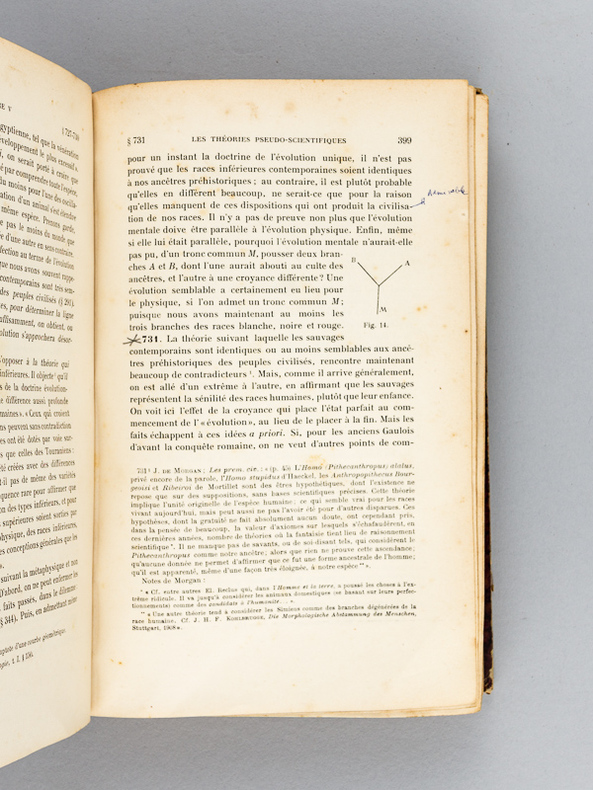
191752626Edition française par Pierre Boven, revue par l'auteur, 2 fort vol. grand in-8 reliure demi-basane noire, Librairie Payot et Cie, Lausanne, Paris, 1917 et 1919, LXII-784 pp. et 1 f. (table du volume 2 rapportée) ; XII pp., pp. 785-1762
151327988Straßburg, Martin Flach, 1513. (4), 253 Bll. Titel in rot und schwarz gedruckt. Mit Holzschnitt-Titelbordüre (Vögel und Reben) von Hans Wechtlin und blattgr. Holzschnitt von Urs Graf am Schluß der Vorstücke. Blindgepr. Schweinslederband der Zeit auf 3 flach gearbeiteten Bünden. 2 intakte ziselierte Schließen. Folio (222:320 mm).
Initialled (K.R.P.) and briefly inscribed atop front free endpaper by Popper to Harry Kidd in year of publication, when Kidd was Secretary of the London School of Economics where Popper taught. xiv, 166 pages. Index. "Puts paid to all attempts at futurology by pointing out that the future depends on new knowledge which by definition we do not have today." - Samuel Brittan, The Week. "Exposes 'historicism' with such force and precision, and makes so clear its incompatability with any kind of scientific empiricism, that there is no further excuse for confusing these two." - Isaiah Berlin. Popper was "One of the most influential thinkers of the 20th century." - The Daily Telegraph. Quarter-inch incidental mark to page 20, otherwise contents clean and unmarked. Minor cant to spine. Modest loss to dust jacket at corners. A quality signed copy of this momentous work. Book
159652474Lyon, Jacob Roussin, 1596. 8vo. Contemporary limp vellum. Title-page printed in red and black. A fine copy. (16), 633 pp.
156252485Balsel, Sebastian Henricpetrus, (1562). 4to. Both volumes bound in one nice mid-19th century half calf with gilt spine. Title to lower edge in contemporary hand. Ex libris to inside of front board. Some browning and brownspotting, and first title-page frayed at edges and with a repaired hole (presumably removing an old owner's name), not affecting printing and a small repaired hole in imprint (affecting the ""Pe"" of ""Per Sebastianum...""). 1) Somniorum Synesiorum: (42) pp., 1 blank leaf, 278 pp., 1 blank leaf. +2) Opera quaedam lectu digna (with a separate title-page and separate pagination): (36), 413, (1, -errata) pp. - lacking the final leaf with printer's devise only (no text).
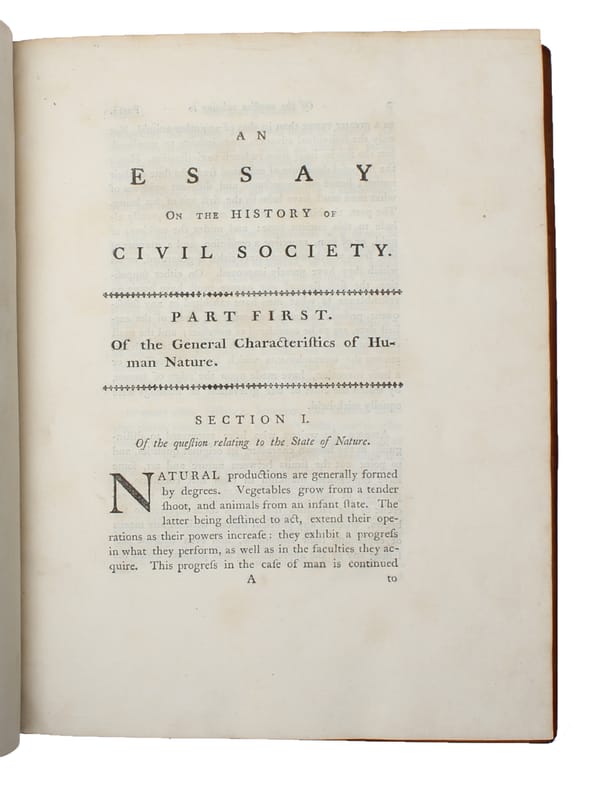
176761031Edinburgh, 1767. Large 4to. Recased preserving the contemporary marbled leather boards with a gilt line-frame over a more recent light brown full calf binding with five raised bands and gilt ornamentations to spine. The contemporary gilt title-label also preserved in second compartment of the spine. A later leather-onlay to the lower compartment, presumably covering an earlier library-marking. All edges of boards gilt. Inner hinges re-enforced. A good, solid, and sturdy copy. Library stamp (Freie Universität Berlin) to verso of title-page, along with a deaccession-stamp, as well as to blank lower margin of p. 48. Apart from the stamps, internally extremely well preserved, clean, and fresh, with only light occasional brownspotting. A very wide-margined copy on good paper. Leaves measuring 27x21 cm. VII, (1), 430 pp.
171639224Napoli, Excudebat Felix Musca, 1716. 4to. Nice contemporary Italian full vellum binding with gilt title to back. A bit of soiling and averall wear. Internally occasional brownspotting, but overall a very nice copy. Title-page in red an black, full-page engraved portrait of Hadrianus Carafa, full-page engraved portrait of Antonius Carafa, six beautiful large engraved vignettes, and six beautiful large engraved initials. Tissue-guards inserted later. (2) ff. (being half-title and title-page), portrait, (12) ff. (dedication), portrait, 501 pp.
Lyon, Jacob Roussin, 1596. 8vo. Contemporary limp vellum. Title-page printed in red and black. A fine copy. (16), 633 pp.
Balsel, Sebastian Henricpetrus, (1562). 4to. Both volumes bound in one nice mid-19th century half calf with gilt spine. Title to lower edge in contemporary hand. Ex libris to inside of front board. Some browning and brownspotting, and first title-page frayed at edges and with a repaired hole (presumably removing an old owner's name), not affecting printing and a small repaired hole in imprint (affecting the ""Pe"" of ""Per Sebastianum...""). 1) Somniorum Synesiorum: (42) pp., 1 blank leaf, 278 pp., 1 blank leaf. +2) Opera quaedam lectu digna (with a separate title-page and separate pagination): (36), 413, (1, -errata) pp. - lacking the final leaf with printer's devise only (no text).
Napoli, Excudebat Felix Musca, 1716. 4to. Nice contemporary Italian full vellum binding with gilt title to back. A bit of soiling and averall wear. Internally occasional brownspotting, but overall a very nice copy. Title-page in red an black, full-page engraved portrait of Hadrianus Carafa, full-page engraved portrait of Antonius Carafa, six beautiful large engraved vignettes, and six beautiful large engraved initials. Tissue-guards inserted later. (2) ff. (being half-title and title-page), portrait, (12) ff. (dedication), portrait, 501 pp.
Leipzig, Insel=Verlag, 1923. 8vo. Original half cloth. Blue paper-covered boards with ""Der Dom"" in gilding to front board. Spine with soiling and upper part of boards faded. 422, (2) pp. + 1 folded plate.
Complete series of Albertus Magnus' works in 38 volumes, together 28831 pages, 27cm., text in Latin, nice uniform hardcover bindings (blue marbled boards, spines in black leather with gilt lettering), 2 stamps at title pages, text clean and bright with only very few occasional foxing, few foxing on edges, with index at end of each volume, nice set of this rare massive and complete work, total weight: 75kg., ["auctaque B. Alberti vita ac bibliographia operum a PP. Quetif et Echard exaratis, etiam revisa et locupletata, cura ac labore Augusti Borgnet". Content: Volume 1-2: Logica (lxxiv,824 + 752pp.) // 3: Physica (pp.) // 4: De coelo et mundo, De generatione et corruptione, De meteoris (835pp.) // 5: Mineralium libri quinque, De anima libri tres, Philosophia pauperum, Liber de apprehensione (753pp.) // 6: Metaphysica (798pp.) // 7: Ethica (690pp.) // 8: Commentarii in octo libros Politicorum Aristotelis (856pp.) // 9-10: Parvorum naturalium pars prima-altera (692 + 703pp.) // 11-12: Animalium lib. XXVI (683 + 664pp.) // 13: Sermones (856pp.) // 14: Commentarii in opp. B. Dionysii Areopagitae (1071pp.) // 15-17: Commentarii in Psalmos (760 + 606 + 632pp.) // 18: Liber de muliere forti, Commentarii in Threnos Jeremiae, in Baruch et in Danielem (655pp.) // 19: Enarrationes in XII prophetas minores (679pp.) // 20: Enarrationes in Evangelium Matthaei I-XX (721pp.) // 21: Enarrationes in Evangelium Matthaei XXI-XXVIII, In Marcum (807pp.) // 22-23: Enarrationes in Evangelium Lucae (778 + 840pp.) // 24: Enarrationes in Joannem (807pp.) // 25-30: Commentarii in Sententiarum (669 + 588 + 792 + 844 + 928 + 811pp.) // 31-33: Summa theologiae (1000 + 642 + 584pp.) // 34: Compendium theologicae veritatis, Prima pars Summae de creaturis (799pp.) // 35: Secunda pars Summae de creaturis (704pp.) // 36: De laudibus B. Mariae Virginis libri XII (879pp.) // 37: Mariale, Biblia Mariana, Paradisus animae, Liber de adhaerendo Deo, Libellus de alchimia, Scriptum super Arborem Aristotelis (579pp.) // 38: Distinctiones in sacramentum Eucharistiae, Enarrationes in Apocalypsim S. Joannis (825pp.)], R92328