"RUSSELL, BERTRAND.MareMagnum
Descartes, RenéAntiquariat.de

Biblion Antiquariat · CH - Zürich3 200,00 €
218 526 résultats
Cambridge, at the University Press, 1903. Royal 8vo. Original blue full cloth binding, all edges uncut. Capitals and upper front hinge with a bit of wear and corners a little bumped. But otherwise a very nice copy. Internally fresh and clean. XXIX, (1), 534 pp.
Trondhjem, Tønnes Andreas Høeg, 1840. 4to. Entire volume present. Later very nice brown hcalf w. gilt spine (Anker Kyster). Pp. (1) - 100. Entire volume: (2), 127, (3) pp. With the general title-page for the volume, title-pages and prefaces for the two works contained in the present volume, and the contents-leaf. The other work is: ""Den Constitutionelle Statsform, betragtet i dens Forhold til Samfundets høiere Interesser. Tale holden i det Kongl. Norske Videnskabers=Selskab paa hans Majestæt Kongens Fødselsdag den 26de Januae 1838, af Frederik Moltke Bugge, Selskabets Præses.""
La Haye, Dètune, 1779. 8vo. Five very nice contemporary full mottled calf bindings with gilt title- and tome-labels to richly gilt backs, triple gilt line-borders to boards and single gilt line-ornamentation to edges of boards. Marbled adges. Minor repairs to a few capitals, but overall a very nice copy indeed. Internally very nice, clean, and fresh printed on good paper. One leaf of volume one with neatly closed tear. Old owner's name to title-page of volume 5. Title-pages printed in red and black. With book-plates of Fritz Trieboe/Twilboe (?), A. Gedeon, and C. Rasch. Frontis-piece portrait, 425 pp. XII, 549 pp. (last leaf uncut an folded) VIII, 526 pp. VIII, 456 pp. + 9 engraved plates, of which 8 are folded " VIII, 462 pp. + 5 folded engraved plates, (1) p (directions for the book binder. In all 14 engraved plates, of which 13 are folded.
Lyon, Franciscus le Preux, 1592. Small 8o. Early 19th century half calf with gilt title-label to spine. A bit of wear to hinges and corners, but fine and tight. Internally exceptionally nice and clean. P. Rubow's owner's signature to front free end-paper. Woodcut vignettes to title-pages and woodcut initials at beginning of both parts. (8), 88 " 270 pp, 1 blank leaf, (16 ff. of indexes and errata at end).
13 volumi di 14,5x21,5 cm, in legatura coeva in mezza pelle avana, dorso liscio con doppio tassello arancione e strisce dorate. 1: La grammaire· 2:Traite de l'art d'ecrire· 3: De l'art de raisonner· 4: De l'art de penser· 5: Histoire ancienne· 6: Histoire ancienne· 7: Histoire ancienne· 8: Histoire ancienne· 9: Histoire moderne· 10: Histoire moderne· 11: Histoire moderne· 12: Histoire moderne· 13: De l'etude de l'histoire. Antiporta incisa di Ravanet con ritratto del Condillac al primo volume. Paginazioni: (4)-128 pp.; 294-(2) pp..; (4)-400 pp.; (4)-326-(2) pp e 9 tavv. più volte rip.; (4)-229 pp.; (4). 706 pp.; (4)-672-(2) pp.; (4)- 660 pp..; (4)-724 pp.; (4)- 646 pp.; (4)- 654-(4)pp.; (4)- 708 pp; (4)- 736 pp..; (4)-366-(2)-84 pp. In appendice: Directions pour la conscience d'un roi, composées pour l'instruction de Louis de France duc de Bourgogne par Messire François de Salignac de La Mothe-Fénelon. Una gora al tomo 3. Errore di paginazione con inversione di quaderni al tomo 10, al tomo 12 e al tomo 13, ma sempre senza mancanze. Qualche usura alle cuffie di alcuni tomo, ma nel comp0lesso condizioni molto buone per questa edizione originale Bodoni dalla travagliata stampa. Essa era infatti già pronta nel 1775, ma la vendita ne venne impedita dalla corte di Spagna; l'edizione venne quindi autorizzata solo nel 1782, a condizione che avesse un luogo di edizione fittizia (Aux Deux Ponts). Bodoni ne cambiò quindi solo la pagina di titolo. Da notare che le edizioni di Parma con data 1775 e 1776 sono delle contraffazioni.
In-4°, (12cc), 512pp, 48cc., buone condizioni restauri al frontespizio, numerosissime note manoscritte, legatura in pergamena coeva. Personalità di spicco della scolastica spagnola del Cinquecento, Luis de Molina fu anche uno dei più controversi pensatori della storia del cattolicesimo. Sulla base di precise tesi teologiche e filosofiche, elaborò una sua propria dottrina che puntava alla conciliazione del libero arbitrio con la prescienza divina e la predestinazione. Oltre al lavoro in campo teologico, dedicò molto tempo anche a temi politici e morali, interrogandosi in particolare sulla legittimazione del potere e dell’autorità politica, sulla schiavitù e su questioni economiche. Nel 1584 si ritirò definitivamente dall’insegnamento e si trasferì a Lisbona, per occuparsi della composizione delle sue opere: in questo periodo, scrisse la notissima Concordia, titolo con cui solitamente si indica lo scritto Liberi arbitrii cum gratiae donis, divina praescientia, providentia, praedestinatione et reprobatione concordia. Questo lavoro, uscito nel 1588, è in realtà solo una parte di un’opera maggiore, intitolata Commentaria in primam divi Thomae partem e pubblicata solo nel 1592 a Cuenca, città dove Molina aveva fatto ritorno dal Portogallo l’anno precedente. Nel 1600, ricevette un incarico come professore al Colegio Imperial di Madrid, città dove morì il 12 ottobre dello stesso anno. In-4°, (12cc), 512pp, 48cc., good condition, title page repaired, manuscript notes, vellum binding. Prominent personality of the Spanish school of the sixteenth century, Luis de Molina was also one of the most controversial thinkers in the history of Catholicism. On the basis of precise theological and philosophical theses, he developed his own doctrine which aimed at reconciling free will with divine foreknowledge and predestination. In addition to his work in the theological field, he also devoted a lot of time to political and moral issues, in particular questioning the legitimacy of power and political authority, slavery and economic issues. In 1584 he definitively withdrew from teaching and moved to Lisbon, to take care of the composition of his works: in this period, he wrote the well-known Concordia, a title that usually indicates the writing Liberi arbitrii cum gratiae donis, divina praescientia, providentia, praedestinatione et reprobatione concord. This work, released in 1588, is actually only a part of a major work, entitled Commentaria in primam div Thomae partem and published only in 1592 in Cuenca, the city where Molina had returned from Portugal the previous year. In 1600, he received an assignment as professor at the Colegio Imperial in Madrid, the city where he died on October 12 of the same year.
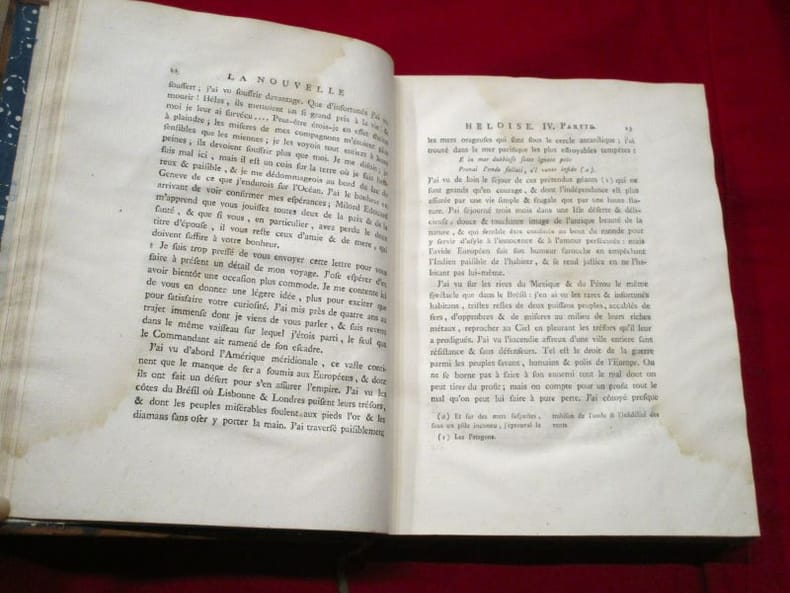
17821170211782 in-4 A Genève, [sans éditeur], 1782, 17 volumes in-4 de 200x255 mm environ, de 460 à 700 pages par volumes, contient un portrait en frontispice d'après La Tour, 35/37 planches (figures de Moreau et Le Barbier) et 24 planches de musique. Plein cuir porphyre, dos à cinq nerfs portant titres et tomaisons dorés sur pièces de cuir vert foncé, caissons à fleurons dorés aux entrenerfs, encadrements à froid sur les plats, filet doré sur les coupes, gardes bleu roi à motifs peints, tranches mouchetées de bleu. Bel état général malgré les défauts indiqués aux reliures (des coiffes et des coins émoussés, discrets et épars trous de ver sur les cuirs et gardes, des frottements, un plat restauré), un tampon d'ex-libris sur chaque page de faux-titre, 2 planches manquantes, une quarantaine de feuillets avec traces importantes de mouillure (Nouvelle Héloïse), auréoles marginales au tome XVI sans atteintes au texte (Confessions), sinon intérieur frais.
1820801014Paris: E.A. Lequien. 1820-1826. (nur wenig berieben und bestoßen, Bände 18, 23, 35, 39, 40, 42, 50, 54, 68 mit kleinen Fehlstellen im Leder, nur wenig störend, Gelenke vereinzelt mit kleinen Einrissen bzw. restaurierten Einrissen, innen nur wenig gebräunt bzw. stockfleckig, ... Zusammen ca. 35000 Seiten. Ganzleder der Zeit mit Gold- und Blindprägung auf Rücken und Deckeln, Stehkanten mit Goldprägung, Innenkanten mit Blindprägung, marmoriertem Schnitt und Vorsätzen aus Marmorpapier,
Riga, Hartknoch, 1788. 8vo. A bit later (1840'ies) half cloth with gilding to spine. Old allegorical stamp to title-page " another stamp at lower margin removed, likewise old owner's name.Otherwise a very nice copy. Woodcut title-vignette. 292 pp.
189257460Paris, Tresse & Stock, 1892. 8vo. Contemporary red half calf with lovely gilt ornamentation to spine and gilt library-lettering to bottom of spine. Spine slightly soiled. Binder's stamp to front free end-paper. Evenly browned throughout. Title-page closely shaven at outer margin, but not affecting print. XV, (1), 297, (1) pp. + (1, contents) f.
194559904Preveo M. Pijade (Belgrad), Biblioteka Marksizma-Lenjinizma, 1945. 8vo (195 x 145 mm). In the original printed wrappers. A few small nicks to wrappers and a few occassional light markings in margin. Otherwise a fine and clean copy. 64, (3) pp.
Paris, Tresse & Stock, 1892. 8vo. Contemporary red half calf with lovely gilt ornamentation to spine and gilt library-lettering to bottom of spine. Spine slightly soiled. Binder's stamp to front free end-paper. Evenly browned throughout. Title-page closely shaven at outer margin, but not affecting print. XV, (1), 297, (1) pp. + (1, contents) f.
Preveo M. Pijade (Belgrad), Biblioteka Marksizma-Lenjinizma, 1945. 8vo (195 x 145 mm). In the original printed wrappers. A few small nicks to wrappers and a few occassional light markings in margin. Otherwise a fine and clean copy. 64, (3) pp.
1749134055Chez Barillot & fils|[Prault] ; Genève [Paris] s.d. (1749) 1749 2 volumes in-4 plein veau blond glacé de l’époque, dos lisse, caissons ornés, pièces de titre en maroquin grenat, triple filets d’encadrement des plats, fleurons d’angles, double filet en coupes, dentelles en contreplats, tranches dorées, 8 XXIV : 522pp. 1p. errata et 4 XVI ; 564pp. Coiffes et coins émoussés, mors fendillés. Infimes rousseurs. Très bon exemplaire. De toute rareté
155556525Naples, (Tomasso Riccione), 1555. Folio (210 x 305 mm). XII ff. With several woodcut initials. Later red half calf over marbled boards with giltstamped spine-title.
Folio (210 x 305 mm). XII ff. With several woodcut initials. Later red half calf over marbled boards with giltstamped spine-title. First and only edition of this exceedingly rare commentary on Aristotle and Averroes, prepared by the Neapolitan philosopher Giovanni Gomezio Pagano (ca. 1500-69), a leading Franciscan theologian active in the San Lorenzo convent in Naples. His work constitutes a remarkable philosophical treatise defending Aristotelianism against the Neoplatonist tendencies of early Greek and Muslim thinkers including Al-Farabi, Ibn Sina (Avicenna), and Themistius, as well as Christian philosophers such as Alexander of Aphrodisias. - Covers somewhat warped; very slightly rubbed. Title-page lightly brownstained. A fine copy of this notable work rarely offered in the trade. OCLC lists a single record (in the Italian National Library). Edit 16, CNCE 38268. OCLC 954806038. Manzi, La tipografia napoletana nel '500. Not in BM-STC Italian or Adams. For Pagano cf. Istoria degli scrittori nati nel Regno di Napoli V, 50-51.
2 volumes in-8 (193 x 117 mm), demi-basane marbrée de l'époque à coins, dos lisses ornés de filets gras dorés, pièces de titre et de tomaison de veau havane encadrées d'une roulette torsadée, plats de papier caillouté (reliure de l'époque), (4), lxxj, 334 p., planche frontispice gravée et (4), 496 p., (4) pages d’avis de l'imprimeur et d’errata pour les 2 tomes. Edition originale sous pages de titre renouvelées à la date de 1795, entièrement conforme à la première. Frontispice gravé par Delaunay d'après Marillier: "Emblème du gouvernement Félicien". Les deux feuillets d'errata sont reliés en fin du tome second. "La seule utopie physiocratique, conçue dans le but de propager les idéaux de l'École par son plus habile représentant". Lemercier de La Rivière était conscient du fait que les productions théoriques des physiocrates étaient trop arides pour le grand public. Par cette oeuvre, la dernière qu'il publia, il ambitionna de diffuser la doctrine à travers un récit utopique situé dans le pays de la "Félicie" : son régime politique et économique, les institutions, les moeurs de ses habitants et les valeurs philosophiques et morales qui le fondent. "Lemercier de La Rivière attribue au couple économique/politique une vocation morale: ‘Le bonheur particulier des individus’, écrit-il, ‘ne peut être établi que sur le bonheur général de l'espèce’. Cet universalisme l'amène à envisager une union des peuples fondée sur le commerce. A la fin de sa vie, alors qu'il travaille à une constitution pour la France, il définit la paix et la confiance comme fondements essentiels du commerce et propose d'interdire les guerres de conquête. Il introduit la fraternité, la bienfaisance et la mutuelle assistance que les hommes se doivent entre eux et explicite l'idée d'une confédération internationale fondée sur le principe d'une fraternité des nations " (B. Herencia, "L'Europe des physiocrates : Lemercier de La Rivière ", ‘Encyclopédie d'histoire numérique de l'Europe’ [en ligne]). Paul-Pierre Lemercier de La Rivière (1719-1801), économiste physiocrate est également l'auteur de l'une des Bibles du mouvement physiocratique: ‘L'Ordre naturel et essentiel des sociétés politiques’ (1767) loué par Diderot comme par Adam Smith. (Cf. Hartig & Soboul, ‚Utopies‘, p. 17. Einaudi, 3304. INED, 2790. Martin-Walter, 20861 [tous pour l'édition de 1792]). WorldCat ne recense aucun exemplaire dans le monde semblable à celui-ci, sous pages de titre renouvelées à la date de 1795. Quelques rousseurs. Très bon exemplaire, bien relié à l'époque.
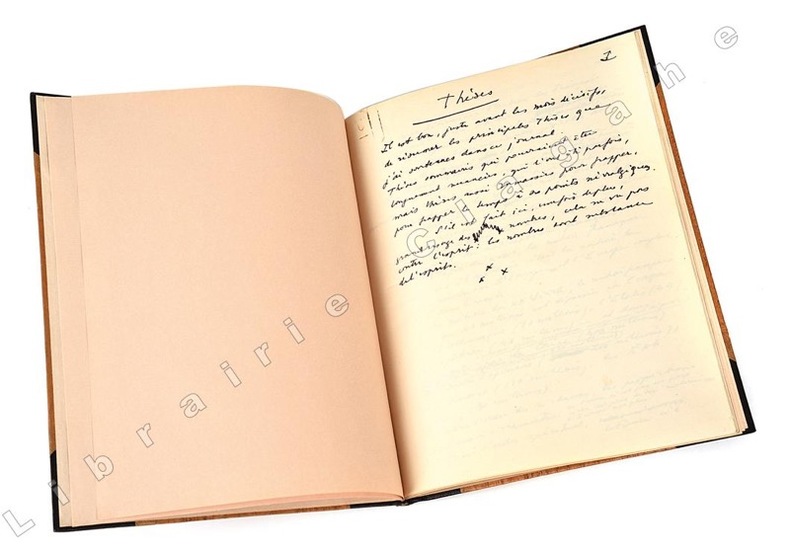
20905In-4°, bradel demi-maroquin à coins noir, plat simili bois ; 17 feuillets (16 + 6bis) manuscrits.
1748382621748 2 volumes in-4 (251 x 192 mm), plein veau marbré de l'époque, dos à 5 nerfs ornés de compartiments fleuronnés et cloisonnés, pièces de titre et de tomaison de maroquin bordeaux, plats encadrés de doubles filets à froid, roulette sur les coupes, tranches rouges, (2) f., (4), xxiv, 522 p., (2) p. d'errata, v° blanc et (2) f., xvi, 564 p. Genève, Barillot, & Fils, s.d. [Paris, Durand, 1748].
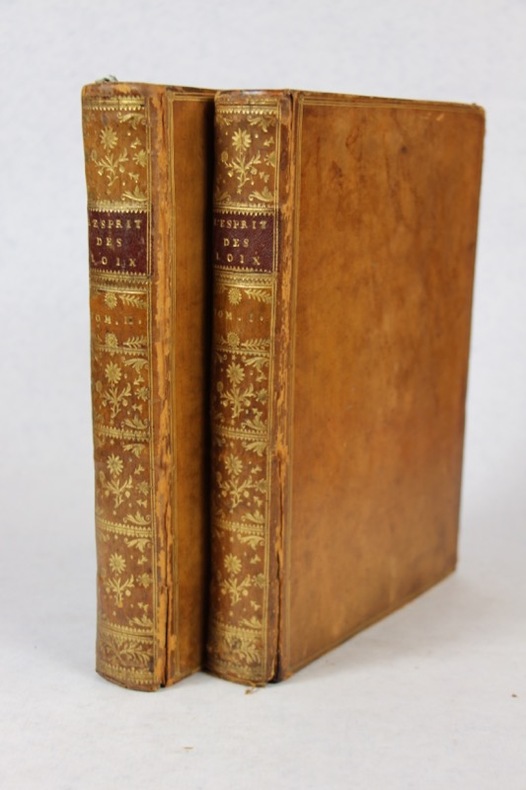
2 volumes in-4 (251 x 192 mm), plein veau marbré de l'époque, dos à 5 nerfs ornés de compartiments fleuronnés et cloisonnés, pièces de titre et de tomaison de maroquin bordeaux, plats encadrés de doubles filets à froid, roulette sur les coupes, tranches rouges, (2) f., (4), xxiv, 522 p., (2) p. d'errata, v° blanc et (2) f., xvi, 564 p. Premier tirage de la seconde édition, imprimée clandestinement à Paris par Durand en décembre 1748 ou janvier 1749, quelques semaines après l'originale. L’errata, en fin du premier tome, qui comporte 35 corrections pour les 2 tomes sur un seul feuillet, permet d'identifier ce premier tirage. C’est principalement par cette édition que fut diffusé le texte de Montesquieu au XVIIIe siècle. "L'oeuvre maîtresse de Montesquieu à laquelle il consacra trente ans de sa vie. L'ouvrage marque un tournant du siècle des Lumières et exercera une influence considérable sur la pensée politique [et les sciences humaines]" (Exposition 'Les Essentiels', BnF en ligne). "In many ways one of the most remarkable works of the eighteenth century" (PMM, n°197). (C.P. Courtney, "L'Esprit des Lois" in: 'Le temps de Montesquieu', n°2 p. 78. C. Volpilhac-Auger et col., '…Histoire éditoriale de l’œuvre de Montesquieu', ENS, 2011. Gébelin, n°2. A. Postigliola, 'Les premières éditions de l'Esprit des Lois', 48P. Tchemerzine-Scheler, IV, p. 930). Discrètes traces de restauration à la reliure. Quelques petites taches. Gardes blanches brunies aux marges. Bel exemplaire, très frais, bien relié à l'époque.
170448975Vienna, Johann Jacob Kürner, 1704. 12mo. (20), 240 pp. With engraved frontispiece and 7 engraved plates. Contemporary blindstamped calf with ties; IHS and MARIA monograms to covers.
12mo. (20), 240 pp. With engraved frontispiece and 7 engraved plates. Contemporary blindstamped calf with ties; IHS and MARIA monograms to covers. Second edition of this extremely rare and curious emblem book, with the text couched in the form of seven dialogues between a "vir politicus" and "theologicus", generally attributed to the Hungarian Jesuit János Rajcsanyi. The dialogues concern (1) the existence of God; (2) divine providence; (3) fate; (4) predestination and divine prescience; (5) the immortality of the soul; (6) on Gehenna; and (7) the resurrection of the dead. Along with a frontispiece, each dialogue is preceded by an emblematic engraving by the Viennese artist (Franz) Ambros Dietel (d. 1737?) which constitute extraordinary, and frequently visionary, pictorial representations of the substance of each of the dialogues. The frontispiece is signed "A. Dietel sc. Vi.", others "Dietell" or "D. sc.". The plates depart from the usual format of the emblem book in that there is no motto, but the symbolic content of the images, each with an accompanying Biblical verse, places it squarely in the tradition. - Although Sommervogel cites no other edition and gives Raicsani's dates as 1670-1733, his text was first published in Vienna in 1676 with six very similar plates which clearly were the model on which Dietel based his engravings. An undated edition which may precede the present one was printed in Passau by Maria Margarete Höller, and reprints appear as late as 1757. All editions are rare: no copy of any edition in U.S. libraries, and only two copies anywhere (Bavaria State Library and Austrian National Library) of this 1704 edition. - Paper lightly browned; a few tiny wormholes to spine. 19th century bookplate of Anton Kurz on pastedown; handwritten and stamped 1979 ownership of the Viennese collector Werner Habel (1939-2015) to the flyleaf. De Backer/Sommervogel VI, 1402f., 1. Cf. VD 17, 12:110764V (1676 ed.).
149958484Tübingen, [Johann Otmar für Friedrich Meynberger, 1499]. 8°. Titel in Rotdruck. Mit 2 (wiederh.) Holzschn.-Initialen. 78 nn. Bll. (Got. Typ., 37 Zeilen), Mod. Ppbd. m. goldgepr. Rückenschild.
1512952693Paris: Henricus Stephanus [Estienne]. 13. August 1512. Oktav, 19,8 cm. (Einband etwas berieben, durchgehende Wurmspur im unteren weißen Rand ohne Textverlust, hinten stärker, erstes Blatt und Bindung gelockert, kleine Fehlstellen ohne Textverlust im Bug der ersten beiden Blätter, Feuchtigkeitsspuren und Überreste von Schimmel) [7 Warenabbildungen] 30 Blatt; Lagenzählung: A 8, B 4, C 8, D 4, E 6. Neuere schmucklose Broschur,