GIAMBATTISTA VICOMareMagnum

1 485 résultats
A CURA E CON INTRODUZIONE DI FABRIZIO LOMONACO ANASTATICA DELL'EDIZIONE FELICE MOSCA DEL 1721 CON POSTILLE AUTOGRAFE MS. XII B 62 LIGUORI 2013 304 PP. FONDO DI MAGAZZINO: LIEVI SEGNI DEL TEMPO ALLA SOVRACCOPERTA, VOLUME INTONSO, MAI SFOGLIATO. Le nostre ristampe anastatiche dei codici del De Uno, del De Constantia e delle Notae (così come è stato per le Scienze Nuove) intendono richiamare, con rinnovata impostazione critica, l’attenzione degli studiosi su un complesso di pagine che segnano una “fase” centrale della riflessione e nella riflessione di Vico. Si tratta, con le ristampe del Diritto universale, di porre in evidenza la maturata e matura opzione di Vico per la conoscenza di un mondo unitario.
in-16 (poche), 345 pp., broche, couverture illustree. Petit accroc au 1er plat de couverture (manque 0,5 cm) sinon très bel exemplaire. [PP-1]
0364351365.Ghardcover. Good. Access codes and supplements are not guaranteed with used items. May be an ex-library book. hardcover
0428459463.Ghardcover. Good. Access codes and supplements are not guaranteed with used items. May be an ex-library book. hardcover
3385027667.Gpaperback. Good. Access codes and supplements are not guaranteed with used items. May be an ex-library book. paperback
3563218072.Gpaperback. Good. Access codes and supplements are not guaranteed with used items. May be an ex-library book. paperback
1019162899.Ghardcover. Good. Access codes and supplements are not guaranteed with used items. May be an ex-library book. hardcover
3382705974.Ghardcover. Good. Access codes and supplements are not guaranteed with used items. May be an ex-library book. hardcover
3382705966.Gpaperback. Good. Access codes and supplements are not guaranteed with used items. May be an ex-library book. paperback
0428459374.Gpaperback. Good. Access codes and supplements are not guaranteed with used items. May be an ex-library book. paperback
108pp., 23cm., original softcover, text in Latin, Doctoral Dissertation at the University of Paris, stamp at verso of title page, text is clean and bright (with only very few foxing), good condition, F111665
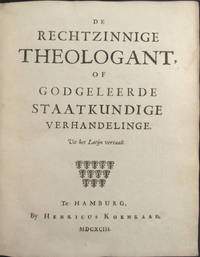
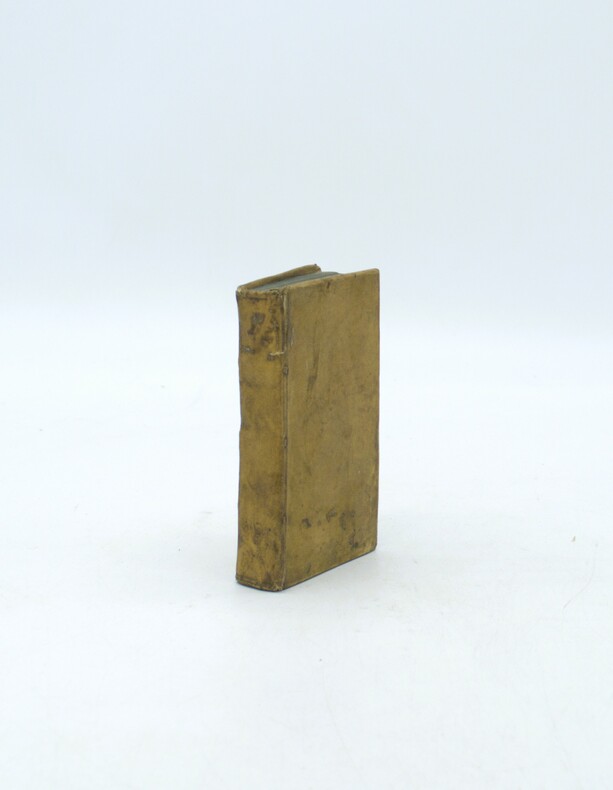
169329710Amsterdam: N.p.: Henricus Koenraad' i.e. Jan Rieuwiertsz jun. 1693. First edition in Dutch of TRACTATUS THEOLOGICO-POLITICUS the THEOLOGICAL-POLITICAL TREATISE. 8vo 16 x 20cm handsomely bound in full vellum with leather bands spine lettered in manuscript. xxviii 360 pp. A very fine and handsome copy of this very scarce first edition printing the text-block very fresh and clean a strong impression of the text the binding as pristine. FIRST ISSUE FIRST PRINTING OF THE VERY RARE DUTCH EDITION WHICH SPINOZA DID NOT WANT PUBLISHED OUT OF FEAR OF RETRIBUTION. QUITE ELUSIVE AND ONE OF THE MOST IMPORTANT PHILOSOPHICAL WORKS OF THE EARLY MODERN PERIOD. Baruch Spinoza is unquestionably one of the most important philosophers of all time -- and certainly perhaps the most radical of the early modern period. His thought combines a commitment to Cartesian metaphysical and epistemological principles with elements from ancient Stoicism and medieval Jewish rationalism into a nonetheless highly original system. His extremely naturalistic views on God the world the human being and knowledge serve to ground a moral philosophy centered on the control of the passions leading to virtue and happiness. They also lay the foundations for a strongly democratic political thought and a deep critique of the pretensions of Scripture and sectarian religion. Of all the philosophers of the seventeenth-century perhaps none have more relevance today than Spinoza.<br> Spinoza's aim in TRACTATUS THEOLOGICO-POLITICUS which he completed and published anonymously in 1670 was to prove that the stability and security of society is not undermined but rather enhanced by freedom of thought meaning primarily the freedom to philosophize. As is clear from the text he concluded that the primary threat to this freedom emanated from the clergy whom he accused of playing upon the fears and superstitions of people in order to maintain power. His solution was to divest the clergy of all political power even to placing authority over the practice of religion into the hands of the sovereign. The sovereign Spinoza argued should extend broad liberties within this domain requiring adherence to no more than a minimal creed that was neutral with respect to competing sects and the meaning of which was open to a variety of interpretations. This he hoped would allow philosophers the freedom to do their work unencumbered by the constraints of sectarianism. <br> As was to be expected the work was met with a firestorm of criticism. It was condemned as a work of evil and its author was accused of having nefarious intentions in writing it. Even some of Spinoza's closest friends were deeply unsettled by it. Though he had assiduously tried to avoid it Spinoza found himself embroiled in heated religious controversy and saddled with a reputation for atheism something he greatly resented. <br> Shortly after the publication Spinoza moved to the Hague where he was to live out his remaining years. Besides having to deal with fallout from this treatise he witnessed a political revolution that culminated in the murder by an angry Orangist-Calvinists mob of the Grand Pensionary of Holland Jan De Witt as well as his brother Cornelius. Spinoza admired De Witt for his liberal policies and was horrified by the murder. With the ascent of the Orangist-Calvinist faction he felt his own situation to be tenuous.<br> In the words of PRINTING AND THE MIND OF MAN ".The TRACTATUS THEOLOGICO-POLITICUS constituted an extension to political thought of his ethical views. Man is moved to the knowledge and love of God; the love of God involves the love of our fellow men. Man in order to obtain security surrenders part of his right of independent action to the State. But the State exists to give liberty not to enslave; justice wisdom and toleration are essential to the sovereign power. <br> Baruch Spinoza 1632-1677 scion of a leading Jewish family in Europe's most cosmopolitan city of the seventeenth century Amsterdam provided the intellectual architecture for a philosophic structure which would level current assumptions and conclusions. For his endeavors Spinoza was excommunicated by his own community and his name Baruch-Benedict which means blessed became anathema both in the community he left and the larger community he never entered. During his lifetime Spinoza's works were published anonymously and even his posthumously published Opera contains neither place nor date of publication. His rise to a central position in the drama of humankind's search for truth came slowly but inexorably as human reason came to be more and more relied upon over the ideas promulgated by an adherence to divine dogma. It is said that Thomas Jefferson would have been one of the first Americans to have accepted Spinoza as his spiritual kin. N.p.: Henricus Koenraad' (i.e. Jan Rieuwiertsz jun.) hardcover
1661PHO-2108S.l., S.e., 1661, in-12 (133x75mm), 1f.-233pp.-4ff-51pp., vélin époque, tranches bleues, début de fentes, rousseurs et brunissures, petits accrocs aux plats.
PENDRAGON 1999 192 PP. FONDO DI MAGAZZINO: PARI AL NUOVO, PERFETTO E INTONSO. Il libro è insieme una introduzione al pensiero di Deleuze - uno dei più importanti filosofi contemporanei - e una ricerca originale sulla concezione di “istituzione” rintracciabile soprattutto nei primi scritti. L’autore raccoglie in questo suo testo, con modifiche e integrazioni rilevanti, alcuni suoi contributi realizzati per diverse sedi: riviste, introduzioni a volumi ecc., per proporre un passo in avanti negli studi deleuziani, un approfondimento dei temi essenziali per la comprensione dell’intera ricerca del pensatore francese. In quest’ottica va appunto collocata la sottolineatura del pensiero di Deleuze su concetti come “istituzione” e “istinto” (un presupposto “forte”, quest’ultimo, per la collaborazione successiva con F. Guattari) e la proposta della centralità filosofica della “coppia” Spinoza-Nietzsche per un pensiero attento alle dimensione del corpo, del desiderio, della potenza di vita. Ubaldo Fadini insegna attualmente alla Facoltà di Scienze della Formazione dell’Università di Firenze. È autore di Il corpo imprevisto. Filosofia, antropologia e tecnica in Arnold Gehlen (Franco Angeli 1988), e Configurazioni antropologiche. Esperienze e metamorfosi della soggettività moderna (Liguori 1991). Ha pubblicato inoltre numerosi saggi sulla filosofia del Novecento (da T. Lessing a G. Deleuze e P. Virilio). Ha curato negli ultimi anni la raccolta di colloqui tra Adorno, Canetti, Gehlen, Desiderio di vita. Conversazioni sulle metamorfosi dell’umano (Mimesis 1996); la raccolta di saggi di G. Deleuze, Divenire molteplice (Ombre corte 1996); l’edizione italiana di P. Virilio, La velocità di liberazione (Strategia della Lumaca 1997).
0365930644.Gpaperback. Good. Access codes and supplements are not guaranteed with used items. May be an ex-library book. paperback
036623661X.Ghardcover. Good. Access codes and supplements are not guaranteed with used items. May be an ex-library book. hardcover
1390307506.Gpaperback. Good. Access codes and supplements are not guaranteed with used items. May be an ex-library book. paperback
1396234667.Ghardcover. Good. Access codes and supplements are not guaranteed with used items. May be an ex-library book. hardcover
3743454408.Gpaperback. Good. Access codes and supplements are not guaranteed with used items. May be an ex-library book. paperback
3743454394.Gpaperback. Good. Access codes and supplements are not guaranteed with used items. May be an ex-library book. paperback
1919JS6971Halle Saale: Weltphilosophischer Verlag 1919-1920. Hardcover. Very Good. Cloth-backed marbled paper over boards handwritten paper spine label; two volumes bound together preserving original printed wraps; 8vo 6.5 x 9.5 inches; 178 233. Boards lightly rubbed; paper spine label lightly chipped. Internally nice and clean. An excellent working copy. <br/><br/> Weltphilosophischer Verlag hardcover books
192091698ABHalle/Saale, Weltphilosophischer Verlag, 1920. 4° (25,5 x 16,5 cm). 233 (3) S. Orangefarbener typographisch gestalteter Original-Pappband. (=Philosophische Weltbibliothek; 4. Band, 2. Teil).
200526735Wiesbaden : Harrassowitz / Herzog August Bibliothek (Wolfenbütteler Forschungen, 108), 2005. 198 S. (25 cm) illustrierter Pappband / gebundene Ausgabe
1892192482Leipzig, 1892. 2 Bl., 44 S., 2 Bl. RBr.
19433084385Bern: Lüthy 1943. 176 Seiten. 8° (17,5-22,5 cm). Orig.-Broschur. [Softcover / Paperback].