"LEIBNIZ (LEIBNITZ), GOTTFRIED WILHELM.Livre Rare Book
1 706 résultats
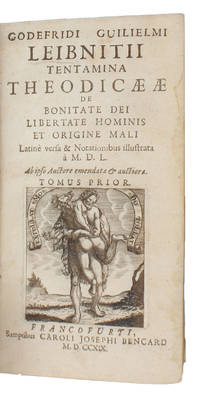
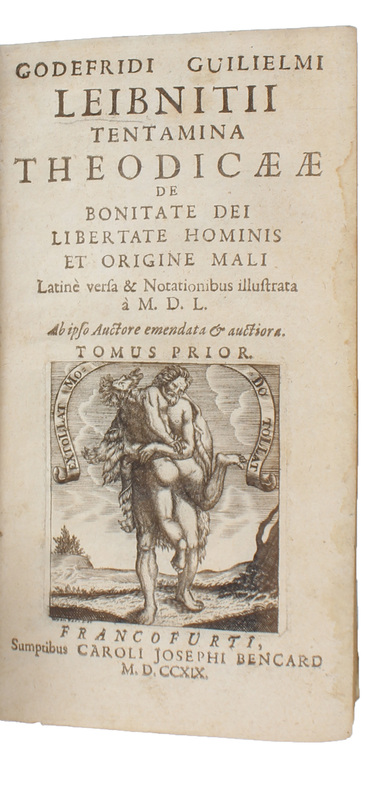
171949802Franckfurt, Bencard, 1719. 8vo. Contemp. full vellum. A few small brownspots to covers. Large engraved titlevignette. (48),(40),408,(12) pp. 1 folded table (between p.48/49). Clean and fine.
171949802Franckfurt Bencard 1719. 8vo. Contemp. full vellum. A few small brownspots to covers. Large engraved titlevignette. 484040812 pp. 1 folded table between p.48/49. Clean and fine. <br/><br/><em>Extremely scarce first Latin edition of Leibniz's hugely influential work "Essais de Theodicée sur la Bonté de Dieu la Liberté de L'Homme et L'Origine du Mal" 1710. It is his importent treatise on the goodnes of God the free will of man and the causes of evil in the world The principal subject of the work being the problem of liberty and free will. It is the only larger philosophical work published by Leibnitz himself.The "Théodicée" was a response to skeptical Pierre Bayle who wrote in his work Dictionnaire Historique et Critique that after rejecting three attempts to solve it he saw no rational solution to the problem of evil.The work was composed at the instigation of Sophia Charlotte with whom Leibniz had conversed concerning the views of Bayle. In response to a request from Prince Eugene for an abstract of the Théodicée Leibniz in 1714 wrote the "Principes de la nature et de la grâce fondées en raison and the Monadologie".It is often the case that this Latin edition is followed by the small work "Causa Dei Asserta per Justitiam Ejus." 32 pp. This work is not withbound here.Ravier "Bibliographie des Oeuvres de Leibniz" No 344. - PMM 1710-edition. </em> hardcover
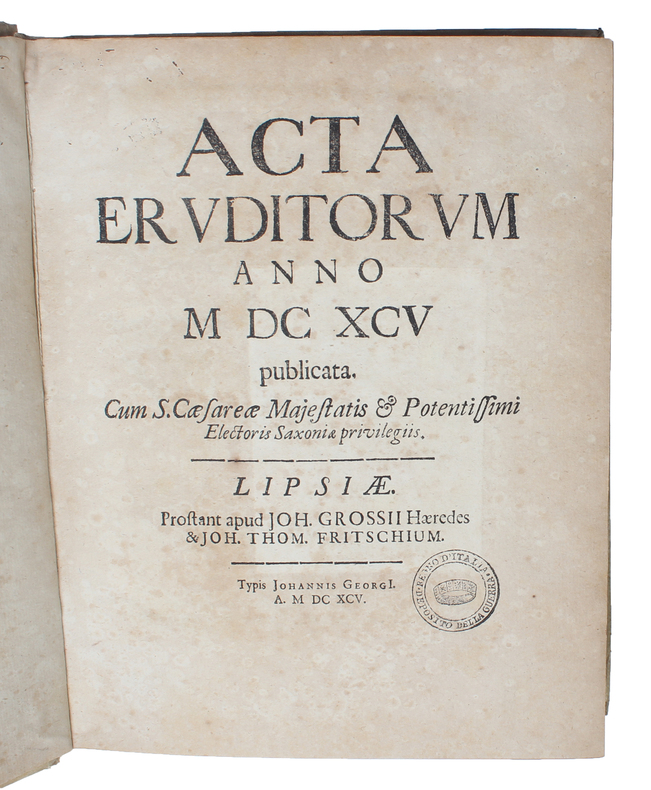
169542860Leipzig, Grosse & Gleditsch, 1695. 4to. Contemp. full vellum. Faint handwritten title on spine. A small stamp on titlepage and pasted library label to pasted down front free end-paper. In: ""Acta Eruditorum Anno MDCXCV"". (2), 560, (52) pp. + 10 plates. As usual with various browning to leaves and plates. The entire volume offered. Leibniz's papers: pp. 145-57" 184-185 310-316 369-372 493-495. Jacob Bernoulli's paper: pp. 537-553 + one folding table 65-66. Johann Bernoulli's: pp. 59-65" 374-376.
169542860Leipzig Grosse & Gleditsch 1695. 4to. Contemp. full vellum. Faint handwritten title on spine. A small stamp on titlepage and pasted library label to pasted down front free end-paper. In: "Acta Eruditorum Anno MDCXCV". 2 560 52 pp. 10 plates. As usual with various browning to leaves and plates. The entire volume offered. Leibniz's papers: pp. 145-57; 184-185; 310-316; 369-372; 493-495. Jacob Bernoulli's paper: pp. 537-553 one folding table; 65-66. Johann Bernoulli's: pp. 59-65; 374-376. <br/><br/><em>First printing of a series of influential papers by Leibniz Jacob Bernoulli and Johann Bernoulli.First publication of Jakob Bernoulli's famous and influential "Bernoulli Equation". In "Notatiuncula Constructiones Lineae" Bernoulli proposed a solution to non linear equations which today is one of the most common used solutions of the general fluid. Bernoulli equations are significant because they are nonlinear differential equations with known exact solutions. In the "Specimen dynamicum" Leibniz presents a conception of body and force which distinct between primitive and derivative forces and between active and passive forces. This article is regarded as being the clearest exposition of Leibniz' dynamics. DSB VII 151b."The first attempt at a detailed account of the dynamics was a long dialogue the "Phoranomus seu de potentia et legibus naturae" written in July 1689 while Leibniz was in Rome. This was quickly followed be the composition of the massive Dynamica de potential et legibus naturae corporeae 1689-90 . Though it was written with the intention of publication and though Leibniz work at publishing it he never considered it entirely finished and it remained unpublished during his lifetime.The later . he finally revealed some of the metaphysical foundations of the project in an essay the present paper." Garber Daniel. Leibniz: body substance monad. 2009. 132 p."Its title suggests a summary of or a selection from the earlier work . However it actually contains something in a way rather more interesting: a careful exposition of the metaphysical foundations of the new science something that is hard to find in the old Dynamica or any of the more Technical pieces." Garber Daniel. Leibniz: Body Substance Monad. 2009. 133 p. </em> hardcover
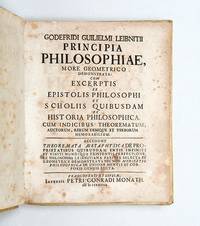
1728149005Frankfurt and Leipzig: Peter Conrad Monath 1728. Leibnizianism outlined by a contemporary First edition of this exposition on Leibniz's philosophy by a contemporary of the philosopher; including a Latin translation of Leibniz's Monadology. "Little is known of Michael Gottlieb Hansch. A theologian from Leipzig and adviser to the Emperor Charles VI he knew Leibniz personally from 1707 onwards. He was thus in an excellent position to acquaint himself with Leibnizian thought having been in correspondence with Leibiniz for five years prior to the writing of the Monadology 1707-13. The first 19 pages of the present work consisted of Hansch's Latin translation of Monadology. Then followed the geometrical demonstration of Leibniz's definitions 2 axioms and 114 theorems. Hansch's erudite commentary on the Monadology contains excerpts from Leibniz's letters and teems with references to the Leibniz-Clarke correspondence the Theodicy the Système nouveau Leibniz's reply to difficulties expressed by Bayle in his article Rosarius in tome II of the Receuil to the Oratio de Sinarum philosophica practica of Wolff. The book contributed to Condillac's understanding of Leibnizian thought" Hine pp. 94-95. Hansch is perhaps best known as the purchaser of and publisher of Kepler's letters a project in which Leibniz took great interest. Quarto 199 x 153 mm. Contemporary calf tooled in compartments blind borders to covers marbled edges. Front endpapers with various ownership inscriptions and notes from 1759 to 1800 in Latin; twentieth-century ink stamp on title page of Samuel Zocha of Modra Slovakia. Extremities worn spine dulled light ring mark to front cover binding firm contents crisp and clean; a very good copy. Ravier 381. Ellen McNiven Hine A Critical Study of Condillac's "Traite des Systemes" 1979. unknown
52885Lipsiae J. Grossius 1700. Small 4to 19.6 x 15.8 cm. pp. 198-208 in the complete volume for the year 1700 containing a total of 586 pp. and ten plates. Contemporary vellum binding with leather title label and gilt lettering. = Leibniz' reaction to Nicolas Fatio de Duillier at the height of the controversy between Leibniz and Newton over the invention of calculus. Up until 1693 the method of fluxions which had been invented by Newton and had been of great assistance to him in his mathematical investigations was still except to Newton and his friends a secret. Newton admirers in the Netherlands informed him that the method of fluxions had been introduced there under the name of Gottfried Leibniz's Calculus Differentialis. In 1699 Nicolas Fatio de Duillier published a tract in which he stated that Newton was by several years the first inventor of the calculus and insinuated that Leibniz had stolen the idea. It was the start of a serious controversy between Leibniz and Newton carried on by their followers for years after both famous mathematicians had died. In this article in the Acta Eruditorum Leibniz replied to Fatio de Duilleir by citing Newton's letters and the testimony that Newton had rendered to him in the Principia as proofs of his independent authorship of the method. A very good copy in contemporary vellum; ancient library stamp and superimposed cancellation stamp on verso of title small paper label with call number on bottom of spine and removed paste on inside cover. Vellum on covers discoloured first few pages age-toned but in general a nice clean copy. hardcover
17141396A AMSTERDAM. CHEZ ISAAC TROYEL, LIBRAIRE. 1714. 2 VOLUMES IN-12 (10 X 16,5 X 5,5 CENTIMETRES ENVIRON) DE (36) + 386 PAGES ET (2) + 216 + 132 PAGES, RELIURE D'EPOQUE PLEIN VEAU BRUN, DOS A 5 NERFS ORNE DE CAISSONS A FLEURONS DORES, TITRE DORE SUR ETIQUETTE MAROQUIN HAVANE, TRANCHES MOUCHETEES ROUGES. RARE SECONDE EDITION DONT ON CONNAIT PEU D’EXEMPLAIRES. PETIT MANQUE DE PAPIER SANS MANQUE DE TEXTE EN MARGE INFERIEURE BASSE DU PREMIER FEUILLET DE PREFACE DU TOME I, PETITE ROUSSEUR AYANT CAUSE UN PETIT TROU SANS GRAVITE PAGES 11/12 ET 161/162 DU TOME I, QUELQUES PETITS DEFAUTS EXTERIEURS, SINON BON EXEMPLAIRE.
1690NF2365REFLEXIONS SUR LES DIFFERENTS DE LA RELIGION troisiESme VOLUME. Ou Les chimEres de M. Jurieu RESPONSE GENERAL A SES LETTRES PASTORALES DE LA SECONDE ANNEE CONTRE LE LIVRE DES REFLEXIONS ET EXAMEN ABREGE DE SES PROPHETIES A Paris Chez Gabriel Martin 1690 first and only edition 12 mo 18 pp. 260 pp. 4pp. bound with DE LA TOLERANCE DES RELIGIONS. LETTRES DE M. DE LEIBNIZ ET RESPONSES DE M. PELLISON: OU QUARTRIEME PARITE DE REFLEXIONS SUR LES DIFFERENDS DE LA RELIGION A Cologne de l'Imprimerie d'Andre Pierrot 1692 206 pp. 2 pp. a tight vg copy bound in the publishers original vellum with the bookplate of Giorgio Di Veroli. Gabriel Martin & Andre Pierrot hardcover
2083002115601918Kosaku-sha N.A. Soft Cover. Fine. Size: 22cm Kosaku-sha paperback
1728149331Frankfurt and Leipzig: Peter Conrad Monath 1728. An exposition of Leibnizianism First edition of this exposition on Leibniz's philosophy by a contemporary of the philosopher; including a Latin translation of Leibniz's Monadology. "Little is known of Michael Gottlieb Hansch. A theologian from Leipzig and adviser to the Emperor Charles VI he knew Leibniz personally from 1707 onwards. He was thus in an excellent position to acquaint himself with Leibnizian thought having been in correspondence with Leibiniz for five years prior to the writing of the Monadology 1707-13. The first 19 pages of the present work consisted of Hansch's Latin translation of Monadology. Then followed the geometrical demonstration of Leibniz's definitions 2 axioms and 114 theorems. Hansch's erudite commentary on the Monadology contains excerpts from Leibniz's letters and teems with references to the Leibniz-Clarke correspondence the Theodicy the Système nouveau Leibniz's reply to difficulties expressed by Bayle in his article Rosarius in tome II of the Receuil to the Oratio de Sinarum philosophica practica of Wolff. The book contributed to Condillac's understanding of Leibnizian thought" Hine pp. 94-95. Hansch is perhaps best known as the purchaser of and publisher of Kepler's letters a project in which Leibniz took great interest. Quarto 207 x 169 mm. Contemporary vellum manuscript title to spine orange speckled edges. Light discolouration to vellum else binding in nice shape contents browned; a very good wide-margined copy. Ravier 381. Ellen McNiven Hine A Critical Study of Condillac's "Traite des Systemes" 1979. hardcover
169642863Leipzig, Grosse & Gleditsch, 1696. 4to. Entire volume present. Nice contemporary full vellum. Small yellow paper label pasted to top of spine and library-label to front free end-papers. Internally some browning and brownspotting. Overall a nice and tight copy. [Bernoulli paper:] pp. 264-69. [Leibniz-paper:] pp. 45-47. [Entire volume: (2), 603, (1) pp. + plates].
169642863Leipzig Grosse & Gleditsch 1696. 4to. Entire volume present. Nice contemporary full vellum. Small yellow paper label pasted to top of spine and library-label to front free end-papers. Internally some browning and brownspotting. Overall a nice and tight copy. Bernoulli paper: pp. 264-69. Leibniz-paper: pp. 45-47. Entire volume: 2 603 1 pp. plates. <br/><br/><em>First printing of the famous 1696-edition of Acta Eruditorum in which Johann Bernoulli published a challenge to the best mathematicians:"Let two points A and B be given in a vertical plane. To find the curve that a point M moving on a path AMB must follow such that starting from A it reaches B in the shortest time under its own gravity."Johann adds that this curve is not a straight line but a curve well known to geometers and that he will indicate that curve if nobody would do so that year. Later that year Johann corresponded directly with Leibniz regarding his challenge. Leibniz solved the problem the same day he received notice of it and almost correctly predicted a total of only five solutions: from the two Bernoullis himself L'Hospital and Newton. Leibniz was convinced that the problem could only be solved by a mathematician who mastered the new field of calculus. Galileo had formulated and given an incorrect solution to the problem in his Dialogo. But by the end of the year Johann had still not received any other solutions. However Leibniz convinced Johann that he should extend the deadline to Easter and that he should republish the problem. Johann now had copies of the problem sent to Journal des sçavans the Philosophical Transactions and directly to Newton. Earlier that year Johann had accused Newton for having filched from Leibniz' papers. Manifestly both Johann and Leibniz interpreted the silence from June to December as a demonstration that the problem had baffled Newton. They intended now to demonstrate their superiority publicly. But Newton sent a letter dated Jan. 30 1697 to Charles Montague then president of the Royal Society in which he gave his solution and mentioned that he had solved it the same day that he received it. Montague had Newton's solution published anonymously in the Philosophical Transactions. However when Bernoulli saw this solution he realized from the authority which it displayed that it could only have come from Newton Bernoulli later remarked that he 'recognized the lion by its claw'. The present volume contains the following articles of interest:Jakob Bernoulli: 1 Observatiuncula ad ea quaenupero mense novembri de Dimensionibus Curvarum leguntur.2 Constructio Generalis omnium Curvarum transcendentium ope simplicioris Tractoriae et Logarithmicae.3 Problema Beaunianum universalius conceptum.4 Complanatio Superficierum Conoidicarum et Sphaeroidicarum.Johann Bernoulli5 Demonstratio Analyticea et Syntetica fuae Constructionis Curvae Beaunianae.6 Tetragonismus universalis Figurarum Curvilinearum per Construitionem Geometricam continuo appropinquantem.Tschirnhaus7 Intimatio singularis novaeque emendationis Artis Vitriariae.8 Responsio ad Observationes Dnn. Bernoulliorum quae in Act. Erud. Mense Junio continentur.9 Additio ad Intimationem de emendatione artis vitriariae. </em> hardcover
200535388Cumberland Rhode Island U.S.A.: Yale Univ Pr. New. 2005. Hardcover. 0300089589 . FREE UPGRADE to Courier/Priority Shipping Upon Request IN STOCK AND IMMEDIATELY AVAILABLE FOR SHIPMENT - BRAND NEW FLAWLESS COPY NEVER OPENED - - pages -- DESCRIPTION: This volume contains papers that represent Leibnizs early thoughts on the problem of evil centering on a dialogue the Confessio philosophi in which he formulates a general account of Gods relation to sin and evil that becomes a fixture in his thinking. How can God be understood to be the ultimate cause asks Leibniz without God being considered as the author of sin a conclusion incompatible with Gods holiness Leibnizs attempts to justify the way of God to humans lead him to deep discussion of related topics: the nature of free choice the problems of necessitarianism and fatalism the nature of divine justice and holiness. All but one of the writings presented here are available in English for the first time. -- with a bonus offer-- . Yale Univ Pr hardcover
199352464Lasalle Illinois: Open Court Pub Co. New. 1993. Paperback. 0875480306 . FREE UPGRADE to Courier/Priority Shipping Upon Request IN STOCK AND IMMEDIATELY AVAILABLE FOR SHIPMENT - FLAWLESS COPY BRAND NEW PRISTINE NEVER OPENED - 296 pages -- with a bonus offer-- . Open Court Pub Co paperback
196891318Manchester University Press. New. 1968. Hardcover. 0719002184 . FREE UPGRADE to Courier/Priority Shipping Upon Request - IN STOCK AND IMMEDIATELY AVAILABLE FOR SHIPMENT - FLAWLESS COPY BRAND NEW PRISTINE NEVER OPENED -- - Corresponds to ISBN: 0719002184. -- with a bonus offer-- . Manchester University Press hardcover
200351979Cambridge University Press. New. 2003. Paperback. 0521576601 . FREE UPGRADE to Courier/Priority Shipping Upon Request IN STOCK AND IMMEDIATELY AVAILABLE FOR SHIPMENT - TEXT PRISTINE CLEAN & UNMARKED TIGHT TO SPINE - 648 pages. Book description: "Challenging Locke's views in `Essays on Human Understanding' chapter by chapter Leibniz's references to his contemporaries and his discussion of the ideas and institutions of the age make this work a fascinating and valuable document in the history of ideas. " -- with a bonus offer-- . Cambridge University Press paperback
198952462Indianapolis IN: Hackett Publishing Company. New. 1989. Paperback. 0872200620 . FREE UPGRADE to Courier/Priority Shipping Upon Request IN STOCK AND IMMEDIATELY AVAILABLE FOR SHIPMENT - Flawless copy brand new pristine never opened - 366 pages. -- with a bonus offer-- . Hackett Publishing Company paperback
200235391Cumberland Rhode Island U.S.A.: Yale Univ Pr. New. 2002. Hardcover. 0300079117 . FREE UPGRADE to Courier/Priority Shipping Upon Request IN STOCK AND IMMEDIATELY AVAILABLE FOR SHIPMENT - BRAND NEW FLAWLESS COPY NEVER OPENED - 576 pp. 35 black and white illus. -- DESCRIPTION: This book gathers together for the first time an important body of texts written between 1672 and 1686 by the great German philosopher and polymath Gottfried Leibniz. These writings most of them previously untranslated represent Leibniz's sustained attempt on a problem whose solution was crucial to the development of his thought that of the composition of the continuum. The volume begins with excerpts from Leibniz's Paris writings in which he tackles such problems as whether the infinite division of matter entails "perfect points " whether matter and space can be regarded as true wholes whether motion is truly continuous and the nature of body and substance. Comprising the second section is Pacidius Philalethi Leibniz's brilliant dialogue of late 1676 on the problem of the continuity of motion. In the selections of the final section from his Hanover writings of 16771686 Leibniz abandons his earlier transcreationism and atomism in favor of the theory of corporeal substance where the reality of body and motion is founded in substantial form or force. Leibniz's texts one in French the rest in Latin are presented with facing-page English translations together with an introduction notes appendixes containing related excerpts from earlier works by Leibniz and his predecessors and a valuable glossary detailing important terms and their translations. -- with a bonus offer-- . Yale Univ Pr hardcover
198551742Garland Publishing. As New. 1985. Hardcover. 0824065352 . FREE UPGRADE to Courier/Priority Shipping Upon Request IN STOCK AND IMMEDIATELY AVAILABLE FOR SHIPMENT - Tight to spine - 180 pages. -- with a bonus offer-- . Garland Publishing hardcover
199830993New York New York U.S.A.: Manchester Univ Pr. New. 1998. Paperback. 0719006694 . FREE UPGRADE to Courier/Priority Shipping Upon Request - IN STOCK AND IMMEDIATELY AVAILABLE FOR SHIPMENT - BRAND NEW FLAWLESS COPY NEVER OPENED - 200 pages. -- with a bonus offer-- . Manchester Univ Pr paperback
197014546Manchester University Press. As New in As New dust jacket. 1970. Hardcover. FREE UPGRADE to Courier/Priority Shipping Upon Request - IN STOCK AND IMMEDIATELY AVAILABLE FOR SHIPMENT - Book In fine Condition. -- with a bonus offer-- . Manchester University Press hardcover
1689614461689. Acta Eruditorum 1689. - Leipzig Grossium & Gleditsch 1689 4° 8 653 7 pp. mit 15 z.T. gefalt. Kupfertafeln feiner Pappand im Stil d.Zt.: frisches Expl. First printing of these extremely important papers in which Gottfried Wilhelm Leibniz 1646-1716 claimed that he independently of Newton had discovered the principal propositions of his "Principia" and which present us with Leibniz's fundamental physico-mathematical theory his dynamics his concepts of force space and time. 1. : De Lineis Opticis et alia; Excerpta ex literis ad pp.36-38 Tab. I Fig. 1 2. : Schediasma de Resistentia Medii Motu projectorum gravium in medio resistente pp.38-46 Tab. I Fig. 2-4. 3. : Tentamen de Motuum Coelestium causis pp.82-96 Tab.II Fig. 1. 4. : De Linea Isochrona in qua grave sine acceleratione descendit & de controversia cum Dn. Abbate D.C. pp.195-198 Tab. IV Fig. 3. The "Tentamen." constitutes Leibniz's response to Newton's theories about the motion of the celestial bodies. Leibniz can be said to have anticipated the modern mathematical principle of relativity as it is his idea of individual co-ordinate systems and his practical rejection of the Galilean co-ordinate system that Newton adopted. Leibniz opposes Newton's ideas of attractions gravitational forces and calls them "occult qualities". The task of the "Tentamen." was to attain a theory mathematically equivalent to Newton's in accounting for planetary motion and especially for the inverse-square law of Kepler's laws but physically sound and capable of explaining the causes of phenomena. Newton attacked Leibniz's claim of priority in his anonymously published paper "Commercium epistolicum" Phil. Transactions 1714 and states that "in those tracts the principal propositions of that book are composed in a new manner and claimed by Mr. Leibniz as if he had found them himself before the publishing of the said book. But Mr. Leibniz cannot be a witness in his own cause. It lies upon him either to prove that he had found them before Mr. Newton or to quit his claim." The features of Leibniz's mathematical representation of motion as put forward in "Tentamen." are -Empty space does not exist. The world is filled with a variety of fluids which are responsible for physical actions including gravity. - Living force and its conservation are the fundamental notion and principle respectively in the investigation of nature however they do not figure prominently in the study of planetary motion. - Finite and infinitesimal variables are regularly employed in the study of motion and of other physical phenomena. Living force and velocity are finite; solicitation and conatus are infinitesimal. - Accelerated motion whether rectilinear or curvilinear is represented as a series of infinitesimal uniform rectilinear motions interrupted by impulses. I call this 'polygonal representation'. Usually the polygon is chosen in such a way that each side is traversed in an equal element of time dt. In polygonal representations accelerations are reduced to a macroscopic phenomenon. - Propositions are often used to safeguard dimensional homogeneity. Constant factors - such as numerical factors mass and the element of time - are usually ignored in the calculations. -cf. D.B. Meli: Equivalence and Priority. Newton versus Leibniz. pp. 90-91. Further we find in this important volume following Papers by Denis Papin - 1. : Descriptio Torcularis cujus in Actis Anni 1688 pag. 646 mentio facta a suit. pp. 96-101 Tab. II Fig. 2 2. : De Gravitatis Causa et proprietatibus Observationes pp.183-188. 3. : Examen Machinæ Dn. Perrault pp.189-195 Tab. IV Fig. 1-3. 4. : Rotatilis Suctor et Pressor Hasciacus in Serenissima Aula Cassellana demonstratus & detectus pp.317-322 Tab. VII Fig. 3-6. This paper describes and depicting Papin's famous invention of the CENTRIFUGAL PUMP 5.: In J.B. Appendicem Illam Ad Perpetuum Mobile Actis Novemb.A. 1688 p. 592. pp.322-324. 6. : Excerpta et Litteris Dn. Dion Papini ad --- de Instrumentis ad flammam sub aqua conservandam pp.485-489 Tab. XI Fig. 2-3. - and 3 papers by Jakob Bernoulli: 1. : De Invenienda Cujusque Plani Declinatione ex unica observatione projectæ a flylo umbræ pp.311-316 Tab. VII Fig. 1-2. 2. : Bernoulli Jakob : Vera Constructio geometrica Problematum Solidorum & Hypersolidorum per rectas lineas & circulos pp.454-459 Tab. X. 3.: Bernoulli Jakob : Novum Theorema Pro Doctrina Sectionum Conicarum. pp.586-588 Tab. XIV. See - Thomas Sonar : The History of the Priority Dispute between Newton and Leibniz: Mathematics . 2018 Ravier 101102103104 unknown
H871Leipzig apud J. Grossii Haeredes. Typis Johannis Georgi 1692. 4to; 570 28 S. mit 8 von 13 teils gefalt. Taflen es fehlen die Tafeln 247810. Pergamentband der Zeit ein schˆnes Exemplar. Die Acta Erudorum war die wahrscheinlich wichtigste wissenschaftliche Zeitschrift ihrer Zeit mit all den groflen Entdeckungen in Physik Chemie Mathematik Astronomie Medizin Biologie und Geschichte. Die Zeitschrift wurde in der gesamten wissenschaftlichen Welt weithin gelesen da sie in lateinischer Sprache verfasst war. Gr¸nder und erste Herausgeber waren Otto Mencke und Gottfried Leibniz. Die Acta Erudorum enthielt Ausz¸ge neuer Schriften Rezensionen und Originalbeitr‰ge. Beitr‰ge von Leibniz Jakob und Johann Bernoulli etc. 1692: J. Bernoulli Solutio Curvae Causticae. J. D. Cassini Diversae Motus-Perioden in Jupiter. E. Halley Emendationes in tria loca Naturalis Historiae C. Plinii. B. Ramazzini De Fontium Mutinensium; Dissertatio de Constitutione. E. Halley Reputatio Circulationis aqueorum maris vaporum. R. Boyle Experimenta medica. unknown
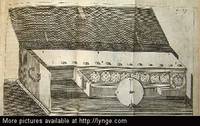
173528333Hannover Zu finden bey Nicolai Försters und Sohns sel. Erben 1735. 8vo. Contemporary full vellum w. author and title in old hand on back. Bdg. a bit soiled. Internally a bit of brownspotting. title-page w. professionally repaired tear. Inner front-hinge starting to crack but bdg. and bookblock tight. Overall a good and fairly well preserved copy. With engr. portrait woodcut vignettes and one folded engr. plate depicting an early calculating machine. 28 64 1030 pp. <br/><br/><em>Rare third German edition. Last Richter-edition. First published in French in 1710. It is the only larger philosophical work Leibnitz himself published and it is a work of immense importance to philosophy theology and mathematics. In this work Leibniz represents his excellent calculating machine which has served as the basis for what we now call a computer as he presents the binary arithmetic "Rechnen mit Null und Eins" "calculating with zero and one" in the Beylage p. 926 which forms the basis for the much later developed computer science see PMM 177. This work contains "Anmerkungen" by Richter and "Lebens=Beschreibung" by Fontenelle followed by "Beylage". In these "Beylage" we find the method of converting numbers into the binary system which here is said to be "etwas recht neues welches der Herr Leibnitz zu Hanover erfunden" "something brand new which Mr. Leibnitz von Hanover has discovered" as well as "Eine Schrift. In welcher klar gezeiget wird/ dass nicht Herr Neutonsondern der Herr von Leibnitz Erfinder des CALCULI DIFFERENTIALIS sey." A Treatise. In which it is clearly shown/ that Mr. Leibniz and not Mr. Newton is the inventor of the CALCULI DIFFERENTIALIS".All early editions of the Theodicee are rare. See D.S.B.: VIII pp. 161-166. </em> hardcover
173528333Hannover, Zu finden bey Nicolai Försters und Sohns sel. Erben, 1735. 8vo. Contemporary full vellum w. author and title in old hand on back. Bdg. a bit soiled. Internally a bit of brownspotting., title-page w. professionally repaired tear. Inner front-hinge starting to crack, but bdg. and bookblock tight. Overall a good and fairly well preserved copy. With engr. portrait, woodcut vignettes and one folded engr. plate depicting an early calculating machine. (28), 64, 1030 pp.