1 705 résultats
169441704Leipzig, Grosse & Gleditsch, 1694. 4to. Contemp. full vellum. Faint handwritten title on spine. a small stamp on titlepage. In: ""Acta Eruditorum Anno MDCXCIV"". (2),518 pp.. and 11 folded engraved plates. As usual with various browning to leaves and plates. The entire volume offered. Leibniz's papers: pp. 311-316, pp. 364-375. - Johann Bernoulli's papers: pp. 200-206, pp. 394-99, pp. 435-437, pp. 437-441. - Huygen's papers: pp. 338, pp. 339-41. - Jakob Bernoulli's papers: pp. 262-276, pp. 276-280, pp. 336-338, pp. 391-400. Some mispaginations.
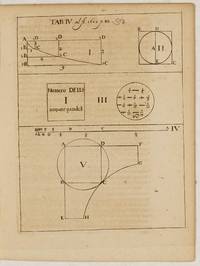
169441704Leipzig Grosse & Gleditsch 1694. 4to. Contemp. full vellum. Faint handwritten title on spine. a small stamp on titlepage. In: "Acta Eruditorum Anno MDCXCIV". 2518 pp. and 11 folded engraved plates. As usual with various browning to leaves and plates. The entire volume offered. Leibniz's papers: pp. 311-316 pp. 364-375. - Johann Bernoulli's papers: pp. 200-206 pp. 394-99 pp. 435-437 pp. 437-441. - Huygen's papers: pp. 338 pp. 339-41. - Jakob Bernoulli's papers: pp. 262-276 pp. 276-280 pp. 336-338 pp. 391-400. Some mispaginations. <br/><br/><em>All papers first appearance dealing with and clarifying the problems and the new applications of Leibniz' inventions of the differential- and integral calculus.In the papers Leibniz shows how to reduce linear first order ordinary differential equations to quadratures. I the other paper he gives a general method of finding the envelope of a family of curves which helped to spread the theory of plane curves.In the groundbreaking paper offered here Jakob Bernoulli introduces THE LEMNISCATE a symmetric self-intersecting curve resembling a figure eight and defined by the condition that the product of the distance of anay point on the curve from two fixed points is d/22 where d is the distance between the fixed points."Jacob Bernoulli was fascinated by curves and the calculus and one curve bears his name - the "lemniscate of Bernoulli" given by the polar equation r2=a cos 2"0". The curve was described in the Acta Eruditorum of 1694 as resembling a figure eight or a knotted ribbon lemniscus. However the curve that most caught his fancy was the logarithmic spiral.he swowed that it had several strioking properties not noted before.it is easy to appreciate the feeling that led Bernoulli to request that the "spira mirabils" be engraved on his tombstone together with the inscription "Eadem mutata resurgo" Though changed I arise again the same." Boyer in his History of Mathematics. </em> hardcover
0300206534New. Brand new and still unused unknown
169230269Paris Jean Anisson 1692. Small8vo. Cont. full mottled calf. Very skillfull rebacked in old style. Gilt titlelabel in leather on back. All edges gilt. 81472185 pp. First and last leaves slightly browned in margins otherwise fine printed on good paper. <br/><br/><em>The scarce first edition of Leibnitz' important work on the tolerance of religions. Leibnitz was interested in the question of religious controversy all of his life and already at a young age he studied Laurentius Valla and Luther. According to Leibnitz one of the resons for religious controversy and dispute lies in the lack of adequate method for discussing and debating such questions. He reflexts thoroughly on the nature of religious controversy. What he means with tolerance of relions is precicely the possibily of discussing religious matters freely on the basis of normative rules that tells us how to conduct the debate. </em> hardcover
169230269Paris, Jean Anisson, 1692. Small8vo. Cont. full mottled calf. Very skillfull rebacked in old style. Gilt titlelabel in leather on back. All edges gilt. (8),147,(2),185 pp. First and last leaves slightly browned in margins, otherwise fine, printed on good paper.
1770PHO-1193Paris: Chez N.M. Tilliard, 1770. in-4 , (24x20) , cxliv-474pp-1ff , illustré de 4 planches , relié demi cuir époque , pièce de titre (petit manque) , papier des plats refait , tranches rouges , vieille mouillure ,début de fente, coiffe de pied courte , 2 planches détachées.
3239Lyon, Périsse, 1767, un volume grand in 4 relié en plein veau, dos orné de fers dorés, filets dorés sur les plats, toutes tranches dorées (reliure de l'époque), 1 portrait, 8pp., 135pp., (1pp.)
170046424Hannover, Nicolai Förster, 1700 - Leipzig, Nicolai Förster, 1698. 4to. Contemp. full calf. Raised bands, richly gilt spine. (16),315,40,124,119 pp. Tome 2: (12),292,592 pp. First titlepage and Praefatio (16) leaves a bit browned, otherwise clean with only a few scattered brownspots. Some neath marginal notes in 2 contemporary hands.
46424Hannover Nicolai Förster 1700 - Leipzig Nicolai Förster 1698. 4to. Contemp. full calf. Raised bands richly gilt spine. 1631540124119 pp. Tome 2: 12292592 pp. First titlepage and Praefatio 16 leaves a bit browned otherwise clean with only a few scattered brownspots. Some neath marginal notes in 2 contemporary hands. <br/><br/><em>Second edition of volume one and first edition of volume two. In the 15 century chronicle "Vetus Chronicon Holsatiae" first printed here by Leibnitz states that the Danes were of the Tribe of Dan while the Jutes the Jews. This is the first announcement of the theory later called Nordic Israelism or Norse Israelism. "It is the belief that Scandinavian peoples or the Nordic countries Denmark Faroe Islands Finland Iceland Norway Sweden descend from the Ten Lost Tribes of Israel. Although there is evidence of such a belief from literature during the Early Modern Period Nordic Israelism as a movement and ideology only emerged in the latter half of the 19th century among several early proponents of British Israelism."Wikipedia.Ravier: 49 tome I 44 Tome II but Ravier is not clear on this point </em> hardcover
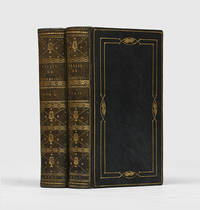
1747170287Amsterdam: Chez François Changuion 1747. The foundation text of theodicy Second edition of Jaucourt's critical edition the first to credit him as the author in a handsome 19th-century binding. Jaucourt's edition includes the Theodicy's four appendices his biography of Leibniz and a chronological catalogue of his works. The Theodicy was originally published in 1710. Jaucourt's edition first appeared in 1734. The Theodicy the only major philosophical treatise that Leibniz published during his lifetime vindicates the justice and goodness of God despite the existence of evil. Notably it includes the first statement of his famed argument that this world despite its manifest problems is nonetheless the best of all possible worlds. "Although the immediate reaction to the book was somewhat muted the Theodicy soon became commonly associated with Leibniz's name in European culture. Today Leibniz's name remains closely associated with the project that he developed most fully in the Theodicy. The neologism that Leibniz coined in the title from the Greek theos dike literally: "the justice of God" has entered the lexicon as a term describing any attempt to reconcile the goodness of God with the presence of evil in the world a project to which Leibniz had devoted a good portion of his life" Jorgensen & Newlands pp. 1-2. Louis de Jaucourt 1704-1779 a prolific Enlightenment scholar contributed over 25 per cent of the total articles for Diderot's Encyclopédie. 2 vols duodecimo 164 x 98 mm. Folding letterpress table Discours sur la conformité with divisional title and renewed collation. Title pages in red and black. Nineteenth-century green levant spines ruled lettered and with tooled fountain decoration in gilt covers with concentric borders and turn-ins in gilt pink watered silk doublures edges gilt pink silk bookmarkers. With 19th-century French ownership inscription to front free endpaper. Light bumping and rubbing faint sunning to spines and covers minor browning and foxing to endpapers slight damp staining and cockling to front doublure of vol. I: a very good copy. Ravier 431. Larry M. Jorgensen & Samuel Newlands eds New Essays on Leibniz's Theodicy 2014. unknown
53639aafHagae Comitum (The Hague, 's Gravenhage), ex typographia Regia, 1833, in-4to, 1 leaf + IV + 324 p. + 1 leaf (errata) + 2 folding plates, heavy foxing in places, light waterstaining to a few leaves and to bottom of both plates, upper corner of front endpaper cut off and repaired, half calf binding, marbled paper on covers, red title label on gold tooled spine, hinge of frontcover loose, slight rubbing.
174753024Wolfenbüttel, Joh. Christoph Meisner, 1747. Fol. Mit zahlr. Holzschn.-Vignetten. 15 Bll., 24, 479 (recte 471) S.; 10 Bll., 180 S.; 6 Bll., 380 S., Blindgepr. Schweinsldr.-Bd. d. Zt. über Holzdeckeln a. 5 Bünden.
171744194Leipzig, Grosse & Gleditsch, 1717. 4to. In: ""Acta Eruditorum Anno MDCCXVII"". The entire volume offered in contemporary full vellum. Hand written title on spine. A yellow label pasted on to top of spine. A small stamp to title-page and free front end-paper. Library label to pasted down front free end-paper. As usual with various browning to leaves and plates. Pp. 317-322" Pp. 322-336 Pp. 353-360 Pp. 360-362. [Entire volume: (4), 553, (39) pp. + seven engraved plates.].
171744194Leipzig Grosse & Gleditsch 1717. 4to. In: "Acta Eruditorum Anno MDCCXVII". The entire volume offered in contemporary full vellum. Hand written title on spine. A yellow label pasted on to top of spine. A small stamp to title-page and free front end-paper. Library label to pasted down front free end-paper. As usual with various browning to leaves and plates. Pp. 317-322; Pp. 322-336; Pp. 353-360; Pp. 360-362. Entire volume: 4 553 39 pp. seven engraved plates. <br/><br/><em>First printing of the famous Libnitz-issue of Acta Eruditorum published a year after the death of Leibnitz including the renowned obituary by the German philosopher Christian Wolff. In 1706 Leibniz recommended Wolff for the Professorship at Halle the post Wolff held for seventeen years until his dismissal and in 1711 Leibniz sponsored Wolff's membership to the Berlin Academy. It is also mentioned that during the year of Leibniz's death in 1716 Leibniz visited Wolff in Halle when returning to Hanover from Vienna. To honor Leibnitz memory Wolff undertook the project of writing ELOGIUM GODOFREDI GUILIEMI LEIBNITII a treatise of the life of Leibnitz. As early as 1679 George I acting as Leibnitz patron directed him to write the history of the house of Brunswick. Immediately after he began arranging material he had collected. The work was however only the preparatory steps when Leibnitz died in 1716 and the work was never published. The present paper NOTITIA DE HISTORIA BRUNSUICENSI is the only part of the work which could have become a opus magnum with historiography that has ever been published. The volume also contains:Goldbach Christian. Temperamentum Musicum Universale. Pp. 114-15.And many other papers by influential contemporary mathematicians philosophers and historians. </em> hardcover
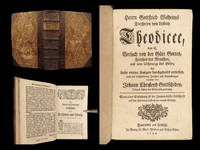
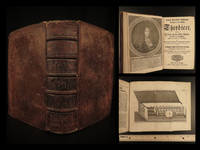
174422865<p><strong>1744 Leibniz THEODICY Essays Philosophy Humanism Free Will Good v Evil RARE</strong></p><p><em>"This is the best of all possible worlds." </em></p><p>― Gottfried Wilhelm Leibniz </p><p>Gottfried Wilhelm Leibniz was a 17th-century German philosopher whose ideas of 'best of all possible worlds' was a landmark attempt to solve all of the world's evils.</p><p>Originally published in 1710 '<em>Essays on Theodicy'</em> was one of Leibniz most well-known works and was the only book by Leibniz to be published during his lifetime. It was the first work to introduce the term 'theodicy.' Leibniz sought to provide a new optimistic approach to curing all of the world's evils. He claimed that human free will against God's true goodness was the root cause of the world's evil.</p><p>Item number: #22865</p><p>Price: $995</p><p>LEIBNIZ Gottfried Wilhelm von</p><p><strong><em>Herrn Gottfried Wilhelms Freyherrn von Leibnitz Theodicee das ist Versuch von der Güte Gottes Freyheit des Menschen und vom Ursprunge des Bösen bey dieser vierten Ausgabe durchgehends verbessert auch mit verschiedenen Zusätzen und Anmerkungen vermehrt von Johann Christoph Gottscheden</em></strong></p><p>Hannover ; Leipzig : In Verlag sel. Nicol. Försters und Sohns Erben 1744. </p><p><u>Details</u>: </p><p><!-- if !supportLists-->· <!--endif-->Collation: Complete with all pages</p><p><!-- if !supportLists-->o <!--endif-->24 64 843 53</p><p><!-- if !supportLists-->· <!--endif-->References: Ziegenfuss II 32</p><p><!-- if !supportLists-->· <!--endif-->Language: German</p><p><!-- if !supportLists-->· <!--endif-->Binding: Leather; tight and secure</p><p><!-- if !supportLists-->· <!--endif-->Size: ~7.25in X 4.75in 18.5cm x 12cm</p><p><!-- if !supportLists-->· <!--endif-->always rare and desirable </p><p>Our Guarantee:</p><p>Very Fast. Very Safe. Free Shipping Worldwide.</p><p>Customer satisfaction is our priority! Notify us with 7 days of receiving and we will offer a full refund without reservation!</p><p>22865</p><p>Photos available upon request. </p> Hannover, In Verlag sel. Nicol. Försters und Sohns Erben hardcover
174417207<p><b>1744 Leibniz Essays on THEODICY Philosophy Humanism Free Will Good v Evil RARE</b></p><p><i>"This is the best of all possible worlds." </i></p><p>― Gottfried Wilhelm Leibniz </p><p>Gottfried Wilhelm Leibniz was a 17th-century German philosopher whose ideas of 'best of all possible worlds' was a landmark attempt to solve all of the world's evils.</p><p>Originally published in 1710 '<i>Essays on Theodicy'</i> was one of Leibniz most well-known works and was the only book by Leibniz to be published during his lifetime. It was the first work to introduce the term 'theodicy.' Leibniz sought to provide a new optimistic approach to curing all of the world's evils. He claimed that human free will against God's true goodness was the root cause of the world's evil.</p><p>Item number: #17207</p><p>Price: $950</p><p>LEIBNIZ Gottfried Wilhelm von</p><p><b><i>Herrn Gottfried Wilhelms Freyherrn von Leibnitz Theodicee das ist Versuch von der Güte Gottes Freyheit des Menschen und vom Ursprunge des Bösen bey dieser vierten Ausgabe durchgehends verbessert auch mit verschiedenen Zusätzen und Anmerkungen vermehrt von Johann Christoph Gottscheden</i></b></p><p>Hannover ; Leipzig : In Verlag sel. Nicol. Försters und Sohns Erben 1744. </p><p><br /></p><p><u>Details</u>:</p><p>· Collation: Complete with all pages</p><p>o 24 64 843 53</p><p>o Signatures: 12 8 2 A-R12 S8 T-Y12.</p><p>· References: Ziegenfuss II 32</p><p>· Language: German</p><p>· Binding: Leather; secure</p><p>· Size: ~7.5in X 5.25in 19cm x 13.5cm</p><p>Our Guarantee:</p><p>Very Fast. Very Safe. Free Shipping Worldwide.</p><p>Customer satisfaction is our priority! Notify us with 7 days of receiving and we will offer a full refund without reservation!</p><p>17207</p><p>Photos available upon request. </p> Verlag sel. Nicol. Försters und Sohns Erben hardcover
2022x-3110772930De Gruyter Akademie Forschung 2022. Hardcover. New. 1047 pages. German language. 9.75x8.00x2.75 inches. De Gruyter Akademie Forschung hardcover
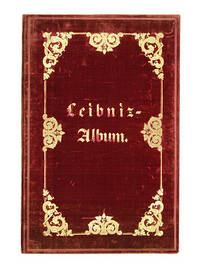
37941Hannover Hahn 1846. Folio 45.3 x 29.5 cm. vi 28 pp. With a nice engraved portrait of Leibniz and one wood-engraving of his house in Hannover. Very nice and highly unusual red velvet binding with elaborate gilt decorated embossed decorations and letterings. = Rare memorial contribution to the famous German polymath principally mathematician and philosopher Gottfried Wilhelm von Leibniz 1646-1716 in a fantastic binding. 'Leibniz sometimes spelled Leibnitz was a prominent German polymath and one of the most important logicians mathematicians and natural philosophers of the Enlightenment. As a representative of the seventeenth-century tradition of rationalism Leibniz's most prominent accomplishment was conceiving the ideas of differential and integral calculus independently of Isaac Newton's contemporaneous developments. Mathematical works have consistently favored Leibniz's notation as the conventional expression of calculus. It was only in the 20th century that Leibniz's law of continuity and transcendental law of homogeneity found mathematical implementation by means of non-standard analysis. He became one of the most prolific inventors in the field of mechanical calculators. While working on adding automatic multiplication and division to Pascal's calculator he was the first to describe a pinwheel calculator in 1685 and invented the Leibniz wheel used in the arithmometer the first mass-produced mechanical calculator. He also refined the binary number system which is the foundation of all digital computers. In philosophy Leibniz is most noted for his optimism i.e. his conclusion that our universe is in a restricted sense the best possible one that God could have created an idea that was often lampooned by others such as Voltaire. Leibniz along with René Descartes and Baruch Spinoza was one of the three great 17th-century advocates of rationalism. The work of Leibniz anticipated modern logic and analytic philosophy but his philosophy also assimilates elements of the scholastic tradition notably that conclusions are produced by applying reason to first principles or prior definitions rather than to empirical evidence. Leibniz made major contributions to physics and technology and anticipated notions that surfaced much later in philosophy probability theory biology medicine geology psychology linguistics and computer science. He wrote works on philosophy politics law ethics theology history and philology. Leibniz also contributed to the field of library science. While serving as overseer of the Wolfenbüttel library in Germany he devised a cataloging system that would serve as a guide for many of Europe's largest libraries. Leibniz's contributions to this vast array of subjects were scattered in various learned journals in tens of thousands of letters and in unpublished manuscripts. He wrote in several languages but primarily in Latin French and German.' Wikipedia. Editor of this memorial album was the German historian Carl or Karl Ludwig Grotefend 1807-1874 who also participated in the publication of Leibnizens Gesammelte Werke Leibniz's collected works. Inner hinge a bit tender; some light shelf-wear to one corner and some of the velvet but overall in great condition. unknown
1682600581682. Acta Eruditorum 1682/ 2. - Leipzig Grossium & Gleditsch Februar 1682 4° pp.33-56 1 Kupferstichtafel feine Broschur. First Edition! This was Leibniz first article published in Acta Eruditorum; He deals with mensuration and describes the Leibniz series 1-1/31/5-1/7.=pi/4. Gottfried Wilhelm Leibniz's 1646-1716 Hannover appointment in the Hanoverian service gave him more time for his favourite pursuits. He used to assert that as the first-fruit of his increased leisure he invented the differential and integral calculus in 1674 but the earliest traces of the use of it in his extant note-books do not occur till 1675 and it was not till 1677 that we find it developed into a consistent system; it was not published till 1684. Most of his mathematical papers were produced within the ten years from 1682 to 1692 and many of them in a journal called the Acta Eruditorum founded by himself and Otto Mencke in 1682 which had a wide circulation on the continent. He was one of the true geniuses of modern history. Although his contributions to the development of differential calculus remain his greatest legacy his definition of identity and his work in establishing a formal notation for all mathematics provided the foundation for others like Peano nearly two hundred years later. Ravier 84 unknown
171244073Leipzig, Grosse & Gleditsch, 1712. 4to. In: ""Acta Eruditorum Anno MDCCXII"". The entire volume offered in contemporary full vellum. Hand written title on spine. A yellow label pasted on to top of spine. A small stamp to title-page and free front end-paper. Library label to pasted down front free end-paper. As usual with various browning to leaves and plates. Pp. 167-69. [Entire volume: (2), 555, (35) pp. + five engraved plates.].
171244073Leipzig Grosse & Gleditsch 1712. 4to. In: "Acta Eruditorum Anno MDCCXII". The entire volume offered in contemporary full vellum. Hand written title on spine. A yellow label pasted on to top of spine. A small stamp to title-page and free front end-paper. Library label to pasted down front free end-paper. As usual with various browning to leaves and plates. Pp. 167-69. Entire volume: 2 555 35 pp. five engraved plates. <br/><br/><em>First printing of one of Leibniz's latest publications in which he proposed an interpretation of infinitesimals by a comparison of bodies of different extensions. The paper is a response to to a problem raised by French philosopher and mathematician Antoine Arnauld who wrote an important philosophical work known as "The Logic of Port-Royal" from 1662 and "Geometry" 1667. In the book he includes an example of symbolic rules that he considers to be against our basic intuitions on magnitudes and proportions. His reasoning goes as follows "Suppose we have two numbers a larger and a smaller one. The proportion of the larger to the smaller one should evidently be larger than the proportion of the smaller to the larger one. But if we use 1 as the larger number and - 1 as the smaller one this would lead to 1/-1 > -1/1 which is against the rules of algebra". Heeffer The Methodological Relevance of the History of Mathematics for Mathematics Education 1992.Leibniz saw this as a genuine mathematical problem but argued that the division should be performed as a symbolic calculation. "Following Leibniz the infinite appeared in two forms as the i Contiuous infinite and ii the discrete infinite. The status of the differentials is closely related to the status of the infinite. . As a consequence there is no clear and consistence distinction between continua of different kind related to i geometry and to ii mechanics. . Leinbiz did neither consequently argue mathematically or arithmetically nor consequently geometrically phenomenologically and mechanically. But The correlation between mathematics and physics is as impressive as possible. Suisky Euler as physicist 2009 p. 89-90.The volume also contains:Bernoulli Johann. Angulorum arcuumque sectio indefinita per formulam universalem expressa. Pp. 274-277; 329-30.And many other papers by influential contemporary mathematicians philosophers and historians. </em> hardcover
2005BN74456Verlag O. Reichl 2005. 2005. Sämtliche Schriften und Briefe. Reihe 1: Allgemeiner politischer und historischer Briefwechsel / hrsg. vom Leibniz-Archiv der Gottfried-Wilhelm-Bibliothek Niedersächsische Landesbibliothek Hannover Bd. 19: September 1700 - Mai 1701 / Bearb. dieses Bd.: Nora Gädeke ; Sabine Sellschopp. <br/><br/> Verlag O. Reichl unknown
168345599Leipzig, Grosse & Gleditsch, 1683. 4to. Without wrappers. In: ""Acta Eruditorum Anno MDCLXXXIII"", No.III + X (March and October issues). Pp. 81-128 + pp. 417-464 a. 2 engraved plates. (Entire issues offered). Tschirnhaus's papers: pp. 122-124 + pp. 433-437. Some browning as usual.
168345599Leipzig Grosse & Gleditsch 1683. 4to. Without wrappers. In: "Acta Eruditorum Anno MDCLXXXIII" No.III X March and October issues. Pp. 81-128 pp. 417-464 a. 2 engraved plates. Entire issues offered. Tschirnhaus's papers: pp. 122-124 pp. 433-437. Some browning as usual. <br/><br/><em>First appearance of Tschirnhaus's two papers in which he used infinitisimal methods which were very close to Leibniz's method and where he tried to lay down criteria for rational quadratures in the case of conic cubic and quadratic curves papers that led Leibniz to publish his first paper on the differential calculus the "Nova Methoda" in the Acta for 1684 in order to secure his priority over Tschirnhaus concerning the calculus. Leibniz discovered when he read Tschirnhaus' papers that Tschirnhaus had here published results showing similarity with Leibniz's invention of the calculus as he had confided to Tschirnhaus earlier during their Parisian stay and this without references to Leibniz.The second issue contains an original paper by LEIBNIZ: "Meditatio Juridico-Mathematica de Interusurio simplice". Pp. 425-32. </em> unknown
174046487Amsterdam Francois Changuion 1740. Small 8vo. Bound in 2 fine contemp. full calf. Profusely gilt spines title-and tomelabels in leather with gilt lettering. Gilt border on covers. Titlepages in red/black with engraved vignettes. CII2429;6550 pp. and 2 engraved plates each with 3 portraits Leibniz Newton Clarke. Printed on good paper. Internally fine and clean. <br/><br/><em>Scarce collection which contains among other correspondences the correspondence of Leibnitz and A.S. Conti on the dispute on the invention of the calculus and also Newton's remarks and Leibnitz's letter to him.Babson 233 the 3rd edition - Ravier: 410. - Gray: 380. </em> hardcover