ERASMUS, DesideriusBiblio.com
134 résultats
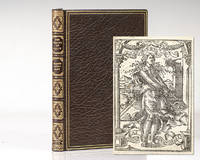
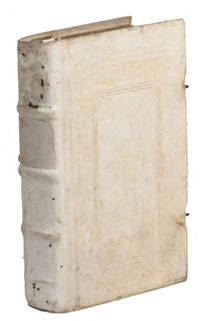
1520ABC_49643Colophon: Basel 1520. Small 8vo. Johann Froben Later blind-tooled pigskin over bevelled wooden boards each board in a panel design with a lozenge-shaped ornament and cornerpieces in the central panel surrounded by a decorative border 2 metal clasps and catches the manuscript title at the head edge a blank paper label on the spine and 4 pigskin tabs. With a decorative woodcut border on the title page of each work a woodcut printer's device at the end of the first 2 works 9 decorative woodcut borders in the text 16 decorative woodcut initials and 4 woodcut headpieces. 4 works in 1 volume. 141 3; 167 1; 91 1 blank; 14 2 blank pp. Compilation of first or early editions of four of the most important religious works by Desiderius Erasmus all printed during his lifetime. The texts which were incredibly popular in his own time were written to promote a more accurate understanding of the scriptures and make them more accessible to the public. Lifetime editions of these four works are quite rare on the market.In 1516 Erasmus published his revolutionary Latin edition of the Greek New Testament. It was not so much a translation but more a correction as Erasmus intended to free the text of the imperfections that had built up over time. When finished he began working on other parts of the scriptures with the same goal. The first two works in the present volume include his paraphrases of the letters of Paul. They were first issued separately in 4 parts starting in 1517. The present works are part of the first collected edition of the Pauline letters published by Froben in 1520 and 1521. This edition is praised for the fine title borders and initials some of them are known to have been cut by Johann Faber after drawings by the renowned artist Hans Holbein the Younger who often worked for Froben. The beautiful border on fol. 2A1 has been monogrammed by Ursus Graf "VG".The third work of this collection Modus orandi Deum is considered a centrepiece of Erasmus teachings on prayer. In it he explains the importance of prayer and provides a manual for how one should pray. He criticises monastic prayer long church services and practices that place the focus on the number of psalms said rather than their content. Instead he emphasises inner devotion and personal communication with God. The work was first published in October 1524 by Froben and in December 1524 by Knobloch. The present March 1525 edition is the second by Knobloch.The final work of the compilation was first published anonymously in 1520 as Consilium cujusdam . cupientis esse consultum & R. Pontificis dignitati & christianae religionis tranquillitati. Only two Latin editions and two German translations of it have been recorded by Vander Haeghen.With a contemporary ownership annotation at the head of the title page "Martini i iouilliami Vinter" a later annotation at the foot "Bernardhus Chymel alias Thalheuser" and a faded library stamp a few contemporary annotations and nota signs in the margins in 2 different hands. The pigskin has been washed with later clasps a few worm holes on the spine. The work is lightly browned throughout with water stains on some of the leaves mostly in the margins a brown stain on the title-page of ad 3. Otherwise in good condition.l Ad 1: Adams E 791; BM STC German p. 115; Erasmus Online 2919; USTC 682536 11 copies; Vander Haeghen I 144; VD16 E 3329; Ad 2: Adams E 792; BM STC German p. 115; Erasmus Online 2914; Vander Haeghen I 144; this ed. not in the USTC; VD 16; Ad 3: Adams E 697; Erasmus Online 2427; USTC 676364 10 copies; Vander Haeghen I 120; VD16 E 3176; not in BM STC German; Ad 4: Erasmus Online 5731; USTC 623273 3 copies; Vander Haeghen I 59; VD16 E 2542; not in Adams; BM STC German. hardcover
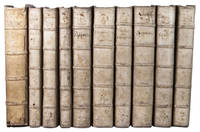
1569ABC_49477Basel: Ambrosius & Aurelius Froben 1569. Contemporary half elaborately blind-tooled pigskin over wooden boards sewn on 5 supports volume 1 on 4 with two brass clasps on the fore edge leather anchor plate brass clasp and catch plate. With the manuscript titles on the spines and the contents of each volume in manuscript on the bottom edge of all but one volume. Probably bound by Michael Hermann in Stuttgart before 1580. See for the workshop einbanddatenbank no. 502297b the rolls used: nos. r004651 and r003964. Folio 38 x 25.5 cm. With the general title page in volume 1 set within an elaborate woodcut frame all other title pages show the large woodcut Froben printer's device repeated on all but one verso of the final page in each part. Further with woodcut decorated initials. 11 parts in 10 volumes. A complete and uniformly bound set of the monumental edition of the complete works of Saint Augustine of Hippo printed by the celebrated Froben press. This edition follows the editorial tradition established by Erasmus and Johann Froben in the early 16th century and reflects the enduring influence of Augustines thought on early modern theology. The present work includes a broad range of Augustines writings: his dogmatic treatises De Trinitate De civitate Dei polemical works notably against Pelagianism and Manichaeism exegetical texts Enarrationes in Psalmos Gospel homilies ascetic and moral discourses and the Epistolae. This edition represents an early attempt to consolidate Augustines vast corpus for academic and ecclesiastical use during period following the Council of Trent. It demonstrates the persistence of Augustinian authority in Reformation-era intellectual life as well as the role of the Swiss printing houses in disseminating patristic texts throughout Europe.Aurelius Augustine 354-430 CE commonly known as Augustine of Hippo was a North African bishop theologian and philosopher widely regarded as one of the most influential figures in Western Christianity and Latin patristic thought. Born in Thagaste modern-day Souk Ahras Algeria Augustine received a classical education in rhetoric and philosophy before embracing Manichaeism and later Neoplatonism.After a period of moral and spiritual searching chronicled in his Confessiones he converted to Christianity in 386 CE under the influence of Ambrose of Milan. He was baptised in 387 ordained a priest in 391 and became bishop of Hippo Regius in 395 a position he held until his death.Augustines vast body of work addresses themes such as original sin grace free will the nature of the Church and the interpretation of Scripture. His most notable writings include Confessiones De civitate Dei the City of God and De Trinitate. His thought shaped the theological foundations of both medieval Catholicism and later Protestant traditions particularly through his doctrines of grace and predestination. He died in 430 CE during the Vandal siege of Hippo. Augustine was later declared a Doctor of the Church and his intellectual legacy remains foundational to Western theology and philosophy.With a manuscript inscription on each of the title pages and a small printed book plate mounted on the front pastedown of volume 1. The bindings are slightly stained and are occasionally slightly bumped and rubbed. The front hinge of volume one is slightly weakened lacking the upper clasp and anchor plate of volume 7 and the front board of volume 9 is slightly damaged along the fore edge. Internally the volumes are variably slightly foxed and/or browned some volumes show very minor water staining most volumes contain some minor worm holes which affect small parts of the letters. A more detailed condition report including collations etc. per volume is available upon request. The 10 volumes are overall in very good condition. A handsome and important Renaissance printing of one of the most significant corpora of Christian antiquity. Rare complete in all ten volumes here uniformly bound.l USTC 686573; VD 16 A 4153; WorldCat 1828402 1406901978 1090145458 1002789099 35656998 222081178 1322263024 1114269923; cf. for the binder see Einbanddatenbank no. 502297b rolls nos. r004651 and r003964. Ambrosius & Aurelius Froben, hardcover
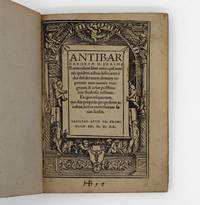
1520375736Basel: Froben 1520. First edition printed in May. Woodcut borders to title leaf and dedication by Hans Holbein printer's device on last page. 150 2 imprint pp. 4to. Eighteenth-century marbled boards ink label. Some toning to spine. Very good fresh copy. First edition printed in May. Woodcut borders to title leaf and dedication by Hans Holbein printer's device on last page. 150 2 imprint pp. 4to. Ignorantiam esse superbiae matrem. Eruditionem contra modestiam parere.<br /> Ignorance is the mother of pride; it is from learning on the contrary that modesty is born.<br /> <br /> First edition of Antibarbari Erasmus' manifesto "defending the arts against the scruples of the barbarians" Tracy. Erasmus argues for the primacy of poetry among the liberal arts for the importance of critical understanding of the writers of classical antiquity and for appropriating what is good in their work. He is also scornful of rote learning and blind repetition of earlier scholarship where "cuckoo calls to cuckoo".<br /> <br /> In Petro summus erat ardor fidei in Hieronymino summa doctrina: alterius animum alterius studia imitar. In Peter there was the ardour of faith at its highest; in Jeronme there was learning at its best. It is for you to imitate the spirit if the one and the scholarship of the other.<br /> <br /> This was a work of very long ripening. Erasmus began the earliest version circa 1490 when he was a newly ordained monk but that manuscript was left behind in his wanderings. Decades later when he came across his earlier work he was at the center of intellectual controversy following publication of of his edition of the New Testament. He revised his Antibarbari to assert the humanist position and Froben published it in May 1520. There were six editions of the work in the early 1520s Froben himself published another edition later the same year and ten editions in his lifetime.<br /> <br /> "it is ignorance rather than erudtion which makes men insolent"<br /> <br /> FIRST EDITION OF A KEY WORK BY ERASMUS. VD16 E1997; Valentina Sebastiani Johann Froben Printer of Basel 170; Bibliotheca Erasmiana p. 9; Adams E-463; Bezzel 157. The standard modern text iwith translation by Margaret Mann Phillips˜The Antibarbarians" is in the Toronto Collected Works vol. 23 1978 Froben unknown
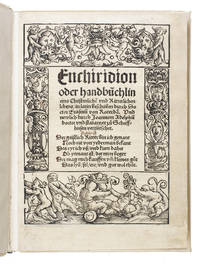
1520ABC_49900Colophon Basel 1520. 4to. Adam Petri Modern overlapping vellum grey endpapers. With an elaborate woodcut border by Hans Franck on the title page 5 half-page woodcut illustrations including 1 repeat in the text Petris device by Urs Graf below the colophon and several large decorated woodcut initials. The text is rubricated throughout. 10 CXIII ll. First German edition of Erasmuss Enchiridion militis christiani one of his most celebrated and influential works here translated by the Strasbourg humanist Johannes Adelphus ca. 1480s-ca. 1523. Erasmus began writing the Enchiridion around 1501 in Paris while fleeing from the plague and completed it some years later in Leuven. Originally conceived as a personal moral guide for the troubled nobleman the text promotes a life of inner devotion and ethical integrity urging Christians to cultivate sincere faith rather than rely on outward ritual. Though modest in origin the work became a cornerstone of Christian humanist thought and was widely reprinted and translated. The translator Joannes Adelphus Mülich or Müling was physician of the town of Schaffhausen; he made the translation at the request of Beatus Rhenanus.The present 1520 Basel edition handsomely produced by Adam Petri with rich woodcut ornamentation brought the Enchiridion to a broader German-speaking audience at a time of intense religious ferment. With a small manuscript annotation on the title page. The title page has been strengthened in the gutter margin and with elaborate restorations in the fore- and bottom edges. The tear in the bottom outer corner of leaf 73 has been restored barely affecting the text. Otherwise in good condition.l Bezzel 882; BM STC German p. 281; Erasmus Online 1708; USTC 650319; Vander Haeghen I 80; VD 16 E 2787; not in Adams. hardcover
15132454Basel: and Strasbourg: and Paris:: Io. Froben and Excusum per Renatum Beck in aedibus zum Thiergarten and Jean Petit In vico Sancti Iacobi 1515 and 1515 and 1513. THIRD FROBEN EDITION of the "Praise of Folly". The two prior editions also appeared in 1515. Written in 1509 as a visitor's gift to Thomas More whose name -Morus- was so aptly similar to the Greek "moros" folly the "Moriae Encomium" was first printed by Gilles de Gourmont at Paris probably in 1511. The first of the Froben editions appeared in 1515. This copy is bound with the "Germania" of Aeneas Sylvius Piccolomini Pope Pius II together with the "Responsio" of Jakob Wimpfeling; and an edition of Lactantius edited by Gilles de Maizières and printed at Paris by Jean Petit. Large Quarto:. 20.2 x 15 cm. 3 works bound in one volume: I. Piccolomini: i-iv A-B4 C8 D-E4 F8 G-H4 I8 K-L4 M8 N-O4 P6. II. Lactantius: A6 B4 a-z8/4 A-D8/4 E6 F-N8/4 O6 P4. III. "Praise of Folly": a-h4 a-z4 A-B4 C6 Bound in contemporary quarter alum-tawed pigskin over wooden boards with working clasps and catches. The pigskin is tooled in blind with repeating vines and floral rolls. The text and binding are beautifully preserved. The contents are fresh and bright with wide margins and a number of deckled edges. Excellent. The "Germania" has a fine title page printed in red and black and surrounded by a fine woodcut border. The printer's beautiful device by Hans Baldung Grien appears on the final leaf. The Lactantius has Jean Petit's device on the title page. The text is adorned with fine floriated criblé initials. A contemporary reader has annotated the "De Opificio Dei" densely in Latin and added a long Latin poem to the final two leaves. The "Praise of Folly" has a fine Holbein border with the decapitation of John the Baptist in the lower register and affine woodcut border with a fool by Urs Graf on the contents leaf. This edition includes the original dedicatory letter to Thomas More whose name Erasmus plays upon cleverly in the title of the work; and the letter to Martin Dorp in which Erasmus explains his motives for writing the "Moria": "My aim in the 'Folly' was exactly the same as in my other works. Only the presentation was different. In the 'Enchiridion' I simply outlined the pattern of a Christian life. In my little book the 'Education of a Christian Prince' I offered plain advice on how to instruct a prince. In my 'Panegyric' I did the same under the veil of eulogy as I had done elsewhere explicitly. And in the 'Folly' I expressed the same ideas as in the 'Enchiridion' but in the form of a joke." The Froben edition is augmented with a number of other texts See the final paragraphs of this description.Praise of Folly:"The 'Praise of Folly' is Erasmus' most famous and controversial work… In Erasmus' lifetime the 'Moria' was condemned in 1527 by the theologians of Paris for its attacks on faith and morality and again in 1533 by the Franciscans who found it full of heresies. The officials of the Sorbonne put it on the list of condemned books in 1542 and 1543 a list that was the basis of the Tridentine Index of 1564…"The 'Moria' may start as a learned joke to amuse a fellow humanist Thomas More but it moves into sharp criticism of contemporary mores and ends with a plea for a return to the Christianity of the Gospels… Erasmus writes in a Lucianic spirit of irreverent burlesque of the gods of classical mythology and light-hearted amusement at the irrationality of mankind. Folly argues that she is all that is natural youthful fecund and happy and that life would be intolerable if it were not ruled by civilized conventions which necessitate a degree of humbug and illusion. By contrast the Stoic ideal rational man is a 'kind of marble statue of a man devoid of sense and any sort of human feeling.' She then shifts her viewpoint and lists the people who enjoy her benefits in so far as they try to preserve their illusions or are happy in their ignorance self-deception or self-love. She even adds superstitious piety to alchemy gambling and the nobility's obsession with hunting and extravagant building…"Next Erasmus starts to deliver a sharp and often bitter attack on all the victims of blind folly those who are deaf to the voice of true religion and lacking the gentler Christian virtues among whom are sycophants self-seekers money-makers pedants scholastics lawyers theologians superstitious worshippers of images and relics courtiers and kings worldly monks and irreligious pontiffs. This section culminates in a savage thrust at Pope Julius II the bellicose pope. The keen wit and ingenuity of the satire can be highly entertaining but there is no note of gaiety now. As Erasmus surveys the gulf between the Church and the 'true philosophy of Christ' he moves into the final section where the alternative offered to barren scholasticism is the vision of reality taken from Plato and folly in the sense used by Saint Paul that of receptivity to the Christian message by the 'fool in Christ.' All irony is dropped until the final short epilogue when Folly light-heartedly cuts short her 'hotch-potch of words'; this is a direct and simply worded account of Erasmus' personal belief moving into an exposition of the Neoplatonist concept that the soul's ascent to beatitude ends in ecstasy a form of folly which is its supreme fulfillment."Betty Radice CWE Vol. 27 pp. 78 ff.Piccolomini's "Germania":Shortly after 1455 Aeneas Sylvius Piccolomini came into possession of the recently rediscovered manuscript of Tacitus' "Germania" the most important ancient account of Germany in the first century. In response to a letter from the Bishop of Mainz lamenting the miserable state of the Holy Roman Empire Piccolomini wrote his "Germania" based on Tacitus' own in which he demonstrates that the present high level of German culture as compared with the barbarous past as presented by Tacitus is an accomplishment of the Church. This edition includes the important response by Jakob Wimpfeling in defense of the ancestors of the Germans.Additional "Moria" texts:The Froben editions of the 'Moria' contain in addition to Erasmus' main text two ancient examples of the mock-encomium Seneca's "Ludus de Morte Claudii Caesaris" and Synesius of Cyrene's "De Laudibus Calvitii" "In Praise of Baldness" translated from the Greek by the Englishman John Phreas d. 1465. In his introductory letter to Thomas More Erasmus cites both the "Ludus" and the "Praise of Baldness" in a pre-emptive defense against those who will object to his literary frivolity "levitas et ludicrum argumenti" pp. 102-104 in this edition. The text of the "Moria" is accompanied by the commentary of Gerard Listrius with assistance from Erasmus. I. "Germania": BM STC German p. 701 = Proctor 10307. Not in Adams. Panzer VI.75.410. Ritter 1878. Muller Bibliographie Strasbourgeoise II 228 no. 26. Schmidt Beck 21. II. Lactantius: Adams L-14; BSB-Ink L-13; HC 9819; Moreau Inventaire chronologique II 637. III. "Praise of Folly": Vander Haeghen I 122; Kossmann 967; Bezzel 1304; Not in De Reuck; BM STC German p. 282; Adams E 392; VD 16E 3184 Io. Froben, and Excusum per Renatu[m] Beck in aedibus zum Thiergarten, and Jean Petit, In vico Sancti Iacobi, 1515 and 1515 and books
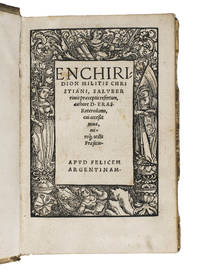
1523ABC_49639Strassburg 1523. 8vo. Colophon: Johann Knobloch Contemporary elaborately blind-tooled pigskin over wooden boards remnants of brass anchor plates. Ad 1 with a woodcut frame on the title page 1 woodcut decorated initial and Knoblochs large woodcut device on the verso of the last blank leaf. Ads 2 and 3 with 1 woodcut decorated initial each. Ad 4 with a woodcut architectural frame on the title page and 1 large woodcut decorated initial. 4 works in 1 volume. 106; 57 1 blank; 49 1 blank ll.;158 pp. Four significant early 16th-century works that illuminate the intellectual and theological tensions of the Reformation. Ad 1: The Enchiridion militis christiani Poinard of the Christian Knight one of Erasmus most influential writings serves as a practical manual for inner reform and devout living. Emphasising moral integrity over ritual this widely reprinted work became a cornerstone of Christian humanist thought.Ad 2: The two homilies in De immensa Dei misericordia include a sermon on divine mercy likely composed for the dedication of a chapel in Basel and a second comparing virginity and martyrdom written for the Benedictine nuns of Cologne. Both reflect Erasmuss pastoral sensibilities and rhetorical skill.Ad 3: In De libero arbitrio Erasmus directly challenges Luthers doctrine of predestination in a pivotal treatise on free will. This foundational text marking the definitive break between the two reformers is one of the periods most significant theological works.Ad 4: The volume concludes with an early -and apparently rare- edition of Henry VIIIs Assertio septem sacramentorum a fierce rebuttal of Luthers De captivitate Babylonica. This work earned the English king the title Fidei Defensor from Pope Leo X. A splendid collection that captures the core tensions of the Reformation and the humanist response to it.Ad 1 with some of the text underlined. Ad 2 with manuscript annotations in the margins. Ad 3 with some marginal annotations and some of the text underlined. Ad 4 with a manuscript inscription on the title page and a few annotations in the margins. The binding shows signs of wear some small pieces of leather missing on the back board revealing the wood below remnants of fastenings along the fore-edge ads 2 and 3 with some minor worm holes in the paper barely affecting the text some staining and browning in places. Otherwise in good condition.l Ad 1: USTC 650175 7 copies; Vander Haeghen I 80; VD 16 E 2772; Ad 2: Bezzel 1131; VD 16 E 3041 and VD 16 E 3659; not in the USTC; Ad 3: VD 16 E 3151; not in the USTC; Ad 4: VD 16 H 2166; this ed. not in USTC. hardcover
155050048London: imprynted at London by Iohn Day dwellinge ouer Aldersgate beneth saint Martyns. And are to be sold at his shop by the litle conduit in Chepesyde at the sygne of the Resurrection 1550. First edition small 8vo 139 x 86mm ff. 116 collating A-O⸠Pâ´; printed in Black Letter throughout; woodcut initials; later vellum-backed marbled boards; title leaf torn at the top margin no loss; the binding lightly rubbed. Early ownership signature of Thomas Ferrar on the title page; ex-Earls of Macclesfield with their North Library bookplate on the front pastedown and their blindstamp at the top of the title page. Part of this is a translation of the De civilitate morum puerilium. libellus of Desiderius Erasmus which was regularly reprinted throughout the 16th century. Rare: ESTC records only 6 copies of this translation only the Huntington and Yale in the U.S. STC 22484; Alston VI 8. Sherry's work "is a mirror of one variation of rhetoric which came to be called the rhetoric of style. As a representative of this stylistic school.it carries forward the medieval concept that ornateness in communication is desirable; it suggests that figures of speech are tools for achieving this ornateness; it supplies examples of ornateness to be imitated in writing and speaking; it supports knowing the figures in order to understand both secular and religious writings; it proposes that clarity is found in the figures. In short the work assisted Englishmen to understand eloquence as well as to create it" Herbert W. Hildebrandt in his introduction to the 1977 facsimile reprint. <br/><br/> imprynted at London by Iohn Day dwellinge ouer Aldersgate, beneth saint Martyns. And are to be sold at his shop by the litle con hardcover books
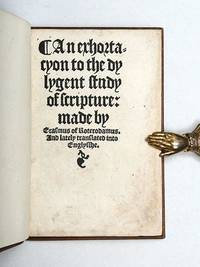
1534150904London: Robert Wyer c.1534. Erasmus on reading the Bible in the vernacular Rare English translation of Erasmus's Paraclesis "a cogently argued text in support of the Bible in the vernacular and it is this particular thrust of the work that must have drawn the early English reformers to it since they too like Erasmus spoke eloquently and at length. in support of the Bible in English" Douglas H. Parker. Based on a translation variously attributed to either William Joy or George Joye which was first printed at Antwerp in 1529 this is one of two editions printed for the first time in England in 1534. While the 1529 Antwerp edition had included a translation of Martin Luther's commentary on 1 Corinthians 7 both 1534 editions replace Luther's text with another Erasmus text "An exhortacyon to the study of the Gospell". This is the only copy to have appeared in commerce in the past 45 years. Octavo 135 x 94 mm in two parts. Woodcut opening initials printer's devices McKerrow 67c and 68 69 "dieu et mon droit" woodcut on I8r. Twentieth-century brown pigskin spine lettered in gilt marbled endpapers. Fore-margins restored throughout affecting woodcuts on final leaf and occasional shoulder notes numerous short wormtracks filled some just into text some mostly marginal staining washed still a presentable copy carefully restored of a notably rare book. STC 10494 four copies only: British Library Oxford Huntington and the present copy. unknown
1549139476London: Thomas Berthelet 1549. First edition in English of one of the most notable and popular works of the Renaissance which played an important role in the beginnings of the Protestant Reformation and swiftly brought its author international fame. First printing with 'latine' and the printer's initials 'TB.' to the title page. Octavo bound in full crushed levant morocco by Sangorski and Sutcliffe gilt titles and elaborate gilt tooling to the spine in six compartments within raised gilt bands triple gilt ruling to the front and rear panels gilt turn-ins and inner dentelles all edges gilt wide woodcut border to the title page signed TB. woodcut printer's device to the final page. In near fine condition. Early ownership name to the title page and light marginalia. Small leather bookplate of Francis Kettaneh affixed to the verso of the front free endpaper. Exceptionally rare with only two other examples traced at auction in the last 100 years. This famous satire was first conceived on the road from Italy to England composed in the house of Erasmus's friend and the dedicatee Thomas More and then first printed under the Latin title Moriae encomium in Paris in 1511. Begun as a paradoxical joke between the two men who had been translating the ancient humorist Lucian together The Praise of Folly is a remarkable work by turns sharp and gentle—but always playful—in its learned treatment of the follies of the world and vision of a humanist life. “The Praise of Folly was written when Erasmus was staying in the house of Thomas More in the winter of 1509–10. Its title is a delicate and complimentary play on the name of his host: its subject matter is a brilliant biting satire on the folly to be found in all walks of life. The book stemmed from the decision which Erasmus had taken when he left Rome to come to England that no form of preferment could be obtained at the sacrifice of his freedom to read think and write what he liked … The work was first secretly printed in Paris and as in other cases its immediate success safeguarded him from the consequences of his audacity … Whenever tyranny or absolute power threatened The Praise of Folly was re-read and reprinted. It is a sign of what was in the air that Milton found it in every hand at Cambridge in 1628. His inherent scepticism has led people to call Erasmus the father of 18th century rationalism but his rationalist attitude is that of perfect common sense to which tyranny and fanaticism were alike abhorrent†PMM. Upon its initial publication in Paris in 1511 Moriae Encomium was hugely popular to Erasmus' astonishment and sometimes his dismay. Even Erasmus' close friends had been initially skeptical and warned him of possible dangers to himself from thus attacking the established religion. Even Pope Leo X and Cardinal Cisneros are said to have found it amusing. Before Erasmus' death it had already passed into numerous editions and had been translated into Czech French and German. An English edition soon followed translated by English poet and diplomat Sir Thomas Chaloner who was renowned among Elizabethans for his Latin verses and pastoral poems three volumes of which were printed during his lifetime by Thomas Berthelet the king’s printer who had published three translations of works by Erasmus in the 1520s. Thomas Berthelet hardcover