134 résultats
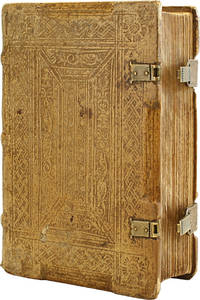
15291832Coloniae: Iohannem Gymnicum 1529. Rare edition a sound complete copy lacking only the final blank. Title within pictorial woodcut border. Octavo contemporary blind-tooled calf over wooden boards dated 1534 in blind brass clasps minor statins and soiling and some early penned marginalia. Also bound in are three additional works De Civilitate Morum Puerilium; Plutarch. De Liberis Educandis; and Horatius Flaccus. Iohannem Gymnicum hardcover books
15291832Coloniae: Iohannem Gymnicum 1529. Rare edition a sound complete copy lacking only the final blank. Title within pictorial woodcut border. Octavo contemporary blind-tooled calf over wooden boards dated 1534 in blind brass clasps minor statins and soiling and some early penned marginalia. Also bound in are three additional works De Civilitate Morum Puerilium; Plutarch. De Liberis Educandis; and Horatius Flaccus. Iohannem Gymnicum hardcover
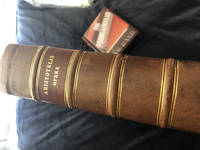
1550P8126The Works of Aristotle "per Des. Eras Roterordamvm" 1550. 2 volumes in one folio 323 x 192mm. Third Edition of The Works of Aristotle of the original text in 1831 prepared by Simon Grynaeus. This edition retains the original letter from Erasmus to Thomas More's son John. Woodcut initials a few woodcut illustrations old calf a few early annotations numerous notes in Latin Greek and English on front and rear flyleaves probably nineteenth-century and in text in ink pencil and red crayon neat annotations in Greek in second volume Greek quotation from Aristotle written on first title-page occasional light staining T5 torn in margin binding rubbed rebacked. Two of history's greatest minds converge. Book #P8126. $6500. We specialize in Rare Ayn rand erotica history and science. Johann Bebel and Michael Isengrin, 1550 hardcover
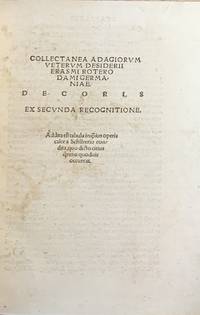
15106221Hardcover. Fine. 4to. Bound in 20th-century 1/4-vellum over marbled boards. Strasbourg: Matthias Schürer <b>Jul</b><b>y 1510. Second Strasbourg</b> edition of Erasmus heavily annotated collection of Greek and Latin proverbs. Printed in Roman and Greek types. <br /><br />This is the original version containing 818 adages which is considerably shorter than the later expanded versions published under the title Adagiorum chiliades. Adams E-420; Bezzel Erasmusdrucke 50; Van der Haeghen Bibliotheca Erasmiana p.25-6; Bibl. Belgica II 276: no. E.61; Muller Strasbourg II p. 179 no. 45. <br /><br />The Adagia could only have been possible in the new world of European education in which careful attention to a broader range of classical texts produced a much fuller picture of the literature of antiquity. Its impact has been long lasting. Such popular expressions such as <i>one step at a time</i> <i>between a rock and a hard place</i> <i>break the ice</i> <i>an iron in the fire</i> l<i>ooking a gift horse in the mouth</i> and many other sayings can trace their origin to the Adagia. <br /><br />The printer Matthias Schürer published 15 works by Erasmus in over 70 editions. It is interesting to note that his relationship with Erasmus began with a rather rough start. In 1509 the year Schürer completed his apprenticeship and opened his own print shop he struck an unauthorized edition of Erasmuss Adagia purloined from the first edition of 1500. In spite of this commercial indiscretion Erasmus favored Schürer with a warm supportive and lasting friendship. The dedicatee of this celebrated work William Blount 4th Baron Mountjoy of Barton Blount Derbyshire was a wealthy English courtier and scholar. A pupil of Erasmus he called him inter nobiles doctissimus The most learned amongst the nobles. Having served since 1512 as Chamberlain to Queen Catherine of Aragon it fell to him to announce to her the intention of Henry VIII to divorce her. Boards slightly rubbed; signatures D-K with a small wormhole to outer margin without loss of text; some slight browning and soiling to some pages; a few leaves with faded manuscript marginalia in a neat 16th-century hand; index leaves with light water staining to upper portion; o/w a very nice unrestored wide-margined example of this rare early edition. Matthias Schürer hardcover
15402712Cologne:: Ex officina Ioannis Gymnici 1540. RARE COLOGNE EDITION. Folio: . 31.2 x 20 cm. . 88 3-874 1 pp. A-d6 e8 f-g6 A-Z6 Aa-Zz6 Aaa-Zzz6 Aaaa-Dddd6 last leaf is blank. A very fine copy bound in contemporary pigskin over beveled wooden boards tooled in blind. The clasps lacking some scuffing and soiling to lower board otherwise a very nice binding. Internally a beautiful copy with the lightest of occasional soiling. Gyminus’ fine hippocamp device appears on the title. A very rare Cologne edition of Erasmus’ beloved and extraordinarily influential “Adages†first conceived as a collection of proverbial sayings drawn from the Latin authors of antiquity elucidated for the use of those who aspired to write an elegant Latin style. In its first incarnation the “Adagia†consisted of about eight hundred proverbs. The present version Erasmus' "Adagia Chiliades" “Thousands of Adages†is more than just a vastly expanded edition of that first enterprise: "A glance at its composition reveals that the ‘Adagia Chiliades’ was in fact -as well as in name- a new book and that Greek scholarship was largely responsible for the difference. Instead of 818 adages there were 3260. Of those about four-fifths were either new or substantially altered in form. And 2734 contained Greek passages of two to six lines or more in length.â€Renaissance Humanism vol. 2 pages 232-233. “In the dedication Erasmus pointed out the profit an author may derive both in ornamenting his style and in strengthening his argumentation from having at his disposal a good supply of sentences hallowed by their antiquity. He proposes to offer such a help to his readers. What he actually gave was much more. He familiarized a much wider circle than the earlier humanists had reached with the spirit of antiquity. “Prior to the ‘Adages’ the humanists had to some extent monopolized the treasures of classic culture in order to parade their knowledge of which the multitude remained destitute and so to become strange prodigies of learning and elegance. With his irresistible need of teaching and his sincere love for humanity and its general culture Erasmus introduced the classic spirit in so far as it could be reflected in the soul of a sixteenth-century Christian among the people. Erasmus made current the classic spirit. Humanism ceased to be the exclusive privilege of a few. According to Beatus Rhenanus he had been reproached by some humanists when about to publish the 'Adagia' for divulging the mysteries of their craft. But he desired that the book of antiquity should be open to all." Huizinga p. 39-40 Van der Haeghen I 4; Bezzel 83; VD16 E 1944 Ex officina Ioannis Gymnici, unknown books
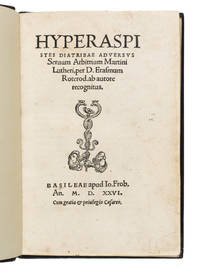
1526ABC_49737Basel: Johann Froben 1526. Modern calf with the author title and year of publication lettered in gold on the spine. Small 8vo. With a woodcut printer's device on the title page and final leaf and 2 decorated woodcut initials. First revised edition of Erasmus' response to Martin Luther which is part of their famous theological debate that took place in the 1520s. Erasmus received Luther's work in February 1526. The Hyperaspistes is his first reply to it which he composed within a few days in March 1526. The present edition revised by Erasmus himself and published in July of the same year supplies a more correct text of this famous refutation.The Hyperaspistes first published in March 1526 deals with the question of free will and was written in response to Luthers De servo arbitrio On enslaved willl 1525 which in turn was written in reply to Erasmuss De libero arbitrio On free will 1524. Luther argued that humans could not achieve salvation through good deeds as they could not choose between good and evil and so could only be redeemed through the will of God. Erasmus on the other hand believed that each individual had the freedom to accept Gods grace and turn towards a Christian life and salvation could be reached through good deeds. The confrontation between Erasmus and Luther was a duel of major importance for Europe in the first half of the 16th century as two visions of man history and faith clashed.The second part of the Hyperaspistes appeared in September 1527 continuing the exegetical controversy with Luther. The present edition however was published before the second part was written.With near- contemporary annotations in the margins of some of the leaves. The work is lightly browned and foxed throughout. Otherwise in good condition.l Adams E-675; Bezzel 1117; BM STC German p. 281; Erasmus Online 2230; USTC 664562; Vander Haeghen I 110; VD16 E 3029; cf. De Reuck 236 other issue. Johann Froben, unknown
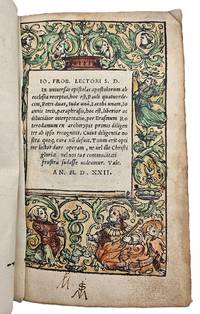
152212717Basel Johannes Froben 1522. Two parts in one 484 folio. Tall octavo H. 185 x W. 11.5 cm. contemporary binding in blindstamped brown leather over wooden boards. Title on the lower cover: ""In Epistola S. Pauli Can. RC."" The blind impression on the front cover faded but still visible is: ""ROTEROD"" as for ""Roterodami"" so from Rotterdam Erasmus' place of birth and ""WSKB"" possibly the initials of the owner. Second edition in an attractive binding the first in 8vo format. Two months before the first edition was edited in Folio. Each part has a woodcut title page. Lacking clasps some light waterstains wide margins with early manuscript annotations and thin strips of medieval manuscripts sewn inside the boards. A good copy. Literature: VD 16 E-3377; Bezzel I. Erasmusdrucke Nr. 1529. Van der Haeghen I 147 Basel, Johannes Froben hardcover
1528CLL-143Lyon, Gryphe, 1528-1529 In-12 de 160 pp., (4) ff. - (16) ff. - (40) ff., veau blond, trois filets dorés en encadrement, dos à nerfs orné de filets et d'un décor à la grotesque doré, pièces de titre et de tomaison de maroquin havane et vert, coupes filetées or, bordures décorées, tranches dorées (Niédrée).
15238509Argentorati Strasburg: Iohannes Cnobloch execudebat Quinto Idus Iunias Anno. M.D.XXIII. 1523. 1523 20 130 i.e. 120; 107 1 leaves ; 16 cm. Collates Aa8 Bb4CC8 a-p8 A-N8 O4. D&M 6103a. Recently bound in calf to style with blind decoration to the boards. The spine has raised bands and is titled in gilt. Marginal annotations thoughout. Part title to Epistolae Apostolicae and Cnobloch's device printed at the end of both parts. The imprint and date are supplied from the colophon. The text of each book begins with a 14 line rubricated initial including one decorated with three parrots at the start of Evangelium Secundum Ioannem. PROVENANCE: The title page verso has the bookplate of the Nuremburg bookseller collector and bibliographer of alchemical literature Friedrich Roth-Scholtz 1687-1736. The title page and part title have a neat 19th century stamp of the Univerity of Erlangen now Erlangen-Nuremberg. an excellent early printing of Erasmus' important NT. Argentorati (Strasburg): Iohannes Cnobloch execudebat Quinto Idus Iunias Anno. M.D.XXIII. hardcover
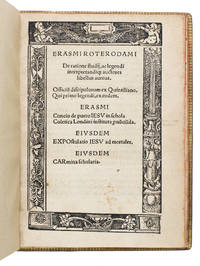
1516ABC_49694Colophon Strasbourg: Matthias Schürer 1516. Modern brown pigskin with a blind-tooled single fillet frame on both boards gold-tooled turn-ins red edges in a beige paperboard slipcase. 4to. With a woodcut decorated title frame and 3 woodcut decorated initials. Early edition of Erasmus seminal educational treatise De ratione studii here presented alongside several other influential pedagogical and devotional texts. It further includes: Officium discipulorum ex Quintiliano The duties of students according to Quintilian including a section on the first stages of learning to read also derived from Quintilian a sermon on the child Jesus by Erasmus intended for delivery at the Colet School in London a lament of Jesus addressed to mankind and a collection of school poems.The opening dedication addressed to Peter Viterius a professor of liberal arts sets the tone for this work: Erasmus praises his friends discernment and judgment in matters of education using vivid comparisons drawn from military strategy and classical mythology to underscore the importance of order and method in learning. Without it he argues even the most gifted minds may falter. Of particular note is Erasmus endorsement of an instructional technique that became central to Renaissance humanist pedagogy: the use of structured annotation. In De ratione studii he recommends that students classify selected passages under thematic headings a mnemonic device that aids both retention and retrieval. This principle would go on to shape the methods of early modern teaching and note-taking. It also reflects Erasmus' broader educational reforms where rhetoric and moral philosophy intersect. His engagement with progymnasmata preliminary rhetorical exercises especially those of Aphthonius favoured for their clear organisation into theory and examples demonstrates his commitment to practical and accessible instruction for young learners.With some contemporary and later underlining and annotations in red and brown ink mainly consisting of corrections additions to the text and markings of significant passages. Two minor worm holes througout barely affecting the text. The gutters between leaves V-VI; VII-VIII; XX-XXI; and after leaf XXIII have been reinforced in the gutter with linen tape slightly browned throughout. Otherwise in good condition.l Adams E 346; Bezzel 1709; USTC 653250 9 copies; Vander Haeghen I 169; VD16 E 3534; not in BM STC German; De Reuck; Kossmann. Matthias Schürer, hardcover
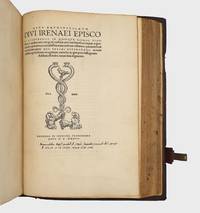
1534372762Basel: Froben 1534. Third revised Erasmus edition first 1526; second 1528 of Irenaeus' treatise "Against Heresies. Printer's device on titlepage and last page; head-pieces; initials; printed marginalia. 1 vols. Folio. Near contemporary dark calf over wooden boards stamped in blind upper board dated 1545 brass clasps. Headcaps worn one clasp perished. Third revised Erasmus edition first 1526; second 1528 of Irenaeus' treatise "Against Heresies". Printer's device on titlepage and last page; head-pieces; initials; printed marginalia. 1 vols. Folio. Third Erasmus edition of Irenaeus' treatise Against Heresies consisting of five books which are preserved in their entirety only in their Latin version. It is Irenaeus' principal literary work which had a significant impact on the development of the church during the first three centuries.<br /> <br /> Colophon: Basileae in officina Frobeniana per Hieronymum Frobenium et Nicolaum Episcopium An. M D XXXIIII mense Martio.<br /> The work is bound with an extensive commentary on the Gospel of Matthew by Wolgang Musculus 1544. The nicely preserved binding is dated M.D.XLV. 1545 on upper board. VD16 I 318. Provenance: Provenance: title page of Musculus signed: Ludovicus Rabus . 1544 and Iohannes Longlinus . 1550; bookseller's label on front paste-down: G. & B. Westermann Bros. Deutsche Buchhandlung 290 Broadway New-York; Bookplate of Rev. Edwin A. Dalrymple; Maryland Diocesan Library; General Theologiccal Seminary bookplates and stamps Froben unknown
152733077-1245Basel Joh. Froben Febr. 1527. Half-title with woodcut printer's device title-page within woodcut architectural border 2nd title-page fol. 1v. with different figured woodcut border different printer's device on last leaf verso and at the end numerous large and small figured woodcut initials in the text by Urs Graf Ambrosius Holbein and Hans Frank. 4 leaves 710 1 pp.; 28 leaves index. Folio. 17th century calf back gilt joints and foot of spine somewhat restored. Old ms. name on title. Basel Joh. Froben Febr. 1527. An important document of the humanistic spirit and remarkably beautifully printed with outstanding book decoration during Erasmus' lifetime. In the early years of the 16th century the demand for the original text of the New Testament began to mount and Erasmus 1467-1536 soon saw the necessity to translate the original Greek text into Latin. His first text-critical edition of the New Testament was one of the important foundations for Reformation theology. These present Erasmus commentaries were the first ferment of theological discussion at that time and are of great value. This is the 4th printing of the additional text notes contributed by Erasmus. They show mistakes that ancient theologians had made during their translation and revealed misunderstandings that had arisen due to the lack of knowledge of the text copyists. The first separate printing of this work was done by Froben at Basel in 1519 Bezzel 1212 as an indepent work. Through the years probably altogether a total of eight editions appeared as listed by most of the bibliographers. Numerous excerpts and vernacular versions circulated later.- Some little wormholes in the last 30 leaves some spots otherwise with wide margins and still a good copy. - VD 16 E 3096; Adams E-891; Vander Haeghen II 58; Bezzel 1215; Hieronymus Oberrhein. Buchillustration II 302 detailed; cf. Knaake II 302. BIBLES ; HELVETICA: ALLGEMEIN ; BIBELN RELIGION ; HUMANISM ; REFORMATION ; Basel, Joh. Froben unknown
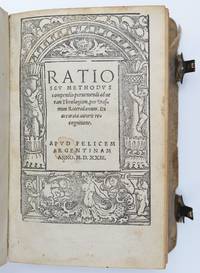
15281361Strasbourg Hagenau: Knobloch; Seltz 1528. Four works in one volume. In contemporary wooden panels with the traces of leather and a codex leaf on spine. Spine with three raised bands. The original copper clasps are presented. The title pages of the first three works by Erasmus with identical architectural borders. Signs on top edge in ink. Old collection stamp on verso of inner front pastedown. Sporadic manuscript marginal notes removed. Occasional underlines in the text throughout. Few stains throughout some leaves tanned. The title page of the fourth work Gebwiler with a tiny loss to the right edge with no effect on the text. Overall in fine condition. Four works in one volume. In contemporary wooden panels with the traces of leather and a codex leaf on spine. Spine with three raised bands. The original copper clasps are presented. The title pages of the first three works by Erasmus with identical architectural borders. <p><br /> Erasmus Desiderius<br /> Ratio seu methodus compendio perveniendi ad veram theologiam. Ratio verae theologiae.<br /> Argentorati Strasbourg: Ioannes Knoblochus Knobloch October 1523. 80 leaves.<br /> <p><p><br /> Bound with:<br /> Erasmus Desiderius<br /> Enchiridion militis Christiani saluberrimis praeceptis refertum ….<br /> Argentorati Strasbourg: Ioannes Knoblochus Knobloch November 1524. 100 leaves.<br /> <p><p><br /> Bound with:<br /> Erasmus Desiderius<br /> Modus orandi Deum. <br /> Argentorati Strasbourg: Ioannes Knoblochus J. Knobloch December 1524. 46 leaves.<br /> <p><p><br /> Bound with:<br /> Gebwiler Hieronymus<br /> Gravissimae sacrilegii ac contemptae theosebiae ultionis ethnicorum Hebraeorum et Christianorum verißimis comprobatae exemplis syngramma …. <br /> Haguenau Wilhelm Seltz 1528. 32 leaves last blank.<br /> <p><p><br /> Three sixteenth-century early Erasmus editions printed by Knobloch bound with Gebwiler’s first edition containing the earliest printed quotation from Hortus deliciarum.<br /> <p><p><br /> The third work in the volume Modus orandi Deum is generally regarded as the central text of Desiderius Erasmus’s teaching on prayer. The present edition dated December 1524 is the second following the first edition issued by Froben in October of the same year. The work circulated widely soon after publication: by the end of 1525 ten further impressions had appeared from presses across Europe. USTC records only eight surviving institutional copies of this December 1524 edition B. Er. I; Mynors 587; Bezzel 1285; Schmidt VII 284; VD16 E 3169; USTC 676366; EON 2424.<br /> <p><p><br /> The first work Ratio seu methodus October 1523 is likewise an early edition. Its editio princeps was published in Leuven by Thierry Martens in November 1518. This Knobloch edition is scarce: USTC records only four copies Augsburg Cambridge Edinburgh Neuchâtel and it is not listed in VD16 USTC 709423; Müller Knobloch 395; Benzing 544.<br /> <p><p><br /> The second work Enchiridion militis Christiani Handbook of the Christian Knight is among Erasmus’ earliest writings first printed in 1503. The preliminaries include all four Latin poems by Thomas More which first appeared together in the Mainz edition of 1520. This edition is also rare: USTC records only five institutional copies VD16 E 2774; USTC 650176.<br /> <p><p><br /> The final work in the sammelband is Gravissimae sacrilegii by Jérôme Gebwiler. Gebwiler is recognized as the earliest scholar to describe Hortus deliciarum Bischoff 1973 p. 13 the illuminated encyclopedic manuscript compiled by Herrad of Landsberg twelfth-century abbess of Hohenburg Abbey Mont Sainte-Odile destroyed in 1870 during the siege of Strasbourg. In this work Gebwiler quotes the dedicatory poem of Hortus deliciarum attributed either to Herrad herself or to Relinda of Hohenburg her predecessor as abbess Griffiths 2013 p. 231. This quotation represents the earliest appearance of the text in print VD16 G 597; USTC 660780.<br /> <p><p><br /> References: Bischoff C.: L’histoire. In: Green R. et al.: Herrad von Hohenburg Hortus deliciarum. London Leiden: The Warburg Institute University of Leiden E. J. Brill 1979. pp. 9–16.; Griffiths F.: Herrad of Hohenbourg and the Poetry of the Hortus deliciarum: Cantat tibi cantica. In: Churchill L. J. et al.: Women Writing Latin. … Volume 2. Medieval Modern Women Writing Latin. New York London: Routledge 2013. pp. 231– 264.<br /> <p>. Knobloch; Seltz unknown
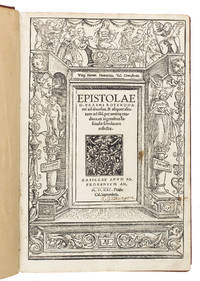
1521ABC_49922Basel 1521. Folio. Johann Froben Modern blind-tooled red morocco with the author title and year of publication lettered in gold on the spine a single fillet border on both boards red edges. With a decorative woodcut border on the title page by Urs Graf 2 decorative woodcut borders in the text by Ambrosius Holbein numerous decorated woodcut initials and a woodcut printer's device at the end of the work. 12 "668" =618 6 pp First complete edition of the letters of Desiderius Erasmus containing 171 letters which had never been published before with correspondence with many of the most prominent figures of the 16th century. The work has been beautifully illustrated with a splendid large woodcut title border by Urs Graf ca. 1485-1528 known as "The triumph of Humanitas" and two fine borders by Ambrosius Holbein ca. 1494-1519. The present copy has been annotated in several contemporary hands and was owned by Ralph Widdrinton d. 1688 the Regius professor of Greek at Cambridge University.The Epistolae ad diversos contains 617 letters in total and is far larger than any of the earlier collections of Erasmus' correspondence namely the Epistolae aliquot of January 1518 52 letters the Auctarium of October 1518 63 letters and the Farrago of November 1519 333 letters. The present letter collection is also the first with a preface by Erasmus. The majority of the letters date to 1519-1521 but some are earlier with the first dated to 11 July 1513. They reflect Erasmus' changing stance towards Luther and Protestantism but also continue his attacks on friars and the theologians of Louvain. Among the authors correspondents are prominent humanists and other important figures including Beatus Rhenanus Ulrich Zasius Johann Eck Guillaume Budé Jean Grolier Georg Spalatin Hermann von dem Busche Konrad Peutinger John Colet Thomas More John Fisher Thomas Linacre William Grocyn Luther Melanchton Pope Leo X and Henry VIII King of England. Erasmus later made many editorial changes to the letters making the present edition of particular importance.With a later ownership annotation "R. Widdrington" on the title page. The binding is very lightly soiled. The work is slightly browned throughout with contemporary and later manuscript annotations in the margins in three different hands a vertical tear in the upper part of the first errata leaf without loss of text. Otherwise a very good copy with ample margins.l Adams E 852; BM STC German p. 276; Erasmus Online 2069; USTC 651629 34 copies; Vander Haeghen I 99; VD 16 VD16 E 2925. hardcover
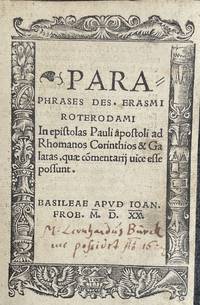
15202283Basileae Basel: Apud Ioan. Frob. Colophon: Per Hieronymvm Frob. Ioan Filium Johann and Hieronymus Froben 1520. First collected edition. . In 17th century vellum the author’s name lettered in ink to spine tinted edges. Leonhard Bürck’s possessor’s inscription in ink on the title page and p. 431. Woodcut borders to the four title pages. Woodcut initials and headpieces. Woodcut printer’s device at the end. Old underlines and marginal notes in ink to a few pages. Stains occasionally. Old restoration to O1–2 with no effect on the text. Overall in very good condition. First collected edition. . In 17th century vellum the author’s name lettered in ink to spine tinted edges. Leonhard Bürck’s possessor’s inscription in ink on the title page and p. 431. Woodcut borders to the four title pages. Woodcut initials and headpieces. Woodcut printer’s device at the end. 465=495 1 p. Some misnumberred omitted. Coll.: A–K8 L4 M–Z8 2A–2e8 2F4 2G–2I8. <p><br /> Scarce first edition of Erasmus’ paraphrases on the first four Pauline epistles with possessor’s inscription of the important 17th-century publisher in Frankfurt Leonhard Brück.<br /> <p><p><br /> <br /> The present volume of Paraphrases is the first collected edition of Erasmus’ monumental commentary on the Gospels which was composed and published between 1517 and 1523. <br /> Erasmus began the work on the commentary of the Gospels with the Pauline epistles. They were first issued separately starting with the paraphrase of Romans in 1517 Thierry Martens continued with both epistles of Corinthians 1519 Thierry Martens and the Galatians which was published in 1520 by Martens in Louvain and Froben in Basel. The remaining epistles appeared by 1521 when they were also published in a collected edition by Froben. Any of the lifetime editions of the Paraphrases both separate and collected are rare on the market.<br /> <p><p><br /> <br /> Provenance: inscription on title page and on p. 431 “M. Leonhardus Bürck me possidit Anno 162â€; Leonhard Bürck Burck Burkius Burcken was a printer and publisher in Frankfurt active between 1611 and 1628. Bürck is identified as the step-grandfather of Hans Jakob Christoffel von Grimmelshausen.<br /> <p><br /> USTC 682544 5 copies only in Germany; Bezzel 1163; VD 16 E 3060. Apud Ioan. Frob. [Colophon: Per Hieronymvm Frob. Ioan Filium] [Johann and Hieronymus Froben] unknown
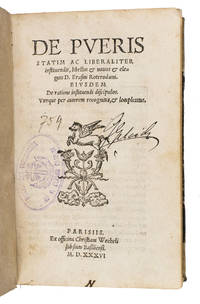
1536ABC_49637Paris: Chrétien Wechel 1536. Half vellum and brown sprinkled paper sides with the faded manuscript title on the spine red edges. 8vo. Ad 1 with Wechels woodcut device on the title page and 3 woodcut decorated initials. Ad 2 with Wechels woodcut device on the title page and the verso of the blank last leaf and 1 woodcut decorated initial. Ad 3 with a woodcut architectural frame on the title page and 2 woodcut decorated initials. Ad 4 with Frobens woodcut device on the title page and the verso of the last blank leaf. 4 works in 1 volume. With:2 IDEM. Responsio ad Petri Cursii defensionem nullo adversario bellacem.Paris Chrétien Wechel 1535.3 IDEM. Responsio ad epistolam paraeneticam clarissimi doctissimicque viri. Alberti Pii carporum principis. Paris Pierre Vidoux April 1529.4 IDEM. Purgatio adversus epistolam non sobriam Martini Luteri.Basel colophon: Hieronymus Froben and Nikolaus Episcopius April 1534. Together these four works capture the remarkable breadth of Erasmuss influence from his visionary humanist pedagogy to his forceful engagement in the theological controversies of the Reformation. Brought together in this volume they reflect both the moral urgency and intellectual sharpness that defined his contribution to early modern thought.Ad 1: First published in September 1529 De pueris statim ac liberaliter instituendis and De ratione instituendi discipulos represent Erasmus principal contribution to Renaissance pedagogy. He argues for the early and liberal education of children stressing mildness rather than severity moral formation alongside learning and the formative power of classical texts. Ad 2: An exceptionally rare edition of a polemic against the Louvain theologian Petrus Curtius in which Erasmus defends his humanist theology whilst ridiculing Curtius as a fighter without an adversary. First issued by Froben and Episcopius earlier that year with only that edition and the present Wechel edition extant; the text was not reprinted until the Opera omnia.Ad 3: A spirited reply to the accusations of Alberto Pio Prince of Carpi coupled with sharp extemporaneous notes against Edward Lee Beda. This double defence displays Erasmus wit and sharpness at the height of the Reformation debates. A very scarce edition; the editio princeps had appeared from Froben in March of the same year.Ad 4: An early witness to the high demand in 1534. Erasmus rejoinder to Luthers intemperate letter written in the wake of De servo arbitrio. Here Erasmus defends himself against charges of paganism whilst censuring Luthers furious and mendacious tone. After 1534 the text was no longer issued separately.With a manuscript owners inscription and a later purple stamp of the library of the Franciscan church and convent of Saint Clare in Kotor Montenegro on the title page of the ad 1. Further with a few manuscript annotations in the margins and some of the text underlined and crossed out throughout the work. The binding shows signs of wear the boards have been rubbed with some loss of material some occasional slight browning. Otherwise in good condition.l Ad 1: Adams 338; Inventaire chronologique des editions Parisiennes du XVIe siecle V no. 144; USTC 185690 1 copy; Vander Haeghen I 164; not in BM STC German; Ad 2: Inventaire chronologique des editions Parisiennes du XVIe siecle IV no. 1299; USTC 185562 1 copy lost; Vander Haeghen I 174; WorldCat 492052585 1 copy; cf. for the 1535 Froben edition see: Bezzel 1782; USTC 635442; VD16E3622; not in Adams; BM STC German; Ad 3: Adams 828; Inventaire chronologique des editions Parisiennes du XVIe siecle III no. 1758; USTC 181160; not in Vander Haeghen; BM ST C German; Ad 4: Vander Haeghen I 164; cf. Adams 809 later edition; USTC 635432 6 copies; VD 16 E 3481; not in BM STC German. Chrétien Wechel, hardcover
1520253908Basel: Johann Froben 1520. First collected editions. Titles within ornamental woodcut border initials printer's device in colophon. 465 i.e. 495 1; 167 1; and 141 3 pp. 1 vols. 8vo. Contemporary blindstamped pigskin. Covers somewhat soiled one brass clasp missing lower joint just starting but quite firm; internally a SUPERB near flawless copy. Bookplate of scholar and author Nathan Comfort Starr. First collected editions. Titles within ornamental woodcut border initials printer's device in colophon. 465 i.e. 495 1; 167 1; and 141 3 pp. 1 vols. 8vo. First collected editions of these "Paraphrases" of the letters of Paul which were undertaken shortly after Erasmus's revolutionary edition of the Greek New Testament of 1516. As part of that monumental reconstruction of the New Testament Erasmus' intention was to "retell" the books of the New Testament in one uninterrupted voice without the clutter of textual commentary or critical interruption. It was a bold undertaking and in 1517 Erasmus began with the letters of Paul. They were first issued separately starting with Romans in 1517; and editions appeared in Louvain Thierry Martens Leipzig Valentin Schumann and Basel Johann Froben. The collected issues - such as the three which are bound together in this exquisite volume - began to be issued in Basel by Froben in 1519; and finally in 1521 Froben issued a collected edition of all of the Pauline letters. All of the lifetime editions both separate and collected are rare on the market: the last copy of any of the above collected Pauline paraphrases to appear at auction was in 1977. Adams E790; E792; E791 Johann Froben unknown books
15242455Paris:: Jodocus Badius Ascensius 1524. FIRST COMPLETE BADIUS EDITION. Quarto:. 19.8 x 14.5 cm. CXX leaves. Collation: a-p8 Bound in contemporary limp vellum lightly soiled. The contents are in very good condition with a few pencil annotations and light soiling to the title page. With Badius' device of his print shop the “Praelum Ascensianum†showing printers working a press on the title page. With large attractive crible initials and smaller charming historiated initials. Passages in Greek. A fine unsophisticated copy of this rare edition. From the personal library of Bob and Emily De Graaf. The rare 1524 Parisian “Praise of Folly†printed by Erasmus’ friend the scholar-printer Badius Ascensius who printed the first authorized edition in 1512. This edition contains all of the supplementary texts found in the Froben edition of 1516 including the dedicatory letter to Thomas More whose name Erasmus plays upon cleverly in the title of the work; and the letter to Martin Dorp in which Erasmus explains his motives for writing the “Moriaâ€: “My aim in the ‘Folly’ was exactly the same as in my other works. Only the presentation was different. In the ‘Enchiridion’ I simply outlined the pattern of a Christian life. In my little book the ‘Education of a Christian Prince’ I offered plain advice on how to instruct a prince. In my ‘Panegyric’ I did the same under the veil of eulogy as I had done elsewhere explicitly. And in the ‘Folly’ I expressed the same ideas as in the ‘Enchiridion’ but in the form of a joke.†“The ‘Praise of Folly’ is Erasmus’ most famous and controversial work… In Erasmus’ lifetime the ‘Moria’ was condemned in 1527 by the theologians of Paris for its attacks on faith and morality and again in 1533 by the Franciscans who found it full of heresies. The officials of the Sorbonne put it on the list of condemned books in 1542 and 1543 a list that was the basis of the Tridentine Index of 1564… “The ‘Moria’ may start as a learned joke to amuse a fellow humanist Thomas More but it moves into sharp criticism of contemporary mores and ends with a plea for a return to the Christianity of the Gospels… Erasmus writes in a Lucianic spirit of irreverent burlesque of the gods of classical mythology and light-hearted amusement at the irrationality of mankind. Folly argues that she is all that is natural youthful fecund and happy and that life would be intolerable if it were not ruled by civilized conventions which necessitate a degree of humbug and illusion. By contrast the Stoic ideal rational man is a ‘kind of marble statue of a man devoid of sense and any sort of human feeling.’ She then shifts her viewpoint and lists the people who enjoy her benefits in so far as they try to preserve their illusions or are happy in their ignorance self-deception or self-love. She even adds superstitious piety to alchemy gambling and the nobility’s obsession with hunting and extravagant building… “Next Erasmus starts to deliver a sharp and often bitter attack on all the victims of blind folly those who are deaf to the voice of true religion and lacking the gentler Christian virtues among whom are sycophants self-seekers money-makers pedants scholastics lawyers theologians superstitious worshippers of images and relics courtiers and kings worldly monks and irreligious pontiffs. This section culminates in a savage thrust at Pope Julius II the bellicose pope. The keen wit and ingenuity of the satire can be highly entertaining but there is no note of gaiety now. As Erasmus surveys the gulf between the Church and the ‘true philosophy of Christ’ he moves into the final section where the alternative offered to barren scholasticism is the vision of reality taken from Plato and folly in the sense used by Saint Paul that of receptivity to the Christian message by the ‘fool in Christ.’ All irony is dropped until the final short epilogue when Folly light-heartedly cuts short her ‘hotch-potch of words’; this is a direct and simply worded account of Erasmus’ personal belief moving into an exposition of the Neoplatonist concept that the soul’s ascent to beatitude ends in ecstasy a form of folly which is its supreme fulfillment.â€Betty Radice CWE Vol. 27 pp. 78 ff. Vander Haeghen I 123; Kossmann 979; Bibl. Belgica E 866; Not in Bezzel De Reuck or BM STC French; Renouard Badius II 424; Adams E 397. Inventaire chronologique des editions Parisiennes du XVIe siecle III no. 669; Renouard Imprimeurs Parisiens du XVIe siècle II no. 539 Jodocus Badius Ascensius, unknown books
1520253908Basel: Johann Froben 1520. First collected editions. Titles within ornamental woodcut border initials printer's device in colophon. 465 i.e. 495 1; 167 1; and 141 3 pp. 1 vols. 8vo. Contemporary blindstamped pigskin over wooden boards spine in four compartments with raised bands over doubled cords ruled in blind and crossed floral ornaments boards tooled with floral borders about a central field edges ochre. Covers somewhat soiled one brass clasp missing upper joint just starting but quite firm; internally a SUPERB near flawless copy. Bookplate and ownership signature of scholar and author Nathan Comfort Starr. First collected editions. Titles within ornamental woodcut border initials printer's device in colophon. 465 i.e. 495 1; 167 1; and 141 3 pp. 1 vols. 8vo. First collected editions of these "Paraphrases" of the letters of Paul which were undertaken shortly after Erasmus's revolutionary edition of the Greek New Testament of 1516. As part of that monumental reconstruction of the New Testament Erasmus' intention was to "retell" the books of the New Testament in one uninterrupted voice without the clutter of textual commentary or critical interruption. It was a bold undertaking and in 1517 Erasmus began with the letters of Paul. They were first issued separately starting with Romans in 1517; and editions appeared in Louvain Thierry Martens Leipzig Valentin Schumann and Basel Johann Froben. The collected issues - such as the three which are bound together in this exquisite volume - began to be issued in Basel by Froben in 1519; and finally in 1521 Froben issued a collected edition of all of the Pauline letters. All of the lifetime editions both separate and collected are rare on the market; this copy is in a well preserved contemporary pigskin binding first binding. Adams E790; E792; E791; VD16 E 3060; E 3324; E 3328 Johann Froben unknown
1525LCS-17326<p><strong>Erasmus and his master Laurent Valla: three founding works of the Renaissance </strong><strong>preserved in their contemporary blind-stamped binding.</strong></p><p><strong>Strasbourg 1523 1525. Cologne 1525.</strong></p><p><strong>From the <em>Campana</em> collection with this 16th century handwritten ex-libris </strong></p><p><strong><em>"Jacobi Campana et Amicorum 1530".</em></strong></p><p>In total three texts bound in one 8vo volume 148 x 100 mm of: I/ 184 ll. the last one blank; II/ 28 ll. ; III/ 1 title-page 148 pp. 10 pp. of index 1 bl.p. Numerous handwritten notes on the last 2 ll. of the 1st text. Bound in blind-stamped pigskin over wooden boards brass clasps. <em>Contemporary binding.</em></p><p>Collection in quite rare and very early editions of 3 important founding works of the Renaissance in philology and grammar by Erasmus and by his master Laurent Valla.</p><p><em>Laurent Valla "the greatest humanist of the first half of the 15th century" </em>was born in Rome around 1407. Guilio Vallese.</p><p><em>"Deeply convinced of the superiority of the antique culture renewed at the time in which he saw an incomparable ferment of regeneration Valla in order to defend it didn't hesitate to take the chance of being condemned in front of the Inquisition court. As other humanists of this time he claimed to be of the rationalist moral antique transmitted in the books of Wisdom when the Middle Ages had impoverished or lost the very meaning of it."</em></p><p>Valla's most famous treatise "<em>Des élégances de la langue latine</em>"that had most contributed to his reputation in six books was quickly given in every school and kept on being a teaching text for the greatest part of the 16th century.</p><p>Erasmus who professes many times in his letters a vivacious admiration for the author and for this particular work had made in his youth an extract for his personal use which was printed twice without his consent.</p><p><em>Valla's observations are about the value of certain forms of words about the value of several difficult terms and even more about the synonymy of the Latin language. This work proves a great sagacity of researches and a great judgment. "King Alphonse who really liked this kind of studies didn't get tired of hearing Valla and let him sometimes battling with Antoine de Parlerme "inde ivae". He gave him a diploma enriched with a golden speech bubble in which he declared him illustrious in almost every science as well as in poetics."</em></p><p>Are joined to this major work of Valla the two great founding texts it inspired to Erasmus:</p><p>-The first one <em>De Conscribendis epistolis</em> in the second edition from Strasbourg of 1525. It was such a success that it was after this one reprinted 77 times in the 16th century alone.</p><p>-The second one <em>De Constructione octo partium orationis libellus</em> printed for the first time in 1514 is here in the edition printed on August 11th 1523 at Sigismon Grim. It was followed by 61 editions in the 16th century alone.</p><p>A magnificent copy with wide margins preserved in its first blind-stamped binding; the clasps and ties are intact.</p><p>It comes from the collections <em>Jacob Campana</em> and <em>Gaspar Campana</em> and bears these two handwritten ex-libris "<em>Jacobi Campanae et Amicorum 1530</em>" and "<em>Gaspari Campanae et Amicorum</em>".</p><p>The<em> Campanas</em> illustrious Neapolitan family counted <em>César Campana</em> among their members a fine erudite from the 16th century.</p><p>FRANCAIS</p><p><strong>Erasme et son maître Laurent Valla : trois uvres fondatrices de la Renaissance</strong></p><p><strong>conservées dans leur première reliure estampée à froid.</strong></p><p><strong>Strasbourg 1523 1525. Cologne 1525.</strong></p><p><strong>De la bibliothèque <em>Campana</em> avec cet ex-libris manuscrit du XVIe siècle</strong></p><p><strong><em>" Jacobi Campana et Amicorum 1530 ".</em></strong></p><p>Soit trois textes reliés en un volume in-8 de I/ 184 ff. le dernier blanc ; II/ 28 ff. ; III/ 1 p. de titre 148 pp. 10 pp. d'index 1 p.bl. Nombreuses annotations manuscrites sur les 2 derniers ff. du 1er texte. Relié en peau de truie estampée à froid sur ais de bois dos à nerfs attaches et fermoirs de laiton. <em>Reliure de l'époque.</em></p><p>148 x 100 mm.</p><p>Réunion en éditions fort rares et très précoces de trois grands textes fondateurs de la Renaissance en philologie et grammaire d'Erasme et de son maître Laurent Valla.</p><p><em>Laurent Valla " le plus grand humaniste de la première moitié du XVe siècle "</em> naquit à Rome vers 1407. Guilio Vallese.</p><p><em>" Profondément convaincu de la supériorité de la culture antique alors renaissante dans laquelle il voyait un ferment incomparable de régénération Valla pour la défendre n'hésita pas à courir le risque d'une condamnation devant le tribunal de l'Inquisition. Comme d'autres humanistes de ce temps il se réclamait de l'antique morale rationaliste transmise dans les livres de la Sagesse dont le Moyen Age avait appauvri ou perdu la signification même. "</em></p><p>Le traité le plus célèbre de Valla qui avait le plus contribué à sa réputation<em>" Des élégances de la langue latine "</em> en six livres se répandit rapidement dans toutes les écoles et continua de faire texte d'enseignement pendant la plus grande partie du XVIe siècle.</p><p>Erasme qui professe en beaucoup d'endroits de ses lettres une vive admiration pour l'auteur et pour cet ouvrage en particulier en avait fait dans sa jeunesse un extrait pour son usage qui fut imprimé deux fois sans son consentement.</p><p><em>Les observations de Valla portent sur la valeur de certaines formes de mots sur celle de plusieurs termes difficiles et plus encore sur les synonymies de la langue latine. Ce travail atteste une grande sagacité de recherches et un rare discernement. " Le roi Alphonse auquel ce genre d'études plaisait singulièrement ne se lassait pas d'entendre Valla et le mettait quelquefois aux prises avec Antoine de Parlerme " inde ivae ". Il lui donna un diplôme enrichi d'une bulle d'or dans laquelle il le déclarait illustre en presque toutes les sciences ainsi qu'en la poétique. "</em></p><p>Sont joints à cette uvre phare de Valla les deux grands textes fondateurs qu'elle inspire à Erasme :</p><p>-Le premier <em>De Conscribendis epistolis</em> dans la seconde édition strasbourgeoise de 1525. Son succès fut tel qu'elle fut après celle-ci réimprimée 77 fois pour le seul XVIe siècle.</p><p>-Le second texte <em>De Constructione octo partium orationis libellus</em> imprimé pour la première fois en 1514 est ici dans l'édition achevée d'imprimer le 11 août 1523 chez Sigismon Grim. Elle fut suivie de 61 éditions pour le seul XVIe siècle.</p><p>Magnifique exemplaire à belles marges conservé dans sa première reliure estampée à froid dont les fermoirs et les attaches sont conservés intacts.</p><p>Il provient des bibliothèques <em>Jacob Campana</em> et <em>Gaspar Campana</em> et porte ces deux ex-libris manuscrits <em>" Jacobi Campanae et Amicorum 1530 "</em> et <em>" Gaspari Campanae et Amicorum "</em>.</p><p>Les<em> Campana</em> illustre famille napolitaine comptèrent parmi leurs membres <em>César</em> <em>Campana</em> fin lettré du XVIe siècle.</p> Iohannem Heruagium.
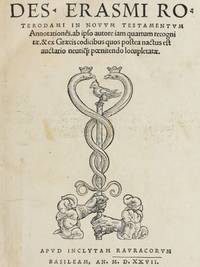
1527505487Froben 1527. Hardcover. VERY GOOD. 9 2-710 56 pp. original endpapers. Folio in sixes complete: a4 a-z6 A-Z6 Aa-Mm6 Nn8 Oo6 Qq8 Rr8. Contemporary blind-tooled alum-tawed pigskin over boards. Original clasps intact originally with corner furniture now lost. First title page with Froben device of crowned snakes and bird perching on hands enshrouded with clouds; second title page within Hans Holbein woodcut border. All edges stained Navy blue. 9 2-710 58 pp. <br /> <br /> Front hinge reattached with non-invasive Japanese paper repair; some staining and patina to the peccary bit of worming to the outer pages otherwise a few clean and fresh internal text. 17th century owner's inscription with hellenized name to FFEP. <br /> <br /> The fourth of six lifetime editions by Erasmus a great leap forward from the previous edition adding nearly 100 pages to the Third edition of 1522. <br /> <br /> First released in 1516 alongside his revised Greek Text and Latin translation of the New Testament the Annotationes are a philological tour de force examining in elaborate detail the differences between the ancient Greek text and the Vulgate in the process demonstrating the need for a new Latin translation namely his own. In the process Erasmus was dangerously frank in his discussion of Church abuses and departures from the teaching of Scripture showing himself 'An unprecedentedly formidable critic of contemporary theological and religious practice' McConicum Oxford Encyclopedia of the Reformation. <br /> <br /> The single greatest scholarly accomplishment of the renaissance was Erasmus's Annotations on the New Testament. Begun in 1516 and revised three times in his lifetime this second revision of 1527 was the greatest expansion of the work more than doubling its size from the first edition. Here the complete force of his philological powers is on full display boring away centuries of accreted dogma and ignorance that had obscured the text. "Without the notes Erasmus said the texts of the Scripture were 'naked and defenceless' open to criticism by uncomprehending readers and corruption by careless printers. The Annotations represent not only Erasmus' defence of the New Testament against such abuses but also a reflection of his own philosophy objectives and working methods. In establishing the text and defending it against his opponents Erasmus drew on manuscript sources classical literature patristic writings scholastic exegesis and the work of his immediate forerunners Valla and Lefevre. He did not hesitate to point out the errors of illustrious writers like Jerome and established medieval authorities like Peter Lombard. In general he was appreciative of the early church Fathers and contemptuous of medieval commentators. Rummel Erika. Erasmus' Annotations on the New Testament : From Philologist to Theologian. <br /> <br /> In many cases the Annotations serve to justify the most controversial renderings in his translation and defend himself against heresy charges. The most notable instance is his translation of the Greek metanoiete in Matt 3 note 1 and Acts 19 note 8. which Jerome had translated as "do penance" a rendering which shored up the Church's sacramental doctrine of a private secret confession made only to a priest. While Erasmus maintained that he himself practiced taught and supported the status quo penitential rite he did not find any grounding in Scripture where he insisted metanoiete referred to a change of mind not penitential confession and that anyway that instances of confession in Scripture were uniformly public and oral. See Rummel 152-156. Adams E-891. Froben hardcover
1545314899Argentorati Strasbourg: Vuendelinus Rihelius Wendelin Rihel 1545. Fourth edition of the Calvin; second Froben folio edition of the Erasmus. Collation alpha-gamma6 delta4 A-Z6 a-s6 t-v4 v4 blank present. Pp. 431 505 3 blank. Errata at foot of index p. 43. 1 vols. Folio 11-3/4 x 8 inches. Contemporary blindstamped pigskin over wooden boards with metal clasps. With 8 pages of contemporary Latin notes loosely inserted; contemporary marginalia throughout second work. L2 in Calvin with old ink stains not affecting legibility; some wear along one bottom edge of binding. Manuscript prayer in Latin on lower pastedown. Small later paper label on upper cover "Bibliothèque de Spietz". A handsome copy. Fourth edition of the Calvin; second Froben folio edition of the Erasmus. Collation alpha-gamma6 delta4 A-Z6 a-s6 t-v4 v4 blank present. Pp. 431 505 3 blank. Errata at foot of index p. 43. 1 vols. Folio 11-3/4 x 8 inches. Calvin's 'Instutitio': Cornerstone of Liberty. "Calvin's 'Institution of the Christian Religion' was the first systematic statement of a Reformed Church. It is the most important doctrinal work of the Reformation as a whole and provided a comprehensive theological system rivaling those of the Middle Ages . Calvinism's most important role despite Calvin's authoritarian influences was to support the movement for liberty and independence in many parts of the world" Printing and the Mind of Man 65. First published in Basel in 1536 the "Institutio was much revised taking its final form in 1559" PMM. Calvin understood the importance of vernacular translations in the transmission of ideas made possible by the printing press and prepared a French edition in 1541. This fourth edition follows closely and corrects the third edition printed in 1543. All early editions are uncommon.<br/><br/>Calvin 1509-64 drew upon St. Augustine and Luther as well as upon classical sources including Plato and Seneca; his work addressed theological issues and also notably the relations between ecclesiastical and civil government. The contemporary annotations often callouts of classical authors and shoulder notes with a few pointing hands are most extensive in the first six chapters again in chapter sixteen on the Lord's Prayer where Melanchthon is cited but appear throughout. <br/><br/>The first work in this well preserved contemporary binding is the second Froben folio edition of Erasmus Ecclesiastes Basel: Froben 1539. OCLC 632887280 BSB Augsburg Univ. Basel. Collation a-z6A-M6N4O-Q6. Pp. 439 1 blank 18 index imprint date 1540 1 blank 1 Froben's device. This was first published in Basel in 1535. The manuscript notes refer to in the early passages of this work. The Bibliotheque de Spietz was dispersed at auction in 1874. The von Erlach family had been established at Bern since the early sixteenth century. Calvin: PMM 65; Adams C357; VD16 C 291; Peter & Gilmont Bib. Calviniana 45/5; En français dans le texte 59 for 1560 ed. Erasmus: Bezzel 823 Adams E632; VD16 E 2723 Vuendelinus Rihelius [Wendelin Rihel] unknown books
152116988Colophon: Mainz: Johannes Schoeffer 1521. German contemporary blind-tooled calf sewn on 3 double cords in a panel design each board with a 15 mm-wide border roll with fillets on either side containing 4 different heads in medaillions separated by quatrefoils. The central panel on each board is filled with dozens of impressions of 3 floral stamps 1 on the front board and 2 on the back. Titles in ink written on the spine partly upside down and the fore-edge; later paper spine label; 2 holes near the fore-edge of each board from fastenings now lost. 8vo. Ad 1: with the title in woodcut architectural border with 3 coats of arms the Isenburg bars and Mainz wagon wheel above left and right and Schoeffer's device here with 2 stars above and a rosette below rather than 3 stars at the foot under his IS-monogram; 6 large beautiful woodcut initials the largest 45 mm with 2 human figures. Both works set throughout in italic types still with upright capitals as always at this date. With 1 initial coloured by hand. Ad 2: with the title in an elaborate woodcut border dated "MDXX" at the head first page of the dedicatory letter by Erasmus to Petrus Aegidius dated Basle 5 October 1514 on back of the title page with a border made of woodcut strips Froben's large woodcut device on the last page and 2 decorative woodcut initials 2 series the 30 mm Q with a scorpion. 2 works in 1 volume. With: 2 ERASMUS Desiderius. Parabolae sive similia.Colophon: Basel Johannes Froben July 1521. Ad 1: Good scholarly edition of Erasmus's famous guide to writing and speaking style in Latin designed to provide the student of Latin with a wide range of words and expressions. Ad 2: A collection of similes or comparisons composed along the same lines and with the same intentions as those that had brought Erasmus much success in his Adagia. In a sense the Parabolae are an addition to and continuation of the Adagia. With some contemporary annotations. In very good condition with only a few minor marginal smudges or chips. Binding lacking fastenings and with damage to the spine and edges but still in good condition with most of the tooling very clear.l Ad 1: VD 16 E 2656; Allen I 260; II 305 311; Bezzel 748; Vander Haeghen Bibl. Erasm. p. 66; Reedijk 95 97; De Reuck Bibl. Erasm. Bruxel. 135 with illus. of the title; ad 2: VD 16 E 3246 2 copies; Bezzel 1371; Vander Haeghen Bibl. Erasm. p. 138; for the binding: cf. K. von Rabenau Deutsche Einbände der Renaissance von Jakob Krause Berlin 1994 7 & 8 similar bindings using stamps with the same motifs. Johannes Schoeffer, unknown
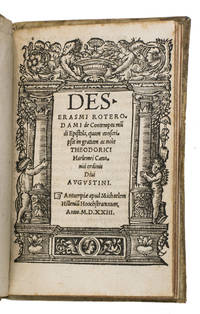
1523ABC_50124Antwerp: Michiel Hillen van Hoogstraten 1523. Later vellum with the manuscript title and year of publication on the spine red sprinkled edges. 8vo. With a decorative woodcut border on the title page and 2 decorated woodcut initials. Very rare early edition of Erasmus first written work a letter in praise of monastic life which was only published later in his career. Erasmus wrote it in 1488 or 1489 when he was 20 years old at the request of Theodoricus of Haarlem a fellow canon at the Augustine monastery at Steyn in order to persuade his nephew to join the order. It circulated in manuscript form for many years and was likely used to entice prospective candidates to enter the order of Canons Regular of St. Augustine.The work is divided into three parts: the first seven chapters focus on the evils of this world; chapter eight through eleven on the pleasures of the religious life; and chapter twelve on the ultimate choice between the material world or the religious state. This final chapter appears to counteract the rest of the work as it advises Theodoricus' nephew to carefully consider whether he truly wanted to enter a religious order since being a Christian is enough in itself. As such it has been suggested that Erasmus rewrote the text before its publication adding the 12th chapter but as he apologises for his adolescent writing style in the preface the work was likely mostly unedited.The first edition was published in Louvain in 1521 more than 30 years after it was written. The present edition is the first by Michiel Hillen van Hoogstraten and one of four printed in 1523. It is exceptionally rare on both the market and in institutions as only four copies have been recorded in libraries and we have not been able to find any others in sales records of the past century.The vellum is slightly soiled. The work is slightly browned throughout. Otherwise in good condition.l Adams E-569; Erasmus Online 1383; Nijhoff & Kronenberg 804; USTC 403708 4 copies; Vander Haeghen p. 64; WorldCat 71746606 2 copies; cf. De Molen R. "First fruits. The place of Antibarbarorum Liber and De contemptu mundi in the formulation of Erasmus Philosophia Christi" in: Colloque érasmien de Liège 1986 pp. 177-196; not in Bezzel; De Reuck; STCV. Michiel Hillen van Hoogstraten, hardcover
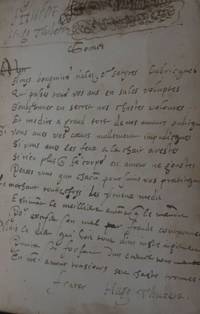
15233722Paris: apud Simon de Colines 1523. First edition. Contemporary French blind-stamped calf over wooden boards panelled with intersecting fillets and lozenge tools; remains of clasps present metal attachments preserved; spine with raised bands. Wide-margined and notably clean throughout. Early manuscript moral sonnet signed "Frater Hugo Thubert" on the front flyleaf and a biblical motto "Si quis vult post me venire." in a seemingly different sixteenth-century hand on the rear flyleaf. With a few early marginal annotations in a sixteenth-century hand on ff. 39 and 253 and f. 9 ruled with brown-ink frames. Leather somewhat worn including a damaged area on the front panel and some loss at the lower corners with surface abrasions and light cracking along the joints; spine rubbed at head and foot. A complete unsophisticated copy in its original binding retaining notable early reader's marks; overall in very good condition. First edition. Contemporary French blind-stamped calf over wooden boards panelled with intersecting fillets and lozenge tools; remains of clasps present metal attachments preserved; spine with raised bands. ff. 373 22. <p><br /> A rare example of early educational use of Erasmus's Adagia in its contemporary French leather binding and preserved with a handwritten French moral sonnet by its sixteenth-century owner Hugues Thubert.<br /> <p><p><br /> First edition of Jean Brouchier's pedagogical epitome of Erasmus's Adagia printed by Simon de Colines in the early years of his Paris press. Though derived entirely from Erasmus's celebrated Chiliades the structure and didactic programme are Brouchier's: an abridged sequence of selected adages arranged for the studiosa iuventus intended to make the moral historical and rhetorical substance of the Adagia usable in the Latin classroom at an elementary stage.<br /> <p><p><br /> Brouchier's dedicatory epistle explains the rationale behind the epitome: while the Adagia had become essential reading for humanist education their full scope far exceeded what younger students could manage. His selection extracts the most serviceable sententiae supplying a compact repertory suited to memorization written exercises and introductory rhetorical training. The epitome reflects early humanist classroom practice when teachers adopted shorter selections to provide beginners with a practical corpus for variation and elementary composition while still introducing Erasmus's ethical and stylistic programme.<br /> <p><p><br /> A dedicatory letter to the magistrates of Florence precedes the text outlining Brouchier's aims and directing readers to Erasmus for fuller commentary. The work aligns with Colines's broader programme of humanist educational printing which equipped collèges and monastic schools with clear reliable editions of classical and contemporary authors. Colines's architectural title border clean roman types and spacious mise-en-page underscore the book's intended function as a school text designed for legibility and daily use. As an adaptation of one of Erasmus's most influential works Brouchier's Epitome documents an early stage in the mediation condensation and classroom transmission of the Adagia illustrating the practical needs of humanist teaching in early sixteenth-century France.<br /> <p><p><br /> Brouchier's biography is largely undocumented; he is known only through a small group of humanist pedagogical editions issued in Paris between 1511 and 1534. Three of these-the present Epitome and the two editions of the Commentarii in Septem Sapientum Graeciae Apophthegmata-were printed by Simon de Colines placing Brouchier within the circle of authors associated with Colines's early humanist programme.<br /> <p><p><br /> This copy preserves an unpublished French moral sonnet in the hand of Hugues Thubert written on the front flyleaf and signed "Frater Hugo Thubert." The poem belongs to the broad and often fragmentary vernacular literary production of the sixteenth century when humanist education and the widespread use of printed and manuscript verse encouraged even non-professional writers to adopt classical forms for ethical reflection. Autograph poems of this type-especially those entered into the flyleaves of school and humanist books-are relatively uncommon and they offer intimate evidence of personal reading practices. Thubert's sonnet in fluent but regionally inflected French adapts the sonnet structure to a concise moral argument setting impurity and chastity in rhetorical opposition a mode familiar from contemporary humanist and devotional writing.<br /> <p><p><br /> An early owner of the present volume Hugues Hugo Thubert was a Benedictine of the Congregation of Chezal-Benoît listed in the 1529 matricule as a monk of Saint-Germain-des-Prés and later recorded as having left the order TELMA IRHT. He signs himself in this volume and appears again as owner of another book-Jean Grolier's former copy of Gaspar Bracellus's Ortus delitiarum Milan Minutianus 1515; Austin 357; Michon 24A-which he inscribed with his name and the date 1580 and which subsequently entered the abbey library of Saint-Germain-des-Prés. These traces collectively document a Paris-based sixteenth-century reader whose surviving books display consistent humanistic engagement.<br /> Rare; USTC lists 14 copies only six outside France and RBH records a single sale 2024.<br /> <p><p><br /> References: USTC 180884; IRHT-CNRS. n.d. Matricule de la Congrégation de Chezal-Benoît 1529. In TELMA - Traitement électronique des manuscrits.<br /> <p>. apud Simon de Colines unknown