119 résultats
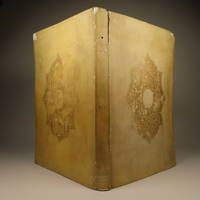
16536648<p>Full yapped vellum; large gilt arabesque decor to boards; particulars debossed in blind to spine. Encased in 1566 edition of J.L. Vives 1493-1540 De Officio Mariti published in Frankfurt.</p><p>Text and plates from the original 1609 printing but now with the Frankfurt 1653 title page. Without additions or corrections but lacking two tables "amphitheatri aeternae" & "primordialiter constituunt mundum". Maintains same curious pagination as 1609 editon 61-42-63; 145-146-145-146-147; 190-192-193-193. No missing pages.</p><p>Eleven plates from the 1609 edition 9 of which are folding attached to rear and twelfth plate at 1653 title page.</p><p>Rear plates most wholly or partially rebacked include: original 1609 title page portrait of Khunrath Tablet of Jesus Tablet of Adam Table of Rebis Laboratorium Designation of the Pyramids or Designatio Porta Amphitheatri Adumbratio Gymnasii Hypotposis Arcis and Feinde Figure of the Panel of Enemies this last with creature-caused losses to top peripheral text see image. Minor loss to upper margin of center fold of plates 8 & 9. Peripheral dampstaining to upper margin of plates 3 4 & 7. Watermark of a crest with 3 towers in a shield over a moat to plate 5. This reissue bound without the elusive wise owl.</p><p>Peripheral worming throughout margins with two exceptions; one of which travels without side-tracking from a2 through z4 see images. Wear and moderate soiling to boards. No previous owners' names or other markings. 222 pp. 1. 8 1/4 x 12 1/4 inches; 20 x 31 cm.</p> Tobiam Gundermannum; Guilielmus Antonius hardcover
1675009581Various places: Various publishers 1675. Book. Very good condition. Hardcover. First Edition. Numerous works bound in one volume. Half vellum binding with marbled paper-covered boards; moderately soiled. Previous owner's bookplate Bilharz on front paste-down endpaper and circular private library sticker at bottom of spine. Works include: 1. Moller D. G. "Dissertatio De Technophysiotameis Von Kunst- und Naturalien- Kammern." Henrici Meyeri: Altdorfii 1704. Dissertaion/Thesis F. S. Wuffbain respondent. 68 pages. 2. Fermin Phillipe. "Memoire sur l'origine de la belemnite contenant la decouverte de l'animal analogue a ce fossile." 4 page manuscript with folding manuscript illustration. Apparently a fair copy of the above named article published in Ph. Renard's "Considerations d'histoire naturelle" pp.63-76 in 1775. 3. Camerarius R. J. "Dissertation inauguralis medica de lapidum figuratorum usu medico." Johannis Cunradi Reissi: Tubingae 1718. Dissertaion/Thesis J. J. Straskircher respondent. 32 pages. 4. Marbodus Bishop of Rennes; edited by F. E. Bruckmann. "Marbodei Galli Poetae Uetustissimi de Lapidibus Pretiosis Enchiridion Cum Scholiis Pictorii Villingensis." Bruckmanniana: Wolffenbuttleae 1740. 82 2 pages. 5. Stella Erasmus; edited by F. E. Bruckmann. "Interpretament Gemmarum Libellus Unicus Plinius Secundus de Gemmis." Carol. Frid. Jungnicolium: Erfurti et Lipsiae 1736. 68 pages. 6. Hebenstreit J. E. "De Ordinibus Gemmarum Verbis C. Plinii ex eius Naturalis Historiae Libr. XXXVII. Qui Totus de Gemmis Est Disserens Panegyrin Medicam." Lipsiae 1747. 16 pages. 7. Hueber G. L. "Disssertatio Inauguralis Physico-Chemico-Medica de Margaritis Earumque Virtute Medica." Joannis Jacobi Christophori Kleyer: Wirceburgi 1744. Dissertaion/Thesis J.G. Gross respondent. 71 xv pages. 8. Vogel R. A. "Terrarum Atque Lapidum Partitio Disputatio Medica Solemnis." Schulzianis Rosenbusch: Gottingae 1762. Dissertaion/Thesis A. F. C. Hempel respondent. 54 pages. 9. Roederer J. G. "Decanus Ordinis Medici in Academia Georgia Augusta Jo. Georg Roderer D. Dissertationem Inauguralem" Schulzianis Rosenbusch: Gottingae 1762. Dissertaion/Thesis with vita of A. F. C. Hempel. 12 pages. 10. Reiske Johannes. "M. Joh. Reiskii de Glossopetris Luneburgensibus ad Virum Nobilissimum Atque Esperientissimum Joh. Georg Hieronymi." Joh. Georg. Lipperi: Lipsiae 1684. 56 pages one folded leaf of illustrations. 11. Guettard Jean Etienne; Philippe Buache. Folding Map. "Carte Mineralogique de la Suisse par Philippe Buache." 1752. 12. Hottinger J. H. "Dissertatio de Crystallis." Bodmeriano: Tiguri 1698. iv 44 pages illustrated by one folding leaf of gems/crystals. 13. Hensing J. T. "Dissertatio Chemica de Germinatione Metallica Arificiali Ejusdemque Novo Invento." Joh. Reinh. Vulpii: Giessae-Hassorum 1718. Dissertaion/Thesis Joh. Georgio Beck respondent. 35 pages. 14. Muller P. L. S. "Dubia Coralliorum Origini Animali Opposita." Io. Diter. Mich. Camerarii: Erlangae 1770. 22 pages. Probably another dissertation: Suscipiet Philippus Ludovicus Statius Muller. 15. Frank Johann. "Disertatio Physica de Coralio Juxta Ductum Plinii Hist. Nat. Lib.32.c.2. adornata." Praelo Bauhoferiano: Jenae 1675. Dissertaion/Thesis Paulus Linsius respondent. 12 leaves. 16. Folding leaf with text and illustrations of tube worms. Measures 10 x 14 inches. "Kurtze Abbildung und Beschreibung der ungewohnten entsetzlichen Wuermen.in gank Nord-holland." Circa 1735. Various publishers Hardcover books
1675009581Various places: Various publishers 1675. Book. Very good condition. Hardcover. First Edition. Numerous works bound in one volume. Half vellum binding with marbled paper-covered boards; moderately soiled. Previous owner's bookplate Bilharz on front paste-down endpaper and circular private library sticker at bottom of spine. Works include: 1. Moller D. G. "Dissertatio De Technophysiotameis Von Kunst- und Naturalien- Kammern." Henrici Meyeri: Altdorfii 1704. Dissertaion/Thesis F. S. Wuffbain respondent. 68 pages. 2. Fermin Phillipe. "Memoire sur l'origine de la belemnite contenant la decouverte de l'animal analogue a ce fossile." 4 page manuscript with folding manuscript illustration. Apparently a fair copy of the above named article published in Ph. Renard's "Considerations d'histoire naturelle" pp.63-76 in 1775. 3. Camerarius R. J. "Dissertation inauguralis medica de lapidum figuratorum usu medico." Johannis Cunradi Reissi: Tubingae 1718. Dissertaion/Thesis J. J. Straskircher respondent. 32 pages. 4. Marbodus Bishop of Rennes; edited by F. E. Bruckmann. "Marbodei Galli Poetae Uetustissimi de Lapidibus Pretiosis Enchiridion Cum Scholiis Pictorii Villingensis." Bruckmanniana: Wolffenbuttleae 1740. 82 2 pages. 5. Stella Erasmus; edited by F. E. Bruckmann. "Interpretament Gemmarum Libellus Unicus Plinius Secundus de Gemmis." Carol. Frid. Jungnicolium: Erfurti et Lipsiae 1736. 68 pages. 6. Hebenstreit J. E. "De Ordinibus Gemmarum Verbis C. Plinii ex eius Naturalis Historiae Libr. XXXVII. Qui Totus de Gemmis Est Disserens Panegyrin Medicam." Lipsiae 1747. 16 pages. 7. Hueber G. L. "Disssertatio Inauguralis Physico-Chemico-Medica de Margaritis Earumque Virtute Medica." Joannis Jacobi Christophori Kleyer: Wirceburgi 1744. Dissertaion/Thesis J.G. Gross respondent. 71 xv pages. 8. Vogel R. A. "Terrarum Atque Lapidum Partitio Disputatio Medica Solemnis." Schulzianis Rosenbusch: Gottingae 1762. Dissertaion/Thesis A. F. C. Hempel respondent. 54 pages. 9. Roederer J. G. "Decanus Ordinis Medici in Academia Georgia Augusta Jo. Georg Roderer D. Dissertationem Inauguralem" Schulzianis Rosenbusch: Gottingae 1762. Dissertaion/Thesis with vita of A. F. C. Hempel. 12 pages. 10. Reiske Johannes. "M. Joh. Reiskii de Glossopetris Luneburgensibus ad Virum Nobilissimum Atque Esperientissimum Joh. Georg Hieronymi." Joh. Georg. Lipperi: Lipsiae 1684. 56 pages one folded leaf of illustrations. 11. Guettard Jean Etienne; Philippe Buache. Folding Map. "Carte Mineralogique de la Suisse par Philippe Buache." 1752. 12. Hottinger J. H. "Dissertatio de Crystallis." Bodmeriano: Tiguri 1698. iv 44 pages illustrated by one folding leaf of gems/crystals. 13. Hensing J. T. "Dissertatio Chemica de Germinatione Metallica Arificiali Ejusdemque Novo Invento." Joh. Reinh. Vulpii: Giessae-Hassorum 1718. Dissertaion/Thesis Joh. Georgio Beck respondent. 35 pages. 14. Muller P. L. S. "Dubia Coralliorum Origini Animali Opposita." Io. Diter. Mich. Camerarii: Erlangae 1770. 22 pages. Probably another dissertation: Suscipiet Philippus Ludovicus Statius Muller. 15. Frank Johann. "Disertatio Physica de Coralio Juxta Ductum Plinii Hist. Nat. Lib.32.c.2. adornata." Praelo Bauhoferiano: Jenae 1675. Dissertaion/Thesis Paulus Linsius respondent. 12 leaves. 16. Folding leaf with text and illustrations of tube worms. Measures 10 x 14 inches. "Kurtze Abbildung und Beschreibung der ungewohnten entsetzlichen Wuermen.in gank Nord-holland." Circa 1735. Various publishers Hardcover
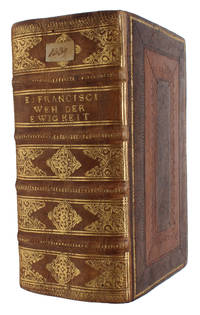
16814103Nürnberg: Wolfgang Moritz Endter and Johann Andreas Endter 1681. Thick 8vo 161 x 95 x 77 mm. 26 1214 2 pages. Title printed in red and black double-page engraved frontispiece or additional engraved title sixty-four numbered engraved plates of which four folding; 43 signed by Cornelius Nicolaus Schurtz 21 unsigned including one of the two frontispiece engravings folding plates 36 and 41 by J. Sandrart. Final errata leaf. Two gothic typefaces woodcut initials typographic printed music on p. 257. Contemporary vellum over pasteboards upper cover stamped in silver-gilt faded I.B.G.V.H. Johann Bernhard Graf von Herberstein and 1681 manuscript spine title edges red-stained lacking pair of fore-edge ties. fine. Provenance: Johann Bernhard Graf von Herberstein 1630-1685 binding and ms. inscription on frontispiece; Christoph Wenzel Graf von Nostitz -Rieneck 1648-1712 bibliophile art collector and art patron engraved armorial bookplate with initials C.W.G.V.N.; stencilled shelfmark 58 on backstrip; with Haus der Bücher Basel catalogue 706 Deutsche Literature der Barockzeit part 1 1963 no. 280.First Edition of a very rare baroque emblem book on the Last Judgment by one of Germany's first professional writers a beautiful copy in immaculate condition. Francisci son of the Lübeck jurist Franciscus von Finx named himself "son of Franciscus" i.e. Francisci. More unusual than this endearing foible was his successful career as a free-lance man of letters. A prolific and popular polymath Francisci died at the age of 68 "having left behind almost as many volumes" Allgemeine Deutsche Biographie. Throughout his career he worked as a sort of house author with the Nuremberg publishing house of the Endter family. "There was hardly an area of knowledge at which he did not try his hand. As one of the first full-time professional authors of Germany Francisci understood how to switch if the need arose to a new area of interest that promised good sales for his publisher" Dunnhaupt Bibliographisches Handbuch I p. 628 my trans. With gusto and success he catered to an audience hungry for tales of distant lands for folklore and "a world saturated with wonders" Faber du Faur German Baroque Literature p. 198 compiling tales of travel and distant lands compendia of natural history and curiosities historical works and devotional meditations. As the thickness of this volume intimates Francisci's Sitzfleisch was awe-inspiring. His versatility huge readership and connections with many members of the "republic of letters" made him one of the most influential German writers of the Baroque. While the prose of his religious works may seem cloying to the modern reader they sold as well as his secular compilations. Being widely read across social classes fine copies of his books are rare. The 64 Bedenckungen considerations of the present treatise are interwoven with fables anecdotes and digressions. Each is illustrated with an engraved emblem Sinnbild set within an exuberant ornamental border the borders of most of the 21 unsigned plates apparently by a less skilled engraver than Schurtz are plainer. Francisci is known to have worked closely with his illustrators and presumably collaborated on the design of these engravings by Cornelius Nicolaus Schurtz Joachim von Sandrart and one other engraver the 21 unsigned plates are in plainer borders and appear to be the work of a less skilled engraver. Characteristically varied in subject-matter the emblems and emblematic scenes are largely secular showing scenes of war domestic life natural disasters seafaring including shipwrecks the plant and animal world including exotic species children romping fireworks alchemical apparatus and even an amputation and a corpse being dissected in an anatomy hall. Only a few contain biblical scenes. Most striking are the four folding plates frightening panoramas of Judgment Day and the two unearthly frontispiece illustrations of which the first shows two men a virtuous man and a sinner in bed dreaming of their respective afterlives. Himself a tireless hymn-writer Francisci dedicated this work on Doomsday to one of the most important composers of Baroque hymns Magdalena Sibylla of Hesse-Darmstadt Duchess of Württemberg 1652-1712. The book includes twenty original hymns or Kirchenlieder to be sung to identified choral melodies. The presumably less well-known music for one Trostlied hymn of consolation is provided on p. 257 with accompanying bass line. This edition collates :8 - :1.8 : : 8 -::8 A-4G8: the signing of the two preliminary quires is odd but this copy is complete. The double-leaf engraving at front may have been counted as the first leaf of the first quire since the first letterpress leaf following the letterpress title is signed ":iii". Both the first quire containing the title-leaf and dedication and the second containing laudatory poems signed by S. E. Gr. zu L and by Joachimus Simon the foreword and the table of contents contain no 8th leaf. This matches other copies and seems to have been due to composing miscalculations resulting in the removal of the final blank of each quire. Some cataloguers included the two-leaf engraved title or frontispiece in their folio count counting 15 preliminary leaves and others more correctly count 13 leaves.Not in NUC; OCLC locates a single copy in an American library at Berkeley. VD-17 reveals that this edition is one of two variant typesettings with the same imprint the other is VD17 1:664300Y; priority is not known and they may be different states of the same edition. A second edition or possibly a re-issue of these sheets appeared in 1684. VD17 12:102498K; Goedeke Grundriss zur Geschichte der Deutschen Dichtung III: 90 176; Dünnhaupt Personalbibliographien zu den Drucken des Barock 1990-93 1538 32.1; Dünnhaupt Bibliographisches Handbuch der Barockliteratur 1980-81 I: 649 32; Praz Studies in Seventeenth-Century Imagery 339. Wolfgang Moritz Endter and Johann Andreas Endter unknown books
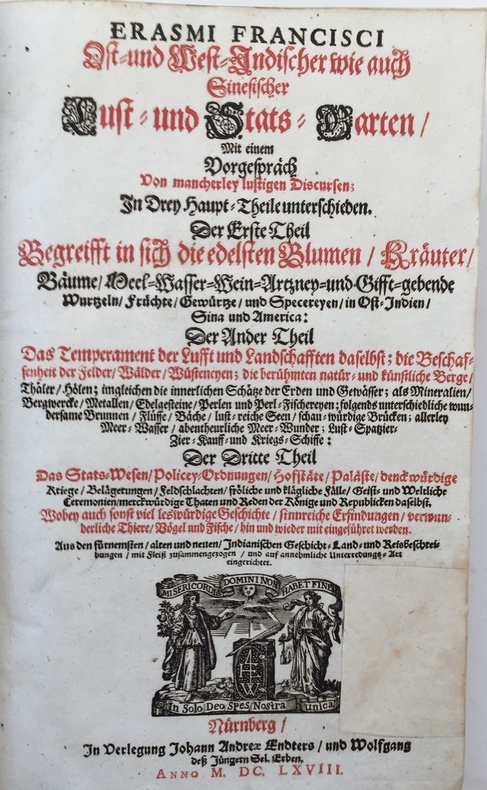
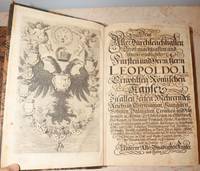
16684248Nuremberg, Johann A. Endters and Wolfgang Sel, 1668. 1668 3 parties reliées en 2 vol. in-folio (318 x 202 mm. de: [20] ff. (frontispice gravé, titre en rouge et noir, armes de Leopold I gravées par C.N. Schurtz, dédicace, liste des auteur), 1762 pp. ; [18] ff. (tables) ; 65 gravures à pleine page numérotées de 1 à 63, avec les planches 45 et 47 doublées (titre et feuillet de dédicace rognés courts, petite découpe comblée dans la marge du titre). Reliure à paneaux mosaïqués d'époque, dos à nerfs orné, titres de maroquin rouge, tranches marbrées ( dos restauré avec dos ancien conservé).
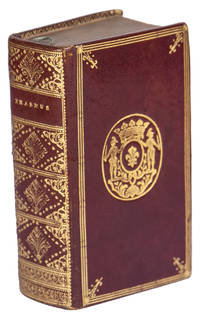
165818897Amsterdam: Joannes Janssonius 1658. 18th-century richly gold-tooled red morocco both boards show a triple fillet frame with small cornerpieces in the inside corners and an oval armorial centrepiece crowned fleur-de-lis flanked by two knights gold-tooled spine with "Erasmus" lettered in gold gold-tooled board edges and turn ins gilt edges marbled endpapers. 12mo. With an engraved title page a full-page engraving showing Erasmus woodcut decorated initials and several woodcut head- and tailpieces. Including: Coronis apologetica pro colloquiis Erasmi ex ipsius scriptis quantum per otium licuit fideliter collecta à P.S. accedit ejusdem De Collequiorum utilitate dissertatio. Montanus' edition of a renowned famous Latin schoolbook written by Erasmus one of the most used Latin schoolbooks for centuries as it discusses all basic scholarly and moral issues. With Erasmus' preface-letter to Froben at Basel dated 1524 and the Vita Erasmi preceding the Colloquia as well as two indices of authors and dialogues. Included at the end is a short essay explaining the usefulness of the book.With a few 17th-century annotations on the engraved and letterpress title pages resp. "1662" and "Besnier". The engraved title page is cut slightly short not affecting the engraving. Otherwise in very good condition.l Bibl. Belg. II E 572; Erasmus Coll. City Library Rotterdam p. 50; STCN 850071909 9 copies; Vander Haeghen p. 40. Joannes Janssonius, hardcover
1668V70496Nurnberg: Johann Andreas Endter & heirs of Wolfgang 1668. Hardcover. Good. Fine full-page engraved plates 65 numbered 1-63 with 2 bis plates 45 & 47 1 text illustration full page elaborate copperplate coat of arms of Leopold I by C.N. Schurtz. Folio old vellum spine split repaired front cover nearly detached. Bookplate of Bibliotheca Prieseriana showing books on shelves and small library stamp on pastedown. Titlepage in red and black with printer's mark of 2 female supporters with sun shining on clasped book with monogram AEW. Titlepage 36pp including full page copperplate coat of arms of Leopold I by C.N.Schurtz 1762pp 34pp indices 2pp errata with a few part-lines of loss to lower outer corner & tatty edges. Double column Gothic type with shoulder notes throughout. Two marginal tears with loss hardly touching print & first page of dedication with cropping to outer edge some corner creases else clean and no worming/no foxing/no ink marks. Despite its huge bulk the book block is square and tight. A fascinating early German account of travels and curisoties and one of the most famous illustrated natural history books of the 17th century Nissen 648; Sabin 25463. Johann Andreas Endter & heirs of Wolfgang hardcover
1613ABC_49605Utrecht 1613. 4to. Jan Amelisz Contemporary gold-tooled overlapping vellum sewn on 4 supports laced through the joints both boards show a double fillet frame with small ornamental cornerpieces in the inside corners and a large ornamental oval centrepiece on both boards and with small ornaments slightly faded and the manuscript title on the spine. With a woodcut printers device on the title page and the rare full-page engraved portrait of Erasmus which is lacking in at least 2 of the 4 copies known in an oval lettered: "Magnus ille Erasmus Roterodamus natus Roterdami Octobr. Ao 1467" with emblems in the corners ink pot trumpets hourglass and Bible and a Latin poem of 4 lines underneath "Post cineres vivo doctis tuta manet". This portrait of Erasmus on leaf p1r half to the left and seated his hands resting on an open book is apparently engraved after the portrait by Frans Huys of 1555 which he engraved after the painted portrait by Hans Holbein the Younger Hollstein Dutch & Flemish engr. and etches 132. On the verso of this portrait is a laudatory "Klanck-Ghedicht" sonnet for Erasmus between typographical borders; the same borders on leaf. p2r: the privilege by the States General verso blank. 18 141 3 ll. Very rare first and only edition of a collection of 27 colloquia dialogues by Erasmus and 13 by Lucian of Samosata ca. 125-after 180 CE. The colloquia were translated into Dutch by Andreas van Oosterbeeck fl. 1584-ca. 1620 a minister in Abcoude 1590 and Montfoort 1616. The 27 dialogues by Erasmus include Proci & Puella Virgo Misogamos Virgo poenitens Coniugium Adolescentis & Scorti Abbatis & Eruditae Puerpera Convivium Fabulorum Absurda Opulentia sordida Naufragium Charon Coniugium impar Inquisition de Fide Exorcismus sive Spectrum Peregrinatio Religionis ergo and others.The Colloquia familiaria is one of the main works by Desiderius Erasmus first published in 1518 as Latin dialogues for school exercises and expanded over the following decades with witty - albeit serious - and often controversial content including contemporary religious practises treated in a pervasively ironic tone. After Cornelis Crul's translations of a number of dialogues published between 1530 and 1545 these annotated translations by Andreas van Oosterbeeck are the first 17th-century edition followed in 1622 and 1634 by translation of the colloquia by Dirck Pietersz. Pers.After Erasmus' dialogues follow after a separate title page the 13 highly ironical dialogues originally written in Greek by Lucian: Gallus Toxaris Cnemon Zenophantes Tantalus Menippus Trophonius Charon Crates Nireus Mausolus Polystratus and Diogenes. These are all translated in Dutch by Andreas van Oosterbeeck after the Latin translations made by Erasmus from the original Greek. Lucian of Samosata - a town in Syria - was a Greek writer and satirist who lived in the 2nd century CE. He invented the genre of comic dialogue a parody of the traditional Socratic dialogues and wrote numerous satires about the Gods and public figures.With later annotations in pencil on the front pastedown and flyleave the fore-edge and the bottom outer corner of the back board are somewhat stained and soiled a water stain in the upper outer corner throughout. Otherwise in good condition.l Van der Aa 14 1867; Gheerebaert Lijst p. 57 LVI: Lucianus no. 1 First translation of a work by Lucianus in Dutch!; STCN 169198340 4 copies; USTC 1019209 4 copies same as STCN. hardcover
1668007387Nuremburg Nürnberg: J.A. Endters 1668. Half Leather sheep. Marbled paper pastedown on boards. Very Good. Three parts in two volumes. Folio 33 by 22 cm. 912 xxxxxx pp. J.A. Endters unknown
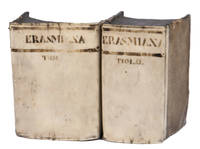
1642AB6GB5JMB8EQLeiden: Joannes Maire 1642. Contemporary half vellum paper sides with "Erasmiana tom. I or II" in manuscript on the spine blue edges. 12mo. Ad 1 with an engraved title page by C. van Dalen showing Erasmus standing in a church with a book in his left hand pointing to three other men. All title pages contain Maire's woodcut device see Breugelmans nr. 13 and a woodcut portrait of Erasmus in a roundel on leaf 8r in ad 1 and his device in a roundel in the text on leaf 25v in ad 1. Further with several woodcut decorated initials throughout. 14 works in 2 volumes. With:2 IDEM. Lingua sive de linguae usu atque abusu liber utilissimus.Leiden Joannes Maire 1649.3 IDEM. Moriae encomium cum Gerradi Listriis commentariis. Epistolae aliqut in fine additae. Leiden Joannes Maire 1648.4 IDEM. Dialogus Ciceronianus: sive de optimo genere dicendi. Leiden Joannes Maire 1643.5 IDEM. Dialogus de recta Latini Graecique sermonis pronuntiatione. Leiden Joannes Maire 1643.6 IDEM. De contemptu mundi liber. Leiden Joannes Maire 1641.7 IDEM. Querela pacis undique gentium ejectae profligataeque. Leiden Joannes Maire 1641.8 IDEM. De immensa Dei misericordia. Leiden Joannes Maire 1641.9 IDEM. Modus orandi Deum. Leiden Joannes Maire 1641.10 IDEM. Precationes quibus homines assuescant cum Deo loqui.Leiden Joannes. Maire 1641.11 IDEM. Enarratio in Psalmum I.Leiden Joannes Maire 1644.12 IDEM. Enarratio triplex in Psalmum XXII. Leiden Joannes Maire 1645.13 IDEM. Enarratio pia juxta ac docta in Psalmum XXXIV.Leiden Joannes Maire 1652.14 IDEM. Concionalis interpretatio plena pietatis in Psalmum LXXXVI.Leiden Joannes Maire 1652. These 14 important works by Erasmus - the edition of his most important letters after the Vita edited by Petrus Scriverius 1576-1660 his famous Laus stultitiae and 3 of his linguistic works in the first volume and 9 theological works in volume 2 - belong to a project of the Leiden publisher printer and bookseller Joannes Maire 1603-1657. This project that can be seen as a series of editions that together represent Erasmus' collected works ensured Maire's stellar reputation through the ages. 23 different works appeared between 1641 and 1652. It has long been thought that Petrus Scriverius was the editor but now there is proof that in fact Willem Henricus Vorstius a learned Remonstrant minister in the village of Warmond near Leiden did the job Breugelmans p. 24.11 works were published in 1641 5 of which in the present collection; 2 in 1642 1 present 3 in 1643 2 present 1 in 1644 also present 3 in 1645 1 present 1 in 1648 also present 1 in 1649 also present 1 in 1650 also present and 2 in 1652 both present. The whole collection brings together a representative selection of Erasmus' spiritual moral and exegetical writings - as it includes treatises on Christian prayer and devotion moral and ascetical reflections expositions of the Creed the Ten Commandments and the Lord's Prayer and commentaries on select psalms. It is presented together with Sriverius' edition of the Vita a biography of Erasmus.Printed in compact duodecimo format with Maires characteristic typographic elegance these Leiden editions form one of the most coherent 17th-century series of Erasmus spiritual writings.With a manuscript owner's inscription on the title pages of ads 1 and 6 a small manuscript inscription on the title page of ad 2 and a small manuscript inscription on the title pages of ads 3 5 and 6-14. Further with two library stamps of the Nordelbische Kirchenbibliothek in Hamburg incl. "Gelöscht" stamps on the versos of the title pages of ads 1 and 6. The bindings are dust soiled and slightly damaged along the extremities but the structural integrity of both bindings remains fine slight foxing and browning throughout. Otherwise in good condition.l Breugelmans Fac et spera. Joannes Maire 2003 1642:7 and other numbers; ads 2-6 and 10-14 in verzicht werken Erasmus Rotterdam 1936; all works in the STCN and USTC; Van der Haeghen I 182 and other numbers. A detailed list of references is available upon request. Joannes Maire, hardcover
16711002105London: E.T. and R.H. for H. Brome B. Tooke and T. Sawbridge 1671. First edition in English of the complete Colloquia Familiaria of Erasmus first published in 1518 and expanded by Erasmus over the next fifteen years a lively collection of Latin dialogues that found a readership far beyond the Renaissance schoolroom. Originally intended to model colloquial conversation for students of Latin the dialogues feature pointed free-thinking exchanges on modern political religious and philosophical questions. In "Of the Abbot and Learned Woman" an ignorant abbot tries and fails to get the better of the classically educated Magdalia a character almost certainly based on Thomas More's eldest daughter: "I think thou art some sophistress thou protest so wittily." Magdalia: "I will not tell thee what I think thou art." And later: "I have often heard it usually spoken that a wise woman is twice a fool." Magdalia: "Indeed it useth to be said so but by fools." The Colloquia Familiaria was widely read and debated across Europe drawing immediate notice for its anticlerical satire: "its influence on the dialogues of Reformation Germany and Tudor England is a critical commonplace" Zlatar Reformation Fictions 11. The original purpose of the Colloquies as a text for teaching Latin postponed its direct translation; this first complete English edition was published more than 150 years after the work's first appearance. The edition opens with a short life of Erasmus and concludes with the first appearance in English of De utilitate colloquiorum Erasmus's 1526 defense of the Colloquies published after the Sorbonne condemned the book for impiety. In response Erasmus makes a case for the educational value of his dialogues' humor: "I cannot tell whether any thing be learned more successfully than that which is learned in playing." Despite his efforts the Colloquies would remain on the Papal Index of banned books through the end of the nineteenth century. Wing E-3190; PMM 53. A very good copy of a humanist landmark in a handsome contemporary binding. Octavo measuring 6.5 x 4.25 inches: 8 555 1. Contemporary Cambridge-style full speckled calf boards ruled and ornamented in blind raised bands red morocco spine label lettered and decorated in gilt top edge stained black. Engraved frontispiece portrait of Erasmus. Final leaf containing second page of bookseller catalogue excised. Joints and spine head expertly repaired; evidence of bookplate removal on front pastedown; effaced signature on title page; some running titles shaved. E.T. and R.H. for H. Brome, B. Tooke, and T. Sawbridge unknown books
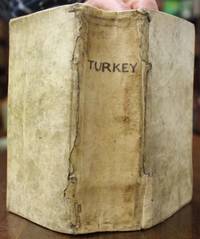
1664B5178Nuremberg: Johann Hofmann c. 1664. There is a fold across one half of the first engraved title page and minor wear but the book is in very good condition. Text and engravings are clean. Binding: Contemporary full vellum. Notes: Text in German. Two volumes in one. This book describes cities and strongholds during the fourth Austro-Turkish War 1663-1664 with the focus being on the year 1663 in particular. The Austro–Turkish War was a short war between the Habsburg Monarchy and the Ottoman Empire. The Ottoman aim was to resume the advance in central Europe conquer Vienna and subdue Austria. The book contains a detailed description of the siege of Vienna with maps and engravings; by C. M. Conrad Meyer perhaps.<br>Erasmus Finx 1627 – 1694 aka Erasmus Francisci was a German Polymath author and writer of Christian hymns. Finx was born in Lübeck the son of a lawyer and received higher education at Lüneburg and Stettin. He studied law and was travelling through Italy France and the Netherlands afterwards. As of 1657 he worked as a reader at Endter publishing at Nuremberg where he also published some of his books. <br> Size: 12vo 129x75mm. Illustration: Illustrated with 2 engraved title pages 4 fold-out maps and 6 views 5 fold-out. Volume: 2 volumes in 1 Provenance: Signed by someone dating to 1664 but the name has been covered by ink and is only partially readable. Pages: P. Blank. Engraved title page. Title page. Introduction 1-19. 1-379 80 mispag. 08. Index 1-5. Blank. Engraved title page. Title page. 1-187 164 mispag. 163. Project 1-21. Blank. Category: Book Europe Hungary; Book Military; Book Near East Turkey; Book Europe Germany; Book Europe Austria; Johann Hofmann hardcover
1676244187Basle: Genathianis 1676. First edition with Holbein's illustrations. Engraved additional title-page full-page engraved portraits of Erasmus Holbein the Elder and Holbein the Younger engraved transcription of Erasmus' memorial stone & 81 illustrations 6 mounted and folding all with the possible exception of 3 or 4 engraved by Caspar Merian from drawings by Holbein found in Oswald Myconius' copy of the 1515 Froben edition. 1 vols. 8vo. Contemporary calf gilt spine with leather label. Slight wear to spine tips joints starting but solid covers somewhat darkened internally fine. First edition with Holbein's illustrations. Engraved additional title-page full-page engraved portraits of Erasmus Holbein the Elder and Holbein the Younger engraved transcription of Erasmus' memorial stone & 81 illustrations 6 mounted and folding all with the possible exception of 3 or 4 engraved by Caspar Merian from drawings by Holbein found in Oswald Myconius' copy of the 1515 Froben edition. 1 vols. 8vo. Holbein's Illustrations to Praise of Folly. A series of illustrated satirical treates on Catholic dogma this book was released in English as "In Praise of Folly" and enjoyed a long life during the Protestant Reformation in several languages. Graesse II 495; Brunet II 1037 Genathianis unknown books
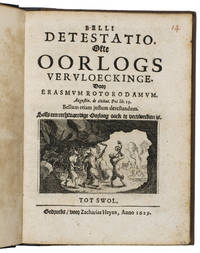
16292941Zwolle 1629. 4to. for Zacharias Heyns colophon: printed by Frans Jorrijaensz 19th century half brown morocco with the author title and imprint lettered in gold on the spine brown cloth sides. With a large engraved emblem on the title page 5 decorated woodcut initials a woodcut headpiece 2 headpieces built up from typographical ornaments a woodcut tailpiece and a tailpiece built up from typographical ornaments. 28 ll. First edition of Zacharias Heyns' new Dutch translation of Erasmus' famous anti-war essay Dulce bellum inexpertis. This essay was originally part of the 1515 edition of the Adagia but was first published as an independent work by Johann Froben in 1517 with the title Bellum. The present Dutch edition is quite rare as we have not been able to find any other copies in sales records of the past hundred years.The Adagia was first published in 1500 but Erasmus continued to edit the work until his death. The 1515 edition published by Froben was greatly expanded but the essay for the proverb Dulce bellum inexpertis war is sweet to the inexperienced was the longest and most remarkable addition. In the essay Erasmus argues that war is senseless unchristian and contrary to human nature. He also critiques the militaristic culture of his time which glorified violence and aggression and advocates instead for diplomacy and negotiation. The essay became so popular that Froben published it separately. Within ten years it had been reissued at Louvain twice at Strasbourg twice at Mainz at Leipzig twice at Paris twice at Cologne at Antwerp and at Venice. German translations of it were published at Basel and at Strasbourg in 1519 and 1520 and an English translation followed in 1533. The first Dutch translation was made in 1622. The present second Dutch translation made during the Eighty Years' War shows how the work continued to inspire more than a hundred years after it was first written.The spine has been slightly rubbed. The end paper are browned the work is lightly browned throughout. Otherwise in good condition.l Knuttel 3921; Bibl. Belgica E 247; Erasmus Bibl. Rotterdam p. 29; Erasmus Online 465; STCN 831153881; USTC 1026760; Vander Haeghen I p. 22. hardcover
168260722Nürnberg W.M. Endters 1682 8vo. In a nice contemporary Cambridge-style mirror binding with four raised bands and richly gilt spine. Small paper-label pasted on to top of spine. A very nice copy. 28 1195 5 pp. frontispiece and 51 engraved plates. <br/><br/><em>Rare first edition of Franciscus' extensive work richly illustrated with exotic depictions of the road to hell. A second edition was published in 1686. German Emblem Books 1531-1888: 290. </em> hardcover
168260722Nurnberg, W.M. Endters, 1682 8vo. In a nice contemporary Cambridge-style mirror binding with four raised bands and richly gilt spine. Small paper-label pasted on to top of spine. A very nice copy. (28), 1195, (5) pp. + frontispiece and 51 engraved plates.
1671Pv5b111a<p>"Prince of Christian Humanists" Desiderius Erasmus 1466 1536 was undoubtedly the most widely read author of the 16th Century. His books were best sellers; his writings accounted for 10-20% of all book sales in Europe by the 1530's. Presented here is the first Printing in the English language of his Colloquies A Work of very great Use to such as desire to attain an exact knowledge of the Latin Tongue. First published in 1518 and expanded by Erasmus over the next fifteen years Erasmus' Colloquies deliver a collection of lively dialogues which delighted readers far beyond the Renaissance schoolroom for whom these were originally intended. They cover a wide range of topics including religion education morality and social issues. The dialogues often satirical and critical address the issues of Erasmus' time and offer sharp commentary on contemporary society. The Colloquies were intended to teach Latin and moral lessons to students but they also serve as a window into the intellectual and cultural landscape of the Renaissance. The English translation of the Erasmus' Colloquies introduced English-speaking audiences to Erasmus' ideas and philosophy creating a profound impact on European intellectual thought during the Renaissance. The Colloquies also played a key role in the development of English prose and language as they were widely read and studied by both students and scholars. This highly enticing very scarce first printing is in excellent condition professionally rebound in full leather with five compartments and four ribs to spine with bright gilt details and title. Binding and hinges are firm new end papers and paste downs no loose or missing pages. Completely free of writings or markings of any kind light scattered foxing some mild damp staining to early and last pages see photos. 555 pages. A desirable example of this most significant Erasmus first appearance in English. Book #Pv5b111. $1895. We specialize in Rare Ayn Rand and other legends and landmarks.</p> Brome, Tooke, Sawbridge hardcover
1603114251Witebergae, Impensis Zacharia Schüreri, impr. Typis Cratontanis 1603 In-16 15,5 x 9,5 cm. Reliure de l’époque vélin ivoire, dos lisse, titre manuscrit illisible, [50]-268-[10] pp. Ouvrage d’une relative rareté. Reliure patinée, pages de garde et de titre déchirées, en coin de pied, 50 premières pages sensiblement jaunies, 1 cahier délié, intérieur correct.
1688LD6060Nurnberg: Hoffmann c. 1688. Hardcover. Very Good. Modern black morocco gilt-stamped lettering in red leather spine label gilt detail stamped direct on spine; 4to; pp. 3-52 plus 46 plates 11 of which are folding and heavily restored; 1 of which is laid-in. First title-page printed in red and black and with 3 additional lavishly engraved half-title pages. Binding is very fine indeed but condition of text block varies -- many folding plates restored full-page plates sometimes a bit browned sometimes a bit fragile and tissuey and sometimes remarkably nice and bright. A nice copy overall offering images of ornate columns window frames cornices ceilings and more. Sold as is. <br/><br/> Hoffmann hardcover books
1688LD6060Nurnberg: Hoffmann c. 1688. Hardcover. Very Good. Modern black morocco gilt-stamped lettering in red leather spine label gilt detail stamped direct on spine; 4to; pp. 3-52 plus 46 plates 11 of which are folding and heavily restored; 1 of which is laid-in. First title-page printed in red and black and with 3 additional lavishly engraved half-title pages. Binding is very fine indeed but condition of text block varies -- many folding plates restored full-page plates sometimes a bit browned sometimes a bit fragile and tissuey and sometimes remarkably nice and bright. A nice copy overall offering images of ornate columns window frames cornices ceilings and more. Sold as is. <br/><br/> Hoffmann hardcover
1676Flo430<p>Very good copy of Erasmus of Rotterdam's <em>Moriae Encomium In Praise of Folly </em>the first edition with the marginal illustrations by Hans Holbein the Younger.</p><p><em>Morias Enkomion. Stultitiae Laus. Des. Erasmi Rot. Declamatio Cum commentariis Ger. Listrii & figuris Jo. Holbenii. E codice Academiae Basiliensis.</em></p><p>The illustrations were engraved by Caspar Merian after the marginal drawings in pen and ink by 18-year-old Hans Holbein in Oswald Myconius's copy of Erasmus' <em>Encomium Moriae </em>of 1515. The images show jesters with marottes kings and bishops nobles attacked by demons gluttons and drunks saints with monsters priests and monks in fools caps spinners astrologers etc. There is also an image of Erasmus before a lectern in his study.</p><p>With three engraved full-page plates title-page portrait of Erasmus and Erasmus' memorial stone along with 78 engravings in the text 6 folding engravings mounted in the text as well as 6 decorative initials and 4 tailpieces. Lacking the portraits of Holbein the Elder and Holbein the Younger.</p><p><em>In Praise of Folly</em> is a satirical Latin essay by the Dutch humanist Erasmus written after a stay with Sir Thomas More in London. It was a surprising hit and was reprinted and translated into other languages throughout Europe.</p><p>In contemporary vellum backed boards ivory vellum grubby and rubbed interior mostly clean with a few finger smudges all engravings bright and strong with good impressions of the woodcuts. Page 3 has a 5cm tear near the gutter with no loss of text. No markings apart from previous bookseller's pencil description on front endpaper.</p><p>Very good 17th-century copy of a classic satire against the Church.</p> Typis Genathianis hardcover
16418AGGC6NMSWHRLeiden 1641. 12mo. Joannes Maire Contemporary overlapping vellum sewn on 3 supports laced through the joints blue edges. With Maire's woodcut devices on all four title pages several woodcut decorated initials throughout. 4 works in 1 volume. 264; 330 2 blank; 144; 1 1 blank 6 4 blank 176 2 blank pp. Fine Sammelband with four theological works by Desiderius Erasmus all published by the well-known Leiden printer Joannes Maire. The present work containing four 17th-century editions reflects the enduring popularity of Erasmus' didactic and theological writings nearly a century after his death.Ad 1: Maire's 1641 his only edition of this compact Latin devotional treatise by Erasmus offering a concise moral and theological commentary on two foundational elements of Christian doctrine: the Apostles' Creed and the Ten Commandments. The work was intended for private reflection or instructional use and it is a good example of Erasmus' characteristic blend of lucid humanist prose and practical Christian ethics urging readers toward sincere faith and virtuous conduct.Ad 2: A finely printed Latin edition of one of Erasmus' most celebrated devotional treatises "The Handbook of the Christian Soldier". The work serves as a practical guide to inner piety and spiritual discipline advocating a faith grounded not in ritual or external observance but in the renewal of the heart and the imitation of Christ. It is preceded by a letter of Erasmus to Paulus Volsius dated Basel 15 August 1518.Ad 3: A succinct yet profound devotional treatise by Erasmus offering guidance on the true manner of prayer and the cultivation of inward piety. The present work distils Erasmus' humanist spirituality into a meditative discourse on sincerity humility and the necessity of aligning one's will with divine purpose. It rejects rote recitation and superstition in favour of heartfelt communion with God reflecting the author's lifelong concern with the reform of Christian practice through education and interior devotion. It was written in the form of a letter to the Polish diplomat and palatine voivode of Inowroclaw and of Sieradz Hieronymus Jaroslaw Laski 1496-1542.Ad 4: A thoughtful and conciliatory treatise by Erasmus addressing the urgent need for unity and peace within a divided Christendom. Originally written and published in the aftermath of the early Reformation it embodies the author's lifelong plea for moderation mutual understanding and the healing of ecclesiastical discord through charity and reason rather than dogmatic strife. The present work shows Erasmus' conviction that genuine reform must begin with the renewal of hearts and minds not the multiplication of schisms a message that remained relevant amid the theological turbulence of the 17th century. The work is preceded by a letter written by Erasmus to the last Catholic bishop of the Diocese of Naumburg Julius von Pflug 1499-1564.With an annotation in Latin on the front pastedown 3 owner's inscriptions on the title page of ad 1 ''Sum Justi Caspari Scherii Berol. Marchici'' Justus Caspar Scher ca. 1700; "Johannes .man. 1651." and "constat 32. gl" and marginal annotations and underlining of the text in ad 2. The binding is somewhat dust soiled slight foxing throughout. Otherwise in good condition.l Ad 1: Breugelmans Fac et spera p. 475; Catalogue of the Erasmus collection in the City Library of Rotterdam p. 128; STCN 840230494; USTC 1028902; Vander Haeghen Bibliotheca Erasmiana p. 105; ad 2: Breugelmans Fac et spera p. 473; Catalogue of the Erasmus collection in the City Library of Rotterdam p. 98; STCN 114270627; USTC 1015925; Vander Haeghen Bibliotheca Erasmiana p. 83; cf. STCN 840231318; USTC 1028909 both ref. for different issue same ed.; ad 3: Breugelmans Fac et spera p. 477; Catalogue of the Erasmus collection in the City Library of Rotterdam p. 148; STCN 840230583; USTC 1028904; Vander Haeghen Bibliotheca Erasmiana p. 121; cf. STCN 06126220X; USTC 1011884 both ref. for different issue same ed.; ad 4: Breugelmans Fac et spera p. 493; Catalogue of the Erasmus collection in the City Library of Rotterdam p. 140; STCN 840230362; USTC 1028901; not in Vander Haeghen Bibliotheca Erasmiana. hardcover
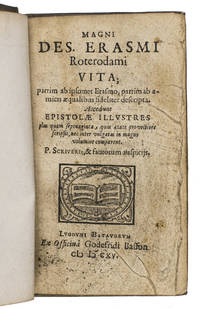
1615AAVD49P5O5GWLeiden: Govert Basson 1615. Contemporary vellum sewn on 3 vellum tapes laced through the joints with the manuscript title on the spine red edges. 12mo. With a woodcut printer's device on the title page a woodcut roundel with portrait of Erasmus on leaf 5 a divisional title page for Erasmus' letters and a few woodcut decorated initials. Important collection of sources for the biography of Desiderius Erasmus 1469-1536 put together and edited by Petrus Scriverius on the basis of the 1607 edition by Merula of the Compendium vitae including a number of new sources and four hitherto unpublished letters by Erasmus. The humanist and independent scholar Petrus Scriverius 1576-1660 worked in Leiden outside the University but he was in continuous contact with the most famous Leiden professors. Scriverius added commentaries and connecting texts by which the collection gained weight as materials for Erasmus' biography. Also through the later editions edited by Thysius and published by Joannes Maire in 1642 and 1649 the collection became very influential regarding Erasmus' "image" before the first critical biography of Erasmus was published by Joannes Clericus in 1705.With a few near-contemporary manuscript annotations and markings in the margins. The vellum and the title page are slightly dust soiled the pastedowns have detached from the inside of the boards and the front pastedown is lacking the upper outer corner the bottom outer corner of leaf C6 is sligthly damaged not affecting the text some occasional very slight foxing. Otherwise in good condition.l Knaake II 355a; STCN 832265039; Tuynman 'Petrus Scriverius 1576-1660' in: Quaerendo 7 1977 pp. 4-45 esp. 23-4; USTC 1027478; Vander Haeghen 182. Govert Basson, hardcover
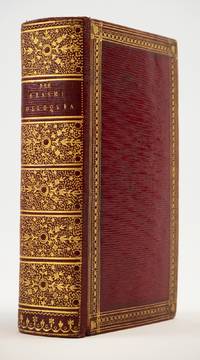
1643ST20492Lugduni Batavorum Leyden: Bonaventura Elzevier and Abraham Elzevier 1643. Second Elzevier Edition. 137 x 78 mm. 5 1/2 x 3". 12 p.l. 672 44 pp. 2 leaves. <br/> ELEGANT EARLY 19TH CENTURY RED STRAIGHT-GRAIN MOROCCO VERY ELABORATELY GILT BY BOZERIAN unsigned but see below covers framed by bead-and-star roll enclosed with double gilt fillets leaf tools at corners. smooth spine in compartments with large central fleuron of floral lancets emanating from central circlet in a richly stippled ground small circles at corners one compartment with gilt lettering cresting tulip and violet roll at foot of spine turn-ins with bead-and-star roll marbled endpapers vellum flyleaves all edges gilt. Woodcut initials headpieces and tailpieces numismatic portrait tondo fine engraved title page by C. C. Dusend showing Erasmus gazing through a telescope at the Godly orb seen through parted clouds. Willems 552; Rahir 546; USTC 1027918. For the binding: Culot "Jean Claude Bozerian" Roulette 9 Plate I and Palette 12 Plate X. Just barely perceptible rubbing to joints and extremities one leaf with tiny burn hole affecting a couple of words intermittent minor foxing negligible ink spots here and there other trivial imperfections but an extremely attractive copy the text fresh and clean and the very well-preserved binding with lustrous leather and bright gilt.<br/> <br/> This is a remarkably pretty copy of an extremely influential but generically elusive work printed by a legendary press and bound by the founder of a celebrated French binding dynasty. First published in 1524 the "Colloquia" comprise 63 conversations originally written for Erasmus' students on varied and overlapping topics but these urbane meditations soon became widely read as they covered subjects that intrigued the important thinkers of the day. Their influence was so profound that it is not saying too much to claim that they helped to speed the Reformation. Although they are difficult to classify precisely one could categorize them as including in general terms exposure of ritualistic fallacies invective against corruption within the church examination of popular imposture deploring of contemporary personal sins practical advice for laymen and miscellaneous discussion of amusing topics. In specific terms the text takes on such controversial topics as the value of pilgrimage celibacy and abstinence from meat on Fridays and other prescribed days. Erasmus' "Colloquia" was frequently published by the Elzeviers once in French and a total of nine times in Latin. The text was universally adopted for school use up through the 18th century. Although our lovely little binding is unsigned Culot firmly identifies its tools as those used by Jean-Claude Bozerian 1762-1840. He was the elder of the Bozerian brothers François is referred to as "le jeune" and was active in Paris from 1795 to about 1810. He began his career in Lyon as an apprentice bookseller printer and bookbinder eventually deciding to focus on the latter craft. Marriage to the widow of binder Pierre Boulier allowed him to establish a binding workshop in Paris where he was joined by his brother. His bindings were soon much in demand by French bibliophiles who appreciated their superior materials tasteful design and flawless execution--all characteristics that are plainly evident in the present case. Bonaventura Elzevier and Abraham Elzevier unknown
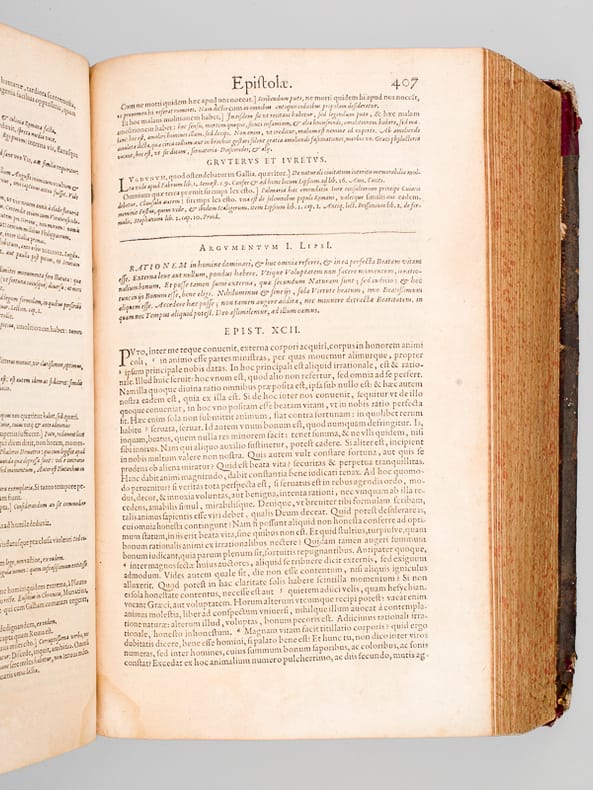
160762101Ad veterum exemplarium fidem nunc recens castigata : Graecis lacuni, quibus superiores Editiones scatebant, expletis ; Ac illustrata Commentariis selectioribus, quorum Auctores citantur pagina sequenti, Accessere Loci Communes ex utroque Seneca facti ; Auctore D. Gothofredo I. C., 1 vol. fort in-folio reliure de l'époque pleine basane granitée, dos à 6 nerfs orné, P. Chevalier, Parisiis [ Paris ], 1607, 24 ff. (certains paginés), 974 pp., 23 ff. n ch., 116 pp., 6 ff. n. ch., 284 pp. [ pp. 277-284, cahier Aa interverti avec le cahier suivant "*" ], [ And. Schottus De Claris apud Senecam rhetoribus ... : ] 98 pp., 17 ff. n. ch.