119 résultats
167649945Basel, Genethianis, 1676. 8vo. Contemp. full vellum. 2 small nicks to vellum at fronthinge. Engraved title-page and printed title-page. (70),336,(12) pp. The printed titlepage with engraved vignette. 2 full-page engravings (portrait of Erasmus by Holbein and Erasmus' Memorial Stone). With 78 textengravings by Hans Holbein (engraved by Casper Merian), some of which are tipped in and folded, some printed in the text. Lacks the 2 portraits of Holbein the Elder and Holbein the Younger. Some leaves in the middle with faint browning in lower part. 2 of the tipped-in engravings with a bit of repair. Printed on good paper.
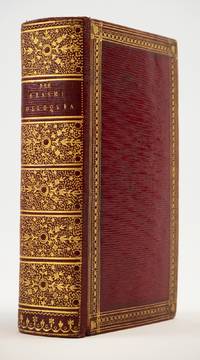
1643ST20492Lugduni Batavorum Leyden: Bonaventura Elzevier and Abraham Elzevier 1643. Second Elzevier Edition. 137 x 78 mm. 5 1/2 x 3". 12 p.l. 672 44 pp. 2 leaves. <br/> ELEGANT EARLY 19TH CENTURY RED STRAIGHT-GRAIN MOROCCO VERY ELABORATELY GILT BY BOZERIAN unsigned but see below covers framed by bead-and-star roll enclosed with double gilt fillets leaf tools at corners. smooth spine in compartments with large central fleuron of floral lancets emanating from central circlet in a richly stippled ground small circles at corners one compartment with gilt lettering cresting tulip and violet roll at foot of spine turn-ins with bead-and-star roll marbled endpapers vellum flyleaves all edges gilt. Woodcut initials headpieces and tailpieces numismatic portrait tondo fine engraved title page by C. C. Dusend showing Erasmus gazing through a telescope at the Godly orb seen through parted clouds. Willems 552; Rahir 546; USTC 1027918. For the binding: Culot "Jean Claude Bozerian" Roulette 9 Plate I and Palette 12 Plate X. Just barely perceptible rubbing to joints and extremities one leaf with tiny burn hole affecting a couple of words intermittent minor foxing negligible ink spots here and there other trivial imperfections but an extremely attractive copy the text fresh and clean and the very well-preserved binding with lustrous leather and bright gilt.<br/> <br/> This is a remarkably pretty copy of an extremely influential but generically elusive work printed by a legendary press and bound by the founder of a celebrated French binding dynasty. First published in 1524 the "Colloquia" comprise 63 conversations originally written for Erasmus' students on varied and overlapping topics but these urbane meditations soon became widely read as they covered subjects that intrigued the important thinkers of the day. Their influence was so profound that it is not saying too much to claim that they helped to speed the Reformation. Although they are difficult to classify precisely one could categorize them as including in general terms exposure of ritualistic fallacies invective against corruption within the church examination of popular imposture deploring of contemporary personal sins practical advice for laymen and miscellaneous discussion of amusing topics. In specific terms the text takes on such controversial topics as the value of pilgrimage celibacy and abstinence from meat on Fridays and other prescribed days. Erasmus' "Colloquia" was frequently published by the Elzeviers once in French and a total of nine times in Latin. The text was universally adopted for school use up through the 18th century. Although our lovely little binding is unsigned Culot firmly identifies its tools as those used by Jean-Claude Bozerian 1762-1840. He was the elder of the Bozerian brothers François is referred to as "le jeune" and was active in Paris from 1795 to about 1810. He began his career in Lyon as an apprentice bookseller printer and bookbinder eventually deciding to focus on the latter craft. Marriage to the widow of binder Pierre Boulier allowed him to establish a binding workshop in Paris where he was joined by his brother. His bindings were soon much in demand by French bibliophiles who appreciated their superior materials tasteful design and flawless execution--all characteristics that are plainly evident in the present case. Bonaventura Elzevier and Abraham Elzevier unknown
168849228Cologne disguised; Paris or the Netherlands: Adrian Le Jeune 1688. First edition. Hardcover. Very good . Duodecimo. Collation: aster.12 2aster.6 A-R12 S4 = 226 leaves. 36 415 1 blankpp. Engraved frontispiece and headpiece; woodcut lettrines head- and tailpieces; printed side notes. Contemporary calf mildly worn at extremities; gilt tooled spine with raised bands gilt lettering piece; edges sprinkled in red. Old inscription cropped from top edge title; one leaf with clean marginal tear just extending into text else fine and crisp throughout.<br /> <br /> First edition of this defense of Jansenism via the celebrated scholar of Rotterdam. Among the works reviewed by Locke for Jean Le Clerc the present title “indicated a new wave of interest in Erasmus†Mansfield. “Jean Richard 1615-1686 wanted to persuade the Roman Catholic Church that in persecuting the Jansenists it was as much in error as it had been when it denounced Erasmus. He also wanted to convince the English monarch that despite appearances to the contrary Erasmus had never adopted any stance outside the Catholic Church†van Herwaarden. The author surely intends the quotation from Cyprian at the verso of the title as a reference to both Erasmians and Jansenists: “This is always the devil’s work to destroy with lies the servants of God and defame their glorious name with false opinions†trans. Mansfield. Early modern reviews were mixed: Bayle considered it a “pity that the author. stopt at the first part of it†General Dictionary 5 1737 “Erasmus†85 note T. Burigny Vie d’Erasme Paris: 1758 judged it “. so badly done and so filled with invectives and declamations that it does not lead one to wish for the second†547; quoted in Mansfield 293n.<br /> <br /> In 1660 the French cleric Jean Richard was imprisoned by the archbishop of Rouen de Harlay a bitter opponent of Jansenism."During this personal crisis he published two works in defense of his Jansenist belief and behaviour. As we shall see there are grounds for believing that his Sentimens. was meant in part at least to achieve the same end. Nevertheless mysteries surround the work: it was published posthumously Richard died in 1686 having been prior of Beaulieu Saint-Avoie since 1673; what we have is the first part and we may only guess at how seriously the promise of a second part was intended. As it stands this is an ill-organized book repetitive with many digressions but filled with a naive enthusiasm and fascinating partly because of the evidences of a sound judgment about Erasmus partly because of the tantalizing but insoluble problem of the author’s aims. The avowed aim was proselytism. The book is dedicated -- on the eve of the Revolution of 1688 -- to James II of England a new Theodosius who is hazarding three kingdoms for the sake of the kingdom of heaven. May it help the English people to follow the king’s example in conversion to Catholicism by showing them the true character of Erasmus’ religion" Mansfield. References: Barbier 4:467. J. v. Herwaarden Between Saint James and Erasmus Studies in Late-Medieval Religious Life 598; Jöcher 3:2078; VD17 12:110664Q. For a thorough discussion see B. Mansfield Phoenix of His Age: Interpretations of Erasmus c. 1550–1750 Toronto 1979 163–174. Locke’s review appears in Bibliotheque universelle et historique VII 1688: 106-122. Adrian Le Jeune hardcover
16651183[Amsterdam, Elzevier], 1665 ; in-12 de 187 pp., [2] ff., reliure du Second Empire maroquin rouge, deux filets en encadrement sur les plats, dos à nerfs orné de caissons dorés, dentelle intérieure, tranches dorées (Thompson).
165012687Amstelodami Amsterdam: Typis Ludovici Elzevirii 1650. Acceptable. From Elzevir the Renaissance scholar's press 1650. In 'pocket' format 3"x5" in full leather. Pictorial title page. Lower third of spine missing board detached but present. Text has been trimmed at top edge. In cloth box. Shadrach Munnings armorial bookplate and bookplate of "Collegii Sti Augustini". The great Christian humanist scholar and teacher evolved the Colloquies as a collection of dialogues on a wide variety of subjects. They began in the late 1490s as informal Latin exercises for Erasmus' own pupils. In about 1522 he began to perceive the possibilities this form might hold for continuing his campaign for the gradual enlightenment and reform of all Christendom. Typis Ludovici Elzevirii hardcover
1689290919London but Germany . 1689. Old green boards. Good covers worn old in name to ffep pages lightly toned contents very good. 12mo. 13.5x8.3 cm. Latin text. “Letters of Obscure Men†a collection of humanist satire directed at the scholastics first published in the early 16th century. Weight: 0.7 lb. Nine portrait plates. hardcover
16518563Deventer Johannes Colomp 1651. 'engraved titlepage 248 p. Contemporary cardboard Binding 12° spine is worn Rare fourth edition of the translation into Latin of Erasmus Alberus' Der Barfusser Monche Eulenspiegel und Alkoran a prose satire to which Martin Luther wrote the postscript. The first edition of the German original appeared in Wittenberg by Hans Luft in 1542 followed by the Latin translation in Frankfurt a year later. The second and third Latin edition were published resp. in 1560 and 1578. This parodic adaptation of the Liber conformitatum of the Franciscan Bartolommeo Rinonico or Albizzi of Pisa is written by Erasmus Alberus ca. 1500-1553 a German humanist reformer and poet who was born in the village of Bruchenbrücken near Frankfurt am Main. Although his father was a schoolmaster his early education was neglected. Ultimately in 1518 he found his way to the University of Wittenberg where he studied theology. He had the good fortune to attract the attention of Martin Luther and Philipp Melanchthon and subsequently became one of Luther's most active helpers. Not only did he fight for the Protestant cause as a preacher and theologian but he was almost the only member of Luther's party who was able to confront the Roman Catholics with the weapon of literary satire. After Luther's death Alberus was for a time a deacon in Wittenberg he became involved however in the political conflicts of the time. In 1552 he was appointed Generalsuperintendent at Neubrandenburg in Mecklenburg where he died on the 5th of May 1553. Deventer, Johannes Colomp unknown
1681PHO-1835Londini, George Wells, 1681, 4°, 2ff.-748pp., plein vélin époque, dos lisse avec titre manuscrit.
166097125ABLübek, auf Michal Volken kosten gedruckt bey säl. Schmalherzen Erben, 1660. Ca. 13,5 x 8 cm. 24 Blläter, 297 S., 18 Blätter. Ganzpergamentbd. der Zeit m. hs. Rückentitel. - Sehr gutes Ex.
1662013144Amsterdam: Apud Ioannem Ianssonium - Johannes Janssonius 1662 Book. Good. Hardcover. 249 15 pages. The title page is engraved. In modern full vellum binding some soiling. Ink number to the front free end paper. Old ink name to the foot of the title page. Light browning and some staining and spotting to pages. Apud Ioannem Ianssonium - Johannes Janssonius hardcover
16432209030005Ex Officina Elzeviriana Lugd. Batavorum Leiden 1643. Hardcover. Good. Bound in full contemporary polished calf. 4 raised spine bands red leather spine label. Head of spine chipped. Good binding and cover. 22pp including engraved title pp. 672; pp. 44. Early marginalia on front paste down. Willems 552. Ex Officina Elzeviriana, Lugd. Batavorum [Leiden] hardcover
167052391670. : 6 The bottom edges of the front and back cover are damaged. 6 Blank pages / Frontispiece / Title Page / 470 Pages / 33 NNP / 9 Blank pages Binding: Contemporary Full Vellum 24mo Height cm: 14 CM Width cm: 8 CM Thickness cm: 4 CM hardcover
164129349<p>Desiderius Erasmus wrote Enchiridion militis Christiani as a guide for Christian discipline urging a life shaped by integrity rather than outward observance. First circulated in 1503 the work became a classic of Renaissance humanist thought read across Europe for generations. This 1641 edition was issued in Leiden by Ioannis Maire and reflects the sustained appeal of Erasmus's teachings more than a century after their first printing. The book is presented in sextodecimo format measuring 5 by 3 inches with 330 pages. Condition: Very Good. The binding with leather spine and marbled boards remains secure with some hinge wear gilt lettering visible on the spine and internally the pages are clean. Collation: 330 pp. No illustrations are present. Edition: 1641 printing. References: not cited. #29349 PHOTOS AVAILABLE UPON REQUEST.</p> officina Ioannis Maire hardcover
169994182Christopheri Salfeldii b. 1699. Hard cover. Fair/No jacket. Bin 4 Long Case. From the library of Friedrich Adolf Trendelenburg and containing his bookplate. Trendelenburg was a key influence on Soren Kierkegaard and the teacher of Franz Brentano and Wilhelm Dilthey. In Latin.<br /> <br /> Cover is heavily worn browned and soiled. Parts of spine are missing and the rest is peeling off binding but remains attached to cover boards. Spine is cracked but all pages remain attached to binding. Pages are tanned and heavily foxed but text is legible. Christopheri Salfeldii b. unknown
168550211<p>This 1685 Amsterdam edition of Desiderius Erasmus's MÅrias EnkÅmion or Stultitiæ Laus presents a Latin printing of one of the most recognized works of Renaissance humanism. First composed in 1509 the text uses satire to examine European society religious customs and intellectual traditions drawing on classical references and allegorical structure. Erasmus remains a central figure in early reformist thought and this work circulated widely across Europe in numerous editions. This compact format reflects continued readership in the seventeenth century. Provenance: Bookplates of Giles Robertson 1913–1987 20th-century British art historian and expert on the Italian Renaissance; and D.S. Robertson 1885–1961 classical scholar and the Regius Professor of Greek at the University of Cambridge on front endpaper. Good full leather binding with tight and secure text block; front cover attached only by threads front endpapers with extensive handwritten notes titled "Index Capitum" pages generally clean with minimal foxing. 16mo single volume. Collation: 8 152 pp. Illustrations: engraved title page. Edition: 1685 edition. #50211. PHOTOS AVAILABLE UPON REQUEST.</p> Henricum Wetstenium hardcover
1671285135Amstelodami: Apud Joannem Ravesteinium 1671. Editio Novissima. Full Leather. Very Good binding. The revised 1671 edition of a collection of aphorisms from ancient Greek and Roman authors edited by the Christian Humanist and classical scholar Erasmus of Rotterdam. Text in Latin. Additional title page engraved; vignette on the title page; engraved initials and tailpieces. Collates complete; 24 642 28 pp.; final page blank; index at the rear. Occasional trimming to the top edge not affecting the running title or pagination. Attractive period binding; full leather with raised bands and titling in gilt on the spine. 32mo in 12. Very Good binding. Apud Joannem Ravesteinium unknown books
164183431641 basane époque (à restaurer mq. coiffes sup. et inf). pet. in-12, 143 et 105pp., Lugduni Batavorum Jean Maire 1641,
165033251BBAmsterdam, Ludwig Elzevir 1650. 24°. 4 n.n. Bl., 589 S., 3 n.n. S. Inhalt. Mit gestochenem Titelkupfer. Pergament der Zeit.
164350089Lugd. Batavorum (Leiden), Ex Officina Elzeviriana, 1643. 12mo. Contemp. full vellum. Some browning to spine and covers. Ms title on spine. Engraved title-page (mounted). (22),672,44 pp. Some old underlining to the first 150 pp. A faint dampstain to some upper right corners of some leaves in the middle of the book. A few scattered brownspots. Angraved medaillon of Ersamus in the text (foreword).
168192281681 Genevae [Genève], apud Samuelem de Tournes, 1681. Un volume in-12° de [16]+809+[3] pages, y compris le titre frontispice gravé anonyme. Reliure de lépoque en pleine basane marron, dos à nerfs orné de fleurons, tranches mouchetées. Coiffe inférieure manquante, malgré une ancienne restauration et bas de la charnière supérieure fendu, coins émoussés; titre frontispice réparé.
1617102301617 veau brun, filets à froid sur les plats, dos à n. muet, (mouillure angulaire, rousseurs), (reliure restaurée). in-folio, (6ff.), 776pp. sur 2 col. , (79ff.), Hanoviae Typis Wechelianis 1617,
1629132971629 vélin ivoire. in-24, (8ff.), 445pp., (9ff.), Amsterod. Ap. Ioannem Ianssonium 1629
164361734Ex Officina Theodori Maire, 1641 1643 In-24, plein vélin crème ép., dos à nerfs, 410, [18] pp. ; 91 pp. Infimes rousseurs. Queques attaques de ver. Bon exemplaire.
160619331Quibus Hadriani Ivnii, Ioannis Alexandri Brassicani, Ioannis Ulpii, Gilberti Cognati, Coelii Rhodigini, Polydori Virgilii, Petri Godofredi, Caroli Bouilli, Adr. turnebi et aliorum quorum dem paramiographorum adagia codem ordine descripta Subiuncta, sunt.Tres indices accesserunt locupletissimi, tam adagiorum iuxta ordinem alphabeticum et secundum locos, quam rerum ac vocum in hoc opere explicatarum, cognituque dignarum.Quae opere toto continentur proxima. Très rare. Seconde édition de ce titre d'Erasme paru pour la 1ère fois en 1599.Aureliae Allobrogum - Sumptibus caldorianae societatis - 1606. Titre frontispice gravé très bien restauré. 10 pp + 1984 colonnes + 42 pp (index proverbiorum iuxta locos) + 49 pp ( in adagia erasmi) + 111 pp ( index proverbiorum erasmi ivnii, cognati, et aliorum quae hoc opere con tinetur, secundum ordinem alphabeti corectus).Belle reliure plein vélin ivoire en très bel état. Dos à 5 nerfs avec titre. Quelques rousseurs et mouillures. Très bon état. Format in-4°(34x22).
164349371643 Lugd. Bat. Elzevir. 1643. Un volume in-12 plein veau d'époque, frontispice représentant Erasme à la lunette, 672+44 pages, texte en latin. Ex-libris du Baron de Manveille en page de garde. Coiffes arasées, épidermures, reliure méritant restauration, intérieur frais.