BATES, WilliamLivre Rare Book
120 résultats
1681PHO-1835Londini, George Wells, 1681, 4°, 2ff.-748pp., plein vélin époque, dos lisse avec titre manuscrit.
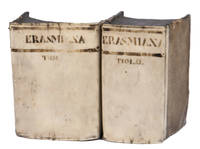
1642AB6GB5JMB8EQLeiden: Joannes Maire 1642. Contemporary half vellum paper sides with "Erasmiana tom. I or II" in manuscript on the spine blue edges. 12mo. Ad 1 with an engraved title page by C. van Dalen showing Erasmus standing in a church with a book in his left hand pointing to three other men. All title pages contain Maire's woodcut device see Breugelmans nr. 13 and a woodcut portrait of Erasmus in a roundel on leaf 8r in ad 1 and his device in a roundel in the text on leaf 25v in ad 1. Further with several woodcut decorated initials throughout. 14 works in 2 volumes. With:2 IDEM. Lingua sive de linguae usu atque abusu liber utilissimus.Leiden Joannes Maire 1649.3 IDEM. Moriae encomium cum Gerradi Listriis commentariis. Epistolae aliqut in fine additae. Leiden Joannes Maire 1648.4 IDEM. Dialogus Ciceronianus: sive de optimo genere dicendi. Leiden Joannes Maire 1643.5 IDEM. Dialogus de recta Latini Graecique sermonis pronuntiatione. Leiden Joannes Maire 1643.6 IDEM. De contemptu mundi liber. Leiden Joannes Maire 1641.7 IDEM. Querela pacis undique gentium ejectae profligataeque. Leiden Joannes Maire 1641.8 IDEM. De immensa Dei misericordia. Leiden Joannes Maire 1641.9 IDEM. Modus orandi Deum. Leiden Joannes Maire 1641.10 IDEM. Precationes quibus homines assuescant cum Deo loqui.Leiden Joannes. Maire 1641.11 IDEM. Enarratio in Psalmum I.Leiden Joannes Maire 1644.12 IDEM. Enarratio triplex in Psalmum XXII. Leiden Joannes Maire 1645.13 IDEM. Enarratio pia juxta ac docta in Psalmum XXXIV.Leiden Joannes Maire 1652.14 IDEM. Concionalis interpretatio plena pietatis in Psalmum LXXXVI.Leiden Joannes Maire 1652. These 14 important works by Erasmus - the edition of his most important letters after the Vita edited by Petrus Scriverius 1576-1660 his famous Laus stultitiae and 3 of his linguistic works in the first volume and 9 theological works in volume 2 - belong to a project of the Leiden publisher printer and bookseller Joannes Maire 1603-1657. This project that can be seen as a series of editions that together represent Erasmus' collected works ensured Maire's stellar reputation through the ages. 23 different works appeared between 1641 and 1652. It has long been thought that Petrus Scriverius was the editor but now there is proof that in fact Willem Henricus Vorstius a learned Remonstrant minister in the village of Warmond near Leiden did the job Breugelmans p. 24.11 works were published in 1641 5 of which in the present collection; 2 in 1642 1 present 3 in 1643 2 present 1 in 1644 also present 3 in 1645 1 present 1 in 1648 also present 1 in 1649 also present 1 in 1650 also present and 2 in 1652 both present. The whole collection brings together a representative selection of Erasmus' spiritual moral and exegetical writings - as it includes treatises on Christian prayer and devotion moral and ascetical reflections expositions of the Creed the Ten Commandments and the Lord's Prayer and commentaries on select psalms. It is presented together with Sriverius' edition of the Vita a biography of Erasmus.Printed in compact duodecimo format with Maires characteristic typographic elegance these Leiden editions form one of the most coherent 17th-century series of Erasmus spiritual writings.With a manuscript owner's inscription on the title pages of ads 1 and 6 a small manuscript inscription on the title page of ad 2 and a small manuscript inscription on the title pages of ads 3 5 and 6-14. Further with two library stamps of the Nordelbische Kirchenbibliothek in Hamburg incl. "Gelöscht" stamps on the versos of the title pages of ads 1 and 6. The bindings are dust soiled and slightly damaged along the extremities but the structural integrity of both bindings remains fine slight foxing and browning throughout. Otherwise in good condition.l Breugelmans Fac et spera. Joannes Maire 2003 1642:7 and other numbers; ads 2-6 and 10-14 in verzicht werken Erasmus Rotterdam 1936; all works in the STCN and USTC; Van der Haeghen I 182 and other numbers. A detailed list of references is available upon request. Joannes Maire, hardcover
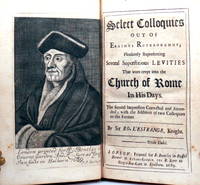
16711002105London: E.T. and R.H. for H. Brome B. Tooke and T. Sawbridge 1671. First edition in English of the complete Colloquia Familiaria of Erasmus first published in 1518 and expanded by Erasmus over the next fifteen years a lively collection of Latin dialogues that found a readership far beyond the Renaissance schoolroom. Originally intended to model colloquial conversation for students of Latin the dialogues feature pointed free-thinking exchanges on modern political religious and philosophical questions. In "Of the Abbot and Learned Woman" an ignorant abbot tries and fails to get the better of the classically educated Magdalia a character almost certainly based on Thomas More's eldest daughter: "I think thou art some sophistress thou protest so wittily." Magdalia: "I will not tell thee what I think thou art." And later: "I have often heard it usually spoken that a wise woman is twice a fool." Magdalia: "Indeed it useth to be said so but by fools." The Colloquia Familiaria was widely read and debated across Europe drawing immediate notice for its anticlerical satire: "its influence on the dialogues of Reformation Germany and Tudor England is a critical commonplace" Zlatar Reformation Fictions 11. The original purpose of the Colloquies as a text for teaching Latin postponed its direct translation; this first complete English edition was published more than 150 years after the work's first appearance. The edition opens with a short life of Erasmus and concludes with the first appearance in English of De utilitate colloquiorum Erasmus's 1526 defense of the Colloquies published after the Sorbonne condemned the book for impiety. In response Erasmus makes a case for the educational value of his dialogues' humor: "I cannot tell whether any thing be learned more successfully than that which is learned in playing." Despite his efforts the Colloquies would remain on the Papal Index of banned books through the end of the nineteenth century. Wing E-3190; PMM 53. A very good copy of a humanist landmark in a handsome contemporary binding. Octavo measuring 6.5 x 4.25 inches: 8 555 1. Contemporary Cambridge-style full speckled calf boards ruled and ornamented in blind raised bands red morocco spine label lettered and decorated in gilt top edge stained black. Engraved frontispiece portrait of Erasmus. Final leaf containing second page of bookseller catalogue excised. Joints and spine head expertly repaired; evidence of bookplate removal on front pastedown; effaced signature on title page; some running titles shaved. E.T. and R.H. for H. Brome, B. Tooke, and T. Sawbridge unknown books
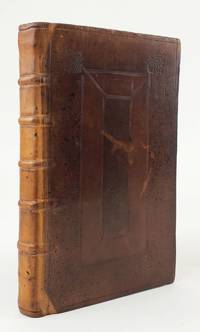
1671Pv5b111a<p>"Prince of Christian Humanists" Desiderius Erasmus 1466 1536 was undoubtedly the most widely read author of the 16th Century. His books were best sellers; his writings accounted for 10-20% of all book sales in Europe by the 1530's. Presented here is the first Printing in the English language of his Colloquies A Work of very great Use to such as desire to attain an exact knowledge of the Latin Tongue. First published in 1518 and expanded by Erasmus over the next fifteen years Erasmus' Colloquies deliver a collection of lively dialogues which delighted readers far beyond the Renaissance schoolroom for whom these were originally intended. They cover a wide range of topics including religion education morality and social issues. The dialogues often satirical and critical address the issues of Erasmus' time and offer sharp commentary on contemporary society. The Colloquies were intended to teach Latin and moral lessons to students but they also serve as a window into the intellectual and cultural landscape of the Renaissance. The English translation of the Erasmus' Colloquies introduced English-speaking audiences to Erasmus' ideas and philosophy creating a profound impact on European intellectual thought during the Renaissance. The Colloquies also played a key role in the development of English prose and language as they were widely read and studied by both students and scholars. This highly enticing very scarce first printing is in excellent condition professionally rebound in full leather with five compartments and four ribs to spine with bright gilt details and title. Binding and hinges are firm new end papers and paste downs no loose or missing pages. Completely free of writings or markings of any kind light scattered foxing some mild damp staining to early and last pages see photos. 555 pages. A desirable example of this most significant Erasmus first appearance in English. Book #Pv5b111. $1895. We specialize in Rare Ayn Rand and other legends and landmarks.</p> Brome, Tooke, Sawbridge hardcover
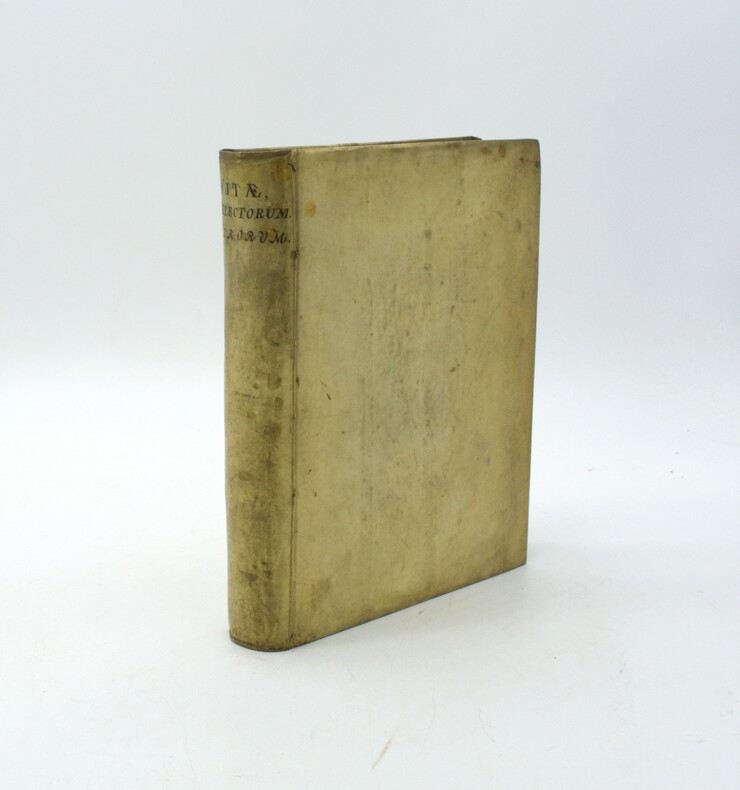
166097125ABLübek, auf Michal Volken kosten gedruckt bey säl. Schmalherzen Erben, 1660. Ca. 13,5 x 8 cm. 24 Blläter, 297 S., 18 Blätter. Ganzpergamentbd. der Zeit m. hs. Rückentitel. - Sehr gutes Ex.
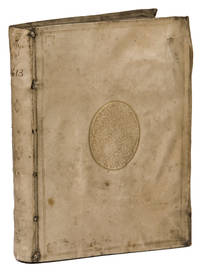
1613ABC_49605Utrecht 1613. 4to. Jan Amelisz Contemporary gold-tooled overlapping vellum sewn on 4 supports laced through the joints both boards show a double fillet frame with small ornamental cornerpieces in the inside corners and a large ornamental oval centrepiece on both boards and with small ornaments slightly faded and the manuscript title on the spine. With a woodcut printers device on the title page and the rare full-page engraved portrait of Erasmus which is lacking in at least 2 of the 4 copies known in an oval lettered: "Magnus ille Erasmus Roterodamus natus Roterdami Octobr. Ao 1467" with emblems in the corners ink pot trumpets hourglass and Bible and a Latin poem of 4 lines underneath "Post cineres vivo doctis tuta manet". This portrait of Erasmus on leaf p1r half to the left and seated his hands resting on an open book is apparently engraved after the portrait by Frans Huys of 1555 which he engraved after the painted portrait by Hans Holbein the Younger Hollstein Dutch & Flemish engr. and etches 132. On the verso of this portrait is a laudatory "Klanck-Ghedicht" sonnet for Erasmus between typographical borders; the same borders on leaf. p2r: the privilege by the States General verso blank. 18 141 3 ll. Very rare first and only edition of a collection of 27 colloquia dialogues by Erasmus and 13 by Lucian of Samosata ca. 125-after 180 CE. The colloquia were translated into Dutch by Andreas van Oosterbeeck fl. 1584-ca. 1620 a minister in Abcoude 1590 and Montfoort 1616. The 27 dialogues by Erasmus include Proci & Puella Virgo Misogamos Virgo poenitens Coniugium Adolescentis & Scorti Abbatis & Eruditae Puerpera Convivium Fabulorum Absurda Opulentia sordida Naufragium Charon Coniugium impar Inquisition de Fide Exorcismus sive Spectrum Peregrinatio Religionis ergo and others.The Colloquia familiaria is one of the main works by Desiderius Erasmus first published in 1518 as Latin dialogues for school exercises and expanded over the following decades with witty - albeit serious - and often controversial content including contemporary religious practises treated in a pervasively ironic tone. After Cornelis Crul's translations of a number of dialogues published between 1530 and 1545 these annotated translations by Andreas van Oosterbeeck are the first 17th-century edition followed in 1622 and 1634 by translation of the colloquia by Dirck Pietersz. Pers.After Erasmus' dialogues follow after a separate title page the 13 highly ironical dialogues originally written in Greek by Lucian: Gallus Toxaris Cnemon Zenophantes Tantalus Menippus Trophonius Charon Crates Nireus Mausolus Polystratus and Diogenes. These are all translated in Dutch by Andreas van Oosterbeeck after the Latin translations made by Erasmus from the original Greek. Lucian of Samosata - a town in Syria - was a Greek writer and satirist who lived in the 2nd century CE. He invented the genre of comic dialogue a parody of the traditional Socratic dialogues and wrote numerous satires about the Gods and public figures.With later annotations in pencil on the front pastedown and flyleave the fore-edge and the bottom outer corner of the back board are somewhat stained and soiled a water stain in the upper outer corner throughout. Otherwise in good condition.l Van der Aa 14 1867; Gheerebaert Lijst p. 57 LVI: Lucianus no. 1 First translation of a work by Lucianus in Dutch!; STCN 169198340 4 copies; USTC 1019209 4 copies same as STCN. hardcover
1688LD6060Nurnberg: Hoffmann c. 1688. Hardcover. Very Good. Modern black morocco gilt-stamped lettering in red leather spine label gilt detail stamped direct on spine; 4to; pp. 3-52 plus 46 plates 11 of which are folding and heavily restored; 1 of which is laid-in. First title-page printed in red and black and with 3 additional lavishly engraved half-title pages. Binding is very fine indeed but condition of text block varies -- many folding plates restored full-page plates sometimes a bit browned sometimes a bit fragile and tissuey and sometimes remarkably nice and bright. A nice copy overall offering images of ornate columns window frames cornices ceilings and more. Sold as is. <br/><br/> Hoffmann hardcover books
1688LD6060Nurnberg: Hoffmann c. 1688. Hardcover. Very Good. Modern black morocco gilt-stamped lettering in red leather spine label gilt detail stamped direct on spine; 4to; pp. 3-52 plus 46 plates 11 of which are folding and heavily restored; 1 of which is laid-in. First title-page printed in red and black and with 3 additional lavishly engraved half-title pages. Binding is very fine indeed but condition of text block varies -- many folding plates restored full-page plates sometimes a bit browned sometimes a bit fragile and tissuey and sometimes remarkably nice and bright. A nice copy overall offering images of ornate columns window frames cornices ceilings and more. Sold as is. <br/><br/> Hoffmann hardcover
168849228Cologne disguised; Paris or the Netherlands: Adrian Le Jeune 1688. First edition. Hardcover. Very good . Duodecimo. Collation: aster.12 2aster.6 A-R12 S4 = 226 leaves. 36 415 1 blankpp. Engraved frontispiece and headpiece; woodcut lettrines head- and tailpieces; printed side notes. Contemporary calf mildly worn at extremities; gilt tooled spine with raised bands gilt lettering piece; edges sprinkled in red. Old inscription cropped from top edge title; one leaf with clean marginal tear just extending into text else fine and crisp throughout.<br /> <br /> First edition of this defense of Jansenism via the celebrated scholar of Rotterdam. Among the works reviewed by Locke for Jean Le Clerc the present title “indicated a new wave of interest in Erasmus†Mansfield. “Jean Richard 1615-1686 wanted to persuade the Roman Catholic Church that in persecuting the Jansenists it was as much in error as it had been when it denounced Erasmus. He also wanted to convince the English monarch that despite appearances to the contrary Erasmus had never adopted any stance outside the Catholic Church†van Herwaarden. The author surely intends the quotation from Cyprian at the verso of the title as a reference to both Erasmians and Jansenists: “This is always the devil’s work to destroy with lies the servants of God and defame their glorious name with false opinions†trans. Mansfield. Early modern reviews were mixed: Bayle considered it a “pity that the author. stopt at the first part of it†General Dictionary 5 1737 “Erasmus†85 note T. Burigny Vie d’Erasme Paris: 1758 judged it “. so badly done and so filled with invectives and declamations that it does not lead one to wish for the second†547; quoted in Mansfield 293n.<br /> <br /> In 1660 the French cleric Jean Richard was imprisoned by the archbishop of Rouen de Harlay a bitter opponent of Jansenism."During this personal crisis he published two works in defense of his Jansenist belief and behaviour. As we shall see there are grounds for believing that his Sentimens. was meant in part at least to achieve the same end. Nevertheless mysteries surround the work: it was published posthumously Richard died in 1686 having been prior of Beaulieu Saint-Avoie since 1673; what we have is the first part and we may only guess at how seriously the promise of a second part was intended. As it stands this is an ill-organized book repetitive with many digressions but filled with a naive enthusiasm and fascinating partly because of the evidences of a sound judgment about Erasmus partly because of the tantalizing but insoluble problem of the author’s aims. The avowed aim was proselytism. The book is dedicated -- on the eve of the Revolution of 1688 -- to James II of England a new Theodosius who is hazarding three kingdoms for the sake of the kingdom of heaven. May it help the English people to follow the king’s example in conversion to Catholicism by showing them the true character of Erasmus’ religion" Mansfield. References: Barbier 4:467. J. v. Herwaarden Between Saint James and Erasmus Studies in Late-Medieval Religious Life 598; Jöcher 3:2078; VD17 12:110664Q. For a thorough discussion see B. Mansfield Phoenix of His Age: Interpretations of Erasmus c. 1550–1750 Toronto 1979 163–174. Locke’s review appears in Bibliotheque universelle et historique VII 1688: 106-122. Adrian Le Jeune hardcover
168942640London: Printed by R. Bentley. and R. Sare 1689. 8vo ii blank vi 293 1 pp. Portrait frontispiece 20th century signature to the fly leaf and notes to a rear blank 19th century to a front blank small piece torn from another blank. 20th century brown cloth slightly sunned. Wing E3208D. Originally published in 1680. One of two issues in this year the other titled "Twenty Two Select Colloquies". This issue seems rarer with ESTC listing five copies in the UK and one in Europe. London: Printed by R. Bentley... and R. Sare unknown
16891345326London: printed for R. Bentley in Russel Street in Covent-Garden and R. Sare at Grays-Inn-Gate in Holborn 1689. Hardcover. Octavo 8 293 1 pages; VG-; Bound by Jon Robbins in modern period-style calf; spine tanned; small patch of damp staining to front board and scattered scratches to both boards; light rubbing at corners. Leaf A1 is blank. The original frontispiece portrait plate of Desiderius Erasmus is absent but has been replaced with a modern reprint. With a table of contents at beginning of text. Two ownership inscriptions reading "Rich. Norton His Book" and "James Martin His Book" on the title page. Arithmetic in ink on the verso of the final page of text. Original frontispiece absent; replaced with modern reprint. Large open cuts to the fore edge margins of pp. 253 and 255 text not impacted. Minor shelfwear and denting to edges of text block. Scattered pencil annotations. Text block age-toned and foxed. <p>JR Consignment. NOTE: Shelved in Room G. ESTC R218873; Wing E3208D. 1345326. Special Collections. printed for R. Bentley in Russel Street in Covent-Garden, and R. Sare at Grays-Inn-Gate in Holborn hardcover
164555861Leyden, J. Maire, 1641-1645. 12°. Mit 7 Holzschn.-Titelvignetten u. einigen Holzschn.-Initialen. Pgmt. d. Zt. m. durchzogenen Bünden, handschriftl. Rückentitel u. dreiseitigem Farbschnitt.
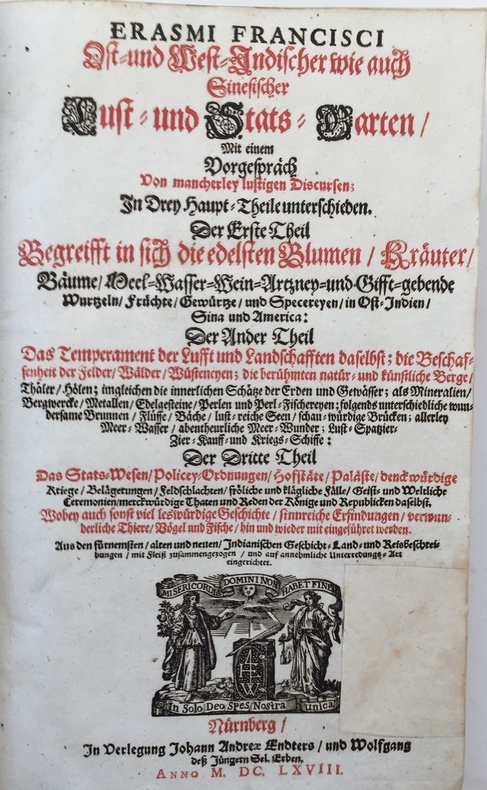
16684248Nuremberg, Johann A. Endters and Wolfgang Sel, 1668. 1668 3 parties reliées en 2 vol. in-folio (318 x 202 mm. de: [20] ff. (frontispice gravé, titre en rouge et noir, armes de Leopold I gravées par C.N. Schurtz, dédicace, liste des auteur), 1762 pp. ; [18] ff. (tables) ; 65 gravures à pleine page numérotées de 1 à 63, avec les planches 45 et 47 doublées (titre et feuillet de dédicace rognés courts, petite découpe comblée dans la marge du titre). Reliure à paneaux mosaïqués d'époque, dos à nerfs orné, titres de maroquin rouge, tranches marbrées ( dos restauré avec dos ancien conservé).
1668007387Nuremburg Nürnberg: J.A. Endters 1668. Half Leather sheep. Marbled paper pastedown on boards. Very Good. Three parts in two volumes. Folio 33 by 22 cm. 912 xxxxxx pp. J.A. Endters unknown
1668V70496Nurnberg: Johann Andreas Endter & heirs of Wolfgang 1668. Hardcover. Good. Fine full-page engraved plates 65 numbered 1-63 with 2 bis plates 45 & 47 1 text illustration full page elaborate copperplate coat of arms of Leopold I by C.N. Schurtz. Folio old vellum spine split repaired front cover nearly detached. Bookplate of Bibliotheca Prieseriana showing books on shelves and small library stamp on pastedown. Titlepage in red and black with printer's mark of 2 female supporters with sun shining on clasped book with monogram AEW. Titlepage 36pp including full page copperplate coat of arms of Leopold I by C.N.Schurtz 1762pp 34pp indices 2pp errata with a few part-lines of loss to lower outer corner & tatty edges. Double column Gothic type with shoulder notes throughout. Two marginal tears with loss hardly touching print & first page of dedication with cropping to outer edge some corner creases else clean and no worming/no foxing/no ink marks. Despite its huge bulk the book block is square and tight. A fascinating early German account of travels and curisoties and one of the most famous illustrated natural history books of the 17th century Nissen 648; Sabin 25463. Johann Andreas Endter & heirs of Wolfgang hardcover
1603114251Witebergae, Impensis Zacharia Schüreri, impr. Typis Cratontanis 1603 In-16 15,5 x 9,5 cm. Reliure de l’époque vélin ivoire, dos lisse, titre manuscrit illisible, [50]-268-[10] pp. Ouvrage d’une relative rareté. Reliure patinée, pages de garde et de titre déchirées, en coin de pied, 50 premières pages sensiblement jaunies, 1 cahier délié, intérieur correct.
16381608040001Witteberg impensis haeredum C. Bergeri 1638-01-01. First Edition. Hardcover. Good. Folio. 680 pp. Modern light brown leather gilt spine 4 raised bands engraved title page additional title in red and black. Pages browned scattered spotting. <br> First edition of Erasmus Schmidt critical concordance of the New Testament in Greek surpassing the Estienne concordance of 1594. A noted German philologist and classical scholar his knowledge of the Greek language was extensive. He express the best way to understand classical Greek was not only to merely understanding the rules of the linguistic structure but from the most intimate familiarity with the language and its context. Not in BM STC C17 Ger. or Darlow and Moule. Not in Brunet or Graesse. Greek Latin. Witteberg, impensis haeredum C. Bergeri hardcover
1638056080Wittebergæ Wittenberg : Impensis hæredum Clementis Bergeri: Wittebergæ 1638. Haeredes Clementis Bergeri publisher 1638. First Edition . Hardcover. Very Good Plus. Folio - 14 x 11 Inches Tall. Engraved frontispiece and Internal Engravings. FIRST EDITION. WITTENBERG : 1638. Hardback. Engraved title-page including portrait of author. Printed title-page in black and red. Text printed in triple columns. Text complete. Foxed. Woodcut initials; ornaments. Text in Greek; title page and preliminaries in Latin. Contemporary full brown calf-leather. Later re-spine to match. Raised bands with decorative gilt panels. Gilt lettered label to spine. Bright tight and clean. No owner name or internal markings. Usual foxing. VERY GOOD INDEED. No page numbers. Signatures: 4 leaves then A-Kkk5. SCARCE. Folio; approx. 14 x 11 inches. LARGE HEAVY BOOK; some extra postage needed. Will be well-packed for posting/shipping. Rosley Books for Antiquarian books C.H.S. Cumberland D.L.S. Everyman G. K. C. Keswick Inklings Literature MacDonald Rarities Theology and History. SCARCE. <br/> <br/> Impensis hæredum Clementis Bergeri: Wittebergæ, 1638. [ Haeredes Clementis Bergeri [publisher] hardcover
1638059759Wittebergæ Wittenberg : Impensis hæredum Clementis Bergeri: Wittebergæ 1638. Haeredes Clementis Bergeri publisher 1638. First Edition . Hardcover. Very Good Plus. Folio - 14 x 11 Inches Tall. Engraved frontispiece and Internal Engravings. FIRST EDITION. WITTENBERG : 1638. Hardback. Engraved title-page including portrait of author. Printed title-page in black and red. Text printed in triple columns. Text complete. Foxed. Woodcut initials; ornaments. Text in Greek; title page and preliminaries in Latin. Contemporary full brown calf-leather. Later professional re-spine to match. Raised bands with decorative gilt panels. Gilt lettered label to spine. Bright tight and clean. No owner name or internal markings. Usual browning to pages. VERY GOOD INDEED. No page numbers. Signatures: 4 leaves then A-Kkk5. SCARCE. Folio; approx. 14 x 11 inches. LARGE HEAVY BOOK; some extra postage needed. Will be well-packed for posting/shipping. Impensis hæredum Clementis Bergeri: Wittebergæ 1638. SCARCE. <br/> <br/> Impensis hæredum Clementis Bergeri: Wittebergæ, 1638. [ Haeredes Clementis Bergeri [publisher] hardcover
1664B5178Nuremberg: Johann Hofmann c. 1664. There is a fold across one half of the first engraved title page and minor wear but the book is in very good condition. Text and engravings are clean. Binding: Contemporary full vellum. Notes: Text in German. Two volumes in one. This book describes cities and strongholds during the fourth Austro-Turkish War 1663-1664 with the focus being on the year 1663 in particular. The Austro–Turkish War was a short war between the Habsburg Monarchy and the Ottoman Empire. The Ottoman aim was to resume the advance in central Europe conquer Vienna and subdue Austria. The book contains a detailed description of the siege of Vienna with maps and engravings; by C. M. Conrad Meyer perhaps.<br>Erasmus Finx 1627 – 1694 aka Erasmus Francisci was a German Polymath author and writer of Christian hymns. Finx was born in Lübeck the son of a lawyer and received higher education at Lüneburg and Stettin. He studied law and was travelling through Italy France and the Netherlands afterwards. As of 1657 he worked as a reader at Endter publishing at Nuremberg where he also published some of his books. <br> Size: 12vo 129x75mm. Illustration: Illustrated with 2 engraved title pages 4 fold-out maps and 6 views 5 fold-out. Volume: 2 volumes in 1 Provenance: Signed by someone dating to 1664 but the name has been covered by ink and is only partially readable. Pages: P. Blank. Engraved title page. Title page. Introduction 1-19. 1-379 80 mispag. 08. Index 1-5. Blank. Engraved title page. Title page. 1-187 164 mispag. 163. Project 1-21. Blank. Category: Book Europe Hungary; Book Military; Book Near East Turkey; Book Europe Germany; Book Europe Austria; Johann Hofmann hardcover
168550211<p>This 1685 Amsterdam edition of Desiderius Erasmus's MÅrias EnkÅmion or Stultitiæ Laus presents a Latin printing of one of the most recognized works of Renaissance humanism. First composed in 1509 the text uses satire to examine European society religious customs and intellectual traditions drawing on classical references and allegorical structure. Erasmus remains a central figure in early reformist thought and this work circulated widely across Europe in numerous editions. This compact format reflects continued readership in the seventeenth century. Provenance: Bookplates of Giles Robertson 1913–1987 20th-century British art historian and expert on the Italian Renaissance; and D.S. Robertson 1885–1961 classical scholar and the Regius Professor of Greek at the University of Cambridge on front endpaper. Good full leather binding with tight and secure text block; front cover attached only by threads front endpapers with extensive handwritten notes titled "Index Capitum" pages generally clean with minimal foxing. 16mo single volume. Collation: 8 152 pp. Illustrations: engraved title page. Edition: 1685 edition. #50211. PHOTOS AVAILABLE UPON REQUEST.</p> Henricum Wetstenium hardcover
16857813<p><b>1685 1ed Praise of Folly Erasmus of Rotterdam Protestant Reform Humanism Latin</b></p><p><i>"When I have a little money I buy books; and if I have any left I buy food and clothes." </i></p><p>― Erasmus</p><p><i>In 1509 Erasmus composed his famous essay 'In Praise of Folly' which was a satirical attack on superstitions and other unconventional traditions in European society. Since its inception in the early 16th-century it is considered one of the most important works of the Renaissance and helped develop early stages of the Protestant Reformation.</i></p><p><i>Erasmus uses satire to examine doctrine and corruption within the Catholic Church even though Erasmus was devoted deeply to Catholicism. He concludes 'In Praise of Folly' with statements of supporting Christian Protestantism. He frequently references Greek mythological creatures and figures.</i></p><p><i>This rare 17th-century edition was published in 1685 by Henry Wetstein. An impressive first edition!</i></p><p>Item number: #7813</p><p>Price: $795</p><p>ERASMUS Desiderius</p><p><b><i>Mōrias egkōmion. = Stultitiæ laus.</i></b></p><p>Amstelaedami: apud Henricum Wetstenium 1685.</p><p><u>Details</u>: </p><p>· Collation: Complete with all pages</p><p>o 8 152</p><p>· Language: Latin </p><p>· Binding: Leather; tight & secure</p><p>· Size: ~5in X 3in 13cm x 8cm</p><p>Our Guarantee:</p><p>Very Fast. Very Safe. Free Shipping Worldwide.</p><p>Customer satisfaction is our priority! Notify us with 7 days of receiving and we will offer a full refund without reservation!</p><p>7813</p><p>Photos available upon request. </p> Henricum Wetstenium hardcover
164885780Leyde, Joannis Maire, 1648, in-12, 528 pp, maroquin rouge du temps, triple filet doré en encadrement sur les plats, fleurons dans les angles, dos à nerfs orné, tranches dorées, Seconde édition de l'Éloge de la Folie d'Érasme par Joannis Maire comprenant le commentaire du médecin et philologue Gérard Listrius. Cette édition de petit format était destiné à une large diffusion du texte le plus célèbre d'Érasme. Afin d'éclairer le lecteur sur les termes parfois hermétiques qui y sont employés ainsi que les passages en grec de ce texte, Maire a repris les explications donnés par Gérard Listrius Rhenensis, un disciple d'Érasme lui-même. Il est également l'auteur de la dédicace qui précède l'Éloge. Le volume se clôt sur deux lettres d'Érasme envoyées respectivement à Martino Dorpio (Maarten van Dorp) et à Thomas More. Jolie édition de petit format, bien établie. Ex-libris manuscrit gratté et cachet double F au titre, ex-libris manuscrit John Burns, mention manuscrite "v. Biblioth. Lambertina. 3080". Esmerian, 101 (un exemplaire relié de façon similaire quoique plus sobre ici mais contenant le même papier de garde à étoiles dorées, le catalogue l'attribue à Derôme); Minet, "Un clin d'oeil à Érasme..." in Tite-Live, une histoire du livre, Namur, 2007, p. 116-118 . Inconnu de Graesse et Brunet. Couverture rigide
1685242378Amsterdam: Henricum Wetstentium 1685. hardcover. very good. Engraved title depicting a court jester on a pulpit before his congregation. 7 152 pages. Slim 16mo early vellum-backed marbled boards with morocco spine label binding well-rubbed but sound and attractive; ownership inkstamp on verso of title which has offset on recto otherwise a rather clean copy with wide margins. Amsterdam: Henricum Wetstentium 1685. An early edition of this uncommon book.<br/><br/> Translated into English as "In Praise of Folly" these are satirical treatises on Catholic Church dogma.<br/><br/> Henricum Wetstentium unknown books
1676244187Basle: Genathianis 1676. First edition with Holbein's illustrations. Engraved additional title-page full-page engraved portraits of Erasmus Holbein the Elder and Holbein the Younger engraved transcription of Erasmus' memorial stone & 81 illustrations 6 mounted and folding all with the possible exception of 3 or 4 engraved by Caspar Merian from drawings by Holbein found in Oswald Myconius' copy of the 1515 Froben edition. 1 vols. 8vo. Contemporary calf gilt spine with leather label. Slight wear to spine tips joints starting but solid covers somewhat darkened internally fine. First edition with Holbein's illustrations. Engraved additional title-page full-page engraved portraits of Erasmus Holbein the Elder and Holbein the Younger engraved transcription of Erasmus' memorial stone & 81 illustrations 6 mounted and folding all with the possible exception of 3 or 4 engraved by Caspar Merian from drawings by Holbein found in Oswald Myconius' copy of the 1515 Froben edition. 1 vols. 8vo. Holbein's Illustrations to Praise of Folly. A series of illustrated satirical treates on Catholic dogma this book was released in English as "In Praise of Folly" and enjoyed a long life during the Protestant Reformation in several languages. Graesse II 495; Brunet II 1037 Genathianis unknown books