FRANCISCI, ErasmusBiblio.com
3 283 résultats
0972-24Nürnberg Michael u. Johann Friedri. Endter 1665-1681. 4 vols. =complet. Deren etliche aus andren Sprachen übersetzt doch allhie mit unrer Teutschen Mutterzunge etwas umständlicher richtiger lehrreicher und völliger ausgesprochen und erzehlet. 8°. Jew. mit gest. Frontisp. Bd. 1: Pgmt.-Bd. d. Zeit mit handschriftl. Rückentitel u. blindgeprägtem Monogramm u. Jahreszahl "FVW SNC 1666". Bzw. restaurierte Ldr.-Bde. Leicht berieben erste u. letzte Ss. etwas gebräunt erste Lage bei Bd. 1 etwas gelockert sonst gut erhalten. Bde. 2-4: Ldr.-Bde. d. Zt. restauriert. Spiegel d. 1. Bd. mit Wappen-Exlibris. Frontisp. von Bd. IV alt ausgeschnitten und aufgeklebt. EA. VD17 1:069070M Bd. I; Faber du Faur I 737 - Seltene komplette Folge aller vier Teile der umfangreichen Reihe tragisch endender Biographien von Erasmus Francisci auch Finx 1627-1694 so etwa Thomas Morus Anne Boleyn Nicolaus Serini Miklós Zrínyi Jane Gray Ibrahim Bassa Paolo da Novi "Trauer-Geschichte von einem Türckischen Lehrer" oder Maria Stuart u. a. Francisci war ab 1657 Korrektor beim Endter Verlag. Das gekrönte Wappen-Exlibris in Bd. I mit Goldenem Vlies dürfte wohl aus dem Burgundischen Umfeld stammen. "Es gibt kaum ein Wissensgebiet auf dem er nicht seine Hand versucht hatte" Dünnhaupt 13.I.1-4. Kollation: Bd. 1: Titelkupfer Drucktit. 6 Bll. Vorrede 2 Bll. Ordnungs-Register 1173 S. 15 S. Inhalts-Register; - Bd. 2: Kupfertit. Drucktit. 10 Bll. Ordnungs-Register 1156 S. 1 S. Blat-Weiser 35 S. Inhalts-Register; - Bd. 3: Kupfertit. Drucktit. 9 S. Vorrede 3 S. Ordnungs-Register 1264 S. 19 Bll. Register 1 Bl. Errata; - Bd. 4: Kupfertit. Drucktit. 9 S. Vorrede 3 S. Ordnungs-Register 1234 S. 1 S. Anmerkungen 40 S. Regsiter. Nürnberg, Michael u. Johann Friedri. Endter 1665-1681. unknown
179133222London: J. Johnson. Near Fine with no dust jacket. 1791. Second Edition. Hardcover. 4to 11" - 13" tall; 214 126 & 202 pages; Contemporary mottled calf with cracked covers both repaired. Small bookplate on inside front cover and old catalog description tipped in. 2nd edition of both parts with all plates. . J. Johnson hardcover
51-4439Paris: F. Buisson An 7 de la République 1798-99. 5 vols. 12.5 x 19.5 cm. Contemporary qtr. roan very good slightly worn on edges. 39 plates including fold-out maps. Cordier Sinica 2384; OCLC Number: 551933808 lists vol 5 only. .CONTENTS:• Tome premier.• 1Front cover• 5Title page• 11Préface du traducteur.• 23Précis de l'histoire de la Chine.• 199Avertissement de l'auteur anglais.• 201Chapitre premier. Motifs qui ont déterminé la cour de Londres a envoyer und ambassade à la Chine.• 240Chapitre II. Préparatifs de l'ambassade.• 268Chapitre III. Passabe de Portsmouth à Madère. Observations sur cette isle.• 312Chapitre IV. Passage à Ténériffe et à Sant-Yago. Remarque sur ces isles.• 388Chapitre V. Le lion et l'Indostan passent la ligne. Navigation dans la mer atlantique. Port ville et pays de Rio-Janeiro.• 457Chapitre VI. Traversée dans la partie méridionale de la Mer Atlantique et de l'Océan Indien. vue des îles de Tristan d'Acunha dans la première de ces mers et de celles de Sain-Paul et d'Amsterdam dans la seconde.• 507Table of contents• 521Back cover• Tome second.• 523Front cover• 527Voyage dans l'intérieur de la Chine et en Tartarie. T. II.• 531Chapitre premier. Entrée dans le détroit de la sonde. Relache A Batavia dans l'esle de Java.• 603Chapitre II. Vue de l'extrémité méridionale de l'isle de Sumatra. Relache à Bantam. Passage dans le détroit de Banca. Arrivée à Pulo-Condor.• 654Chapitre III. Cochinchine.• 737Chapitre IV. Traverseée de la Cochinchine aux isles des Larrons près de Macao et de la a Chu-San. Observations sur ces diférens pays.• 811Chapitre V. Navigation dans la Mer Jaune. Entrée de l'ambassade dans la rivière qui conduit à Tien-Sing.• 850Chapitre VI. Entrée de l'ambassadeur dans la rivière qui conduit à Tien-Sing.• 919Chapitre VII. L'ambassade remonte la rivière Peiho pour se rendre dans la capitale de la Chine.• 940Table of contents• 955Back cover• Tome troisième.• 957Front cover• 961Title page• 965Chapitre premier. Continuation du voyage sur le Peiho. Les vaisseaux-anglais quittent le golfe de Pé-Ché-Lée.• 1012Chapitre II. Continuation du voyage sur le Peiho. Les vaisseaux anglas quittent le golfe de Pé-Ché-Lée.• 1058Chapitre II. =III. L'ambassade débarque près de Tong-Chou-Fou. Elle traverse Pékin pour se rendre dans un palais qui est au-dela. Elle retourne dans la capitale.• 1229Chapitre IV. L'ambassade anglaise arrive auprès de l'empereur de la Chine en Tartarie dans le palais ou ce prince fait sa résidence pendant l'été.• 1336Chapitre V. Retour à Pékin. Séjour de l'ambassade dans cette capitale et à Yuen-Min-Yuen. Observations qui y ont rapport.• 1387Table of contents• 1409Back cover• Tome quatrième.• 1411Front cover• 1415Title page• 1419Chapitre premier. Suite des observations qui ont rapport à Pékin et à la cour de la Chine.• 1455Chapitre II. Départ de Pékin. Voyage à Han-Chou-Fou fait en partie sur le canal impérial.• 1596Chapitre III. Vue de Han-Chou- Fou et voyage à Chu-San.• 1626Chapitre IV. Voyage de Han-Chou-Fou à Canton. Passage du lion et de l'Indostan de Chu-San à Canton.• 1720Chapitre V. Séjour de l'ambassade anglaise à Canton.• 1799Table of contents• 1817Back cover.Voyage dans l'intérieur de la Chine et en Tartarie fait dans les années 1792 1793 et 1794. Staunton George Leonard 1737-1801 - Sir Macartney George 1737-1806. Auteur Gower Erasmus 1742-1814 - Sir. Auteur Huttner Johann Christian 1766-1847. AuteurParis Buisson an 7 2e édition augmentée 5 volumes in-8 reliés demi-basane dos lisses ornés double pièce de titre. Illustrés de 39 planches dont 4 frontispices et 4 cartes.Cette seconde édition publiée un an après la première contient 32 nouvelles planches qui ont également été réunies dans un atlas pour les acquéreurs de la première édition. Macartney fut envoyé en Chine par George III pour établir un contact avec les élites de la dynastie Qing et en rapporter toutes les observations possibles tant sur le plan des moeurs de la nature que du commerce. Il fut le premier européen à naviguer sur la mer Jaune et fut reçu à la résidence de l'empereur avec les honneurs les plus extravagants.Expertise by F. Valleriaux Paris. Paris: F. Buisson, An 7 de la République (1798-99) unknown
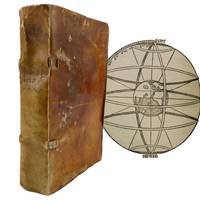
1558800Wittenberg: Krafft 1558. Softcover. Fair. Misc. A remarkable survivor clearly a student's copy of Sacrobosco's Libellus de Sphaera printed in 1558 with the student's inscription at the bottom of the title page and a question and answer styled study guide bound at the rear 1560 by Hartmann Beyer. The shared shelfmark from the title page to the binding indicates the wallet-style binding may be contemporary to the book. Also this copy still retaining its broadside with the locations of the sun updated since the 365.25 days per calendar year causes yearly drift in the location of the sun by day since the true day is slightly shorter. Sacrobosco's work was first produced around 1230 a text book dedicated to spherical astronomy. Although Sacrobosco did use the Earth as central to all rotation his methods of finding the locations of stars the sun and moon based on elliptical patterns was fairly reliable and became the standard of students for centuries to come. He also correctly identified the world as a sphere. By 1558 the idea of the Earth as the center of the universe was largely dispelled but Sacrobosco's calculations and tables were so good that they were yet to be replaced so academies were updating to accommodate the new science. This copy has the commentary and editing of several 16th century scholars Philip Melanchthon and Erasmus Reinhold as well as a second book with commentary of Hartmann Beyer. The university usage of this copy is clear and to be noted. The scholar one Wolfgang notes at the bottom of the title page that he is studying physics. The 17th century date of study denotes that an older book was still acceptable in studies. Yet despite the later date the binding contains both the 1558 Sacrobosco and essentially a 1560 study guide posing the question ""Has this book been used for study before Wolfgang wrote in it"" A mystery is the Cistercian monastery also holding the work. Did they possess the book before or after Wolfgang Or was it from a different Cistercian monastery that was dissolved during the protestant reformation years leading up to Wolfgang's study Bibliographic Details - 1558 Sacrobosco - Universal Short Title Catalogue USTC number 668014 6 copies recorded in the world's libraries. 1560 Quaestiones. - Universal Short Title Catalogue USTC number 689026 5 copies recorded in the world's libraries and USTC 689025 recording four more copies. Physical Attributes - Measures approx. 15 x 9 x 3 cm. Vellum wallet-style wrapper. Spine with two bands. Spine with author/title in old hand. Sacrobosco's work is illustrated throughout some with diagrams that could be used as the base for moving parts. Sacrobosco - Pages - Not paginated Collation - A-R8 with last two blank leaves present. Collates complete. Beyer - Pages - xxxii 302 2 blank pages last leaf blank Collation - aa8 a8 b-u8 collates complete. Condition - See pictures. Wallet-style vellum binding with wear and cockling waviness. Bottom of flap corner chipped away. Top front strap missing from binding to text block causing looseness still connected in back. No pastedowns used. Matching library number to title page written on front board inner as well as bookseller notes of date/publication and ex libris of Gingerich. 1st gathering almost loose chipping to top edge. Title page heavily annotated with two ex libris. One is the library of a Cistercian monastery and the other is of an early 16th century student. The title page has heavy toning and some chipping along edges. Bottom corner of front of text block dog eared. Throughout text block there is use consistent with student usage. Occasional thumbing dog-eared corners annotations page-edge chips/tears fox spots candle ember marks etc. Occasional moisture mark from edge second half from upper corner worst at last page. Occasional faded page E gathering ink light. Krafft
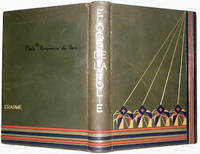
192798313Paris : Editions J. Terquem 1927. IX 3 ff. - 147 pages 235x170mm frontispice en couleurs bandeaux culs-de-lampe 10 compositions coloriÂŽes de Chas-Laborde le tirage des gravures a ÂŽtÂŽ executÂŽ par E. Monnard imprimeur en taille douce ˆ Paris; les coloris par le Maitre Enlumineur J. SaudÂŽ Reliure plein maroquin. Titre dorÂŽ au dos et auteur dorÂŽ sur le plat infÂŽrieur. Mosa•que sur le plat supÂŽrieur et quatre filets de mosa•ques continus entre les plats et le dos. Trois filets de mosa•ques sur le bord latÂŽral du plat supÂŽrieur. Bordures avec triple filets dorÂŽs. Garde papier marbrÂŽ dorÂŽ. Couvertures et dos conservÂŽs. TrÂs belle reliure. Edition originale sur papier vÂŽlin du Marais numÂŽrotÂŽe n.¡ 696 / 1000 avec les initiales de lՎditeur tirÂŽe ˆ 1100 exemplaires tous paraphÂŽs par lՎditeur. Magnifique reliure signÂŽe Lucy Weith et dÂŽdicace de lÕillustrateur avec un dessin aux crayon ˆ papier pour la relieuse: Ã’ A Madame Lucy Weith Hommage respectueux Chas-Laborde Ó sur la page de faux-titre. TrÂs bel exemplaire. 865 Editions J. Terquem unknown
0195992520New. Brand new and still unused unknown
1676Flo430<p>Very good copy of Erasmus of Rotterdam's <em>Moriae Encomium In Praise of Folly </em>the first edition with the marginal illustrations by Hans Holbein the Younger.</p><p><em>Morias Enkomion. Stultitiae Laus. Des. Erasmi Rot. Declamatio Cum commentariis Ger. Listrii & figuris Jo. Holbenii. E codice Academiae Basiliensis.</em></p><p>The illustrations were engraved by Caspar Merian after the marginal drawings in pen and ink by 18-year-old Hans Holbein in Oswald Myconius's copy of Erasmus' <em>Encomium Moriae </em>of 1515. The images show jesters with marottes kings and bishops nobles attacked by demons gluttons and drunks saints with monsters priests and monks in fools caps spinners astrologers etc. There is also an image of Erasmus before a lectern in his study.</p><p>With three engraved full-page plates title-page portrait of Erasmus and Erasmus' memorial stone along with 78 engravings in the text 6 folding engravings mounted in the text as well as 6 decorative initials and 4 tailpieces. Lacking the portraits of Holbein the Elder and Holbein the Younger.</p><p><em>In Praise of Folly</em> is a satirical Latin essay by the Dutch humanist Erasmus written after a stay with Sir Thomas More in London. It was a surprising hit and was reprinted and translated into other languages throughout Europe.</p><p>In contemporary vellum backed boards ivory vellum grubby and rubbed interior mostly clean with a few finger smudges all engravings bright and strong with good impressions of the woodcuts. Page 3 has a 5cm tear near the gutter with no loss of text. No markings apart from previous bookseller's pencil description on front endpaper.</p><p>Very good 17th-century copy of a classic satire against the Church.</p> Typis Genathianis hardcover
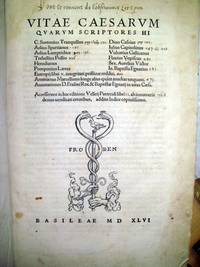
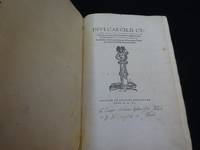
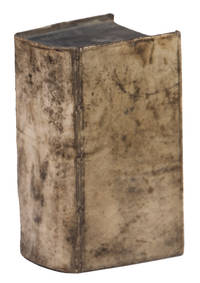
154613096Basilae Basel Bâle Basel: Froben 1546. Fine. Froben Basilae Basel Bâle Basel 1546 33 x 22.50 cm relié Colophon: Basileae per Hieronymvm Frobenivm et Nic. Episcopvm mense Septembri M.D.XLVI. First edition. Decorated with numerous historiated initials. Printer's device on the title page and verso of the final leaf. Absent from French catalogues but present in English catalogues 2 copies in Germany at the GBV union catalogue of northern Germany and one at the University of Munich. The 1544 edition published in Paris does not include Erasmus's notes and the complete assembly of authors gathered in this edition; the Parisian edition was reissued in 1551 in Lyon by Gryphium but not this Froben edition which reproduces only Egnazio's edition. The first edition of Suetonius dates from 1479. Full sheep binding 17th century decorated raised spine red morocco title label. Overall rubbed and worn on boards numerous scratches upper headcap missing 2 upper corners broken and missing. Fine interior condition with pale dampstaining running through about twenty pages at top center pp. 29 to 45. Several pagination errors same number repeated leaf skipped without lack. The evident interest of this edition was to gather together all the writers of antiquity who wrote about the Roman empire not only Suetonius but also rarer writers such as Dio Cassius translated by Merula Herodian translated by Angelo Ambrogini Poliziano Spartianus or Lampidius Velleius Paterculus Vulcatius Gallicanus Ammianus Marcellinus. Two commentators: Erasmus died in 1536 and Giovanni Battista Egnazio 1478-1553. Froben 1501-1563 is one of the great publishers of the Renaissance and the worthy successor of Johann Froben the first of the dynasty who established his printing house in Basel in 1491; it was with him that Erasmus was linked and worked and Jerome Froben merely reaped the fruits. This edition is the alliance of Froben and Nikolaus Episcopius his brother-in-law. Gothic manuscript note: ""pour le couvent de l'observance des Lyon"" and manuscript pagination of the authors. Froben hardcover
STGT12024SchwBasilae d.i. Basel Ex Officina Hervagian d.i. Herwagen Johannes d.Ä. 1540. Gr.-4°. Tit. 13 Bll. 5271 S. 14 Bll. Index. Mit 3 wiederh. Druckermarken sowie zahlreichen kleineren und größeren Initalen in Holzschnitt. Schweinslederband d. Zeit auf 4 Bünden mit reicher Blindprägung von Rollenstempeln Rückenbeschriftung v. alter Hand und fragmentarisch erhaltenen Schließbändern. Einband mit altersbedingten Gebrauchsspuren Untere Ecke am hinteren Deckel beschädigt Vorsätze etwas fleckig u. wurmstichig mit kleineren nicht störenden Wurmspuren am weißen Rand im Text sauber und kaum abgegriffen. Adams C 3155 VD16 C 6514. Erasmus von Rotterdam gab unterstützt durch zahlreiche Mitarbeiter zusammen mit dem Basler Buchdrucker Johann Frobenius der die meisten seiner Werke druckte zwischen 1520 und 1530 mehrere wissenschaftliche Ausgaben der Schriften der Kirchenväter heraus. ""Er begann mit den Schriften des hl. Hieronymus die er in Basel 1516-1520 in neun Foliobänden edierte und seinem Freunde dem Erzbischofe von Wareham widmete. Durch diese Arbeiten war sein Ruhm auf's Höchste gestiegen und er unter den Gelehrten Europa's unstreitig der gefeiertste."" vgl. dazu Wetzer/Welte IV 736. - Die Schriften des hl. Cyprian Thascius Caecilius um 200-258 gehören zu den wichtigsten Quellen der Kirchengeschichte und sind seit 1471 immer wieder aufgelegt worden wobei die kritische Gesamtausgabe durch Erasmus zu den Besten zu zählen hat. Die erste durch E. besorgte Ausgabe von Cyprians Schriften erschien 1521. Hier vorliegend die erste Ausgabe bei Herwagen die siebente insgesamt. Mit Widmungsbrief des Erasmus an Lorenzo Pucci. Basilae (d.i. Basel), Ex Officina Hervagian [d.i. Herwagen, Johannes d.Ä.] 1540. unknown
16418AGGC6NMSWHRLeiden 1641. 12mo. Joannes Maire Contemporary overlapping vellum sewn on 3 supports laced through the joints blue edges. With Maire's woodcut devices on all four title pages several woodcut decorated initials throughout. 4 works in 1 volume. 264; 330 2 blank; 144; 1 1 blank 6 4 blank 176 2 blank pp. Fine Sammelband with four theological works by Desiderius Erasmus all published by the well-known Leiden printer Joannes Maire. The present work containing four 17th-century editions reflects the enduring popularity of Erasmus' didactic and theological writings nearly a century after his death.Ad 1: Maire's 1641 his only edition of this compact Latin devotional treatise by Erasmus offering a concise moral and theological commentary on two foundational elements of Christian doctrine: the Apostles' Creed and the Ten Commandments. The work was intended for private reflection or instructional use and it is a good example of Erasmus' characteristic blend of lucid humanist prose and practical Christian ethics urging readers toward sincere faith and virtuous conduct.Ad 2: A finely printed Latin edition of one of Erasmus' most celebrated devotional treatises "The Handbook of the Christian Soldier". The work serves as a practical guide to inner piety and spiritual discipline advocating a faith grounded not in ritual or external observance but in the renewal of the heart and the imitation of Christ. It is preceded by a letter of Erasmus to Paulus Volsius dated Basel 15 August 1518.Ad 3: A succinct yet profound devotional treatise by Erasmus offering guidance on the true manner of prayer and the cultivation of inward piety. The present work distils Erasmus' humanist spirituality into a meditative discourse on sincerity humility and the necessity of aligning one's will with divine purpose. It rejects rote recitation and superstition in favour of heartfelt communion with God reflecting the author's lifelong concern with the reform of Christian practice through education and interior devotion. It was written in the form of a letter to the Polish diplomat and palatine voivode of Inowroclaw and of Sieradz Hieronymus Jaroslaw Laski 1496-1542.Ad 4: A thoughtful and conciliatory treatise by Erasmus addressing the urgent need for unity and peace within a divided Christendom. Originally written and published in the aftermath of the early Reformation it embodies the author's lifelong plea for moderation mutual understanding and the healing of ecclesiastical discord through charity and reason rather than dogmatic strife. The present work shows Erasmus' conviction that genuine reform must begin with the renewal of hearts and minds not the multiplication of schisms a message that remained relevant amid the theological turbulence of the 17th century. The work is preceded by a letter written by Erasmus to the last Catholic bishop of the Diocese of Naumburg Julius von Pflug 1499-1564.With an annotation in Latin on the front pastedown 3 owner's inscriptions on the title page of ad 1 ''Sum Justi Caspari Scherii Berol. Marchici'' Justus Caspar Scher ca. 1700; "Johannes .man. 1651." and "constat 32. gl" and marginal annotations and underlining of the text in ad 2. The binding is somewhat dust soiled slight foxing throughout. Otherwise in good condition.l Ad 1: Breugelmans Fac et spera p. 475; Catalogue of the Erasmus collection in the City Library of Rotterdam p. 128; STCN 840230494; USTC 1028902; Vander Haeghen Bibliotheca Erasmiana p. 105; ad 2: Breugelmans Fac et spera p. 473; Catalogue of the Erasmus collection in the City Library of Rotterdam p. 98; STCN 114270627; USTC 1015925; Vander Haeghen Bibliotheca Erasmiana p. 83; cf. STCN 840231318; USTC 1028909 both ref. for different issue same ed.; ad 3: Breugelmans Fac et spera p. 477; Catalogue of the Erasmus collection in the City Library of Rotterdam p. 148; STCN 840230583; USTC 1028904; Vander Haeghen Bibliotheca Erasmiana p. 121; cf. STCN 06126220X; USTC 1011884 both ref. for different issue same ed.; ad 4: Breugelmans Fac et spera p. 493; Catalogue of the Erasmus collection in the City Library of Rotterdam p. 140; STCN 840230362; USTC 1028901; not in Vander Haeghen Bibliotheca Erasmiana. hardcover
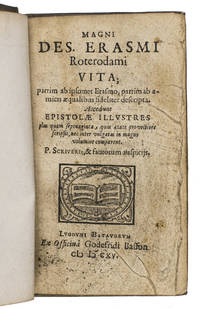
1615AAVD49P5O5GWLeiden: Govert Basson 1615. Contemporary vellum sewn on 3 vellum tapes laced through the joints with the manuscript title on the spine red edges. 12mo. With a woodcut printer's device on the title page a woodcut roundel with portrait of Erasmus on leaf 5 a divisional title page for Erasmus' letters and a few woodcut decorated initials. Important collection of sources for the biography of Desiderius Erasmus 1469-1536 put together and edited by Petrus Scriverius on the basis of the 1607 edition by Merula of the Compendium vitae including a number of new sources and four hitherto unpublished letters by Erasmus. The humanist and independent scholar Petrus Scriverius 1576-1660 worked in Leiden outside the University but he was in continuous contact with the most famous Leiden professors. Scriverius added commentaries and connecting texts by which the collection gained weight as materials for Erasmus' biography. Also through the later editions edited by Thysius and published by Joannes Maire in 1642 and 1649 the collection became very influential regarding Erasmus' "image" before the first critical biography of Erasmus was published by Joannes Clericus in 1705.With a few near-contemporary manuscript annotations and markings in the margins. The vellum and the title page are slightly dust soiled the pastedowns have detached from the inside of the boards and the front pastedown is lacking the upper outer corner the bottom outer corner of leaf C6 is sligthly damaged not affecting the text some occasional very slight foxing. Otherwise in good condition.l Knaake II 355a; STCN 832265039; Tuynman 'Petrus Scriverius 1576-1660' in: Quaerendo 7 1977 pp. 4-45 esp. 23-4; USTC 1027478; Vander Haeghen 182. Govert Basson, hardcover
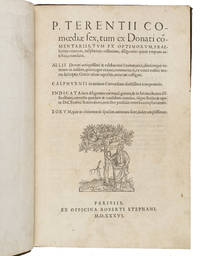
1536ABC_49923Paris: Robert Estienne 1536. Late 17th-century calf sewn on five supports with corresponding raised bands richly gold-tooled spine with the author title and year lettered in gold and red and-brown sprinkled edges. Small folio 20.2 x 30.3 cm. With Estiennes small woodcut device ona small woodcut the title page. Second edition of Terences Comoediae published by the French humanist and printer Robert Estienne 1503-1599. Publius Terentius Afer also known as Terence ca. 195-ca. 159 BCE was a Roman playwright of North African origin and one of the foremost authors of Latin comedy. The present work includes the commentary of Aelius Donatus 4th century CE based on a manuscript provided by Estiennes father-in-law Josse Bade 1462-1535. Donatus was a Roman grammarian and teacher of rhetoric best known for his grammatical works Ars Minor and Ars Maior. Building on Estiennes earlier 1529 folio edition this one was printed in the new Roman types and divided into acts and scenes a notable innovation. In addition Estienne incorporated Erasmus treatise on comedic metres which provided a scholarly analysis of the rhythmic and metric structures of classical comedies enhancing readers understanding of Terences original cadence and comedic effect.The boards are severely rubbed light foxing and staining throughout the title page is very slightly browned the head margin is cut slightly short. Otherwise in good condition.l Adams T 326; BM STC French p. 416; De Reuck 512; Inventaire chronologique des editions Parisiennes du XVIe siecle V 314; Renouard Estienne I 43 no. 15; Schreiber 52; USTC 147028 9 copies; Vander Haeghen II 55. Robert Estienne, hardcover
15411903140038Basel: Westhemerus 1541. Hardcover. Good. 2nd ed. First published in 1538. Contemporary vellum-backed pasteboard binding. Solid binding some wear to cover extremities. All edges red. Printer's snake device verso colophon. Internally clean and unmarked. Early signature of Robert Guyard Roberti Guyardi and "Carmelus Cadomensis". A collection of Erasmus letters for the use in Latin schools. Refs: Index Aurel. 163.109 9. VD-16 E-2958. Vanderhaeghen I 101. Bezzel 1043. Cat. Rotterdam 121. De Reuck 220. Not in Adams. "Adiecimus in Calcem proverbiorum & graecarum vocum interpretationem floresq ; in elocutione latina selectissimos que omnia commentarii vice esse possunt ; opus novum et recens natum. Basel: Westhemerus hardcover
15591807040010Basel: Frobenium et Nicol. Episcopium Froben 1559. Hardcover. Good. Bound in contemporary 1/2 vellum. Worn cover edges. Collated: 10 of 12 preliminary pages 886 pages blank 16 leaves. Lacking 2nd preliminary leaf and top half of 3rd. Handsome Froben printer's device on title and final leaf. Internally clean. Larger figurative initials at the start of each section and smaller historiated initials throughout. All edges red. Not in Adams See Adams J 360 for first edition of 1534 De bello Judaico; Contra Apionem; De imperio rationis Later Latin edition of one of the main works of the ancient historian Flavius Josephus 38-100 on Roman-Jewish history. Basel: Frobenium et Nicol. Episcopium (Froben) hardcover
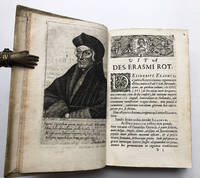
84746Amsterdam Typographia Blaviana 1693. 8° gestochenes Titelbl. «P. P. sc.» 5 Bl. Zueignung «Vita Erasmi» Index 784 S. 10 Bl. Register Pgt. d. Zt. m. handschrift. Rückentitel am Kopf Deckel etw. verzogen Exlibris a. Innendeckel 2 Besitzereinträge von alter Hand a. Vs. Papier etw. wellig u. gebräunt in oberer Ecke tlw. etw. knittrig tlw. min. stockfl.; allg. gutes Ex. 010 Amsterdam, Typographia Blaviana, 1693 unknown
172058442à Leyde Leiden: Chez Pierre VanderBoudoin Janisson Vander 1720. Fine. Chez Pierre Vander Boudoin Janisson Vander à Leyde Leiden 1720 9.50 x 17 cm 6 volumes reliés First edition of Nicolas Gueudeville's translation particularly sought after for its illustration with the first printing of 55 half-page figures unsigned in the style of Romain de Hooge or Harrewyn Cohen 347. A frontispiece by Schinove and a large vignette with the arms of Frederick of Gloucester Prince of Hanover. Title pages in red and black. Contemporary full speckled brown calf bindings. Decorated smooth spines. Red morocco title labels and tan morocco volume labels. Triple fillet frame on boards. Head caps partially missing on volumes III and IV the others worn. Tail caps on volumes II III and VI worn. In volume VI from p. 95 to 115 a folded corner. Despite the noted flaws a handsome set well bound. Just like The Praise of Folly translated by Guedeville a little earlier which met with such success that this was the title retained in France for Erasmus's work although it was the translator's The Colloquies is a mixed work not merely an adaptation like most 18th-century translations but a recreation according to Guedeville's aims. The Colloquia Familiares or familiar conversations are a series of dialogues with very varied characters intended to represent the human comedy with a real didactic intention on the author's part: didacticism of language and morals. It is the entire society of the 16th century that parades through these dialogues with a watchword for the whole: the folly of men. Aubrey Rosenberg and most recently Paul Smith have examined Gueudeville's style as a translator and its main characteristics: amplification modernization oralization. As a general rule the translation is twice as long as the original the additions consisting essentially of humorous touches and jokes that accentuate the banter intended for a popular readership that does not necessarily read Latin. Allusions to current events are scattered here and there: the translator does not forget that he is also a journalist and there would undoubtedly remain discoveries to be made if one wanted to scrutinize more precisely the political scope of certain choices. The modernization furthermore consists in the use of fashionable vocabulary as well as the invention of pleasant neologisms. The insertion of oral turns of phrase such as interrogatives engaging the reader finally proceeds from Gueudeville's particular attention to the genre of texts he translates. He is thus sensitive to the theatricality implied by declamations. Similarly from the preface of his Colloquies he addresses his readers: ""Voulez vous bien que nous approfondissions un peu la Matière "" ""Would you like us to delve a little deeper into the Matter"". It nonetheless remains that the translator intends to be very respectful and faithful to Erasmus's work as evidenced by the numerous preliminary pieces on the author but he was above all concerned with amusing while instructing in keeping with the spirit of his century and the result seems to measure up as the philosophical and moralist matter of these dialogues is enhanced by a freshness of tone and banter for which Gueudeville is responsible. Chez Pierre VanderBoudoin Janisson Vander hardcover
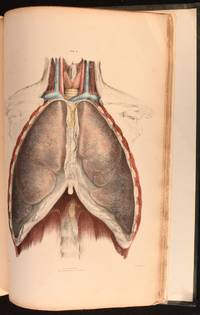
18421012F13London: Taylor and Walton 1842. First edition. Cloth. Very Good. 20.5" by 13.5". J. Walsh and William Bagg. Impressively illustrated throughout with hand-coloured anatomical lithographs this is the very scarce first edition of the first volume of Quain and Wilson's study of human anatomy. Volume I only of the very scarce two volume first edition of this work. The first volume of an impressive two volume study of human anatomy edited by Jones Quain and Erasmus Wilson in which detailed anatomical description accompanied impressive plates. Volume I is divided into three parts covering the bones ligaments muscles and viscera of the body with individual title pages. 'The Bones and Ligaments' 1842 illustrated with nine hand-coloured lithographs and twenty-one monochrome lithographs totalling 30 plates. Collated complete. 'The Muscles of the Human Body' 1836 illustrated with fifty-three hand-coloured lithographs and one monochrome lithograph. Collated complete. 'The Viscera of the Human Body' 1840 illustrated with twenty-six hand-coloured lithographs. Collated lacking three plates. These impressive plates were drawn by J. Walsh and William Bagg transferred to stone by William Fairland and printed by some of the most celebrated lithographers of the period. Rebound in library cloth with endpapers renewed. Pencil library notations to title page head. Published in fascicles and with the plates often removed and used for educational purposes complete volumes are exceptionally scarce. Rebound in full cloth with endpapers renewed. Bumping to back strip tail with light rubbing to boards. Hinges strained but firmly held. Internally generally firmly bound. Pages bright with handling marks throughout. Pencil inscriptions to title page head. Small losses to fore edges of leaves growing more significant to the rear of the work. Tide marks to perimeters of leaves to 'Bones and Ligaments'. Lacking three 'Viscera' plates. Very Good Taylor and Walton hardcover
1643ST20492Lugduni Batavorum Leyden: Bonaventura Elzevier and Abraham Elzevier 1643. Second Elzevier Edition. 137 x 78 mm. 5 1/2 x 3". 12 p.l. 672 44 pp. 2 leaves. <br/> ELEGANT EARLY 19TH CENTURY RED STRAIGHT-GRAIN MOROCCO VERY ELABORATELY GILT BY BOZERIAN unsigned but see below covers framed by bead-and-star roll enclosed with double gilt fillets leaf tools at corners. smooth spine in compartments with large central fleuron of floral lancets emanating from central circlet in a richly stippled ground small circles at corners one compartment with gilt lettering cresting tulip and violet roll at foot of spine turn-ins with bead-and-star roll marbled endpapers vellum flyleaves all edges gilt. Woodcut initials headpieces and tailpieces numismatic portrait tondo fine engraved title page by C. C. Dusend showing Erasmus gazing through a telescope at the Godly orb seen through parted clouds. Willems 552; Rahir 546; USTC 1027918. For the binding: Culot "Jean Claude Bozerian" Roulette 9 Plate I and Palette 12 Plate X. Just barely perceptible rubbing to joints and extremities one leaf with tiny burn hole affecting a couple of words intermittent minor foxing negligible ink spots here and there other trivial imperfections but an extremely attractive copy the text fresh and clean and the very well-preserved binding with lustrous leather and bright gilt.<br/> <br/> This is a remarkably pretty copy of an extremely influential but generically elusive work printed by a legendary press and bound by the founder of a celebrated French binding dynasty. First published in 1524 the "Colloquia" comprise 63 conversations originally written for Erasmus' students on varied and overlapping topics but these urbane meditations soon became widely read as they covered subjects that intrigued the important thinkers of the day. Their influence was so profound that it is not saying too much to claim that they helped to speed the Reformation. Although they are difficult to classify precisely one could categorize them as including in general terms exposure of ritualistic fallacies invective against corruption within the church examination of popular imposture deploring of contemporary personal sins practical advice for laymen and miscellaneous discussion of amusing topics. In specific terms the text takes on such controversial topics as the value of pilgrimage celibacy and abstinence from meat on Fridays and other prescribed days. Erasmus' "Colloquia" was frequently published by the Elzeviers once in French and a total of nine times in Latin. The text was universally adopted for school use up through the 18th century. Although our lovely little binding is unsigned Culot firmly identifies its tools as those used by Jean-Claude Bozerian 1762-1840. He was the elder of the Bozerian brothers François is referred to as "le jeune" and was active in Paris from 1795 to about 1810. He began his career in Lyon as an apprentice bookseller printer and bookbinder eventually deciding to focus on the latter craft. Marriage to the widow of binder Pierre Boulier allowed him to establish a binding workshop in Paris where he was joined by his brother. His bindings were soon much in demand by French bibliophiles who appreciated their superior materials tasteful design and flawless execution--all characteristics that are plainly evident in the present case. Bonaventura Elzevier and Abraham Elzevier unknown
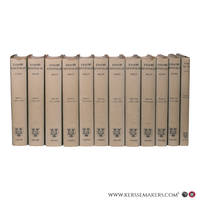
1992QQ0157Oxonii E Typo. Clarendoniano Oxford / Clarendon 1992. ~Pagination: xxiv 615 xx 608 xxxi 640 xxxii 639 xxiii 631 xxxi 518 xxiii 560 xliv 15 516 xxiv 497 xxiv 440 xxxii 400 iv 189pp. frontis to some vols. Latin text English footnotes. Reprint of the original 1906-1958 edition. Navy blue cloth gilt bright & fresh corners sharp. With the original clear polythene dustwrappers. No ownership marks. ~Robust packaging. Tracking can be added to overseas orders on request. Used books are exempt from USA tariffs. Fine/Fine. Lge 8vo 24 x 16 cm. Oxonii E Typo. Clarendoniano ( Oxford / Clarendon ) Hardcover
179817365<p>Philadelphia: Printed by John Omrod 1798 First American edition of this educational classic that shows the influence of Rousseau on the work of Erasmus Darwin 1731 – 1802. First published in London the previous year. Included in this edition is an American printing of Mrs. M. Peddle's Rudiments of Taste a popular conduct book was first published in London in 1789 and in the United States in 1790. Contemporary tree sheep with red morocco spine label. Gilt-ruled spine. Twelvemo. Separate title-page for Mrs. M. Peddle's The Rudiments of Taste. Some wear to binding and a couple cracks to sheep on upper board. Quite a fresh copy despite some foxing to first few leaves and some slight toning throughout. A very good tight copy of a fragile book. Darwin wrote the present work after helping his daughters Susan and Mary Parker establish a boarding school for young women in 1794. Here he draws on the theories of Rousseau Locke and Genlis to advocate for the education of women in schools in topics like philosophy the natural sciences history art manufacturing and language. Darwin believed that women should be educated for the purpose of becoming better wives and companions to men but promoted progressive notions that women's education would take place in well-resourced schools rather than in the home and that women should be educated in the concepts of finance industry and manufacturing. In Peddle's The Rudiments of Taste "Classical influence blends with Christian…Peddle recommends reading ancient and modern history travels biography science and good poetry not novels which leave their readers incapable of 'relishing anything superior'" Blain Grundy and Clements eds. The Feminist Companion to Literature in English p. 841.</p> Printed by John Omrod,
1800D18575London: J. Johnson 1800. First Edition. Hardcover. Near Fine. 4to. 19th century diced gilt-ruled calf. With 12 finely engraved plates. This copy has a nice provenance with early ownership signature of James Law a Lichfield resident as was Erasmus Darwin. Later bookplate of Marshall Laird to front pastedown. The content of this marvelous book ranges from a poem on broccoli to a detailing of the struggle for existence xix.7; a struggle that his grandson Charles would elaborate on sixty years later. <br/><br/> J. Johnson hardcover
1795019670London: Printed for J. Johnson St. Paul's Church-Yard 1795. Book. Very good condition. Hardcover. 3rd Edition. Quarto 4to. Part I: 3rd edition printed 1795; xx 200 pages of text. Part II: 4th edition printed 1794; viii 218 pages followed by Additional Notes with 124 pages. Leather spine and corners with marbled paper-covered boards; hinges professionally mended. The spine has two large raised sections and is gilt lettered and decorated. Part I and Part II each contains a frontispiece. The text contains 19 plates including one fold-out and an additional in-text engraving. Previous owner's bookplate and notation on the inside front cover. Two plates are by William Blake Fertilization of Egypt and Tornado with 4 plates of the Portland Vase attributed to Blake but are unsigned. Two plates by Fuseli. Except for a few spots of soiling in the margins the text is clean and unmarked. Height = 285mm 11.25 inches. . Printed for J. Johnson, St. Paul's Church-Yard Hardcover
173417931Amsterdam: Aux dépens de la Compagnie 1734. Fine. Aux dépens de la Compagnie Amsterdam 1734 10.50 x 17 cm deux tomes reliés en deux volumes First illustrated edition of a work that was initially published in 1542 in Wittenberg. 2 frontispieces and 21 engravings by Bernard Picard representing hagiographical episodes from the life of Saint Francis. Cohen 5. Red and black title pages. The half-title in an engraved border by Picard bears the date 1733. Contemporary full navy morocco bindings. Smooth Jansenist spine. Series of hatchings on the leading edges. Edges gilt. Spines slightly faded. Handsome binding quite rare. Famous pamphlet particularly violent against the book by Barthelemy de Pise which highlighted the similarities between the life of Jesus Christ and the life of Saint Francis. The book begins with a preface by Conrad Badius and Martin Luther very insulting towards the Papists and Cordeliers. The work is in Latin and French it reprises the hagiographical account of Saint Francis while adding footnotes and extremely severe and virulent criticisms. More generally the book is a direct attack against Catholics by Protestants accusing them of heresies abominations satanism. « Car il ce livre est tel que quand hommes et diables dégorgeraient leurs poisons exécrables tous contre Dieu ils n'en sauraient plus dire qu'un moine seul en a osé écrire » For it this book is such that when men and devils would pour out all their execrable poisons against God they could not say more than what one monk alone has dared to write Conrad Badius. Aux dépens de la Compagnie unknown
1796023399New-York: T. and J. Swords. Volume 1 only of 2 volumes. First American Edition. Full leather expertly rebacked with new spine label and volume number. Very early bookplate of Pardon Bowen of Providence possibly the Dr. Pardon Bowen who was born in 1757. Also a hospital library bookplate from Providence. 434 pp. All 6 color plates called for on the final page are present. 1796 on title page and advertisement on final page dated October 1 1796.Occasional slight foxing Very Good. . Very Good. Hardcover. 1st Edition. 1796. T. and J. Swords hardcover
196378653Oxonii: In Typographeo Clarendoniano 1963. 23.5 x 15 cm. original cloth with gilt lettering with dust jackets. 12 volumes. Over 6000 pages illustrated with plates. Text in Latin. Some edges with few stains; paper browned due to aging; dust jackets slightly damaged price clipped dust-jackets. Previous owner's names in first volume; some notes and underlinings in pencil and some notes in ink in the margins not very disturbing. Still good set see pictures. ¶ P.S. Allen began to work on his edition of Erasmus' correspondence in 1893 and the first volume was published in 1906. He died in 1933 with the edition more than half complete. His wife the late Mrs. H.M. Allen and his friend Professor Garrod continued the work; and the last volume of the text Volume XI appeared in 1947. - Reprinted lithographically in Great Britain at the University Press Oxford. In Typographeo Clarendoniano hardcover