4 536 résultats
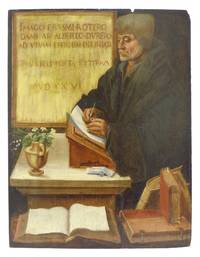
12140s.l. s.n. 16XX. 465 x 355 cm. Not dated not signed early XVII century. Painted on a thin wooden panel consisting of two parts with a small indentation at the top. The original engraving was made in 1526 in Rotterdam by the Germain painter Albrecht Dürer 1471-1528 and is now in The Metropolitan Museum of Art in New York. A Roman Catholic reformer and one the most important Netherlandish humanists Erasmus of Rotterdam held a deep admiration for Albrecht Dürer whom he praised in a eulogy as the greatest of graphic artists: ""And is it not more wonderful to accomplish without the blandishment of colors what Apelles accomplished with their aid"" In likening Dürer to Apellesindeed in asserting the German's superiority over the Greek artistErasmus echoed a tradition dating back to antiquity of judging artists and the visual character of their work by the standards set by their predecessors. Dürer would certainly have appreciated the praise for his graphic talents. The portrait amply demonstrates the virtuous effects Dürer was able to achieve without the benefit of color or a liquid medium. Convincingly aligned at an angle to the picture plane Erasmus stands writing in his study with the books that indicate his substantial intellect and scholarship arranged around him. The vase of lilies probably refers to the purity of his mind while the Latin and Greek inscription prominently framed like a picture on the wall underscores the scholar's humanistic interests: ""This image of Erasmus of Rotterdam was drawn from life by Albrecht Dürer."" Below is the date 1526 in Roman numerals. Dürer met Erasmus at least once in Brussels and twice in Rotterdam during a trip to the Netherlands in 1520 and 1521. Although he sketched Erasmus several times during his trip he did not execute the engraving until six years later and only then with the encouragement of his close friend Willibald Pirkheimer. For certain reasons Dürer had been disappointed by the well-known Protestant reformer. Dürer based the portrait on a medal of 1519 in Pirkheimer's collection by Quentin Massys and reproduced the Greek inscription found on the medal which states: ""A better portrait his writings show."" Presumably Erasmus agreed because he made known his disappointment with this portrait to at least two of his colleagues. And yet Dürer's Erasmus remains one of history's richest and most powerful depictions of scholarly preoccupation and the humanist ideal. 465 x 36 cm. Niet gedateerd niet gesigneerd begin XVII eeuw. Geschilderd op een op een dun houten paneel bestaande uit twee delen met aan de bovenzijde een kleine inkeping. De originele gravure werd in 1526 gemaakt in Rotterdam door de Duitse schilder Albrecht Dürer 1471-1528 en bevindt zich nu in The Metropolitan Museum of Art in New York. Erasmus van Rotterdam een rooms-katholiek hervormer en een van de belangrijkste Nederlandse humanisten had grote bewondering voor Albrecht Dürer die hij in een lofrede prees als de grootste van alle grafische kunstenaars: ""En is het niet wonderbaarlijker om zonder de verleiding van kleuren te volbrengen wat Apelles met hun hulp heeft volbracht"" Door Dürer met Apelles te vergelijken ja door de superioriteit van de Duitser over de Griekse kunstenaar te bevestigen herhaalde Erasmus een uit de oudheid stammende traditie om kunstenaars en het visuele karakter van hun werk te beoordelen naar de maatstaven van hun voorgangers. Dürer zou de lof voor zijn grafische talenten zeker op prijs hebben gesteld. Het portret laat goed zien welke fraaie effecten Dürer kon bereiken zonder het gebruik van kleur of een vloeibaar medium. Erasmus staat overtuigend in een hoek ten opzichte van het beeldvlak schrijvend in zijn studeerkamer met om hem heen de boeken die getuigen van zijn grote intellect en geleerdheid. De vaas met lelies verwijst waarschijnlijk naar de zuiverheid van zijn geest terwijl de Latijnse en Griekse inscriptie prominent ingekaderd als een afbeelding aan de muur de humanistische belangstelling van de geleerde onderstreept: ""Deze afbeelding van Erasmus van Rotterdam is naar het leven getekend door Albrecht Dürer."" Daaronder staat de datum 1526 in Romeinse cijfers. Dürer ontmoette Erasmus ten minste eenmaal in Brussel en tweemaal in Rotterdam tijdens een reis naar de Nederlanden in 1520 en 1521. Hoewel hij Erasmus tijdens zijn reis verschillende malen schetste voerde hij de gravure pas zes jaar later uit en dan nog alleen op aanmoediging van zijn goede vriend Willibald Pirkheimer; kennelijk was Dürer om bepaalde redenen teleurgesteld in de bekende protestantse hervormer. Dürer baseerde het portret op een penning uit 1519 in Pirkheimers verzameling van Quentin Massys en reproduceerde de Griekse inscriptie die op de penning te vinden was en die luidt: ""Een beter portret tonen zijn geschriften."" Vermoedelijk was Erasmus het daarmee eens want hij heeft zijn teleurstelling over dit portret aan tenminste twee van zijn collega's kenbaar gemaakt. En toch blijft Dürers Erasmus een van de rijkste en krachtigste afbeeldingen uit de geschiedenis van de wetenschappelijke preoccupatie en het humanistische ideaal. s.l., s.n. unknown
17078Bâle, J. Froben, 1526 - 1527.
1675009581Various places: Various publishers 1675. Book. Very good condition. Hardcover. First Edition. Numerous works bound in one volume. Half vellum binding with marbled paper-covered boards; moderately soiled. Previous owner's bookplate Bilharz on front paste-down endpaper and circular private library sticker at bottom of spine. Works include: 1. Moller D. G. "Dissertatio De Technophysiotameis Von Kunst- und Naturalien- Kammern." Henrici Meyeri: Altdorfii 1704. Dissertaion/Thesis F. S. Wuffbain respondent. 68 pages. 2. Fermin Phillipe. "Memoire sur l'origine de la belemnite contenant la decouverte de l'animal analogue a ce fossile." 4 page manuscript with folding manuscript illustration. Apparently a fair copy of the above named article published in Ph. Renard's "Considerations d'histoire naturelle" pp.63-76 in 1775. 3. Camerarius R. J. "Dissertation inauguralis medica de lapidum figuratorum usu medico." Johannis Cunradi Reissi: Tubingae 1718. Dissertaion/Thesis J. J. Straskircher respondent. 32 pages. 4. Marbodus Bishop of Rennes; edited by F. E. Bruckmann. "Marbodei Galli Poetae Uetustissimi de Lapidibus Pretiosis Enchiridion Cum Scholiis Pictorii Villingensis." Bruckmanniana: Wolffenbuttleae 1740. 82 2 pages. 5. Stella Erasmus; edited by F. E. Bruckmann. "Interpretament Gemmarum Libellus Unicus Plinius Secundus de Gemmis." Carol. Frid. Jungnicolium: Erfurti et Lipsiae 1736. 68 pages. 6. Hebenstreit J. E. "De Ordinibus Gemmarum Verbis C. Plinii ex eius Naturalis Historiae Libr. XXXVII. Qui Totus de Gemmis Est Disserens Panegyrin Medicam." Lipsiae 1747. 16 pages. 7. Hueber G. L. "Disssertatio Inauguralis Physico-Chemico-Medica de Margaritis Earumque Virtute Medica." Joannis Jacobi Christophori Kleyer: Wirceburgi 1744. Dissertaion/Thesis J.G. Gross respondent. 71 xv pages. 8. Vogel R. A. "Terrarum Atque Lapidum Partitio Disputatio Medica Solemnis." Schulzianis Rosenbusch: Gottingae 1762. Dissertaion/Thesis A. F. C. Hempel respondent. 54 pages. 9. Roederer J. G. "Decanus Ordinis Medici in Academia Georgia Augusta Jo. Georg Roderer D. Dissertationem Inauguralem" Schulzianis Rosenbusch: Gottingae 1762. Dissertaion/Thesis with vita of A. F. C. Hempel. 12 pages. 10. Reiske Johannes. "M. Joh. Reiskii de Glossopetris Luneburgensibus ad Virum Nobilissimum Atque Esperientissimum Joh. Georg Hieronymi." Joh. Georg. Lipperi: Lipsiae 1684. 56 pages one folded leaf of illustrations. 11. Guettard Jean Etienne; Philippe Buache. Folding Map. "Carte Mineralogique de la Suisse par Philippe Buache." 1752. 12. Hottinger J. H. "Dissertatio de Crystallis." Bodmeriano: Tiguri 1698. iv 44 pages illustrated by one folding leaf of gems/crystals. 13. Hensing J. T. "Dissertatio Chemica de Germinatione Metallica Arificiali Ejusdemque Novo Invento." Joh. Reinh. Vulpii: Giessae-Hassorum 1718. Dissertaion/Thesis Joh. Georgio Beck respondent. 35 pages. 14. Muller P. L. S. "Dubia Coralliorum Origini Animali Opposita." Io. Diter. Mich. Camerarii: Erlangae 1770. 22 pages. Probably another dissertation: Suscipiet Philippus Ludovicus Statius Muller. 15. Frank Johann. "Disertatio Physica de Coralio Juxta Ductum Plinii Hist. Nat. Lib.32.c.2. adornata." Praelo Bauhoferiano: Jenae 1675. Dissertaion/Thesis Paulus Linsius respondent. 12 leaves. 16. Folding leaf with text and illustrations of tube worms. Measures 10 x 14 inches. "Kurtze Abbildung und Beschreibung der ungewohnten entsetzlichen Wuermen.in gank Nord-holland." Circa 1735. Various publishers Hardcover books
1675009581Various places: Various publishers 1675. Book. Very good condition. Hardcover. First Edition. Numerous works bound in one volume. Half vellum binding with marbled paper-covered boards; moderately soiled. Previous owner's bookplate Bilharz on front paste-down endpaper and circular private library sticker at bottom of spine. Works include: 1. Moller D. G. "Dissertatio De Technophysiotameis Von Kunst- und Naturalien- Kammern." Henrici Meyeri: Altdorfii 1704. Dissertaion/Thesis F. S. Wuffbain respondent. 68 pages. 2. Fermin Phillipe. "Memoire sur l'origine de la belemnite contenant la decouverte de l'animal analogue a ce fossile." 4 page manuscript with folding manuscript illustration. Apparently a fair copy of the above named article published in Ph. Renard's "Considerations d'histoire naturelle" pp.63-76 in 1775. 3. Camerarius R. J. "Dissertation inauguralis medica de lapidum figuratorum usu medico." Johannis Cunradi Reissi: Tubingae 1718. Dissertaion/Thesis J. J. Straskircher respondent. 32 pages. 4. Marbodus Bishop of Rennes; edited by F. E. Bruckmann. "Marbodei Galli Poetae Uetustissimi de Lapidibus Pretiosis Enchiridion Cum Scholiis Pictorii Villingensis." Bruckmanniana: Wolffenbuttleae 1740. 82 2 pages. 5. Stella Erasmus; edited by F. E. Bruckmann. "Interpretament Gemmarum Libellus Unicus Plinius Secundus de Gemmis." Carol. Frid. Jungnicolium: Erfurti et Lipsiae 1736. 68 pages. 6. Hebenstreit J. E. "De Ordinibus Gemmarum Verbis C. Plinii ex eius Naturalis Historiae Libr. XXXVII. Qui Totus de Gemmis Est Disserens Panegyrin Medicam." Lipsiae 1747. 16 pages. 7. Hueber G. L. "Disssertatio Inauguralis Physico-Chemico-Medica de Margaritis Earumque Virtute Medica." Joannis Jacobi Christophori Kleyer: Wirceburgi 1744. Dissertaion/Thesis J.G. Gross respondent. 71 xv pages. 8. Vogel R. A. "Terrarum Atque Lapidum Partitio Disputatio Medica Solemnis." Schulzianis Rosenbusch: Gottingae 1762. Dissertaion/Thesis A. F. C. Hempel respondent. 54 pages. 9. Roederer J. G. "Decanus Ordinis Medici in Academia Georgia Augusta Jo. Georg Roderer D. Dissertationem Inauguralem" Schulzianis Rosenbusch: Gottingae 1762. Dissertaion/Thesis with vita of A. F. C. Hempel. 12 pages. 10. Reiske Johannes. "M. Joh. Reiskii de Glossopetris Luneburgensibus ad Virum Nobilissimum Atque Esperientissimum Joh. Georg Hieronymi." Joh. Georg. Lipperi: Lipsiae 1684. 56 pages one folded leaf of illustrations. 11. Guettard Jean Etienne; Philippe Buache. Folding Map. "Carte Mineralogique de la Suisse par Philippe Buache." 1752. 12. Hottinger J. H. "Dissertatio de Crystallis." Bodmeriano: Tiguri 1698. iv 44 pages illustrated by one folding leaf of gems/crystals. 13. Hensing J. T. "Dissertatio Chemica de Germinatione Metallica Arificiali Ejusdemque Novo Invento." Joh. Reinh. Vulpii: Giessae-Hassorum 1718. Dissertaion/Thesis Joh. Georgio Beck respondent. 35 pages. 14. Muller P. L. S. "Dubia Coralliorum Origini Animali Opposita." Io. Diter. Mich. Camerarii: Erlangae 1770. 22 pages. Probably another dissertation: Suscipiet Philippus Ludovicus Statius Muller. 15. Frank Johann. "Disertatio Physica de Coralio Juxta Ductum Plinii Hist. Nat. Lib.32.c.2. adornata." Praelo Bauhoferiano: Jenae 1675. Dissertaion/Thesis Paulus Linsius respondent. 12 leaves. 16. Folding leaf with text and illustrations of tube worms. Measures 10 x 14 inches. "Kurtze Abbildung und Beschreibung der ungewohnten entsetzlichen Wuermen.in gank Nord-holland." Circa 1735. Various publishers Hardcover
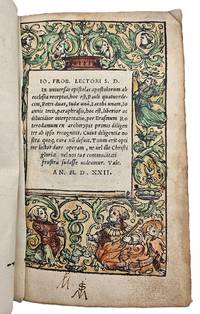
1536ABC_49637Paris: Chrétien Wechel 1536. Half vellum and brown sprinkled paper sides with the faded manuscript title on the spine red edges. 8vo. Ad 1 with Wechels woodcut device on the title page and 3 woodcut decorated initials. Ad 2 with Wechels woodcut device on the title page and the verso of the blank last leaf and 1 woodcut decorated initial. Ad 3 with a woodcut architectural frame on the title page and 2 woodcut decorated initials. Ad 4 with Frobens woodcut device on the title page and the verso of the last blank leaf. 4 works in 1 volume. With:2 IDEM. Responsio ad Petri Cursii defensionem nullo adversario bellacem.Paris Chrétien Wechel 1535.3 IDEM. Responsio ad epistolam paraeneticam clarissimi doctissimicque viri. Alberti Pii carporum principis. Paris Pierre Vidoux April 1529.4 IDEM. Purgatio adversus epistolam non sobriam Martini Luteri.Basel colophon: Hieronymus Froben and Nikolaus Episcopius April 1534. Together these four works capture the remarkable breadth of Erasmuss influence from his visionary humanist pedagogy to his forceful engagement in the theological controversies of the Reformation. Brought together in this volume they reflect both the moral urgency and intellectual sharpness that defined his contribution to early modern thought.Ad 1: First published in September 1529 De pueris statim ac liberaliter instituendis and De ratione instituendi discipulos represent Erasmus principal contribution to Renaissance pedagogy. He argues for the early and liberal education of children stressing mildness rather than severity moral formation alongside learning and the formative power of classical texts. Ad 2: An exceptionally rare edition of a polemic against the Louvain theologian Petrus Curtius in which Erasmus defends his humanist theology whilst ridiculing Curtius as a fighter without an adversary. First issued by Froben and Episcopius earlier that year with only that edition and the present Wechel edition extant; the text was not reprinted until the Opera omnia.Ad 3: A spirited reply to the accusations of Alberto Pio Prince of Carpi coupled with sharp extemporaneous notes against Edward Lee Beda. This double defence displays Erasmus wit and sharpness at the height of the Reformation debates. A very scarce edition; the editio princeps had appeared from Froben in March of the same year.Ad 4: An early witness to the high demand in 1534. Erasmus rejoinder to Luthers intemperate letter written in the wake of De servo arbitrio. Here Erasmus defends himself against charges of paganism whilst censuring Luthers furious and mendacious tone. After 1534 the text was no longer issued separately.With a manuscript owners inscription and a later purple stamp of the library of the Franciscan church and convent of Saint Clare in Kotor Montenegro on the title page of the ad 1. Further with a few manuscript annotations in the margins and some of the text underlined and crossed out throughout the work. The binding shows signs of wear the boards have been rubbed with some loss of material some occasional slight browning. Otherwise in good condition.l Ad 1: Adams 338; Inventaire chronologique des editions Parisiennes du XVIe siecle V no. 144; USTC 185690 1 copy; Vander Haeghen I 164; not in BM STC German; Ad 2: Inventaire chronologique des editions Parisiennes du XVIe siecle IV no. 1299; USTC 185562 1 copy lost; Vander Haeghen I 174; WorldCat 492052585 1 copy; cf. for the 1535 Froben edition see: Bezzel 1782; USTC 635442; VD16E3622; not in Adams; BM STC German; Ad 3: Adams 828; Inventaire chronologique des editions Parisiennes du XVIe siecle III no. 1758; USTC 181160; not in Vander Haeghen; BM ST C German; Ad 4: Vander Haeghen I 164; cf. Adams 809 later edition; USTC 635432 6 copies; VD 16 E 3481; not in BM STC German. Chrétien Wechel, hardcover
15202283Basileae Basel: Apud Ioan. Frob. Colophon: Per Hieronymvm Frob. Ioan Filium Johann and Hieronymus Froben 1520. First collected edition. . In 17th century vellum the author’s name lettered in ink to spine tinted edges. Leonhard Bürck’s possessor’s inscription in ink on the title page and p. 431. Woodcut borders to the four title pages. Woodcut initials and headpieces. Woodcut printer’s device at the end. Old underlines and marginal notes in ink to a few pages. Stains occasionally. Old restoration to O1–2 with no effect on the text. Overall in very good condition. First collected edition. . In 17th century vellum the author’s name lettered in ink to spine tinted edges. Leonhard Bürck’s possessor’s inscription in ink on the title page and p. 431. Woodcut borders to the four title pages. Woodcut initials and headpieces. Woodcut printer’s device at the end. 465=495 1 p. Some misnumberred omitted. Coll.: A–K8 L4 M–Z8 2A–2e8 2F4 2G–2I8. <p><br /> Scarce first edition of Erasmus’ paraphrases on the first four Pauline epistles with possessor’s inscription of the important 17th-century publisher in Frankfurt Leonhard Brück.<br /> <p><p><br /> <br /> The present volume of Paraphrases is the first collected edition of Erasmus’ monumental commentary on the Gospels which was composed and published between 1517 and 1523. <br /> Erasmus began the work on the commentary of the Gospels with the Pauline epistles. They were first issued separately starting with the paraphrase of Romans in 1517 Thierry Martens continued with both epistles of Corinthians 1519 Thierry Martens and the Galatians which was published in 1520 by Martens in Louvain and Froben in Basel. The remaining epistles appeared by 1521 when they were also published in a collected edition by Froben. Any of the lifetime editions of the Paraphrases both separate and collected are rare on the market.<br /> <p><p><br /> <br /> Provenance: inscription on title page and on p. 431 “M. Leonhardus Bürck me possidit Anno 162â€; Leonhard Bürck Burck Burkius Burcken was a printer and publisher in Frankfurt active between 1611 and 1628. Bürck is identified as the step-grandfather of Hans Jakob Christoffel von Grimmelshausen.<br /> <p><br /> USTC 682544 5 copies only in Germany; Bezzel 1163; VD 16 E 3060. Apud Ioan. Frob. [Colophon: Per Hieronymvm Frob. Ioan Filium] [Johann and Hieronymus Froben] unknown
1521ABC_49922Basel 1521. Folio. Johann Froben Modern blind-tooled red morocco with the author title and year of publication lettered in gold on the spine a single fillet border on both boards red edges. With a decorative woodcut border on the title page by Urs Graf 2 decorative woodcut borders in the text by Ambrosius Holbein numerous decorated woodcut initials and a woodcut printer's device at the end of the work. 12 "668" =618 6 pp First complete edition of the letters of Desiderius Erasmus containing 171 letters which had never been published before with correspondence with many of the most prominent figures of the 16th century. The work has been beautifully illustrated with a splendid large woodcut title border by Urs Graf ca. 1485-1528 known as "The triumph of Humanitas" and two fine borders by Ambrosius Holbein ca. 1494-1519. The present copy has been annotated in several contemporary hands and was owned by Ralph Widdrinton d. 1688 the Regius professor of Greek at Cambridge University.The Epistolae ad diversos contains 617 letters in total and is far larger than any of the earlier collections of Erasmus' correspondence namely the Epistolae aliquot of January 1518 52 letters the Auctarium of October 1518 63 letters and the Farrago of November 1519 333 letters. The present letter collection is also the first with a preface by Erasmus. The majority of the letters date to 1519-1521 but some are earlier with the first dated to 11 July 1513. They reflect Erasmus' changing stance towards Luther and Protestantism but also continue his attacks on friars and the theologians of Louvain. Among the authors correspondents are prominent humanists and other important figures including Beatus Rhenanus Ulrich Zasius Johann Eck Guillaume Budé Jean Grolier Georg Spalatin Hermann von dem Busche Konrad Peutinger John Colet Thomas More John Fisher Thomas Linacre William Grocyn Luther Melanchton Pope Leo X and Henry VIII King of England. Erasmus later made many editorial changes to the letters making the present edition of particular importance.With a later ownership annotation "R. Widdrington" on the title page. The binding is very lightly soiled. The work is slightly browned throughout with contemporary and later manuscript annotations in the margins in three different hands a vertical tear in the upper part of the first errata leaf without loss of text. Otherwise a very good copy with ample margins.l Adams E 852; BM STC German p. 276; Erasmus Online 2069; USTC 651629 34 copies; Vander Haeghen I 99; VD 16 VD16 E 2925. hardcover
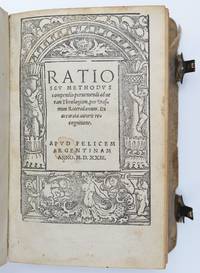
15281361Strasbourg Hagenau: Knobloch; Seltz 1528. Four works in one volume. In contemporary wooden panels with the traces of leather and a codex leaf on spine. Spine with three raised bands. The original copper clasps are presented. The title pages of the first three works by Erasmus with identical architectural borders. Signs on top edge in ink. Old collection stamp on verso of inner front pastedown. Sporadic manuscript marginal notes removed. Occasional underlines in the text throughout. Few stains throughout some leaves tanned. The title page of the fourth work Gebwiler with a tiny loss to the right edge with no effect on the text. Overall in fine condition. Four works in one volume. In contemporary wooden panels with the traces of leather and a codex leaf on spine. Spine with three raised bands. The original copper clasps are presented. The title pages of the first three works by Erasmus with identical architectural borders. <p><br /> Erasmus Desiderius<br /> Ratio seu methodus compendio perveniendi ad veram theologiam. Ratio verae theologiae.<br /> Argentorati Strasbourg: Ioannes Knoblochus Knobloch October 1523. 80 leaves.<br /> <p><p><br /> Bound with:<br /> Erasmus Desiderius<br /> Enchiridion militis Christiani saluberrimis praeceptis refertum ….<br /> Argentorati Strasbourg: Ioannes Knoblochus Knobloch November 1524. 100 leaves.<br /> <p><p><br /> Bound with:<br /> Erasmus Desiderius<br /> Modus orandi Deum. <br /> Argentorati Strasbourg: Ioannes Knoblochus J. Knobloch December 1524. 46 leaves.<br /> <p><p><br /> Bound with:<br /> Gebwiler Hieronymus<br /> Gravissimae sacrilegii ac contemptae theosebiae ultionis ethnicorum Hebraeorum et Christianorum verißimis comprobatae exemplis syngramma …. <br /> Haguenau Wilhelm Seltz 1528. 32 leaves last blank.<br /> <p><p><br /> Three sixteenth-century early Erasmus editions printed by Knobloch bound with Gebwiler’s first edition containing the earliest printed quotation from Hortus deliciarum.<br /> <p><p><br /> The third work in the volume Modus orandi Deum is generally regarded as the central text of Desiderius Erasmus’s teaching on prayer. The present edition dated December 1524 is the second following the first edition issued by Froben in October of the same year. The work circulated widely soon after publication: by the end of 1525 ten further impressions had appeared from presses across Europe. USTC records only eight surviving institutional copies of this December 1524 edition B. Er. I; Mynors 587; Bezzel 1285; Schmidt VII 284; VD16 E 3169; USTC 676366; EON 2424.<br /> <p><p><br /> The first work Ratio seu methodus October 1523 is likewise an early edition. Its editio princeps was published in Leuven by Thierry Martens in November 1518. This Knobloch edition is scarce: USTC records only four copies Augsburg Cambridge Edinburgh Neuchâtel and it is not listed in VD16 USTC 709423; Müller Knobloch 395; Benzing 544.<br /> <p><p><br /> The second work Enchiridion militis Christiani Handbook of the Christian Knight is among Erasmus’ earliest writings first printed in 1503. The preliminaries include all four Latin poems by Thomas More which first appeared together in the Mainz edition of 1520. This edition is also rare: USTC records only five institutional copies VD16 E 2774; USTC 650176.<br /> <p><p><br /> The final work in the sammelband is Gravissimae sacrilegii by Jérôme Gebwiler. Gebwiler is recognized as the earliest scholar to describe Hortus deliciarum Bischoff 1973 p. 13 the illuminated encyclopedic manuscript compiled by Herrad of Landsberg twelfth-century abbess of Hohenburg Abbey Mont Sainte-Odile destroyed in 1870 during the siege of Strasbourg. In this work Gebwiler quotes the dedicatory poem of Hortus deliciarum attributed either to Herrad herself or to Relinda of Hohenburg her predecessor as abbess Griffiths 2013 p. 231. This quotation represents the earliest appearance of the text in print VD16 G 597; USTC 660780.<br /> <p><p><br /> References: Bischoff C.: L’histoire. In: Green R. et al.: Herrad von Hohenburg Hortus deliciarum. London Leiden: The Warburg Institute University of Leiden E. J. Brill 1979. pp. 9–16.; Griffiths F.: Herrad of Hohenbourg and the Poetry of the Hortus deliciarum: Cantat tibi cantica. In: Churchill L. J. et al.: Women Writing Latin. … Volume 2. Medieval Modern Women Writing Latin. New York London: Routledge 2013. pp. 231– 264.<br /> <p>. Knobloch; Seltz unknown
152733077-1245Basel Joh. Froben Febr. 1527. Half-title with woodcut printer's device title-page within woodcut architectural border 2nd title-page fol. 1v. with different figured woodcut border different printer's device on last leaf verso and at the end numerous large and small figured woodcut initials in the text by Urs Graf Ambrosius Holbein and Hans Frank. 4 leaves 710 1 pp.; 28 leaves index. Folio. 17th century calf back gilt joints and foot of spine somewhat restored. Old ms. name on title. Basel Joh. Froben Febr. 1527. An important document of the humanistic spirit and remarkably beautifully printed with outstanding book decoration during Erasmus' lifetime. In the early years of the 16th century the demand for the original text of the New Testament began to mount and Erasmus 1467-1536 soon saw the necessity to translate the original Greek text into Latin. His first text-critical edition of the New Testament was one of the important foundations for Reformation theology. These present Erasmus commentaries were the first ferment of theological discussion at that time and are of great value. This is the 4th printing of the additional text notes contributed by Erasmus. They show mistakes that ancient theologians had made during their translation and revealed misunderstandings that had arisen due to the lack of knowledge of the text copyists. The first separate printing of this work was done by Froben at Basel in 1519 Bezzel 1212 as an indepent work. Through the years probably altogether a total of eight editions appeared as listed by most of the bibliographers. Numerous excerpts and vernacular versions circulated later.- Some little wormholes in the last 30 leaves some spots otherwise with wide margins and still a good copy. - VD 16 E 3096; Adams E-891; Vander Haeghen II 58; Bezzel 1215; Hieronymus Oberrhein. Buchillustration II 302 detailed; cf. Knaake II 302. BIBLES ; HELVETICA: ALLGEMEIN ; BIBELN RELIGION ; HUMANISM ; REFORMATION ; Basel, Joh. Froben unknown
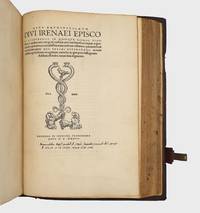
1534372762Basel: Froben 1534. Third revised Erasmus edition first 1526; second 1528 of Irenaeus' treatise "Against Heresies. Printer's device on titlepage and last page; head-pieces; initials; printed marginalia. 1 vols. Folio. Near contemporary dark calf over wooden boards stamped in blind upper board dated 1545 brass clasps. Headcaps worn one clasp perished. Third revised Erasmus edition first 1526; second 1528 of Irenaeus' treatise "Against Heresies". Printer's device on titlepage and last page; head-pieces; initials; printed marginalia. 1 vols. Folio. Third Erasmus edition of Irenaeus' treatise Against Heresies consisting of five books which are preserved in their entirety only in their Latin version. It is Irenaeus' principal literary work which had a significant impact on the development of the church during the first three centuries.<br /> <br /> Colophon: Basileae in officina Frobeniana per Hieronymum Frobenium et Nicolaum Episcopium An. M D XXXIIII mense Martio.<br /> The work is bound with an extensive commentary on the Gospel of Matthew by Wolgang Musculus 1544. The nicely preserved binding is dated M.D.XLV. 1545 on upper board. VD16 I 318. Provenance: Provenance: title page of Musculus signed: Ludovicus Rabus . 1544 and Iohannes Longlinus . 1550; bookseller's label on front paste-down: G. & B. Westermann Bros. Deutsche Buchhandlung 290 Broadway New-York; Bookplate of Rev. Edwin A. Dalrymple; Maryland Diocesan Library; General Theologiccal Seminary bookplates and stamps Froben unknown
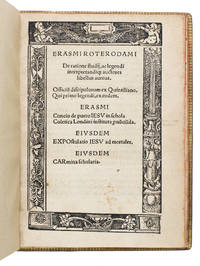
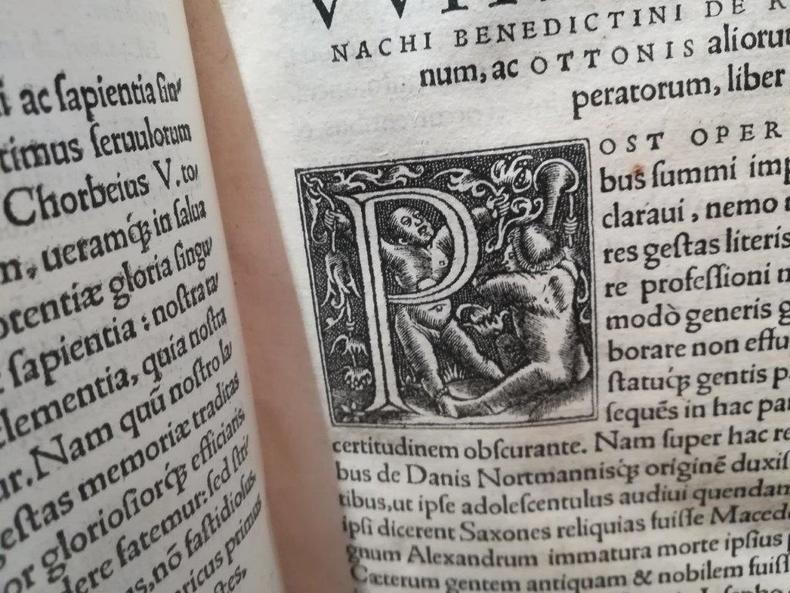
1516ABC_49694Colophon Strasbourg: Matthias Schürer 1516. Modern brown pigskin with a blind-tooled single fillet frame on both boards gold-tooled turn-ins red edges in a beige paperboard slipcase. 4to. With a woodcut decorated title frame and 3 woodcut decorated initials. Early edition of Erasmus seminal educational treatise De ratione studii here presented alongside several other influential pedagogical and devotional texts. It further includes: Officium discipulorum ex Quintiliano The duties of students according to Quintilian including a section on the first stages of learning to read also derived from Quintilian a sermon on the child Jesus by Erasmus intended for delivery at the Colet School in London a lament of Jesus addressed to mankind and a collection of school poems.The opening dedication addressed to Peter Viterius a professor of liberal arts sets the tone for this work: Erasmus praises his friends discernment and judgment in matters of education using vivid comparisons drawn from military strategy and classical mythology to underscore the importance of order and method in learning. Without it he argues even the most gifted minds may falter. Of particular note is Erasmus endorsement of an instructional technique that became central to Renaissance humanist pedagogy: the use of structured annotation. In De ratione studii he recommends that students classify selected passages under thematic headings a mnemonic device that aids both retention and retrieval. This principle would go on to shape the methods of early modern teaching and note-taking. It also reflects Erasmus' broader educational reforms where rhetoric and moral philosophy intersect. His engagement with progymnasmata preliminary rhetorical exercises especially those of Aphthonius favoured for their clear organisation into theory and examples demonstrates his commitment to practical and accessible instruction for young learners.With some contemporary and later underlining and annotations in red and brown ink mainly consisting of corrections additions to the text and markings of significant passages. Two minor worm holes througout barely affecting the text. The gutters between leaves V-VI; VII-VIII; XX-XXI; and after leaf XXIII have been reinforced in the gutter with linen tape slightly browned throughout. Otherwise in good condition.l Adams E 346; Bezzel 1709; USTC 653250 9 copies; Vander Haeghen I 169; VD16 E 3534; not in BM STC German; De Reuck; Kossmann. Matthias Schürer, hardcover
16814103Nürnberg: Wolfgang Moritz Endter and Johann Andreas Endter 1681. Thick 8vo 161 x 95 x 77 mm. 26 1214 2 pages. Title printed in red and black double-page engraved frontispiece or additional engraved title sixty-four numbered engraved plates of which four folding; 43 signed by Cornelius Nicolaus Schurtz 21 unsigned including one of the two frontispiece engravings folding plates 36 and 41 by J. Sandrart. Final errata leaf. Two gothic typefaces woodcut initials typographic printed music on p. 257. Contemporary vellum over pasteboards upper cover stamped in silver-gilt faded I.B.G.V.H. Johann Bernhard Graf von Herberstein and 1681 manuscript spine title edges red-stained lacking pair of fore-edge ties. fine. Provenance: Johann Bernhard Graf von Herberstein 1630-1685 binding and ms. inscription on frontispiece; Christoph Wenzel Graf von Nostitz -Rieneck 1648-1712 bibliophile art collector and art patron engraved armorial bookplate with initials C.W.G.V.N.; stencilled shelfmark 58 on backstrip; with Haus der Bücher Basel catalogue 706 Deutsche Literature der Barockzeit part 1 1963 no. 280.First Edition of a very rare baroque emblem book on the Last Judgment by one of Germany's first professional writers a beautiful copy in immaculate condition. Francisci son of the Lübeck jurist Franciscus von Finx named himself "son of Franciscus" i.e. Francisci. More unusual than this endearing foible was his successful career as a free-lance man of letters. A prolific and popular polymath Francisci died at the age of 68 "having left behind almost as many volumes" Allgemeine Deutsche Biographie. Throughout his career he worked as a sort of house author with the Nuremberg publishing house of the Endter family. "There was hardly an area of knowledge at which he did not try his hand. As one of the first full-time professional authors of Germany Francisci understood how to switch if the need arose to a new area of interest that promised good sales for his publisher" Dunnhaupt Bibliographisches Handbuch I p. 628 my trans. With gusto and success he catered to an audience hungry for tales of distant lands for folklore and "a world saturated with wonders" Faber du Faur German Baroque Literature p. 198 compiling tales of travel and distant lands compendia of natural history and curiosities historical works and devotional meditations. As the thickness of this volume intimates Francisci's Sitzfleisch was awe-inspiring. His versatility huge readership and connections with many members of the "republic of letters" made him one of the most influential German writers of the Baroque. While the prose of his religious works may seem cloying to the modern reader they sold as well as his secular compilations. Being widely read across social classes fine copies of his books are rare. The 64 Bedenckungen considerations of the present treatise are interwoven with fables anecdotes and digressions. Each is illustrated with an engraved emblem Sinnbild set within an exuberant ornamental border the borders of most of the 21 unsigned plates apparently by a less skilled engraver than Schurtz are plainer. Francisci is known to have worked closely with his illustrators and presumably collaborated on the design of these engravings by Cornelius Nicolaus Schurtz Joachim von Sandrart and one other engraver the 21 unsigned plates are in plainer borders and appear to be the work of a less skilled engraver. Characteristically varied in subject-matter the emblems and emblematic scenes are largely secular showing scenes of war domestic life natural disasters seafaring including shipwrecks the plant and animal world including exotic species children romping fireworks alchemical apparatus and even an amputation and a corpse being dissected in an anatomy hall. Only a few contain biblical scenes. Most striking are the four folding plates frightening panoramas of Judgment Day and the two unearthly frontispiece illustrations of which the first shows two men a virtuous man and a sinner in bed dreaming of their respective afterlives. Himself a tireless hymn-writer Francisci dedicated this work on Doomsday to one of the most important composers of Baroque hymns Magdalena Sibylla of Hesse-Darmstadt Duchess of Württemberg 1652-1712. The book includes twenty original hymns or Kirchenlieder to be sung to identified choral melodies. The presumably less well-known music for one Trostlied hymn of consolation is provided on p. 257 with accompanying bass line. This edition collates :8 - :1.8 : : 8 -::8 A-4G8: the signing of the two preliminary quires is odd but this copy is complete. The double-leaf engraving at front may have been counted as the first leaf of the first quire since the first letterpress leaf following the letterpress title is signed ":iii". Both the first quire containing the title-leaf and dedication and the second containing laudatory poems signed by S. E. Gr. zu L and by Joachimus Simon the foreword and the table of contents contain no 8th leaf. This matches other copies and seems to have been due to composing miscalculations resulting in the removal of the final blank of each quire. Some cataloguers included the two-leaf engraved title or frontispiece in their folio count counting 15 preliminary leaves and others more correctly count 13 leaves.Not in NUC; OCLC locates a single copy in an American library at Berkeley. VD-17 reveals that this edition is one of two variant typesettings with the same imprint the other is VD17 1:664300Y; priority is not known and they may be different states of the same edition. A second edition or possibly a re-issue of these sheets appeared in 1684. VD17 12:102498K; Goedeke Grundriss zur Geschichte der Deutschen Dichtung III: 90 176; Dünnhaupt Personalbibliographien zu den Drucken des Barock 1990-93 1538 32.1; Dünnhaupt Bibliographisches Handbuch der Barockliteratur 1980-81 I: 649 32; Praz Studies in Seventeenth-Century Imagery 339. Wolfgang Moritz Endter and Johann Andreas Endter unknown books
150031801Lugduni Batavorum Leiden: Pieter van der Aa 170306. Folio extra 39.4 cm 15.5". 10 vols. in 11. I: 3 ff. 24 64 pp. 1226 cols. i.e. 1240; engr. t.-p. 1 double-pg. engr. plt. and 1 full-pg. engr. plt. II: 6 ff. 1212 cols. 54 pp. IIIa: 15 ff. 1104 cols.; 18 full-pg. engr. plts. IIIb: 2 ff. cols. 1105-944 92 ff.; 2 full-pg. engr. plts. IV: 3 ff. 758 cols. i.e. 768; 1 full-pg. engr. plt. 75 single-col. engr. vignettes 3.5 sq. and 6 double-col. engr. vignettes 4.25 x 7.25. V: 3 ff. 1360 cols. VI: 29 ff. 1126 cols. 17 pp. VII: 6 ff. 1198 cols. 1 p. VIII: 3 ff. 652 cols. IX: 3 ff. 1248 cols.; 1 fold-out plt. 1 full-pg. plt. X: 2 ff. cols. 1249860 64 ff. <br><br>Before his death Erasmus 14661536 divided his writings into nine ordines categories for posthumous publication. This is the second edition of his collected works first published in nine volumes by Froben in 1540. Like the original this set includes additions by authors from the Dutch humanist's international circle and portraits of the same as well as => myriad engravings after Holbein. The printer Pieter van der Aa 16591733 was an apprentice of Daniel van Gaasbeeck fl. 165592 and primarily known for maps and travel books.<br>Â Â Â Â The text in all volumes is in Latin with some Greek printed in roman and italic mostly double-column with sidenotes and many large woodcut initials and tailpieces as well as some engraved headpieces. Vol. I has both a general title-page and a volume title-page; each of the volume title-pages is printed in red and black and features a large engraved vignette signed by the illustrator J. Goeree and the engraver J. Baptist; some volumes also have sectional title-pages. There are many engraved plates: vol. I features an added engraved title-page a double-page plate and one full-page plate; in vol. III part one there are => 18 full-page engraved portraits of contemporaries of Erasmus including Melanchthon Alciatus Charles V and Bembo as well as two more full-page portraits in vol. III part two.<br>Â Â Â Â In Praise of Folly in vol. IV is illustrated with => 75 single-column-width engraved vignettes 3.5 sq. and six double-column-width engravings 4.25 x 7.25 after the famous Holbein originals and a full-page engraved portrait of the artist. Vol. IX has one large engraved fold-out plate signed by van der Aa at Leiden engraved by D. Stoopendael as well as one full-page engraved plate unsigned of medallions against a drapery backdrop.<br>Â Â Â Â => A handsome folio set.<br>Â Â Â Â Provenance: Most volumes have a large stamped "Y" on the front pastedown and a faded => 18th-century ink inscription by a monk on the title-page. All volumes in contemporary sheep recently rebacked and repaired using brown calf spine with raised bands accented by gilt ruling with a blind ornament in each compartment title and tome number gilt on green leather spine labels and date gilt collector-style on red leather labels at bases; marbled endpapers and red edges. Boards scuffed and chipped in places; all hinges inside repaired with later marbled paper. Ex- library: most volumes with bookplate and old-fashioned oval stamp on front pastedown stamps on bottom edge and multiple leaves of text early accession number to front free endpaper verso and bottom margin of first text leaf. In all volumes some leaves very browned; occasional dampstaining foxing or other small stains from chemical reactions in paper; small natural paper flaws short closed tears and a few corners torn away not affecting text. Title-page of vol. I with closed interior tear stemming from deep impression of its large engraved vignette; one small tear in vol. IV repaired with monogrammed sticker! Tout entière a nice set. Pieter van der Aa hardcover books
15238509Argentorati Strasburg: Iohannes Cnobloch execudebat Quinto Idus Iunias Anno. M.D.XXIII. 1523. 1523 20 130 i.e. 120; 107 1 leaves ; 16 cm. Collates Aa8 Bb4CC8 a-p8 A-N8 O4. D&M 6103a. Recently bound in calf to style with blind decoration to the boards. The spine has raised bands and is titled in gilt. Marginal annotations thoughout. Part title to Epistolae Apostolicae and Cnobloch's device printed at the end of both parts. The imprint and date are supplied from the colophon. The text of each book begins with a 14 line rubricated initial including one decorated with three parrots at the start of Evangelium Secundum Ioannem. PROVENANCE: The title page verso has the bookplate of the Nuremburg bookseller collector and bibliographer of alchemical literature Friedrich Roth-Scholtz 1687-1736. The title page and part title have a neat 19th century stamp of the Univerity of Erlangen now Erlangen-Nuremberg. an excellent early printing of Erasmus' important NT. Argentorati (Strasburg): Iohannes Cnobloch execudebat Quinto Idus Iunias Anno. M.D.XXIII. hardcover
LCS-18181Précieux volume conservé dans son élégante et intéressante reliure parisienne strictement de l’époque, très proche des reliures alors réalisées pour le bibliophile de la Renaissance Marcus Fugger (1529-1597). Paris, Jean Longis, 1553. In-8 de (8), 191 ff. Les gardes et les contreplats sont couvertes d’annotations manuscrites anciennes. Veau blond, double encadrement de trois filets à froid avec petits fleurons dorés aux angles, fleuron central argenté, dos à nerfs orné de filets à froid et d’un petit fer répété, mors et coiffes restaurés. Reliure parisienne de l’époque de belle facture proche de celles réalisées pour Marcus Fugger. 166 x 102 mm.
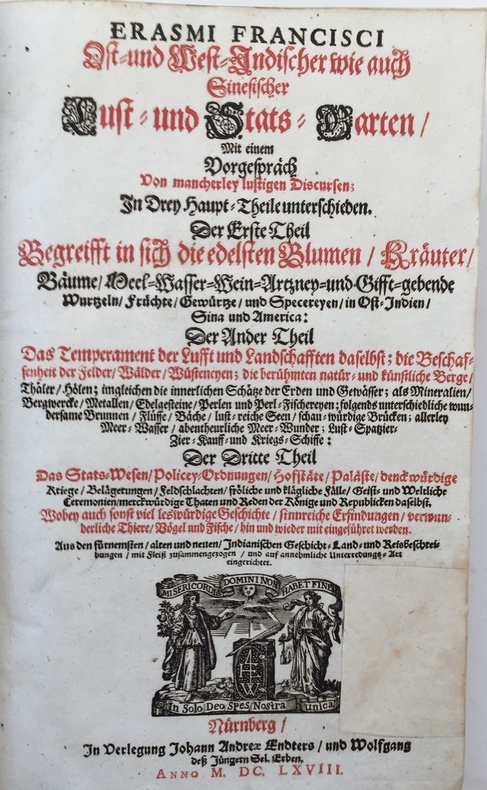
16684248Nuremberg, Johann A. Endters and Wolfgang Sel, 1668. 1668 3 parties reliées en 2 vol. in-folio (318 x 202 mm. de: [20] ff. (frontispice gravé, titre en rouge et noir, armes de Leopold I gravées par C.N. Schurtz, dédicace, liste des auteur), 1762 pp. ; [18] ff. (tables) ; 65 gravures à pleine page numérotées de 1 à 63, avec les planches 45 et 47 doublées (titre et feuillet de dédicace rognés courts, petite découpe comblée dans la marge du titre). Reliure à paneaux mosaïqués d'époque, dos à nerfs orné, titres de maroquin rouge, tranches marbrées ( dos restauré avec dos ancien conservé).
32693Deux textes dans une même reliure de l'époque, vélin estampé à froid. Grand in-4. - Witichindi Saxonis rerum ab Henrico et Ottone I. impp. gestarum libri III, una cum aliis quibusdam raris et antehac non lectis diversorum autorum historiis, ab Anno salutis DCCC usque ad praesentem aetatem: quorum catalogus proxima patebit pagina. Huc accessit rerum scitu dignarum copiosus index. Froben, Basileae 1532. 393 pages. - Beati Rhenani Selestadiensis rerum Germanicarum libri tres, ab ipso autore diligenter revisi ,emendati, addito memorabilium rerum Indice accuratissimo. Quibus praemissa est Vita Beati Rhenani, à Ioanne Sturmio eleganter conscripta. Froben . Basileae, 1551. 206 pages. Ouvrage rare. Bel état. (quelques soulignures et notes anciennes à l'encre rouge). De la révolte des Saxons contre Charlemagne à l'amitié d'Erasme.
1528CLL-143Lyon, Gryphe, 1528-1529 In-12 de 160 pp., (4) ff. - (16) ff. - (40) ff., veau blond, trois filets dorés en encadrement, dos à nerfs orné de filets et d'un décor à la grotesque doré, pièces de titre et de tomaison de maroquin havane et vert, coupes filetées or, bordures décorées, tranches dorées (Niédrée).
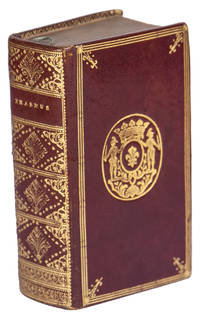
165818897Amsterdam: Joannes Janssonius 1658. 18th-century richly gold-tooled red morocco both boards show a triple fillet frame with small cornerpieces in the inside corners and an oval armorial centrepiece crowned fleur-de-lis flanked by two knights gold-tooled spine with "Erasmus" lettered in gold gold-tooled board edges and turn ins gilt edges marbled endpapers. 12mo. With an engraved title page a full-page engraving showing Erasmus woodcut decorated initials and several woodcut head- and tailpieces. Including: Coronis apologetica pro colloquiis Erasmi ex ipsius scriptis quantum per otium licuit fideliter collecta à P.S. accedit ejusdem De Collequiorum utilitate dissertatio. Montanus' edition of a renowned famous Latin schoolbook written by Erasmus one of the most used Latin schoolbooks for centuries as it discusses all basic scholarly and moral issues. With Erasmus' preface-letter to Froben at Basel dated 1524 and the Vita Erasmi preceding the Colloquia as well as two indices of authors and dialogues. Included at the end is a short essay explaining the usefulness of the book.With a few 17th-century annotations on the engraved and letterpress title pages resp. "1662" and "Besnier". The engraved title page is cut slightly short not affecting the engraving. Otherwise in very good condition.l Bibl. Belg. II E 572; Erasmus Coll. City Library Rotterdam p. 50; STCN 850071909 9 copies; Vander Haeghen p. 40. Joannes Janssonius, hardcover
152212717Basel Johannes Froben 1522. Two parts in one 484 folio. Tall octavo H. 185 x W. 11.5 cm. contemporary binding in blindstamped brown leather over wooden boards. Title on the lower cover: ""In Epistola S. Pauli Can. RC."" The blind impression on the front cover faded but still visible is: ""ROTEROD"" as for ""Roterodami"" so from Rotterdam Erasmus' place of birth and ""WSKB"" possibly the initials of the owner. Second edition in an attractive binding the first in 8vo format. Two months before the first edition was edited in Folio. Each part has a woodcut title page. Lacking clasps some light waterstains wide margins with early manuscript annotations and thin strips of medieval manuscripts sewn inside the boards. A good copy. Literature: VD 16 E-3377; Bezzel I. Erasmusdrucke Nr. 1529. Van der Haeghen I 147 Basel, Johannes Froben hardcover
1668V70496Nurnberg: Johann Andreas Endter & heirs of Wolfgang 1668. Hardcover. Good. Fine full-page engraved plates 65 numbered 1-63 with 2 bis plates 45 & 47 1 text illustration full page elaborate copperplate coat of arms of Leopold I by C.N. Schurtz. Folio old vellum spine split repaired front cover nearly detached. Bookplate of Bibliotheca Prieseriana showing books on shelves and small library stamp on pastedown. Titlepage in red and black with printer's mark of 2 female supporters with sun shining on clasped book with monogram AEW. Titlepage 36pp including full page copperplate coat of arms of Leopold I by C.N.Schurtz 1762pp 34pp indices 2pp errata with a few part-lines of loss to lower outer corner & tatty edges. Double column Gothic type with shoulder notes throughout. Two marginal tears with loss hardly touching print & first page of dedication with cropping to outer edge some corner creases else clean and no worming/no foxing/no ink marks. Despite its huge bulk the book block is square and tight. A fascinating early German account of travels and curisoties and one of the most famous illustrated natural history books of the 17th century Nissen 648; Sabin 25463. Johann Andreas Endter & heirs of Wolfgang hardcover
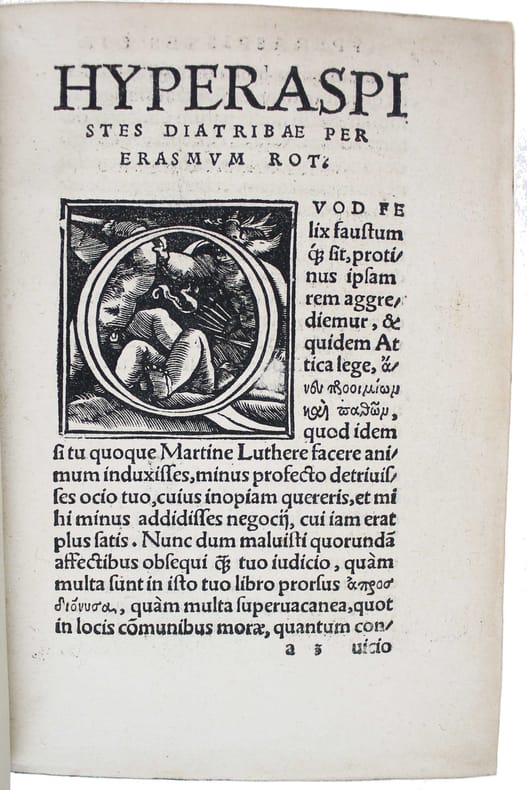
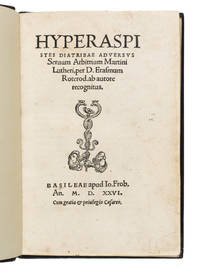
1526ABC_49737Basel: Johann Froben 1526. Modern calf with the author title and year of publication lettered in gold on the spine. Small 8vo. With a woodcut printer's device on the title page and final leaf and 2 decorated woodcut initials. First revised edition of Erasmus' response to Martin Luther which is part of their famous theological debate that took place in the 1520s. Erasmus received Luther's work in February 1526. The Hyperaspistes is his first reply to it which he composed within a few days in March 1526. The present edition revised by Erasmus himself and published in July of the same year supplies a more correct text of this famous refutation.The Hyperaspistes first published in March 1526 deals with the question of free will and was written in response to Luthers De servo arbitrio On enslaved willl 1525 which in turn was written in reply to Erasmuss De libero arbitrio On free will 1524. Luther argued that humans could not achieve salvation through good deeds as they could not choose between good and evil and so could only be redeemed through the will of God. Erasmus on the other hand believed that each individual had the freedom to accept Gods grace and turn towards a Christian life and salvation could be reached through good deeds. The confrontation between Erasmus and Luther was a duel of major importance for Europe in the first half of the 16th century as two visions of man history and faith clashed.The second part of the Hyperaspistes appeared in September 1527 continuing the exegetical controversy with Luther. The present edition however was published before the second part was written.With near- contemporary annotations in the margins of some of the leaves. The work is lightly browned and foxed throughout. Otherwise in good condition.l Adams E-675; Bezzel 1117; BM STC German p. 281; Erasmus Online 2230; USTC 664562; Vander Haeghen I 110; VD16 E 3029; cf. De Reuck 236 other issue. Johann Froben, unknown
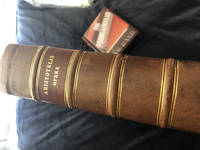
1550P8126The Works of Aristotle "per Des. Eras Roterordamvm" 1550. 2 volumes in one folio 323 x 192mm. Third Edition of The Works of Aristotle of the original text in 1831 prepared by Simon Grynaeus. This edition retains the original letter from Erasmus to Thomas More's son John. Woodcut initials a few woodcut illustrations old calf a few early annotations numerous notes in Latin Greek and English on front and rear flyleaves probably nineteenth-century and in text in ink pencil and red crayon neat annotations in Greek in second volume Greek quotation from Aristotle written on first title-page occasional light staining T5 torn in margin binding rubbed rebacked. Two of history's greatest minds converge. Book #P8126. $6500. We specialize in Rare Ayn rand erotica history and science. Johann Bebel and Michael Isengrin, 1550 hardcover
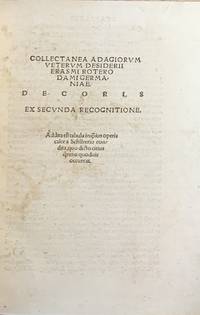
15106221Hardcover. Fine. 4to. Bound in 20th-century 1/4-vellum over marbled boards. Strasbourg: Matthias Schürer <b>Jul</b><b>y 1510. Second Strasbourg</b> edition of Erasmus heavily annotated collection of Greek and Latin proverbs. Printed in Roman and Greek types. <br /><br />This is the original version containing 818 adages which is considerably shorter than the later expanded versions published under the title Adagiorum chiliades. Adams E-420; Bezzel Erasmusdrucke 50; Van der Haeghen Bibliotheca Erasmiana p.25-6; Bibl. Belgica II 276: no. E.61; Muller Strasbourg II p. 179 no. 45. <br /><br />The Adagia could only have been possible in the new world of European education in which careful attention to a broader range of classical texts produced a much fuller picture of the literature of antiquity. Its impact has been long lasting. Such popular expressions such as <i>one step at a time</i> <i>between a rock and a hard place</i> <i>break the ice</i> <i>an iron in the fire</i> l<i>ooking a gift horse in the mouth</i> and many other sayings can trace their origin to the Adagia. <br /><br />The printer Matthias Schürer published 15 works by Erasmus in over 70 editions. It is interesting to note that his relationship with Erasmus began with a rather rough start. In 1509 the year Schürer completed his apprenticeship and opened his own print shop he struck an unauthorized edition of Erasmuss Adagia purloined from the first edition of 1500. In spite of this commercial indiscretion Erasmus favored Schürer with a warm supportive and lasting friendship. The dedicatee of this celebrated work William Blount 4th Baron Mountjoy of Barton Blount Derbyshire was a wealthy English courtier and scholar. A pupil of Erasmus he called him inter nobiles doctissimus The most learned amongst the nobles. Having served since 1512 as Chamberlain to Queen Catherine of Aragon it fell to him to announce to her the intention of Henry VIII to divorce her. Boards slightly rubbed; signatures D-K with a small wormhole to outer margin without loss of text; some slight browning and soiling to some pages; a few leaves with faded manuscript marginalia in a neat 16th-century hand; index leaves with light water staining to upper portion; o/w a very nice unrestored wide-margined example of this rare early edition. Matthias Schürer hardcover
15402712Cologne:: Ex officina Ioannis Gymnici 1540. RARE COLOGNE EDITION. Folio: . 31.2 x 20 cm. . 88 3-874 1 pp. A-d6 e8 f-g6 A-Z6 Aa-Zz6 Aaa-Zzz6 Aaaa-Dddd6 last leaf is blank. A very fine copy bound in contemporary pigskin over beveled wooden boards tooled in blind. The clasps lacking some scuffing and soiling to lower board otherwise a very nice binding. Internally a beautiful copy with the lightest of occasional soiling. Gyminus’ fine hippocamp device appears on the title. A very rare Cologne edition of Erasmus’ beloved and extraordinarily influential “Adages†first conceived as a collection of proverbial sayings drawn from the Latin authors of antiquity elucidated for the use of those who aspired to write an elegant Latin style. In its first incarnation the “Adagia†consisted of about eight hundred proverbs. The present version Erasmus' "Adagia Chiliades" “Thousands of Adages†is more than just a vastly expanded edition of that first enterprise: "A glance at its composition reveals that the ‘Adagia Chiliades’ was in fact -as well as in name- a new book and that Greek scholarship was largely responsible for the difference. Instead of 818 adages there were 3260. Of those about four-fifths were either new or substantially altered in form. And 2734 contained Greek passages of two to six lines or more in length.â€Renaissance Humanism vol. 2 pages 232-233. “In the dedication Erasmus pointed out the profit an author may derive both in ornamenting his style and in strengthening his argumentation from having at his disposal a good supply of sentences hallowed by their antiquity. He proposes to offer such a help to his readers. What he actually gave was much more. He familiarized a much wider circle than the earlier humanists had reached with the spirit of antiquity. “Prior to the ‘Adages’ the humanists had to some extent monopolized the treasures of classic culture in order to parade their knowledge of which the multitude remained destitute and so to become strange prodigies of learning and elegance. With his irresistible need of teaching and his sincere love for humanity and its general culture Erasmus introduced the classic spirit in so far as it could be reflected in the soul of a sixteenth-century Christian among the people. Erasmus made current the classic spirit. Humanism ceased to be the exclusive privilege of a few. According to Beatus Rhenanus he had been reproached by some humanists when about to publish the 'Adagia' for divulging the mysteries of their craft. But he desired that the book of antiquity should be open to all." Huizinga p. 39-40 Van der Haeghen I 4; Bezzel 83; VD16 E 1944 Ex officina Ioannis Gymnici, unknown books