Locke, JohnBiblio.com
185 résultats
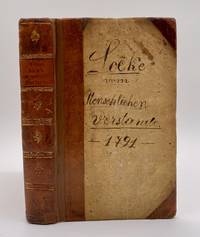
1791019936Mannheim: Schwan und Götz 1791. Book. Very good condition. Hardcover. First thus edition. Octavo 8vo. xxxii 557 pages of text. Contemporary half leather binding with paper-covered boards has moderate wear soiling and discoloration. The front board is hand-lettered. The exterior front hinge was expertly repaired. First edition of this annotated new translation by Tittel 1739-1816 who was an eclectic philosopher and critic of Kantian philosophy. Previous owner's oval bookplate affixed to the inside front cover: Le Chevalier Charles de Bohr. There are a few tiny spots of staining to the page edges and the text is minimally browned and foxed. The text is otherwise clean and unmarked. An abridgment of Locke's "Essay Concerning Human Understanding". . Schwan und Götz Hardcover
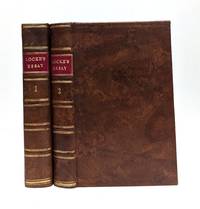
1721014642London: Printed for A. Churchill and A. Manship 1721. Complete in 2 volumes. Books measure 20x13.cm. Collation iv 26372pp 16 34027pp engraved postrait in volume 1. Bound in period full leather. Both volumes have been rebacked retaining the panelled boards. Calf rubbed bumped. Bindings in good clean firm condition. Internally prvious owners bookplate period inscription crease on title page. Pages in good clean condition. A good set in a amateurishly repaired bindings. F. Eighth Edition. Full Calf. Very Good. 8vo. Printed for A. Churchill and A. Manship Hardcover
1709097678Lipsiae: Sumptibus Theophili Georgie 1709. Book measures 6 3/4 x 4 1/4 inches. Collation 591943pp engraved frontis. Bound in full period vellum yapp edges title in manuscript. Vellum dust/dirt marked. Binding in very good solid condition. Internally light tanning throughout. Pages in good clean condition. A very nice copy in an attractive period binding. Text in Latin. Period Vellum. Very Good. 8vo. Sumptibus Theophili Georgie Hardcover
1766442990London : Printed for T. Osborne 1766. 5th edition. Hardcover. Very good copies in marbled boards backed in gilt-blocked full calf. Spine and boards dust-toned bumped and rubbed as with age. Somewhat nicked pages. Stretched hinges with loose pages. Scattered foxing. Physical description; xii 360 p. ; 27 cm. Subjects; Bible ; Indexes ; Early works to 1800. Bible ; Index ; Ouvrages avant 1800. John Locke critical studies. Common-place-book. London : Printed for T. Osborne hardcover
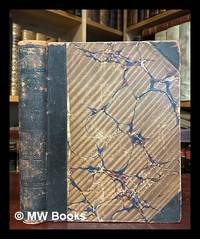
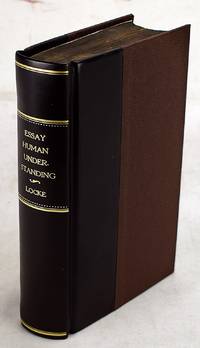
17152007190011London : Printed for J. Churchill ; And Samuel Manship 1715. 7th . Hardcover. Acceptable. Locke's Foundational Work on Human Knowledge 2 volumes bound as one. Printed 1715-1716. Rebound in modern 1/2 leather over cloth boards. Good binding and cover. First volume title page provided in facsimile lacks portrait. Second volume has its own title page. Tear to the margin of p. 335-336. Minor restoration work conservation of some of the page edges p. 369-370. Some marginal browning edge wear. Minor water damage mostly to a few leaves at the end of the second volume. ESTC T65491. London : Printed for J. Churchill ; And Samuel Manship hardcover
173527686Amsterdam Pierre Mortier 1735 in-4° Traduction de Coste , un portrait , XLII- 602 - 9 ff de tables , un mors fendu sur 5 cm sans gravité. Troisième édition revue et corrigée, & augmentée de quelques aditions importantes de l'auteur et qui n'ont paru qu'après sa mort & de quelques remarques du traducteur
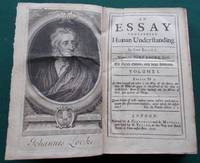
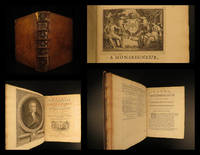
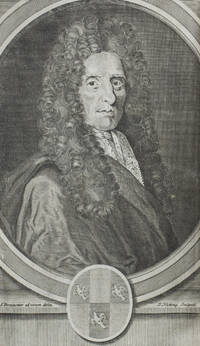
173511270<p><b>1735 John LOCKE Essay Concerning Human Understanding Philosophy Tabula Rasa </b></p><p><i>"I have always thought the actions of men the best interpreters of their thoughts." </i> </p><p>– John Locke </p><p>After studying medicine under the teaching of Thomas Sydenham John Locke began his journey of philosophical thinking that would develop into his most famous written work. '<i>An Essay Concerning Human Understanding</i>' is one of the most important books on the development and cultivation of human understanding and knowledge. It is in this work that Locke first describes the idea of 'blank slate' of the mind or 'tabula rasa.' Locke's 'Essay' is known to have directly influenced famous philosophers such as David Hume and George Berkeley. </p><p>This 1735 French edition was translated out of the original English by Pierre Coste and published in Amsterdam by Mortier. This edition is notably desirable because of the full-page portrait of Locke along with smaller beautiful engraved vignettes.</p><p>Item number: #11270</p><p>Price: $550</p><p>LOCKE John</p><p><b><i>Essai philosophique concernant l'entendement humain</i></b></p><p>Amsterdam: chez Pierre Mortier 1735.</p><p><br /></p><p><u>Details</u>: </p><p>· Collation: Complete with all pages</p><p>o XXIX 1 601 17</p><p>· Language: French</p><p>· Binding: Leather; tight & secure</p><p>· Size: ~10.25in X 8.25in 26cm x 20.5cm</p><p>Our Guarantee:</p><p>Very Fast. Very Safe. Free Shipping Worldwide.</p><p>Customer satisfaction is our priority! Notify us with 7 days of receiving and we will offer a full refund without reservation!</p><p>11270</p><p>Photos available upon request. </p> Pierre Mortier hardcover
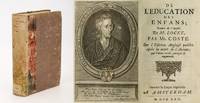
173029248AB1730. Édition pirate de Suisse. Amsterdam 1730. Octavo 11 cm x 16.5 cm. Frontispiece - Portrait of John Locke 6 3-24 468 12 pages. Hardcover / Reliure originale. Un peu taché frotté et heurté par endroits le dos collé avec des bandes de papier et des étiquettes en papier. Globalement un très bon exemple de cette importante publication. John Locke Bibliography No.584 - "A pirated edition published in Switzerland" / Not in Y; copies at Univ. of Michigan and Illinois "Some Thoughts Concerning Education" is a 1693 treatise on the education of gentlemen written by the English philosopher John Locke. For over a century it was the most important philosophical work on education in England. It was translated into almost all of the major written European languages during the eighteenth century and nearly every European writer on education after Locke including Jean-Jacques Rousseau acknowledged its influence. In his Essay Concerning Human Understanding 1690 Locke outlined a new theory of mind contending that the gentleman's mind was a tabula rasa or "blank slate"; that is it did not contain any innate ideas. Some Thoughts Concerning Education explains how to educate that mind using three distinct methods: the development of a healthy body; the formation of a virtuous character; and the choice of an appropriate academic curriculum. Locke wrote the letters that would eventually become Some Thoughts for an aristocratic friend but his advice had a broader appeal since his educational principles suggested anyone could acquire the same kind of character as the aristocrats for whom Locke originally intended the work. Wikipedia __________________________________________________________________________________________________________ "De leducation des enfans" étaient le résultat final des années productives de Locke en Hollande. Le travail a commencé par une série de lettres écrites en 1684 à son ami Edward Clarke donnant des conseils sur léducation des enfants de Clarke. Bien quil ne se soit jamais marié Locke semble avoir eu une attirance mutuelle pour les enfants damis - le petit-fils de Shaftesbury le futur 3e comte les enfants de Clarke les jeunes Masham dOates. Les lettres à Clarke étaient pleines de conseils pratiques du médecin pragmatique sur des questions telles que les vêtements et l'alimentation. Locke sinquiétait également du développement moral de lenfant soulignait limportance des habitudes desprit et mettait en garde contre la volonté et «lamour de la domination». Il était moins préoccupé en comparaison avec d'autres auteurs sur l'éducation de proposer un programme détaillé de lecture et d'étude. Les lettres de Locke à Clarke ont servi de base à Quelques réflexions sur léducation. En janvier 1685 il compila des copies des lettres de cette époque mais continua à y ajouter du matériel pendant plusieurs années. Il n'y revint qu'à l'hiver 1689/90 après les manuscrits de Deux traités de gouvernement et Un essai concernant la compréhension humaine avait été envoyée à la presse. Les réflexions sur l'éducation furent achevées en mars 1690 mais Locke ne savait pas s'il devait publier. Finalement il fut convaincu par William Molyneux et le livre parut en juillet 1693. Il s'avéra être l'une de ses uvres les plus populaires Bibliographie de John Locke hardcover
1794848581794. LOCKE John ed. John WYNNE. AN ABRIDGEMENT OF MR. LOCKE'S ESSAY CONCERNING HUMAN UNDERSTANDING. Boston: Printed by Manning & Loring for J. White Thomas & Andrews D. West E. Larkin J. West and the Proprietor of the Boston Bookstore 1794. First American edition. 250 pp. A6 - W6 last page blank. 12mo. brown calf with gilt spine rules and gilt red morocco spine label. Joints cracked spine shallowly chipped at heel and crown corners and edges worn. Label gilt lettering slightly rubbed. Light to moderate occasional foxing. Offset tanning to title page. Ink ownership dated "June '97" to blank recto preceding title page. Overopened at title page; contents page through p. 10 partially detached. The last four blank pages are dampstained. The only 18th century edition published in America; the full text was not published in America until 1803. Benjamin Franklin called it 'the best Book of Logick in the World" LCP First American Editions Exhibit 1984. Evans 21227. Quite scarce. unknown books
173590957Chez Pierre Mortier | Amsterdam 1735 | 20.5 x 26.5 cm | Relié
170146405757London, Aunshami & Johan. Churchil, 1701 ; in-folio, plein veau brun, dos à nerfs orné de caissons dorés. 13 ff. n. ch., 317 pp.Exemplaire sans le portrait. Derniers feuillets roussis. De la bibliothèque P. Guiraudi et de ses successeurs (Languedoc) ex-libris.
1714281400London : Printed for John Churchill 1714. First Edition. Hardcover. Poor copy wear and tear as with age. Boards damaged. Crudely repaired with adhesive tape. Some pages loose but present. Text remains in fine condition. Physical description; 12 xxviii 575 17 p. ; 33 cm. Subjects; Locke John 1632-1704. Knowledge Theory of ; Early works to 1800. Philosophy ; Early works to 1800. Economics ; Early works to 1800. Religion ; Early works to 1800. London : Printed for John Churchill hardcover
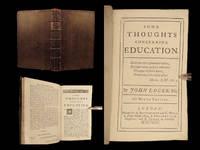
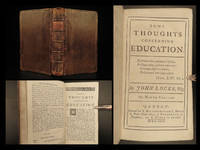
173224992<p><strong>1732 John LOCKE Essay Concerning Education English Philosophy Pedagogy Sydenham</strong></p><p><em>"I have always thought the actions of men the best interpreters of their thoughts." </em></p><p>– John Locke</p><p>After studying medicine under the teaching of Thomas Sydenham John Locke began his journey of philosophical thinking that would develop into some of his most famous works. In 1693 Locke published a treatise on education entitled '<em>Thoughts Concerning Education'</em>. Throughout the 18th-century it was <strong><u>the most important work on the philosophy of education in England</u></strong>. This work was an extension from 'Concerning Human Understanding' in which he describes how to educate the 'blank slate' mind described in<em> 'Human Understanding'.</em></p><p>A rare 1732 edition of Locke's famous education treatise.</p><p>Item number: #24992</p><p>Price: $599</p><p>LOCKE John</p><p><strong><em>Some thoughts concerning education</em></strong></p><p>London: Printed for A. Bettesworth and C. Hitch . 1732</p><p><u>Details</u>: </p><p><!-- if !supportLists-->· <!--endif-->Collation: Complete with all pages</p><p><!-- if !supportLists-->o <!--endif-->6 331 i.e. 325 3</p><p><!-- if !supportLists-->· <!--endif-->Provenance: Armorial bookplate – Edward Francis Witts</p><p><!-- if !supportLists-->o <!--endif-->Likely Edward Francis Witts 1813-1886 rector of Upper Slaughter in Gloucestershire. He was also the father of George Backhouse Witts 1846–1912 a British civil engineer and archaeologist who specialised in the prehistoric barrows of Gloucestershire. Motto: ANTE OBITUM NEMO FELIX</p><p><!-- if !supportLists-->· <!--endif-->Language: English</p><p><!-- if !supportLists-->· <!--endif-->Binding: Leather; tight and secure</p><p><!-- if !supportLists-->· <!--endif-->Size: ~6.5in X 4in 16.5cm x 10.5cm</p><p>Our Guarantee:</p><p>Very Fast. Very Safe. Free Shipping Worldwide.</p><p>Customer satisfaction is our priority! Notify us with 7 days of receiving and we will offer a full refund without reservation!</p><p>24992</p><p>Photos available upon request. </p> for A. Bettesworth and C. Hitch hardcover
1732218191732 John LOCKE Essay Concerning Education English Philosophy Pedagogy Sydenham"I have always thought the actions of men the best interpreters of their thoughts." – John LockeAfter studying medicine under the teaching of Thomas Sydenham John Locke began his journey of philosophical thinking that would develop into some of his most famous works. In 1693 Locke published a treatise on education entitled 'Thoughts Concerning Education'. Throughout the 18th-century it was the most important work on the philosophy of education in England. This work was an extension from 'Concerning Human Understanding' in which he describes how to educate the 'blank slate' mind described in 'Human Understanding'.A rare 1732 edition of Locke's famous education treatise.Item number: #21819Price: $599LOCKE JohnSome thoughts concerning educationLondon: Printed for A. Bettesworth and C. Hitch . 1732Details: • Collation: Complete with all pageso 6 331 i.e. 325 3• Provenance: Armorial bookplate/Handwritten – Wm. Strong o William Strong 1808–1895 was an American lawyer jurist and politician who served as an Associate Justice of the Supreme Court of the United States from 1870 to 1880. Strong previously served as a U.S. Representative from Pennsylvania from 1847 to 1851 and as a justice of the Supreme Court of Pennsylvania from 1857 to 1868. He also served on the Commission that adjudicated the disputed presidential election of 1876.• Language: English• Binding: Leather; tight and secure• Size: ~6.75in X 4in 17cm x 10.5cmOur Guarantee:Very Fast. Very Safe. Free Shipping Worldwide.Customer satisfaction is our priority! Notify us with 7 days of receiving and we will offer a full refund without reservation! 21819Photos available upon request. for A. Bettesworth and C. Hitch hardcover
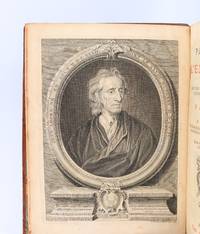
171642019London: J. Churchill Vol. 1; A. and J. Churchill Vol. 2 1716. Seventh Edition with large Additions. Hardcover. fair to vg. Octavo 8 x 5". 32 372 1; 16 340 25 index 1pp. Contemporary full calf with modern white lettering on spine. Raised bands. Previous owner's gift inscription on front free endpaper: "To the Edinburgh Academical Club This Book Is Presented By One of its Original Members John M. Balfour. 1829." Engraved frontispiece portrait of John Locke by J. Nutting after a painting by S. Brounower. Title page for each volume.<br /> <br /> Seventh and enlarged edition of John Locke’s Essay "Concerning Human Understanding" a philosophical landmark originally published in 1689 although dated 1690.5<br /> <br /> One of the principal sources of empiricism in modern philosophy this essay presents a detailed systematic philosophy of mind and thought and wrestles with fundamental questions about how we think and perceive and it even touches on how we express ourselves through language logic and religious practices. In the introduction entitled 'The Epistle to the Reader' Locke describes how he became involved in his current mode of philosophical thinking. He relates an anecdote about a conversation with friends that made him realize that men often suffer in their pursuit of knowledge because they fail to determine the limits of their understanding. <br /> <br /> The Essay is divided into four books two per volume:<br /> <br /> First volume:<br /> <br /> - Book I is devoted to an attack on nativism or the doctrine of innate ideas. Locke allowed that some ideas are in the mind from an early age but argued that such ideas are furnished by the senses starting in the womb: for instance differences between colors or tastes. If we have a universal understanding of a concept like sweetness it is not because this is an innate idea but because we are all exposed to sweet tastes at an early age. One of Locke's fundamental arguments against innate ideas is the very fact that there is no truth to which all people attest. He took the time to argue against a number of propositions that rationalists offer as universally accepted truth for instance the principle of identity pointing out that at the very least children and idiots are often unaware of these propositions. <br /> <br /> - Book II: Whereas Book I is intended to reject the doctrine of innate ideas proposed by Descartes and the rationalists Book II explains that every idea is derived from experience either by sensation - direct sensory information - or reflection - "the perception of the operations of our own mind within us as it is employed about the ideas it has got". Furthermore Book II is also a systematic argument for the existence of an intelligent being: "Thus from the consideration of ourselves and what we infallibly find in our own constitutions our reason leads us to the knowledge of this certain and evident truth that there is an eternal most powerful and most knowing being; which whether any one will please to call God it matters not!" <br /> <br /> Second volume:<br /> <br /> - Book III focuses on words. Locke connects words to the ideas they signify claiming that man is unique in being able to frame sounds into distinct words and to signify ideas by those words and then that these words are built into language. Chapter ten in this book focuses on "Abuse of Words." Here Locke calls out metaphysicians for making up new words that have no clear meaning. He also criticizes the use of words which are not linked to clear ideas and to those who change the criteria or meaning underlying a term. Thus he uses a discussion of language to demonstrate sloppy thinking. Locke followed the Port-Royal Logique 1662 in numbering among the abuses of language those that he calls "affected obscurity" in chapter 10. Locke complains that such obscurity is caused by for example philosophers who to confuse their readers invoke old terms and give them unexpected meanings or who construct new terms without clearly defining their intent. Writers may also invent such obfuscation to make themselves appear more learned or their ideas more complicated and nuanced or erudite than they actually are. <br /> <br /> - Book IV and last focuses on knowledge in general - that it can be thought of as the sum of ideas and perceptions. Locke discusses the limit of human knowledge and whether knowledge can be said to be accurate or truthful. Thus there is a distinction between what an individual might claim to "know" as part of a system of knowledge and whether or not that claimed knowledge is actual. For example Locke writes at the beginning of Chap. IV Of the Reality of Knowledge: "I doubt not my Reader by this Time may be apt to think that I have been all this while only building a Castle in the Air; and be ready to say to me To what purpose all of this stir Knowledge say you is only the Perception of the Agreement or Disagreement of our own Ideas: but who knows what those Ideas may be . But of what use is all this fine Knowledge of Man's own Imaginations to a Man that enquires after the reality of things It matters now that Mens Fancies are 'tis the Knowledge of Things that is only to be priz'd; 'tis this alone gives a Value to our Reasonings and Preference to one Man's Knowledge over another's that is of Things as they really are and of Dreams and Fancies." In the last chapter of the book Locke introduces the major classification of sciences into physics semiotics and ethics.<br /> <br /> Binding heavily rubbed along edges with closed tears along joints. Head and tail of spine slightly chipped. Hinges reinforced with binder's tape. Previous owner's bookplate on inside of front cover James A. Young. Stamp of the Edinburgh Academical Club at lower margin of front free endpaper and on both title pages. Moderate and sporadic age-toning throughout and minor and sporadic creasing along paper margin not affecting lettering. Binding in overall fair interior in good to very good condition. "John Balfour 1750-1842 was a Scottish politician and a civil servant in the East India Company with connections to the Orcadian island of Shapinsay." From Wikipedia. J. Churchill (Vol. 1); A. and J. Churchill (Vol. 2) hardcover
179818190Edinburgh: Mundell & Son; and J. Mundell. Near Fine with No dust jacket as issued. 1798. Reprint. First Printing. Leather. Contemporary calf rebacked gilt lettering on burgundy and gilt labels on spines. First appearing in 1689 although dated 1690 "An Essay Concerning Human Understanding" by John Locke concerns the foundation of human knowledge and understanding. He describes the mind at birth as a blank slate filled later through experience. The essay was one of the principal sources of empiricism in modern philosophy and influenced many enlightenment philosophers such as David Hume and George Berkeley. Expertly rebacked unmarked tight square and clean. A very attractive set. NEAR FINE. 12mo 7" - 7½" tall. liii 271; xvi 264; xiv 308 pp . Mundell & Son; and J. Mundell hardcover
1729130261Pierre Mortier, Amsterdam 1729 In-4, plein veau blond, dos à nerfs, caissons orné, dentelles en coupes, xlvi- 595- 16 pages. Portrait de l'auteur en frontispice, vignette, bandeaux et lettrines. Seconde édition, en partie originale. Dos frotté, petit accroc de coiffe supérieure. Bon exemplaire.
173590957Amsterdam: Chez Pierre Mortier 1735. Fine. Chez Pierre Mortier Amsterdam 1735 20.5 x 26.5 cm Relié Third edition revised corrected and enlarged with several important Additions by the author published posthumously and with Remarks by the Translator our own translation with the portrait of John Locke by Godfrey Kneller engraved by François Morellon de La Cave. Contemporary full brown calf spine with five raised bands decorated with gilt compartments brown morocco lettering-piece triple fillet border to covers in blind red edges marbled pastedowns and endpapers. Headcaps missing surface losses to covers and one larger loss to upper left corner of back cover corners bumped and worn rubbing to edges with a small loss at foot of front cover ink gift inscription to first blank leaf. In this copy: light marginal dampstaining to early leaves and to pp. 53-58 and pp. 463-472 not affecting text. This volume is enriched with ink annotations: ""n°23 ="" to verso of front free endpaper another inscription to recto of second endpaper and several ink corrections to margins and text at pp. 3 125 127 148 and 269. Chez Pierre Mortier hardcover
174265230Amsterdam: chez Pierre Mortier 1742. 4to pp. xlii 603 18; engraved vignette title page printed in red and black engraved frontispiece portrait by F. Morellon La Cave after G. Kneller and engraved headpiece at the top of the dedication page; nice copy in contemporary full mottled calf gilt-decorated spine in 6 compartments red morocco label in 1. This French translation of Locke's Essay Concerning Human Understanding was first published in 1700 and it is the last with revisions by Coste as he died in 1747. He also translated Newton's Opticks. Yolton 96. chez Pierre Mortier unknown
172134662London 1721. 36 x 26cm. unknown books
17352346391Edinburgh: Mundell & Son; and J. Mundell 1735. Eleventh Edition. Full-Leather. Good/No Jacket. 1735 eleventh edition. Three volumes bound in two. Large discolored area on rear board of second volume a few spots on boards otherwise evidence of repair along joints of both spines corners a bit rubbed a few pages lightly foxed ink names on title page of each volume C.J. Forbes Florence; Tho. Storer. xxxii 372; xvi 340 27 pp. 8vo. Contemporary full calf black and red morocco spine labels five raised spine bands gilt titles and rules with decorations in compartments speckled edges and marbled endpapers. First published in 1689 this is a foundational work in the influential British school of empiricism of which Locke was among the leading proponents. Empirical philosophy argued that knowledge stemmed from subjective experience a posteriori rather than the operation of objective reason a priori. As such this work contains commentary on how the formation of ideas relates to sensation and perception. This edition includes an extensive index. Mundell & Son; and J. Mundell hardcover
172134662London 1721. 36 x 26cm. unknown
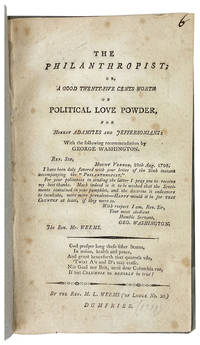
179911478Dumfries VA: n.p. 1799. Very Good. Dumfries VA: s.i. 1799. Octavo; recent grey card wrappers; 230 pp. Touch of spotting to title page; overall very good. <br /> <br /> Scarce pamphlet from Parson Weems the source of many apocryphal anecdotes about George Washington such as the tale of the cherry tree and the author of the first biography of George Washington in 1800. Here Weems attempts to reconcile feuding Federalists and Republicans and prints Washington's favorable recommendation on the title page. Printed on the second leaf is a dedicatory letter addressed to Washington. <br /> <br /> Evans 36697; Sabin 102492. [n.p.] unknown
1753652421Printed for S. Birt et al. 1753. Fourth Edition. Leather Binding. Near Fine. 2 volumes. Beautifully rebound in period style in full brown calf spines with raised bands red morocco labels and gilt rules some leaves have marginal staining - binding is fine. The Fourteenth edition. Printed for S. Birt, et al. unknown
1753232002London 1753. Hardcover. Very Good. 2 Volumes originally published in 1689. In Four Books. Vol. 1- 372 pages containes Book I and Book II; drawing of Locke on frontispiece. Vol.2 - 340 pages contains Book III and Book IV. Previous owner's name-plate on front paste-down endpaper. Full brown leather spine was restored. Both volumes are solid and tight and a few pages show some marks. VG/VG. <br/> <br/> hardcover