Schopenhauer, ArthurBiblio.com

88 résultats
1873310562Leipzig: F. V. Brodhaus 1873. First Edition. Leather Bound. Good. 0x0x0. Good condition. Scarce German 1st editions 1873-1874 of all 6 volumes of Schopenhauer's complete works edited by Schopenhauer's executor Julius Frauenstadt. Hinge is rubbed on Volume One. Volumes Two and Three are lightly rubbed Volume Four has 3/4 inch chip and hinge is worn but sound Volume Five outer hinge is starting Volume Six has some apparent successful repair and chipping at head and hinge. Bookseller/binder's mark at top corner inside board. Now in archival acrylic jackets. Provenance: this set was formerly owned by Elizabeth Von Arnim Schlagenthin anonymous author of the beloved turn of the century classic "Elizabeth and Her German Garden". Each volume of the Sammtliche Werke features her bookplate on the inside front board stating "This book belongs to Elizabeth Chanterai Ma Chanson" with stamp of Von Arnim- Schlagenthin on the front free endpaper - likely from the large library at her estate Chalet Soleil where she seduced the young man who came to catalog it. Literary associations She was Katherine Mansfield's cousin. E. M. Forster and Hugh Walpole tutored her children. She had an affair with H. G. Wells. And then there is Schopenhauer. He influenced perhaps her notoriously mordant wit. The set is well read. Each volume is half leather. Ships from Dinkytown in Minneapolis Minnesota. Due to the size/weight of this set extra charges to apply for international shipping. F. V. Brodhaus hardcover
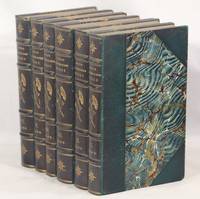
1891000013367Leipzig: F.A. Brockhaus 1891. Later edition. Hardcover. Very Good. 6 vol. 7 viii 3 4-203 6 vi-xiv 3 2-160 3 iv-xvi 1-93 3 1-58 2; 7 viii-xxxvi 3 4-633 3; 5 vi 3 4-743 3; 9 x-xxxi 1 1-275 3; 5 vi-xii 7 4-532 2; 5 vi 3 4-696 2 pp. Half contemporary green morocco over marbled boards spines in five compartments with gold lettering and decorations; all edges sprinkled purple. Bound by Otto Knoll of N.Y. Volume one illustrated with a folding chart and with two in-text diagrams volumes two and three each with a folding chart. Edited by Julius Frauenstädt. A reprint of the second edition. Volume one with works on epistemology and writings on a theory of vision and colors. Volume one's text in German except for the final essay which is in Latin. Volume two is in four books with an appendix containing a criticism of Kantian philosophy. Volume three with additions to the contents of the books in volume two. Volume four with an essay about the will in nature and an essay on "the two basic problems of ethics". The final two volumes contain Parerga und Paralipomena philosophical reflections by Schopenhauer. Stanford Encyclopedia of Philosophy "Arthur Schopenhauer". With work in aesthetics ascetics and reason Schopenhauer's philosophy was influential for Nietszche Bergson and for countless literary figures including Borges. SEP cites the authors ethics as one of his boldest ideas. His ethical framework does not require the existence of a deity for it to be justified. Each volume with a bookplate light rubbing to the extremities and the joints and corners touched up. F.A. Brockhaus hardcover
181828300Leipzig: F. A. Brockhaus 1818 1818. Second edition considerably revised; the first was published in 1813. Edges a little worn; spines slightly faded; very good copy. 2 vols 8vo contemporary quarter paper spines marbled paper boards gilt lettering untrimmed. With half-titles. Between 1803 and 1805 Johanna Schopenhauer 1766-1838 traveled extensively with her family in England and Scotland. She is known today primarily as the mother of the philosopher Arthur Schopenhauer 1788-1860 but in her time she was a popular novelist and travel writer and she hosted a prominent literary salon in Weimar. This second edition was significantly reorganized with a new preface explaining the changes. In addition to descriptions of the great country houses Blenheim and Chatsworth among them landmarks the Tower of London Windsor Castle Hampton Court and cultural life in London particularly the theater Schopenhauer describes the industrial north coal mines a munitions factory a steel mill and offers her observations on industrialization and social conditions of the working families in the vein of Harriet Martineau. Bookplate of Bibliotheca Congregationis SS. Redemtoris on the front paste-downs and their small shelf label at the feet of the spines. <br/><br/> Leipzig: F. A. Brockhaus, 1818 hardcover books
188938084London England: George Bell & Sons. As New. 1889. Hardcover. FREE UPGRADE to Courier/Priority Shipping Upon Request IN STOCK AND IMMEDIATELY AVAILABLE FOR SHIPMENT - TEXT PRISTINE Hinges cracked; else fine. -- with a bonus offer-- . George Bell & Sons hardcover
184072553Trondhjem 1840. Liten 4to. Samtidig skinnryggbind med marmorerte dekler. 100 s. Trykt af Tønnes Andreas Høeg Norsk. <br/><br/><em>I “Det Kongl. Norske Videnskabers-Saelskabs Skrifter i det 19de Aarhundrede. 3die Binds 2det Hefteâ€. Bindet eller har en rekke interessante artikler. Med tidligere eieres anmerkninger. Et svært viktig filosofisk skrift. </em> unknown
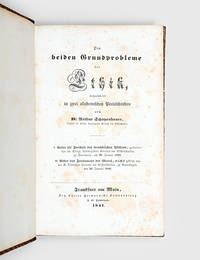
1840170880Frankfurt am Main: Joh. Christ. Hermannsche Buchhandlung 1841 i.e. 1840; 1854. I am read and I will be read First edition of the German philosopher's best and most focussed work on ethics outlining stinging attacks on both Kant and Hegel. In 1839 Schopenhauer wrote an essay titled On the Freedom of Human Will which won him the gold medal from the Royal Norwegian Society of Sciences. Buoyed he wrote a complementary essay one year later On the Foundations of Morality which did not fare as well. Although this was the only submission to a competition run by the Royal Danish Society it was rejected on the grounds that it was opinionated and brutally disrespectful to prominent philosophers - Hegel in particular. Schopenhauer responded by publishing the two papers as Two Fundamental Problems of Ethics original German - Die Beiden Grundprobleme der Ethik with a lengthy preface outlining some choice thoughts on both Hegel and the Royal Danish Society. Although the Two Fundamental Problems carries an 1841 date it was published late in 1840. This volume also includes the second edition of On the Will in Nature original German - Ueber den Willen in der Natur originally published in 1836 which aims to bring recent developments in 19th-century science in line with Schopenhauer's nascent theory of the will. By 1854 his intellectual isolation had begun to abate and as he confidently wrote in the preface to the second edition "legor et legar" "I am read and I will be read" - p. vi. Octavo 203 x 126 mm pp. xl 278 2; pp. xxiv 135 1. Near-contemporary brown quarter cloth spine ruled and lettered in gilt marbled paper sides and edges. Near-contemporary library ticket of Ad. Scheefer. Infrequent near-contemporary pencil annotations. Light bumping and rubbing minor foxing to outer leaves: a very good copy. Hübscher 33 & 37. hardcover
1851916Berlin: A. W. Hayn 1851. First Edition. Hardcover. Very good. The Book That Finally Made Schopenhauer Popular! <br /> <br />SCHOPENHAUER Arthur Parerga und Paralipomena: kleine philosophische Schriften Appendices and Omissions: a small philosophical writing. Berlin: A. W. Hayn 1851. Volume 1: TP i = Inhalt iii-iv = Vorwort half-title 3-465 466 = Druchfehler; Volume 2: TP III-IV = Inhalt half-title 3-531; Octavo. First Edition. <br /> <br />This work published in an edition of only 750 copies is a significant supplement to The World as Will and Idea. <br /> <br />Parerga und Paralipomena Greek for "Appendices" and "Omissions" is a collection of later philosophical reflections by Schopenhauer. The selection was compiled not as a summation of or introduction to his philosophy but rather as supplementary readings for those who had already embraced it although the author did maintain that it would still be comprehensible and of interest to the uninitiated. <br /> <br />The collection is divided into two volumes covering first the parerga Appendicies and thereafter the paralipomena omissions to that philosophy. The parerga are six extended essays intended as supplementary to the author's thought. The paralipomena short ruminations divided by topic into thirty-one subheadings cover material hitherto unaddressed by the philosopher but deemed by him to be complementary to the parerga. <br /> <br />As a result of this book especially the Aphorisms of Wisdom Schopenhauer finally gained popularity in Germany as a philosopher. <br /> <br />The contents include: Fragments on the History of Philosophy On Academic Philosophy On Visions and Related Matters On Logic and Dialectic On the Philosophy of Science and Nature On Suicide On Women and others. <br /> <br />CONDITION: Very good or better in original publishers cloth Light scuffing and edgewear. Former owners name neatly inscribed to upper corner of front free endpapers. Light foxing. Overall a very desirable copy. <br /> <br /> <br/><br/> A. W. Hayn hardcover
184038535Trondhjem, Tønnes Andreas Høeg, 1840. 4to. Entire volume present. Later very nice brown hcalf w. gilt spine (Anker Kyster). Pp. (1) - 100. Entire volume: (2), 127, (3) pp. With the general title-page for the volume, title-pages and prefaces for the two works contained in the present volume, and the contents-leaf. The other work is: ""Den Constitutionelle Statsform, betragtet i dens Forhold til Samfundets høiere Interesser. Tale holden i det Kongl. Norske Videnskabers=Selskab paa hans Majestæt Kongens Fødselsdag den 26de Januae 1838, af Frederik Moltke Bugge, Selskabets Præses.""
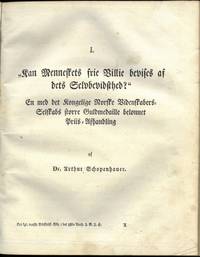
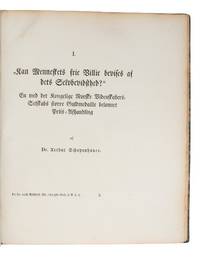
184038535Trondhjem Tønnes Andreas Høeg 1840. 4to. Entire volume present. Later very nice brown hcalf w. gilt spine Anker Kyster. Pp. 1 - 100. Entire volume: 2 127 3 pp. With the general title-page for the volume title-pages and prefaces for the two works contained in the present volume and the contents-leaf. The other work is: "Den Constitutionelle Statsform betragtet i dens Forhold til Samfundets høiere Interesser. Tale holden i det Kongl. Norske Videnskabers=Selskab paa hans Majestæt Kongens Fødselsdag den 26de Januae 1838 af Frederik Moltke Bugge Selskabets Præses." <br/><br/><em>The scarce first printing of Schopenhauer's "Prize Essay" "On the Freedom of Human Will" which constitutes one of Schopenhauer's greatest successes one of the works of which he was the most proud and the work that was awarded the large gold medal from the Royal Norwegian Society of Sciences being an answer to the proposed question from the Society "Is it possible to demonstrate human free will from self-consciousness". The following year Schopenhauer wrote his "On the Foundations of Morality" "Über die Grundlage der Moral" which he sent to the Royal Danish Society of Sciences but which was not honoured with an award although it was the only submission to the competition. It is these two works that together constitute his "Two Fundamental Problems of Ethics" "Die Beiden Grundprobleme der Ethik" which was published in 1941. The title-page and the preface are in Norwegian but the essay itself is in German "partly because a translation would undoubtedly be superfluous even unwelcome by anyone who possesses enough scientific education to lead the treatise with interest and knowledge partly because the copies that would be given to the author would probably lack all interest to him if they were printed in the Norwegian language and finally partly because the esoteric nature of the contents seem to make it preferable that the treatise as far as possible would not be made accessible to others than those who due to fairly thorough education are able to avoid misunderstandings as well as being able to properly appraise the value of the treatise with regards to its reality in general and partially own translation - Introduction pp. 2 - 3.Schopenhauer's work is generally accepted as being one of the most brilliant and elegant treatments of free will and determinism. He clearly and elegantly distinguishes between the freedom of acting and the freedom of willing. His conclusion is that human beings do have the freedom of acting whereas they do not have the freedom of willing since they are completely determined by the way that their bodies react to outside stimuli and causes. From the libraries of the two notable collectors Ejnar Christiansen and Esli Dansten. </em> unknown
1886140941121Boston: J.R. Osgood & Co 1886. First American edition. Near Fine. First American edition. xxxii 532; viii 496; viii 509 pp. Publisher's brown pebbled cloth with paper title labels. Light wear to title labels and slight darkening to spines traces of paper stuck to back board of Vol. 1 else Fine with contents bright and unmarked. A scarce set in truly excellent condition.<br /> <br /> A major work of 19th century philosophy and the author's magnum opus which he spent the remainder of his life revising and promoting. The title is generally translated The World as Will and Representation. Herein Schopenhauer maintains that life is a constant struggle and suffering the "heroic life project" that is doomed to fail. His call for realism and pessimism in the face of disaster to avoid sugar-coating reality makes this work always relevant and challenging. J.R. Osgood & Co unknown books
185162019Berlin Hayn 1851. 8vo. Uniformly bound in two uniform contemporary - possibly original! - embossed full cloth bindings. Embossed lettering and ornamentation to spine. Spines and borders of boards slightly faded. Spines with repairs. Front free end-paper in vol. 2 with repair. Previous owner's label Julius Kotrtsch pasted on to lower margin of title-pages. Previous owner's name in contemporary hand to upper margin of title-pages. Verso of last leaf in vol. 2 annotated in pencil. Vol. 1 with light occasinal marginal browspotting. 6 465 1 pp.; IV 531 pp. <br/><br/><em>The scarce first edition of Schopenhauer's most influential work his final masterpiece which consists in his seminal philosophical reflections. The Parerga and Paralipomena was the first of his works to gain recognition and the work that propelled the then obscure figure into lasting philosophical prominence. Seeing that all of Schopenhauer's previous publications had been complete failures it was only with great difficulty and reluctance that Hayn of Berlin was pesuaded to print the work which they then only did in a small printrun of merely 750 copies which now makes the first edition very difficult to find. The work is is two parts with the first "parerga"-part consisting in six extended essays intended as supplementary to the author's thought whereas the second "paralipomena"-part consists in shorter elaborations divided by topic into thirty-one subheadings that cover material hitherto unaddressed by Schopenhauer but complementary to the "parerga". In spite of the poor reception of his earlier works somehow the “Parerga and Paralipomena attracted the attention of John Oxenford a noted observer and translator of German literary culture who contributed a favourable review of the work in 1852 and in 1853 wrote an article on Schopenhauer's philosophy entitled "Iconoclasm in German Philosophy" which through its German translation in Vossische Zeitung sparked in immediate interest of Schopenhauer's work in Germany and propelled him into philosophical fame. “The effect was dramatic and almost overnight Schopenhauer in his own country passed from obscurity to fame and from then till his death in 1860he basked in the sunshine of belated recognition and eminence.†Payne in the Preface to his translation of Parerga and Paralipomena into English Oxford 2000p. xii The work greatly influenced later philosophers most notably Nietzsche whose fondness of aphorism is directly inspired by “Parerga and Paralipomenaâ€. “One of the most significant and fascinating works of the great philosopher Arthur Schopenhauer 1788-1860. The Parerga Volume 1 are six long essays; the Paralipomena Volume 2 are shorter writings arranged under thirty-one different subject-headings. These works won widespread attention with their publication in 1851 helping to secure lasting international fame for Schopenhauer. Indeed their intellectual vigor literary power and rich diversity are still extraordinary even today.†Payne. </em> hardcover
185162019Berlin, Hayn, 1851. 8vo. Uniformly bound in two uniform, contemporary - possibly original! - embossed full cloth bindings. Embossed lettering and ornamentation to spine. Spines and borders of boards slightly faded. Spines with repairs. Front free end-paper in vol. 2 with repair. Previous owner's label (Julius Kotrtsch) pasted on to lower margin of title-pages. Previous owner's name in contemporary hand to upper margin of title-pages. Verso of last leaf in vol. 2 annotated in pencil. Vol. 1 with light occasinal marginal browspotting. (6), 465, (1) pp." IV, 531 pp.
1886140948846London: Truebner & Co 1886. First British Edition. Very Good. First British edition and first English translation. Three volumes. 8 ads dated 7/11/83 4 xxxii 532; 8 ads viii 496 pp.; 8 ads viii 506 pp. Foldout table to Volume I facing p. 64. Bound in publisher's blue cloth stamped in black and gilt brown coated endpapers. Very Good with sunned spines rubbed at the extremities soiling and light stains to covers light foxing to cloth and textblock edges. Volume I: hinges starting front free endpaper detached. Volume II: hinges tender tidemark to lower front endpapers second ad leaf torn vertically in half with marginal loss to separated half fourth ad leaf torn from binding with loss of lower two-thirds. Volume III: lacking final ad leaf hinges tender tidemark to lower gutter of front endpapers. Housed in custom clamshell cases quarter navy morocco over blue marbled boards decorative gilt stamping to spines.<br /> <br /> <p>The first British edition of Schopenhauer's magnum opus Die Welt als Wille und Vorstellung which he first published in 1818 and spent a lifetime revising. Schopenhauer's depiction of life as eternal struggle met with a chilly reception from German idealists and the pessimist was not recognized as a major philosopher until 1851. It took another thirty years for Schopenhauer's most important work to be translated into English by R. B. Haldane and J. Kemp but many of his theories were widely accepted by the end of the 19th century. His faith in art as a means to perceive the underlying truth of all things "the Will" influenced the French Decadent movement and the works of Wagner Kafka and Borges. Thomas Mann championed Schopenhauer's clear-eyed rationalism as a necessary counter to the twentieth century's glorification of instinct including bad instincts: "We have seen instead of pessimistic conviction deliberate malice." His work is as relevant now as it was when these books were first printed. Truebner & Co unknown