72 résultats
189874261ABDresden, Reißner, 1898. Mit 1 Bildnistaf. 3 Bll., 274 S. Marmor. roter Hlwd. d. Zt. m. Rt. - Männer der Zeit, Bd. 4. - Minimal fleckig, StaT., gutes Expl.
18980546-17Dresden u. Lpz.,Reißner 1898. (4),(6),274 S. mit 1 Porträt. Oln., etw. (Rücken stärker) berieben, gering bestoßen, gering schiefgelesen, Buchblock im oberen Rand etw. wellig, vereinzelt min. fingerfleckig, stellenw. Bleistiftanstreichungen, insges. aber noch gut erh. - Männer der Zeit, 4.Bd. - Mit eh. Widmung d. Verf. an Friedrich Paulsen a.d. Titelbl. [2 Warenabbildungen]
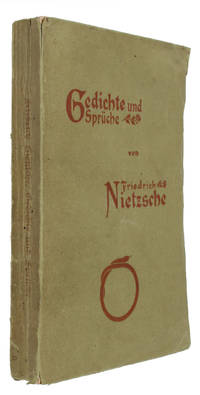
189843879Leipzig Naumann 1898. Small 8vo. Uncut in the original green printed wrappers. Spine with a bit of wear and minor wear to extremities. A very fine and clean copy in the scarce original wrappers. A 4-line presentation-inscription by Friedrich Jodl to front free end-paper dated "23.8.98". <br/><br/><em>The rare first edition of Nietzsche's poems and maxims the first complete collection of his poetry which furthermore constitutes the first appearance of all nine properly corrected "Dionysian Dithyrambs" in one volume.This one of 1.000 copies printed of the first run without "Second Edition" on the title-page as the other 1.000 copies of the first edition had. According to Elizabeth Förster-Nietzsche Nietzsche's sister who has assembled the present collection "this collection of poems and maxims shows the entire poetic development of my brother over a period of 30 years. It begins at a time when the earliest stuttering poetical expression has been overcome and ends with the highest rising of the poetic spirit who in order to find words can now only speak in dithyrambs." own translation from the Introduction p. XIII. Numerous of the poems have never been printed before and many are printed from the original manuscripts which Elizabeth had in her possession.Though Nietzsche is primarily understood and remembered as one of the greatest philosophers of all times his poems occupy a central place in his literary production and many of them e.g. the Dithyrambs are intimately linked with the philosophy for which he is so famous today. Furthermore the present volume underlines the popular modern view of Nietzsche as the not only philosophical but also literary and artistic genious. The first edition of the work is difficult to find and is rarely seen for sale.THE PRESENT COPY HAS BELONGED TO FREIDRICH JODL 1849-1914 the famous German philosopher and contemporary of Nietzsche and bears his signature as well as a 4-line dated presentation-inscription to front free end-paper. Jodl ranks as one of the most significant representatives of German expressionism and is still remembered for his original ontological works with their constant focus on empiricism as the only true strand of philosophy. He has also written a number of important works within the history of philosophy and ethics psychology and aesthetics which for decades counted as standard works and he is among the first to develop the intellectual environment that ultimately led to among many other things the founding of the Vienna Circle. His main task was to develop and spread a purely naturalistic ethics free of any religious or metaphysical elements and he is considered a modern "Enlightenment philosopher" whose consistent empiricism well-founded philosophical ideas optimistic theories of culture ethics the value of life & the progress of man inspired many later thinkers and furthermore helped promote important political and social ideas such as free popular education etc. His main works which are now standard works within ethics and psychology and which were printed over and over again are "Geschichte der Ethik als philosophischer Wissenschaft" in which he presents man's cultural development as the process of liberation from religious and metaphysical ideas and the change from a theocentric to an anthropocentric foundation of ethics. This work is followed up by his purely epirically founded "Lehrbuch der Psychologie" which grounds the same ideas psychologically. After having been Privatdzent in Munich he was named professor of philosophy at the German University in Prague and in 1896 he accepted a professorship of philosophy at the University of Vienna. He was greatly successful in Vienna and was considered the most prominent liberal professor here whose numerous lectures and articles against the reigning "Ultramintanismus" and the clerical influence in schools and universities found great resonance with scholars and students. He had a huge number of followers not only at the university but also in the public as a political figure as well. He is partly to thank for the emergence of an intellectual climate in Vienna in the 20th century which later led to Neopositivism and the founding of the Vienna Circle."We need no other mediator between us and nature except our understanding and a courageous will nor any mystery behind nature to console us for her; we are alone with nature and we feel secure because we possess intellect and she behaves according to laws" Jodl Vom wahren und vom falschen Idealismus p. 40. </em> unknown
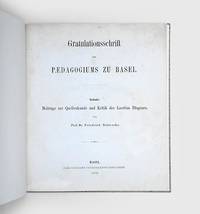
1870170977Basel: Carl Schultze's Universitaetsbuchdruckerei 1870. Nietzsche's early work on Diogenes Laertius First edition of this scarce early article privately printed in a run of 100 copies. The Gratulationsschrift was written shortly after Nietzsche had gained tenure at the University of Basel at the age of 24. He began his academic career as a philologist and the Gratulationsschrift outlines a philological study of Diogenes Laertius the shadowy author of the Lives and Opinions of the Eminent Philosophers. Nietzsche dedicates the work to F. D. Gerlach a colleague at Basel and copies were distributed at the ceremony marking Gerlach's retirement despite the fact Gerlach had opposed Nietzsche's appointment. Some copies were issued with a half-page cancel either bound between pages 2 and 3 or pasted to the lower half of page 3 that is not present here. No priority has been identified. Provenance: Hermann Türck 1856-1933 a philosopher and Nietzsche scholar who wrote Fr. Nietzsche und seine philosophischen Irrwege in 1891 a psychological study of the man and his later works. Türck's large printed bookplate is on the front pastedown. Quarto 218 x 193 mm pp. iv 36 8. Recent sprinkled grey boards printed paper label to spine. Minor browning and foxing to outer leaves: a very good copy indeed. Schaberg 18. hardcover
1893823<p>Leipzig: Naumann 1893. Second Edition. Wraps. Very good. Second Edition of Nietzsches Twilight of the Idols in Original Printed Wraps <br /><br />NIETZSCHE Friedrich Götzen-Dämmerung Twilight of the Idols Naumann Leipzig 1893. Half title TP 1 leaf = Inhalt I-II = Vorwort 1-116. Second Edition Krummel XVIII a p. 120. <br /><br />Nietzsche began to write Twilight of the Idols at the end of June of 1888 and was finished by early Septemberanother lightning-quick production that he claimed to have been the "work of so few days that I am hesitant to mention exactly how many." His hesitancy becomes even more understandable when one remembers that part of July was devoted to the preparation of the final typescript of The Case of Wagner and that during August he produced two "Postscripts" and the "Epilogue" and then proofed the entire work. In the final analysiswhen the book was finally completedNietzsche bragged to Gast that "I could hardly have used ten days more efficiently for it certainly took me no longer to write the book." Yet another ten-day wonder! <br /><br />The new book was originally entitled A Psychologist at Leisure when Nietzsche mentioned it to Naumann on 7 September: <br /><br />I am about to give you a nice surprise. You probably think we are finished with printing but even now the cleanest manuscript I have ever sent to you is on its way. Regarding layout and design this new work should be a twin to The Case of Wagner. The title is A Psychologist at Leisure. It is imperative for me that we publish this now because by the end of next year we will have to begin the printing of my main work The Revaluation of All Values which will be a stern and serious book and I will not be able to publish anything cheerful and winsome right after it. <br /><br />This book though not very large may cause a few ears to be opened so that the main work will not be greeted with silence like my Zarathustra. <br /><br />The manuscript was mailed two days later and the single-page first draft for the Preface came three days after that. Nietzsche thought of this bookin conjunction with the Wagner bookas a light and brief respite before the publication of his masterwork: "In the final analysis both of these works are only recuperations in the midst of an immensely difficult and decisive task which when properly understood will split humanity in two." Unfortunately Nietzsche never recovered from these "recuperations" and The Revaluation of All Values was never completed <br /><br />Even as the book was being printed Peter Gast pleaded with Nietzsche to change the title: <br /><br />When I consider how other people will respond to this title I think A Psychologist at Leisure is much too unassuming. You have dragged your artillery to the highest mountains you have guns such as have never existed and even if you shoot blindly you will inspire terror all around. The stride of a Giant which can make the mountains shake to their core is hardly leisure . . . and so I pleadif an incompetent may make such a requestlet us have a more resplendent a more radiant title! <br /><br />Nietzsche immediately agreed and changed the title to Twilight of the Idols75 and three days later he penned the final version of the Preface which was dated 30 September 1888. <br />Schaberg The Nietzsche Canon pp. 166-167 <br /><br />CONDITION: Uncut copy in original wraps printed front and back as well as on the spine. The covers are very lightly chipped and have a 1½ closed tear on the right side near the center of the front cover. The rear cover has five number inked next to the advertisements for Nietzsches books presumably noting their issuing sequence in the then-in-the-press Collected Works. A bit worn but still a lovely affordable and collectible copy of this important work by Nietzsche. <br /><br />PHOTOS AVAILABLE UPON REQUEST</p> Naumann paperback
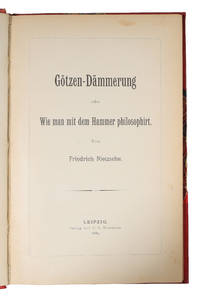
188961353Leipzig C.G. Naumann 1889. 8vo. Bound in a contemporary red half cloth binding with red marbled paper over boards and single gilt lines. Gilt lettering and a single gilt ornamentation to spine. Lovely patterned irdiscent end-papers in blue with white flowers. Boards slightly faded at top. Front hinge a bit soiled. Spine a bit discoloured and a bit worn at capitals. A few leaves with light scattered brownspotting but overall very clean and fresh. A few minor pencil marks on several pages and some faint brown spots on the final page. 8 144 pp. <br/><br/><em>First edition published in 1889 from Nietzsche's private press of the epitome of Nietzsche's final project -a re-valuation of all values "Eine Umwerthung aller Werthe" -his hugely interesting "declaration of war" preface p. 4: "Diese Schrift ist eine grosse Kriegserklärung" which was written during his last productive year just before his big breakdown in Turin. "Götzen-Dämmerung" "The Twilight of the Idols" arguably constitutes the culmination of the production of this giant of philosophy who turned mad after having finished it.Early in 1889 Nietzsche began to exhibit signs of serious mental illness; in Turin he finally broke down and was brought back to Basel by his friends. "The Twilight of the Idols" was released merely a few weeks after this collapse and Nietzsche never wrote again.Nietzsche had 1.000 copies of the work privately printed. The work is considered one of his most popular and it is here that we find some of the most frequently quoted passages from the works of Nietzsche e.g. "What does not kill me only makes me stronger" p.2.: "Was mich nicht umbringt macht mich stärker".The Twilight was meant as an introduction to or summary of Nietzshe's philosophy and as such it is one of his most interesting works. It is written almost as in a rage of fever - it took him no more than a week to write it - and he regarded it a world-changing magnum opus. As he states at the end of the preface: "Turin am 30. September 1888 am Tage da das erste Buch der Umwerthung aller Werthe zu ende kam." i.e. "Turin on September 30. 1888 on the day that the first book on the re-valuation of all value came to an end.". This highly polemical work makes clear reference to Wagner's opera "Götterdämmerung" and it presents us with a sharp critique of the most influential philosophers in history e.g. Kant and Plato and of Christianity in general but also the likes of Rousseau Hugo Renan Mill Darwin Dante etc. are attacked as the causes of cultural decadence in Europe. Giants like Caesar Napoleon Dostojevski Goethe and Thukydides are considered representatives of the opposite.The mental collapse of the author may not come as a surprise to anyone reading the work.Of the 1.000 copies 659 still remained unsold by October 1893.Twilight of the Idols: Schaberg: 56a </em> hardcover
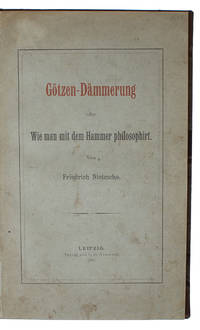
188960004Leipzig C.G. Naumann 1889. 8vo. Bound with the original printed wrappers in a nice near contemporary brown half cloth with gilt lettering to spine. Lovely marbled end-papers. A bit of light soiling and brownspotting to wrappers which are otherwise very well preserved. A few leaves with some very light brownspotting and a couple of leaves with small closed tears to blank inner margin far from affecting text. Overall very nice. With the engraved book plate of Adolf Fischer to inside of front board. 8 144 pp. <br/><br/><em>First edition - with the scarce original wrappers - of the epitome of Nietzsche's final project -a re-valuation of all values "Eine Umwerthung aller Werthe" -his hugely interesting "declaration of war" preface p. 4: "Diese Schrift ist eine grosse Kriegserklärung" which was written during his last productive year just before his big breakdown in Turin. "Götzen-Dämmerung" "The Twilight of the Idols" arguably constitutes the culmination of the production of this giant of philosophy who turned mad after having finished it.Early in 1889 Nietzsche began to exhibit signs of serious mental illness; in Turin he finally broke down and was brought back to Basel by his friends. "The Twilight of the Idols" was released merely a few weeks after this collapse and Nietzsche never wrote again.Nietzsche had 1.000 copies of the work privately printed. The work is considered one of his most popular and it is here that we find some of the most frequently quoted passages from the works of Nietzsche e.g. "What does not kill me only makes me stronger" p.2.: "Was mich nicht umbringt macht mich stärker".The Twilight was meant as an introduction to or summary of Nietzshe's philosophy and as such it is one of his most interesting works. It is written almost as in a rage of fever - it took him no more than a week to write it - and he regarded it a world-changing magnum opus. As he states at the end of the preface: "Turin am 30. September 1888 am Tage da das erste Buch der Umwerthung aller Werthe zu ende kam." i.e. "Turin on September 30. 1888 on the day that the first book on the re-valuation of all value came to an end.". This highly polemical work makes clear reference to Wagner's opera "Götterdämmerung" and it presents us with a sharp critique of the most influential philosophers in history e.g. Kant and Plato and of Christianity in general but also the likes of Rousseau Hugo Renan Mill Darwin Dante etc. are attacked as the causes of cultural decadence in Europe. Giants like Caesar Napoleon Dostojevski Goethe and Thukydides are considered representatives of the opposite.The mental collapse of the author may not come as a surprise to anyone reading the work.Of the 1.000 copies 659 still remained unsold by October 1893.Twilight of the Idols: Schaberg: 56a </em> hardcover
1897307471Hamburg, Haring, 1897. 22 Seiten. 21 cm. Halbleinenband der Zeit mit Papier-Rückenschildchen.
1894103785Leipzig: Naumann 1894. 2 Bl. 292 S. 2 Bl. Reklame; 4. Aufl.; Papier altersgemäß leicht nachgedunkelt sehr wenige saubere Randanstreichungen in Bleistift Einband berieben u. fleckig kleinste äussere Läsuren. Halbleinen. Befriedigend. 225 cm. Naumann Hardcover
189911769Leipzig 1899. 8.u. 9. Tsd./6.u.7.Tsd. Gr.-8°. Hldr. Literatur unknown
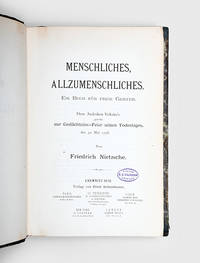
1878170976Chemnitz: Ernst Schmeitzner 1878. The defining work of Nietzsche's positivist period First edition of Nietzsche's first major polemical and aphoristic work marking his transition "from the philologist and cultural critic he had been into the kind of philosopher and writer he came to be" Schacht p. vii. The work which is translated as Human All Too Human embraces positivist reason in opposition to the metaphysical idealism of Schopenhauer and Wagner. For Nietzsche a naturally grounded reason was the only viable option to secure the ultimate enhancement of human life. The Menschliches reflects on religion art and morality and its incisive attacks on conventional pieties foreshadowed the thought of Nietzsche's mature period. It includes early expressions of many major Nietzschian concepts including the "will to power" and the rejection of Christian morality. Menschliches expresses Nietzsche's final direct disillusionment with Wagner of whom he had been a devoted admirer. He even claimed to have begun writing the work in response to the first Bayreuth production of the Ring cycle. On receiving his copy Wagner remarked that "he would be doing the author a favor for which the latter would one day thank him if he did not read it" quoted in Schaberg p. 64. Octavo 216 x 143 mm pp. viii 377 3. Contemporary half roan spine lettered and ruled in gilt marbled sides yellow coated endpapers edges marbled. Without the small cancel slip to p. 290. Late 19th-century bookplate of the author Gerhard Ouckama Knoop 1861-1913 to front free endpaper and his ink signature to head of half-title. Twentieth-century armorial bookplate of one Dr Roman Wolf to front pastedown. Contemporary purple ink bookseller's stamp to title page. Extremities restored. Light bumping and rubbing minor browning foxing and chipping to otherwise clean contents: a very good copy. Schaberg 29. Richard Schacht "Introduction" in Human All Too Human. A Book for Free Spirits 1996. unknown
1878182922Chemnitz: Ernst Schmeitzner 1878. The defining work of Nietzsche's positivist period First edition of Nietzsche's first major polemical and aphoristic work marking his transition "from the philologist and cultural critic he had been into the kind of philosopher and writer he came to be" Schacht p. vii. The work which is translated as Human All Too Human embraces positivist reason in opposition to the metaphysical idealism of Schopenhauer and Wagner. For Nietzsche a naturally grounded reason was the only viable option to secure the ultimate enhancement of human life. The Menschliches reflects on religion art and morality and its incisive attacks on conventional pieties foreshadowed the thought of Nietzsche's mature period. It includes early expressions of many major Nietzschian concepts including the "will to power" and the rejection of Christian morality. Menschliches expresses Nietzsche's final direct disillusionment with Wagner of whom he had been a devoted admirer. He even claimed to have begun writing the work in response to the first Bayreuth production of the Ring cycle. On receiving his copy Wagner remarked that "he would be doing the author a favor for which the latter would one day thank him if he did not read it" quoted in Schaberg p. 64. Octavo 215 x 143 mm pp. viii 377 3. Contemporary half roan rebacked with original spine laid down spine lettered ruled and decorated in gilt marbled sides yellow coated endpapers edges marbled yellow silk bookmarker. With the small cancel slip to p. 290. Light bumping and rubbing minor browning and foxing to contents damp stain to foot of endpapers and preliminary leaves: a very good copy. Schaberg 29. Richard Schacht "Introduction" in Human All Too Human. A Book for Free Spirits 1996. unknown
1878952Chemnitz: Schmeitzner 1878. First Edition. Hardcover. Very good. Nietzsches First Aphoristic Work and His Introduction of Perspectivism <br /> <br />NIETZSCHE Friedrich. Menschliches Allzumenschliches. Ein Buch für freie Geister Human all too Human. A Book for Free Spirits. Schmeitzner Chemnitz 1878. 1 blank leaf half title TP 1 leaf = Vorrede 1 leaf = Inhalt 1 leaf = half title 3 377 378= Printers information 1 leaf = publisher's advertisements 1 blank leaf. Octavo. First Edition First Issue Schaberg 29. <br /> <br /> <br />Includes initial half title before the full title page and the eere correction cut and pasted by Schmeitzner over menon a non-word to create meere sea on p290 aphorism 431 and advertisements. <br /> <br />Only 489 copies of this first edition first issue as the remaining 511 of the original 1000 first edition copies were sold to E. W. Fritzsch in 1886 for use in a new edition with new title page and without the ads. Thus this copy is extremely rare in any state. <br /> <br />This is the first book by Nietzsche where he is listed simply as Friedrich Nietzsche rather than as prof. In fact Human All Too Human constituted such a radical departure in style and content for Nietzsche that he first proposed to his publisher that it be released anonymously or with a pseudonym. Schmeitzner however would not allow it. <br /> <br />Reluctant to construct a philosophical system and sensitive to the importance of style in philosophic writing Nietzsche composed these works as a series of several hundred aphorisms a departure from his style up to this point. Much of the work is devoted to what one might now call "psychoanalytical" insights into the nature of common human experience and the origins of our human valuations. At the time serious inquiry into such things as the nature of dreams the meaning of pity or the phenomenon of laughter had no place in the field of philosophy. <br /> <br />Human All Too Human also contains Nietzsches reflections upon cultural and psychological phenomena in reference to individuals' organic and physiological constitutions. The idea of power sporadically appears as an explanatory principle but Nietzsche tends at this time to invoke hedonistic considerations of pleasure and pain in his explanations of cultural and psychological phenomena. It is here too that Nietzsche's famous epistemological "perspectivism" is first broached: the view that "truths" are nothing more than interpretations of reality formed from different perspectives and more or less successful in their struggle against competing "truths." <br /> <br />Like the four books to follow the present work is addressed to the "free spirits of Europe." It was the present work that finally divided Nietzsche from his greatest friend Richard Wagner more and more in Nietzsche's mind motivated by only the most simplistic greed for power and betraying the promise of his art. <br /> <br />CONDITION: Very good in somewhat later boards with cloth spine. Origiinal front wrapper affixed to front board slightly browned. Internally bright and clean with a couple pages of some spotting along edges. One page of publisher's ads present but seeminly repaired along fore edge . Sunning to rear board. <br/><br/>PHOTOS AVAILABLE UPON REQUEST Schmeitzner hardcover
188720695Leipzig, Fritsch, 1887. XI, 363 (recte 361) S. 8°. HLdr. der Zeit mit Rückentitel (bestoßen und beschabt). [5 Warenabbildungen]
190063780Leipzig, Hermann Seemann Nachfolger, 1900. 8°. 2 Bll., 308 S., HLdr. d. Zt. m. Rückenverg. u. goldgepr. Rückentitel.
190013816Leipzig, Lehmann, 1900. 2. Tausend 308 S. 8°, OLwd, Einband leicht fl., Innen ca. 20 S. mit Anstr., sonst guter Zust.
190019185Leipzig, Seemann, 1900. 2 Bll., 308 S. 8°. Mod. Kart. mit aufgeklebtem vorderen OU (kl. Gebrssprn., etw. gebräunt).
1900R0478-95Lpz.,Seemann 1900. (2),308 S. Priv.Hln. Einband leicht berieben, Titel geringfügig fleckig, sonst gut erhalten.
1895700Leipzig: C. G. Naumann 1895. Fourth Edition. Publisher's boards. Very good. NIETZSCHE Friedrich. Nietzsches Werke Band II: Menschliches Allzumenschliches: Ein Buch fur freie Geister Erste Band Human All too Human: A Book for free Spirits first volume. Leipzig: C. G. Naumann 1895. 1 blank leaf with half-title on verso TP folded facsimile of handwritten notes half-title 1 leaf = Inhalt 3 - 414 half-title 1 leaf = 2 poems i - xxix. Octavo. Fourth edition. <br /> <br />Volume two of the first collected edition of Nietzsches works presents the first volume of Human All Too Human first published in 1878 here in its fourth edition. <br /> <br />Human All Too Human also contains Nietzsches reflections upon cultural and psychological phenomena in reference to individuals' organic and physiological constitutions. The idea of power sporadically appears as an explanatory principle but Nietzsche tends at this time to invoke hedonistic considerations of pleasure and pain in his explanations of cultural and psychological phenomena. It is here too that Nietzsche's famous epistemological "perspectivism" is first broached: the view that "truths" are nothing more than interpretations of reality formed from different perspectives and more or less successful in their struggle against competing "truths." <br /> <br />CONDITION: Very good in original Naumann binding: half-leather with marbled boards. Some edge wear and scuffing. Marbled endpapers. Corners bumped. Pages clean and unmarked. <br /> <br/><br/> C. G. Naumann hardcover
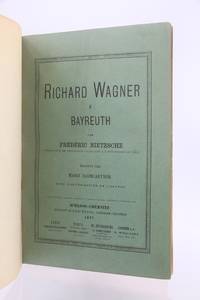
1895699Leipzig: C. G. Naumann 1895. publishers boards. Very good. NIETZSCHE Friedrich. Nietzsches Werke Band I: Die Geburt der Tragodie Birth of Tragedy fourth ed.; Unzeitgemäße Betrachtungen Untimely Meditations third ed. Leipzig: C. G. Naumann 1895. 1 blank leaf with half-title on verso TP tissue guard and frontis-portrait 1 leaf = facsimile of handwritten note 1 leaf = inhalt TP = Geburt der Tragödie half-title 1 - 589 i - xxii. Octavo. Fourth and Third editions. <br /> <br />In the first collected edition of Nietzsches work his first two books combine to form the first volume: Birth of Tragedy originally published in 1872 revised in 1886 here in its fourth edition and Untimely Meditations originally published in four installments from 1874 - 1876 here in its third edition. <br /> <br />BIRTH OF TRAGEDY: Nietzsche argues that the tragedy of Ancient Greece was the highest form of art due to its mixture of both Apollonian and Dionysian elements into one seamless whole allowing the spectator to experience the full spectrum of the human condition. The Dionysian element was to be found in the music of the chorus while the Apollonian element was found in the dialogue which gave a concrete symbolism that balanced the Dionysiac revelry. Basically the Apollonian spirit was able to give form to the abstract Dionysian. <br /> <br />UNTIMELY MEDITATIONS 1 - 4: The first Untimely Meditation was David Strauss der Bekenner und der Schriftsteller David Strauss the Confessor and the Writer in which Nietzsche viciously attacked Strauss most recently published book Der alte und der neue Glaube The Old and the New Faith which advocated the rejection of the Christian faith in favor of a Darwinian materialistic and patriotic world-view. Nietzsche accuses Strauss of being a "Cultural Philistine" and denounces him as the exemplar par-excellence of pseudo-culture. The second book Vom Nutzen und Nachtheil Der Historie für das Leben The Use and Disadvantage of History for Life attacked the then current faith in historical research that was one of Nietzsche's major complaints with contemporary German culture and a topic to which he returned with some regularity in his later works. The third Untimely Meditation was entitled Schopenhauer als Erzieher Schopenhauer as Educator and it took up the topic of self-perfection and set up the philosopher Schopenhauer then one of Nietzsches philosophical heroes as a paradigm of self-direction. The last book in this series Richard Wagner in Bayreuth was released to coincide with the very first performance at the Bayreuth Festival in July of 1876. This is the last of Nietzsches works that mentions Wagner favorably and even here the picture presented of Wagner shows some signs of the troubles to come. In Nietzsches view the creation of Bayreuth was representative of The New Empire and had become one of the cultural centers. <br /> <br /> <br />CONDITION: Very good in original Naumann binding: half-leather with marbled boards. Some edge wear and scuffing. Marbled endpapers. Pages clean and unmarked. <br /> <br/><br/> C. G. Naumann hardcover
1895701Leipzig: C. G. Naumann 1895. Fourth Edition. publisher's boards. Very good. NIETZSCHE Friedrich. Nietzsches Werke Band III: Menschliches Allzumenschliches: Ein Buch fur freie Geister Zweiter Band Human All too Human: A Book for free Spirits second volume. Leipzig: C. G. Naumann 1895. 1 blank leaf with half-title on verso TP half-title 1 leaf = Inhalt 3 - 375 i - xxv. Octavo. Fourth edition. <br /> <br />Volume three of the first collected edition of Nietzsches works presents the appendix Anhang to Human All Too Human and Wanderer and His Shadow a third part of the three-part Human All Too Human first published in 1879 anhang and 1880 Wanderer here in its fourth edition. <br /> <br />The present work was conceived as an addendum Anhang to the previous book and it continues Nietzsches incisive observations and evaluations on any number of topics once again presented in the famous aphoristic style that characterizes these works of Nietzsches middle period the works for free spirits. A second sequel to Human All Too Human The Wanderer and his Shadow was published in the year following Nietzsches departure from academia. The title is perhaps autobiographical reflecting Nietzsche and his shadow heading off into the wilderness of the unknown. This third of Nietzsche's aphoristic volumes continues his appeal to the "free spirits" of Europe. <br /> <br />CONDITION: Very good in original Naumann binding: half-leather with marbled boards. Some edge wear and scuffing. Minor loss to head of backstrip. Marbled endpapers. Pages clean and unmarked. <br/><br/> C. G. Naumann hardcover
189797709HBBerlin:, Hermann Walther, 1897.
189717290Leipzig, C. G. Naumann, 1897. Gr.-8vo. 2 Bl., 110 S. Schlichte Hlwd. d. Zt.
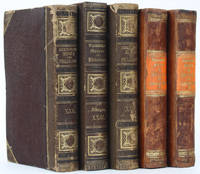
18671001<p>1867-73 First Edition of Seven of Nietzsche's Philological Articles Accepted as his Dissertation Requirement – Qualifying Him to Become a Professor at Age 24</p><p>Rheinisches Museum für Philologie Edited by F.G. Welcker & F. Ritschl 1867-68 F.G. Welcker F. Ritschl A. Klette 1869 Friedrich Ritschl & Anton Klette 1870 & 1873 Johann David Sauerländer Frankfurt am Main 1867-1870 1873. 1867 Volume: Facing TP TP V-XVI 1-648; 1868 Volume: Facing TP TP V-XVI 1-704; 1869 Volume: Facing TP TP V-XVI 1-640; 1870 Volume: Facing TP TP V-XV 1-640; 1873 Volume: Facing TP TP V-XV 1-640; First Edition of seven of the eight philological articles written by Nietzsche Schaberg 9-14 & 16.</p><p>Friedrich Nietzsche began his publication career at the age of twenty-two while he was a student of philology at the University of Leipzig. In Nietzsche's day to be a philologist meant that one studied ancient languages texts history philosophy art and even archeology in an attempt to recapture and understand the meaning of Greece and Rome. Nietzsche was a prize student first at the University of Bonn and then in Leipzig and as such he published several papers in scholarly journals… All but one of these essays appeared in the Rheinisches Museum für Philologie which was—and remains today—a respected journal in the field of classical studies. The single exception was The So-Called Contest of Homer and Hesiod which appeared in Volume I of the Acta Societatis Philologae a compendium organized in 1870 by Ritschl that published just four volumes before its demise in 1875.</p><p>Four of the philological articles were written in German and four in Latin. At least one of the articles On the Sources of Diogenes Laertius was originally composed in German and then translated into the required Latin. The German articles were signed at the end either as 'Friedrich Nietzsche.' or 'F. Nietzsche.' In the Latin articles the author was credited on the first page of each as 'Fridericus Nietzsche'. .</p><p>In later years Nietzsche was understandably dismissive of his philological works. He once wrote to Georg Brandes that "there are of course also Philologica by me but that need not concern either of us anymore." Certainly this was true in 1888 but twenty years earlier when these articles were published they were of major personal importance. Nietzsche's mentor Ritschl used the first four articles as justification for the recommendation that resulted in Nietzsche's spectacularly early appointment to Basel as professor at the age of twenty-four. Ritschl then went further and allowed the articles to be accepted as the dissertation requirement for Nietzsche's doctorate which was conferred without oral examination on 23 March 1869…</p><p>All of his philological works were published prior to the appearance of The Birth of Tragedy January 1872 except for the last article the second half of The Florentine Manuscript concerning Homer and Hesiod dated August of 1872 which appeared in February of 1873. It was the last piece of traditional classical scholarship that Nietzsche published.</p><p>Schaberg The Nietzsche Canon pp. 8-14</p><p>CONDITION: Very good or better in contemporary boards leather spines with gilt lettering. Two different styles of binding. Light edgewear. Three volumes in quarter leather with black boards and marbled endpapers; two volumes in quarter leather with marbled boards. See photos.</p> Johann David Sauerländer hardcover
187788235Schloss-Chemnitz: Ernest Schmeitzner 1877. Fine. Ernest Schmeitzner Schloss-Chemnitz 1877 12.50 x 18.50 cm relié The rare first edition of Friedrich Nietzsche's first work translated into French. Light rubbing to head of spine small brown stains at foot of second cover some foxing. Full khaki cloth Bradel binding smooth spine decorated with gilt floral motif gilt date and double fillet at tail navy blue shagreen title-label covers preserved contemporary binding signed Carayon. Ernest Schmeitzner hardcover