Hegel, Georg Wilhelm FriedrichBiblio.com
4 018 résultats
3843026300.Gpaperback. Good. Access codes and supplements are not guaranteed with used items. May be an ex-library book. paperback
1492163414.Gpaperback. Good. Access codes and supplements are not guaranteed with used items. May be an ex-library book. paperback
3787311467.Ghardcover. Good. Access codes and supplements are not guaranteed with used items. May be an ex-library book. hardcover
3787311181.Ghardcover. Good. Access codes and supplements are not guaranteed with used items. May be an ex-library book. hardcover
72679Hamburg Meiner 1998. Gr.8° CCXXIV 439 S. OLwd. Tadellos. EA. = Vorlesungen Bd. 2. 010 Hamburg, Meiner, 1998 unknown
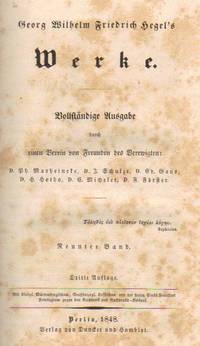
184840875AB1848. Dritte Auflage besorgt von Karl Hegel. Berlin Verlag von Dunder und Humblot 1848. 22.2cm x 140cm. XXVI 547 Seiten. Hardcover / Originaler sehr dekorativer Halblederband mit reicher Rückenvergoldung. Die Bindung wunderbar erhalten. Etwas berieben. Zu Beginn und im hinteren Teil etwas stärker stockleckig. Mit handschriftlicher Widmung auf dem Zwischentitel: "T.J.N.Utrecht from his friend Charly Jennings - Edinb. Feby.7.1853" Werke - Neunter Band. Enthält u.a.: Geographische Grundlage der Weltgeschichte / Die neue Welt / Die alte Welt / Afrika / Asien und Europa / Die orienthalische Welt / China / Indien / Der Buddhaismus / Persien / Das Zendvolk / Die Assyrier Babylonier Meder und Perser / Das persiche Reich und seine Bestandtheile / Persien / Syrien und das semitische Vorderasien / Judäa / Aegypten / Uebergang zur griechischen Welt / Die griechische Welt / Die Elemente des griechischen Geistes / Die Gestaltungen der schönen Individualität / Das subjektive Kunstwerk / Das objektive Kunstwerk / Das politische Kunstwerk / Die Kriege mit den Persern / Athen / Sparta / Der peloponnesische Krieg / Das macedonische Reich / Der Untergang der griechischen Welt / Rom bis zum zweiten punischen Kriege / Die Elemente des römischen Geistes / Die Geschichte Roms bis zum zweiten punischen Kriege / Rom vom zweiten punischen Kriege bis zum Kaiserthum / Rom in der Kaiserperiode / Das Christenthum / Das byzanthinische Reich / Die germanische Welt / Die Elemente der christlich germanischen Welt / Die Völkerwanderungen / Der Muhamedanismus / Das Reich Karl des Großen / Das Mittelalter / Die Feudalität und die Hierarchie / Die Kreuzzüge / Der Uebergang der Feudalherrschaft in die Monarchie / Kunst und Wissenschaft als Auflösung des Mittelalters / Die neue Zeit / Die Reformation / Wirkung der Reformation auf die Staatsbildung / Die Auflösung und Revolution / hardcover
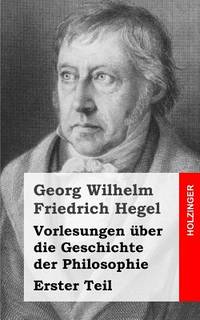
183343486Berlin 1833-36. 8vo. Three contemporary uniform brown half calf bindings with gilt title- and tome-labels. Professional restorations to capitals and hinges. Elegant library-stamp to inside of front boards of the first two volumes. Vol. 2 with a few pencil-underlinings and vol. 3 with pencil-annotations to last leaf. A bit of occasional brownspotting. With all three title-pages for "Werke. Vollständige Ausgabe" vol. 13-15 facing the title-pages for the "Vorlesungen". XX 418 1 -errata; VI 586; VIII 692 pp. <br/><br/><em>First edition of Hegel's seminal "Lectures on the History of Philosophy" which was published posthumously by Michelet. The work comprises Hegel's nine lectures on the history of philosophy given in Jena in the winter of 1805-6 Heidelberg in the winters of 1816-17 and 1817-18 Berlin in the summer of 1819 and the winters of 1820-21 1823-23 1825-26 1827-28 and 1829-30. Just before his death in November 1931 Hegel had begun his tenth lecture course on the history of philosophy but only get two give the first two hours of it. The work is based on Hegel's own lecture manuscript from Jena which is stilized throughout and written in full "er wagte damals noch nichts dem freien mündlichen Vorträge zu überlassen" -Michelet Preface p. VI his shorter draft written in Heidelberg meant for further development at the lectures as well as number of later endorsements and additions written in the margins of the two manuscripts and on loose leaves "Diese Blätter sind von unschätzbarem Werthe weil sie die höchst reichen Zusätze aller Vorlesungen spätere Jahre durch seine eigene Handschrift dokumentieren" Michelet Preface p. VI. Besides this a number of lecture notes from learned students including those of Michelet and the other "Freunde des Verewigten" have been used to establish the text as correctly as possible. These highly influential lectures which attracted philosophers from all over Europe make up a cornerstone in the philosophy of Hegel and his view on the history of philosophy is something that understreams all of his thought. These lectures and not least the publication of them after his death have seminally influenced later philosophy and the following fifty years after Hegel's death were philosophically culturally and historically much indebted to them. It is the Hegelianism that also springs from Hegel's lectures on the history of philosophy that carries historicism the conception of cultural and social relations as products of history through the 19th century. </em> hardcover
1993DADAX3787311165Felix Meiner 1993-01-01. perfect. New. 6.00x1.06x9.00. Buy with confidence. Excellent Customer Service & Return policy. Felix Meiner unknown
1986SONG3787306390Felix Meiner 1986-01-01. hardcover. Used: Good. 6.00x1.13x9.00. Buy with confidence. Excellent Customer Service & Return policy. Felix Meiner hardcover
1976618397Verlag von Felix Meiner 1976. Text in German; cover rubbed/very faintly soiled corners lightly rubbed/bumped spine rubbed spine ends rubbed/lightly bumped; edges soiled; erasures on ffep inside rear flap lightly soiled erasures on inside rear flap; binding tight; cover edges and interior intact and clean except as noted. paperback. Good. Verlag von Felix Meiner paperback
20011075643Marbach am Neckar : Deutsche Schillergesellschaft, 2001. 99 S. + Kt.-Beil. (1 Bl.) Mit zahlr. Abb. Originalbroschur.
200722968Hildesheim/Zürich/New York, Olms, 2007. 8°, 553 Seiten. Orig.Karton.
1974975068Hamburg: Hoffmann und Campe. 1974. 512 S. 21 cm. Zustand: Sehr Gut min. gebräunt (Innen); Kleiner Schrifteintrag vor dem Titelblatt; Einband (Außen) hat geringe Gebrauchsspuren; Schnitt ist im Durchschnitt gering angestaubt; Buchrücken etwas lesespurig; 1. - 3. Tsd. Broschiert
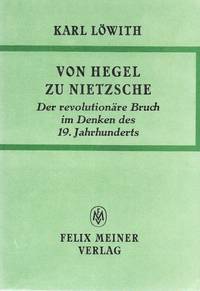
19812539BB1981. Achte Auflage. Hamburg Felix Meiner Verlag 1981 15 x 21 cm. 498 Seiten. Softcover/ Kartoniert. Sehr guter Zustand mit minimalen Gebrauchsspuren. Aus der Bibliothek des Philosophen Graham Parkes. Mit seinem Namenszug auf dem Vorsatz. Enthält unter anderem: Goethe und Hegel; Der endgeschichtliche Sinn von Hegels Vollendung der Geschichte der Welt und des Geistes; Althegelianer Junghegelianer Neuhegelianer etc. paperback
198819913Köln, Pahl-Rugenstein, 1988. 8°, 344 Seiten. Orig.Karton.
RUBBETTINO 2005 517 PP. FONDO DI MAGAZZINO: LIEVI SEGNI DEL TEMPO ALLA COPERTINA E AI TAGLI, PER IL RESTO INTONSO, MAI SFOGLIATO. Muovendosi entro una precisa cornice concettuale, nella quale emergono le nozioni fondamentali di stratificazione e di polarità della vita, il presente lavoro si profila come un tentativo di ricostruzione di una delle problematiche più congeniali alla sensibilità filosofica di Herman Nohl: la ricerca dei fondamenti antropologici dell’etica intesa come scienza comprendente dei valori e delle oggettivazioni della prassi umana; una indagine nella quale diventa preponderante e significativo, per Nohl, l’incontro e il confronto critico con le istanze dei grandi maestri del cosiddetto movimento spirituale tedesco, la cui ricostruzione storico-sistematica costituisce uno dei centri nevralgici, se non addirittura il nucleo tematico principale, del lungo e laborioso lavoro filosofico di Nohl.
Ripetutamente si è considerato Hegel il profeta di un'apocalisse culturale, il filosofo visionario che ha vaticinato una morte dell'arte che nel Novecento si sarebbe manifestata in tutta la sua drammaticità. Ma l'eredità che la filosofia dell'arte hegeliana ha consegnato al nostro tempo è veramente un'eredità luttuosa? Alcuni tra i più autorevoli interpreti di Hegel, da Dieter Henrich a Annemarie Gethmann-Siefert, da Erzsébet Rózsa a Klaus Vieweg si confrontano con questo interrogativo mostrando le suggestioni ancora vive nella filosofia dell'arte sviluppata da Hegel. Da questo confronto con lo Hegel berlinese si aprono molteplici interstizi che garantiscono all'arte nuova vita, nonostante la frammentazione e la parzializzazione che la investe nel moderno. Quando l'arte si svincola dal legame simbiotico con la religione e si secolarizza rimane infatti come elemento imperituro l'umano, quel nuovo sacro che l'arte moderna celebra nelle sue opere, spesso dissonanti. E seppure la più elevata destinazione dell'arte è ormai passata, essa continua ad essere Bildung, continua cioè a formare la coscienza umana attraverso la profonda capacità di rispecchiamento che offre agli uomini. Curatori: F. Iannelli.
96402-JB091Librairie universitaireJ. Gamber 1928
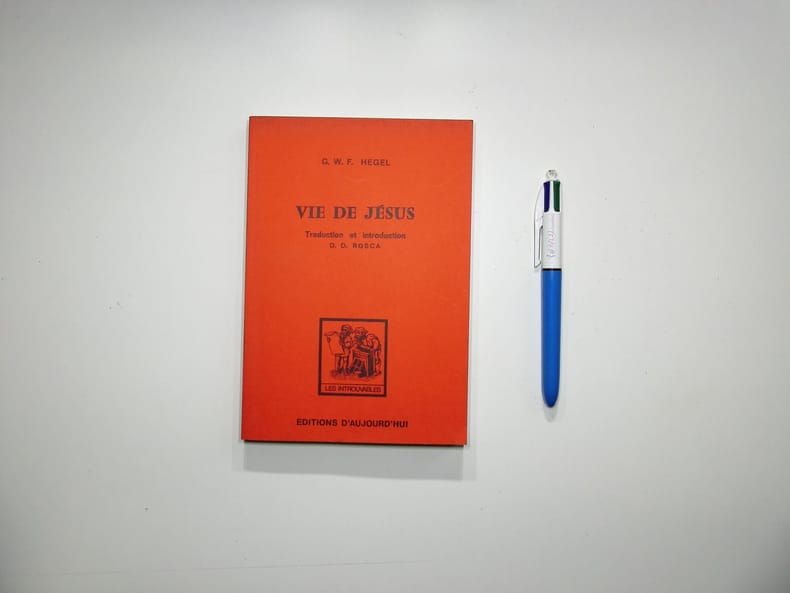
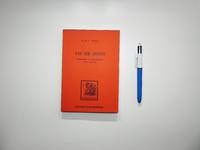
1928LRB846Éditions d'Aujourd'hui Le Plan-de-la-Tour (Var) 1928 Traduction : Rosca D. D.Introduction/ — Préface : Rosca D. D. — Collection : Les Introuvables — Langue : français — Reliure : broché, couverture orange imprimée — État : très bon état
1928LRB846Le Plan-de-la-Tour Var: Éditions dAujourdhui 1928 Titre : Vie de JésusAuteur : Hegel Georg Wilhelm FriedrichTraduction : Rosca D. D.Introduction/Préface : Rosca D. D.Éditeur : Éditions dAujourdhuiCollection : Les IntrouvablesLieu : Le Plan-de-la-Tour VarDate : s.d. réimpression de la traduction de 1928Langue : françaisReliure : broché couverture orange impriméeÉtat : très bon étatDescription : Première rédaction de jeunesse de Hegel consacrée à la figure de Jésus et à une lecture critique des Évangiles. Version française établie par D. D. Rosca qui signe également une substantielle introduction situant le texte dans lévolution intellectuelle du jeune Hegel et ses rapports avec la philosophie de la religion. Réédition Éditions dAujourdhui dans la collection Les Introuvables ; mention « C/ D. D. Rosca Paris 1928 » au début du volume. Softcover. Very Good. Éditions d?Aujourd?hui paperback
K. ROSENKRANZ Vie de Hegel suivi de Apologie de Hegel contre le docteur Haym. Francia, Gallimard 2004 french, 731 ST1098D Brossura editoriale, volume in ottime condizioni, copertina in condizioni eccellenti eccetto etichetta adesiva sul retro, interno come nuovo, legatura salda, testo in francese 731 pagine circa Copertina come da foto
feb100897Used. For more details please contact me unknown
feb46348Used. For more details please contact me unknown
TRADUZIONE DI EUGENIO ZANIBONI SANSONI 1981 614 PP. SEGNI DEL TEMPO, BRUNITURE AI TAGLI, PER IL RESTO OTTIMO. Il signor «Möller», che desiderava di non essere riconosciuto come l'autore del Werther e che sognava di poter compiere in silenzio e in segreto il proprio pellegrinaggio, entra in Italia l'otto settembre del 1786. Ha compiuto da undici giorni i trentasette anni. E già entrato con futti gli onori del genio nella corte di Weimar, di quel piccolo Stato è diventato ministro, di una città di provincia farà l'Atene della Germania. A Weimar si davano proprio allora ai torchi i primi fogli di quelle che per il momento erano le opere complete del poeta: otto volumi. Egli aveva con sé il manoscritto incompiuto della nuova Ifigenia e seguiva nella fantasia l'Egmont e il Tasso. In una scansia del suo studio di Weimar, era custodito il manoscritto del primo Faust. Il Werther era stato tradotto in otto lingue. Il viaggio non è quello italiano che sarà compiuto nel 1818 dal giovane Aroldo byroniano. Goethe ha stabilito dei limiti precisi, non solamente al proprio itinerario geografico, ma anche a quello del suo spirito. Tutta l'Italia non è che la progressiva conquista del Mito romano. A Roma il genio troverà la scuola e la patria che il suo spirito va cercando. In questa serenità classica si stagliano le figure, nitide e precise, in continuo movimento, del suo viaggio in Italia. Su queste pagine tornò a posarsi lo sguardo del poeta quattro decenni più tardi. Il poeta aveva ottant'anni e lavorava al secondo Faust; si può dunque dire che i fogli del Viaggio in Italia l'hanno accompagnato fin quasi alla soglia della morte, a testimonianza di un amore per l'Italia che resta una componente della sua formazione culturale e fonte continua di ispirazione poetica.