Descartes ReneABAA
2 377 résultats
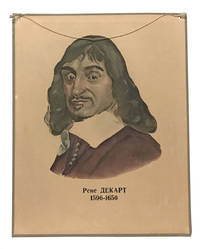
19601002537U.S.S.R. 1960. Classroom poster of pioneering French mathematician scientist and philosopher Rene Descartes 1596-1650 part of the "Cabinet of Mathematics" series designed to be displayed in Soviet schools. Descartes's important contributions to mathematics included the development of Cartesian geometry which laid the groundwork for calculus later in the seventeenth century. Captioned with his name in Cyrillic and dates this portrait of Descartes maintains direct eye contact with its presumably captive viewers. A compelling artifact of Soviet mathematical education during the Cold War. Color-printed educational poster measuring 18.75 x 14.75 inches mounted to stiff cardboard backing with two punched holes and cord for hanging. Numeral "2" stamped to verso with ink notation. A few faint splashmarks. unknown books
024733New York: Tudor Publishing Company. n.d. Translated from the original texts with a new introductory essay historical and critical by John. And a special introduction by Frank Sewall. xviii 371p. original green cloth. Tudor Publishing Company unknown books
1965038652Paris: Union Générale 'Editions 1965. 373p. original stiff printed wrappers Le monde en 10/18. La collection des grands textes 276/277. Union Générale 'Editions unknown books
19251320813Chicago: Open Court Publishing Company 1925. Hardcover. Octavo; G-/no DJ; Hardcover w/out DJ; Spine white tanned with gold print spine caps torn away; Boards quarter bound with white leather to spine and grey paper to boards tanning to spine spine caps torn away worn corners slight bump to rear top edge slight crease to paper on rear mild shelfwear; Text block has name in ink of front pastedown light tanning to endpapers and title page minor pencil notation at bottom of page 5; Text in English and French in facsimile on facing pages; xiii 246 pages. 1320813. FP New Rockville Stock. Open Court Publishing Company hardcover books
1983M12921Baltimore & London:: Johns Hopkins University Press 1983. 1983. 8vo. xi 301 pp. Figures index. Full gilt stamped brick-red cloth. Fine. A crisp and clean copy. First edition. Carter reexamines Descartes in respect of his contribution to the philosophy of medicine and focuses on the interplay of mental physical and emotional processes in Cartesian thought. ISBN: 0801828945 / 0-8018-2894-5 Johns Hopkins University Press, 1983. hardcover books
1668D4760Paris: Chez Charles Angot 1668. Hardcover. Very Good. 4to 223 x 160mm. 303pp. xxiii of tables. Full contemporary calf; well rubbed; tear to top of spine. Over 100 fine woodcut diagrams throughout several full-page. Woodcut printers device to title; small tear to title at upper right margin slighty browned; slightly rubbed corners bumped. From the collection of J. Richard D.M. Ex Bibliotheca 18th-century armorial rubber stamp to title and p. 3 possibly French 1638-1739. Early Illustrated Edition of Descartes Discourse on the Method one of the most influential works in the history of modern philosophy and important to the evolution of natural sciences. This work features Descartes famous line I think therefore I am which he wrote in French Je pense donc je suis thereby reaching a wider audience in his country than that of scholars. The Discours was originally published in Leiden in 1637. Published also in Paris the same year as this edition is an edition by Bobel and De Gras. Descartes started his line of reasoning by doubting everything so as to assess the world from a fresh perspective clear of any preconceived notions. In the Discourse Descartes tackles the problem of skepticism which had previously been studied by Sextus Empiricus Al- Ghazali and Michel de Montaigne. The Discourse divided into six parts was intended as an introduction to three of his works Dioptrique Météores and Géométrie. His statements of the elementary laws of matter and movement in the physical universe the theory of vortices and many other speculations threw light on every branch of science from optics to biology; all this found its starting-point in the Discourse. La Géométrie contains Descartes first introduction of the Cartesian coordinate system. Together with his Meditations on First Philosophy Meditationes de Prima Philosophia Principles of Philosophy Principia philosophiae and Rules for the Direction of the Mind Regulae ad directionem ingenii the Discourse forms the base of the Epistemology known as Cartesianism. The Discours was Descartes first published work the much-talked about World or Cosmos having been suppressed or destroyed on his hearing of the condemnation of Galileo in 1632. In 1636 however when 40 years of age he felt that it was time to bring his views before the public and publish them abroad. Descartes endeavored to preserve the anonymity of his work with scrupulous care but in the end he found himself compelled to avow his authorship Osler 928. Descartes Discourse thoroughly a foundational work in the history of modern philosophy this augmented edition with many fine woodcuts remaining fresh and bright. <br/><br/> Chez Charles Angot hardcover books
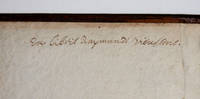
16684897Paris: Bobin & Le Gras 1668. Hardcover. Very Good. 4to - over 9¾ - 12" tall. 55 477 pp 2. With 22 full-page woodcuts 1 folding and 70 woodcut illustrations in text. Ink ownership inscription of Raymond Vieussens to front pastedown & shelf mark on front free endpaper. Bound in contemporary French calf spine in six compartments with gilt florets and title; some wear to boards but generally an excellent copy clean and fresh. Scarce edition of Descartes' magnum opus bearing the manuscript ex-libris of Raymond Vieussens 1635-1715 Royal Physician to Louis XIV and an important anatomist in his own right. Drawing directly on the dualistic theories of Descartes Vieussens became fascinated by the actions of the heart and of the brain in particular. "In his speculations on physiology Vieussens drew inspiration from both the mechanistic philosophy of Descartes and the iatrochemical ideas of F. de la Boë Sylvius. He believed that he had demonstrated the existence of the nervous fluid." DSB "Without Descartes the seventeenth-century mechanization of physiological conceptions would have been inconceivable" notes the DSB ".No other great philosopher except perhaps Aristotle can have spent so much time in expermintal observation. According to Baillet over several years he studied anatomy dissected and vivisected embryos of birds and cattle and went on to study chemistry. His correspondence from the Netherlands described dissections of dogs cats rabbits cod and mackerel; eyes livers and hearts obtained from an abattoir.". Descartes' magnum opus his Principia Philosophiae presented to the world the purest expression of his mechanist vision of the universe seized upon eagerly by later anatomists such as Thomas Willis Nicolas Steno and as is evident from the present copy Raymond Vieussens. Intended to replace the Aristotelian texts used in universities with a curriculum based on physical and immutable laws of nature Descartes' Principles especially in its French editions comes replete with numerous plates of his famous swirling vortices as well as discussions of the Copernican system. Curiously as C. F. Fowler has noted a direct reference to the Principia is lacking from the Index Librorum Prohibitorum of 1664 which otherwise banned most of Descartes' works - although a blanket clause is also given "and the philosophical works of same author". Evidently the decree of the Catholic Church disuaded neither French publishers from printing the work nor the Royal Physician from purchasing it! In particular Veussens seems to have been inspired by the Cartesian concept of cerebral localization; but while Descartes considered the pineal body to be the seat of animal spirits and the soul Veussens regarded the corpora striata as the seat of the imagination. "Inspired by both Descartes's mechanistic and the iatrochemical philosophies Vieussens studied the white matter of the brain by tracing the path of its fibers" Schlager & Lauer eventually providing us with an early description of the brain's centrum semiovale sometimes referred to as Vieussens' centrum. Following his well-received Neurographica Universalis 1685 the Royal Physician issued his Traité nouveau des Liqeurs de Corps Humain 1705 in which he describes the three Cartesian elements in detail and their functions within the body. Guilbert "Les Principes" 13; cf also Schlager & Lauer eds Science and Its Times 3 Gale 2001 p. 154; Fowler Descartes on the human soul: philosophy and the demands of Christian doctrine Kluwer 1999 pp 8-10. For the impact of Descartes' philosophy see PMM 129. Bobin & Le Gras hardcover books
1979S11084New York:: Arabis Books 1979. 1979. Series: The Janus Library. 8vo. xxvi 224 pp. Original French text opposite English translation. Gilt-stamped green cloth. Bookplate. Very good. ISBN: 0913870358 Arabis Books, (1979). hardcover books
1980S11758Indianapolis:: Bobbs-Merrill 1980. 1980. Series: The American Heritage Series. Second revised edition twelfth printing. 8vo. xviii 85 pp. Bibliog. Printed wrappers. Ownership signature. Very good. Bobbs-Merrill, (1980). unknown books
195390767Paris:: Librairie Gallimard Bibliotheque de la Pleiade. Near Fine in Near Fine dust jacket. 1953. Hardcover. Text is in French. Introduction by Andre Bridoux. Two sewn-in ribbon bookmarks. Near fine in a near fine dust jacket and acetate dust cover. No slipcase. ; 1102 pages . Librairie Gallimard (Bibliotheque de la Pleiade), hardcover books
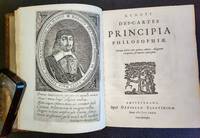
16726345Amsterdam: Daniel Elzevir 1672. Fine/According to Guibert the general title page "Opera philosophica" with its table of contents listing four works was slapped onto blocks of the three works included here in anticipation of finishing the Meditations which in fact was not printed until six years later in 1678 Willems #1545. Some volumes were bound with the 1670 printing of the Meditations but when that ran out examples such as the one offered here continued to go to market until 1678 when the companion printing of Meditations finally appeared. Quarto 20 cm. Three parts in one volume of four--see below. Each part with separate title page. Principia philosophiae xxxvi 222; Specimina philosophiae xvi 248; Passiones animae xxiv 92 4; all preceded by general title with contents on verso and engraved portrait frontispiece. Numerous figures in text. Bound in contemporary speckled calf rebacked. Armorial bookplate. References: Willems 1469; Guibert p. 231. Daniel Elzevir unknown books
16856380Amsterdam: Blaeu 1685. Editio ultima. Good/Based on the Elzevir edition of 1678 "the last edition" The "Meditiations" which should complete the contents of Opera Philosophica was published in a separate volume. . Quarto 22 cm; Three works in one volume each with separate title page and pagination. 6; 36 222 2 blank; 16 248; 24 92 4 pages including engraved portrait frontispiece. Title pages with Blaeu's armillary device. Woodcut illustrations in text many of them full-page. Shoulder notes. Occasional reader's notes in margins contemporary hand and occasional underlining. In contemporary polished vellum over boards stamped in blind with arabesque cartouche on both boards. Hinges cords and linings exposed pastedowns never pasted down. Blaeu hardcover books
1979S10731New York:: Abaris Books 1979. 1979. 8vo. xxvi 224 pp. Green cloth gilt-stamped cover and spine title. Ownership signature on ffep. Very good. Scarce. English translation. ISBN: 0913870358 Abaris, Books, (1979). hardcover books
169539902Francofurti ad Moenum: Sumptibus Friderici Knochii 1695. 4to 21.3 cm 8.3". 8 420 4 42368 2 pp.; diagrs. <br><br>Important gathering of Cartesian mathematical thought opening with van Schooten's Latin introduction to and commentary on Descartes' La Géométrie followed by De aequationum natura constitutione & limitibus by de Beaune Elementa curvarum linearum by de Witt Tractatus de concinnandis demonstrationibus geometricis ex calculo algebraïco by van Schooten and the closing Notae et animadversiones tumultuariae in universum opus by Bartholin who edited the texts. Each work has a separate title-page and numerous equations and small in-text diagrams appearing throughout; the volume ends with a one page list of errata chiefly of errors in the mathematical notations.<br>Â Â Â Â The trio here was first published as the second volume of the two volume edition of the Latin translation of Descartes' Geométrie issued in Amsterdam by the Elzevirs 165961.<br>Â Â Â Â Provenance: From the residue of the stock of the F. Thomas Heller bookselling firm est. ca. 1928.<br>Â Â Â Â Searches of NUC and WorldCat locate only four U.S. libraries UChicago U.S. Naval Observatory UMinnesota Linda Hall reporting ownership. <br>Â Â Â Â <br>Â Â Â Â VD17 3:301520H. 19th-century half calf and marbled papercovered sides spine with gilt-stamped leather title and date label; mildly rubbed overall. Title-page with rectangular portion on either side of printer's device excised and repaired repair apparently done some time ago with excision just barely touching the ends of the motto banner. First few leaves browned; foxing and offsetting throughout. => A worthwhile exploration of mathematical thought as it stood toward the close of the 17th century and a good solid copy. Sumptibus Friderici Knochii hardcover books
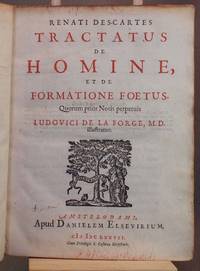
16776332Amsterdam: Daniel Elzevir 1677. Good/The first illustrated Latin edition of this seminal textbook on physiology. Descartes prepared the manuscript in the early 1630s but shelved it when news of Galileo's conviction reached him in 1633. He revisited it in 1648 but was unable to finish the project of provide the necessary illustrations. Editors recovered the manuscript after Descartes died in 1650 and eventually assigned it to Louis de la Forge together with Gerard van Gutschoven for preparation. The "Traité de l'Homme" with extensive notes by La Forge was published in 1664. An expanded version with further development of the text by La Forge came out four years later. Claude Clerselier editor of Descartes' posthumous works translated the 1664 text into Latin and delivered it to Daniel Elzevir for publication. . Small quarto 21 cm; 76 239 pages. Title in red and black. Woodcut anatomical illustrations in text. Bound in polished panel calf ruled in blind and tooled at panel corners with diamond-shaped fern tool on both boards. Gilt tooling along board edges and on spine. Text edges stained red. Covers re-attached with strong Japanese paper. Boards somewhat splayed. References: Willems 1531; Osler 932; Garrison-Morton 5th ed. 574. Daniel Elzevir hardcover books
19412312671Kansas: Haldeman-Julius Company 1941. Stapled Binding. Very Good. Front wrapper lightly foxed wrappers and pages toned. 1941 Stapled Binding. 47 pp. Introduction by Joseph McCabe. Translated from the French and collated with the Latin. "Discourse on the Method of Rightly Conducting One's Reason and of Seeking Truth in the Sciences French: Discours de la M Haldeman-Julius Company unknown books
18552305444Paris: Librairie de Firmin Didot Freres 1855. First Edition. First Edition. Very Good/No Jacket. First edition. Boards lightly rubbed and faded rebacked in leather. 1855 Half-Leather. Leather spine over pebbled cloth boards gilt titles and decorations blind-stamped borders marbled endpapers. A collection of four works by Rene Descartes in the original French including Discours de la Methode Meditations Les Passions de l'Ame Regles pour la Direction de l'Esprit with additional material. Descartes is considered the father of modern philosophy and best known for laying the foundation for rationalism. "Rene Descartes 31 March 1596 Librairie de Firmin Didot Freres unknown books
1954UDESMED00efLiberal Arts Press 1954. Very Good. Descartes Rene. Meditations. Priest editor Oskar. New York: Liberal Arts Press 1954. 80pp. 8vo. Wraps. Book condition: Very good with slightly rubbed and yellowed edges. Small tape remnant and a light stain on front cover. Liberal Arts Press paperback books
229pp.avec frontispice, pour la plupart non coupé
Un volume broché au format poche de 254 pp.; quelques reproductions in-texte d'illustrations de l'époque; couverture illustrée. Parfait état. Voir photos.
In-8, broché, couverture de papier moderne, 6 p. Edition originale. Chénier fait l’éloge de Descartes et réclame "l’honneur du Panthéon". Le rapport est suivi du projet de décret en 5 articles qui organise le transfert des cendres du philosophe au Panthéon. Enregistré le 17 octobre 1793, ce décret ne fut jamais exécuté. Une nouvelle proposition, dans le même sens, a été déposée à l’Assemblée nationale en décembre 2010. Auteur de tragédies et parolier de nombreux chants révolutionnaires, notamment le "Chant du départ", membre de l’Académie française (1803), l’auteur était le frère du poète. (Tourneux, III, 1657). Bon exemplaire.
194410137New York: Brentano's 1944. Later printing of this edition Very Good plus in cream wrappers with moderate tanning to spine. Brentano's unknown books
1985S10743Minneapolis:: University of Minnesota Press 1985. 1985. 8vo. x 225 pp. Printed wrappers. Ownership signature on ffep. Fine. ISBN: 0816614555 University of Minnesota Press, (1985). unknown books
1978S10744Baltimore & London:: Johns Hopkins University Press 1978. 1978. 8vo. viii 322 pp. Printed wrappers. Ownership signature on ffep. Fine. ISBN: 0801821223 Johns Hopkins University Press, (1978). unknown books
solo II volume intonso leggerissime tracce di umido