DESCARTES (René).Livre Rare Book

2 377 résultats
164730509A Paris, chez la Veuve de Jean Camusat et Pierre Le Petit, 1647 - Amstelodami [Amsterdam], apud Danielem Elzevirium [Daniel Elzevier / Elsevier], 1664 - Amstelodami, apud Danielem Elzevirium, 1664 - Amstelodami, apud Ludovicum & Danielem Elzevirios, 1664 - Lugduni Batavorum [Leyde / Leyden], apud Franciscum Moyardum & Petrum Leffen, 1662 - A Paris, chez Michel Bobin et Nicolas Le Gras, 1677. 3 vol. au format pt in-4 (208 x 165 mm) de 1 f. bl., 7 ff. n.fol., 606 pp., 1 f. n.fol. et 1 f. bl. ; 1 f. bl., 20 (dont frontispice gravé) ff. n.fol. et 222 pp. ; 1 f. bl., 8 ff. n.fol. et 248 pp. ; 12 ff. n.fol., 92 pp. et 2 ff. n.fol. ; 18 ff. n.fol., 121 pp. et 1 f. bl. ; 32 ff. n.fol., 511 pp., 4 ff. n.fol. et 1 f. bl. Reliures uniformes (début XIXème) de pleine basane racinée blonde, plats jansénistes, dos lisses ornés de jeu de filets gras et maigres dorés, larges fleurons dorés, entrelacs de petits filets doré formant croisillons, pièces de titre de maroquin carmin, pièces de tomaison de maroquin vert-bronze, titre doré, tomaison dorée, palette dorée en queue, filet doré sur les coupes, tranches mouchetées.
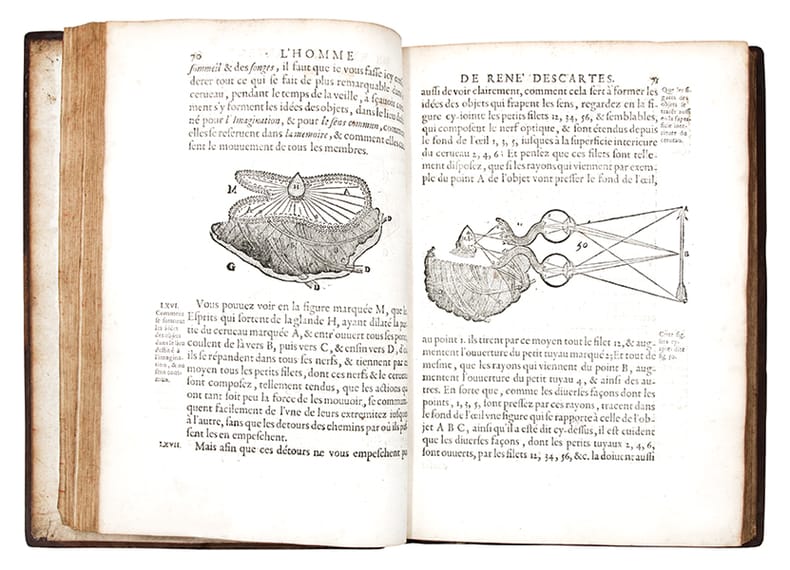
1507JC029<p>Figuris et Latinitate Donatus a Florentio Schuyl Inclytae Urbis Sylvae-Ducis Senatore & ibidem Philosophiae Professore. Lugduni Batavorum: Apud Franscicum Moyardum & Petrum Leffen CIC ICC LXII. Leyden 1662.</p>_x000d_<p>In 4º 205x155 cm. Com 36 121 1 págs.</p>_x000d_<p>Encadernação da época em pergaminho rígido.</p>_x000d_<p>Ilustrado com 10 gravuras impressas em extratexto algumas com texto impresso e em técnica de «pop-up» e mais 54 gravuras no texto muitas de página inteira representando partes do corpo humano.</p>_x000d_<p>Bom exemplar apresentando anotações e cnferêcias bibliográficas manuscritas a lápis nas folhas anteriores de guarda: «Completo. Impecável. Raríssimo». No entanto apresenta alguns fólios com leve oxidação natural do papel; e uma leve mancha de tinta da época nas páginas 90 e 91.</p>_x000d_<p>Raríssima PRIMEIRA EDIÇÃO deste importantíssimo texto de René Descartes na qual o filósofo desenvolve o seu conceito de dualismo corpo-mente e o automatismo animal no homem considerado por muitos como um apêndice fisiológico do seu Discurso do Método. A primeira edição em francês foi publicada dois anos depois em 1664.</p>_x000d_<p>Nesta obra Descartes defende que o corpo humano seria como uma máquina sujeita às leis da natureza e que a alma pelo contrário era imaterial e portanto não seguia as leis naturais.</p>_x000d_<p>A importância desta obra é o seu texto considerado o primeiro tratado de fisiologia humana ainda hoje cientificamente válido. As gravuras e o texto em latim foram ambos colocados postumamente pelos editores. Descartes evitou publicar esta obra durante a sua vida devido às perseguições religiosas e as cópias circulavam manuscritas e sem gravuras. No entanto todo o mecânismo fisiológico proposto por Decartes era conhecido na prática através dos autómatos hidráulicos construídos em Versailles. Por esse motivo a edição seguinte em francês apresenta outras gravuras que suscitaram no seu tempo uma querela editorial hoje irrelevante.</p>_x000d_<p>Referências bibliográficas:</p>_x000d_<p>BNP - Biblioteca Nacional de Portugal - tem um exemplar da edição elzeviriana: Amstelodami: apud Danielem Elsevirium 1677; para o qual refere: Willems 1531 Rahir E. 1661.</p>_x000d_<p>Brunet Tomo II 611 ref. 3592: FR «L´ Homme de René Descartes avec les remarques de Louis de La Forge est un traité de la formation du foetus par le meme Descartes Paris 1664 in 4º. Ces deux opuscules posthumes ont été mises en ordre et publiés par Clerselier aidé par L. de La Forge. Avant leur publication il en avait paru une traduction latine sous ce titre: Renatus Descartes de Homine figuris et latinitate donatus a Florentio Schuyl. Lugduni 1662 aussi 1664 in 4º 3592. Malheureusement cette tradution a été faite sur une mauvaise copie de l'original mais le traducteur l'a enrichie dúne excellente préface dont la traduction a été placé à la fin de l'édition du texte français».</p>_x000d_<p>EN In 4º 215 c m. 36 121 1 pag. Ilustrated with 10 engravings.</p>_x000d_<p>Binding: Contemporary parchment.</p>_x000d_<p>Rare first edition of this important René Descartes text where the philosopher develops his concept of mind - body dualism and the animal automatism in man and considered by many as a physiological appendix on his Discourse on Method. The first edition in French was published two years later in 1664.</p>_x000d_<p>In this work Descartes advocates that the human body would be like a machine subject to the laws of nature. On the other hand the soul was immaterial and therefore did not follow the natural laws.</p>_x000d_<p>The work is illustrated with 10 engravings hors text and 54 more in the text many full page representing parts of the human body.</p>_x000d_<p> </p> M-18-C-5 unknown
ABAA-75TH-VBF-23<p>Amsterdam Blaeu 1682-1683.</p><p>3 parts in 3 volumes 4to I/ 1 bl.l. 4 ll 383 pp 1 bl.l.; II/ 1 bl.l. 2 ll 404 pp. 2 ll. 1 bl.l.; III/ 1 bl.l. 8 ll. 427 pp. 1 bl.l. small burnhole pp. 249 and 413 with damage to 2 letters.</p><p>Full Dutch vellum blindstamped fleuron in the center of the covers double blindstamped fillet around the covers flat spines speckled edges. <em>Contemporary binding by the editor Blaeu.</em></p><p>201 x 154 mm.</p><p><strong>First complete edition of Descartes' Letters to princess Elisabeth and Mersenne.</strong> The 3rd volume contains the continuation of Descartes' Latin correspondence and appears here for the first time.</p><p>Tchemerzine II 786.</p><p><strong>For several years from 1642 to the end of 1649 i.e. during the period of his life from the "Meditations Metaphysiques" to his death in Stockholm Rene Descartes 1596-1650 corresponded assiduously with princess Elisabeth daughter of Frederic V elector palatine and king of Bohemia.</strong></p><p><em>"Princess Elisabeth a highly cultured woman with a special interest in mathematics had read the 'Méditations métaphysiques' with great interest and admiration. Through a French émigré and friend of Descartes Palotti she had penetrated further into the thinking of the man she soon considered her master.</em></p><p><em>And in her very first letter May 1643 she asked the philosopher to explain a point in his "Meditations" that she didn't quite grasp: how it could be that "the soul can determine the spirits animals of the body to do voluntary actions being only a thinking substance" and therefore unexpanded. Descartes explains why this point may have remained obscure in his exposition. This discussion which is the most interesting in the whole "Correspondence" occupies all the letters of 1643. In the years that followed the problems that arose with the publication of Descartes' works he sent them to his friend and dedicated his "Passions de l'amour" to her were of all kinds: about the "Principles of Philosophy" about books he advised her to read or on which she asked his opinion about new scientific developments the princess asked for clarification and discussed certain points of physics mathematics morals and metaphysics that she had not grasped or that seemed questionable. "My admiration increases every time I reread the objections made to you how it is possible that people who have spent so many years meditating and studying could not understand things so simple and clear that most in disputing the true and the false seem not to know how they should be discerned and that the sieur Gassendus Gassendi who is in the greatest repute for his learning has made after the Englishman Hobbes objections less reasonable than all the others. "</em></p><p><strong>This correspondence is of very great interest; for in connection with the questions of his interlocutor Descartes was led to take up a certain number of problems and to give a clearer and more complete account of them than in his works</strong>;<em> but above all it is the only direct document that lets us get to know him intimately and in him the man and not just the philosopher. "We learn that he had planned to write a 'Traité de l'érudition' Treatise on Erudition; we gain interesting details about the life all secluded and devoted to study and above all meditation he led in Holland and about the few months he spent at the court of Christine of Sweden."</em></p><p><strong>Descartes also wrote to Mersenne</strong> improvising answers to countless questions with extraordinary ease.</p><p>"The 3 volumes of this correspondence are illustrated with numerous figures and geometric woodcuts". Guibert <em>Bibliographie des Œuvres de René Descartes</em> p. 94.</p><p><strong>A fine copy preserved in its contemporary Dutch vellum binding.</strong></p><p><strong>FR</strong></p><p>Amsterdam Blaeu 1682-1683.</p><p>3 parties en 3 volumes in-4 I/ 1 f.bl. 4 ff. 383 pp. 1 f.bl. ; II/ 1 f.bl. 2 ff. 404 pp. 2 ff. 1 f.bl. ; III/ 1 f.bl. 8 ff. 427 pp. 1 f.bl. pte. brulure pp. 249 et 413 avec atteinte à 2 lettres.</p><p>Plein vélin hollandais fleuron à froid au centre des plats double filet à froid autour des plats dos lisses tranches jaspées. <em>Reliure de l'époque de l'éditeur Blaeu</em>.</p><p>201 x 154 mm.</p><p><strong>Première édition originale complète des Lettres de Descartes à la princesse Élisabeth et à Mersenne.</strong>Le 3ème volume contient la suite de la correspondance latine de Descartes et paraît ici pour la première fois.</p><p>Tchemerzine II 786.</p><p><strong>Pendant plusieurs années de 1642 à la fin de 1649 c'est-à-dire pendant la période de sa vie qui va des " Méditations métaphysiques " à sa mort à Stockholm René Descartes 1596-1650 échangea une correspondance assidue avec la princesse Élisabeth fille de Frédéric V électeur palatin et roi de Bohême.</strong></p><p><em>" Celle-ci femme fort cultivée et spécialement versée dans les sciences mathématiques avait lu avec beaucoup d'intérêt et une vive admiration les 'Méditations métaphysiques'. Par un émigré français ami de Descartes Palotti elle avait pénétré plus avant dans la pensée de celui qu'elle considéra bientôt comme son maître.</em></p><p><em>Et dès sa première lettre mai 1643 elle demande au philosophe quelques explications sur un point de ses " Méditations " qu'elle ne saisit pas bien : comment peut-il se faire que " l'âme puisse déterminer les esprits animaux du corps pour faire les actions volontaires n'étant qu'une substance pensante " donc inétendue. Descartes explique pourquoi ce point a pu demeurer obscur dans son exposé. Cette discussion qui est la plus intéressante de toute la " Correspondance " occupe toutes les lettres de l'année 1643. Au cours des années suivantes les problèmes qui se poseront à l'occasion de la parution des œuvres de Descartes celui-ci les faisait parvenir à son amie et lui dédia ses " Passions de l'amour " sont de tous ordres : à propos des " Principes de la Philosophie " à propos des livres qu'il lui conseille de lire ou sur lesquels elle lui demande son avis à propos des nouveautés scientifiques la princesse se fait éclaircir et discute certains points de physique de mathématiques de morale et de métaphysique qu'elle n'a point saisis ou qui lui semblent contestables. " Mon admiration s'augmente toutes les fois que je relis les objections qu'on vous a faites comment il est possible que des personnes qui ont employé tant d'années à la méditation et à l'étude ne sauraient comprendre des choses si simples et si claires que la plupart en disputant du vrai et du faux semblent ne pas connaître comment il les faut discerner et que le sieur Gassendus Gassendi qui est en la plus grande réputation pour son savoir a fait après l'Anglais Hobbes des objections moins raisonnables que tous les autres. "</em></p><p><strong>Cette correspondance présente un très grand intérêt ; car à propos des questions de son interlocutrice Descartes se trouve amené à reprendre un certain nombre de problèmes et à en donner un exposé plus clair et plus complet que dans ses œuvres </strong>; <em>mais surtout c'est le seul document direct qui nous le fasse connaître dans son intimité et en lui l'homme et non plus seulement le philosophe. " Nous y apprenons qu'il avait projeté d'écrire un " Traité de l'érudition " ; nous y gagnons d'intéressants détails sur la vie toute retirée et consacrée à l'étude et surtout à la méditation qu'il mena en Hollande et sur les quelques mois qu'il passa à la cour de Christine de Suède.</em> "</p><p><strong>Descartes écrit aussi à Mersenne</strong><strong> </strong>improvisant des réponses à d'innombrables questions avec une facilité extraordinaire.</p><p>" Les 3 volumes de cette correspondance sont illustrés de nombreuses figures et dessins géométriques sur bois ". Guibert <em>Bibliographie des Œuvres de René Descartes</em> p. 94.</p><p><strong>Bel exemplaire conservé dans son vélin hollandais de l'époque. </strong></p> hardcover
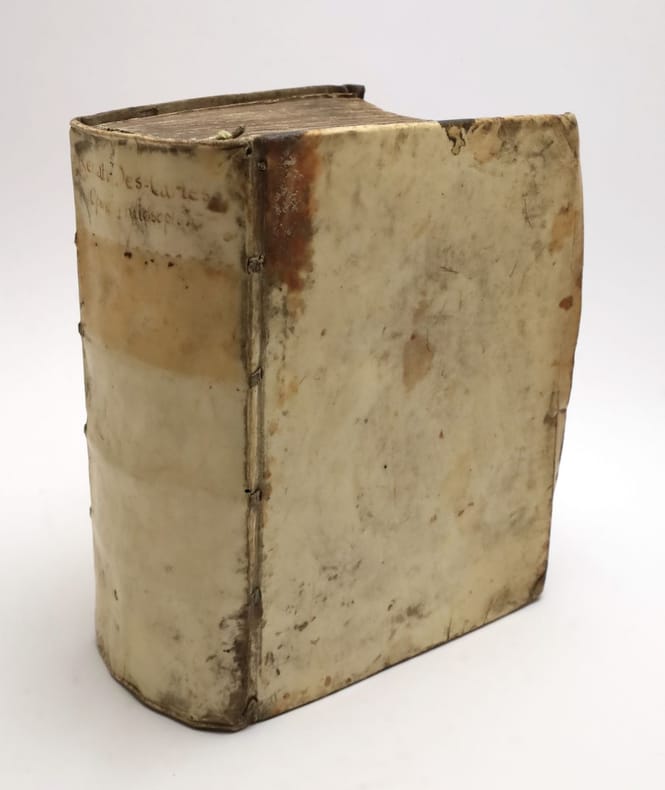
166276611Lugduni Batavorum [Leyde], Apud Franciscum Moyardum & Petrum Leffen, 1662, in-4, [36], 121 (i.e.123), [1] pp, 10 pl. [Signatures : a-d4 ; e2 ; A-P4 ; Q2], Basane granité havane, dos à nerfs orné, tranches jaspées de rouge. Reliure de l?époque, Édition originale, parue posthume, de cet ouvrage dans lequel Descartes expose sa célèbre théorie de « l'animal machine », ainsi qu'une théorie mécanique du mouvement involontaire, parfois considérée comme le germe de la conception du réflexe conditionné. Il reconnaît ici l'importance de la découverte de Harvey mais ne croit pas que la circulation du sang ait pour cause les pulsations cardiaques. Descartes en avait achevé la rédaction, en français, en 1633. La même année, Galilée était condamné pour la publication de son Dialogue sur les deux grands systèmes du monde ; le philosophe français, craignant que sa vision matérialiste-mécaniste ne soit également considérée comme hérétique, se ravisa et ne fit pas publier ce traité de son vivant. L'ouvrage parait finalement en 1662 à Leyde, traduit du français par Florent Schuyl (1619-1669) à partir d'une copie manuscrite considérée comme insuffisante. L'édition fait l'objet, la même année, de deux tirages simultanés, issus l'un de l'imprimerie de Peter Leffen, l'autre de celle Francis Moyard : notre exemplaire fait partie de ceux imprimés par Moyard, reconnaissables au fait que le nom de ce dernier apparait avant celui de son confrère, et surtout à sa marque typographique représentant Apollon jouant de la lyre sous le laurier. Le livre est orné de nombreuses gravures sur bois et sur cuivre dans le texte, ainsi que de dix très belles planches en taille-douce, certaines dépliantes ; l'une d'entre elles, représentant le coeur, comporte six parties mobiles montrant l'intérieur de l'organe. La partie mobile sur la planche du cerveau manque comme toujours. Bel exemplaire. Reliure restaurée avec soin. Guibert, p. 197. Norman 627. Tchemerzine, II, 798. Osler 931. Couverture rigide
LCS-18486Bel exemplaire conservé dans son vélin hollandais de l'époque. Amsterdam, Blaeu, 1682-1683. 3 parties en 3 volumes in-4, I/ (1) f.bl., (4) ff., 383 pp., (1) f.bl.; II/ (1) f.bl., (2) ff., 404 pp., (2) ff., (1) f.bl.; III/ (1) f.bl., (8) ff., 427 pp., (1) f.bl., pte. brulure pp. 249 et 413 avec atteinte à 2 lettres. Plein vélin hollandais, fleuron à froid au centre des plats, double filet à froid autour des plats, dos lisses, tranches jaspées. Reliure de l'époque de l'éditeur Blaeu. 201 x 154 mm.
1604NM004<p>RENATI DES-CARTES PRINCIPIA PHILOSOPHIAE. AMSTEDOLAMI. Apud Johannem Jansonium Juniorrem. Anno MDCLVI 1656. Com ilustrações no texto.</p>_x000d_<p>Junto com: <strong>RENATI DES CARTES SPECIMINA PHILOSOPHIAE SEV DISSERTATIO DE METHODO</strong> Restè regendae rationis & veritatis in scientiis investigandae: DIOPTRICE ET METEORA. Ex Gallico translata & ab Autore perlecta variisque in locis emendata. AMSTEDOLAMI Apud Johannem Janssonium Juniorem Anno MDCLVI 1656. Com ilustrações no texto.</p>_x000d_<p>Junto com: <strong>PASSIONES ANIMAE PER RENATUM DES-CARTES</strong>: Gallicè ab ipso conscriptae nunc autem in exterorum gratiam Latina civitate donatae. Ab H. D. M. I. V. L. AMSTEDOLAMI Apud Joahannem Janssonium Juniorem. Anno MDCLVI 1656.</p>_x000d_<p>Junto com: <strong>RENATI DES CARTES MEDITATIONES De Prima PHILOSOPHIA</strong> In quibus Dei existentia animae humanae à corpore distinctio demonstrantur. His adjunctae sunt variae objectiones doctorum virorum in istas de Deo anima demostrationes; Cum Responsionbus Authoris. Edito ultima prioribus auctior & emendatior. AMSTEDOLAMI Apud Johannem Janssonium Juniorem. Anno MDCLVIII 1658.</p>_x000d_<p>Junto com: <strong>APPENDIX Continens OBIECTIONES QUINTAS & SEPTIMAS In RENATI DES-CARTES MEDITATIONES DE Primâ Philosophiâ</strong> Cum ejusdem ad illas Responsionibus & duabus Epistelis Vna ad Patrem Dinet Societatis Iesu Praepositum Provincialem per franciam Altera ad celeberrimum Virum D. GISBERTUM VOETIUM. AMSTEDOLAMI Apud Johannem Jansonium Juniorem MDCLVII 1657.</p>_x000d_<p>Junto com: <strong>EPISTOLA RENATI DES CARTES</strong> Ad celeberrimum Virum D. GISBERTUM VOETIUM In qua examinantur duo libri nuper pro Voetio Vltrajecti aemul editi unus de Confraternitate Mariana alter de Philophia Cartesiana.</p>_x000d_<p>6 obras encadernadas num volume de 21x17 cm. Com 34 241; 16 290 aliás 288; 20 115 5; 10 226; 199; 108 págs. Com salto de numeração de 256 para 259 sem perda de texto na segunda obra e com erros de numeração sem influência no texto entre a página 100 e a 108 da quarta obra.</p>_x000d_<p>Encadernação inteira de velino com ferros a seco nas pastas e com nervos na lombada.</p>_x000d_<p>Exemplar com falha marginal de papel na página 57 e com leves anotações marginais coevas. Títulos de posse manuscritos na folha de guarda.</p>_x000d_<p>EN Together with: RENATI DES CARTES SPECIMINA PHILOSOPHIAE SEV DISSERTATIO DE METHODO Restè regendae rationis & veritatis in scientiis investigandae: DIOPTRICE ET METEORA. Ex Gallico translata & ab Autore perlecta variisque in locis emendata. AMSTEDOLAMI Apud Johannem Janssonium Juniorem Anno MDCLVI. Illustrations in text.</p>_x000d_<p>Together with: PASSIONES ANIMAE PER RENATUM DES-CARTES: Gallicè ab ipso conscriptae nunc autem in exterorum gratiam Latina civitate donatae. Ab H. D. M. I. V. L. AMSTEDOLAMI Apud Joahannem Janssonium Juniorem. Anno MDCLVI.</p>_x000d_<p>Together with: RENATI DES CARTES MEDITATIONES De Prima PHILOSOPHIA In quibus Dei existentia animae humanae à corpore distinctio demonstrantur. His adjunctae sunt variae objectiones doctorum virorum in istas de Deo anima demostrationes; Cum Responsionbus Authoris. Edito ultima prioribus auctior & emendatior. AMSTEDOLAMI Apud Johannem Janssonium Juniorem. Anno MDCLVIII.</p>_x000d_<p>Together with: APPENDIX Continens OBIECTIONES QUINTAS & SEPTIMAS In RENATI DES-CARTES MEDITATIONES DE Primâ Philosophiâ Cum ejusdem ad illas Responsionibus & duabus Epistelis Vna ad Patrem Dinet Societatis Iesu Praepositum Provincialem per franciam Altera ad celeberrimum Virum D. GISBERTUM VOETIUM. AMSTEDOLAMI Apud Johannem Jansonium Juniorem MDCLVII.</p>_x000d_<p>Together with: EPISTOLA RENATI DES CARTES Ad celeberrimum Virum D. GISBERTUM VOETIUM In qua examinantur duo libri nuper pro Voetio Vltrajecti aemul editi unus de Confraternitate Mariana alter de Philophia Cartesiana.</p>_x000d_<p>6 works bound in one volume of 21x17 cm. With 34 241; 16 290 actually 288; 20 115 5; 10 226; 199; 108 pp. Page numbers jump from 256 to 259 without loss of text on the second work and numeration errors between pages 100 and 108 on the fourth book with no influence on the text.</p>_x000d_<p>Binding: Full vellum blind tooled on folders and raised bands on spine.</p>_x000d_<p>Copy with slight paper tare on page 57 and light marginal manuscript notes. Handwritten ownership title on front endpaper.</p> M-18-C-9 hardcover
165880311658 Amstelodami: Apud Johannem Janssonium Juniorem, 1658. Trois parties, complet en un vol. in-4: 5 ff. n. chiff. [titre, Epistola, Paefatio, Contenta], 226 pp. [Meditatio I-VI, Objectiones et Responsiones I-VI, Notae...], 199 pp. [Appendix (daté de 1657), Contienens obiectiones quintas & septimas], 108 pp. [Epistola ad Gisbertum Voetium] Sixième édition latine des Méditations métaphysiques de Descartes, mais troisième édition en trois parties, avec l'appendice et les remarques, après les deux éditions elzéviriennes de 1650 et 1654. Les méditations occupent les pages 1 à 54, les objections et leurs réponses vont de la page 54 à 198. Les notes occupesnt les pages 201 à 226. (Guibert, Bibliographie Descartes, 1976, pp. 53-55). Reliure aux armes en basane mouchetée. Dos à cinq nerfs avec pièce de titre de basane lavallière et caissons ornés de fleurons à froid. Plats frappés aux armes de Louis-Joseph de Montmorency-Laval (1724-1808), évêque dOrléans dès 1754, grand aumônier de France entre 1786 et 1789, puis enfin crée cardinal le 30mars1789par le papePieVI. Sceaux en cire rouge aux armes du grand aumônier sur le contreplat. Dos habilement restauré, notamment aux mors et aux coiffes. Bel exemplaire de cet incontournable de la philosophie occidentale.
In-4to piccolo, (36), 121, (1) pp., 10 tavole. Completo delle 56 silografie nel testo (molte delle quali a piena pagina) e delle 10 tavole incise in rame fuori testo, una delle quali (cuore) con volvelle. Vitello coevo, dorso ben restaurato.
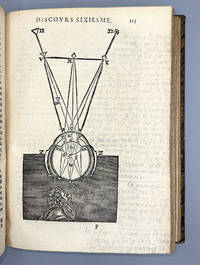
1668cmd333This item is currently on reserve; please contact dealer for more details.<p><strong> DESCARTES EXTENSIVELY ANNOTATED IN FRENCH</strong></p><p><strong>A 17th CENTURY READER ATTENTIVE TO MECHANICAL ARTS</strong></p><p><strong> AND TO THE ENGRAVINGS </strong></p><p><strong>DESCARTES René</strong></p><p><strong> <em>Discours de la méthode pour bien conduire sa raison … </em></strong></p><p><strong><em> La Dioptrique Les Météores La Mécanique et La Musique.</em></strong></p><p><strong> Paris Charles Angot 1668. </strong>2 parts in one vol. 4to 2 ff. 63 pp. <em>Discours de la méthode</em>; pp. 63- 186 <em>Dioptrique</em> and pp. 187-303 and 1 p. <em>Les Météores</em> 15 ff.; pp. 1-52 <em>Traité de la Mécanique</em> and pp. 53-127 <em>Abrégé de la Musique</em> with 1 p. of privilege. 19th-century half calf.</p><p>A remarkable edition illustrated with numerous engravings and geometric woodcuts. This edition includes the first translation into French of the <em>Abrégé de musique</em> by Nicolas Poisson. <strong>A copy extensively annotated by a late 17th-century scientist. The volume contains 270 marginal notes in pencil and ink by a reader keen on explaining the figures and experimental data in Descartes' work. </strong>The annotator exhibits a strong interest in mechanical arts within Descartes' writings. He highlights a passage on the movement of a sphere down an inclined plane addressing the question of mass.</p><p><strong>Notably the reader focuses on the interpretation of the book's illustrations. </strong>For example when exploring complex issues related to light he adds clarifications regarding a diagram in <em>La Dioptrique</em> where he carefully annotates the figure from the Sixth Discourse which deals with vision and the optical function of the eye in perceiving distances p. 113: <em>"Distance is perceived in four ways" </em>and <em>"Size is known through distance compared with the size of images."</em></p><p><strong>An important annotated copy of Descartes by a late 17th-century scientist.</strong></p> Charles Angot
18684Paris, Charles Angot, 1664. Petit in-4, [70]-448-[8] pp., basane mouchetée brune postérieure, dos à nerfs orné de caissons et fleurons dorés, pièce de titre rouge, tranches rouges (quelques restaurations à la reliure, galeries de ver sans atteinte au texte, quelques petites rousseurs, pâle mouillure angulaire à plusieurs ff.).
168511556Amstelodami, Ex typographia Blaviana, 1685. 3 pièces reliées en 1 vol. in-4, vélin rigide (reliure de l'époque).
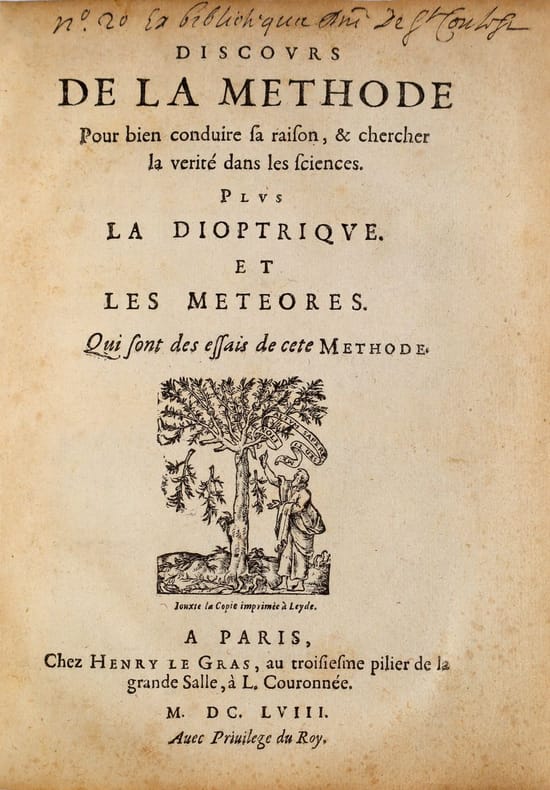
1658102765Paris, Henry Le Gras, 1658, in-4, 78-[2]-294-[26] pp, Vélin rigide de l'époque, à petits recouvrements, Deuxième édition du célébrissime Discours de la méthode, identique et aussi rare que la première édition de 1637. Le texte est illustré de belles et nombreuses figures gravées sur bois, dont plusieurs sont répétées. Le privilège pour l'impression de cette édition fut partagé entre les libraires Henry Le Gras et Th. Girard; ce dernier fit paraître la sienne quelques mois avant (1657). "Pendant que je voulois ainsi penser que tout estoit faux, il falloit necessairement que moy qui le pensoit susse quelque chose : Et remarquant que cette vérité, je pense, donc je suis, estoit si ferme & si assurée, que toutes les extravagantes suppositions des sceptiques n'estoient pas capables de l'esbranler je jugeay que je pouvois la recevoir sans scrupule pour le premier principe de la philosophie que je cherchois"(p. 33). C'est dans ce texte fondamental que s'expose la pensée de Descartes. Le philosophe y délivre intimement les étapes de sa grande réflexion : le doute, l'excellence des mathématiques, les règles mêmes de sa méthode, la nécessité d'une morale provisoire ? car la vie ne s'interrompt pas pendant la quête de la vérité ? "le point archimédique du je pense donc je suis", la preuve de l'existence de Dieu, et enfin, à partir de ces fondements, "l'extension au monde entier des lumières de sa raison" (En français dans le texte, n° 90). Cachet de cire sur le premier contreplat. Ex-libris manuscrit ancien en tête de la page de titre. Bon exemplaire, malgré de menus défauts : vélin un peu sali, une petite déchirure sans perte, une infime lacune angulaire et une fine auréole marginale sur quelques feuillets. Guibert p. 17, n° 3. Couverture rigide
165094237Amstellodami, Apud Ludovicum Elzevirium, 1650, in-4, 4 tomes en 1 volume, pagination mutliple, Vélin rigide de l'époque, titre manuscrit en tête du dos, Éditions issues de l'officine de Louis III Elzevier d'Amsterdam, à qui Descartes (1596-1650) confia, à partir de 1642, l'impression de tous ses ouvrages. Ces quatre tomes, qui forment la collection de ses oeuvres philosophiques, ont paru l'année de sa mort. Ils sont souvent réunis en un seul volume, comme c'est le cas ici; ils s'accompagnent alors d'un titre général portant : Opera philosophica. Editio secunda (Willems n° 1106). L'ouvrage a été mis à l'Index par décret du 20 novembre 1663 (Bujanda, Index librorum prohibitorum, p. 281). 1? Meditationes de prima philosophica... Tertia editio... , 1650. [14]-191-164-88 pp. Première édition elzvirienne publiée dans le format in-4. Trois parties : les Meditationes (1650), l'Appendix (qui a sa page de titre propre, à la date de 1649), et L'Epistola ad... Gilbertum Voetium. Guibert p. 229-230. Willems n° 1107. 2? Principa philosophiae. [40]-302 pp. Figures gravées sur bois dans le texte, plusieurs répétées. Réimpression de l'édition originale de 1644, augmentée de la traduction latine de la Lettre de l'autheur à celuy qui a traduit le livre; Epistola authoris ad Principiorum philosophiae interpretem gallicum (p. [9] et suiv). Guibert p. 121-122. Willems n° 1106. 3? Specimina philosophiae. [16]-316 pp. Figures gravées sur bois dans le texte, certaines répétées. Réimpression de l'édition originale de 1644; cet ouvrage renferme la traduction latine du Discours de la méthode, par Estienne de Courcelle, avec révisions de Descartes, la Dioptrique et les Météores. Guibert p. 105-106. Willems n° 1106. 4? Passiones animae. [24]-98-[5] pp. Seconde édition de la traduction latine des Passions de l'âme. Guibert p. 158-159. Willems n° 1106. Ex-libris manuscrit ancien accompagné d'un schéma circulaire sur la première garde blanche : "Th. Montanus D. Med."; probablement Thomas Montanus (ou Thomas Van den Berghe,1617-1685) médecin à Bruges. Autres ex-libris manuscrits anciens au verso, l'un étant biffé (date de 1660). Cachets anciens sur les pages de titre. Bon exemplaire. Trace ancienne d'une pièce de titre au dos, salissures du vélin. Mouillures claires, réparation en tête d'une page. Couverture rigide
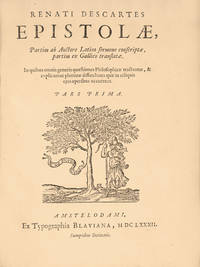
1664002480Ex Officina Hackiana 1664 Title: De Homine Figuris et La Tinitate Donatus a Florentio Schuyl Inclytæ Urbis Sylvæ-Ducis Senatore & ibidem Philosophiæ Professore. Author: Renatus Des Cartes Publisher: Ex Officina Hackiana Place: Lugduni Batavorum Leiden Publication date: 1664 Description: 1664. Second edition only two years after the first appeared in the same city contemporary with the final definitive edition. Latin text. 38 121 Pp. 10 plates 2 folded and 1 with 2 movable overlays showing the interior regions of the heart. Profusely adorned with numerous splendid anatomical illustrations engraved in copper and wood many in half or full page. Woodcut title-page device; head and tailpieces. Small 4to. Full contemporary red morocco with gilt stamped title and design over spine and boards red marble endpapers. Provenance: Ex-Libris label of M. Gonzalez-Ulloa of Mexico book plate. Notes: As is known Descartes labored on the work since 1630 but decided not to publish it privy to knowledge of Galileos conviction in 1633. In acknowledgement of Harveys important discovery Descartes did not believe that blood circulation was caused by heartbeats but considered the human body as a machine directed by a rational principle located in the pineal gland. Considered the first attempt to embrace all animal physiology the De Homine . is actually a kind of physiological supplement to the Discours de la Methode published in 1637 a source of inspiration for many scholars. This book was the first attempt to cover the whole field of animal physiological appendix to his Discourse on method. Garrison-Morton. Work of fundamental importance among the most eminent products of human ingenuity. Good example Garrison-Morton 574. Wellcome Catalogue. II 453. Measures: 8.25 H x 6.5 D x 1 W inches. 2nd Edition. Hardcover. Very Good/No Jacket. Ex Officina Hackiana hardcover
165491261654 Amstelodami, apud Ludovicum Ezevirium, 1654. Un volume, in-4° (14,5 x 18,5 cm), 1 f. + page de titre + [10 pp.] de préface + 191 pages. Relié avec : «Appendix continens obiectiones quintas & septimas in Renati Des-Cartes Meditationes De Prima Philosophia, cum eiusdem ad illas Responsionibus & duabus Epistolis, Una ad Patrem Dinet Societatis Iesu Praepositum Provincialem per Franciam, Altera ad celeberrimum Virum D. Gisbertum Voetium.». À Amstelodami, chez Ludovicum Elzevirum, 1654. Un volume, in-4°, 164 pages. Relié avec : «Epistola Renati Des Cartes ad celeberrimum virum D. Gisbertum Voetium. In qua examinantur duo libri, nuper pro VoetioUltrajecti simul editi, unus de Confraternitate Mariana, alter de Philosophia Cartesiana», in-4°, 88 pages.Seconde édition elzévirienne de ce format, la première est apparu en 1650 (Willems, 1174 et 1008). Reliure ancienne en plein basane mouchetée brun, dos lisse (renouvelé), pièce de titre verte, tranches mouchetées de bleu. Petit travail de vers au plat supérieur, petite déchirure à longle supérieur de la page 1 sans manque de texte, autrement ouvrage en très bon état.
166841596Reliure d'époque veau brun granité. Dos à nerfs orné, manques de cuir à caisson en tête et en pied. Médaillon central de l'académie royale des sciences, belles-lettres et arts de Bordeaux avec la devise «Crescam et Lucebo» encerclant un croissant de lune, fleur de lys et palmes académiques intercalées dans la devise (fer postérieur à l'édition, l'académie n'ayant vu le jour qu'en 1712). Petits manques en bordures des plats. Roulette dorée sur coupes. Tranches rouges.Nombreuses illustrations et dessins géométriques gravés dans le texte.
165367749First Edition in English of Descartes Earliest Surviving Work DESCARTES RenÈ. Excellent Compendium of Musick: with Necessary and Judicious Animadversions Thereupon. By a Person of Honour. London: Printed by Thomas Harper for Humphrey Moseley 1653. First English edition. Small quarto 7 5/16 x 5 3/8 inches; 187 x 135 mm. 16 94 1 errata 1 blank pp. Two parts in one volume. With three engraved plates and with numerous woodcuts including head-and-tail pieces and initials. Title-pages with woodcut vignette. Much of the illustrations are of musical notes staffs and various charts relating to music theory. Also with a detailed and attractive engraving of a lute. The translator the "Person of Honour" refers to Lord Brouncker. His name has been printed neatly on the title-page in old ink by a previous owner. A separate title-page for Animadversions vpon the musick-compendium of Renat. Des-Cartes is included but the pagination and collation is continuous. Modern half calf over marbled boards. Morocco spine label lettered in gilt. Newer endpapers. Front pastedown with previous owner's bookplate. Some toning and spotting throughout the first two leaves being the worst. Tiny burn hole to top margin of two leaves in the "To the Reader" not affecting text. Written in 1618 when he was 22 the Compendium was not published until after his death. "Although it is his earliest surviving work the Compendium was not published until 1650 shortly after his death in Stockholm. The English translation was published in 1653 by William Brouncker 2nd Viscount Brouncker 1620ñ1684 a mathematician who became the first President of the Royal Society in 1662 and was a close friend of both Samuel Pepys and John Evelyn. He is named on the title page of the Compendium as a "Person of Honour" and his commentary the "animadversions" on Descartes work constitute his only publication. They include an unsuccessful mathematical attempt to divide the diapason into seventeen equal semitones. Descartesà study of the mathematical basis of music was also an examination of methodology: the application of empirical deductive and scientific approaches to the study of sensory perception. It is thus among the earliest attempts to define the dual relationship between the physical and psychological phenomena in music." Thomas Fisher Rare Book Library University of Toronto. ESTC R13570. HBS 67749. $3750 Printed by Thomas Harper, for Humphrey Moseley hardcover books
165367749London: Printed by Thomas Harper for Humphrey Moseley 1653. First English edition. Small quarto 7 5/16 x 5 3/8 inches; 187 x 135 mm. 16 94 1 errata 1 blank pp. Two parts in one volume. With three engraved plates and with numerous woodcuts including head-and-tail pieces and initials. Title-pages with woodcut vignette. Much of the illustrations are of musical notes staffs and various charts relating to music theory. Also with a detailed and attractive engraving of a lute.<br> <br> The translator the "Person of Honour" refers to Lord Brouncker. His name has been printed neatly on the title-page in old ink by a previous owner. A separate title-page for Animadversions vpon the musick-compendium of Renat. Des-Cartes is included but the pagination and collation is continuous.<br> <br> Modern half calf over marbled boards. Morocco spine label lettered in gilt. Newer endpapers. Front pastedown with previous owner's bookplate. Some toning and spotting throughout the first two leaves being the worst. Tiny burn hole to top margin of two leaves in the "To the Reader" not affecting text.<br> <br> Written in 1618 when he was 22 the Compendium was not published until after his death. "Although it is his earliest surviving work the Compendium was not published until 1650 shortly after his death in Stockholm. The English translation was published in 1653 by William Brouncker 2nd Viscount Brouncker 1620-1684 a mathematician who became the first President of the Royal Society in 1662 and was a close friend of both Samuel Pepys and John Evelyn. He is named on the title page of the Compendium as a "Person of Honour" and his commentary the "animadversions" on Descartes work constitute his only publication. They include an unsuccessful mathematical attempt to divide the diapason into seventeen equal semitones. Descartes' study of the mathematical basis of music was also an examination of methodology: the application of empirical deductive and scientific approaches to the study of sensory perception. It is thus among the earliest attempts to define the dual relationship between the physical and psychological phenomena in music." Thomas Fisher Rare Book Library University of Toronto.<br> <br> ESTC R13570.<br> <br> HBS 67749.<br> <br> $3750. Printed by Thomas Harper, for Humphrey Moseley unknown
165063878Amsterdam: Apud Ludovicum Elzevirium 1650. Two vols. in one. 4to. xl 216 227-302 collation complete w/ M5 for M3 error so pagination jumps but catchword and signatures contiguous; xvi 316 pp. With many woodcut engravings throughout some full page. Contemporary flexible vellum ownership markings on endpapers & titles former ownership excised w/ expert paper repairs occasional pencil ms markings in 2nd vol. still a VG clean copy. Second collected edition of Descartes groundbreaking works in philosophy and the history of science which were also sold separately or under a general title following the original 1644 Elzevir edition. The Principia Philosophiae was the first comprehensive study of the nature of the universe as well as an epochal work in the history of science where Descartes first developed his vortex theory arguing that the Earth was immobile and at rest while the entire vortex circled the sun. This served as Descartes’ attempt to reconcile Copernican heliocentric astronomy with traditional theology and also included the first scientific discussion of magnetism as well as investigations into heat light gravity and electricity. This second Latin edition of Specimina philosophiae was first published anonymously in 1637 in Leiden and then revised later by Descartes. This work includes his contributions on mathematics as well as significant studies of optics light colour and meteors. In De Methodo his summary of cardiovascular physiology significantly influenced the study of medicine in the 17th-Century while his De Dioptrice summarized his basis for the detailed study of sensation image formation and visual perception. See: Willems 1008; Cushing D124; Garrison & Morton 574 1662 ed.; Norman 623. Apud Ludovicum Elzevirium, hardcover
1651RMP799<p>París Henry Le Gras et Edme Pepingvé 1651</p><p>4º. 31 h. 486 p. 1 h. 20 láminas grabadas desplegables. Encuadernación en plena piel de época con nervaduras y compartimentos cuajados de dorados. Tapas ligeramente gastadas; pequeña muesca en el borde inferior de la tapa posterior. Página de título grabada y página tipográfica; guardas delanteras algo manchadas; guarda anterior con anotaciones manuscritas antiguas; nombre antiguo parcialmente borrado en esquina inferior derecha de página de título; pequeña mancha tenue en el margen superior de las primeras hojas; algunas hojas con ligeras manchas; por lo demás ejemplar limpio y bien conservado. Las láminas presentan una mancha en la esquina superior izquierda fuera de la imagen.</p><p>Obra en 4 partes: <em>Des principes de la connaissance humaine – Des principes des choses matérielles – Du monde visible – De la terre</em>.</p><p><strong>Segunda edición francesa</strong> traducida de la primera edición latina de <em>Principia philosophiae</em> 1644 por el abate Picot. En esta obra Descartes presenta su sistema general de epistemología y física —incluyendo la teoría de los torbellinos la imposibilidad del vacío etc.— con un copernicanismo atenuado por la idea de que todo movimiento es relativo.</p><p>En la carta que Descartes antepone a esta traducción francesa de los <em>Principios</em> afirma que dos condiciones y solo dos determinan si los primeros principios propuestos pueden aceptarse como verdaderos: "primero que sean tan claros y evidentes que la mente del hombre no pueda dudar de su verdad cuando se aplica atentamente a considerarlos; y segundo que todo lo demás pueda deducirse de ellos." Pero añade: "En realidad sólo Dios posee la sabiduría perfecta es decir un conocimiento completo de la verdad de todas las cosas."</p><p>Brunet II:611.</p> Henry Le Gras et Edme Pepingvé hardcover
195930479Paris Editions Vialetay 1959 2 volumes in-4, box tte-de-ngre, plats entirement recouverts dun semis dempreintes triangulaires en creux rehauss de jeux de trs petits carrs pousss loeser rouge, jaune, vert et bleu, et de deux bandes transversales obliques en lger relief pousses la feuille dor, dos sans nerfs ; doublures et gardes de soie moire verte, ttes dores, non rogns, couvertures imprimes.31 burins originaux de Josso, dont 12 pleine page. Tirage limit 259 exemplaires numrots, signs par l'artiste et l'diteur. Un des 21 exemplaires sur japon nacr, comprenant un dessin original la mine de plomb sign de Camille Josso ayant servi lillustration de louvrage, le cuivre original encr correspondant au dessin, 2 suites des illustrations dont ltat dfinitif sur auvergne et celui avec remarques sur vlin de Rives, une suite de 4 planches refuses sur vlin de Rives et une suite sur satin des 6 double pages. Exemplaire enrichi dun second dessin original dune des lettrines de louvrage.
38674In-4 (235 x 178), plein veau brun moucheté de l'époque, dos à nerfs orné de compartiments fleuronnés et cloisonnés, doubles filets dorés en encadrement des plats, roulette sur les coupes, titre doré, (1) f. de titre, (66), 448, (8) p. Paris, Charles Angot, 1664.
1654920Amstelodami Amsterdam: Ludovicum Elzevirium 1654. vellum. Very good. Second Elzevir Edition of Descartes Meditations Published Just Four Years <br />After His Death <br /> <br />DESCARTES René. Meditationes de Prima Philosophia Meditations on First Philosophy Ludovicum Elzevirium Amstelodami Amsterdam 1654. 2 blank leaves TP i - v = Epistola vi-viii = Praefatio ad Lectorem ix-x = Contenta 1-191 TP Appendix Continens Objectiones Quintas & Septimasin Renati Des-Cartes Meditationes de Prima Philosophia 3 - 164. TP Epistola Renati Des Cartes ad celeberrimum virum D. Gisbertum Voetium 3 - 88. Quarto. Second Elzevir Edition. <br />$ 3500 <br /> <br />The first edition of Descartes Meditations was published in Paris in 1641 presenting the most detailed explanation of his metaphysical system. The six meditations follow Descartes as he categorically doubts everything he knows and then tries to discover a method whereby he can establish what if anything can be known with certainty. This book along with the earlier presentation Discours 1637 of roughly the same ideas was the foundational moment in Modern Philosophy and a seismic event in the history of Western ideas. This Second Elzevir Fifth Latin edition also includes the 164-page further Response to Gassendis objection along with a later refutation of a Seventh Set of Objections that had been sent to Descartes by the Jesuit Pierre Bourdin primarily attacking his method of doubt as well as a letter addressed to the Jesuit Father Dinet revisiting and rebutting the accusations that had formerly been made against Descartes by his virulent Dutch enemy Voetius. The book concludes with the 88 page Letter to the Very Famous Man Mr. Gisbert Voetius where Descartes defends his philosophy. <br /> <br />CONDITION: Very good or better in original full vellum. Spine with soiling and remnants of labels library. Covers lightly soiled with yapped edges. Pages crisp and clean and free of markings. <br /> <br/><br/> Ludovicum Elzevirium hardcover
1656918Amsterdam: Elzevier 1656. vellum. Very good. DESCARTES René Opera philosophica Amsterdam: L. & D. Elzevier 1656. 3 parts in 1 volume: 2 blank leaves TP 1 leaf Typographus with portrait on verso TP Principia 3 leaves = dedication 14 leaves = introduction & index 1 - 222 TP Specimina philosophiae 7 leaves = index 1 - 248 TP Passiones animae 11 leaves Praefatiuncula 1 - 92 2 leaves index 3 blank leaves Quarto. Third Latin Edition. <br /> <br />This Edition Tertia includes numerous woodcut figures with an engraved portrait of Descartes by Franciscus van Schooten. <br /> <br />OPERA PHILOSOPHICA EDITIO TERTIA contains three major works: <br /> <br />Principia Philosophiæ. Principles of Philosophy 1650 focuses on metaphysics and natural philosophy. <br /> <br />Specimina Philosophiæ: seu Dissertatio de Methodo Rectè regendæ rationis & veritatis in scientiis investigandæ: Dioptrice et Meteora. The Proofs of Philosophy: The Discourse on the Method of Properly conducting the reason & seeking for truth in the sciences: Dioptics and Meteors 1650 outlines the process of Cartesian doubt as a method for proper philosophical and scientific investigation. <br /> <br />Passiones Animæ. The Passions of the Soul 1650 addresses the interaction between the mind and the body. <br /> <br />CONDITION: Very good or better in original full vellum. Spine with soiling and remnants of labels library. Covers lightly soiled with yapped edges. Pages crisp and clean and free of markings. <br /> <br/><br/> Elzevier hardcover
1668243951668 Paris, Chez Charles Angot, 1668, in-4, veau brun de l'époque, dos à 5 nerfs orné de caissons et de fleurons dorés, roulette dorée sur les coupes et les coiffes, tranches mouchetées rouges, 303 pages suivies des tables (23 pages) ; 127 pages et 1 feuille.