Descartes, ReneBiblio.com

2 323 résultats
1025579941.Gpaperback. Good. Access codes and supplements are not guaranteed with used items. May be an ex-library book. paperback
197057375Nendeln/Liechtenstein : Kraus Reprint 1970. 235x155mm. figures n/b in texte reliure d'ÂŽditeur. cachet de bibliothÂque. Bel exemplaire. 725 Kraus Reprint unknown
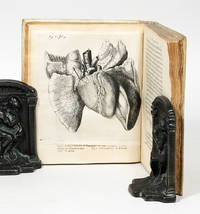
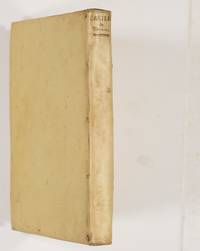
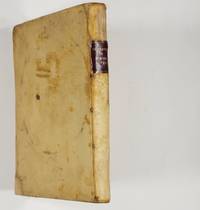
16622203Leydon: Peter Leffen & Francis Moyard 1662. First edition. contemporary vellum. Very Good. FIRST EDITION OF THE FIRST TEXTBOOK OF PHYSIOLOGY. "René Descartes's Treatise of man De homine 1662; Traité de l'homme 1664 was never intended to stand as a work on its own. It was one part of a much larger work Le monde The world. Although this was finished around 1633 Descartes did not publish it himself because he was alarmed by the Italian Inquisition's condemnation of Galileo Galilei that year. Some time after Descartes's death in 1650 his French manuscript copies of which had circulated among his friends and correspondents was edited and published. The first version was a Latin translation De homine by Florentius Schuyl in 1662 the second the now better known 'original' French version Traité de l'homme edited by Descartes's self-appointed literary executor Claude Clerselier in 1664. In the seventeenth century the 1662 Latin version was probably much more widely read than the French text" Donaldson J R Coll Physicians Edinb 2009; 39:375-6. Heirs of Hippocrates 295. Garrison-Morton 574. With 10 engraved plates; with 2 lift-up flaps on plate depicting the heart but without flap on plate of the brain as usual; numerous full-page and text engravings and woodcuts. Inscribed on title to Mart. Christian Sweerts "ex dono Autoris". The "author" in this case is most likely the translator Schuyl. De homine figuris et latinitate donatus a Florentio Schuyl. Leyden: Peter Leffen & Francis Moyard 1662. Small quarto contemporary vellum with leather spine label. Evidence of old label at base of spine. Remnants of old stamp on title occasional very light browning to margins. A beautiful copy. Peter Leffen & Francis Moyard unknown
1662176381662. Lugduni Batavorum: Apud Petrum Leffen & Franciscum Moyardum 1662 4° 36 121 pp. 123 111/112 repeated 1 p. Nota 56 woodcut and engraved text-illustrations 10 engraved plates contemporary vellum; complete fine copy. First Edition! Complete with all 56 woodcut and engraved text-illustrations many of which are full-page and the 10 full-page engraved plates several folded one of which is the heart-plate with the 6 moveable parts the Cardiac-flaps. This edition was posthumously published and translation by Florentius Schuy. A seminal work René Descartes 1596-1650 'Treatise on man' is known as the first European textbook of physiology and the first purely mechanistic account of bodily functions. "In the Treatise of man Descartes did not describe man but a kind of conceptual models of man namely creatures created by God which consist of two ingredients a body and a soul. "These men will be composed as we are of a soul and a body. First I must describe the body on its own; then the soul again on its own; and finally I must show how these two natures would have to be joined and united in order to constitute men who resemble us"." SEP. "This highly influential work was the first to present a coherent description of bodily responses in neurophysiological terms that are still to a wide extent accepted today. In his attempt to solve the central question around which almost all philosophical thought had revolved since the time of Aristotle what the relation between the soul and the body actually is Descartes came to create a milestone work of physiology which changed the entire trajectory of modern physiological conceptions. "Without Descartes the seventeenth-century mechanization of physiological conceptions would have been inconceivable." He believed that the relationship between the soul and the body was mediated by the brain and the nervous system and his seminal attempts to explain neural mechanisms drew a great deal on the engineering developments of his time. He developed a hydro-mechanical theory of how the soul controlled the contraction of muscle through the intermediary of the pineal and the cerebral ventricles and he produced an explanation of how it received through the nerves from the periphery signals that gave rise to sensation. Descartes' theories quickly spread throughout Europe and the work in which he had developed them his "De Homine" became extremely influential. "Descartes was one of the first to embrace Harvey's doctrine of the circulation and the book opens with an account of the cardiovascular system illustrated by a plate of the heart with movable flaps. From a mechanistic survey of general physiology Descartes moves to the nervous system which he treats in great detail. Particularly important is his discussion of the eye drawing on Kepler for the optical part and the physiology of perception. 'The impact of the Cartesian physiological program once it was publicly known was enormous. In two ways -philosophically and physiologically -Descartes transformed long-standing beliefs about animals and men. Philosophically of course his notions of mind-body dualism and animal automatism had extremely important implications that were not lost on Henry More Malebranche Spinoza and Leibniz along with many others in the seventeenth century . But physiologically too Descartes' conceptions had an impact that in many ways was even more impressive than the philosophical influence because it affected the actual course of contemporary science'. DSB. Descartes was prepared to publish this book in 1633 but decided to withhold it when he learned of Galileo's condemnation by the Church. As a result the first edition was not published until 1662. This first Latin translation De homine by Florentius Schuyl in 1662 was probably much more widely read than the two years later published French edition. Guibert Nr. 1. Edition Originale. Grolier Medicine 31; Garrison-Morton 574; Wellcome II p. 453; Krivatsy 3120; Norman 627 hardcover
1662679671662. Lugduni Batavorum: Apud Franciscum Moyardum & Petrum Leffen 1662 4° 36 121 pp. 123 111/112 repeated 1 p. Nota 56 woodcut and engraved text-illustrations 10 engraved plates contemporary vellum; complete fine copy. First Edition! Complete with all 56 woodcut and engraved text-illustrations many of which are full-page and the 10 full-page engraved plates several folded one of which is the heart-plate with the 2 moveable parts the Cardiac-flaps and one for flab for the brain Fig. 54. This edition was posthumously published and translation by Florentius Schuy. A seminal work René Descartes 1596-1650 'Treatise on man' is known as the first European textbook of physiology and the first purely mechanistic account of bodily functions. "In the Treatise of man Descartes did not describe man but a kind of conceptual models of man namely creatures created by God which consist of two ingredients a body and a soul. "These men will be composed as we are of a soul and a body. First I must describe the body on its own; then the soul again on its own; and finally I must show how these two natures would have to be joined and united in order to constitute men who resemble us"." SEP. "This highly influential work was the first to present a coherent description of bodily responses in neurophysiological terms that are still to a wide extent accepted today. In his attempt to solve the central question around which almost all philosophical thought had revolved since the time of Aristotle what the relation between the soul and the body actually is Descartes came to create a milestone work of physiology which changed the entire trajectory of modern physiological conceptions. "Without Descartes the seventeenth-century mechanization of physiological conceptions would have been inconceivable." He believed that the relationship between the soul and the body was mediated by the brain and the nervous system and his seminal attempts to explain neural mechanisms drew a great deal on the engineering developments of his time. He developed a hydro-mechanical theory of how the soul controlled the contraction of muscle through the intermediary of the pineal and the cerebral ventricles and he produced an explanation of how it received through the nerves from the periphery signals that gave rise to sensation. Descartes' theories quickly spread throughout Europe and the work in which he had developed them his "De Homine" became extremely influential. "Descartes was one of the first to embrace Harvey's doctrine of the circulation and the book opens with an account of the cardiovascular system illustrated by a plate of the heart with movable flaps. From a mechanistic survey of general physiology Descartes moves to the nervous system which he treats in great detail. Particularly important is his discussion of the eye drawing on Kepler for the optical part and the physiology of perception. 'The impact of the Cartesian physiological program once it was publicly known was enormous. In two ways -philosophically and physiologically -Descartes transformed long-standing beliefs about animals and men. Philosophically of course his notions of mind-body dualism and animal automatism had extremely important implications that were not lost on Henry More Malebranche Spinoza and Leibniz along with many others in the seventeenth century . But physiologically too Descartes' conceptions had an impact that in many ways was even more impressive than the philosophical influence because it affected the actual course of contemporary science'. DSB. Descartes was prepared to publish this book in 1633 but decided to withhold it when he learned of Galileo's condemnation by the Church. As a result the first edition was not published until 1662. This first Latin translation De homine by Florentius Schuyl in 1662 was probably much more widely read than the two years later published French edition. Guibert mentions two states of the the title-page: the first with the imprint "Apud Leffen & Franciscum Moyardum and a woodcut printer's device of a phoenix rising from the flames motto "ex morte immortalia"; and the second with the names of the publishers reversed and a device showing an angel under a laurel tree "motto insigne maxime laurus". He does not establish any priority of issue. Guibert Nr. 2. Edition Originale. Grolier Medicine 31; Garrison-Morton 574; Wellcome II p. 453; Krivatsy 3120; Norman 627 hardcover
166252487Lugduni Batavorum Leyden Apud Petrum Leffen & Franciscum Moyardum 1662. 4to. Contemporary full calf with gilt title-laebl to spine. 36 121 1 pp. 10 plates. Complete with all 56 woodcut and engraved text-illustrations many of which are full-page and the 10 full-page engraved plates several folded one of which is the heart-plate with the 6 moveable parts the Cardiac-flaps of which only the smallest is missing. One folded plate cropped at fore-margin. <br/><br/><em>First edition of Descartes' seminal treatise on man the first European textbook of physiology constituting an epochal work of modern thought defining the mechanism of man as it does. "In the Treatise of man Descartes did not describe man but a kind of conceptual models of man namely creatures created by God which consist of two ingredients a body and a soul. "These men will be composed as we are of a soul and a body. First I must describe the body on its own; then the soul again on its own; and finally I must show how these two natures would have to be joined and united in order to constitute men who resemble us"." SEP. This highly influential work was the first to present a coherent description of bodily responses in neurophysiological terms that are still to a wide extent accepted today. In his attempt to solve the central question around which almost all philosophical thought had revolved since the time of Aristotle what the relation between the soul and the body actually is Descartes came to create a milestone work of physiology which changed the entire trajectory of modern physiological conceptions. "Without Descartes the seventeenth-century mechanization of physiological conceptions would have been inconceivable." DSB. He believed that the relationship between the soul and the body was mediated by the brain and the nervous system and his seminal attempts to explain neural mechanisms drew a great deal on the engineering developments of his time eg. the hydraulic automata that had been installed at the Versailles. He developed a hydro-mechanical theory of how the soul controlled the contraction of muscle through the intermediary of the pineal and the cerebral ventricles and he produced an explanation of how it received through the nerves from the periphery signals that gave rise to sensation. Descartes' theories quickly spread throughout Europe and the work in which he had developed them his "De Homine" became extremely influential. This posthumously published work was actually written in the 1630's but after the condemnation of Galilei in 1633 Descartes did not dare publish it; "although it thus had to await posthumous publication in the 1660's his writing of the Traité de l'homme proved extremely important in the further maturation of Descartes's physiological conceptions." D.S.B. p.62. "Some time after Descartes's death in 1650 his French manuscript copies of which had circulated among his friends and correspondents was edited and published. The first version was a Latin translation De homine by Florentius Schuyl in 1662 the second the now better known 'original' French version Traité de l'homme edited by Descartes's self-appointed literary executor Claude Clerselier in 1664. In the seventeenth century the 1662 Latin version was probably much more widely read than the French text. There were problems for the editors of both versions. Firstly there were differences between the manuscripts: Clerselier in Paris claimed that his version was Descartes's own that the others were 'corrupt' and that Schuyl had been 'misled' by them. However a more important difficulty was raised because it was clear that the text was intended to be illustrated - Descartes refers to figures and to features within these labelled by letters. But no set of figures accompanied the manuscripts. Both editors have left quite detailed accounts in their long prefaces - little treatises in themselves. Here I consider only Schuyl the editor of the Latin De homine. Schuyl 1619-69 was a professor of philosophy in the town of 's-Hertogenbosch in the Netherlands the country in which Descartes was living during the writing of Le monde. Two of the author's friends had copies of the manuscript that they supplied to Schuyl and with one of these were included two sketches of illustrations apparently in Descartes's own hand. These Schuyl included. One of them represents the medial and lateral rectus muscles in the orbit which deflect the eye nasally and temporally. The other figures Schuyl had to have made and since he mentions no one else one supposes that he designed them himself." IML Donaldson J R Coll Physicians Edinb 2009; 39:375-6.Wellcome II:453; Osler 931; Garrison and Morton 574. Waller only has a later edition. </em> unknown
3787340777.Ghardcover. Good. Access codes and supplements are not guaranteed with used items. May be an ex-library book. hardcover
1020585706.Ghardcover. Good. Access codes and supplements are not guaranteed with used items. May be an ex-library book. hardcover
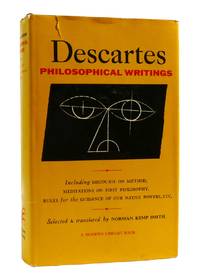
1958192739New York: Modern Library 1958. Modern Library Edition. Hardcover. Near Fine in a Very Good dust jacket. Modern Library hardcover
2004Q-0760762414Barnes & Noble Collector's Library 2004-01-01. Hardcover. New. New. In shrink wrap. Looks like an interesting title! Barnes & Noble Collector's Library hardcover
1018011277.Ghardcover. Good. Access codes and supplements are not guaranteed with used items. May be an ex-library book. hardcover
197816113New York University Press. As New. 1978. Hardcover. 0814709990 . FREE UPGRADE to Courier/Priority Shipping Upon Request - IN STOCK AND IMMEDIATELY AVAILABLE FOR SHIPMENT - AS NEW THE TEXT BLOCK IS PRISTINE CLEAN UNMARKED AND IN EXCELLENT CONDITION - -- with a bonus offer-- . New York University Press hardcover
69824Hamburg Meiner 1995. 8° LV 340 S. OLwd. Tadellos. EA. = Philosophische Bibliothek Bd. 475. 010 Hamburg, Meiner, 1995 unknown
0282306110.Gpaperback. Good. Access codes and supplements are not guaranteed with used items. May be an ex-library book. paperback
0521631580New. Brand new and still unused unknown
19962C2-00029Cambridge University Press 1996-04-26. paperback. New. 6x0x9. Ship within 24hrs. 100% Satisfaction is Our #1 Goal! Cambridge University Press paperback
0521552524.Ghardcover. Good. Access codes and supplements are not guaranteed with used items. May be an ex-library book. hardcover
1996Q-0521558182Cambridge University Press 1996-04-26. Paperback. New. New. In shrink wrap. Looks like an interesting title! Cambridge University Press paperback
1998Q-0521636469Cambridge University Press 1998-12-28. Paperback. New. New. In shrink wrap. Looks like an interesting title! Cambridge University Press paperback
0521352649.Ghardcover. Good. Access codes and supplements are not guaranteed with used items. May be an ex-library book. hardcover
1998Q-0521631580Cambridge University Press 1998-12-28. Hardcover. New. New. In shrink wrap. Looks like an interesting title! Cambridge University Press hardcover
0521631580.Ghardcover. Good. Access codes and supplements are not guaranteed with used items. May be an ex-library book. hardcover
1998x-0521636469Cambridge Univ Pr 1998. Paperback. New. 208 pages. 9.25x6.25x0.75 inches. Cambridge Univ Pr paperback
1998DADAX0521631580Cambridge University Press 1998-12-28. hardcover. New. 6.50x1.00x9.75. Buy with confidence. Excellent Customer Service & Return policy. Cambridge University Press hardcover
196754044Leipzig 1967. Ballett aufgeführt anno 1649. Hochschule für Grafik und Buchkunst Leipzig Eines von 90 Expl. signiert vom Künstler im Impressum 2°. br. Literatur unknown