HEMINGWAY ErnestBiblio.com
3 992 résultats
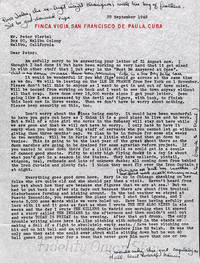
19491237151949. HEMINGWAY Ernest. Typed letter twice signed ""Papa"" to Peter Viertel. Finca Vigia Cuba 29 September 1949. Quarto two sheets of Hemingway's ""Finca Vigia San Francisco de Paula Cuba"" stationery each leaf measuring 8-1/2 inches by 11 inches typed in black ink single-spaced on one side of each leaf for two full pages of typed text heavily annotated in pen by Hemingway. $25000.Extraordinary typed and heavily annotated letter from Hemingway in Cuba to friend and fellow author and screenwriter Peter Viertel in Malibu California a long lively letter discussing his writing progress a proposed trip hunting and shooting pigeons drinking baseball and a new whore in town with over 150 words of additional notes written in the margins and on the verso of the second page in blue ink by Hemingway. Twice signed as 'Papa.'.The letter on Hemingway's Finca Vigia stationery addressed to Peter Viertel in Malibu CA reads in full with Hemingway's manuscript annotations in brackets and italics:Poor John the ex-light weight champion with his bag of feathers. I'll be god-damned. Papa.Dear Peter: Am awfully sorry to be answering your letter of 31 August now. I thought I had done it but have been working so very hard that it got mixed in with other stuff that I put away in the ""Must Be Answered at Once"". That is no damn excuse. Have been jamming like in a six day bike race.It would be wonderful if you and Jige could go across at the same time as we do. We will be leaving on the ILE DE FRANCE from New York on 1 November. Please don't tell this to anyone as I want to get in and out o town quiet. Will be pooped from working on book and I want to see the town anyway without all that crap. Have done over 15000 words snice I got your letter. Been going like I was possessed by the devil and figure with luck to finish this book now in three weeks. Then we don't have to worry about nothing. Please keep security on this too.Don't worry about the Finca being empty. It would have been wonderful to have you guys out here as I think it is a good place to live and to work. But a Hell of a nice girl who works in the Embassy will stay out here while we are gone and that we will not have to worry. I only hate to have it empty when you keep on the big staff of servants who you cannot let go without giving them three months' pay. We plan to be in Europe for some six weeks to two months. Will be in Paris for a little while and then go down to Venice. This is going to be the last year of the great shoot there as the duck marshes are going to be drained for some agrarian reform project. If you wanted to come down there for a little while we could get in a couple of damned good shoots. Fifty to sixty high flying ducks in a day is about what you'd get in a season in the states. They have mallards pintail widgeon teal redheads and lots of unknown ducks; all coming down from behind the Iron Curtain and plenty fat. I think they must fly over the Iron Curtain at night.Everything goes good down here. Mary is up in Chicago checking on her folks who are quite old and she should pay them a visit. Haven't heard from her yet about how they are because she figures that we are at sea. they are ok but her mother too bored with death coming on and too fragile to travel. But we had to put back in after six days out because there are about five tropical disturbances forming and kicking around. In the bad weather we stayed at Puerto Escondido you remember the place where I shot that iguana and I wrote 5000 some words while we were holed up. Have been having awfully good luck with it and it goes as fast as when I wrote THE SUN ALSO RISES in six weeks and the day I wrote THE KILLERS in Madrid one morning when it snowed and a story called TEN INDIANS in the afternoon and then couldn't cool out and wrote TODAY IS FRIDAY in the evening. After that got drunk. The only trouble writing alone here is like pitching with nobody in the stands or making a Hell of a fight to absolutely empty seats. I wonder why this girl capitalizes Hell. Must be early training. Have been pitching one hit and no hit ball and am pitching double headers like Ed Walsh. He was the only man they said who could ever strut while sitting down but he won 40 ball games in one year for a team that never gave him more than one or two runs. I'm going awfully good. Wish the Hell you and Jige were here to read it and tell me whether it's as good as it feels. When you're half a hundred years old you ought to be able to tell pretty well though unless you've gone into your second childhood. Hope this hasn't happened. Would like to live to be a smart and mean old man. Removed. And just lay back and let the bastards lead. Have scrapped about 100000 words. After all the test of whether a book is any good is how much good stuff you can remove from it. This also confidential.John's evening life with his hound sounds very interesting. What happens here is that I wake up around 3 or 4 in the morning and go to work and Blackie wakes up very reluctantly because he certainly loves his sleep and then lies down beside where I am working and keeps his eyes open all the time. He had a terrible nervous crisis when we made him retrieve a couple of pigeons at the club. He doesn't believe in hurting anything nor in anything hurting him. Have got him threw sic it and he retrieved 17 then 22 and yest 40. I killed 23 x 25 from 30 meters. All cats are fine and so are all the dogs. Please give my best to Eddie Rolfe and tell him I am writing him. Have been terribly remiss on letters on account of working so hard. When you finish working you try to get some exercise so as to be able to sleep a little so you can work the next day. I can always work but I know you have to feed the horse and let him rest sometimes.I am shooting good and have been practicing shooting pigeons from 30 meters so as to be able to go up to the big shoot in Kansas City next March if my form justifies it. So far it does but working tires your eyes and your eyes are what you shoot with along with a couple of other things. The entry fee on that shoot is $1000. I have beaten several of the guys who have won it but you have to be in really good form to shoot it as it's 100 birds and that more or less eliminates the luck and separates the characters pretty well. If you guys need any dough for trip or anything let me know because as soon as book is finished I will stink with it. or stench with it. But not for long.I read the bull book that you wrote about but it didn't mean anything to me. Know 30 or more better stories than that about bull fighting that will never write. That may sound conceited and it probably is but who the Hell isn't sometimes Will tell you three stories when we get together that I know as samples.Please give my best love to Jige and the two of you accept Mary's which I know she would send if she were here. There is a big wind today so we are going down and shoot some pigeons. They ought to fly very well. Wish you were here. It is very lonesome. We have a fine new whore in town who has just come in and who really loves the profession. She was cut out for it. But have turned her over to a friend of mine and am sticking it out that's probably not the phrase til Mary gets back. don't know when that will be yet. Had hoped to stay at sea so as to be a good boy. But this weather has bitched that. It is hard being a good boy alone in this town when you are a lonesome character.I had to give in and play the whore and we drank 7 bottles of Roederers Brut '42 and fucked all night until it was daylight both got battle fatigue I guess. Anyway I wrote only 708 words. I speak to whore very slow in English since she wants to learn English like all whores have some project and then translate soft and good in Spanish. There are going to be a lot of complications in Venice and we will have to cover it like Tinker and Johnny Evers. What we need is a third baseman and Hal Clease at 1st. Papa. Maybe we can recall Willie Walton from the American Association to play 3rd. He can't hit. But he can field womens. Fine condition. An extraordinary Hemingway letter. unknown
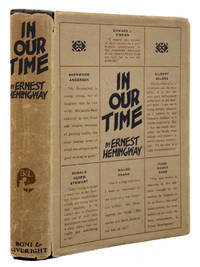
1925140945392New York: Boni & Liveright Inc 1925. First Edition. Near Fine/Very Good. First American edition first printing and first thus with the inclusion of additional stories preceded by a much shorter Paris edition just 32 pages in length published one year prior; additionally the author's first book to be published in America. Bound in publisher's original black cloth binding stamped in gilt to upper board and spine. Near Fine with former owner bookplate to front paste down pages lightly tanned. In a Very Good unclipped dust jacket slightly darkened and chipped at the edges wear to the spine ends short split started along the bottom edge of the front spine joint and a tear at the top end of the rear flap fold with associated creasing to the rear panel. This first printing was limited to only 1335 copies. Hanneman A3.A. Boni & Liveright, Inc unknown
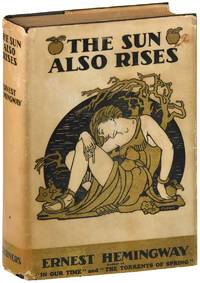
19267284New York: Charles Scribner's Sons 1926. Hemingway's first novel synonymous with the Lost Generation in which "the post-war disillusion and the post-war liberation are united in the physical enjoyment of living and the pains of love" Connolly p.53. The novel portrays a group of English and American expatriates frequenting the cafés of Paris who travel along the Camino de Santiago to the Fiesta de San Fermín in Pamplona where they watch the running of the bulls. Basis for Henry King's 1957 film adaptation starring Tyrone Power and Ava Gardner. Uncommon in dustjacket. Grissom A.6.1b. Hanneman 6A; Connolly 100. Second printing one of 1970 copies with the typographical error on p.181 line 26 "stoppped" for "stopped" in the corrected state. Octavo 19.75cm; black cloth with printed gold paper title labels mounted to spine and front cover; dustjacket; viii23-2591pp. Early ownership markings to front endpaper mild softening to spine ends gentle sunning to spine with some trivial dust-soil to upper edge of textblock and some darkening and pinpoint wear to title labels; contents clean; Very Good. In the correct second state dustjacket unclipped priced $2.00 with the typographical error in "In Our Times" in the corrected state along the lower front panel; spine and panels gently sunned and lighty dust-soiled some moderate external wear with a few small nicks and closed tears particularly at base of spine and a few faint scattered stains; still a presentable example unrestored Very Good or better. Housed in a custom clamshell case. Charles Scribner's Sons unknown
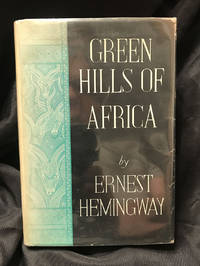
1935162<p><em><strong>ERNEST HEMINGWAY</strong></em> <em><strong>Inscribed first edition first printing </strong></em><em><strong>in original first state dust jacket.</strong></em> <em><strong>THE GREEN HILLS OF AFRICA</strong></em> <em><strong>Published in 1935; Scribners' New York.</strong></em> <em><strong>"A" on copyright page.</strong></em> <em><strong>Original price of "$2.75" still on front inner flap of dust jacket.</strong></em> <em><strong>CONDITION: Book is in very good plus condition: no problems other than a lightly sunned </strong></em><em><strong>spine; gold and black print still vibrant. Green cloth covers show some lightening along cloth </strong></em><em><strong>edges. Dust jacket front and back panels are bright clean with only minor scratching and </strong></em><em><strong>edge wear; jacket spine show sunning matching that of the book's spine cloth with printing </strong></em><em><strong>still highly readable. </strong></em> <strong><em>Ed Hanes to who this book is inscribed by Hemingway was an</em></strong> <strong><em>acquaintance Hemingway had met in Key West Florida.</em></strong> <em><strong> Book has no writing in it other than Ernest Hemingway's inscription to Ed Hanes.</strong></em> <em><strong>EDWARD SHENTON drew decorations </strong></em><em><strong>and illustrations the same artist who </strong></em><em><strong>did the</strong></em> <em><strong>decorations and illustrations for </strong></em><em><strong>F. Scott Fitzgerald's TENDER IS THE NIGHT.</strong></em> <em><strong>COLORADO ARTIFACTUAL</strong></em></p> Scribners hardcover
19355255New York: Charles Scribner's Sons 1935. First edition. Very Good/Very Good. First printing in early issue dust jacket with green bar on rear panel extending through nine lines of the blurb. A Very Good copy in like dust jacket. Book with spine toned and a faint dampstain to front board. Front inner hinge now professionally repaired. Price-clipped dust jacket with spine toned a large crease running down the front panel and some chipping and wear at the spine ends and extremities. Inscribed by the author: "For Daisy G. Roe Wishing her all good luck from her friend Ernest Hemingway. Key West March 18 1936." The recipient Daisey G. Roe was a Florida neighbor who had recently married up-and-coming politician and future Jacksonville Florida mayor Caulie F. Whitehead. Authentic signed Hemingway material is becoming scarce on the market. Housed in a custom green quarter-leather slipcase with chemise.<br /> <br /> After publishing Winner Take Nothing in 1933 "Hemingway went to Africa to shoot the bounding kudu and to reply to his critics. The result is Green Hills of Africa. It is the most literary hunting trip on record" New York Times. Here Hemingway "attempted to write an absolutely true book to see whether the shape of a country and the pattern of a month's action can if truly presented compete with a work of the imagination." It stands as one of his most memorable books set in the continent and along with The Snows of Kilimanjaro helped to establish his reputation as a safari-hunter and outdoorsman. Very Good in Very Good dust jacket. Charles Scribner's Sons unknown
192774614New York:: Charles Scribner's Sons 1927. First edition first printing weighing 15.5 ounces. publisher's black cloth with gold labels in dust jacket. Preserved in a custom quarter morocco folding clamshell box. Tiny ding to the front cover near the joint; else a fine copy in a bright fresh dust jacket with very slight tanning to the spine. Much nicer than usually seen. . 8vo. Charles Scribner's Sons, hardcover
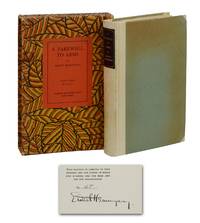
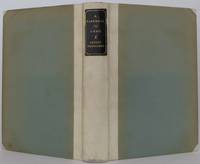
1929140944651New York: Charles Scribner's Sons 1929. Signed Limited First Edition. Near Fine/Near Fine. First edition limited issue. Copy #398 of a limited 510 signed by Ernest Hemingway on the limitation page. Publisher's pale green paper covered boards over vellum spine black leather title label to spine stamped in gilt in publisher's leaf-patterned slip case with red title label to front panel with matching number. Near Fine with slight toning to binding light soiling and wear to spine several small nicks to the bottom edge. In Near Fine publisher's original slipcase with light rubbing and light toning. A beautiful copy of the only signed limited edition ever issued of Hemingway's work. Hanneman 8B. Charles Scribner's Sons unknown
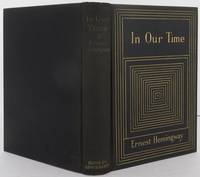
97639New York Boni & Liveright 1925. . First edition 8vo; slight age-toning bookplate to upper pastedown else fine; publisher's black cloth gilt geometric design to upper cover printed dust-jacket the upper panel bisected into boxes containing appraisals of the author's literary skills and the rear one with reviews of this title from literary luminaries such as Ford Madox Ford John Dos Passos and Waldo Frank some age-darkening more so to spine chipped on corners and spine-ends with professional restoration to spine fold of upper panel otherwise in a remarkably good state; 1-15 16-214 215 blank pp.<br /> The collection of short stories and vignettes that marked Ernest Hemingway's American debut and brought him fame.<br /><br />When In Our Time was published it was praised by Ford Madox Ford John Dos Passos and F. Scott Fitzgerald for its simple and precise use of language to convey a wide range of complex emotions and it earned Hemingway a place beside Sherwood Anderson and Gertrude Stein as one of the most promising American writers of that period. This collection contains several early Hemingway classics including the famous Nick Adams stories Indian Camp The Doctor and the Doctor's Wife The Three Day Blow and The Battler. It introduces readers to the hallmarks of the Hemingway style: a lean tough prose enlivened by an ear for the colloquial and an eye for the realistic that suggests through the simplest of statements a sense of moral value and a clarity of heart. <br /><br />Now recognised as one of the most original short story collections in twentieth-century literature In Our Time serves as a key to Hemingway's later works. <br /><br />Banned in Germany from 1933 to 1945 by the ruling National Socialist party.<br /> New York, Boni & Liveright, 1925. hardcover
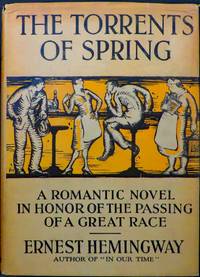
192628091New York: Charles Scribner's Sons 1926. First edition First Issue with nine titles listed on the rear panel of the dustjacket. A superb advance copy of the first printing with an original photograph of Hemingway tipped in and the printed publisher's biographical statement affixed announcing that " "The Sun Also Rises" will be published by Charles Scribner's Sons in the Fall" 8vo original black cloth lettered in red on the spine and upper cover and in the original dustjacket. 8 143 pp. A very fine especially well preserved copy of Hemingway's first novel clean and solid hinges firm the jacket with a bit of mellowing caused by time and with a small chip to the tip of the jacket's spine panel. FIRST EDITION FIRST ISSUE VERY RARE ADVANCE COPY WITH ORIGINAL PHOTOGRAPH AND PUBLISHER'S TYPED STATEMENT AFFIXED ANNOUNCING THE FORTHCOMING PUBLICATION OF "THE SUN ALSO RISES" AND WITH FORD MADDOX FORD'S LAUDATORY COMMENT ON HEMINGWAY. THIS IS THE AUTHOR'S FIRST LONG WORK TO BE PUBLISHED. Although it was written after THE SUN ALSO RISES --"to cool out" Hemingway explained-- THE TORRENTS OF SPRING was published prior to his more famous novel. It was written as a parody of Sherwood Anderson's Dark Laughter. "It seems to have started as a knockabout parody of Sherwood Anderson's mechanized folkware" quoted in THE HEMINGWAY READER. Written in ten days it is a satirical treatment of pretentious writers. Hemingway received a mixed reaction to the novella that was sharply critical of other authors. His wife Hadley believed the characterization of Anderson was "nasty" while F. Scott Fitzgerald considered the novella to be a masterpiece. Charles Scribner's Sons hardcover
1929140945742New York: Charles Scribner's Sons 1929. Signed limited first edition. First edition limited issue. Copy #167 of a limited 510 signed by Ernest Hemingway on the limitation page. x 355 pp. Bound in publisher's pale green paper covered boards over vellum spine black leather title label to spine stamped in gilt housed in publisher's leaf-patterned slipcase with red title label to front panel with matching number. Near Fine with toning to boards slight darkening to spine vellum residue from removed bookplate on paste down in Near Fine slipcase lightly edge-worn. An attractive copy of the only signed limited edition ever issued of Hemingway's work. Hanneman 8B. Charles Scribner's Sons unknown
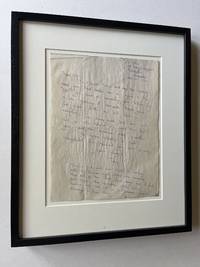
19611669Rochester Minnesota 1961. Very good. A one-page autographed letter signed to Hemingway's youngest son Gregory which reads in full: "6-292 St. Mary's Hospital Rochester Minnesota 1961 Dear Gig Dr. Howard Rome told me this morning that you had called him in regard to the $350.00 you need on completing your tuition and I am enclosing herewith. Thank you for your letters and best luck in everything. Am doing well here and will not go into details but send this off to you with the minimum delay possible. The Cuban situation is quite complicated but appreciate your offer of help. Yours Always Papa." In a postscript he adds: "Mary is quite well and I will be talking with her tomorrow night. Have been swimming three out of the last four days and it feels good again. There are some really fine doctors here and it is a pleasure about a privilege to know them. EH." A significant letter as it is written from the famous Mayo Clinic hospital where he was being treated via electroshock therapy for depression. Hemingway stayed at the hospital from November 1960 to January 1961 and then again from April through June. The letter comes only 33 days before he would take his own life in Ketchum Idaho immediately after his release. The "Cuba Situation" he mentions in the letter is of course the Cuban Missile Crisis and Hemingway was unsure if he would be able to return to his home there Finca Vigia not least to save a number of manuscripts. One almost senses his resignation in the letter but the postscript suggests he felt the need to revise his haste and add an upbeat more descriptive note for Gig. Gregory Hemingway was in medical school at the time and became a doctor. For many years he had a strained relationship with his father in part because of instances of cross-dressing as early as 12 years of age. Much later Gregory came out publicly as trans and went by Gloria. She thus was clearly caught between Hemingway's hyper masculine world and her own inclinations. She is buried beside Ernest and her brother Jack in Ketchum. An all around poignant letter from a pivotal moment. The letter is in very good condition folded twice vertically and once horizontally for mailing lightly wrinkled and with one short split to the lower right edge at a fold and a touch of soiling to that same corner. It is impeccably mounted and framed in black wood behind UV-resistance glass by a Ketchum Idaho shop. unknown
19252405002Boni & Liveright 1925. first. hardcover. fine/fine. First edition with 1925 on title and copyright page. In professionally restored dust jacket that is in fine condition. Book fine slight foxing small sticker to bottom of rear free end paper. Comes with publisher's ad pamphlet and the first magazine appearance of In Our Time in Little Review Exiles' Number Spring 1923. Housed in custom-made fold-out case. More photos upon request. Boni & Liveright unknown
1929014379New York: Charles Scribner's Sons 1929. First Edition. Hardcover. A beautiful Fine copy of this desirable book in an attractive new slipcase. Original vellum spine and green boards with vellum tips. Copy #48 of 510 SIGNED by the author Hemingway's only signed and limited edition. An absolutely gorgeous copy the boards and the vellum both sparkling fresh with the black leather label completely intact and bright. Housed in a new and attractive slipcase reproducing the original and on which the original limitation label has been mounted. Laid in are receipts for purchase of this book from 1932 private purchase for five dollars and 1984 Goodspeed's. <br/><br/> Charles Scribner's Sons hardcover
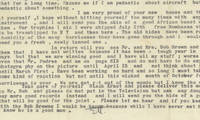
266226/10/55. <blockquote><p>“When you are dead you are dead for a long time.""</p><p> </p><p>He advises a young woman friend “Please be careful about aircraft…It is one of the great pleasures of life but you pay off accordingly.â€</p><p> </p><p>Hemingway will send her an animal skin from his African safari to decorate her new house""</p><p> </p><p>Our trophies sic were shipped July 18th from Mombassa via Amsterdam to be trans-shipped to NY and then here.""</p><p><img class=""alignnone wp-image-26883 size-post-window"" src=""https://cdn.raabcollection.com/wp-content/uploads/20231204131000/Hemingway-Oct-6-1955-2-1-1600x198.jpg"" alt="""" width=""1600"" height=""198"" /></p></blockquote><p>After covering the Spanish Civil War in 1939 Hemingway purchased Finca VigÃa “Lookout Farm†an unpretentious estate outside Havana Cuba. In 1940 he published “For Whom the Bell Tolls†which many consider his best book. All of his life Hemingway was fascinated by war - in “A Farewell to Arms†he focused on its pointlessness and in “For Whom the Bell Tolls†on the comradeship it creates. During World War II he flew several missions with the Royal Air Force and landed with American troops on D-Day. He saw a good deal of action in Normandy and in the Battle of the Bulge. He also participated in the liberation of Paris. Following the war in Europe Hemingway returned to his home in Cuba and turned his attention to writing again. He also traveled widely and at the end of their 1953-1954 African safari the Hemingways survived a near-fatal plane crash only to have their rescue plane crash the very next day. Though they survived the second crash as well newspapers around the world carried brought the details to the reading public.</p><p>Soon after he received the Pulitzer Prize in fiction for “The Old Man and the Sea†a short heroic novel about an old Cuban fisherman who after an extended struggle hooks and boats a giant marlin only to have it eaten by voracious sharks during the voyage home. That book also played a role in gaining for Hemingway the Nobel Prize for Literature in 1954. It ran in its entirety in five million copies of Life Magazine and the 50000 copies printed in book form sold out in ten days.</p><p>In 1955 back in Cuba Hemingway turned fifty-five and tried to follow his doctors’ advice by reducing his drinking. In October it is announced that he has been awarded the 1954 Nobel Prize in Literature. All of his wife’s’ efforts to protect his privacy were sabotaged by the crush of worldwide press and the fact that Hemingway invited any and all to the Finca Vigia to visit. In the summer of 1955 he was working on the filming of “The Old Man and the Sea†starring Spencer Tracy. The pace of people and press of lunches and drinking finally takes its toll and in the autumn of 1955 Hemingway took to his bed for two months suffering from hepatitis and nephritis.</p><p>Hemingway's relationship with faith was complicated. Raised protestant he converted to catholicism but was largely religiously indifferent. He had seen so much death and tragedy. At this point evidently he had long since abandoned the faith of his youth.</p><p><img class=""alignnone wp-image-26884 size-post-window"" src=""https://cdn.raabcollection.com/wp-content/uploads/20231204130953/Hemingway-Oct-6-1955-2-2-1600x219.jpg"" alt="""" width=""1600"" height=""219"" /></p><p>Mary Lou Firle a second year student at CCNY was in Cuba in early 1955. Before she left she bet a friend that she would have Ernest Hemingway sign the book she had “Farewell to Arms.†She picked up the phone and called Ernest Hemingway. When he answered she introduced herself and added “I have a friend at Fordham University.†Hemingway immediately assumed the friend was Prof. Bob Brown who had been in touch with Hemingway on several occasions. Brown was writing a book or articles about Hemingway. Hemingway told Mary Lou that his wife Mary was away and he had to entertain visitors from the French Embassy that afternoon. He asked her if she would come to his home and help him. Mary Lou agreed and Hemingway sent his driver to pick her up.</p><p>After the meeting the group drove her back to Havana. Hemingway invited her back the next day for lunch and sent his driver to pick her up. They spent the afternoon talking. She had told him of her family background that her parents were born in Germany. Since she had been at Veradero Beach for a week she had a deep tan and Hemingway called her the “Black Kraut.†The reason for the nickname Hemingway said was that he called his good friend Marlene Dietrich the famous German actress “Krautâ€; so Mary Lou who was very tan would be the “Black Kraut.†Later that day Hemingway’s driver drove her back to Havana. The two exchanged letters in July 1955. She wrote him again in October and received this response.</p><p>In the summer of 1955 he was working on the filming of “The Old Man and the Sea†starring Spencer Tracy. The pace of people and press of lunches and drinking finally takes its toll and he was grateful to have the weather interrupt the filming. Hemingway famously rewrote the ending to ""A Farewell to Arms"" numerous times and that is possibly the writing he refers to.</p><p><img class=""alignnone wp-image-26885 size-post-window"" src=""https://cdn.raabcollection.com/wp-content/uploads/20231204130947/Hemingway-Oct-6-1955-2-3-1600x201.jpg"" alt="""" width=""1600"" height=""201"" /></p><p><strong>Typed letter signed</strong> with typewriter corrections and a pencil notation by Hemingway Finca Vigia San Francisco de Paula Cuba October 6 1955 to Mary Lou on his fear of flying and unbelief in the afterlife signed EH with the original envelope sending it. He also jokes about the equity that hurricanes are named invariably after women.</p><p><em>“Thank you for writing and I wish to congratulate your mother and your new step father if they would like that. I hope they are happy. With a good daughter like you they should be.</em></p><p><em>“Am very happy you took your vacation up north as down here it was rugged with the effects of the different hurricanes. Hope we are not going to have Za-Za. I knew a girl named Janet once but she never killed any people in Barbados nor Tampico. It is easy to get tired of this naming tropical storms after girls and I think it is in bad taste especially when you have been through bad tropical storms.</em></p><p><em>“Please be careful about aircraft. If I ever see you will tell you how and why. It is one of the great pleasures of life but you pay off accordingly. No second thoughts will help you and when you are dead you are dead for a long time. Maybe we are only alive when we are dead but I have not believed that for a long time. Excuse me if I am pedantic about aircraft but everybody is pedantic about something.</em></p><p><em>“I am very proud of your new house and that you made it yourself I hope without hitting yourself too many times with any blunt instrument and I will send you the skin of a good African beast when I receive them. Our trophies sic were shipped July 18th from Mombassa via Amsterdam to be trans-shipped to NY and then here. The old hides have been ruined by the humidity of the many hurricanes they have gone through and I would rather send you a fresh newly tanned one.</em></p><p><em>“In return will you see Mr. and Mrs. Bob Brown and tell them that I have not written because it has been a tough year in many ways but that we are winning good and I have all my stuff; worse even that Mr. Podres and am on page 613 and do not have to do any more photography on the picture until April 15 and not think about it until March first. Have been working so hard and so long I must take some kind of vacation but not until this wicked month of October for hurricanes is over. We are not yet out of the woods but I know the woods ok.</em></p><p><em>“Take care of yourself Black Kraut and please deliver this message to Mr. Bob and please do not put in the television but use any dough to buy more good records instead and I will send you the hide of a good beat that will be good for the joint. Please let me hear and if you keep contact with the Bob Browns I would be happy because while I have never met him I know he is a good man.""</em> Signed by Hemingway with initials.</p><p>A fascinating letter showing Hemingway’s feelings about life after death the importance of life love but of but fear of flying and interest in hunting game in Africa. It has been in the recipient’s family’s possession since it was received and we acquired it direct from them. Mary Lou had promised Hemingway that she would not sell the letter during her lifetime and kept her promise. She told Morris it would be ok to sell it after she passed.</p><p><img class=""alignnone wp-image-25018 size-post-window"" src=""https://cdn.raabcollection.com/wp-content/uploads/20231204144051/Folder-site-11-1600x1327.jpg"" alt="""" width=""1600"" height=""1327"" /></p> unknown
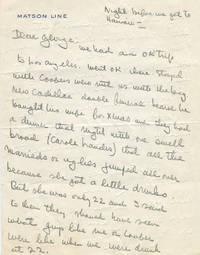
194133<p>Ernest Hemingway<br />Autograph letter signed "Ernesto" to George Brown.<br />Dated "The night before our arrival in Hawaii" February 1941.<br />7 pages 12mo in pencil on two bifolia with the letterhead of the Matson Line shipping company.<br /><br /><strong>A remarkable letter: pure Hemingway.</strong><br /><br /></p><p><em>"Dear George </em></p><p><em>We had an OK trip to Los Angeles. Went OK there. Stayed with Coopers who met us with the big new Cadillac double funeral hearse he bought his wife for Xmas and they had a dinner that night with one swell broad Carole Landis that all the married or uglies jumped all over because she got a little drunko. But she was only 22 and I said to them they should have seen what guys like me or Cooper were like when we were drunk at 22. Coopers wife Rocky and I beat Cooper and Marty 5 set of tennis to win 11 dollars in 2 days. But no money changes hands that way on acct of husband and wife. I think Marty and I could beat them but Mrs C. likes to win very much. More even than giggy. She has very extensive taught ground strokes but she has a high bouncing serve that I could set myself and murder so it is better for her happiness that we are partners. Marty was much prettier than the hollwood shes and looked like a human being instead of a kennel entry but I shudder to think what would pass with the Colonel faced by them blondes altho lots of them were 22-23 years old which is aged in the Colonels book. With a cold my ears gave me hell on the plane. Never had that before. San Francisco was fine. We ate very well and saw Mike Ward an old pal and his wife and shipped up Ingrid Bergman to look her over for Maria for the picture. She is perfect. Really swell. Not like those Hollywooders. On this boat it has been rough as a bastard all the time. The gym guy wouldn't box. He rubs too and he says he is afraid it would hurt his hands altho he says he teaches boxing. he comes from Hollywood too where I guess hands hurt easy. Probably his thumbs swell up. It was a shame because I was going to left hook him in the profile like Barney Gimbel ruining a bum. But I worked on the big bag instead but couldn't rouse no really dirty feeling against it on such short acquaintance and when you get close to it the fucking thing seems sort of dead and helpless and not like ones fellow man. I practiced hitting it in the balls a little. Tomorrow we get into Honolulu. It sounds more like a ½ jig Coney Island or Polynesian Miami Beach all the time. The food on this boat is swell tho. Marty sends her love. We got a bang out of the wire. I miss you and the reading Colonel and working out and all the fun we have but will be back soon with a lot of new lies and stories. Take care of yourself.</em></p><p><em>Best always from us both</em></p><p><em>Ernesto"</em></p><p><br /><br />This letter is addressed to George Brown a very close friend of Hemingway an Irishman who had given him boxing lessons in New York and who would still be by his side the day before his suicide.<br /><br />Hemingway had spent a few days in Los Angeles staying with Gary Cooper where preparations were underway for the film adaptation of For Whom the Bell Tolls starring Gary Cooper and Ingrid Bergman directed by Sam Wood and released in 1943.<br /><br />In his inimitable style—full of energy humor and coarseness—Hemingway recounts the various episodes that punctuated his stay.<br /><br />We encounter Gary Cooper his wife Sandra Shaw known as Rocky the actress Carole Landis Ingrid Bergman David O. Selznick amid tennis matches drinking boxing and social gatherings.<br /><br />Hemingway begins by gently mocking the actor and his "double Cadillac hearse" then introduces us to a Hollywood party where Carole Landis 1919–1948 has had a bit too much to drink prompting "the married men and the ugly ones" to crowd around her.<br /><br />Nurturing his own legend the author cannot resist adding: "they should have seen what guys like me or Cooper were like when we were drunk at 22." Hemingway formed a genuine friendship with the actor of whom he said: "Coop is a fine man; as honest upright kind and decent as he seems. If one invented a character like Coop no one would believe it. He is simply too good to be true."<br /><br />His admiration also extends to Ingrid Bergman: "She is perfect. Really wonderful. Not like those Hollywood women."<br /><br />Hemingway had just married his third wife Martha Gellhorn whom he praises here in his own way: "Marty was much prettier than the Hollywood women and looked like a human being instead of a kennel entry."<br /><br />The two couples exchanging partners engage in fierce tennis matches. Here again the writer's confidence comes through: "She has very extensive well-trained ground strokes but she has a high-bouncing serve that I could murder so it is better for her happiness that we are partners."<br /><br />But it is in his account of the boxing bouts he longs to fight that Hemingway appears most fully himself. He overwhelms with sarcasm the ship's gym instructor who refuses to spar with him for fear of hurting his hands.<br /><br />So Hemingway unleashes himself on the punching bag giving us a small anthology piece brimming with humor: "But I worked on the big bag instead… and when you get close to it the damn thing seems sort of dead and helpless and not like one's fellow man. I practiced hitting it in the balls a little."<br /><br />His description of Honolulu is equally striking: "It sounds more and more like some half-assed Coney Island or Polynesian Miami Beach."<br /><br />These lines give an exact sense of what the writer's conversation with his friends must have been like.<br /><br />The letter also mentions another of his close friends Taylor Williams his hunting guide known as "the Colonel" who seems to have had a taste for rather young women: "I shudder to think what would pass with the Colonel faced by them blondes… even if many were 22–23 years old which is aged in the Colonel's book."<br /><br />As he says at the end of the letter "we will be back soon with a lot of new lies and stories."<br /><br />This lively letter is a wonderful example of those stories that delighted his friends—and now delight us.</p>
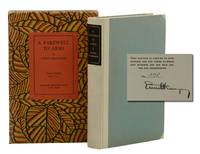
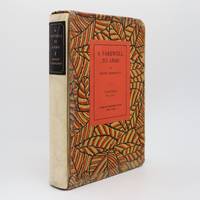
1929375418New York: Scribners 1929. First edition number 56 of 510 copies signed by the author on the limitation leaf. 10 355 pp. 1 vols. 8vo. Publisher's light bluish-green boards backed and cornered with vellum black morocco spine label lettered in gold. Near fine in original decorative-paper board slipcase repaired in custom half-morocco clamshell box. First edition number 56 of 510 copies signed by the author on the limitation leaf. 10 355 pp. 1 vols. 8vo. The only signed limited issue of Hemingway's work and one of the greatest war novels of all time. "His first full-length novel and probably his best . Its success was so enormous that it may be said to have ended Hemingway's influence as a writer. After it one could no more imitate that musical crystal-clear style; blown like glass from the white-heat of violence" Connolly. Hanneman 8b; Grissom A.8.1.a2; Connolly Modern Movement 60 Scribners unknown
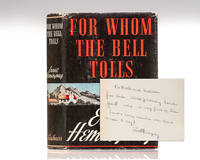
1940149834New York: Charles Scribner's Sons 1940. First edition early printing of Hemingway's third novel a tragic exploration of love duty and the futility of war. Octavo original publisher's cloth. Association copy lengthily inscribed by Ernest Hemingway to his cousin on the front free endpaper "For Ruth and Malcolm from their child producing house guest who is very fond of them what a lousy dedication when there is so much to say Ernest Hemingway." The recipients Ruth White Lowry 1884–1974 and her husband William Malcolm Lowry 1884–1953 were longtime residents of Kansas City Missouri and integral members of Ernest Hemingway’s extended Midwestern family. Ruth the daughter of William White and Mary Hall White was a first cousin of Grace Hall Hemingway the author’s mother. This made her Ernest’s first cousin once removed though their families were close enough that Hemingway referred to her simply as “Cousin Ruth.†The White and Hall families had deep Midwestern roots—Ruth was educated in Kansas City and was part of the city’s civic and cultural life throughout the early twentieth century. When Hemingway and his second wife Pauline Pfeiffer returned from Paris to the United States in 1928 they came to Kansas City for the birth of their first child Patrick Hemingway who was delivered at St. Mary’s Hospital on June 28 of that year. The Hemingways stayed with Ruth and Malcolm Lowry at their Kansas City home both before and after the delivery. Pauline returned to the same house three years later in November 1931 for the birth of their second son Gregory Hancock Hemingway while Ernest shuttled between Kansas City and Key West during the final stages of Death in the Afternoon. The Lowrys’ hospitality offered Hemingway a familial refuge far from the expatriate world of Europe and the growing celebrity that attended his literary success. The relationship between the two families endured for decades. Letters and family recollections describe Ruth as a warm maternal presence in Hemingway’s life—a relative he could trust with his young family during periods of upheaval. The Lowry household thus occupies a unique place in Hemingway’s biography: it was the setting for the births of both of his sons with Pauline and the site of rare domestic calm amid his restless movements between continents. Copies inscribed to members of the Lowry family remain among the most significant Hemingway association copies linking the author’s private life in the American Midwest to his public identity as one of the central figures of twentieth-century literature. Ernest Hemingway’s For Whom the Bell Tolls 1940 represents one of the author’s most complex meditations on war love and moral responsibility. Set during the Spanish Civil War the novel follows Robert Jordan an American volunteer in the International Brigades as he undertakes a mission to destroy a fascist-held bridge. Drawing on Hemingway’s own experiences as a journalist in Spain the novel fuses political engagement with psychological depth exploring the tension between individual conviction and collective duty. Stylistically it embodies Hemingway’s characteristic economy of language—his “iceberg theoryâ€â€”while broadening his earlier focus on personal heroism to encompass a larger ethical inquiry into the nature of sacrifice and solidarity. The novel’s title drawn from John Donne’s Devotions upon Emergent Occasions underscores its universalist theme: the interconnectedness of human suffering and mortality. Through its spare prose shifting perspectives and symbolic use of death and time For Whom the Bell Tolls transforms the brutality of civil conflict into a profound reflection on the cost of idealism and the enduring value of human compassion amid catastrophe. Charles Scribner's Sons hardcover
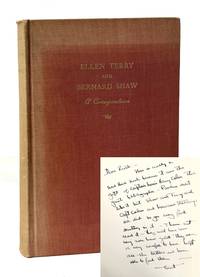
1931EH315New York: G. P. Putnam's Sons 1931 Preface by George Bernard Shaw. First edition first printing. Signed and inscribed by Hemingway to his cousin Ruth White Lowry on the front free endpaper with reference to the previous owner Hemingway bibliographer Captain Louis Henry Cohn: "Dear Ruth: - This is really a 2nd hand book because it was the gift of Captain Louis Henry Cohn the great bibliographer - Pauline didn't like it but Shaw and Terry and Capt. Cohn and Lawrence Stallings all did so you may find something in it - I have not read it - They must have been very sure how great they were or very careful to have kept all the letters and been able to find them - Ernest." Publisher's red cloth with front board and spine lettered in gilt red topstain; lacking dust jacket. Very good with toning to spine and board edges heavy dimming to spine gilt some very light scratches to rear board small House of Books ticket Captain Cohn's bookshop to rear pastedown. Overall a uniquely inscribed copy with exceptional provenance. From the personal library of Hemingway's cousin Ruth White Lowry. This book is a collection of correspondence between the great Irish playwright George Bernard Shaw 1856 - 1950 and leading English actress Ellen Terry 1847 - 1928. In 1892 Ellen reached out to Shaw then a 36-year-old music critic to get his opinion on the career prospects of a musical protégé of hers. This began a roughly 30-year correspondence between the two which was marked by flirtation genuine affection and Shaw's repeated attempts to lure Ellen away from Henry Irving's productions at Lyceum Theatre to star in theatrical productions of his own work. With praise from its New York Times review: "It represents the very flower of the minds and hearts-the select harvest of sentiment and wit-of two of the most remarkable personages of our generation." Captain Louis Henry Cohn 1889- 1953 born in Brooklyn New York earned his military rank by fighting in the French Army during World War I. In 1930 Cohn wrote a letter to Hemingway asking him for permission to compile a bibliography of his works. Hemingway begrudgingly agreed and in 1931 the book A Bibliography of the Works of Ernest Hemingway was published: in a note from Hemingway to Cohn which was later included as the frontispiece of the bibliography Hemingway wrote "I think it all balls to publish bibliographies of living writers". Later Cohn and his wife Marguerite opened House of Books a successful bookshop specializing in modern first editions. Under the House of Books imprint Cohn published an edition of Hemingway's short story "God Rest You Merry Gentlemen" 1933 limited to 300 numbered copies and a facsimile of Hemingway's "Bastard Note"-a legal disclaimer page included in the second printing of A Farewell to Arms with a humorous note to the printer in Hemingway's hand-limited to 93 numbered copies. Signed. First Edition. Hard Cover. Very Good. New York: G. P. Putnam's Sons hardcover
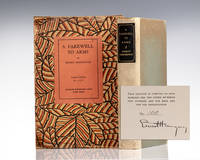
1929149688New York: Charles Scribner's Sons 1929. Signed limited edition of this early Hemingway classic which established him among the American masters. Tall octavo original publisher's white vellum over green boards with black morocco spine label lettered in gilt. One of 510 copies signed by Ernest Hemingway this is number 102. Very good with toning to the spine. Housed in the rare original slipcase which is in good condition with tape repairs. Written when Ernest Hemingway was thirty years old and lauded as the best American novel to emerge from World War I A Farewell to Arms is the unforgettable story of an American ambulance driver on the Italian front and his passion for a beautiful English nurse. Set against the looming horrors of the battlefieldweary demoralized men marching in the rain during the German attack on Caporetto; the profound struggle between loyalty and desertionthis gripping semiautobiographical work captures the harsh realities of war and the pain of lovers caught in its inexorable sweep. Ernest Hemingway famously said that he rewrote the ending to A Farewell to Arms thirty-nine times to get the words right. Farewell To Arms is the only signed limited edition of Ernest Hemingway's works. It is the basis for the 1932 film bearing the same name directed by Frank Borzage and starring Gary Cooper Helen Hayes and Adolphe Menjou. Charles Scribner's Sons hardcover
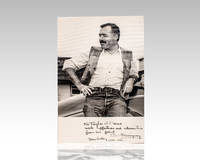
150070Rare original black and white photograph of legendary American writer Ernest Hemingway. Black and white matte photograph of Hemingway at his peak wearing Western garb and leaning on a car. Inscribed by Ernest Hemingway in black ballpoint at the bottom margin below the image "For Taylor Williams with affection and admiration from his friend Ernest Hemingway Sun Valley 1939 - 1940." The recipient was Hemingway's great friend Taylor “Beartracks†Williams the well-known Sun Valley hunting and fishing guide. Hemingway’s friendship with Williams dated back to their meeting in Idaho in the late 1930s after which Hemingway frequently returned to Ketchum before eventually settling there. The spring of 1953 also marked a peak moment in Hemingway’s career and personal life: he had recently written The Old Man and the Sea and received the Pulitzer Prize and this period preceded the airplane accidents of 1954 and his later forced departure from Cuba during the Castro regime—events that would profoundly affect his final years and contribute to his death in 1961. In fine condition. Triple matted and framed. The photograph measures 6.5 inches by 9.5 inches. The entire piece measures 16.75 inches by 13.5 inches. Ernest Hemingway 1899–1961 was one of the most influential American writers of the 20th century whose concise prose style and exploration of universal themes reshaped modern literature. Known for his works such as The Old Man and the Sea A Farewell to Arms and For Whom the Bell Tolls Hemingway developed a narrative voice that captured the complexities of human struggle and resilience with stark simplicity. His experiences as a journalist and participant in both World Wars deeply informed his writing lending authenticity to his depictions of courage loss and alienation. While his personal life marked by adventure and tragedy often overshadowed his literary contributions his stylistic innovations and engagement with existential themes solidified his status as a transformative figure in American letters. By pushing the boundaries of narrative form and emphasizing the power of understatement Hemingway left an enduring legacy on both literature and the cultural understanding of the human condition. unknown
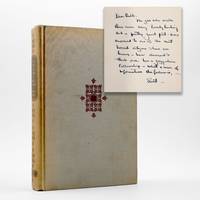
1930372878New York: Alfred A. Knopf 1930. First edition second printing. Illustrated xxi 378 vi 1 pp. 8vo. Grey linen stamped and printed. Spine and top edge sunned some light soiling from handling partially unopened very good with Bennett Schneider Book Seller ticket at rear. First edition second printing. Illustrated xxi 378 vi 1 pp. 8vo. Inscribed by Hemingway to his Kansas City Cousin Ruth Lowry: "Dear Ruth: The girl who wrote this was very lovely looking and a pretty good poet - was married to one of the most horrid citizens I have ever known now divorced. Think one has a Guggenheim fellowship - what a mine of information the fellow is- / Ernest-"<br /> <br /> The "lovely looking" "pretty good poet" who wrote this Genevieve Taggard 1894-1948 was an acquaintance of Hemingway's known to him from his travels in expatriate and leftist circles. Elsewhere he called her "a good poet" with a "very good heart" Maris Kathryn "Buried twice" TLS Sept. 27 2024. The "horrid citizen" Hemingway refers to is author Robert L. Wolf 1895-1970 a Jewish radical from a wealthy Cleveland family who was married to Taggard from 1921-1934 so the inscription must have been made after this date. Wolf lived in Paris from 1926-1928 where he was part of Hemingway's social circle and known for his amorous affairs and his struggles with mental illness. Wolf's letters to Taggard during this period mostly detail the agony of their failing relationship but Taggard has suggested that he also blamed his failure to produce novels to the responsibilities of marriage and fatherhood.<br /> <br /> The recipient of the inscription is Ruth White Lowry 1884-1974 Hemingway's Kansas City Cousin. Hemingway was familiar with the city having spent time there as a cub reporter for the Kansas City Star. After returning from Europe Ernest and his second wife Pauline spent time in Arkansas with Pauline's family; they needed somewhere with a good hospital where Pauline could give birth to their son so he went up to stay with Ruth and her husband Malcolm in their large house in Mission Hills where he worked on A Farewell to Arms writing pages 156-260 there in the mornings and swimming in their swimming pool in the afternoon and drinking bootleg Scotch at the country club. It was there that Pauline suffered a life-threatening cesarean section that informed the childbirth scene at the end of his novel. They returned in 1931 so that Pauline could give birth to their second child under the care of the same attending doctor and it was in the Lowry's house that Hemingway finished Death in the Afternoon. Alfred A. Knopf unknown
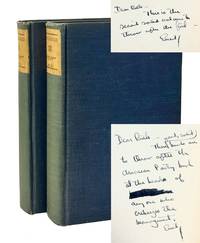
1923EH312New York: Alfred A. Knopf 1923 Two volumes. Foreword by Lady Gregory. Later American edition "Third and Popular Edition". Signed and inscribed by Hemingway to his cousin Ruth White Lowry on front free endpapers of both volumes. Volume I: "Dear Ruth: - These good solid books are to throw after the American Poetry book at the head of strikeout any one sic who criticizes the management -- Ernest."; Volume II: "Dear Ruth - This is the second solid volume to throw after the first - Ernest."; Ruth Lowry's ownership signature in pencil on front pastedown of Vol. I. Publisher's dark blue cloth with title labels to spines printed in black; lacking dust jackets. Very good set with some toning to spines and labels light wear to spine ends light rubbing to front board of Vol. I Bennett Schneider bookseller tickets to both rear pastedowns and Bennett Schneider bookmark laid in to Vol. II. Overall a lovely set inscribed twice by Hemingway. From the personal library of Hemingway's cousin Ruth White Lowry. Wilfrid Scawen Blunt 1840 - 1922 was an English poet diplomat and outspoken critic of colonialism. Blunt married Lady Anne Noel the granddaughter of Lord Byron in 1869 and together they ran the Crabbet Arabian Stud a prominent horse breeding farm in Sussex which imported exceptional Arabian horses from the Middle East. Blunt's marriage to Lord Byron's granddaughter was emblematic of his broader aspiration to emulate Byron: much like the renowned Romantic poet Blunt was a strikingly handsome womanizer a social outcast and a world traveler who fought for idealistic causes. Some of the chapter titles in My Diaries illustrate the sweeping range of Blunt's interests and adventures: "A Visit to Greece in 1888" "Egypt under Tewfik in 1889" "A Visit to Tunis and Tripoli" "Satan Absolved - The Boer War" "Literature and Politics" "The French Invade Morocco" and "The War with Germany Declared." Blunt published many works in his lifetime including The Love Sonnets of Proteus 1881 The Future of Islam 1882 and Satan Absolved: A Victorian Mystery 1899. Blunt and Hemingway were similar in personality and lifestyle in that they are both remembered not only for their literary contributions but also for embracing a comprehensive life and valuing the wisdom gained from experiences. . Signed. Later American Edition. Hard Cover. Very Good. New York: Alfred A. Knopf hardcover
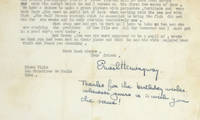
19552662629/07/1955. <blockquote><p>“You need an awful lot of luck when working with the sea and with fish.â€</p><p> </p><p>A fascinating unpublished letter obtained by us directly from the recipient’s family</p></blockquote><p><img class=""alignnone wp-image-26886 size-post-window"" src=""https://cdn.raabcollection.com/wp-content/uploads/20231204130941/Hemingway-July-29-1955-1-1-1-1600x411.jpg"" alt="""" width=""1600"" height=""411"" /></p><p><strong>On Hemingway</strong></p><p>After covering the Spanish Civil War in 1939 Hemingway purchased Finca VigÃa “Lookout Farm†an unpretentious estate outside Havana Cuba. In 1940 he published “For Whom the Bell Tolls†which many consider his best book. All of his life Hemingway was fascinated by war - in “A Farewell to Arms†he focused on its pointlessness and in “For Whom the Bell Tolls†on the comradeship it creates. During World War II he flew several missions with the Royal Air Force and landed with American troops on D-Day. He saw a good deal of action in Normandy and in the Battle of the Bulge. He also participated in the liberation of Paris. Following the war in Europe Hemingway returned to his home in Cuba and turned his attention to writing again. He also traveled widely and at the end of their 1953-1954 African safari the Hemingways survived a near-fatal plane crash only to have their rescue plane crash the very next day. Though they survived the second crash as well newspapers around the world carried brought the details to the reading public. Soon after he received the Pulitzer Prize in fiction for “The Old Man and the Sea†a short heroic novel about an old Cuban fisherman who after an extended struggle hooks and boats a giant marlin only to have it eaten by voracious sharks during the voyage home. That book also played a role in gaining for Hemingway the Nobel Prize for Literature in 1954. It ran in its entirety in five million copies of Life Magazine and the 50000 copies printed in book form sold out in ten days.</p><p>In 1955 back in Cuba Hemingway turned fifty-five and tried to follow his doctors’ advice by reducing his drinking. In October it is announced that he has been awarded the 1954 Nobel Prize in Literature. All of his wife’s’ efforts to protect his privacy were sabotaged by the crush of worldwide press and the fact that Hemingway invited any and all to the Finca Vigia to visit. In the summer of 1955 he was working on the filming of “The Old Man and the Sea†starring Spencer Tracy. The pace of people and press of lunches and drinking finally takes its toll and in the autumn of 1955 Hemingway took to his bed for two months suffering from hepatitis and nephritis.</p><p><img class=""alignnone wp-image-26887 size-post-window"" src=""https://cdn.raabcollection.com/wp-content/uploads/20231204130935/Hemingway-July-29-1955-1-2-1600x361.jpg"" alt="""" width=""1600"" height=""361"" /></p><p><strong>On his friend Mary Lou</strong></p><p>A young American naval officer named Morris was on a training mission with the military and a liberty stop was scheduled for Havana Cuba in late January 1955. Mary Lou Firle his girl friend at the time and later his wife was then a second year student at CCNY and she arranged a trip Cuba so they could meet in Havana. She went a week earlier and stayed at Veradero Beach outside Havana with some other students. Their place at the beach cost $1.00 per day. Before she left she bet a friend that she would have Ernest Hemingway sign the book she had “Farewell to Arms.†Mary Lou and boyfriend Morris met in Havana. They went to the famous El Floridita for daiquiris and had dinner. She wore pants slacks which were unusual for ladies at the time. The next day they went to Veradero Beach. His ship departed on Sunday.</p><p>A day or so Later Mary Lou telephoned Ernest Hemingway. When he answered she introduced herself and added “I have a friend at Fordham University.†Hemingway immediately assumed the friend was Prof. Bob Brown who had been in touch with Hemingway on several occasions. Brown was writing a book or articles about Hemingway. Hemingway told Mary Lou that his wife Mary was away and he had to entertain visitors from the French Embassy that afternoon. He asked her if she would come to his home and help him. Mary Lou agreed and Hemingway sent his driver to pick her up.</p><p>At the meeting a member of the group possibly the ambassador said she looked familiar and that he had seen her at the Floridita with a naval officer. She stood out because she wore pants. After the meeting the group drove her back to Havana. Hemingway invited her back the next day for lunch and sent his driver to pick her up. They spent the afternoon talking. When Hemingway asked her about Prof. Brown she replied “Who is Professor Brown†She said she knew one of his students. Hemingway laughed really hard about that and her “trick.†She had told him of her family background that her parents were born in Germany. Since she had been at Veradero Beach for a week she had a deep tan and Hemingway called her the “Black Kraut.†The reason for the nickname Hemingway said was that he called his good friend Marlene Dietrich the famous German actress “Krautâ€; so Mary Lou would be the “Black Kraut.†Later that day Hemingway’s driver drove her back to Havana.</p><p><img class=""alignnone wp-image-26888 size-post-window"" src=""https://cdn.raabcollection.com/wp-content/uploads/20231204130929/Hemingway-July-29-1955-1-3-1600x297.jpg"" alt="""" width=""1600"" height=""297"" /></p><p>In the Spring of 1955 Mary Lou a friend and Morris met Professor Brown at his home on Long Island. When Mary Lou wrote to Hemingway about a possible trip to Cuba in the Summer he wrote back to discourage the trip too hot in Cuba. He told about how busy he was with his film “The Old Man And The Sea†adding that “You need an awful lot of luck when working with the sea and with fish.â€</p><p><strong>Hemingway’s letter to his black kraut</strong></p><p><strong>Typed letter signed</strong> Finca Vigia San Francisco de Paula Cuba July 29 1955 to Mary Lou. <em>“I don't think August is a good time to take a vacation in Cuba . It is cooler here in the hills than any place except the sea but last night it was so hot I couldn't sleep. The trade winds are not blowing and the general weather plan for July has been very hot mornings in town and moderately cool here until lately; then rains starting at noon. For two weeks the first part of July it rained nearly all day day and night. This was good for the farm because we had had a seven months drought. But it is poor vacation weather. August promises to be very hot and probably with rains in the afternoons. You would be much better off to take a vacation somewhere in the north where it should be cool by then. That heat spell they have been having can't keep on forever.</em></p><p><img class=""alignnone wp-image-26889 size-post-window"" src=""https://cdn.raabcollection.com/wp-content/uploads/20231204130923/Hemingway-July-29-1955-1-4-1600x335.jpg"" alt="""" width=""1600"" height=""335"" /></p><p><em>“I am working terribly hard on my book and am on page 526. I have to concentrate on it all August heat or no heat as must start photography at sea of fishing for The Old Man and The Sea. Have had to interrupt several times to organize on this. It is a tough job with many problems; some very difficult. There will be people here that are working on that and the house unfortunately will be full in August and September when the actual photography starts. Peter Viertel will be back from Europe with the script which he and I worked on the first two weeks of June. We have a chance to make a great picture with patience fortitude and very much luck. You need an awful lot of luck when working with the sea and with fish. The Gulf Stream current which is essential to bring the fish did not run for six weeks and is only starting tentatively now.</em></p><p><em>“Must stop now and get to work as I have to take two men who are studying the problems of the film out all day tomorrow and I must get in a good day's work today. Bob Brown the man you were supposed to be a pupil of wrote me that you had been out at their place and that he and his wife enjoyed your visit and found you charming.â€</em> He adds in his hand <em>“Thanks for the birthday wishes. Whenever yours is I wish you the same.â€</em> With the envelope addressed in his hand.</p><p>The subjects and subtexts of the letter are all the essential Hemingway and rare to find together in one letter - script writing working on a book thoughts on the sea and fish photography the challenges of making a great film from one of his books his hospitality and his strong sexual impulse his wife was away. Hemingway famously rewrote the ending to ""A Farewell to Arms"" numerous times and that is possibly the writing he refers to.</p><p>The letter has been in the family’s possession since it was received and we acquired it direct from them. Mary Lou had promised Hemingway that she would not sell the letter during her lifetime and kept her promise. She told Morris it would be ok to sell it after she passed.</p><p><img class=""alignnone wp-image-25018 size-post-window"" src=""https://cdn.raabcollection.com/wp-content/uploads/20231204144051/Folder-site-11-1600x1327.jpg"" alt="""" width=""1600"" height=""1327"" /></p> unknown
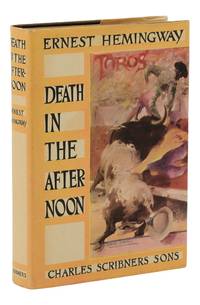
1932140949333New York: Charles Scribner's Sons 1932. First Edition. Near Fine/Near Fine. First edition first printing with an "A" and publisher's seal on copyright page. xi 517 pp. Illustrated with color frontispiece by Juan Gris and 81 black and white photographs. Bound in publisher's black cloth stamped in gilt dark topstain. Near Fine with light wear to extremities fraying at head and tail of spine bookseller ticket to back pastedown. In a Near Fine unclipped $3.50 dust jacket with light toning and edgewear and vertical crease to spine. A magnificent copy of Hemingway's novelistic nonfiction account of Spanish bullfighting scarce with a dust jacket in this condition. Hanneman 10A. Charles Scribner's Sons unknown
19292210410Charles Scribner's Sons 1929. signed limited. hardcover. near fine. SIGNED LIMITED edition. This being #12 of 510 copies of which 500 were for sale and 10 for presentation. Book near fine minor tanning on covers book very fine on inside pages still uncut at top. Housed in a custom-made elaborate fold-out case. Charles Scribner's Sons