158 résultats
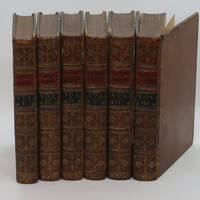
1750292361London: Henry Lintot 1750. Third Edition. Full Leather. Good binding. The set in two volumes in worn period calf with morocco labels. With loss to the leather and wear at the extremities. Volume I is lacking at least the last leaf of the Index with significant damping to the Index as well. Lacking the front endpaper as well. Volume II appears to be complete. ESTC T97037. Good binding. Henry Lintot unknown
1790ABE-17460245941291790. 1st Edition. Hardcover. Very Good. Designed chiefly for the Use of Manufacturers. The Chemical Principles of the Metallic Arts; With an Account of the Principal Diseases Incident to the Different Artificiers; The Means of Prevention and Cure; and a Concise Introduction to the Study of Chemistry Birmingham: Printed by Thomas Pearson; and sold by R. Baldwin Pater-Noster Row London 1790 First Edition first issue 8vo: Endpapers 47 leaves mispaginated as clii 1 leaf 201 1 pp 2 leaves index 1 blank 3 folding tables first two following p xxxii; third following p 186. Modern ¼ calf over cont. marbled boards. Maroon morocco label and gilt decorations on smooth spine. Light library stamps of Birmingham General Hospital Library. Overall VG. Neville II p 376: An important and certainly one of the earliest English books on diseases resulting from working in the mining and extractive metallurgy industries. The sheets of this 1790 book were reissued in 1806 with a new title page. See Neville for very brief biogtaphical details of this surgeon. hardcover
1768000247London: J. Rivington R. Baldwin et. Al. 1768. Sixth Edition. Full Calf. Very Good. Isaac Taylor. 12mo - over 6¾. Book. Full contemporary calf. Each volume with frontis plate. Also one foldout of music. Calf is considerably worn on these volumes with shelfwear rubbing some dryness but holding and worth preserving as is. Interiors are tight and pages generally age toned but clean as are the plates and it is an average of these condition elements that leads to my assessment of VG. <br/><br/> J. Rivington, R. Baldwin, et. Al. unknown books
1750292361London: Henry Lintot 1750. Third Edition. Full Leather. Good binding. The set in two volumes in worn period calf with morocco labels. With loss to the leather and wear at the extremities. Volume I is lacking at least the last leaf of the Index with significant damping to the Index as well. Lacking the front endpaper as well. Volume II appears to be complete. ESTC T97037. Good binding. Henry Lintot unknown books
1766112161766 Paris, Libraires Associés,1766. Nouvelle édition.:13 tomes reliés en 6 volumes in12 plein veau raciné,dos lisses ornés,.avec 24 gravures ht d'apres Eisen par Duflos,xxxij+244,222,224,207,188,184,232, 232, 223,220,300,192,216 p.,
17768608London: printed for John Donaldson corner of Arundel-Street No. 195. in the Strand. Sold by T. Wilson at York 1776. Seventh edition. 8 vols. 12mo. pp. ix iii 345 i; ii 315 i; 299 i; 308 ii; 322; 320; 324 ii; 346 ii portrait frontispiece of Richardson. One or two trivial spots and stains; L1 pp. 121-22 in vol IV torn without loss old repair; contemporary sheep smooth spines gilt with contrasting red and green lettering and numbering pieces a little worn and rubbed and a couple of small areas of loss. ESTC T58983 Book printed for John Donaldson, corner of Arundel-Street, No. 195. in the Strand. Sold by T. Wilson, at York unknown
177955722BBLeipzig, in der Weygandschen Buchhandlung. 1779. 8°. Titel, 2 Widmungsblätter, S.72 S., 4 n.n.S., 335 S., 1 S. Druckfehler. Schlichter Interimspappband der Zeit mit handschriftlichem Rückenschild.
1777RO80016298A AMSTERDAM. 1777. In-16. Relié plein cuir. Etat d'usage, Couv. légèrement passée, Dos à nerfs, Intérieur frais. 172 + 204 + 195 + 177 + 192 + 242 pages. Quelques bandeaux et culs-de-lampe. Relié plein cuir marron marbré. Titre, tomaison et caissons dorés sur le dos à 5 nerfs. Tranches rouges. Mors fendus. Coiffes usées. Coins frottés sur le 2ème volume.. . . . Classification Dewey : 820-Littératures anglaise et anglo-saxonne
178683901786 Londres (Paris), Cazin, 1786, 7 tomes en 7 vol. in 16, rel. d'ép. de plein veau blond granité, dos lisses ornés de fers dorés, encadrements de double-filets dorés, tranches dorés, petits accidents aux coiffes, sinon bon ex.
177085209,5 x 17 Amsterdam 1770 Huit tomes reliés en quatre volumes, s.n., reliure plein veau fauve raciné de l'époque, dos à cinq nerfs ornés de fleurons et de palmettes dorés, pièces de titre lavalière, titres et tomaisons dorés, filets dorés sur les coupes, gardes à la coquille, tranches rouges, signets de soie verte, vignettes de titre, [4]-xij-192 pp. ; [4]-228 pp. et [4]-215 pp. ; [4]-196 pp. et [4]-213 pp. ; 1 f. bl., 254 pp. et [4]-226 pp. ; 1 f.bl., [4]-284 pp. Traduit par l'abbé Prévost avec sa célèbre introduction, qui établit une relation entre le travail du traducteur et celui du sculpteur, et qui légitime ainsi les coupes drastiques qu'a faites Prévost dans le texte de Richardson. La première traduction était parue en 1755 et 1758. Les romans de Richardson, loués par Diderot, inspirants pour Rousseau, ont connu un véritable engouement. Les traductions de l'abbé Prévost y participèrent largement. Bonne reliure avec quelques frottements, mors fendu en queue du volume IV, marques d'usure sur les coupes des volumes I et III, absence de pages de faux titre et de titre à l'intérieur du volume III en ouverture du sixième tome, contre-gardes blanches plus ou moins roussies, intérieur frais. Bon ensemble.(Bbis5) PHOTOS NUMERIQUES DISPONIBLES PAR EMAIL SUR SIMPLE DEMANDE-DIGITAL PHOTOGRAPS MAY BE AVAILABLE ON REQUEST
177085209,5 x 17 Amsterdam 1770 Huit tomes reliés en quatre volumes, s.n., reliure plein veau fauve raciné de l'époque, dos à cinq nerfs ornés de fleurons et de palmettes dorés, pièces de titre lavalière, titres et tomaisons dorés, filets dorés sur les coupes, gardes à la coquille, tranches rouges, signets de soie verte, vignettes de titre, [4]-xij-192 pp. ; [4]-228 pp. et [4]-215 pp. ; [4]-196 pp. et [4]-213 pp. ; 1 f. bl., 254 pp. et [4]-226 pp. ; 1 f.bl., [4]-284 pp. Traduit par l'abbé Prévost avec sa célèbre introduction, qui établit une relation entre le travail du traducteur et celui du sculpteur, et qui légitime ainsi les coupes drastiques qu'a faites Prévost dans le texte de Richardson. La première traduction était parue en 1755 et 1758. Les romans de Richardson, loués par Diderot, inspirants pour Rousseau, ont connu un véritable engouement. Les traductions de l'abbé Prévost y participèrent largement. Bonne reliure avec quelques frottements, mors fendu en queue du volume IV, marques d'usure sur les coupes des volumes I et III, absence de pages de faux titre et de titre à l'intérieur du volume III en ouverture du sixième tome, contre-gardes blanches plus ou moins roussies, intérieur frais. Bon ensemble.(Bbis5) PHOTOS NUMERIQUES DISPONIBLES PAR EMAIL SUR SIMPLE DEMANDE-DIGITAL PHOTOGRAPS MAY BE AVAILABLE ON REQUEST
177054171S. n. | à Amsterdam 1770 | 9.50 x 17 cm | 8 tomes reliés en 4 volumes
17255074London: Printed for A.C. and sold by A Bettesworth. 1725 1725. Second edition. 8vo. 195x115mm. pp. 14 153174-220; 2342. Lacking divisional title page "The Connoisseur". Contemporary panelled calf rebacked with modern black morocco labels lettered in gilt. Very slight rubbing to edges and boards but otherwise very good. Internally there is some water staining to the first few leaves and to the fore-edges of leaves y3/4 and Z1/2 of part one. Leaf H2 of part one has been trimmed at fore-edge but with no loss of text. First issued in 1719 these works were then republished in 1725 with a new general title but with the divisional titles still dated 1719. Rare in commerce and comparatively so institutionally ESTC recording seven copies in the UK and nine in the US and Canada. Jonathan Richardson 1667-1745 was a painter but has had more lasting influence as a writer on the theory of art. His first writing on the subject was An Essay on the Theory of Painting 1715 which is said to have inspired Joshua Reynolds. Richardson's 1722 Account of Some of the Statues Bas-Reliefs Drawings and Pictures in Italy was required reading for English aristocrats off on their Grand Tour and many of its ideas and theories were adopted by Winckelmann. The Two Discourses in this book are essentially essays on taste and a plea to take more seriously the development of an aesthetic sensibility. ESTC No.: N22288 London: Printed for A.C. and sold by A Bettesworth. 1725 hardcover
1776WB16282London: W. Strahan 1776. Eleventh Edition. Hardcover. Very Good. Four Volume set. 19th century 3/4 calf and marbled boards; spines attractively gilt. Some modest rubbing but still a nice set. First published in 1740 this work is notable in that Richardson kept revising it before each edition before his death in 1761. This edition the 11th in just 26 years attests to the work's popularity. <br/><br/> W. Strahan hardcover books
176369841763 A Amsterdam [i.e. Paris], s. éd, 1763. 8 tomes rel. en 4 vol. in-12: 10 x 17 cm. I/ 2 ff., xii-175 pp., 2 ff., 208 pp.; II/ 2 ff., 196 pp., 2 ff., 180 pp.; III/ 2 ff., 196 pp., 2 ff., 229 pp.; IV/ 2 ff., 192 pp., 2 ff., 254 pp. Nouvelle impression de la traduction de lAbbé Prévost de l'anglais de Samuel Richardson après l'originale de 1755 (Barbier, II, 2ed., 1823: no. 12802). Reliures de l'époque en basane imitant le veau moucheté. Dos à nerfs avec pièces de titre en maroquin rouge, pièces de tomaison en maroquin noir et caissons à fers dorés. Tranches rouges. Papier parfois insolé mais propre. Dos frottés par endroits, not. aux pièces de titre. Charmant ensemble.
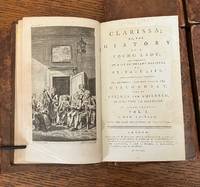
1764FB367 (1 to 6) /4C<p>Leather binding with black and red title plates.</p><p>Volumes I. to VII. but <strong>volume III. is missing.</strong></p><p><strong>A noteworthy collection.</strong> <strong><em>Clarissa; or The History of a Young Lady: Comprehending the Most Important Concerns of Private Life. And Particularly Shewing the Distresses that May Attend the Misconduct Both of Parents and Children In Relation to Marriage</em></strong> is an epistolary novel by English writer Samuel Richardson published in 1748. It tells the tragic story of a young woman Clarissa Harlowe whose quest for virtue is continually thwarted by her family. The Harlowes are a recently wealthy family whose preoccupation with increasing their standing in society leads to obsessive control of their daughter Clarissa. It is considered one of the longest novels in the English language based on estimated word count. It is generally regarded as Richardson's masterpiece. In 2015 the BBC ranked <em>Clarissa</em> 14th on its list of the 100 greatest British novels. In 2013 <em>The Guardian</em> included <em>Clarissa</em> among the 100 best novels written in English.</p><p><strong>PLOT SUMMARY </strong> Robert Lovelace a wealthy "libertine" and heir to a substantial estate begins to court Arabella Clarissa's older sister. However she rejects him because she felt slighted by his more ardent interest in her parents approval than in her. Lovelace quickly moves on from Arabella to Clarissa much to the displeasure of Arabella and their brother James. Clarissa insists that she dislikes Lovelace but Arabella grows jealous of Lovelace's interest in the younger girl. James also dislikes Lovelace greatly because of a duel which had occurred between the two of them. These feelings combine with resentment that their grandfather had left Clarissa a piece of land and lead the siblings to be aggressive to Clarissa. The entire Harlowe family is in favour of her marrying Roger Solmes however Clarissa finds Solmes to be unpleasant company and does not wish to marry him either. This makes her family suspicious of her supposed dislike of Lovelace and they begin to disbelieve her. The Harlowes begin restricting Clarissa's contact with the outside world by forbidding her to see Lovelace. Eventually they forbid her to either leave her room or send letters to her friend Anna Howe until Clarissa apologises and agrees to marry Solmes. Trapped and desperate to regain her freedom Clarissa continues to communicate with Anna secretly and begins a correspondence with Lovelace while trying to convince her parents not to force her to marry Solmes. Neither Clarissa nor her parents will concede. They see her protests as stubborn disobedience and communication between parents and daughter breaks down. Lovelace convinces Clarissa to elope with him to avoid the conflict with her parents. Joseph Leman a servant of the Harlowes shouts and makes noise so it may seem like the family has awoken and discovered that Clarissa and Lovelace are about to run away. Frightened of the possible aftermath Clarissa leaves with Lovelace but becomes his prisoner for many months. Her family now will not listen to or forgive Clarissa because of this perceived betrayal despite her continued attempts to reconcile with them. She is kept at many lodgings including unknowingly a brothel where the women are disguised as high-class ladies by Lovelace so as to deceive Clarissa. Despite all of this she continues to refuse Lovelace longing to live by herself in peace. Lovelace is too cynical to believe that virtuous women exist and he is desperately trying to seduce Clarissa despite declaring that he loves her. Although he puts her under increasing pressure to submit Clarissa does not waver. Under the pretence of saving her from a fire Lovelace at last gains entry to Clarissa's bedroom but she thwarts his attempted assault with vigorous resistance. She promises under threat of rape to forgive and marry him. However she considers this promise made under duress as void; soon after she makes her first successful escape from Lovelace concealing herself in lodgings in Hampstead. Enraged by Clarissa's flight Lovelace vows to seek revenge. He hunts her down to the lodgings where she is hiding and rents all the rooms around her effectively trapping her. He hires people to impersonate respectable family members of his in order to gain her trust. During this time he intercepts a letter to Clarissa from Anna Howe warning her of true extent of his deception and roguery. He commits forgery to put an end to the communication between them. Eventually he persuades Clarissa to accompany his imposter-relatives out in a carriage and thus carries her back to the disguised brothel. There with the assistance of the prostitutes and brothel madam he first drugs and then rapes her. After the rape Clarissa suffers a loss of sanity for several days presumably brought on by her extreme distress as well as the dose of opiates administered to her. This temporary insanity is represented in her "mad letters" by the use of scattered typography. When Clarissa recovers her senses Lovelace soon realises that he has failed to "subdue" or corrupt her; instead she is utterly repulsed by him repeatedly refusing his offers of marriage despite her precarious situation as a fallen woman. She accuses him of deceiving and unlawfully detaining her and insists that he set her free. He continues to claim that the impersonators really were his family members and that his crime was simply one of desperate passion. He tries to convince her to marry him alternating between threats and professions of love. She steadfastly resists and attempts several more escapes. Lovelace is forced to concede that Clarissa's virtue remains untarnished but he begins to convince himself that the "trial" was not properly conducted. Since Clarissa was drugged at the time she could consent nor refuse. He decides to orchestrate a second rape but without drugs. Pretending to be angered by the discovery that she has bribed a servant to help her escape Lovelace begins to menace Clarissa intending to escalate the confrontation to physical violence but she majestically condemns his premeditated villainy and threatens to kill herself with a penknife should he proceed. Utterly confounded by her righteous indignation and terrified by her willingness to die for her virtue Lovelace retreats. More intent than ever to make Clarissa his wife Lovelace is called away to attend his dying uncle from whom he is expecting to inherit an Earldom. He orders the prostitutes to keep Clarissa confined but well-treated until he returns. Clarissa escapes however. The brothel madam is able to have her jailed for a few days for unpaid bills and Clarissa finds sanctuary with a shopkeeper and his wife when she is released. Corresponding with Lovelace's real family she discovers for herself the true extent of his deception. She lives in constant fear of again being found by him who continues to send her marriage offers through his disreputable friend John Belford as well as through his own family members. Clarissa is determined not to accept. She becomes dangerously ill from the stress rarely eating convinced that she will die soon. Her illness and probable anorexia progress. She and Belford become correspondents she appointing him executor of her will as she puts all of her affairs in order to the alarm of the people around her. Belford is amazed at the way Clarissa handles her death and laments what Lovelace has done. In one of the many letters sent to Lovelace he writes "if the divine Clarissa asks me to slit thy throat Lovelace I shall do it in an instance." Eventually surrounded by strangers and her cousin Col. Morden Clarissa dies in the full consciousness of her virtue and trusting in a better life after death. Belford manages Clarissa's will and ensures that all her articles and money go into the hands of the individuals she desires should receive them. Lovelace departs for Europe and continues to correspond with Belford. Lovelace learns that Col. Morden has suggested he might seek Lovelace and demand satisfaction on behalf of his cousin. He responds that he is not able to accept threats against himself and arranges an encounter with Col. Morden. They meet in Munich and arrange a duel. Morden is slightly injured in the duel but Lovelace dies of his injuries the following day. Before dying he says "let this expiate!" Clarissa's relatives finally realise they have been wrong but it comes too late. They discover Clarissa has already died. The story ends with an account of the fate of the other characters.</p><p><strong>Samuel Richardson</strong> baptised 19 August 1689 – 4 July 1761 was an English writer and printer best known for three epistolary novels: <em>Pamela; or Virtue Rewarded</em> 1740 <em>Clarissa: Or the History of a Young Lady</em> 1748 and <em>The History of Sir Charles Grandison</em> 1753. He printed almost 500 works in his life including journals and magazines working periodically with the London bookseller Andrew Millar. Richardson had been apprenticed to a printer whose daughter he eventually married. He lost her along with five sons but remarried and had four daughters who reached adulthood but no male heirs to continue the print shop. As it ran down he wrote his first novel at the age of 51 and immediately joined the admired writers of his day. Leading figures he knew included Samuel Johnson and Sarah Fielding the physicians Behmenist and George Cheyne and the theologian and writer William Law whose books he printed. At Law's request Richardson printed some poems by John Byrom. In literature he rivalled Henry Fielding; the two responded to each other's literary styles.</p> J Rivington.
179211296<p>B. Law and Son T. Cadell G. G. and J. Robinson R. Baldwin J. Johnson . London. 1792. EIGHT VOLUMES. Complete. 8vo. 7 x 4.4 inches. Engraved frontis in each volume the one in volume 2 being supplied in facsimile the others all original. Folding engraved music plate in Volume 2. Neat previous owner name to the top of the blank front free endpapers and a couple of volumes with a previous owners page number notes alongside them otherwise a lovely bright fresh and clean set throughout. Bound without the half titles in contemporary full tree calf bindings. Spines decorated and ruled in gilt. Red and green labels double ruled and lettered in gilt. Spines rubbed and chipped to extremities. Several hinges rubbed or cracked but all still holding firm. Aside from the one facsimile frontis plate this is a better set than usually found internally in worn but still atractive early leather bindings.</p> B. Law and Son, T. Cadell, G. G. and J. Robinson, R. Baldwin, J. Johnson .......... London. 1792 hardcover
1770162911770. Book Hardcover. Fair. 7 volumes complete. Contemporary calf worn and cracked around spines with loss at top of volume VII due to damp - stain visible to top of pages. Volume III top board loosening. Volume III also has a stain to bottom of pages throughout. Otherwise pages free from foxing and tight. Good for age. hardcover
177054171à Amsterdam: S. n. 1770. Fine. S. n. à Amsterdam 1770 9.50 x 17 cm 8 tomes reliés en 4 volumes New edition. Translation by Abbé Prevost with his introduction on the translation. Full glazed purple calf bindings. Smooth spines decorated in the grotesque style. Red morocco title labels and beige morocco volume labels. Headcap of volume 4 worn down with lack to joint at head. 9 corners bumped. Overall rubbed. Cut on upper board of volume 1. Half-title of volume III lacking. Good copy. ""Richardson was the inventor of bourgeois tragedy . He invented this novel where art consists in neglecting all the precepts of art where the accumulation of details foreign to the action where the repetition of the same scenes and the same feelings produce more effect than precision taste accuracy and order have ever produced"". AUGUSTIN FILON Histoire de la littérature anglaise : depuis ses origines jusqu'à nos jours Paris Hachette 1883. Abbé Prévost was not content to translate Richardson's novel he arranged and reworked it; not liking the ending he probably rewrote it and it is this version that circulated throughout Europe and made Richardson's reputation whereas the original comprised 28 volumes which Prévost reduced to 8 systematically cutting the verbosity and characteristic length of Richardson. S. n. unknown
177215426Amsterdam sans nom 1772 8 tomes en 4 volumes in-12 (10 X 17 cm) basane havane racinée, dos lisse ornés de fers dorés, pièce de titre et tomaison, tranches marbrées. (Reliure de l'époque).
177711940S. n. | à Amsterdam 1777 | 16.50 x 9.50 cm | relié
179957341Madfrid: la Imprenta Real por D. Pedro Pereyra impressor de Camara de S.M. 1799. Tomo I-8 in four volumes 16mo full contemporary calf leather labels on spines; some worming in spines of all four volumes with some loss to the calf; and with small loss of text in the last 8 leaves of volume II the first 5 leaves of volume III and the first 14 leaves of volume 5; the last volume not uniform and with very light worming. The first modern novel published in London in 1740 and 1741. First published in Spain in 1794-95. la Imprenta Real por D. Pedro Pereyra, impressor de Camara de S.M. unknown
179957341Madfrid: la Imprenta Real por D. Pedro Pereyra impressor de Camara de S.M. 1799. Tomo I-8 in four volumes 16mo full contemporary calf leather labels on spines; some worming in spines of all four volumes with some loss to the calf; and with small loss of text in the last 8 leaves of volume II the first 5 leaves of volume III and the first 14 leaves of volume 5; the last volume not uniform and with very light worming. The first modern novel published in London in 1740 and 1741. First published in Spain in 1794-95. <br/><br/> la Imprenta Real por D. Pedro Pereyra, impressor de Camara de S.M. hardcover books
17662408070028Edinburgh: publisher not identified 1766. Hardcover. Good. Douglas Peerage Case Quarto. Leather backed. Gilt ruled. Marbled boards. Spine join cracked. Binding sound. Shelf wear rubbing to board. Hardcover. Clean unmarked pages. 549 pages. <br> Relating to the claim of Archibald Douglas formerly Stewart to be heir of his uncle Archibald Duke of Douglas which was disputed by the Duke of Hamilton on the ground that Archibald was not the son of Lady Jane Douglas in trials before the Scottish courts 1761-1767 and before the House of Lords 1769. Douglas's mother Lady Jane Douglas reportedly birthed Archibald at age 50 in Paris her husband was 63. Lady Jane Douglas d.1753 was the sister of the extremely wealthy Duke of Douglas who died childless. The inheritance would have passed to the Duke of Hamilton if not for the birth of Archibald. The circumstances of Archibald's birth were in question with reports that Archibald was actually the son of a French glassblower. The peerage case was quite a scandal and was eventually overturned by the House of Lords who ruled in favor of Archibald in 1769. [publisher not identified] hardcover
1792016939London: Sold By T. And J. Egerton 1792. Book measures 23x20.cm. vi287pp complete with 12 plates. A disbound copy with the period boards so ideal for rebacking. Internally endpapers dirt marked text claen plates are stained mainly to verso but moderately showing on the printed side. Ideal binding copy. A New Edition. Good Plus. Quarto. Sold By T. And J. Egerton hardcover