Hugo BauerBiblio.com

30 636 résultats
0484895613.Ghardcover. Good. Access codes and supplements are not guaranteed with used items. May be an ex-library book. hardcover
1330136039.Gpaperback. Good. Access codes and supplements are not guaranteed with used items. May be an ex-library book. paperback
1020896205.Ghardcover. Good. Access codes and supplements are not guaranteed with used items. May be an ex-library book. hardcover
1340212390.Ghardcover. Good. Access codes and supplements are not guaranteed with used items. May be an ex-library book. hardcover
1805814419.Gpaperback. Good. Access codes and supplements are not guaranteed with used items. May be an ex-library book. paperback
49828846like new. unknown
49828846-nnew. unknown
ria9781805814412_inpPaperback. New. New Book; Fast Shipping from UK; Not signed; Not First Edition; N/A paperback
6130164890.Gpaperback. Good. Access codes and supplements are not guaranteed with used items. May be an ex-library book. paperback
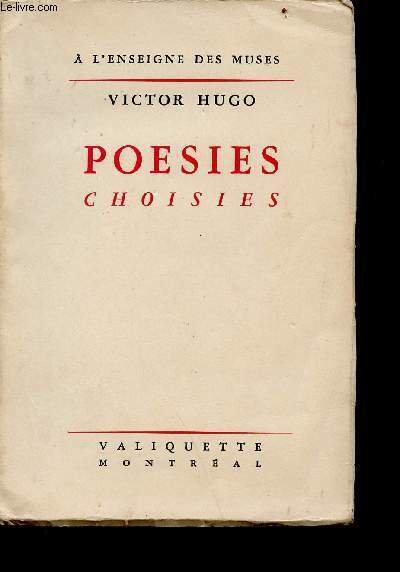
R160211643Editions Bernard Valiquette. non daté. In-8. Broché. Etat d'usage, Couv. légèrement passée, Coiffe en pied abîmée, Intérieur acceptable. 212 pages - coiffes, coins et tranches légèrement frottés - légères tâches sur les plats - traces d'adhésif sur la page de garde. . . . Classification Dewey : 841-Poésie
lc_89267Dargaud juin 1984
1979RO30081917DARGAUD EDITEUR. 1979. In-4. Broché. Bon état, Couv. convenable, Dos satisfaisant, Intérieur frais. 47 pages de bandes dessinées en couleurs.. . . . Classification Dewey : 843.061-Albums BD
1979R100062322Dargaud. 1979. In-4. Broché. Bon état, Couv. convenable, Dos satisfaisant, Intérieur frais. 47 pages - nombreux dessins en couleurs dans le texte.. . . . Classification Dewey : 843.06-Bande dessinée
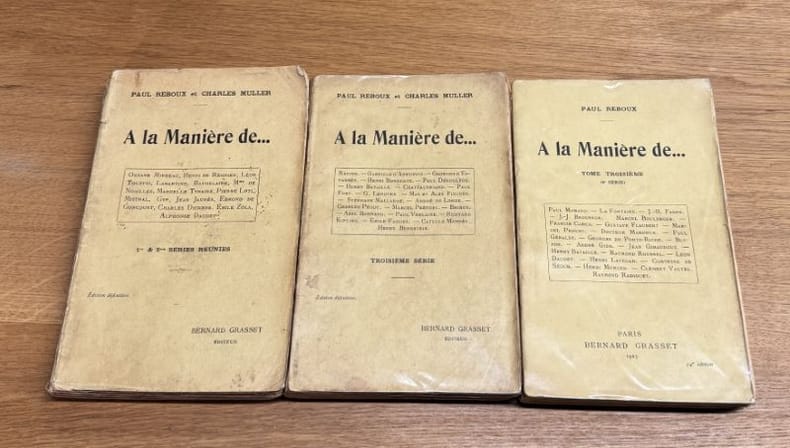
1925126480Paris Grasset 1925 3 vol. broché 3 vol. in-12, brochés, 280, 256 et 294 pp. Série complète de ces célèbres pastiches à quatre mains, le premier volume réunissant les deux premières séries. Couvertures défraîchies.
1925126480Paris Grasset 1925 3 vol. broché 3 vol. in-12, brochés, 280, 256 et 294 pp. Série complète de ces célèbres pastiches à quatre mains, le premier volume réunissant les deux premières séries. Couvertures défraîchies.
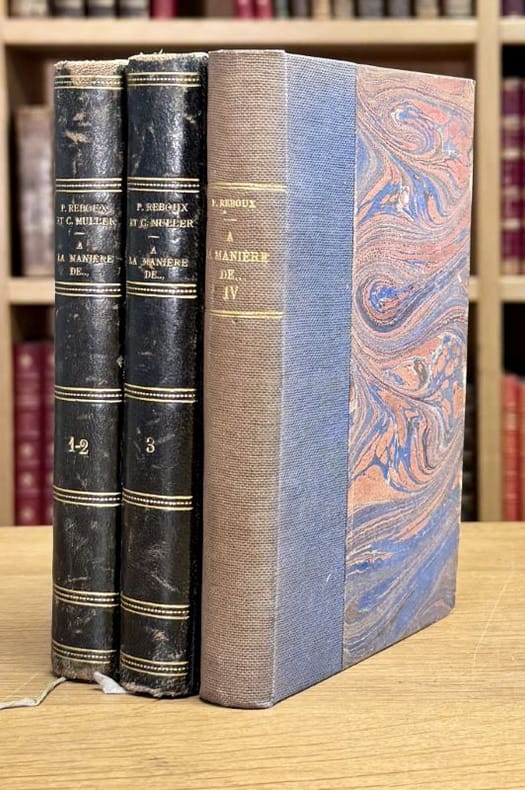
126481Paris Grasset 1920-1925 3 vol. relié 3 vol. in-12, dont 2 demi-basane verte et 1 demi-percaline bleue, 280, 256 et 294 pp. Série complète de ces célèbres pastiches à quatre mains, le premier volume réunissant les deux premières séries. Le 3e volume dans une reliure différente.
126481Paris Grasset 1920-1925 3 vol. relié 3 vol. in-12, dont 2 demi-basane verte et 1 demi-percaline bleue, 280, 256 et 294 pp. Série complète de ces célèbres pastiches à quatre mains, le premier volume réunissant les deux premières séries. Le 3e volume dans une reliure différente.
1981119635Guatemala City Guatemala: Universitaria de Guatemala 1981. stiff paper wrappers. 8vo. stiff paper wrappers. 221 3 pages. Text in Spanish. Limited to 1000 copies. A review of publications in Guatemala 1980-1. Introduction Four appendices. Index. Universitaria de Guatemala unknown books
195244789New York: Masses & Mainstream 1952. First Trade Edition. First Printing. Octavo 20.75cm; grayish-green cloth with titles stamped in gilt on spine; dustjacket; 288pp. Gentle sunning to spine and upper board edges small tear to front hinge else Very Good. In the Hugo Gellert dustjacket unclipped priced $2.50 with sunning to spine several short tears and attendant creases with modest wear overall; Very Good. Autobiographical novel with a Polish setting by the prominent American Marxist essayist and critic; a sequel was published posthumously in 1966. RIDEOUT p.300. Masses & Mainstream unknown books
1797615173.Gpaperback. Good. Access codes and supplements are not guaranteed with used items. May be an ex-library book. paperback
2111JS278<p>Por. Coordenador de Edição. EDP. Edições Afrontamento Lda. Porto. 2017.</p>_x000d_<p>De 25x21 cm. Com xiii i 545 págs. Brochado. Ilustrado no texto com tabelas fotografias reproduções de documentos e mapas a preto e branco.</p> I-189-C-33 unknown
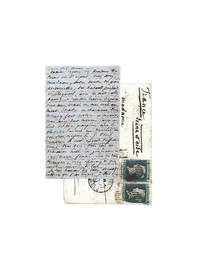
1855Hugo17<p><strong>HUGO Victor 1802-1855</strong></p><p>Autograph letter to Alphonsine Masson<br />Marine Terrace Jersey 5th August 1855 4 pp. small in-12°<br />With autograph envelope<br />Postmark: ANGL –5 Augt departure / CHEVREUSE 99th Août arrival<br />Fine condition throughout</p><p><strong>A long unpublished letter with mystical overtones addressed to his psychic friend Alphonsine Masson through which Victor Hugo addresses a message to his former love Léonie Biard – The exiled poet expresses in the manner of a prose poem and like a waking dream the power of loving memory for the woman he was forced to leave behind during the coup d'Etat of December 2 1851</strong></p><p><u>We transcribe here only a few fragments</u></p><p><em>" Comme toutes les femmes de cœur et d'esprit vous avez Madame outre toutes vos grâces personnelles des hasards profonds et éloquents. <strong>Avec ce mot : <u>elle partie c'est ma lumière disparue</u></strong><u></u> <strong>vous avez remué en moi tout un monde sombre et charmant vous m'avez fait revivre et mourir vous avez fait monter jusqu'au bord de ma paupière tout le flot des larmes non versées et qui sont toujours là. Je vous remercie de cette exquise souffrance que je vous dois</strong>.</em> …<em>. Rien ne vous manque ; vous charmez de près et vous consolez de loin.</em><br /><em>Je suis heureux des deux douces lettres que j'ai reçues. <strong>Je sais bien ce qui manque à l'une mais <u>elle</u> le sait aussi. Et – qui connaît l'avenir </strong></em><br /><em>Vous me faites un adorable tableau ; je vous vois toutes deux dans cette belle nature qui vous aime parce qu'elle voit vos âmes ; vous êtes là dans les fleurs sous les astres harmonies vous-mêmes ; vous causez ; je retiens mon souffle et il me semble que je vous entends.</em><br /><strong><em>Et tous les soirs je regarde là-haut je fais des signes d'intelligence aux yeux célestes de la nuit et il me semble que je la vois.</em></strong><br /><em>Je suis avec elle dans l'inexprimable. Elle qui pourtant devrait tout comprendre elle ne comprend pas cela. Elle me dit : écrivez-moi donc.</em> … <em>Je regarde les étoiles en songeant à elle et je lui dis : traduisez-moi.</em><br /><em>Soyez heureuse. Soyez heureuses. La beauté lui revient. Est-ce qu'elle était partie Est-ce qu'elle partira Qu'<u>elle</u> ouvre la sombre poitrine de l'absent ; il y a là un miroir. Qu'elle s'y regarde.</em><br /><em>Je dis l'absent. Et vous vous n'êtes pas absentes où vous êtes où elle est la présence est. <strong>Je regarde avec dédain et pitié ce Paris qui me fait l'effet d'un grand vide depuis qu'elle n'y est plus.</strong></em><br /><em>Je veux m'arrêter car il y a des portes d'écluses qu'il ne faut pas rouvrir. À quoi servirait le flot qui en sortirait </em><br /><em>Pardonnez-moi toutes deux ce mélange de rêves et de souvenirs.</em> …. <strong><em>Qu'elle en prenne ce qu'elle voudra. Qu'elle y lise ce qu'elle voudra</em></strong><em>. Je suis sûr des commentaires de votre noble et charmant cœur. –</em> …<br /><strong><em>Un jour elle me comprendra. En attendant elle fait ce qu'elle peut pour croire à un abîme ; elle dit toujours <u>fini</u> à moi qui ne sait pas d'autre mot qu'<u>infini</u>. Qu'elle me voie donc où je suis ; dans la mort et dans le ciel ; dans la mort par l'absence dans le ciel par sa pensée</em></strong><em>. "</em></p><p><u>Léonie Biard's loving memory from exile</u><br />A great love of Victor Hugo Léonie Biard 1820-1879 was the only woman for whom the writer hesitated to leave Juliette Drouet. Born into a family of minor nobility Léonie Thévenot received a good education before marrying the painter François Biard. In the spring of 1843 she met Victor Hugo perhaps in Fortunée Hamelin's salon. They became lovers in December of the same year. Léonie inspired him to write many poems of which we can find traces in <em>Les Contemplations</em>. In July 1845 the two lovers were caught in the act of adultery. Léonie Biard was arrested and thrown into the prison of Saint-Lazare where she remained from 5 July to 10 September. She was then transferred to the convent of Sentenced by the Seine court she lost custody of her children. Victor Hugo benefiting from his inviolability as Peer of France will always feel indebted to her. He sent her money regularly and continued to send her his books. Their affair was abruptly interrupted during the coup d'état of 2 December 1851 forcing the poet into exile. Juliette Drouet unaware of the affair learned of this seven-year affair from Léonie herself who on June 28 1851 sent her back the poet's letters. They were published by Jean Gaudon and are kept at the Maison de Victor Hugo after having belonged successively to Juliette Drouet Louis Koch Paul Meurice Alexandrine de Rothschild sale I n°67 and then to Colonel Sickles II 1989 n°361.</p><p><u>Alphonsine Masson the spiritual link</u><br />The direct recipient of this letter Alphonsine Masson played an essential role as an intermediary between the poet and Léonie Biard. The two friends knew each other from before the exile. It is therefore through her that Victor Hugo can reach Léonie through words. An exalted personality Alphonsine wanted to go beyond a wise conjugal existence through literary essays and an eventful spiritual quest. Marked by an education received from a militant agnostic father and a pious mother she first devoted herself to spiritualism establishing contacts with spirits from beyond the grave. In 1857 she was a member of an association that had rediscovered Franz Mesmer's scorned and abandoned science. Around 1860 she suddenly lost her ability as a medium: "Whatever I did then to get it back together I couldn't do it." She then proclaimed herself a Christian convert and published an autobiography <em>Ma conversion</em> Paris 1864 in which she recounted her spiritual journey. At the same time as this conversion remembering that she had been asked to write for many years by friends eminent in letters she became emboldened and responded to her late vocation. She wrote three novels: <em>Louise</em> <em>Les Trois amies</em> <em>La Perle noire</em> which appeared only in serials in <em>L'Estafette</em> <em>Le Siècle</em> and other Parisian newspapers.</p><p>Why did Victor Hugo pass on his messages to Léonie Biard through Alphonsine Masson Was it a question of not reviving the scandal that had marked the discovery of adultery No doubt the poet wanted to escape any police control over this correspondence which if revealed could have compromised the exile in the eyes of public opinion. He might also be afraid of hurting Juliet by reviving an old wound.</p><p><u>Provenance:</u><br />Alphonsine Masson's etate until 2002<br />Then private collection</p>
A9781168125637New. unknown
B9781168125637New. unknown
1160763860.Gpaperback. Good. Access codes and supplements are not guaranteed with used items. May be an ex-library book. paperback