21 585 résultats
191668262London:: The Egoist Ltd. 1916. First edition; English issue made up of American sheets. rebound in modern morocco t.e.g. illustrated after a photograph of Joyce on the front panel and a cross on the rear panel. Preserved in a custom 1/4 morocco folding box. Joyce made an earlier attempt to inscribe this copy to someone else; the eradication of the earlier inscription can be seen if the page is held to the light. The binder has trimmed the top edge of the sheets in order to gild the top edge and the last letter of "Wadsworth" is very slightly affected. Otherwise a fine copy. . 8vo. Slocum and Cahoon A12. Signed and inscribed by James Joyce for Percy Wadsworth Paris 30 July 1921 at the upper corner of the blank leaf preceding the half-title. The Egoist Ltd., unknown
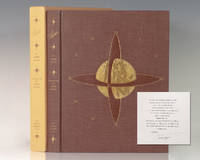
1935140072New York: Limited Editions Club 1935. First illustrated edition of Joyce’s landmark Ulysses one of only 250 examples signed by James Joyce in pen and Henri Matisse in pencil with 26 illustrations by him one of the 20th-century’s most desirable illustrated books combining the work of two great modern artists. Large quarto original gilt-stamped pictorial brown cloth original slipcase. In fine condition with the rare original slipcase which is in good condition and original glassine jacket. With an introduction by Stuart Gilbert. An exceptional example most rare in this condition and in the seldom seen glassine jacket. One of the most arresting collaborations in 20th-century literature. "It was a great idea to bring them together; celebrities of the same generation of similar virtuosity" Wheeler 15. The 26 beautiful full-page illustrations by Matisse accompany the text of Joyce's Ulysses including six soft-ground etchings with reproductions of the sketches on blue and yellow paper. "One of the very few American livres de peintres issued before World War II. According to George Macy this work's designer who undertook this only American publication of Matisse's illustrations he asked the artist how many etchings the latter could provide for $5000. The artist chose to take six subjects from Homer's Odyssey. The preparatory drawings reproduced with the soft-ground etchings Matisse's only use of this medium record the evolution of the figures from vigorous sketches to closely knit compositions" Artist and the Book 197. Limited Editions Club hardcover
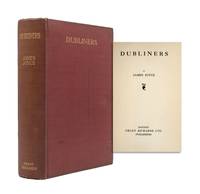
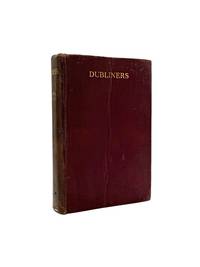
dubliners<p>A beautful example of the first published edition of one of the greatest short story collections of all time James Joyce's Dubliners.<br></p><p>One of approximately 746 copies bound in the publisher's maroon cloth. However now only one of 246 examples after 500 were destroyed in a shipwreck on the way to America.<br></p><p>The publishing history of Dubliners is convoluted to say the least: Joyce had originally hoped to publish the book in 1906 after it was accepted for publication by the London publishers Grant Richards. But "after skirmishes with printers over objectionable passages the publisher abandoned the book".</p><p>Four years later the Dublin publishing house Maunsel & Company agreed to publish the book and 1000 copies were printed in 1910. But there was another row over allegedly objectionable passages in at least one of the stories which Joyce refused to remove and the copies were burnt.</p><p>Another four years passed and in 1914 back in London Grant Richards finally published the book.</p><p>It is believed that 1250 sets of sheets were printed of which 746 were bound up in London and the remainder shipped to the US for an American edition. So the “true†first edition of Dubliners is one of the 746 copies published in London in June 1914 by Grant Richards. However some 500 copies were reputedly lost in a shipwreck so only 246 copies are believed to have survived making this one of the rarest of Joyce's iconic works.<br></p><p><em>First edition first impression. A near fine example in the original publishers maroon cloth binding. Minor wear to the spine. Internally fine the best I have ever seen not a single blemish. A beautiful example with no restoration. </em><br></p><p><em>Published by Grant Richards Ltd London 1914.</em></p> hardcover
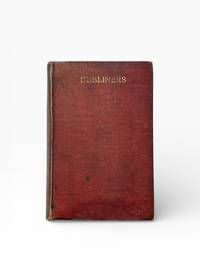
1914365353London: Grant Richards Ltd 1914. First edition one of 746 bound for Richards 1250 copies printed. 278 pp. 1 vols. 8vo. Original dark red cloth gilt stamped lettering on the spine and front cover some light fading to spine with slightest rubbing along top edge front cover with some bubbling; marks to endpapers from former protective cover bookplate on front pastedown slight cracking to text block at p. 144. First edition one of 746 bound for Richards 1250 copies printed. 278 pp. 1 vols. 8vo. The rocky publishing history of Dubliners is well documented: finished in 1905 it was rejected by 15 publishers before Grant Richards accepted it. Richards' printers refused to set some of the type - inaugurating Joyce's lifelong struggle with censorship - and Joyce refused most of Richards' changes. It was then taken up by Maunsel & Roberts of Dublin who eventually came to a similar conclusion. Maunsel even burned all but one of the copies of the sheets which Joyce managed to wheedle out of him and it was given back to Richards who set the type from the lone Maunsel sheet saved from the flames. Joyce subsequently added "A Little Cloud" and "The Dead" - possibly his most famous single story - to the collection. Slocum and Cahoon A8 Grant Richards Ltd unknown
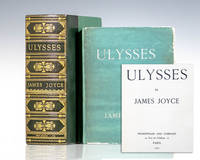
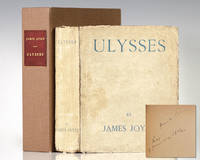
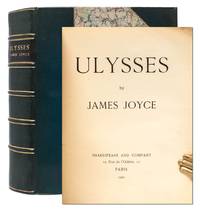
1922142260Paris: Shakespeare and Company 1922. First edition of Joyce's masterpiece one of 750 numbered copies printed on handmade paper from a total edition of 1000 copies this is number number 817. Thick quarto original blue and white wrappers. In very good condition with some expert restoration to the spine and a crease to the front wrapper which has been coloured. Housed in a custom half morocco chemise and clamshell box. Ulysses was published in Paris by Shakespeare & Company 1922. It was a struggle for the author to find a publisher a comic irony considering that Ulysses is "universally hailed as the most influential work of modern times" Grolier Joyce 69. Ulysses was an immediate success. The first printing sold out and "within a year Joyce had become a well-known literary figure. Ulysses was explosive in its impact on the literary world of 1922" de Grazia 27. Even so the book faced difficulties in global reception. It was banned in the U.K. and was prosecuted for the obscenity in the Nausicaa episode Ellmann 1982. Joyce's inspiration for the novel began as a young boy reading Charles Lamb's Adventures of Ulysses and writing an essay entitled "My Favorite Hero" after being impressed by the wholeness of the character Goreman 1939. The idea for the novel grew from a story in Dubliners in 1906 which Joyce expanded into a short book in 1907 before reconceptualizing it as the heady novel in 1914 Ellmann 1982. The book can initially seem unstructured and chaotic and Joyce admitted that he "put in so many enigmas and puzzles that it will keep the professors busy for centuries arguing over what I meant" The Observer 2000. The French translator Stuart Gilbert published a defense of Ulysses shortly after its publication in which he supported the novel's use of obscenity and explained its internal structure and links to the Odyssey against accusations of ambiguity. Every episode Gilbert explained is connected to the Odyssey by theme technique and correspondence between characters. Another instance of Ulysses' literary contribution is his use of stream-of-consciousness a technique employing carefully structured prose both humorous and charactering and involving puns and parodies. Joyce was a precursor to the use of stream of consciousness in the later decades. Similar narrative techniques were used by his contemporaries Virginia Wolfe William Faulkner and Italo Svevo. Their style can be better characterized as an "interior monologue rather than stream of consciousness is the appropriate term for the style in which subjective experience is recorded both in The Waves and in Woolf's writing generally" Stevenson 1992. Shakespeare and Company unknown
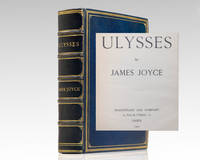
1922151271Paris: Shakespeare and Company 1922. First edition first printing of Joyce's masterpiece one of 750 numbered copies printed on handmade paper from a total edition of 1000 copies this is number 909. Thick quarto bound in full morocco by Baker Bindery with gilt titles and tooling to the spine in six compartments within raised gilt bands triple gilt ruling to the front and rear panels gilt turn-ins and wide gilt scrolled inner dentelles marbled endpapers top edge gilt. In near fine condition. An exceptional example. Ulysses was published in Paris by Shakespeare & Company 1922. It was a struggle for the author to find a publisher a comic irony considering that Ulysses is "universally hailed as the most influential work of modern times" Grolier Joyce 69. Ulysses was an immediate success. The first printing sold out and "within a year Joyce had become a well-known literary figure. Ulysses was explosive in its impact on the literary world of 1922" de Grazia 27. Even so the book faced difficulties in global reception. It was banned in the U.K. and was prosecuted for the obscenity in the Nausicaa episode Ellmann 1982. Joyce's inspiration for the novel began as a young boy reading Charles Lamb's Adventures of Ulysses and writing an essay entitled "My Favorite Hero" after being impressed by the wholeness of the character Goreman 1939. The idea for the novel grew from a story in Dubliners in 1906 which Joyce expanded into a short book in 1907 before reconceptualizing it as the heady novel in 1914 Ellmann 1982. The book can initially seem unstructured and chaotic and Joyce admitted that he "put in so many enigmas and puzzles that it will keep the professors busy for centuries arguing over what I meant" The Observer 2000. The French translator Stuart Gilbert published a defense of Ulysses shortly after its publication in which he supported the novel's use of obscenity and explained its internal structure and links to the Odyssey against accusations of ambiguity. Every episode Gilbert explained is connected to the Odyssey by theme technique and correspondence between characters. Another instance of Ulysses' literary contribution is his use of stream-of-consciousness a technique employing carefully structured prose both humorous and charactering and involving puns and parodies. Joyce was a precursor to the use of stream of consciousness in the later decades. Similar narrative techniques were used by his contemporaries Virginia Wolfe William Faulkner and Italo Svevo. Their style can be better characterized as an "interior monologue rather than stream of consciousness is the appropriate term for the style in which subjective experience is recorded both in The Waves and in Woolf's writing generally" Stevenson 1992. Shakespeare and Company unknown
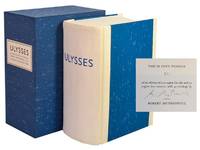
19881734961988. MOTHERWELL Robert. Ulysses. By James Joyce. 838 pp. With 40 etchings by Robert Motherwell of which 20 are in colour. Thick folio 322 x 240 mm. bound in original publisher's white half-pigskin over blue patterned silk over boards in original blue patterned silk box. San Francisco: Arion Press 1988. A fine copy of one of the seminal books produced in America in the twentieth century. Robert Motherwell 1915-1991 a founder of Abstract Expressionism counted Joyce as his favorite modern author and drew upon his writing for titles to his paintings drawings and prints throughout his career. The project was four years in planning and a year and a half in production. Copies with the white pigskin still in fine condition are extremely rare. Edition limited to 150 copies signed by Motherwell on the statement of limitation. The type is Monotype and handset Perpetua printed by letterpress on French mouldmade Johannot. The intaglio printing was done by R. E. Townsend Inc. Georgetown Massachusetts in black and 19 colours on heavier-weight Johannot. Slipcase with a little fading else fine. Arion Press 27. hardcover
191422776London: Grant Richards 1914. A first edition first printing of 'Dubliners' published by Grant Richards in 1914. A very good copy with a touch of spotting to the page edges. Some light dulling to the gilt tiles to the spine and to the front panel and a little browning to the spine. No inscriptions. Scattered spotting to the prelims and to the page edges. Some wear to the extremities and some scattered stains here and there. James Joyce's landmark collection of fifteen short stories portraying ordinary Dublin life in the early 20th century. Through characters trapped by routine poverty and social expectation Joyce explores themes of paralysis epiphany and the quiet struggles of everyday existence. Stories like "Araby" "Eveline" and "The Dead" reveal moments of painful insight that illuminate the gap between aspiration and reality. Written in a clear restrained style 'Dubliners' offers a profound humane portrait of a city and its people on the edge of modernity. Grant Richards unknown
1922841781922. JOYCE James. Ulysses. Modern full morocco with inlaid crushed morocco embossed with novel's title in custom chemise and slipcase. Paris: Shakespeare and Company 1922. First edition of modernist literature's magnum opus. Slocum and Cahoon A17. One of 750 copies on handmade paper this being no. 464. With original front wrapper bound in at the back. Fine. unknown
1922140939492Paris: Shakespeare and Company 1922. First Edition. Near Fine. First trade edition first printing. One of 750 numbered copies from an edition of 1000 total copies this being number 909. Finely bound in full dark blue morocco decorated in gilt with inner dentelles top edge gilt; bound without first two and final blank leaves. Toning to pages. Repairs to gutter and fore edge margin of half-title page three preliminary pages; chip to edge of last two pages the second of which has been repaired. A beautiful copy of Joyce's stream-of-conscious masterpiece which is considered one of the most important works of modernist literature and beyond. Shakespeare and Company unknown books
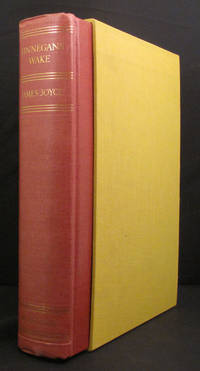
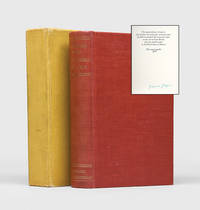
193919769London: Faber and Faber 1939. First Edition First Issue Signed by James Joyce and limited to 425 copies only of which this is number 341. 8vo publisher’s original red buckram lettered in gilt on spine t.e.g. other edges untrimmed. Yellow cloth slipcase expertly re-created as the original. 628. A fine copy very handsome bright and clean very well preserved and without wear. The slipcase in beautiful condition. IMPORTANT FIRST EDITION SIGNED BY JAMES JOYCE. A very desirable copy of this the best and scarcest issue of the first editions. <br> No book has ever been more ambitiously conceived than Joyce’s FINNEGAN'S WAKE. If ULYSSES represents the pinnacle of the Modernist movement FINNEGAN'S WAKE is a step beyond; it stands in the same relation to ULYSSES as ULYSSES does to A PORTRAIT OF THE ARTIST.—an extension which is also a completely new conception. Joyce envisioned the book as nothing less than a "history of the world." Seventeen years in the writing and composed in a sort of meta-language--"an Esperanto for the art of fiction"--it stands as a unique monument to language and literature and the modern age. Slocum and Calhoun A49; Bradbury The Modern World 157-176. About this work he stated “‘I might easily have written this story in the traditional manner. Every novelist knows the recipe.But I after all am trying to tell the story of this Chapelizod family in a new way. Time and the river and the mountain are the real heroes of my book. I am trying to build many planes of narrative with a single aesthetic purpose.’†Ellmann Faber and Faber hardcover
192250307Paris: Shakespeare and Company 1922. First Edition. Hardcover in slipcase. One of 750 numbered copies on handmade paper from a total edition of 1000 copies. This being No. 310. Quarto bound in full blue morocco. The original wrapped are bound in. Near Fine in bespoke slipcase with blue morocco spine five raised bands and gilt lettering. Shakespeare and Company hardcover
1939238469London: Faber & Faber 1939. Limited. hardcover. very good. Tall 8vo original brick red cloth g.t. other edges uncut. London: Faber & Faber 1939. Limited First Edition.<br/><br/> Number 356 of only 425 numbered copies signed by Joyce. There is some residue from tape on the front & back fly-leaves otherwise a nearly fine copy in the original yellow cloth box which has very slight wear on the front edges.<br/><br/> Faber & Faber unknown books
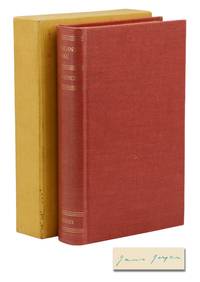
193567248Limited Edition Signed By Henri Matisse and James Joyce JOYCE James. MATISSE Henri illustrator. Ulysses LEC. With an Introduction by Stuart Gilbert and Illustrations by Henri Matisse. New York: The Limited Editions Club 1935. Limited to 250 numbered copies from a total edition of 1500 signed by both James Joyce and Henri Matisse. Quarto 11 11/16 x 9 1/16 inches; 296 x 230 mm. xv 3 363 7 pp. Twenty-six plates by Matisse consisting of six etchings printed by hand and twenty lithographic drawings made as studies for the etchings printed on thin colored papers. Original full brown buckram embossed in gilt on front cover and spine from a design by LeRoy H. Appleton. Top edge speckled brown others uncut. A bit of browning to the inner hinges as usual. An about fine copy. Housed in the publisher's original board slipcase printed on the spine. Some minor wear to the slipcase at corners and edges but better than usually seen. Housed in a custom red half morocco clamshell. "One of the very few American livres de peintres issued before World War II. According to George Macy who undertook this only American publication of Matisse's illustrations he asked the artist how many etchings the latter could provide for five thousand dollars. The artist chose to take six subjects from Homer's Odyssey. The preparatory drawings reproduced with the soft-ground etchings Matisse's only use of this medium record the evolution of the figures from vigorous sketches to closely knit if less spontaneous compositions." The Artist and the Book. The Artist & the Book 197. LEC bibliography 71. Slocum and Cahoon A22. HBS 67248. $20000 The Limited Editions Club hardcover books
1939140948664London: Faber and Faber 1939. Signed Limited Edition. Near Fine. First edition signed limited issue. Number 334 of limited 425 copies signed by James Joyce. 628 pp. Bound in publisher's red cloth with spine lettered in gilt; top edge gilt. In original yellow cloth-covered slipcase. Near Fine with trivial fading to spine. Foxing and soiling to slipcase light edge wear. A handsome copy of Joyce's final linguistically complex novel that took him seventeen years to complete; scarce. Slocum & Cahoon A49. Faber and Faber unknown
193024937Paris and New York:: Babou and Kahane / The Fountain Press 1930. First edition; one of 100 copies on Imperial handmade iridescent Japan signed by James Joyce. publisher's printed wrappers in glassine and publisher's slipcase. A near fine copy. The glassine is very slightly worn in spots. The slipcase has had some internao reinforcement but is complete and attractive. . Small folio. Babou and Kahane / The Fountain Press, unknown
1924139635Paris: Shakespeare and Company 1924. Fourth printing of Joyce's masterpiece signed by him. Quarto original wrappers. Signed by the author in the month of publication on the front free endpaper "James Joyce Paris 7 January 1924." In very good condition the joints lightly repaired. Housed in a custom clamshell box. Uncommon signed. Ulysses was published in Paris by Shakespeare & Company 1922. It was a struggle for the author to find a publisher a comic irony considering that Ulysses is "universally hailed as the most influential work of modern times" Grolier Joyce 69. Ulysses was an immediate success. The first printing sold out and "within a year Joyce had become a well-known literary figure. Ulysses was explosive in its impact on the literary world of 1922" de Grazia 27. Even so the book faced difficulties in global reception. It was banned in the U.K. and was prosecuted for the obscenity in the Nausicaa episode Ellmann 1982. Joyce's inspiration for the novel began as a young boy reading Charles Lamb's Adventures of Ulysses and writing an essay entitled "My Favorite Hero" after being impressed by the wholeness of the character Goreman 1939. The idea for the novel grew from a story in Dubliners in 1906 which Joyce expanded into a short book in 1907 before reconceptualizing it as the heady novel in 1914 Ellmann 1982. The book can initially seem unstructured and chaotic and Joyce admitted that he "put in so many enigmas and puzzles that it will keep the professors busy for centuries arguing over what I meant" The Observer 2000. The French translator Stuart Gilbert published a defense of Ulysses shortly after its publication in which he supported the novel's use of obscenity and explained its internal structure and links to the Odyssey against accusations of ambiguity. Every episode Gilbert explained is connected to the Odyssey by theme technique and correspondence between characters. Another instance of Ulysses' literary contribution is his use of stream-of-consciousness a technique employing carefully structured prose both humorous and charactering and involving puns and parodies. Joyce was a precursor to the use of stream of consciousness in the later decades. Similar narrative techniques were used by his contemporaries Virginia Wolfe William Faulkner and Italo Svevo. Their style can be better characterized as an "interior monologue rather than stream of consciousness is the appropriate term for the style in which subjective experience is recorded both in The Waves and in Woolf's writing generally" Stevenson 1992. Shakespeare and Company unknown
1925131904Paris: Privately Printed 1925. James Joyce's first edition copy of the collected works of Marguerite Finaly compiled by her husband Horace Finaly in her memory and privately printed for distribution to friends; with Joyce's ownership inscription. Octavo bound in full crushed morocco by G. Cretté with gilt titles to the spine silk-watered doublures and endleaves tissue-guarded frontispiece portrait of Marguerite Finaly. One of 150 copies privately printed. Signed and dated by Joyce on the title page "James Joyce Paris 27.xi.1926." Horace Finaly became a close friend of Marcel Proust in Paris and contributed to the magazine La Banquette. He rose to prominence as head of La Banque de Paris et des Pays-Bas from 1919 to 1937 and enabled several major French-American industrial collaborations. He is referred to in Finnegans Wake which Joyce was writing at the time of his inscription: "Play actors by us ever have crash to their gate. Mr.Messop and Mr Borry will produce of themselves as they're twof genitalmen of Veruno Sernior Nowno and Senior Brolano finaly! finaly! all for love of a fair penitent that a she be broughton rhoda's a rosy she. Their two big skins! How they strave to gat her! Such a boyplay!" In very good condition. Housed in a custom marbled slipcase. Rare and desirable from Joyce's personal collection. One of the most influential and important writers of the 20th century Irish novelist James Joyce is best known for his masterworks Ulysses 1922 Portrait of the Artist of a Young Man 1916 and Finnegans Wake 1939. Joyce began working on Finnegans Wake shortly after the 1922 publication of Ulysses. By 1924 installments of Joyce's new avant-garde work began to appear in serialized form in Parisian literary journals transatlantic review and transition under the title "fragments from Work in Progress". The actual title of the work remained a secret until the book was published in its entirety on 4 May 1939. The work has assumed a preeminent place in English literature. Anthony Burgess praised the book as "a great comic vision one of the few books of the world that can make us laugh aloud on nearly every page." Harold Bloom called the book "Joyce's masterpiece" and wrote that "if aesthetic merit were ever again to center the canon Finnegans Wake would be as close as our chaos could come to the heights of Shakespeare and Dante." Listed by Modern Library as one of the 100 greatest novels of the twentieth century. Privately Printed unknown
1930WRCLIT64985Paris: Henry Babou and Jack Kahane 1930. Quarto. Printed wrappers. A fine copy in glassine with some tanning to the spine in edgeworn and slightly marked slipcase with cracks at the front portions of the top and bottom panel joints and with a small poiece of the lower panel detached. First edition deluxe issue. One of one hundred numbered copies on "Imperial hand- made iridescent Japan" signed by the author from a total edition of 685 copies. SLOCUM & CAHOON A41. Henry Babou and Jack Kahane unknown books
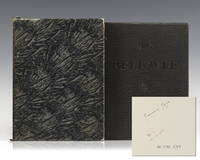
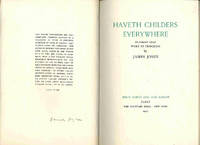
19301282461930. First Edition. Signed. JOYCE James. Haveth Childers Everywhere. Fragment from Work in Progress. Paris: Henry Babou and Jack Kahane; New York: Fountain Press 1930. Slim folio original printed paper wraps uncut and unopened original glassine original gilt chemise and green cardboard slipcase. Housed in a custom chemise and clamshell box. $17500.First edition number 50 of only 100 signed copies on Imperial Hand-Made Iridescent Japan paper out of a total edition of 685 copies. A stunning copy.This is one of several fragments from Work in Progress published in 1939 as Finnegans Wake that Joyce issued to raise money while working on the mammoth project. One of the publishers Jack Kahane who idolized Joyce had originally asked Sylvia Beach to allow him to take over publication of Ulysses. Instead she introduced Kahane to Joyce who then agreed to let him publish Haveth Childers Everywhere. The effort nearly ruined Kahane and only by selling the American rights to the work were he and co-publisher Henry Babou able to save themselves from bankruptcy. When Faber and Faber was preparing the first London editions of Anna Livia Plurabelle and Haveth Childers Everywhere 1930 and 1931 respectively ""Joyce wrote rhymes for the 'blurb' on the dust jacket. The Haveth Childers verse is quoted in this description headline He was a little annoyed when the publicity department used them only on a mimeographed publicity release to which they prefixed a note: 'The Sales department puzzled as such departments are wont to be have sought some light on the two James Joyce contributions to Criterion Miscellany. Below the explanations offered are passed on that you may be able to derive similar enlightenment"" Ellmann 617n. Slocum and Cahoon A41. A beautiful fine copy in a slightly worn slipcase. paperback
19227586Paris: Shakespeare and Company 1922. First edition. Very Good . One of 750 copies on handmade paper from the wider first edition limitation of 1000 copies. Based on Sylvia Beach's records it has been asserted that out of the three issues of the first edition this one was sent out first. This copy marked as number 482. Modern blue half morocco gilt over marbled boards bookplate of Giles Alexander Esme Gordon to front pastedown. Front free endpaper with some marginal restoration a few small unrestored closed tears to preliminary leaves a little occasional foxing a few gatherings a little roughly opened. Housed in a custom morocco-backed clamshell case. A Very Good copy. <br /> <br /> Arguably the key text of the Modernist movement. "Joyce not to mince words is Ireland's Shakespeare its Goethe its Racine its Tolstoy" John Sutherland. The book also proved to be a major test case for laws of freedom of expression. "Forced underground by censors this was a cryptoclassic already before it was read a subversive colossus" Sherry. <br /> <br /> Provenance: Giles Gordon was a literary agent and writer working for publishers Secker & Warburg and Gollancz the latter as Editorial Director before representing writers such as Peter Ackroyd and Vikram Seth. <br /> <br /> Slocum and Cahoon A17. 7586. Very Good . Shakespeare and Company unknown
1988206010San Francisco CA: The Arion Press 1988. First edition thus. Hardcover. 835 pages. Number 82 of only 150 from a total edition of 175 with 25 hors commerce copies. The twenty-seventh publication from the Arion Press and widely considered their most sought after book. Designed by Andrew Hoyem with assistance from several others and done with the Eric Gill designed Perpetua monotype and printed on two different weights of French mould-made Johannot paper. Features Joyce's dense novel accompanied by forty etchings - 18 chapter numbers and 22 color illustrations by Robert Motherwell. A fine copy in blue cloth boards with white pigskin spine and in a very near fine cloth covered slipcase with printed paper spine label. Signed by Motherwell on the limitation page. The blue binding and slipcase are likely a nod to the original Shakespeare and Company edition. An exquisite production of one of the most important novels of the 20th century. The Arion Press unknown
1939171352London: Faber & Faber; Viking Press New York 1939. His final and most experimental work First edition signed limited issue number 366 of 425 copies signed by the author printed on handmade paper and specially bound; complete with the publisher's slipcase. The limitation was split between the British and American markets and sold simultaneously with the trade issues on 4 May 1939. "The most conspicuous innovation of Finnegans Wake is its use of 'dream-language'. After Ulysses Joyce believed that he had 'come to the end of English' and his last novel is a pervasive layering of multilingual puns in successive drafts which produces a fabric rich in semantic possibilities" ODNB. Large octavo. Original red buckram spine lettered and ruled in gilt top edge gilt other edges uncut leaves unopened. Housed in publisher's yellow cloth slipcase. Later compliments slip from Patricia MacManus 1914-2005 of the Viking Press marking the publication of Steinbeck's East of Eden on 19 September 1952 loosely inserted. Spine very gently sunned and bumped at foot minor rubbing internally clean; lightly soiled slipcase with wear to edges and two short splits: a near-fine copy. Burgess 99 Novels: The Best in English Since 1939 p. 25; Connolly The Modern Movement 87; Slocum & Cahoon A49. hardcover
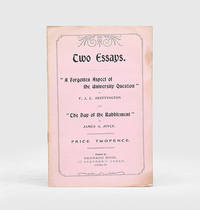
1519183717Dublin: privately printed by Gerrard Bros. 15 October 1901. His first obtainable publication First edition of the author's first obtainable separate publication a plea for the freedom of the theatre published when he was 19. This copy is from the library of the 3rd Viscount Esher Oliver Brett 1881-1963 with his bookplate on the chemise. Joyce was a student at University College Dublin in 1901 when he penned The Day of the Rabblement. The essay and one advocating female equality within the university by Joyce's schoolmate F. J. C. Skeffington A Forgotten Aspect of the University Question were both rejected by the University College newspaper. In the case of Joyce's essay this was because he mentioned D'Annunzio's Il Fuoce which was on the Index librorum prohibitorum while Skeffington's essay was rejected owing to its radical content. Instead the two paid to have the essays published as a pamphlet in a small run which they hand-delivered. The exact number of copies printed is not recorded but was surely small. The figure cited in the 1933 Catalogue of Rare Books by the Ulysses Bookshop is as low as 85 while Skeffington's son estimated a run of around 100 to 200 copies Slocum & Cahoon. Only a small number of these were preserved since Joyce did not reach any degree of literary fame for many years. In the essay Joyce attacks the Irish theatre for catering to popular tastes and promotes free expression. "Joyce was stirred by a group of fellow university students - the 'rabble' of the title - signing a letter of protest on political and religious grounds against the Irish Literary Theatre's first performance of The Countess Cathleen by W B Yeats. Joyce critiques the Irish Literary Theatre for its response to the protest which Joyce claims saw them bow to public pressure and 'prejudice' and become 'shy of presenting Ibsen Tolstoy or Hauptmann'. In Joyce's opinion the work of these three European writers was profound innovative and worthy of attention. Significantly the essay shows Joyce upholding the principle of artistic freedom and condemning censorship in all its forms - an outlook that he would maintain throughout his career" British Library 'The Day of the Rabblement'. Joyce's only previously published works were Et Tu Healy! a pamphlet printed by his father when he was aged nine of which no known copies survive and an article on Ibsen included in the Fortnightly Review April 1900. Octavo 8 pp. Original pink wrappers printed in black. Housed in a custom yellow cloth chemise. Front wrapper slightly toned at edges rear wrapper browned else clean. A very good copy. Slocum & Cahoon B1. hardcover
1914751London: Grant Richards LTD 1914. First Edition First Impression. Publisher's Gilt Stamped Maroon Cloth. Good. A Good Book Without its Issued Dust Jacket. Front board has a vertical crease down the entirety of the board affecting exterior and interior. Extremities generally rubbed and bumped. Cloth scuffed and soiled spine darkened. Bump to top right corner has rolled the first few leaves of text block. Text block toned and mildly soiled. Minor paper damage to several various leaves along top edge text unaffected. Evidence of a dog-ear to leaf 129/130. Gutter visible between 144 145 and again at 224 225. Last blank page shows shadows possibly from thin post-it strips. vi 7-278pp. One of 746 Copies Bound for Grant Richards of 1250 copies printed. An exceptionally scarce volume of Joyce's first major published work. Grant Richards LTD unknown