MareMagnum
MareMagnum
L'ILLUSTRAZIONE ITALIANA. 5 Ottobre 1902. Anno XXIX - N. 40.
In-4, brossura. In buono stato di conservazione. In questo numero: “Emilio Zola”.

Bottega delle Occasioni · Milano, IT9,90 €
3 265 résultats
In-4, brossura. In buono stato di conservazione. In questo numero: “Il processo Zola alla Assisie di Parigi”.
In-4, brossura. In buono stato di conservazione. In questo numero: “Emilio Zola”.
In-folio, pp. 12 (da pag. 485 a 496), con due illustrazioni a colori a piena pagina raffiguranti “La morte di Emilio Zola” e “Un bambino torturato dalla madre a Napoli”. All'interno articoli riguardanti: “I funerali di Emilio Zola"; "Cronaca femminile: Emilio Zola poeta"; "L'ultima scoperta per la granicoltura. Intervista col signor Croppi"; "Un bambino torturato a Napoli: Elvira Panico maltratta il figlioletto Ugo"; "I lavori intorno al campanile di San Marco a Venezia", con 3 illustrazioni fotografiche; "Il più giovane dei giganti: Eduardo Beaupré", con illustrazione fotografica; "Il re dei bottoni: M. Croft di Somers Town", con illustrazione fotografica; "Il massaggio agli elefanti", con illustrazione; "La carne nell'alimentazione umana. Una bistecca in una pillola"; "In morte di Emilio Zola", con 11 illustrazioni fotografiche raffiguranti "Fac-simile della sua scrittura", "Villa Zola a Medan", "E. Zola prende delle fotografie nel parco di Medan", "Ingresso della villa Zola", "E. Zola e il cagnolino Lulù", "E. Zola in bicicletta", "Casa di E. Zola nella Rue Bruxelles a Parigi", "La signora Alessandrina Zola", "Sala da biliardo nella casa di Zola a Parigi", "Camera da letto di E. Zola", "La salma di E. Zola nella camera mortuaria"; "Il nubifragio di Modica", con 6 illustrazioni fotografiche; "Un nuovo sport americano: il Push-Ball", con illustrazione fotografica; "Per incidere sul vetro", con illustrazione. Normale patina del tempo alle pagine, qualche leggero segno d'umido, per il resto, ben conservato. Fascicolo completo proveniente da rilegatura.
Le procès Zola. 7 février - 23 février 1898 devant la cour d'assise de la Seine.. , Stock 1998 , Ottime condizioni. Copertina morbida. Pagg. 1015. LF66
25x25 cm, brossura illustrata con risvolti; pp. 54, numerose illustrazioni e foto a colori nel testo
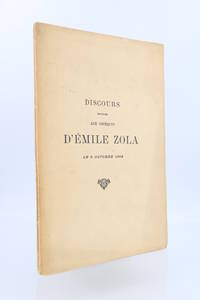
190291912Paris: Eugène Fasquelle 1902. Fine. Eugène Fasquelle Paris 1902 16.7 x 26 cm Broché First edition printed in a small number on Dutch paper. Spine and covers lightly sunned small tears to the spine final endpapers browned. Speeches by M. Chaumié Anatole France and Abel Hermant. Autograph inscription signed by Eugène Fasquelle to Marcel Batilliat whose name he misspelled: ""à M. Marcel Batillat."" The Symbolist novelist Marcel Batilliat was a close friend of Émile Zola and campaigned to preserve the memory of the author of the Rougon-Macquart cycle. Eugène Fasquelle unknown
193244553Paris: Editions du Trianon 1932. Fine. Editions du Trianon Paris 1932 11.50 x 17.50 cm broché First edition one of 800 numbered copies on Auvergne paper. Autograph inscription signed by André Thérive to Emile Mireaux "". qui a gardé sûrement le goût des canulars"" "". who surely retained his taste for hoaxes"". Spine and first cover uniformly faded as usual second cover marginally faded handsome interior condition. Editions du Trianon unknown
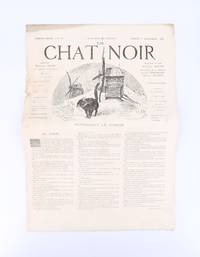
188788816Paris: Au cabaret Le Chat noir 1887. Fine. Au cabaret Le Chat noir Paris 3 septembre 1887 31 x 45 cm en feuillets First edition one of the rare copies printed on laid paper. This four-page issue features a comic strip by Louis-Christian known as Döes: ""La bonne galette"". Includes literary contributions by Francisque Sarcey on ""La Terre"" by Emile Zola Charles Cros ""Psaume CCCCXXXIV"" Alfred Béjot ""Épitre à Allais"" Georges Auriol ""Malabar"" among others. One tear with loss and some light staining to the margins of the covers. Le Chat Noir was a weekly review founded by Rodolphe Salis and Emile Goudeau published from 1882 to 1897 intended to promote the famous cabaret of the same name and to serve as its chronicle. It featured the texts recited during performances and constitutes an important literary and artistic record of late 19th-century bohemian life and the unique vibrancy of Paris during that era. Au cabaret Le Chat noir unknown
189621947Paris & Bruxelles Brussels: SeghersA. Manceaux 1896. Fine. Seghers A. Manceaux Paris & Bruxelles Brussels 1896 16.50 x 25.50 cm broché First edition of which no deluxe copies are mentioned. Spine split one joint cracked at head and foot otherwise a rare and handsome copy. SeghersA. Manceaux unknown
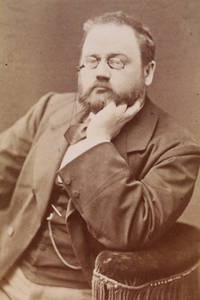
187072935Paris: Ernest Ladrey 1870. Fine. Ernest Ladrey Paris 1870 6.50 x 10.50 cm une photographie Very rare original albumen photograph in carte-de-visite format mounted on yellow cardboard with red border. Manuscript annotation on verso. The address at Passage des Princes on the back of the photograph indicates that the photograph was taken before 1875. Handsome copy of this photograph of the writer with his lorgnette and beard. Ernest Ladrey unknown
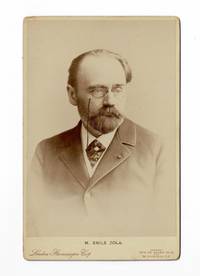
190073358Londres London: London Stereoscopic Company 1900. Fine. London Stereoscopic Company Londres London 1900 10.70 x 16.60 cm une photographie au format carte cabinet Handsome original photographic portrait of Emile Zola in cabinet card format period print on albumen paper mounted on cardboard from the London Stereoscopic Company and taken by an unidentified photographer. The writer poses there rosette of the Legion of Honor at his buttonhole. Condemned for defamation after the publication of his famous ""J'Accuse!"" on the front page of L'Aurore and to escape prison Zola secretly fled to London on July 18 1898. On July 26 1898 the Legion of Honor was withdrawn from him. A snub to this France that did not understand him this ""rosette"" photograph was most likely taken after his removal from the order of the Legion of Honor. Exceptional state of conservation. London Stereoscopic Company unknown
189822226Paris: La Revue Blanche 1898. Fine. La Revue Blanche Paris 1er Mars 1898 17.50 x 26 cm broché First edition presented under double cream wrappers one of the rare copies on Holland paper from a very small print run whose number is not specified the only deluxe copies. Contributions by G. Kahn J. de Mitty J.P. Jacobsen on the plague in Bergamo tribute from the Revue Blanche to Emile Zola for the condemnation he faced in the verdict of February 23 1898 regarding the Dreyfus affair. Minor marginal worming without consequence to the covers of the double wrappers handsome copy. Rare. La Revue Blanche unknown
188720546Paris: Extrait de La Revue des deux mondes 1887. Fine. Extrait de La Revue des deux mondes Paris 1887 15.50 x 25 cm agrafé First edition. Plain paper cover. Rare. Extrait de La Revue des deux mondes unknown
190014035Paris: Imp. A. Eyméoud 1900. Fine. Imp. A. Eyméoud Paris s. d. circa 1900 11 x 16.50 cm agrafé First edition. Three small marginal lacks to the slightly faded front cover handsome interior condition. Rare. Imp. A. Eyméoud unknown
190016528Paris: Imp. A. Eyméoud 1900. Fine. Imp. A. Eyméoud Paris s. d. circa 1900 11 x 17 cm agrafé First edition. A good copy. Imp. A. Eyméoud unknown
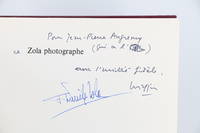
197987588Paris: Denoël 1979. Fine. Denoël Paris 1979 21.50 x 27.50 cm reliure de l'éditeur The first edition of which there were no deluxe copies. Work illustrated with 480 documents selected and presented by François Emile-Zola and Massin. Handsome copy despite light foxing to edges. Publisher's full red cloth binding smooth spine complete with illustrated dust jacket. Autograph inscription signed by Massin with a small drawing of an eye to the Immortal Pierre-Jean Rémy nom de plume of Jean-Pierre Angremy: ""Pour Jean-Pierre Angremy qui a l'oeil avec l'amitié fidèle Massin."" ""For Jean-Pierre Angremy who has the eye with faithful friendship Massin."" with the manuscript signature of François Emile-Zola. Denoël hardcover
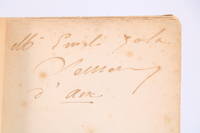
187590869Paris: Ernest Leroux 1875. Fine. Ernest Leroux Paris 1875 1879 12.2 x 11.8 cm Broché Second edition the dedication to Pierre Laffitte is dated 1879. A study of madness from a positivist perspective based on the work of Auguste Comte. The dedicatee Pierre Laffitte was the editor of the review ""Le Positivisme"". Spine cracked with small losses occasional foxing and a horizontal crease at the foot of the upper cover small marginal tears on the cover firts cover reattached. With a fine signed presentation inscription from Emile François Eugène Sémérie to Émile Zola on the half-title: ""A Mr. Émile Zola. Sémérie d'Aix"" the final word underlined. The close connections between positivism and naturalism the literary doctrine developed in the 1860s1880s are well known: positivist philosophy the observation of reality and the primacy of experience influenced naturalist writers in their concern to depict reality with strict objectivity. Zola made an essential contribution to the movement with his study ""Roman expérimental"" 1880. Ernest Leroux unknown
Zola Predosa, 2002, 8vo quadrato (cm. 22 x 22) punto metallico con copertina illustrata a colori, pp. 46 riccamente illustrate da fotografie a colori. Stato di nuovo.
Bologna, 1848, lugllo 10, Tip. alla Volpe, bando di cm. 30 x 42, Stato Pontificio. Provincia di Bologna. Comune di Zola Predosa.
Bologna, 1842, luglio 27, Governo Pontificio. Provincia di Bologna. Il Priore della Comune di Zola Predosa, Gio. Calzolari. Di cm. 21,5 x 31. A firma Negroni.
45384138like new. unknown
1998G1573922056I5N00Prometheus Books Publishers 1998. Paperback. Acceptable. Disclaimer:Readable copy. Pages may have considerable notes/highlighting. ~ ThriftBooks: Read More Spend Less.Dust jacket quality is not guaranteed. Prometheus Books, Publishers paperback
2845950012.Gpaperback. Good. Access codes and supplements are not guaranteed with used items. May be an ex-library book. paperback
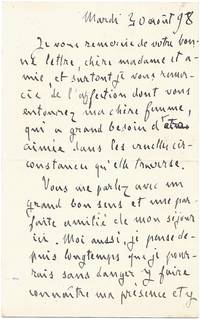
1898ZolaDreyfusAffair1<p><strong>AFFAIRE DREYFUS ZOLA Émile 1840-1902</strong></p><p>Autograph letter signed " Z " to Alice Mirbeau<br />N.p Addlestone Tuesday 30th August 1898 4 p. in-8° on laid paper<br />Central fold reinforced with Japan paper light browning lower margin stain on second folio see scans</p><p><strong>Letter from exile testifying to the writer's unwavering commitment to the Dreyfus affair</strong></p><p><em>" Je vous remercie de votre bonne lettre chère madame et amie et surtout je vous remercie de l'affection dont vous entourez ma chère femme qui a grand besoin d'être aimée dans les cruelles circonstances qu'elle traverse.<br />Vous me parlez avec un grand bon sens et une parfaite amitié de mon séjour ici. Moi aussi je pense depuis longtemps que je pourrais sans danger y faire connaître ma présence et y prendre une attitude que je saurais rendre utile et <strong>digne. Mais il y a aussi l'autre parti celui de rentrer en France et d'y faire mon devoir jusqu'au bout. Je ne puis donc encore me prononcer j'attends l'avis de nos amis et j'attends aussi les évènements</strong>. De toutes façons d'ailleurs je ne puis guère rentrer avant la fin d'octobre car je désire que la chambre soit réunie et qu'on ait liquidé toutes les autres affaires pendantes.<br />Vous me touchez infiniment en m'offrant vos services dévoués ici et même à Paris. Ici le mieux est que je vive encore ignoré travaillant en paix dans une solitude dont personne le connaît le chemin. Mon travail que j'ai repris régulièrement m'est un grand repos. À Paris certes si j'avais besoin de vous je serais fort heureux de me confier à votre dévouement et à votre discrétion.<br /><strong>Les infamies s'entassent cela devait être. C'est avec un serrement douloureux de cœur que je songe à la pure victime</strong></em> <strong><em>qu'ils vont encore condamner ; et cela ne me donne qu'une passion celle du sacrifice la volonté de m'immoler moi-même.<br /></em></strong><em>Embrassez bien tendrement votre cher mari. Je sais tout ce qu'il fait pour vous et j'en suis profondément ému.<br />Merci encore chère madame et amie et mille bonnes affections.<br />Z "</em></p><p>Convicted definitively on appeal on July 18 1898 by the Versailles court Zola left France to return to England. His open letter "J'accuse…!" published in <em>L'Aurore</em> on January 13 1898 earned the writer a fine of 3000 francs and 1 year of imprisonment. Committed body and soul to the defense of Captain Dreyfus Zola was forced into exile by Clemenceau and Labori and at the same time into silence. Kept away from the Parisian furnace prey to all the passions surrounding the affair Zola sometimes lets glimpse from England like this letter a share of frustration at no longer being at the center of the chessboard.<br />Regarding the support he received from his close friends the writer could count on that of Octave Mirbeau a Dreyfusard from the very beginning. The latter whose role has long been underestimated was one of the most influential defenders of Captain Dreyfus and Zola. After taking a public stand for the first time in an article in the Journal of 28 November 1897 two days after Zola's first article it was Mirbeau who in July 1898 paid out of his own pocket the entire fine to which Zola was sentenced on appeal in Versailles. Two weeks after Zola's conviction he wrote in L'Aurore on 2 August 1898:<br />" Will not professors philosophers scholars writers artists all those in whom truth resides from all parts of France finally free their souls from the terrible weight that oppresses them Faced with these daily challenges to their genius their humanity their spirit of justice their courage will they not finally understand that they have a great duty… that of defending the heritage of ideas of science of glorious discoveries of beauty with which they have enriched the country of which they are the guardians… "</p><p>We know the letter of support that Alice Mirbeau committed to her husband sent to Zola on August 24 and to which the writer replied above: " Despite the pain I feel in knowing how much you suffer from your isolation I persist in believing that you must find the strength to wait and that at no cost should the end be hastened. Certainly prison where all those who love you could come and embrace you would be sweeter for you and for your friends but you must not abandon everything especially now that there is a new victim on the eve of being so harshly struck. … I am very happy that you have resumed your work it will console you a little because you must persist … If I can do you any pleasure soften your captivity a little by a few steps for anything that you would like to be done use me I beg you I put my tenderness at your service and I will be happy to use myself to be agreeable to you…"</p><p>At the time he wrote this letter Zola did not yet know it but the affair was about to change on this August 30. After having completed the Dreyfus file with a piece that he himself had forged Commander Henry confessed after his forgery was discovered by Captain Cuignet military attaché to Minister Cavaignac. Taken immediately to detention at Mont Valérien Henry committed suicide the next day in his cell his throat slit with a razor. Already imprisoned at La Santé in July 1898 Picquart was again imprisoned at Cherche-Midi prison on September 22 proving Zola's prediction right.</p><p><u>Provenance:<br /></u>Collection particulière</p><p><u>Bibliography:<br /></u><em>Correspondance</em> éd. Maurice et Denise Leblond Bernouard 1929 t. II p. 811<br /><em>Correspondance</em> t. IX éd. du CNRS p. 285-286 n°186</p>
186782102Paris:: E. Dentu 1867. First edition. handsome later half morocco and marbled sides t.e.g.; elaborately gilt spine. Some extremely light marginal foxing to the margins of the text; original etching of Olympia and the portrait fine; binding fine. . 8vo. Accompagnee d'un portrait d'Ed. Manet par Bracquemond et d'une eau-forte d'Ed. Manet d'apres Olympia. E. Dentu, unknown