6 560 résultats
187779046L'Estaque - Marseille 22 septembre 1877 | 13.30 x 20.80 cm | 3 pages 1/2 sur un double feuillet
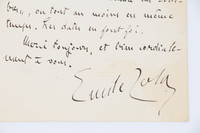
189084423Paris 20 Février 1890 | 13.50 x 20.50 cm | une page
18988675015 décembre 1898 | 13.50 x 20.50 cm | quatre pages sur un bifeuillet
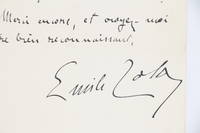
189886837[Weybridge] 19 août 1898 | 13.50 x 20.50 cm | quatre pages sur un bifeuillet
189886837Weybridge 1898. Fine. In the midst of universal cowardice you wouldn't believe how moved I am to feel a few faithful people around me Weybridge 19 août 1898 13.50 x 20.50 cm quatre pages sur un bifeuillet Autograph letter signed by Emile Zola to Octave Mirbeau dated August 19 1898. Four pages in black ink on a bifolium written to Octave Mirbeau. Usual trace of horizontal fold. Published in Zola's uvres complètes t. XLIX ed. F. Bernouard 1927 p. 808. Exceptional testament of friendship and self-sacrifice from Emile Zola in exile after being sentenced to the maximum penalty for writing ""J'accuse!"" the most famous article proclaming Captain Dreyfus's innocence. After his historic article in L'Aurore Zola was sentenced a first time by a jury on February 23 1898 to one year's imprisonment and a fine of three thousand francs. The verdict was overturned and the case was referred back to the Versailles court of justice which upheld only three of the eight hundred lines in ""J'accuse!"" as a charge. Unwilling to accept such a stifling of the proceedings Zola's defense decided to default and the conviction was upheld. After his eventful exit from the courthouse Clémenceau and his lawyer Labori advised him to leave the country before the judgment could become enforceable. Zola left on the last train that evening with only a shirt hastily rolled up in newspaper as luggage. A month after his departure the writer writes this superb reply to a letter from his loyal supporter Octave Mirbeau who had written to him a few days earlier: ""We think only of you; there isn't a minute of our existence that you don't fill entirely"" August 14 1898. Settled in the London suburb of Weybridge he angrily receives the ""echoes of Paris"" and is enraged to see Esterhazy the true culprit of the Dreyfus Affair once again cleared - this time by civil courts. ""My dear friend Thank you for your kind letter . In the midst of universal cowardice you wouldn't believe how moved I am to feel a few faithful people around me. My existence here has become possible since I've been able to get back to work. Work has always comforted me saved me. But my poor hands are still trembling with a shiver that cannot end. You wouldn't believe the outrage I feel at the echoes from France that reach me. In the evening when daylight falls I think it's the end of the world. You think I should go back and make myself a prisoner without returning to Versailles. That would be too good to have the peace of prison and I don't think it's possible. I didn't set out to go back like that; our attitude would be neither logical nor beautiful. Rather I think I'm in indefinite exile unless I run the abominable risk of a new trial. Besides we won't be able to make up our minds until October. And by then who knows Although I'm counting on a miracle in which I have little faith. So let us be brave my friend and let our work be done! If I can keep working things won't be too bad yet. . I shake your hand my good friend the faithful and rare friend of bad days"". Poignant manuscript confession from Zola forced into exile. Death would strike him in the midst of his glory days without him ever knowing the outcome of the affair he had devoted so many years of struggle. unknown
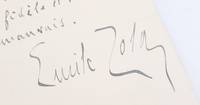
188279108Médan 1882. Fine. Médan 23 juin 1882 13.40 x 21.60 cm 1 page 1/2 sur un double feuillet - enveloppe jointe Autograph letter signed by Emile Zola - apparently unpublished - addressed to Léon Carbonnaux written in black ink on a double sheet. Folds inherent to mailing. Envelope included. Important testimony to the colossal documentation work and the capital role of Emile Zola's informants in depicting his immense natural and social fresco. This letter was sent to Léon Carbonnaux department head at Bon Marché who transmitted precious information to Emile Zola for the creation of the eleventh volume of the Rougon-Macquart series: Au Bonheur des Dames. Only two letters from Léon Carbonnaux to Emile Zola are known: they can be consulted in the digitization of the preparatory file for Bonheur des Dames made available online by the Bibliothèque nationale de France. However we know thanks to this same file which contains a long section entitled ""Notes Carbonnaux"" that this department head at Bon Marché provided a significant amount of information to Zola particularly about employee customs and their remuneration. The two men undoubtedly met when Emile Zola eager for information about the functioning of department stores conducted field research in February and March 1882. This response would therefore be the very first that the writer addressed to the department head in reply to his letter of June 19 1882. Far from imagining the keen success that this new novel would achieve Zola even seems to take it lightly: ""Je désire simplement toucher au sujet dans mon livre pour le besoin du petit drame commercial qui me sert de fable. Vos notes sont excellentes. . Enfin me voilà au travail. Le sujet est à la fois bien vaste - et bien ingrat pour un roman. On devra me tolérer un peu de fiction car il faut bien que je passionne la matière. Mais je tâche de m'en tenir le plus strictement possible à mes notes."" ""I simply wish to touch on the subject in my book for the needs of the little commercial drama that serves as my fable. Your notes are excellent. . Finally here I am at work. The subject is both very vast - and very thankless for a novel. One will have to tolerate a bit of fiction from me for I must make the material passionate. But I try to stick as strictly as possible to my notes."" It must be said that Carbonnaux takes his role as informant very much to heart and having no doubt about the book's success he writes: ""Dans le bâtiment chez nous d'ailleurs partout on attend votre livre. Les lecteurs ne vous manqueront pas. Soyez-en sûr. Vous n'en êtes plus à compter les succès celui-là s'annonce comme devant dépasser les autres."" letter of June 19 1882 For another work on the same subject has just appeared: ""J'ai lu le volume de Pierre Giffard. Il me paraît comme vous injuste et même faux dans plusieurs parties. C'est bâclé. Il aurait fallu pour un pareil ouvrage de documents purs une entière exactitude. Moi qui écris une uvre d'imagination je ne me permettrai pas de tels écarts."" ""I have read Pierre Giffard's volume. It seems to me like you unjust and even false in several parts. It is hastily done. For such a work of pure documents complete accuracy would have been necessary. I who write a work of imagination would not allow myself such deviations.""It was Carbonnaux who had pointed out the work to Zola: ""Pierre Giffard du Figaro vient de faire paraître chez Havard un vol de 300 pages intitulé « Les Grands bazars de Paris ». . On sait que le Figaro est inféodé au Louvre magasin concurrent au Bon Marché & on peut assurer que ce livre a été commandé et bâclé dès que votre intention de traiter le même sujet a été connue. . Il fallait déguiser un peu la réclame pour le Louvre."" letter of June 19 1882 We can clearly see here how much department stores fascinate and we understand the immense success that this novel by Zola describing their advent and supremacy would achieve. unknown
188879098Paris 1888. Fine. Paris 11 février 1888 13.20 x 20.50 cm 2 pages sur un double feuillet Autograph letter signed by Emile Zola addressed to Henry Fouquier written in black ink on a bifolium. Usual folds from mailing. This letter was transcribed in the complete correspondence of Emile Zola published by the CNRS and the Presses de l'Université de Montréal. A fine letter evoking La Terre and Tolstoy's The Power of Darkness. Henry Fouquier 1838-1900 was a literary critic and columnist for numerous newspapers. A close friend of Guy de Maupassant he supported Emile Zolas candidacy for the Académie française. This letter was written to him the day after the performance of Tolstoy's The Power of Darkness at the Théâtre-Libre. We have not found evidence of an article in which the journalist explicitly drew a parallel between the Russian drama and Zolas La Terre but Zola here addresses his thanks: « Merci mon cher Fouquier de ce que vous voulez bien dire de « la Terre » si attaquée. J'en suis touché vivement et croyez à toute ma gratitude. » It must be said that the fifteenth volume of the Rougon-Macquart cycle was harshly received unleashing passions from the moment of its serial publication in Gil Blas. On 18 August 1887 even before the conclusion of the novel was revealed to the public Le Figaro published the Manifeste des Cinq written by Paul Bonnetain J.-H. Rosny Lucien Descaves Paul Margueritte and Gustave Guiches. These young authors issued a severe verdict: « La Terre a paru. La déception a été profonde et douloureuse. Non seulement l'observation est superficielle les trucs démodés la narration commune et dépourvue de caractéristiques mais la note ordurière est exacerbée encore descendue à des saletés si basses que par instants on se croirait devant un recueil de scatologie : le Maître est descendu au fond de l'immondice. . Nous répudions ces bonshommes de rhétorique zoliste ces silhouettes énormes surhumaines et biscornues dénuées de complication jetées brutalement en masses lourdes dans des milieux aperçus au hasard des portières d'express. De cette dernière uvre du grand cerveau qui lança L'Assommoir sur le monde de cette Terre bâtarde nous nous éloignons résolument mais non sans tristesse. Il nous poigne de repousser l'homme que nous avons trop fervemment aimé. » Zola who had been developing the idea of a peasant novel for a decade was deeply affected. Though he never responded publicly to these accusations his correspondence is strewn with clarifications about the work whose sheer brutality alone seemed to occupy readers minds: « Mais vous ajoutez que notre thèse à Tolstoï et à moi est la même et peut se résumer en ceci : le travail de la terre est corrupteur. Tolstoï il me semble protesterait bien haut et quant à moi je vous affirme que je n'ai jamais voulu prouver une telle chose radicalement fausse à mon avis. Ce que je pense c'est que la petite propriété telle qu'elle existe chez nous c'est que la suite de faits sociaux qui ont abouti à notre forme sociale nous ont donné notre paysan d'aujourd'hui avec ses qualités et ses vices. Notre paysan est le prisonnier de sa terre et non l'homme libre qu'il devrait être. Comment voulez-vous qu'il n'y étouffe pas dans son ignorance et sa passion unique Labourer est très sain mais à la condition qu'on sera le maître de son champ au lieu d'en être le forçat. Je me suis exténué à faire sortir cette vérité de mon livre si l'on ne m'a pas compris la faute en est sans doute à moi. » A remarkable letter from the master of Naturalism shedding new light on one of the most brutal volumes of the Rougon-Macquart series. unknown
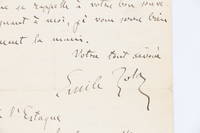
187779046L'Estaque - Marseille Marseille 1877. Fine. L'Estaque - Marseille Marseille 22 septembre 1877 13.30 x 20.80 cm 3 pages 1/2 sur un double feuillet Autograph letter signed by Emile Zola addressed to Louis-Edmond Duranty written in black ink on a double leaf. Some deletions and corrections; folds inherent to postal transmission. This letter has been transcribed in the complete correspondence of Emile Zola published by the CNRS and the Presses of the University of Montreal. Long letter evoking the heat wave at L'Estaque Une page d'amour and Edouard Manet. ""Il y a quatre mois que nous sommes ici et je vous avais promis de vous écrire. Mais j'ai tant travaillé et j'ai eu si chaud que vous m'excuserez de mon apparente paresse. Imaginez-vous que jusqu'au 15 août la température a été très agréable ; il faisait beaucoup moins chaud qu'à Paris et nous respirions chaque soir une brise de mer délicieuse. Puis voilà que brusquement lorsque je nous croyais hors de toutes mauvaises plaisanteries de la chaleur le thermomètre est monté à 40 degrés et s'y est maintenu nuit et jour. Nous avons ainsi passé deux semaines intolérables. Aujourd'hui la fraîcheur est revenue et nous allons rester jusqu'aux premiers jours de novembre pour jouir des charmes d'un bel automne."" ""We have been here for four months and I had promised to write to you. But I have worked so much and have been so hot that you will excuse my apparent laziness. Imagine that until August 15th the temperature was very pleasant; it was much less hot than in Paris and we breathed each evening a delicious sea breeze. Then suddenly when I thought we were safe from all the nasty tricks of the heat the thermometer rose to 40 degrees and stayed there night and day. We thus spent two unbearable weeks. Today the coolness has returned and we will stay until the first days of November to enjoy the charms of a beautiful autumn."" In this summer of 1877 Zola left the tumultuous capital for a five-month stay at L'Estaque ""banlieue de Marseille"" ""suburb of Marseille"" in the company of his wife Alexandrine and his mother Emilie Aubert. This long southern interlude reminded him of his youth in Aix: ""Je suis d'ailleurs enchanté de mon été. Les pays est splendide et me rappelle toute ma jeunesse."" ""I am moreover delighted with my summer. The country is splendid and reminds me of all my youth."" ""Pour finir avec moi j'ajouterai que j'ai travaillé vigoureusement à mon roman sans pourtant l'avancer autant que je l'aurais voulu. Ce roman doit paraître dans le Bien Public à partir du 14 novembre. J'en serai quitte pour donner encore un vigoureux coup de collier à Paris."" ""To finish with myself I will add that I have worked vigorously on my novel without however advancing it as much as I would have liked. This novel must appear in the Bien Public starting November 14th. I will have to give another vigorous push in Paris."" The new novel in question here is Une page d'amour whose plot and style contrast completely with the previous volume of the Rougon-Macquart: ""Je ne sais vraiment pas ce que vaut mon travail. J'ai voulu donner une note absolument opposée à celle de L'Assommoir ce qui me déroute parfois et me fait trouver mon roman bien gris. Mais je vais tout de même bravement mon chemin. Il faudra voir."" ""I really don't know what my work is worth. I wanted to give a note absolutely opposite to that of L'Assommoir which sometimes disconcerts me and makes me find my novel quite gray. But I am nonetheless bravely going my way. We will have to see."" But this ""page of love"" conceals another and during this stay in the Marseilles furnace Emile Zola was already thinking about the following volume: ""What is simmering in his southern pot is nothing less than a new bomb. Not Une page d'amour: 'it is a work too gentle to excite the public.' But Nana is already announced: 'I dream here of an extraordinary Nana. You will see that.' letter to Marguerite Charpentier of August 21 1877"" Henri Mitterrand Zola Even t unknown
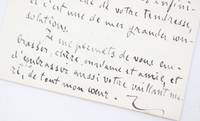
1898867501898. Fine. ""The nervous and passionate man that I am is not made for exile for resignation and silence"" 15 décembre 1898 13.50 x 20.50 cm quatre pages sur un bifeuillet Autograph letter initialed by Emile Zola dated in his hand April 10 1898. Four pages in black ink on a bifolium addressed to Octave Mirbeau's wife. Horizontal fold mark inherent to mailing very rare and discrete foxing on the first leaf. A particularity of this exile correspondence Zola chose to omit his signature in his letters - or as here to initial only protecting himself from censorship or police investigations. Published in his Complete Works vol. XXV ed. F. Bernouard 1927 p. 820. Heart-wrenching letter by Zola written in complete exile the most unknown retreat the most absolute silence. The justiciar writer is secluded in England forced to leave Paris after being condemned to the maximum penalty for having written ""J'accuse!"" during these cruel hours. After his historic cry from the heart in l'Aurore Zola was condemned a first time by the Seine jury on February 23 1898 to one year in prison and three thousand francs fine. The judgment was annulled on appeal and the case was referred to the Versailles assizes which retained only three lines out of the eight hundred that ""J'accuse!"" contains as the charge. To not accept such a stifling of the debates Zola's defense decided to default and the condemnation was confirmed. The very evening of his tumultuous exit from the Palace of Justice Clémenceau and his lawyer Labori advised him to leave the country before the judgment could become executable. The writer struggles to bear this voluntary exile so contrary to his character and opens his heart in this missive he addresses to Mirbeau's wife who was for him unconditional support alongside her husband. He does not hide the feeling of guilt that gnaws at him and exposes his strategy: ""Dear Madam and friend what a good and comforting letter you wrote to me! I confess that I needed this cordial somewhat for the nervous and passionate man that I am is not made for exile for resignation and silence. You perfectly guessed that my torture is to be sheltered in too much peace and security while others are fighting. And you know that my resolution was taken to say nothing to anyone and to return one fine morning. Now here you are writing to me and you are not the only one everyone writes to me that I must stay where I am under penalty of unleashing the worst catastrophes. I don't believe it I confess I remain convinced that my project was brave even useful and that we would have been victorious once more. But faced with unanimous opinion I must bow. As I write to Labori this is the greatest sacrifice I have yet made to the cause for one cannot imagine all that I suffer here morally intellectually in the powerlessness to act in which I find myself. And I do not speak of my poor heart torn from all that it loved. As for leaving this country I will not even attempt it. All my suffering would be renewed. I have reflected on it at length all good reasons are that I stay where I am even if the affair must last months more. It seems to me that this is better for it would only be lacking that I go amuse myself in the sun while others are fighting. You already guess the articles of the vile press France sold to Italy for the thirty pieces of silver of Judas. Tell your husband how much I love and admire him. There he is thrown into action too and he behaves superbly in it. Thanks also to both of you for the affection with which you surround my dear wife devoting yourselves to our interests ensuring that she is not alone in Paris in the midst of battle. I am infinitely touched by your tenderness and it is one of my great consolations. I take the liberty of embracing you dear madam and friend and of also embracing your valiant husband with all my heart."" While his own camp forces him into exile events unfold in Fran unknown
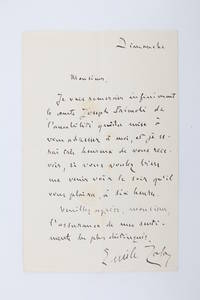
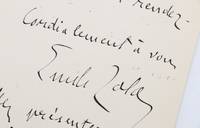
189480728s. l. Rome Rome 1894. Fine. s. l. Rome Rome Dimanche 4 novembre 1894 13.20 x 20.50 cm une page sur un double feuillet et une enveloppe Autograph letter signed by Emile Zola addressed to Ugo Ojetti. One page written in black ink on the first page of a double sheet. Folding inherent to postal transmission. Envelope included. This letter was addressed by the father of naturalism to journalist Ugo Ojetti when he had just arrived in Rome: ""Monsieur je vais remercier infiniment le comte Joseph Primoli de l'amabilité qu'il a mise à vous adresser à moi et je serai très heureux de vous recevoir si vous voulez bien me venir voir le soir qu'il vous plaira à six heures."" ""Sir I wish to thank Count Joseph Primoli infinitely for the kindness he has shown in directing you to me and I shall be very happy to receive you if you would be so good as to come and see me any evening that suits you at six o'clock."" Having arrived a few days earlier in the eternal city to conduct research for Rome Emile Zola hoped to meet Count Joseph Primoli there. The latter was unfortunately in Paris but he sent him this young journalist from La Tribuna who would serve as his guide but also as secretary. The two men clearly got along well and Zola even authorized Ojetti to adapt an opera libretto from his famous Nana. The project would unfortunately never come to fruition. Joseph Napoléon Count Primoli 1851-1927 was the great-great-nephew of Napoleon Bonaparte. Very close to the imperial family under the Second Empire he subsequently remained faithful to the salon of his beloved aunt Princess Mathilde in her private mansion on rue de Berri. His refined and witty conversation worked wonders there and he met as a passionate bibliophile some of the greatest writers of his time: Gustave Flaubert Théophile Gautier the Goncourts and Guy de Maupassant. unknown
189084423Paris 1890. Fine. Paris 20 Février 1890 13.50 x 20.50 cm une page Autograph letter dated and signed by Emile Zola 12 lines in black ink addressed to librettist Louis Gallet concerning the operatic adaptation by Alfred Bruneau of the novel ""Le rêve"". Folds inherent to postal dispatch. Emile Zola was to meet jointly with Alfred Bruneau who had adapted the novel ""Le rêve"" for the opera and Louis Gallet the librettist of this adaptation. ""Je vous attends demain matin. pour causer des trois derniers tableaux. J'écris également à Bruneau pour lui donner rendez-vous"" ""I await you tomorrow morning. to discuss the last three tableaux. I am also writing to Bruneau to arrange a meeting with him"" and shows himself very satisfied with this prospect: ""Tout va bien."" ""All goes well."" unknown
1954R320090601FASQUELLE. 1954. In-12. Broché. Bon état, Couv. convenable, Dos satisfaisant, Intérieur frais. 501 pages -. . . . Classification Dewey : 840.08-XIX ème siècle
RO40017605Fasquelle. Non daté. In-12. Broché. Etat d'usage, Couv. convenable, Dos frotté, Intérieur frais. 574 pages.. . . . Classification Dewey : 840.08-XIX ème siècle
1941R300297307Bibliothèque-Charpentier. 1941. In-12. Broché. Etat d'usage, Couv. légèrement passée, Dos plié, Papier jauni. 223 pages. Mors légèrement fendus en coiffes.. . . . Classification Dewey : 840.08-XIX ème siècle
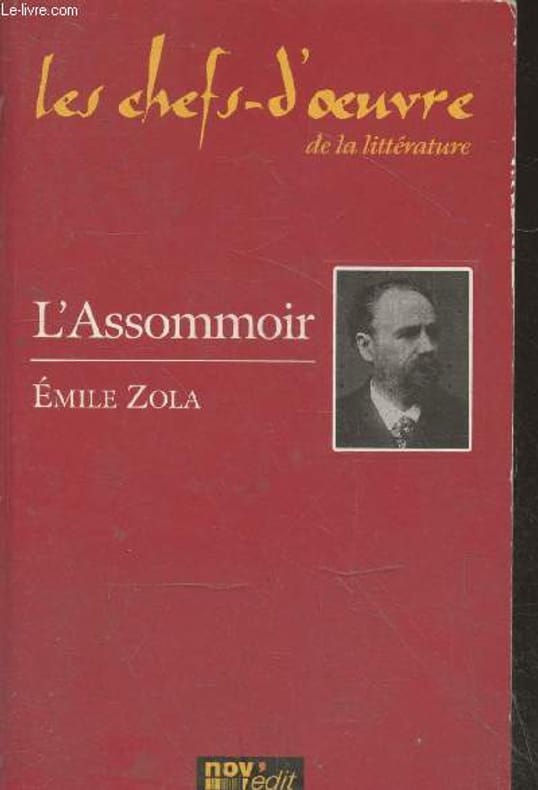
2005RO20244163Nov' édit. 2005. In-12. Broché. Bon état, Couv. convenable, Dos satisfaisant, Intérieur frais. 320 pages. . . . Classification Dewey : 840.08-XIX ème siècle
1918R300319234Bibliothèque-Charpentier. 1918. In-12. Relié. Etat d'usage, Coins frottés, Dos satisfaisant, Papier jauni. VII + 568 pages. Plats jaspés. Pièce de titre abîmée ; titre, auteur et filets dorés.. . . . Classification Dewey : 840-Littératures des langues romanes. Littérature française
2008R300328266Gallimard. 2008. In-12. Broché. Etat d'usage, Couv. légèrement passée, Dos satisfaisant, Papier jauni. 566 pages.. . . . Classification Dewey : 840-Littératures des langues romanes. Littérature française
80388Paris, Omnibus, 1883-1884. "21 x 30, 828 pp., reliure dsc/coins cuir, couvertures conservées illustrées, bon état (dos en très bon état; bords et coins émoussés) )"
190187263Paris 4 Mars 1901 | 13.50 x 20.50 cm | deux pages sur un bifeuillet
1958RO40017608Fasquelle. 1958. In-12. Broché. Etat d'usage, Couv. légèrement passée, Dos satisfaisant, Intérieur frais. 654 pages.. . . . Classification Dewey : 840.08-XIX ème siècle
R320003472LES EDITIONS PARISIENNES. NON DATE. In-12. Broché. Etat d'usage, Livré sans Couverture, Dos abîmé, Intérieur acceptable. 128 + 128 +128 pages - Couverture muette - Couverture partiellement dessolidarisée du corps de l'ouvrage.. . . . Classification Dewey : 840-Littératures des langues romanes. Littérature française
R320025502EDITIONS PARISIENNES. NON DATE. In-12. Broché. Etat d'usage, Plats abîmés, Dos abîmé, Intérieur acceptable. 126 pages - Coiffes en tete et pied abimées - 1er et 2eme plats defraichis.. . . . Classification Dewey : 840.08-XIX ème siècle
1887R320049038CHARPENTIER G. ET CIE. 1887. In-12. Relié. Etat d'usage, Plats abîmés, Dos fané, Mouillures. 519 pages - couverture conservée - Traces de mouillure a l'intérieur de l'ouvrage sans grande conséquence sur la lecture - Page 11-12 desolidarisée - Plats et contre-plats japsés -. . . . Classification Dewey : 840.08-XIX ème siècle
ROD0117102ERNEST FLAMMARION. NON DATE. In-12. Relié demi-cuir. Etat d'usage, Coins frottés, Dos satisfaisant, Rousseurs. 594 pages. Un signet. Titre et auteur sur pièces de titre marron. Contre-plats jaspés. Nombreuses illustrations en noir et blanc dans texte.. . . . Classification Dewey : 840-Littératures des langues romanes. Littérature française
1920R320111671FASQUELLE EUGENE. 1920. In-12. Broché. Etat d'usage, Couv. convenable, Dos satisfaisant, Papier jauni. 237 pages -. . . . Classification Dewey : 840.08-XIX ème siècle