12 326 résultats
Very Good English Paperback. Pbo. Cr. 8vo. (20 x 14 cm). In Turkish. 333 p. Urban history of Kilis. 40 yilin içinde Kilis.
JULLIARD. 1973. In-8 Carré. Broché. Bon état. Couv. légèrement passée. Dos satisfaisant. Intérieur acceptable. 246 pages. Cpouverture illustrée en couleurs. Préface de MARCEL JULLIAN.
Stavenow-Hidemark, ElisabNot in perfect condition. unknown
c4035Alger, Baconnier, 1941; 1 volume grand in-8°, demi- toile rouge, nom d'auteur et titre argentés au dos ; 382pp.; tache au premier et au dernier feuillet ( blanc), sinon bon exemplaire .
in-8, 296 pp., broché, couv. ill. Bel exemplaire. [SC-4][MA-2]
1863Paris, Julliard, 1983 15 x 24, 778 pp., broché, bon état
29523Paris, Julliard, 1983. Fort in-8, broché, portrait de l'auteur sur la couverture, 778 pp.
Paris, Julliard, 1983. Fort in-8, broché, portrait de l'auteur sur la couverture, 778 pp. Edition originale, bel exemplaire.
194339291943 P., Jean Renard, 1943, in 12 broché, 309 pages ; petit défaut au dos.
Fine Turkish Paperback. Cr. 8vo. (20 x 14 cm). In Turkish. 383 p. 50 yillik anilarim. Memoirs and poems of an intellectual exiled Crimean-Karaite Jew. A diaspora book. Extremely rare. Not in Bali.
Dehn-Nielsen, HenningIn Pristine Condition. unknown
Fine Turkish Paperback. Pbo. Roy. 8vo. (24 x 17 cm). In Turkish. [xxi], 426 p., b/w and color ills. 60 yil Almanya. (1936-1996) Bir yabancinin gözü ile geziler - arastirmalar - hatiralar. Sechzig Jahre Deutschland, (1936-1996).
Bernhard, KerstinIn Pristine Condition. unknown
Fine English Paperback. Pbo. Cr. 8vo. (20 x 14 cm). In Turkish. 139 p. B/w ills. Memoirs of a Cypriot of '64 generation. 64 kusagi bir Kibrisli'nin anilari.
Fine English Paperback., Very good., 20 x 14 cm, 139 p., b/w ills. "64 Kusagi Bir Kibrisli'nin anilari, RÜSTEM KÖKEN, Troy Mühendislik, Ankara, 2004".
Rausing, SigridIn Pristine Condition. unknown
1972100151359Grange Bateliere 1972 in8. 1972. Broché. L'ouvrage '8 passages' du Colonel Rémy (Gilbert Renault) relate des épisodes de la Seconde Guerre mondiale avec des passages censurés par le clergé romain. Publié en 1972 par Grange Batelière il contient 286 pages et des photographies en noir et blanc
1958va699Besson, Chantemerle Broché 1958 In-8 (14,7 x 22,6 cm), broché, 331 pages ; pliure au dos, papier bruni, bon état général. Livraison a domicile (La Poste) ou en Mondial Relay sur simple demande.
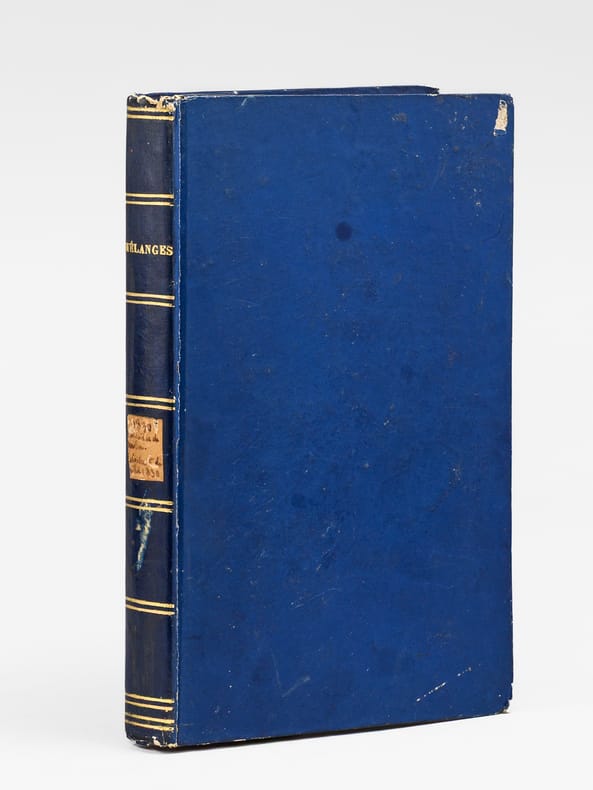
1830712031 vol. in-8 cartonnage bradel bleu, étiquette manuscrite de titre en dos : Appel à l'opinion publique, sur la mort de Louis-Henri-Joseph de Bourbon, Prince de Condé, Par l'auteur des Mémoires secrets et universels des malheurs et de la mort de la Reine de France. Chez G.-A. Dentu, Imprimeur-Libraire, Paris, 1830, 2 ff., 48 pp. [ Suivi de : ] La garde royale pendant les évènemens du 26 juillet au 5 aout 1830, Par un officier employé à l'état-major. "Fais ce que dois, advienne que pourra." Imprimerie-Librairie de G. A. Dentu, Paris, 1830, Imprimerie-Librairie de G. A. Dentu, 1830, 2 ff., 128 pp. [ Suivi de : ] Relation fidèle du voyage du Roi Charles X, depuis son départ de Saint-Cloud, jusqu'à son embarquement, Par un garde-du-corps. Seconde édition. Chez G.-A. Dentu, Imprimeur-Libraire, Paris, 1830, 2 ff., 58 pp. [ Suivi de : ] Le retour à la religion, poëme, suivi du sacre de Charles X, Par M. Baour-Lormian, de l'Académie française. Chez M. Paul Dottin, éditeur, M. Aimé André, libraire, M. Lerond, libraire, Paris, 1825, 2 ff., 63 pp.
Very Good Turkish First and only edition of this very rare 20th century Turkish-Americana, and the first book written to introduce the world of Hollywood to the Turkish audience, by the first Turkish society reporter. Turan Aziz Beler was a modern pioneer of magazine journalism in Turkey. Beler was born in Istanbul in 1912. He started his literary career as a journalist. His first novel "Sevda" [i.e. Love] also stands out but "Türedi Ailesi" [i.e. Türedi Family] brought him fame. According to Beler's foreword in the book, the purpose of his travel is to clarify all things known incorrectly about Hollywood in Turkey. He spent three and a half years in Hollywood with many celebrities and interviewed American stars. He examined the conditions under which American popular cinema was formed. According to his own statement, he expressed the witty language that he was grateful to Hollywood for not having gotten married or gotten beaten He has very interesting and funny wording in this 1930s Hollywood travel memoirs. This book caused him to be sentenced to two years in prison in Turkey according to contemporary sources. Paperback. Large roy. 8vo. (25 x 18,5 cm). In Turkish. 213, [3] p., many b/w plates.
Very Good Turkish, Ottoman (1500-1928) Original wrappers. No bdg. Wear spine, dispersed pages. Roy. 8vo. (24 x 17 cm). In Ottoman script (Old Turkish with Arabic letters). 197, 6 p., 5 panoramic folded huge b/w plates (Including the photographic plts.; 1-) Turkish Convention May, 13, 1923, Detroit, Mich by Photo Craft Byallen -23x39 cm-; 2-) [Among the Young Turks in Detroit, -23x106 cm-; 3-) In the White House with the President, -23x106 cm-; 4-) Islamic Society in the US, -32x40 cm-; 5-) Among the Young Turkish people in Chicago, -23x26 cm-). First and only edition of this exceedingly rare travel account of America by Dr. Mehmed Fuad [Umay], (1885-1963), who was a Turkish doctor and the founder of Himâye-i Etfâl [i.e. Society for the Protection of Orphans], a society that was established in 1921 to provide orphanages to children of the deceased soldiers in the Turkish War of Independence; began visiting many of the Turkish colonies in the US, giving lectures and raising a considerable amount of money for the establishment of these orphanages in Turkey. On 21 March 1923, Fuad Bey was granted permission from the Grand National Assembly of Turkey to go to the US in order to raise funds among the Ottoman immigrants for immediate war relief. Thus, for the first time, humanitarian action became an organized effort by fostering diaspora mobilization. Fuad Bey arrived in Ellis Island on 6 April 1923 on a ship named SS Aquitania and headed to the Ottoman Welfare Association at 35 Rivington Street. In the first meeting held by the Ottoman Welfare Association for the benefit of Turkish Orphan Society, Fuad Bey notes that a total of USD 17,500 was raised in just six hours. To those who donated over USD 1,000, a personally autographed picture of Mustafa Kemal was given by Fuad Bey. He visited the Turkish colonies in Wisconsin, Illinois, Michigan, New York, New Jersey, Massachusetts and Rhode Island. He lectured about the Turkish War of Independence (1919-1922) and the success of the struggle, and many Turkish and Kurdish workers residing in these cities donated their life savings to support the construction of orphanages and the reconstruction of the entire country. Fuad's visit to Peabody, Massachusetts aroused exceptional excitement among the Turkish and Kurdish immigrants. It was the first chance for the Muslim Anatolian immigrants to manifest their national pride and attachment to the homeland. At the same time, their socioeconomic achievement was evidenced with the arrival of Fuad Bey in Peabody in an auto decorated with a large American flag and followed by a dozen autos filled with Turks, the machines decorated with American and Turkish flags.". A day before his arrival, the Turks refrained from work and "went around with badges in honor of his coming. Mehmed Fuad noted that there were around 600 Turks when he visited Peabody in 1923. Despite their small number, they had established Kizilay [i.e. Turkish Red Crescent] society. After being shown some of the tanneries in Peabody and Salem, Fuad gave an address to the Turks and Kurds at the Peabody Institute. The scene was described as: "All the Turks in town were present. They made a spectacle of the doctor's visit, many of them taking a day off. They wore badges in his honor and displayed in front of the Institute the American and Turkish flags. Great enthusiasm was shown. Baskets of roses were carried down the aisles and the flowers were bought at any price, bunches of money being put in the baskets. It was said that USD 8,000 was raised among the Turks of this city for Dr. Fuad Bey to take back with him.". Fuad Bey visited Peabody for a second time on 14 August 1925, as he came for the National Conference of Social Workers held in Denver, Colorado in June, 1925. When he arrived in Massachusetts, he was met by a delegation of Turkish people from [.]". (Source: Ottoman Immigrants and the Formation of Turkish Red Crescent Societies in the United States). No printed copy in OCLC.; Özege 727.; TBTK 11126.
Very Good Arabic Original manuscript without binding. 12mo. (16 x 11 cm). In Arabic. [40] p., drawings, and tables. Marginal texts additionally. A linear wormhole on the bottom from beginning to the end, the thread in the spine is broken hence two separate parts. Otherwise a good copy. Rare manuscript compiled from works related to astronomical instruments written by probably Sibtu'l-Mardînî, copied anonymously in the early 19th century on the paper with 'ahar' with four marginal drawings and tables. The copier of this manuscript is not described. An 'Ebced' notes on the last blank page. The manuscript starts with a calendar in the Islamic system which is prepared with red and black inks and annotated info around the table. The first part includes how to use an almucantar, directions on the sphere, location of the stars in the sky. On the last two pages, the author describes the preparation of an almucantar. The second part is titled "Hadhâ risâle-i cenûb tarafi" [i.e. Tractate on the South direction], and the third and last part titled " Hadhâ risâle-i cenûb taraf, Hadha mukharrar latashich al-shaat fî taraf al-cayb min al-rub'u' mu'âl-ihtizâr", includes some 'sinus mathematics' with two impressive tables on the opposite page. Sibt al-Maridini, the full name Muhammad ibn Muhammad ibn Ahmad ibn Muhammad ibn al-Ghazal (1423-1493), was an Egyptian-born astronomer and mathematician. His father came from Damascus. The word "Sibt al-Maridini" means "the son of Al-Mardini's daughter". His maternal grandfather, Abdullah al-Mardini, was a reputed astronomer of the eighth century AH. He was a disciple of the astronomer Ibn al-Majdi (d. 850/1506). Sibt al-Mardini taught mathematics and astronomy in the Great Mosque of al-Azhar, Cairo. He was also a timekeeper (muwaqqit) of the mosque. He wrote no fewer than fifty treatises in astronomy (sine quadrants, sundials, astronomical tables, and prayer times) and wrote at least twenty-three mathematics textbooks. Al-Sakhawy counted two hundred books that were written by Sibt al-Mardini, on Islamic law, astronomy, and mathematics. Libraries that specialize in ancient manuscripts, all over the world, have transcripts of his works. Sibt al-Mardini's declared that "the opinion of the muezzins (those who call people to prayer) is less correct than that of the legal scholars and it is the latter that should be used as the basis for the determination of prayer time". (Wikipedia). Sib? al-Maridini was a prolific author of astronomical texts, which were still being used and studied into the 19th century. Little is known with certainty about his life. It is thought that he grew up in Damascus, where his maternal grandfather, Abd Allâh ibn Khalîl ibn Yûsuf Jamâl al-Dîn al-Mâridînî (died: 1406), was the muwaqqit (timekeeper) in charge of regulating the daily rituals of the Islamic community) of the Umayyad Mosque. Later he traveled to Cairo, where tradition places him as a student of Ibn al-Majdî. Sib? al-Mâridînî wrote extensively on mathematics and mathematical astronomy. Like his grandfather, he was especially interested in astronomical instruments. The bio-bibliographical sources list some 25 treatises, many of which exist today in multiple copies. According to the historian al-Jabarti (died: 1822), Sib? al-Mâridînî's works on mîqât (ritual timekeeping) and astronomical instruments were still being studied in the curriculum of Cairo's al-Azhar, one of the preeminent educational institutions in the Islamic world, at about the beginning of the 19th century. (Biographical encyclopedia of astronomers, 2007).
Very Good Turkish, Ottoman (1500-1928) Original wrappers. Slightly split on margins. Otherwise a very good copy. Cr. 8vo. (20 x 14,5 cm). In Ottoman script. 212 p. It's written with a legible hand script. Mehmed Tevfik was a 'Hafiz'. Hafiz is a term used by Muslims for someone who has completely memorized the Quran. His name is not figured out in the literature. Manuscript starts with that he describes to started of neighborhood school in Tosya, Kastamonu and his first teacher Ismail Efendi. We learned that his father was professor in Abdurrezzak Madrasa in Tosya which was first and only madrasa in Tosya. After that he mentions his brother Ali, his primary school was in Çankiri. He describes their family journeys from Çankiri to Tosya in a very bright style which was a day and night and eventful journey. They crossed Devrez Baglari by a horse carriage. He gave some examples from Tosya (Kastamonu) local dialect like 'Kadinine' to 'Nine' [i.e. Grandmother]. He cited in very detail that his father's hajj and Hejaz journey with his grandfather. After that he talked about his first special lessons from a hafiz in 1309 [Hegira]. After two years of that, he started to High School in September of 1311 [Hegira]. His daughter's birth (Fatma Hayriye) and he traveled to Istanbul. He describes his military memoirs in Istanbul and when he saw who cursed to Sultan (Abdulhamid II) he was very surprised. After that confusions and difficulties in the last period of the Ottoman Empire, press in the Ottoman Empire, political events, murders and crimes in Istanbul city was told by Tevfik. All kind of events, according to him, a betrayal to the empire and Islamic culture. Based on his memoirs, he was a conservative person. A fine manuscript is not only describing which is an autobiography as well, showing a person who has passion to be an Islamic scholar, but also reflecting thoughts of an anti-revolutionary and the last period of the Ottoman Empire besides events in Istanbul city which was heart of an empire. It's unpublished. Extremely rare.
Very Good Turkish, Ottoman (1500-1928) Original autograph telegraph signed by Ali Riza sent to Seyhülislâm Ürgüplü Mustafa Hayri Efendi, (1867-1922). 1 p. In Ottoman script. Postal stationery, 'Erenköy' stamped. Bilingual in Ottoman and French scripts in stamp.
Very Good Turkish, Ottoman (1500-1928) Original autograph telegraph signed by Mehmed Ata sent to Seyhülislâm Ürgüplü Mustafa Hayri Efendi, (1867-1922). 1 p. In Ottoman script. Postal stationery, 'Erenköy' stamped. Bilingual in Ottoman and French scripts in stamp.