12 324 résultats
Very Good French Paperback. 4to. (27,5 x 21,5 cm). In French. [15] p., b/w ills. Contents: La vengeance des serpents, Metin Erksan, (1929-2012).; La legende de mouton noir, Lütfi Ömer Akad, (1916-2011).; Chemin sans fin, Duygu Sagirohglu, (1932-).; Le temps d'aimer, Metin Erksan, (1919-2012).
Very Good Turkish, Ottoman (1500-1928) A modern fine black leather bdg. Small 4to. (26 x 18 cm). In Ottoman script. 3 volumes set: ([13], 448, [11], [6] p.; 386, [12], [6] p.; 203 p). Ibn Battuta was the greatest medieval Muslim traveler and the author of one of the most famous travel books, the Ri?lah (Travels). His great work describes his extensive travels covering some 75,000 miles (120,000 km) in trips to almost all of the Muslim countries and as far as China and Sumatra (now part of Indonesia). Ibn Battuta was from a family that produced a number of Muslim judges (qadis). He received the traditional juristic and literary education in his native town of Tangier. In 1325, at the age of 21, he started his travels by undertaking the pilgrimage (hajj) to Mecca. At first his purpose was to fulfill that religious duty and to broaden his education by studying under famous scholars in Egypt, Syria, and the Hejaz (western Arabia). That he achieved his objectives is corroborated by long enumerations of scholars and Sufi (Islamic mystic) saints whom he met and also by a list of diplomas conferred on him (mainly in Damascus). Those studies qualified him for judicial office, whereas the claim of being a former pupil of the then-outstanding authorities in traditional Islamic sciences greatly enhanced his chances and made him thereafter a respected guest at many courts. That renown was to follow later, however. In Egypt, where he arrived by the land route via Tunis and Tripoli, an irresistible passion for travel was born in his soul, and he decided to visit as many parts of the world as possible, setting as a rule "never to travel any road a second time." His contemporaries traveled for practical reasons (such as trade, pilgrimage, and education), but Ibn Battuta did it for its own sake, for the joy of learning about new countries and new peoples. He made a living of it, benefitting at the beginning from his scholarly status and later from his increasing fame as a traveler. He enjoyed the generosity and benevolence of numerous sultans, rulers, governors, and high dignitaries in the countries he visited, thus securing an income that enabled him to continue his wanderings. From Cairo, Ibn Battuta set out via Upper Egypt to the Red Sea but then returned and visited Syria, there joining a caravan for Mecca. Having finished the pilgrimage in 1326, he crossed the Arabian Desert to Iraq, southern Iran, Azerbaijan, and Baghdad. There he met the last of the Mongol khans of Iran, Abû Sa'îd (ruled 1316-36), and some lesser rulers. Ibn Battuta spent the years between 1327 and 1330 in Mecca and Medina leading the quiet life of a devotee, but such a long stay did not suit his temperament. Embarking on a boat in Jiddah, he sailed with a retinue of followers down both shores of the Red Sea to Yemen, crossed it by land, and set sail again from Aden. This time he navigated along the eastern African coast, visiting the trading city-states as far as Kilwa (Tanzania). His return journey took him to southern Arabia, Oman, Hormuz, southern Persia, and across the Persian Gulf back to Mecca in 1332. There a new, ambitious plan matured in his mind. Hearing of the sultan of Delhi, Mu?ammad ibn Tughluq (ruled 1325-51), and his fabulous generosity to Muslim scholars, he decided to try his luck at his court. Forced by lack of communications to choose a more indirect route, Ibn Battuta turned northward, again passed Egypt and Syria, and boarded ship for Asia Minor (Anatolia) in Latakia. He crisscrossed that "land of the Turks" in many directions at a time when Anatolia was divided into numerous petty sultanates. Thus, his narrative provides a valuable source for the history of that country between the end of the Seljuq power and the rise of the house of Ottoman. Ibn Battuta was received cordially and generously by all the local rulers and heads of religious... Hejra: 1333; 1335; 1336 = Roumi: 1335 ; 1337; 1340 = Gregorian: 1917; 1919; 1921. Ozege: 21289. For fihrist: 5771.
Very Good Turkish, Ottoman (1500-1928) Original quarter black leather. Ottoman title-lettered gilt on the spine with decorative elements in compartments. Demy 8vo. (22 x 14 cm). In Ottoman script (Old Turkish with Arabic letters). 459 p., 32 woodcut plates with tissue papers and a folding color map of Khiva calligraphed by Mehmed Vasfi. AH 1292 = Gregorian: 1875. Extremely rare first Turkish edition of this richly illustrated eye-witness travel account of the 1873 Russo-Khivan war and the fall of the Khivan Khanate, by the American war correspondent MacGahan (1844-1878), which was first published in New York in 1874 as "Campaigning on the Oxus and the fall of Khiva", translated by Ahmed Sükrü (?-1876-77) who was the first Postmaster General. After a daring journey through the Kyzil Kum desert, McGahan joined von Kaufmann's army on the banks of the Amu-Darya, shortly before the fall of Khiva. Interesting and lively report with a description of Kazakh- (systematically called "Kirghiz", following the confusing habit of Russian historians) and Yomud Turkmen nomads, as well as of the settled Uzbek, Sart - and enslaved Persians of the Khanate. Probably one of the most complete and objective descriptions of the fall of the Khivan Khanate to three Russian columns which reach it from North and from East, after difficulties due to the climate and the huge distances. The young American makes many friends with Russian officers and gets a lot of information directly from the horse's mouth. There is also a well-documented report about previous Russian attempts to conquer Khiva, which all turned into disasters. The rather civilized behavior of the Russian army with the vanquished Khivans contrasts very much with their cruel and unfair treatment of the brave Yomud nomads, who offer only serious military opposition despite their heavy losses. The Khivan oasis is described as being very fertile and outstandingly well-cultivated. While Mac Gahan is impressed by the beautiful gardens and orchards of the Khanate, he is disappointed by the city of Khiva, the capital, the main residence of its ruler, and the second largest city of the Khanate. Even the Khan's palace (in which he is allowed to spend a few days by the Russian authorities) is disappointing. He visits the treasury room of the palace, in which the fleeing Khan left most of his possessions. He also left his whole harem behind, in his precipitous escape. The text is illustrated with numerous engravings from original designs and paintings by artists (and Russian officers), like Vereschagin and Feodoroff, and enriched with a great number of anecdotes. MacGahan was an American journalist and war correspondent working for the New York Herald and the London Daily News. His articles describing the massacre of Bulgarian civilians by Turkish soldiers and irregular volunteers in 1876 created public outrage in Europe and were a major factor in preventing Britain from supporting Turkey in the Russo-Turkish War of 1877-78, which led to Bulgaria gaining independence from the Ottoman Empire. He learned in 1873 that Russia was planning to invade the khanate of Khiva, in Central Asia. Defying a Russian ban on foreign correspondents, he crossed the Kyzyl-Kum desert on horseback and witnessed the surrender of the city of Khiva to the Russian Army. There he met a Russian Lieutenant Colonel, Mikhail Skobelev, who later became famous as a Russian commander during the Russian-Turkish War of 1877-78. In 1874 he spent ten months in Spain, covering the Third Carlist War. In 1875, he voyaged with British explorer Sir Allan William Young on his steam yacht HMS Pandora on an expedition to try to find the Northwest Passage from the Atlantic to the Pacific. The expedition got as far as Peel Sound in the Canadian Arctic before it met pack ice and was forced to return. OCLC 1014870496.; Özege 7682.; Atabey 744 (Ed. in English).
Very Good English Paperback. Demy 8vo. (21 x 14 cm). In English. 14, [1] p. This rare program was printed for the XXII. International Congress of Orientalists held in Istanbul in 1951 and includes three chapters titled 'Program', 'Explanatory Notes', and 'Turkish music in a nutshell'. The program section has five parts and the second section titled 'explanatory notes' has a short but very detailed dictionary on the composers and maqams (scales) seen in the program prepared carefully for the orientalist participators and audience. The last section has a short history of classical Ottoman / Turkish music, pp. 13-15. Exceedingly rare.
208093Chissay [Loir-et-Cher], 1914-1918 171 pièces in-12 ou in-8, en feuilles.
Very Good Turkish, Ottoman (1500-1928) A fine half leather bdg. with marbled boards. Two volumes in one. Cr. 8vo. (20 x 14 cm). The text in Ottoman script (Old Turkish with Arabic letters) with bilingual titles in Ottoman Turkish and French on frontispieces and title pages. 2 volumes set: (248 p.; 270, [1] p., the first volume has Columbus' engraved portrait frontispiece, the second has Amerigo Vespucci's portrait). Hegira: 1310 = Gregorian: 1893. First and only edition of this very rare book, which is the first Turkish original work on the history of the discovery of America printed for the Quadricentennial of the Discovery. With this book, Christopher Columbus and Amerigo Vespucci quickly became popular among Ottoman readers (soon after Iranian readers with a translation of the first volume only), and immediately among other Middle Eastern readers, and thus the first comprehensive and original text describing Colombus and the discovery of America appeared in the Middle East and Islamic world. It's been published in Istanbul under the title "The history of the discovery and conquest of America". The first volume is on Christopher Columbus, and the second volume is on Amerigo Vespucci, their lives and travels. Andreas Kopassis Efendy (1856-1912) was one of the few Ottoman Greeks proficient in the Ottoman literary language. Cretan Kopassis is an intriguing figure who made a remarkable career serving the Ottoman state. At the time of the publication, he was a member of the State Council (Sura-yi Devlet). He displayed quite an extraordinary interest in scholarly research and he seems to have been one of the first to have studied Ottoman "tahrir defterleri" [i.e. Ottoman tax registers]. This could be called a translation in a sense. Kopassis makes no reference to preceding translations, nor does he refer to Robertson's history of America. His main source was a more recent equally "classic" work on Christopher Columbus, Washington Irving's "History of the life and voyages of Christopher Columbus" (first published in 1828). Another source referred to by Kopassis is J. H. Campe's "Entdeckung von Amerika" (first published in 1781). His educational background is evident particularly in the introductory chapter where ample references are made to Pliny, Ptolemy, and Plato's Timaios which contain allusions to Atlantis. In his takri (Introduction) to this work, Kemalpasazade Said Bey (1848-1921) praised the author for his elegant prose. Sultan Abdülhamid awarded the order of merit (liyâkât) in gold to the author. In the same year (1315=1895), an aide-de-camp at the Iranian Ministry of War, Muhibb-i 'Âli Khan, translated the first volume into Persian. At the turn of the century, Christopher Columbus had become a very popular figure for Ottoman readers of all ages...". (Source: STRAUS, JOHANN: Nineteenth-century Ottoman Americana.; "Frontiers of the Ottoman Imagination: Studies in Honour of Rhoads Murphey."). Only one copy in OCLC 777274675 (Leiden University Library). Not in American libraries.; Özege 19857.
Very Good Russian Original concert advert in Russian with autograph signature and inscription by Turkish female pianist Idil Biret. (21x14 cm). Printed advert in Russian, inscription and signature in Turkish. 4 p. Signed to Turkish diplomat Ismail Berduk Olgaçay, (1925-). [Concert advert of Idil Biret, Moskovskaia Gosudarstvennaia Filarmoniia with autograph signed Biret to Turkish diplomat Ismail Berduk Olgaçay]. Illustrated cover. Rare.
Very Good Georgian Original bdg. HC. Cr. 8vo. (20 x 14 cm). In Georgian. 188, [1] p. [Description of Mingrelia]. Samegrelos aghnera. Father Archangel Lambert, Neapolitan monk, who travelled through Mingrelia in the 17th century, was told that a warlike and ruthless nation, amongst whom were several female warriors, dwelt somewhere in the neighbourhood of the Caucasus. They were often at war with the Calmuc Tatars and various tribes living near them. Travel memoirs on Migrelian lands in Georgia.
Very Good Turkish, Ottoman (1500-1928) In modern aesthetic full leather bdg. in Ottoman style. Roy. 8vo. (24 x 17 cm). In Ottoman script (Old Turkish with Arabic letters). 184 p., numerous b/w plates. First and only edition of this scarce travelogue which was planned for fifteen days on January 19, 1909, but took about forty days, containing a first-hand travel account of Egypt in 1909, an Islamic country that began to modernize at the beginning of the 20th century, written by an Ottoman intellectual, one year after the Second Constitutional Regime. This rare book contains early descriptions of the Egyptian municipality, the Red Crescent, gardens and parks, urbanism, zoo, and botanic gardens, tramps, bridges, social life, folkloric customs, Mahmil Alays, cemeteries, music and history of art, hotels, Nile and many historical heritages, architecture, etc. Agop [or Agob] Matyosyan was one of the first Armenian printers to apply during the inspections of printing houses that were done in accordance with the Nizam-name-i Cedid (Jareeda-i Mahakim, No. 429 (13 Jamazia al-awwal 1305) in the late Imperial Ottoman period. Hegira: 1327 = Gregorian: 1910. Özege: 14459. OCLC: 476243661 / 16347814.
Very Good Armenian In modern full morocco. Roy. 8vo. (24 x 17 cm). In Armenian. 464 p., b/w plates and maps., 2 portraits of Lynch, bibliography. First and early banned Armenian edition printed in Istanbul (Constantinople) of Lynch's travel account of Armenia and Highlands. Original English First Edition published in 1901 as 2 volumes. Vol. 1 is the Russian provinces, 2 is the Turkish provinces. This Armenian edition contains selections from both volumes. "Henry Finnis Blosse Lynch was born in London in 1862, of Irish parentage. His family ran Lynch Brothers, a firm that traded with and ran shipping lines in Persia and Mesopotamia. Lynch had already traveled widely in those regions before their geographical closeness to Armenia, together with the growing importance of the "Armenian Question", attracted him to Armenia. Lynch later became a member of the British Parliament. He died suddenly in November 1913 of pneumonia. Lynch's two-volume work "Armenia: Travels and Studies" was published in London in 1901, and remains the definitive account in English of Armenia before the 1915 Deportation. An Armenian translation of the book was published in London in 1902, and another in Constantinople in 1913. In modern Turkey, the book was on the official list of banned books until at least the late 90s. "Armenia: Travels and Studies" was the result of two extensive visits he made to the Turkish and the Russian-controlled areas of Armenia - the first visit lasting from August 1893 to March 1894, and the second from May to September 1898. Lynch visited Ani ruins in October 1893 and his account of that visit, with the accompanying photographs, is reproduced below. His footnotes are on a separate page. The border graphic on this page is based on the decorative band on the binding of Lynch's book, was inspired by the vine-scroll relief on the church of the Holy Cross on Acht'amar island.". Source: Virtualani. First and Only Armenian Edition. Extremely rare. A censored and collectible item of Armenian literature.
Very Good Turkish Original grey cloth bdg. Roy. 8vo. (25 x 17 cm). In Turkish. [xxviii], [4], [4], 1112 p., 2 full-page color maps. First map is the most famous one showing the Nile and the second one shows the Mediterranean shores and cities of Egypt. Rare first edition of the 10th, and the last volume of the Evliya's travel corpus including his descriptions of Egypt, Sudan, and Ethiopia in the late 17th century. This legendary travel account was published between 1896-1938 respectively in ten volumes. "Book X lands him in Egypt and takes him up the Nile to the Sudan and Ethiopia. When Evliya reaches Ibrim on the Nile, the southernmost limit of the Ottoman Empire, he remarks on the intense heat of the place; contrasting it with the intense cold he experienced at the northernmost limit, Azov; and with the mild climates at the eastern and western frontiers, Baghdad on the one hand, and Istolnibelgrad on the other. Apparently, Egypt suited him best, and he found Cairo a worthy counterpart to Istanbul; for he settled there to work up his memoirs of forty-one years of travel. He died around 1683, and there is controversy over whether a certain cryptic passage refers to the Ottoman defeat at Vienna.". (Evliya Çelebi's book of travels. 2. Evliya Çelebi in Bitlis). Evliya Çelebi visited Suakin during one of his journeys across Egypt, Sudan, Ethiopia, Somalia, Djibouti and Tanzania. He describes this territory under the title "The characteristics of old throne center Suakin" as "we stayed in this city for 12 days, trading with all kinds of people with camel trains. I sold 40 dromedaries in return for 500 piasters and also disburdened, sold 50 tusks for 500 piasters. Then we started to wander around the city. The Suez Sea is to the north of the island, and it takes 12 hours to reach Mecca from the island. Therefore, the direction of Mecca from this city is to the north. Suakin is a little island stretching three miles from east to west. (Afyoncu, Daily Sabah). Further travels in the 1670s took him to western and southwestern Anatolia and Syria. He completed the Hajj again and appears to have settled in Egypt for several years. He traveled in Upper Egypt, Sudan, and Ethiopia searching for the sources of the River Nile, before settling down to compile his great travel book. OCLC 630428224 (with four copies).
New German Original bdg. HC. Elephant folio. (67 x 51 cm). -Text book: 30 x 24 cm- In German. 2 volumes set: ([xii], [vii], [Lii], 140 p., 2 plates.; 39 color and b/w plts. (Tafeln)). Limited reprint edition (all copies are numbered) of 1854-1855 Berlin edition of Salzenberg's book exemplifying a growing 19th-century appreciation of Romanesque and 'Byzantine' architecture. For the original edition see Blackmer 1483; Brunet V, 103. "Salzenberg's important work remains the major source of information about the mosaics of St. Sophia". (Blackmer). 1000 copies were printed for individual persons. This copy belonged to 'Ender S. Özer Bagciman. All copies were numbered. (651/1000). The churches Salzenberg describes illustrating the development of a Christian architecture away from the secular long nave basilica or of the classical temple (never intended for congregational use), to a Greek-cross plan with a central dome, allowing greater accessibility to the altar table. Most of the text is devoted to the cathedral of the Holy Wisdom [i.e. Hagia Sophia], built-in Constantinople for Justinian I by Anthemius of Tralles and Isidore of Miletus, who dared to set a large dome over a square with the support of pendentives, achieving, with eastern and western half-domes, an uninterrupted span of over 200 feet. This building provided a model or inspiration to architects of the Middle East and Europe seeking to experiment with central, domed structures. Contents: Titelblatt.; Frontispiz.; Titelblatt.; Inhalt des Textes.; Vorwort.; Einleitung.; Verschiedene Baureste der aelteren Zeit.; Agios Johannes, Klosterkirche des Studios.; Agios Sergios, Kirche des Klosters Hormisdas.; Agia Sophia.; Agia Irene.; Agia Theotokos, Klosterkirche des Lips.; Agios Pantokrator.; Saalbau des Hebdomon.; Cisterne des Philoxenos (Bin-Bir-Direk).; Wasserpfeiler oder Suterasi.; Kirchen aus Klein-Asien.; Anmerkungen.; Anhang: Des Silentiarius Paulus: Beschreibung der Heiligen Sophia und des Ambon.; Vorwort.; I-VI i: Die H. Sophia des Silentarius Paulus.; VII-XIV Der Ambon.; Verzeichniss der Abbildungen.; Blatt I - XXXIX.; Maßstab/Farbkeil.
Very Good Turkish, Ottoman (1500-1928) Lithographed Edition. First and Only Edition of this first Turkish book exclusively related to America. This very rare work (both in scarce institutional holdings and market rarity) is the first book in Turkish to describe the discovery and conquest of America. Thus, it is an important and early source on America in the Islamic world. "The first treatise [in Turkish] dedicated exclusively to America" (Strauss). It is printed in a format that is specific to the early printing period of the Ottoman Empire and is written in a tâliq script and has the appearance of a manuscript. It has neither a preface nor a proper title. The heading (serlevha) on the first page which is placed in a decorative floral design reads: "First chapter: On the Islands Discovered by the Venetian and Genoese seafarers, and, secondly, on the discovery of America by Christopher Columbus". It also contains the mandatory praise of the ruler, i.e., Sultan Abdülmecid, and indicates that it was "translated and transferred from some selected writings (ba'z-i evrâk-i müntahabe)". The dramatic events of the discovery and of the different conquests by the Spaniards are vividly described in plain and simple language. Though it is not free from clichés adopted from Western sources, the darker aspects of the European expansion are not omitted. Particular interest is devoted to the fauna and flora of the American continent. The modern territorial divisions of the American continent, and briefly, its political history, are dealt with in a special chapter at the end of the book. This chapter comprises information about both North and South America from the Polar Regions (Arazi-i kutbiyye) and "Russian America" (Amerika-i Rusiyye) to the Banda Oriental (Banda) or the Cisplatine Republic (Çisplatin) and the Province of Patagonia (Patakonya Eyaleti). It takes into account the latest developments. The last event referred to is General Soulouque's takeover in Haiti. "[.] ?in Santa Domingo (Sen Domeng), i.e., the island of Haiti, a general from the Negro people appeared in the Frankish year of 1847 and beat the Spaniards and the French. Assuming the title of 'king', he is known today as Faustin I." (p. 54). In fact, General Soulouque (Emperor of Hayti, (1782-1867)) had assumed the title of 'Emperor' in 1849. His reign lasted until 1859. (Source: Nineteenth-Century Ottoman Americana by Johann Strauss). Original wrappers. Occasionally slight stains on some pages and chipped on front cover, otherwise a very good copy. Roy. 8vo. (23 x 16 cm). In Ottoman script (Turkish with Arabic letters). 56 p. Litho. Only two copies in OCLC: (University of California, Los Angeles & Library of Congress, Karl Süssheim Collection, no. 1717.): 948879228.; TBTK 4412 / 5557.; Özege 1591 / 22639.
Very Good Turkish, Ottoman (1500-1928) Original wrappers. Foolscap 8vo. (18 x 12 cm). In Ottoman script (Turkish with Arabic letters). 158 p., 4 plans. Occasionally stains on cover, pages, and edges; chipped on extremities of front cover and spine. Overall a good copy. Some uncut pages. First and Only Edition of this rare first-hand account tells the failures, deficiencies of the Ottoman army in the Balkan War (1912-1913), and the conflicts between the commanders during the war. Bekir Sitki [or Sidki] participated in the war with the rank of lieutenant. The wars and struggles fought by the Vardar army, a branch of the Western army called Câvîd Pasha branch affiliated to it, are explained day by day with four plans in this work in a plain language, and information is given about the situation of the Ottoman army, its deficiencies, the difficulties experienced during the war, and thus the difficulties of the war and the deficiencies of the Ottoman army. Only one paper copy could be found in OCLC: 283477138 (Universita?tsbibliothek der Eberhard Karls Universita?t).; Özege 6039.; TBTK 5822.; Not in ATYB. First Edition.
Very Good Turkish, Ottoman (1500-1928) Original wrappers. Foolscap 8vo. (18 x 13 cm). In Ottoman script (Old Turkish with Arabic letters). 112 p. On the first page, written 'copies without seals are fake', and this copy is with a seal. Slightly faded and chipped on extremities. Foxing on first pages. Uncut marginal extremities Otherwise a good copy. Exceedingly rare first edition of the first Ottoman voyage to Cape of Good Hope and first-hand travel account of the Ottoman qadi Abubakr Effendi (1814-1880) of South Africa and Mozambique, who was sent in 1862 by Sultan Abdulaziz at the British Queen Victoria's request in order to teach and assist the Muslim community of the Cape Malays. The presence of the Muslim population in South Africa dates back to the 16th century, South Africa and the Cape of Hope have become a colony of Western countries such as Portugal, the Netherlands, and the United Kingdom. The Ottoman Empire was interested in the Far East, Javanese, and South African regions in the 16th century and then tried to establish a relationship. The direct relationship between the Ottoman Empire and South Africa in the 19th century, upon the request of the Muslim people and England, was formed through Abubakr Effendi. The Muslims in conflict with various religious issues have found the remedy by consulting a scholar from the Ottoman Empire through England. After all, Abubakr Effendi reached Cape Town in 1862 and tried to resolve the conflicts among the Muslim people. (Abubakr Effendi: An Ottoman Scholar in South Africa in the Nineteenth Century: Yilmaz, Yusuf). "Abubakr Efendi was sent to Cape Town by Ottoman Sultan Abdulaziz. When chaos reigned in the Islamic society because of the imams who declared themselves as leaders in the region, Muslim leaders in Cape of Good Hope conveyed their letters to the Queen of England in 1862 declaring that they needed a religious leader. Since they had not been educated for years, they had forgotten their Java language and could not read their own books. They sent a letter to the Queen of England, informing them that help could be sought from the Ottoman court, the center of Muslim countries in the period. The issue was refused in the Parliament and the Ottoman Ambassador Musurus Pasha was offered it to the Ottoman Sultan. Abubakr Effendi's mission was to prevent Muslims in Cape of Good Hope to clash with each other and teaching them authentic Islamic knowledge free of superstition. Although Abubakr Efendi had some Arabic translators in his service, he still learned English and African languages in a short time and wrote books in order to benefit the Muslims there. On the fifteenth day he set foot on the continent, he opened a madrasah called the "Ottoman School" and enrolled three hundred students in twenty days. He traveled to Mauritius and Mozambique. He wrote his famous book 'Bayan al-Din' (a sort of catechism) in Afrikaan in Arabic letters. Then he married Rukiye Hanim, but they divorced after a while since they had to communicate by using an English and Arabic dictionary. Then he married James Cook's nephew Tahota Saban Cook. In his memoir, Ömer Lütfi wrote down all the travels of Abubakr Efendi for two years. Abubakr Efendi stayed in South Africa for 22 years and died there." (140 yillik miras: Güney Afrika'da Osmanlilar: Uçar, Ahmet). Abubakr Efendi first traveled to London and then to South Africa by a ship with his assistant Omar Lutfi. He established the first Ottoman School in Cape Town and then wrote his work Bayan Al-Din in Afrikaans with Arabic letters and distributed it to the Muslim population of South Africa. Four printed copies in OCLC: 427674106 (Three copies); 635151131 (One copy). Özege 22397. First Edition. Extremely rare.
Very Good Turkish, Ottoman (1500-1928) Original illustrated wrappers. Chipping on top edge and front cover. Occasional foxing on pages. Overall a good copy. Roy. 8vo. (23 x 15 cm). In Ottoman script (Old Turkish with Arabic letters). 103 p., b/w plates (19 unnumbered b/w plates and 1 map). First edition of this extremely rare first-hand and historically significant eyewitness account of the Syrian and the Suez Canal Operations during the Great War by an Ottoman soldier and statesman. Erden describes in this book his return to Istanbul after his military attaché duty in Paris and his departure to Damascus to join the 4th Army in Syria under the command of Cemal Pasha (1872-1922). He then discusses the Arab Revolt in Hejaz and its possible effects on the Ottoman Empire (The Arab Uprising was initiated by Sharif Hussein bin Ali in June 1916 during the Great War with the aim of creating an independent and united Arab state comprising of Aden in Yemen and Aleppo in Syria against the Imperial Ottoman). After disclosing his views and the actions of the army in the region, he goes on to describe Jerusalem, the Suez Canal, and the wars that took place there. Erden gave new information on the reasons and results of the Canal operation, the condition of the Turkish army along Palestine and Syria fronts, the relations among the Turkish staff, and the nature of the Arab revolt through his views and observations in Egypt, Palestine, and Syria fronts accumulated as he was Cemal Pasha's chief of staff. Erden was a Turkish soldier and war historian. After graduating from the Military Academy in 1903, he worked in the units and headquarters in Yemen, as the staff of the 3rd Corps in the Balkan War and as the Paris Military Attaché. During the Great War, he served as the Chief of Staff of the 4th Army within the entourage of Admiralty Minister Cemal Pasha in Syria. Özege 16174. Kursun p. 51.
Very Good Turkish, Ottoman (1500-1928) Original wrappers. 16mo. (14,5 x 10,5 cm). In Ottoman script (Old Turkish with Arabic letters). 20 p. First and only edition of this extremely rare pamphlet includes the chapters of 'From Marseilles to Gabon' and 'From Libreville to Banguela' of Trivier's expeditions in Africa. First chapter includes Trivier's Mozambique travel by ship over the Strait of Gibraltar. In this chapter, Trivier described the purpose of his voyage as "After returning to France from my last trip in January 1890, I declared that many more places should be seen. I have written many articles about the necessity of looking for new ways to eliminate the fears and worries caused by McKinley tariffs that are harmed everywhere. As a nice result of this, the Paris City Council and the Bordeaux Chamber of Commerce decided not to be dispatched to the hometown of Africans with an amount of money close to 11,000 francs.". In the second chapter, he describes Congo and other parts of Central Africa. French explorer Elisee Trivier followed in the footsteps of Scottish missionary David Livingstone in his attempt to explore the interior of Africa. Trivier's expedition traveled in 1889 up the Congo and across Africa to the island of Zanzibar on the eastern coast. Trivier is considered the first French explorer to have crossed Africa. Hegira: 1313 = Gregorian: 1896 Özege 21221.; Not in OCLC.
Very Good Turkish, Ottoman (1500-1928) Original wrappers. Foolscap 8vo. (17 x 12 cm). In Ottoman script (Old Turkish with Arabic letters). 152 p. Roumi: 1324 = Gregorian: 1906. Taken from a volume including multiple books. Spine is restored. A very good copy. First and only edition of this early and extensively rare book including a first-hand account of the topography and descriptions of Hejaz, Mecca, and other parts of Arabian Peninsula such as Taif and Yemen by Sadiq Sherif, who was the first person to take photographs of Mecca, Medina, and the Hajj in 1880 and 1881 as well. Sadiq Sherif was the grandson of Serif Abdulmuttalib, the Emîr of Mecca. This book written by Sherif was dedicated to 'the Progress and Union Society' [i.e. Ittihad ve Terakki Cemiyeti]. The book describes the way of administration and territorial division of Hejaz after giving some information of its geography, borders, tribes and natives, mountains, rivers, crops and products, and animals of this Ottoman 'vilâyat' [i.e. province]. Sherif gives detailed information on how and when the Ottoman Empire ruled Hejaz, the location of Mecca city, its borders, physical and social geography, crops in Mecca and around, its flora, fauna, demographic structure, 'nahiyes', Kâba's construction, and its history, sacred places around, Masjid-i Haram and other masjids, cemeteries, mountains, gifts by Ottoman caliphs to Kaba, 'Taif' area, people who were 'Emîr' of Mecca from the period of Mohammad, Wahhabism and its birth, etc. At the last, Sherif gives place to his personal letter (layihâ) including 49 articles. The letter was about the reforms that Hejaz needs and it was sent to the Ottoman 'sadâret' [i.e. prime ministry]. (Source: History of geographical literature during the Ottoman Empire, Edited by Ihsanoglu). Muhammad Sadiq Sherif Bey was the first person to take photographs of Mecca, Medina, and the Hajj in 1880 and 1881. Sadiq Bey trained as a military engineer after completing his studies in Cairo and at the École Polytechnique in Paris. It is not known when, or from whom, Sadiq Bey learned to take photographs but it was most probably through one of the resident photographers in Egypt. In 1861, prompted by the need to carry out more extensive military land surveys of the area between Wajh and Medina, Sadiq Bey made his first journey to Arabia. He took a camera along with his surveying equipment and took his very first photographs of Medina. In a series of articles published in the Egyptian Military Gazette in 1877, he refers to his early photography at Medina describing the use of a 'photographia'. Sadly, however, none of the photographs from this first journey has survived. In 1880 he was appointed as the treasurer of the Mahmal, the ornate cloth to cover the Ka'ba brought each year on a special litter to Mecca. He accompanied the Mahmal to Medina and Mecca from September 1880 until January 1881. Again equipped with his camera, he succeeded in producing the series of photographs that are now considered some of the earliest known photographs of the region, those of the Ka'ba, taken under great secrecy. Sadiq Bey published various accounts of his travels in Arabia in military journals, through the Emiry Grand Press in Cairo, but the 1880/81 series of photographs appear to have been issued separately for wider distribution through the Société Khédiviale de Géographie. The society's secretary, Dr. Frederic Bonola, advertised sets of photographs for sale. In January and April 1880 Sadiq Bey gave a talk and report to the society on his earlier 1861 expedition, and on 20 May 1881 he presented a report on his recent journey to Mecca; detailed accounts were published in the society's bulletins, numbers 9/10 and 12. (Source: Christie's). Özege 11888.; Karatay, TM II: 695.; MKAHTBK, II: 991.; OCLC 248374684 / 4082352.
Very Good Turkish, Ottoman (1500-1928) Original illustrated wrappers. Cr. 8vo. (19 x 13 cm). In Ottoman script (Old Turkish with Arabic letters). 105 p., 8 b/w plates. First edition of this illustrated travel account of one of the exiled Young Turks to Afghanistan, who was invited to the country by the reformist Afghan Emir Habibullah Khan (1872-1919), who was the ruler of Afghanistan from 1901 to 1919. The news that the reformist Afghan Emir Hamidullah Khan was looking for well-educated Turkish youth to help the development of his country, reached the Young Turks in exile in Egypt. The author of this book, Mehmet Fazli was one of the Young Turks (A reformist group in the early 20th century that favored the replacement of the Ottoman Empire's absolute monarchy with a constitutional government), and he followed this royal invitation and set off with his friends. He reached Kabul via an adventurous journey through Austria-Hungary, Russia, Azerbaijan, Turkmenistan, and Iran. With his guide and friend who was an Afghan and his Turkish friend Hüseyin Hüsni Bey, Fazli met in Cairo and they went to Afghan lands. He described Kabul, Herat, Ghazna, Belh, and Kandahar cities during their travel, wrote about the Afghan Emîr and the dynasty. His book revolves around the many details on Afghan peoples' customs, social life, education, industry, roads, antiquity, postage system and organization, arms and army, etc. The book has a photo of the Afghan Emir beside other attractive illustrations and photographs. (Sources: Afganistan'da Bir Jöntürk: Misir Sürgününden Afgan Reformuna., Prep. by Kenan Karabulut.; History of Geographical Literature during the Ottoman Period., Edited by Ekmeleddin Ihsanoglu). Özege 16749.; OCLC 868007927.; MKAHTBK, II 948.
Very Good Urdu Extremely rare first and only edition (not in institutional catalogues and market) of this travel book to America in the mid 20th century by Pakistani journalist and intellectual Sharif Farooq, who was invited to visit the USA on the Leader Specialist Programme in 1958. Sharif Farooq visited America in 1958. In his travelogue, he highlights the lifestyle, educational system, and foreign policy of America in detail. He also introduces the economical situation of the country, economical trends, and the condition of different institutions. Reports of press conferences are also a part of this travelogue. (Source: Travelogues of America in the Urdu Language: Trends and Tradition). "Wherever the Americans deserve appreciation for their intense patriotism and enthusiasm for labor, the author has given unstinted praise but where criticism is due he has not spared them, though the language used is very sober and moderate. I am confident that this book will be widely read and aimed as one of the good travel books written about America". (From the preface of the book by advocate-general Muhammad Ali). In original boards with lettering in both Latin and Arabic, spine missing. Otherwise a good copy. Demy 8vo. (22 x 14 cm). Text is in Urdu with a one-page English preface. 387, [1] p. In the Land of Lincoln. First Edition. No copy in OCLC.
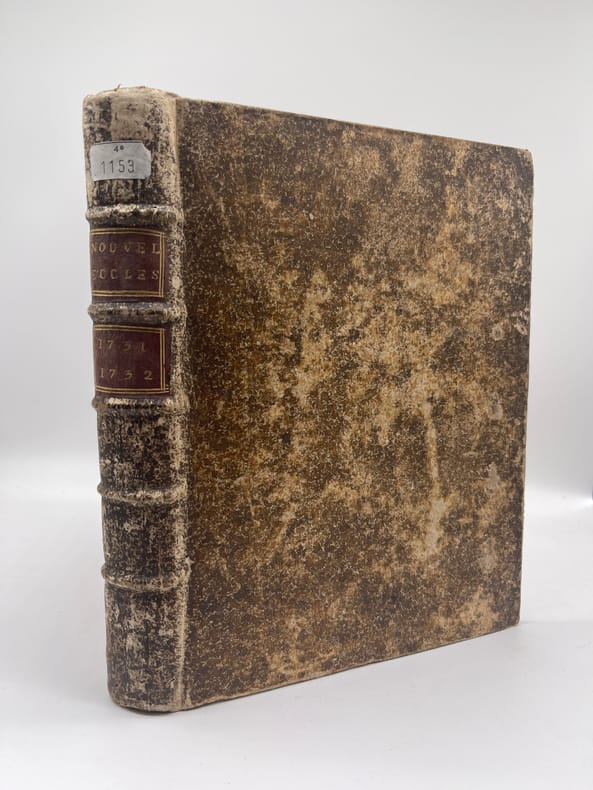
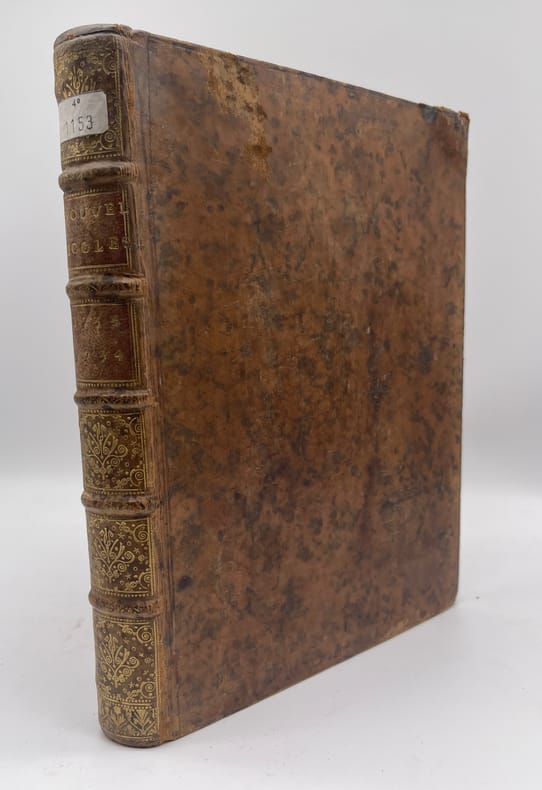
017371[Jansénisme] Nouvelles ecclésiastiques ou mémoires pour servir à l'histoire de la Constitution Unigenitus pour l'année M.DCC.XXXIII. [et] M.DCC.XXXIV. Paris, s.n., 1733-1734. In-4, front.-220-front.-228p. Deux années complètes de cet important journal publié clandestinement à partir de 1728 et jusqu'en 1803, farouchement militant pour les jansénistes et contre les partisans de la Bulle Unigenitus. On notera la présence de 4 gravures dont 2 frontispices et 2 portraits, placés en 1733, d'Alexandre Levier (p.44) et Firmin Tournus (p.196). Les frontispices semblent être en supplément, l'un deux portant un prix, 6 sols, en pied. Ils sont néanmoins particulièrement révélateurs de l'esprit des rédacteurs. Le numéro du 10 janvier 1734 est absent et a été remplacé à l'époque par une copie manuscrit de 8p. Plein veau, dos à nerfs orné, pièces de titre, tranches rouges. Coins supérieurs écrasés par une chute, tache brune sur 3 feuilles de 1733, légers défauts. Etiquette sur le dos, cachet sur la première page, répété p.100 (petit séminaire de Caen).
017372[Jansénisme] Nouvelles ecclésiastiques ou mémoires pour servir à l'histoire de la Constitution Unigenitus pour l'année M.DCC.XXXI. [et] M.DCC.XXXII. Paris, s.n., 1731-1732. In-4, 280-252-XIIp. Deux années complètes de cet important journal publié clandestinement à partir de 1728 et jusqu'en 1803, farouchement militant pour les jansénistes et contre les partisans de la Bulle Unigenitus. Ex-libris « Caroli Du Ruisseau in supremo senatu Patroni », Charles du Ruisseau, avocat au parlement de Paris en 1735 (base AFCEL D1915). Plein papier d'époque, dos à nerfs, pièces de titre, tranches rouges. Papier parfois un peu usé, reliure parfaitement solide. Etiquette sur le dos, cachet sur la première page, répété p.100 (petit séminaire de Caen). Quelques rares feuillets avec petit manque de papier marginal.
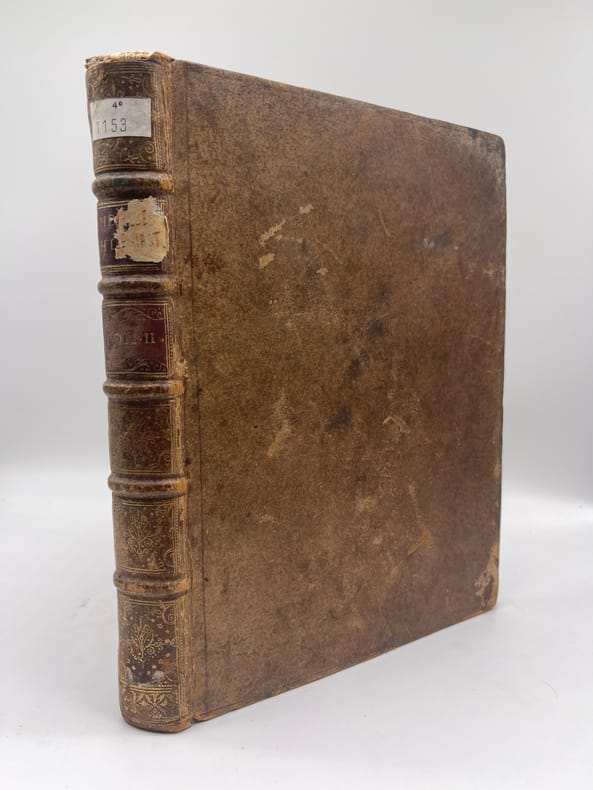
017373[Jansénisme] Nouvelles ecclésiastiques ou mémoires pour servir à l'histoire de la Constitution Unigenitus pour l'année M.DCC.XXVIII. Paris, s.n., 1728. In-4, environ 370p, paginations diverses. Année 1728 complète, commençant le 23 février 1728, avec des formats légèrement différents (certains numéros sont remargés à l'époque) et similaire à l'exemplaire de la BnF (numérisé sur gallica). Toutefois le volume débute par 5 feuilles « extrait d'une lettre de. » datées d'août à octobre 1727 (9 feuillets). On voit la trace de deux feuillets retirés (un autre extrait) et un exemplaire de « l'extrait d'une lettre d'Ambrun du 11 août 1727 » a été ajouté (volant). A la fin du volume se trouvent diverses pièces : « Supplément aux recueils des ordres émanés de la cour », un « avis de l'éditeur », une « ordonnance de Monseigneur l'évêque d'Auxerre » et une « très humble remontrance de M. de Montempuis au R.P. du Cerceau ». On remarquera que le volume, dont la reliure est d'époque, porte toutefois « tome II ». En effet, rapidement après la publication, un volume fut publié pour la période 1713-1728, considéré probablement comme le tome I. Provenance : Charles-Armand-René de La Trémoille (1708-1741), membre de l'Académie française, avec une grande vignette à ses armes en garde. TOUTEFOIS, nous supposons cette provenance purement fantaisiste, cela ressemblant à une vignette découpée (même si un second volume dans la même reliure porte la même vignette). Plein veau, dos à nerfs orné, pièces de titre et tomaison, tranches rouges. Coiffe supérieure arasées, étiquette sur le dos, cachet du petit séminaire de Caen p.100.
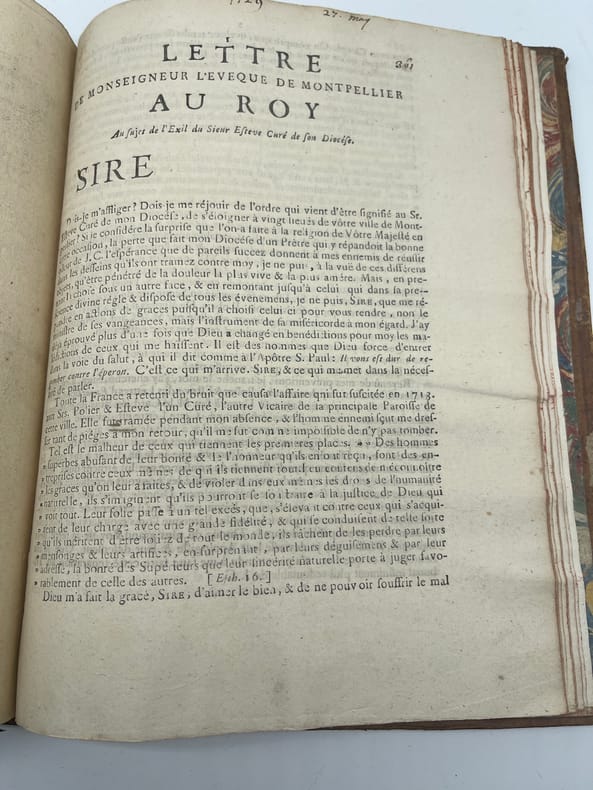
017374[Jansénisme] Nouvelles ecclésiastiques ou mémoires pour servir à l'histoire de la Constitution Unigenitus pour l'année M.DCC.XXIX. Paris, s.n., 1729. In-4, environ 345p, paginations diverses. Année 1729 complète, commençant le 15 février 1729, avec des formats légèrement différents (certains numéros sont remargés à l'époque). La numérotation manuscrite ajoutée à l'époque commence à la page 11, comme si le commanditaire de la reliure pensait qu'il manquait des numéros. Toutefois, l'exemplaire est similaire à celui de la BnF, ce qui nous fait dire que l'année est bien complète ainsi. A partir de la page 325 de notre exemplaire, plusieurs corrections manuscrites, similaires là-aussi avec celles de l'exemplaire de la BnF. A la fin du volume se trouvent diverses pièces : « Ordonnance de son éminence Monseigneur le Cardinal de Noailles » du 12 novembre 1716 [publié en 1729 par Delespine], « Lettre de Monseigneur l'Eveque de Montpellier au Roy au sujet de l'exil du sieur Esteve » et « Le Guichotisme nouveau ou le formulaire » [qui aurait été publié en 1727, un feuillet déchiré et réparé à l'époque]. On remarquera que le volume de cette deuxième année, dont la reliure est d'époque, porte toutefois « tome III ». En effet, rapidement après la publication, un volume fut publié pour la période 1713-1728, considéré probablement comme le tome I. Provenance : Charles-Armand-René de La Trémoille (1708-1741), membre de l'Académie française, avec une grande vignette à ses armes en garde. TOUTEFOIS, nous supposons cette provenance purement fantaisiste, cela ressemblant à une vignette découpée (même si un second volume dans la même reliure porte la même vignette). Plein veau, dos à nerfs orné, pièces de titre et tomaison, tranches rouges. Accroc en pied d'un mors, manque sur une coupe, cachet du petit séminaire de Caen.
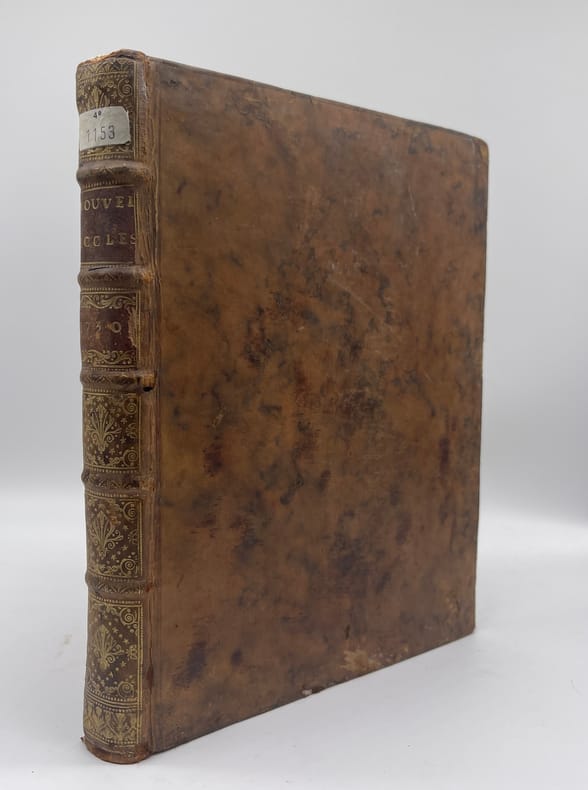
017375[Jansénisme] Nouvelles ecclésiastiques ou mémoires pour servir à l'histoire de la Constitution Unigenitus pour l'année M.DCC.XXX. Paris, s.n., 1730. In-4, environ 353p, paginations diverses. Année 1730 complète, truffé de 3 belles gravures au format in-folio et donc pliées : « Les premiers deffenseurs de l'Eglise contre la Constitution Unigenitus » (p.1, portraits de 9 appelants, cartouche de titre ajouté, collé en tête) ; un portrait de Charles-Joachim Colbert de Croissy (1667-1738) entouré d'une liste de ses oeuvres (p.83) ; un portrait de Jean Soanen (1647-1740) entouré lui aussi de la liste de ses oeuvres (p.195). Après les 258p de l'année (numérotées à l'encre) se trouvent différents textes : « relation de ce qui s'est passé au parlement de Rouen » du 28 avril au 19 mai 1730 ; « Lettre du père Chamillart jésuite au sujet du bruit qui avait couru de sa mort. » ; « Lettre d'un jésuite de Paris à un prélat au sujet d'une calomnie atroce. » (Paris, Herault, 30 mars 1732) ; « déclaration du père Tournemine jésuite sur des écrits supposés. » (Paris, Herault, 19 mars 1732) ; « Lettre au révérend père de Tournemine jésuite. » ; « Mandement de Monseigneur l'archevêque de Paris portant condamnation de plusieurs libelles qui ont pour titre Nouvelles ecclésiastiques » (Paris, P Simon, 1732) et une table pour les années 1730 et 1731. Plein veau, dos à nerfs orné, pièces de titre, tranches rouges. Petits défauts usuels, accroc à la coiffe supérieure, petite mouillure claire en tête (marginale).