34 254 résultats
1994354805Cambridge: University Press 1994. First Edition. Softcover. Near fine set in the original stiff-card wrappers; edges very slightly dust-dulled and toned. Remains particularly and surprisingly well-preserved; tight bright clean and especially sharp-cornered. Physical description; 36 volumes. Contents; vol. 2 part 1: February 1994 ; v. 2 no. 2: June 1994 ; v. 2 part 3: October 1994 ; v. 3 part 1: February 1995 ; v. 3 part 2: June 1995 ; v. 3 part 3: October 1995 ; v. 8: part 1: February 2000 ; v. 8 part 2: June 2000 ; v. 8: part 3: October 2000 ; v. 11 Part 1: February 2003 ; v. 11 part 2: June 2003 ; v. 11 part 3: October 2003 ; v. 12 part 1: February 2004 ; v. 12 part 2: June 2004 ; v. 12 part 3: October 2004 ; v. 13 part 1: February 2005 ; v. 14 part 1: February 2006 ; v. 14 part 1; February 2006 ; v. 14 part 2: June 2006 ; v. 14 part 3: October 2006 ; v. 15 no. 1: February 2007 ; v. 15 no. 2 June 2007 ; v. 15 no. 3: October 2007 ; v. 14 n.S. 2008 ; v. 16 no. 1: February 2008 ; v. 16 no. 2: June 2008 ; v. 16 no. 3: Special Issue: Colonial Legacies: October 2008 ; v. 17 no. 1: Special Issue: Anthropology of contemporary China: February 2009 ; v. 17 no. 2: May 2009 ; v. 17 no. 3: August 2009 ; v. 17 no. 4: Special Issue: 'Muslim Women' in Europe: November 2009 ; v. 18 no. 1: special issue: Anthropologies of university reform: February 2010 ; v. 18 no. 2: May 2010 ; v. 18 no. 3: August 2010 ; v. 18 No. 4: Special Issue: a cosmopolitan anthropology: November 2010. Subjects; Social Anthropology. Anthropology. Cambridge: University Press paperback
19712080502106910816Not Available 1971. Soft Cover. Fine. The book is in fine condition. Not Available paperback
19762080502106905316Not Available 1976. Soft Cover. Fine. The book is in fine condition. Not Available paperback
8 vols., 8vo., First Edition with numerous illustrations, diagrams and maps throughout; strongly and uniformly bound in blue cloth, gilt backs, all in very good, bright, state.
15192Handwritten journal Notebook recording death dates and obituaries for a teenage girl in 1857 upstate New York and others in her community. 96 pages numbered in pencil with 60 pages of content. Originally owned by Anna Arthur a school girl the initial pages record daily life including her daily interests in shopping and fashion. However Anna's contributions to the journal end abruptly in 1857 when she died suddenly "of brain congestion". The remainder of her journal is carried out by a family member likely her mother. Anna's obituary is pasted in. "Died. In this Village of Congestion of the brain after a short illness of but two days Miss Anna Arthur aged 17." Followed with handwritten pencil inscription with date of death Dec. 23 1857. "Among the deaths published in our paper this week is that that of Miss Anna Arthur only daughter of Charles Artur of this village. She was in the enjoyment of usual health until a day or two preceeding sic her death and no alarm was experienced by herself or family at the slight illness which suddenly terminated in Congestion of the brain. Miss Arthur was but seventeen years of age and was a young lady of much promise. -- The mysterious Providence which in the morning of life has removed from earth a darling child falls heavily upon the heads of a fond father and mother and a large circle of youthful friends and acquaintances. Truly we are as the flowers of the valley flourishing to day to-morrow no more! Happy visions rise before us our hearts are joyous no clouds dim the bright future when without a moments warning unseen and unknown the messenger of death lays his blightin touch upon the loved one and our hearts bleed with sorrow and refuse to be comforted."<br/><br/>Also includes a poem "Lines on the Death of Miss Anna Arthur" printed in an Essex County newspaper on Christmas day. "I gazed on a flower that modestly boomed On the breast of a maiden whom Death ahd entombed On her breast was a rose but not spirit was there.The roses that filled with their scented perfume The air which the mortals so softly did breathe: Were naought when compared witht the exquisite bloom Of those flowers that sigh where no spirit can grieve." The poems is signed off from Keeseville a small hamlet in the Adirondacks of New York. Followed by a handwritten poem "A Dirge". "Weep not for her; she died in early youth Ere Hope had lost its rih romantic hues; When human bosoms deemed that home of truth And earth still gleamed with beauty's radiant dews Her summer prime waned not to days that freeze; Her wine of line was run not the the lees; Weep not for her.Weep not for her she is an angel now And treads the sapphire floors of Paradise; All darkness wiped from her refulgent brow; Sin sorrow suffering banished from her eyes Victorious over death to her appear The vista'd joys of Heaven's eternal year; Weep not for her."<br/><br/>Includes obituary notices for members of the local community and others in the family including brother Asahel Arthur who passed in 1914. Includes handwritten poem "Rest Thee Brother." "Rest thee brother rest thee Underneath the snow; Winds shall sing a dirge for thee Murmuring waters flow." Begins with a log of various expenses for items needed in the year 1857 for sewing projects and other fancies that a young lady would enjoy such as "velvet ribbon" "bonnet" black silk kid gloves hair pinsand linen floss among others. Leather cover in poor condition. Wrapped in an attractive marbled folder. unknown books
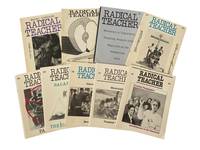
1981223841981. SocialismLaborFeminismEducation Nine-issue archive of Radical Teacher a socialist and feminist journal devoted to theory and practice in education spanning the 1980s and early 90s. These issues capture a generation of leftist educators and scholars responding to U.S. imperialism apartheid racism sexism and structural inequality through pedagogical critique. The archive foregrounds writing by and about women and people of color particularly Black feminist educators women's studies pioneers and anti-racist activists in academia. Contributors include Sharon Dean Erlene Stetson Sara Freedman Cynthia Kinnard and Becky Thompson among others .Archive includes:<br /> <br /> 1 Radical Teacher No. 18 Spring 1981. Focuses on feminist teaching and women's studies. Opens with "Flower-Dust and Springtime: Harlem Renaissance Women" by Sharon Dean and Erlene Stetson-a rare educational examination of Zora Neale Hurston Georgia Douglas Johnson and other Black women writers. Essays include feminist teaching guides course design and critical reflections on pedagogy by and for women. Contributors include Nancy Schniedewind Cynthia Kinnard Berenice Fisher and Jean Robinson. Light edgewear.<br /> <br /> 2 Radical Teacher No. 21 1982. Issue theme: anti-imperialism and critical pedagogy. Features teaching on Nicaragua and essays on apartheid women college students and the return of the draft. Of special note is Renate Duelli-Klein's "Women College Students and Feminism" an intersectional analysis of women's shifting relationship to institutional politics. Also includes coverage of South African resistance and PACE Progressive Adult and Continuing Education. Moderate edge wear else clean.<br /> <br /> 3 Radical Teacher No. 32 Spring 1987. A cluster on women and labor in socialist Eastern Europe including "Education in Yugoslavia" and Madonne Miner's "Another Women's Play Doesn't That Make Like Number 6"-a critique of the marginalization of women's theatrical texts in English curricula. Also includes discussions of Simone de Beauvoir Fred Ho and Croom Helm and Cold War pedagogy. Light wear very good.<br /> <br /> 4 Radical Teacher No. 35 Summer 1988. Theme: Christianity and education. Articles examine radical Christianity teaching religion critically and confronting fundamentalism in schools. Notable contributions include Kathleen Sands on religion in the university and Caroline Zinsser on biblical literalism. While not a themed feminist issue several authors critique patriarchy in religious education. Minor corner crease.<br /> <br /> 5 Radical Teacher No. 36 1989. Family and education theme. Articles include Sara Freedman's "To Love and to Work" on the double burden of women teachers and mothers and Ynestra King's "Family Secrets" on teaching domestic violence. The issue challenges traditional conceptions of the nuclear family through a feminist lens. Excellent feminist scholarship by and about women. Light wear to spine.<br /> <br /> 6 Radical Teacher No. 37 1989. Theme: balancing the curriculum. Focuses on race gender and class integration in U.S. syllabi. Includes a collective essay by Marie Buncombe and Dorothy O. Helly on curriculum transformation and a review of Women Teaching for Change. Particularly rich in content on BIPOC authors and inclusive pedagogy. Near fine.<br /> <br /> 7 Radical Teacher No. 38 1990. Special issue on Mississippi Freedom Schools. Includes Charles Cobb Liz Fusco and Jimmy Garrett on education in the 1964 Freedom Summer with facsimiles of original curricula and poetry. Features Susan O'Malley's tribute to Myles Horton. An essential issue for those studying African American education SNCC pedagogy and movement schooling. Excellent condition.<br /> <br /> 8 Radical Teacher No. 40 1991. Issue on education and revolution. Focuses on Nicaragua Cuba Palestine and apartheid-era South Africa. Judy Brady's "Why Do Cuban Children Learn" and Ellen Fleischmann's "Education in the West Bank" are standout articles. Centers anti-imperialist and decolonial education frameworks. Light wear to fore-edge.<br /> <br /> 9 Radical Teacher No. 41 1992. Feminist Pedagogies and Difference in the Classroom. A landmark issue featuring Becky Thompson and Signe Disch on anti-oppression teaching Sarah Napier on elementary-level women's studies and Ruth Hsiao's guide to teaching Asian American literature. Noteworthy for its intersectional focus and diverse author pool including multiple women of color educators. Near fine.<br /> <br /> Overall condition very good with light handling wear and some edge toning. A rich pedagogical archive documenting the intersections of feminism socialism anti-racism and education in late 20th-century activist scholarship. unknown
25583EXPOSITION--LONDON--1851 THE ART JOURNAL. ILLUSTRATED CATALOGUE. THE INDUSTRY OF ALL NATIONS 1851. London: The Art Journal 1851. Folio. Rebacked calf spine and tips with marb boards. xxvi 328 xvi viii xxii viii viii pages. First edition. Containing hundreds of engravings and articles on science by Robert Hunt textiles by Lewis D.B. Gordon the exhibition itself by Ralph Wornum plants agriculture by Edward Forbes and color by Mrs. Merrifield. Rebacked else ve good. unknown books
16721Handwritten diary of a high school girl detailing her experience at the 1876 World's Fair in Philadelphia and over 30 pages of poetry to write in the autograph albums of schoolmates. <br/>8 x 5 in. Original leather boards. 48 handwritten pages. Writing on first 5 pages pasted over partially or completely. "Cora B. Wakelee Huntington Conn. May 22 1876" inscribed on front end page. Includes memories of the World's Fair from the perspective of a young girl in addition to pithy lines on friendship and original mourning poetry.<br/><br/>The 1876 Centennial Exposition in Philadelphia was the first official World's Fair to be held in the US. Wakelee details all of the marvelous things she saw including a model of Niagara Falls that was 160 ft long and 80 ft high. ".Niagara where the water comes pouring over he falls like the real Niagara. There was a house or cottage of each state. The New England House was a log house which as one story and one half high in which everything was 100 years old or over. The Bedstead was 200 years old and the bedding 100. There were two girls quilting a bedquilt. In the Connecticut Cottage there was a New England kitchen with the old fashioned chimney and the wooden nutmegs and wooden ham and gourds. In the Missippi sic state building everything was covered with moss. In Agricultural Hall they made tin pails and cups. All kinds of carpets Rag Three ply Brussels and Ingrain were made. Also cotton cloth bagging and silk handkerchiefs. In Horticultural Hall there was a Fig tree with figs on them also Orange lemon and Pineapple trees. The Egyptian mummies which were human bodies dried. A Swiss watch not so large as a gold dollar. There was Washington's horses and private carriage. There was a picture of Washington and the Declaration of Independence worked with hari. And a picture of Washtington and family worked with worsted. In the lady's pavilion was the head of a lady made of butter called the Butterhead. There was a large collection of animals and birds which were killed by a lady in Kansas. An Eagle made of gold pens was made to look like quills a little way off."<br/><br/>Records information on the High School classes from 1880-1881. Newspapers cutting from 1881 that was also transcribed by hand into the notebook: "We are pleased to note that our side shared in the honors at the close of the Birmingham high school Miss Cora B. Wakelee taking the unabridged dictionary as the first prize for spelling." The previous year she won $3.00 as thesecond place prize for Scholarship. Pages 14-48 are filled with handwritten poems and lines that would be copied into memory books or autograph albums of friends. These had sentimentality as well as humorous tone. "A wish for earth tis often given My wish for thee a home in Heaven." "Though short our acquaintance has been And quickly the hours fave flown Permit me to call you my friend As others I longer have known." "Come what may Come what will Remember the girl that went up hill." "Way over here clear out of sight is the only place she'd let me write." The entries also include original poetry mourning the loss of a close friend: "A sparkle of hope for the Lost In the deepest gloom of winter On a cold and stormy day While the shades of night were falling Mattie Otis passed away./ While the storm was in its fury One could hear the wild winds ror She has gone yes gone forever We shall never see her more." Losses to spine loose hinges. Some toning. Good condition. unknown books
1921ZB626412NY 1921. volumes 113 114 116 117 119 120 124 125 127 128 129 1921-1929 bound ex library with all the ads having been pulled; else texts clean & bindings tight. - If you are reading this this item is actually physically in our stock and ready for shipment once ordered. We are not bookjackers. Buyer is responsible for any additional duties taxes or fees required by recipient's country. Photos available upon request. NY unknown
1989ZB393463Elsevier 1989. complete volume partly bound ex library overall near very good. - If you are reading this this item is actually physically in our stock and ready for shipment once ordered. We are not bookjackers. Buyer is responsible for any additional duties taxes or fees required by recipient's country. Photos available upon request. Elsevier unknown
1967206701967. African American Education Archive of five issues of The Journal of Negro Education: A Quarterly Review of Problems Incident to the Education of Negroes published by The Howard University Press for the Bureau of Educational Research Washington D.C. between 1967 and 1973. Original printed blue wrappers. Founded in 1932 by educator and psychologist Charles Henry Thompson the first African American to earn a doctorate in educational psychology and later Dean of Howard University's School of Education the journal became one of the most influential scholarly publications devoted to the study of Black education in the United States.<br /> <br /> Established during the era of Jim Crow segregation and continuing through the Civil Rights and Black Power movements the journal sought to collect and disseminate research on the education of African Americans critically evaluate educational policies and practices and encourage scholarly investigation into issues affecting Black students and communities. By the 1960s and 1970s it had become a leading forum for examining school desegregation educational inequality Black identity poverty higher education and the social consequences of racial discrimination. The archive includes five substantial issues published during a transformative period in American education and race relations:<br /> <br /> Winter 1967 Vol. XXXVI No. 1. Articles include Some Effects of Deprivation on Intelligence Achievement and Cognitive Growth; Notes on the Education of Negroes in North Carolina During the Civil War; The Negro Undergraduate Student: Factors Relative to Performance in Predominantly White State Colleges and Universities in Tennessee; and Beyond Poverty of Income. Published amid the national debate surrounding the War on Poverty and educational inequality.<br /> <br /> Spring 1967 Vol. XXXVI No. 2. Features studies on school improvement unemployment emotional development among Black youth and contemporary trends in Black education reflecting growing concern over urban poverty and unequal educational opportunity.<br /> <br /> Summer 1967 Vol. XXXVI No. 3. The annual Yearbook Number devoted to The Higher Education of Negro Americans: Prospects and Programs. Essays examine graduate education the role of predominantly white institutions in educating Black students educational opportunity and the experiences of Black college students in the South. Issued during a period of rapidly expanding college enrollment and increasing demands for equal access to higher education.<br /> <br /> Fall 1969 Vol. XXXVIII No. 4. Published in the aftermath of major civil rights legislation and amid widespread school desegregation efforts. Articles analyze academic desegregation interracial attitudes among college students self-concept among Black and white youth in segregated environments and methodological questions surrounding social science research on race.<br /> <br /> Winter 1973 Vol. XLII No. 1. Reflecting the intellectual climate of the Black Power era this issue includes studies such as Differences Between Black Youth Who Support the Black Panthers and the NAACP; Do Black Studies Make a Difference in Ghetto Children's Achievements and Attitudes; The Children of Immigrants in the Schools; and School Desegregation Socioeconomic Status Sex and the Aspirations of Negro Adolescents. The issue captures scholarly efforts to evaluate the impact of Black Studies programs and evolving forms of Black political and educational activism.<br /> <br /> Taken together these volumes document some of the most significant debates in twentieth-century African American educational history including segregation and desegregation educational deprivation Black identity formation civil rights Black Power access to higher education and the continuing struggle for educational equality. The contributors represent a generation of educators psychologists sociologists and policy researchers whose work helped shape both academic scholarship and public discussion of race and education in the United States.<br /> <br /> Light fading to wrappers primarily along spines and edges with minor staining and handling wear. Bindings remain sound and contents clean. Overall very good condition. An important scholarly archive documenting the evolution of Black educational thought during the Civil Rights and Black Power eras. unknown
In folio (mm. 412x280), un volume in mz. tela coeva (un piatto con abras.). Offriamo una straordinaria raccolta di complessivi "61 fascicoli" di stampa umoristica, con numeri tutti in sequenza, così composta: - "Super Calandrino", “supplemento mensile di ‘Calandrino’”, di pp. 24 cad., illustrato in b.n. da ‘500 vignette e battute’ (la p. 1 di copertina è in tinta, blu o rossa); disponibili: Anno II (1953) solo n. 12 // Anno III (1954), completo dal n. 1 (gennaio) al n. 12 (dicembre); complessivamente sono 13 fascicoli. - "Calandrino", “selezione settimanale della stampa umoristica”, di pp. 12 cad., illustrato in b.n. da 1 foto e da vignette (anche qui la p. 1 di copertina è in tinta rossa o blu); disponibili: Anno V, dal n. 49 (6 dicembre 1953) al n. 53 (3 gennaio 1954) // Anno VI, dal n. 1 (10 gennaio 1954) al n. 43 (31 ottobre 1954); complessivamente sono 48 fascicoli. Considerati “i giornali inutilmente imitati”, sono opera dei migliori disegnatori delle migliori riviste di tutto il mondo (Marc’Aurelio - Buddies - Ici Paris - Fourire - Weltwoche - Good Humour - London Opinion - C’est la Vie - Cartoon Humour - The New Yorker - Paprika - Schweizer Illustrierte - Candido - Cosmopolitan - Punch - Lilliput - Merlo Giallo - Asso di Bastoni - Pasquino - Epoca, ecc., ecc.) Estremamente raro trovare una raccolta come la nostra, per di più in ottimo stato di conservazione.
PHIL1802St. Louis, Miss., Eden Publish. House. gr.-8°, OKart., Eigentümer-Prägestemp., abgegriff., an den Kap. tlw. etw. rissig, schwache Bräunungsspuren. In Englisch.
In-8 (mm. 241x174), similpelle mod., filetti e tit. oro al dorso, pp. 432,44, con 6 tavole f.t. inc. in rame, ciascuna con più figg. (2 sono carte geografiche). Tomo XXII di questo importante periodico scientifico milanese che raccoglie saggi e memorie dei più grandi scienziati dell’epoca, edito dal 1778 al 1803. In Appendice “Libri nuovi” in Italia e all’estero. Questo vol. raccoglie 54 saggi di cui: 18 di Agricoltura ed Arti (”Del montone idraulico” del C. di Montgolfier - “Ricerche chimico economiche sull’imbiancamento della seta” del Prof. G.A. Giobert - “Sulla coltivazione dell’oppio in Toscana” del Dr. Carradori) 26 di Fisica, Chimica e Storia Naturale (”Sopra un Arco-baleno lunare” di P. Spadoni - “Sulle stelle cadenti” di Beuzenberg e Brandes - “Transunto d’un viaggio fatto nell’interno dell’Africa” di Horneman - “Transunto de’ viaggi di Mackenzie nell’interno dell’America settentrionale” - “Osservazioni sulle anguille” di C. Amoretti - “Ragguaglio del viaggio aereo del C. Zambeccari agli 8 ottobre 1803, ecc.) 10 di Medicina e Anatomia (”Sull’applicazione del galvanismo alla medicina” di A.M. Vassalli-Eaudi - “Della vaccinazione fatta nel dipartimento del Verbano” del Dr. L. Sacco - “Su alcune cure fatte in Como col voltaismo medico” di Laverine - “Storia del Galvanismo”, ecc.). Con aloni ma complessivam. un buon esemplare.
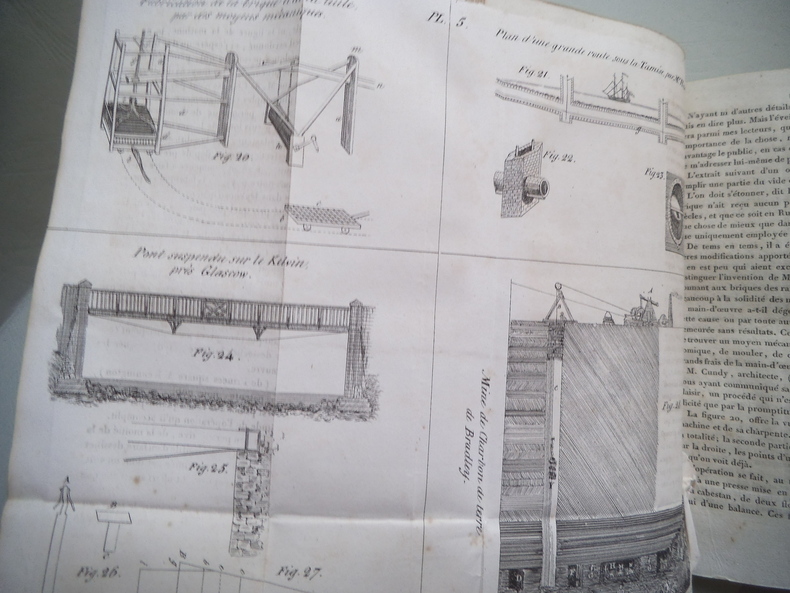
13314Journal hebdomadaire des Arts et Métiers de la mécanique pratique, et découvertes, inventions, perfectionnements, procédés utiles, de l ‘industrie et de l’économie facturière, commerciale, rurale et domestique de l’Angleterre, etc. Tome premier In 8 demi cuir, titre , tomaison, fers, roulette, filets dorés. 545 pages, 7 pages de table des matières et d’errata. 24 planches hors-texte, la plupart dépliantes. Planche 1 : instrument pour cueillir des fruits, trompette à l’usage des sourds, machine à vapeur ; locomotive etc. Sautelet Charpenay & Cie. 1825. Peu courant.
13349Journal hebdomadaire des Arts et Métiers Journal hebdomadaire des Arts et Métiers de la mécanique pratique, et découvertes, inventions, perfectionnements, procédés utiles, de l ‘industrie et de l’économie facturière, commerciale, rurale et domestique de l’Angleterre, etc. Tome second In 8 demi cuir, titre, tomaison, fers, roulette, filets dorés. XXXII-445 pages, pages de table des matières et d’errata. 20 planches hors-texte, la plupart dépliantes dont 3 avec déchirures, et une avec un petit manque de papier au niveau d’une pliure. Machines à vapeur, navigation chauffage, mécanique physique chimie, agriculture, économes Sautelet Charpenay & Cie. 1825. Peu courant.
4863Journal in folio de 8 pages,texte sur 3 colonnes, bi-hebdomadaire, paraît le dimanche et le jeudi.Rédacteur H de VILLEMESSANT.5ème année complète du n°301 du dimanche 3 janvier 1858 au n° 404 du jeudi 30 décembre 1858.En deux volumes demi-cuir vert époque,titre,année,tomaison,filets dorés.Un coin,une coiffe,restaurés.RARE
sb54Gallimard Broché Vingt-quatre volumes in-12 (12 x 19 cm.), brochés, tome 1 à 28, manquent les tomes 7 / 20 / 22 / 23, Journaliers 1957 - 1959 (257 pages - 1961), Les instantanés de la mémoire (1962 -163 pages), Littérature confidentielle (1963 -138 pages), Que tout n'est qu'allusion (1980 - 146 pages), Le Bien du Mal (1964 - 136 pages), Être inimitable (1964 - 291 pages), Que la vie est une fête (1966-339 pages), Que l'amour est un (1967-264 pages), Le gourdin d'Elise (1967-14 pages), La vertu dépaysée (1968 - 269 pages), Nouveau Testament (1968-244 pages), Magnificat (1969 - 244 pages), La Possession (1970-144 pages), Confrontation avec la poussière (1970 - 202 pages), Aux cent actes divers (1971-142 pages), Gémonies (1972-150 pages), Paulo minus ab angelis (1973-277 pages), Un second soleil (1973-301 pages), Orfèvre et sorcier ou Invraisemblable et vrai (1975-276 pages), Une gifle de bonheur (1977-171 pages), La mort d'Elise (1979-176 pages), Nunc dimittis (1979-145 pages), Du singulier à l'Éternel (1981-177 pages), Dans l'épouvante le sourire aux lèvres (1982-198 pages) ; dos plissés, coiffes et mors un peu frottés, certains plats défraîchis, traces d'étiquette au bas de 7 dos, intérieur frais,, assez bon état d'ensemble. Livraison a domicile (La Poste) ou en Mondial Relay sur simple demande.
22643Printed heading Essex County Standard Office Colchester 22 Nov. 1941. Two pages 8vo tipped on top slightly larger backing page information about author typed under the letter good condition. He thinks an author is wrong in a statement saying "The duty levied under Charles I fixed in 1628 was 36 pence underlined per gross on all playing cards not 36 shillings underlined. Actually the duty was 2s. pergross but there was a further 1s. pergross payable to the Officer appointed as Receiver of the Duty. This levy was granted to the London Company or Corporation of Makers of Playing Cards." He goes on to discuss the later history of the duty on cards one increase rousing "vehement protest by the Company of Playing Card Makers. Sone years ago I went carefully through the Company's Records of Minutes. They do not record an increase in the duty in the time of Charles I but it may that there was an increase. Unfortunately there is not in existence a pack of English Playing Cards of the 17th Century." He then refers Leftwich to his book if he has a copy offering to send one if he hasn't. He concludes with discussion of excavations at Lexden including Cymbeline's 'tomb'. They were both local historians of note. He concludes "I rather hope that the prohibition of Christmas Cards for 1942 may be withdrawn or modified next year but this will depend upon the war developments .". Benham's other claim to fame is his book of quotations. [Printed heading] Essex County Standard Office, Colchester, 22 Nov. 1941. unknown
NC00G-00151The Christian Science Journal. Used - Good. Good condition. Lot of 19 The Christian Science Journal ranging 1900-1979. Rebound. Slightly dampstained. Bookplate inside. Writing inside. christianity christian living periodicals NOT AVAILABLE FOR SHIPMENT OUTSIDE OF THE UNITED STATES. The Christian Science Journal unknown
4696JAPAN. Diary. January 14 1950 to late 1954. Various places Philadelphia Japan Fort Meade. A lengthy diary of an American officer Lieutenant Louis T. Holtz who was stationed in Japan during the Korean War. It was written on dozens of sheets of loose-leaf notebook pages and it contains many black and white photographs with captions as well as newspaper and magazine cutouts and brochures from places he visited. The diary begins on January 14 1950 in Philadelphia and he discuses seeing shows and such but notes that All in all this constituted a very enjoyable ten days of leave prior to going overseas. Sometimes I wish I could stay at home and live a normal routine life like everyone else. Other times I find myself eager to goAlmost two years ago who could forecast a war in Korea and the manner in which it would rip everyones life to shreds He writes on January 2 1951 from Kurume Japan: perhaps 10 years from now it the diary will be of interest if any of our civilization remains in 1961I collapsed 28 June and spent 3 weeks in the hospital with excessive fatigueI am the Officer-in-charge of the Kurume Office with an area of jurisdiction of approximately 1000 square miles. In April 1951 he mentions I am very busy in my position as OIC Officer In Charge. Its a full 7-day-a-week jobThe Korean mess has everyone guessing as to eh future of the Far Eastbeing the senior official in an area of jurisdiction of nearly 10000 square miles with dozens of mayors and police chiefs constantly catching my every word as official. The next couple dozen pages contain black and white photographs of protests in Japan and Holtzs commentary about the images including When people get hurt propaganda fills the air. The winner: the Kremlin always! Demonstrations take planning and people. You can always be sure the plans were framed in red and the spectators sprinkled liberally with dye-hard communist stooges Demonstrations & rallies are usually fantastically well organized. And as often as not they can be unbelievably orderly and But orderly or violent you can always be sure there is a professional communist keeping the sheep in line or arousing them to maximum fury. In September 1951 Holtz writes from Sapporro life in the Armed Services has been a miserable one because of one bad experience after anotherKurume was one of the most pleasant and enjoyable assignments I ever held. The 45th was without doubt the most bitter and least enjoyable. I gave up so much for so little. Holtz was in Californias Camp Stoneman in November 1951: with all the hundreds of officers here not particularly anxious to go overseas and with several actually fighting the assignment I was amazed to find that someone eager to return is sidetracked so abruptly. He was back in Japan by December and then wrote a lengthy entry entitled The Korean Story starting with Combat precautions make it mandatory that no diaries or personal papers be kept where they may fall into enemy hands and he spends the next seven pages describing his experiences in the Korean War. Holtz wrote in part: Things had not gone well at all with Trubotas unit prior to August 1951. After my arrival working results proved very satisfactoryThree other officers has also joined up in the interim between leaving Sapporo and going to KoreaWhen oriented in Tokyo they were told that the 45th Detachment would remain in Sapporo and they had already alerted their families to start to prepare to join them overseasI had to fight Trubota in order to be able to fight the enemy. In one occasion I was reprimanded for going to a forward observation post and not being personally available to answer the telephone at my CP and the section finishes with a photograph of the USS Marine Lynx the ship that brought him home. The diary continues with his being stationed at Marylands Fort Meade. There are photographs of the mansion he occupied in Kyushu Japanese women at the beach his fellow soldiers after a bowling tournament etc. There are Samples of United Nations propaganda leaflets dropped on North Korean positions early in the Korean conflict that show Truman and MacArthur a December 7 1950 letter signed by the mayor of Kurume City Japan. The condition is fine to very fine. unknown
D17552Autograph diary written in pencil signed by Miss Elizabeth Woods of Bowling Green Kentucky. 135 pp. Well educated wealthy American woman's account of seeing Europe; mostly Paris France. Her Southern sensibilities were shocked at seeing a white woman at the same table with a black man. Turns out he was a minister from Haiti and the lady was his wife. Miss Woods saw the Paris Exposition several times; saw Sarah Bernhardt perform; saw President Kruger of South Africa; saw a street where Jews were not allowed to come out after 6pm; describes fancy balls and dinners; shopping for clothes.much of interest. Worn oil cloth binding. Numerous accounts of "charming" or "lovely" people. <br/><br/> hardcover
D17552Autograph diary written in pencil signed by Miss Elizabeth Woods of Bowling Green Kentucky. 135 pp. Well educated wealthy American woman's account of seeing Europe; mostly Paris France. Her Southern sensibilities were shocked at seeing a white woman at the same table with a black man. Turns out he was a minister from Haiti and the lady was his wife. Miss Woods saw the Paris Exposition several times; saw Sarah Bernhardt perform; saw President Kruger of South Africa; saw a street where Jews were not allowed to come out after 6pm; describes fancy balls and dinners; shopping for clothes.much of interest. Worn oil cloth binding. Numerous accounts of "charming" or "lovely" people. <br/><br/> hardcover books
4696JAPAN. Diary. January 14 1950 to late 1954. Various places Philadelphia Japan Fort Meade. A lengthy diary of an American officer Lieutenant Louis T. Holtz who was stationed in Japan during the Korean War. It was written on dozens of sheets of loose-leaf notebook pages and it contains many black and white photographs with captions as well as newspaper and magazine cutouts and brochures from places he visited. The diary begins on January 14 1950 in Philadelphia and he discuses seeing shows and such but notes that “All in all this constituted a very enjoyable ten days of leave prior to going overseas. Sometimes I wish I could stay at home and live a normal routine life like everyone else. Other times I find myself eager to go…Almost two years ago who could forecast a war in Korea and the manner in which it would rip everyone’s life to shreds†He writes on January 2 1951 from Kurume Japan: “…perhaps 10 years from now it the diary will be of interest – if any of our civilization remains in 1961…I collapsed 28 June and spent 3 weeks in the hospital with excessive fatigue…I am the Officer-in-charge of the Kurume Office with an area of jurisdiction of approximately 1000 square miles…â€. In April 1951 he mentions “I am very busy in my position as OIC Officer In Charge. It’s a full 7-day-a-week job…The Korean mess has everyone guessing as to eh future of the Far East…being the senior official in an area of jurisdiction of nearly 10000 square miles with dozens of mayors and police chiefs constantly catching my every word as official.â€. The next couple dozen pages contain black and white photographs of protests in Japan and Holtz’s commentary about the images including “When people get hurt propaganda fills the air. The winner: the Kremlin – always!†“Demonstrations take planning and people. You can always be sure the plans were framed in red and the spectators sprinkled liberally with dye-hard communist stooges†“Demonstrations & rallies are usually fantastically well organized. And as often as not they can be unbelievably orderly†and “But orderly or violent you can always be sure there is a professional communist keeping the ‘sheep’ in line or arousing them to maximum fury.†In September 1951 Holtz writes from Sapporro “…life in the Armed Services has been a miserable one because of one bad experience after another…Kurume was one of the most pleasant and enjoyable assignments I ever held. The 45th was without doubt the most bitter and least enjoyable. I gave up so much for so little…â€. Holtz was in California’s Camp Stoneman in November 1951: “…with all the hundreds of officers here not particularly anxious to go overseas and with several actually fighting the assignment I was amazed to find that someone eager to return is sidetracked so abruptly…â€. He was back in Japan by December and then wrote a lengthy entry entitled “The Korean Story†starting with “Combat precautions make it mandatory that no diaries or personal papers be kept where they may fall into enemy hands†and he spends the next seven pages describing his experiences in the Korean War. Holtz wrote in part: “…Things had not gone well at all with Trubota’s unit prior to August 1951. After my arrival working results proved very satisfactory…Three other officers has also joined up in the interim between leaving Sapporo and going to Korea…When oriented in Tokyo they were told that the 45th Detachment would remain in Sapporo and they had already alerted their families to start to prepare to join them overseas…I had to fight Trubota in order to be able to fight the enemy. In one occasion I was reprimanded for going to a forward observation post and not being personally available to answer the telephone at my CP…†and the section finishes with a photograph of the USS Marine Lynx the ship that brought him home. The diary continues with his being stationed at Maryland’s Fort Meade. There are photographs of the mansion he occupied in Kyushu Japanese women at the beach his fellow soldiers after a bowling tournament etc. There are “Samples of United Nations propaganda leaflets dropped on North Korean positions early in the Korean conflict†that show Truman and MacArthur a December 7 1950 letter signed by the mayor of Kurume City Japan. The condition is fine to very fine. unknown books
1930D14181930. Very Good. Cloth-covered boards 12 x 10.5 inches; contains 30 grey heavy cardstock leaves. Nicely preserves silver-gelatin photographs in sepia and b/w average size is 2 x 4 inches passenger lists postcards telegrams newspaper clippings pamphlets a few manuscript entries and more tipped-onto the rectos and versos of every leaf or laid-in at rear. Boards a bit scuffed with a scattering of tiny bleached spots. Binding a bit shaken as expected as the volume is near-to bursting with keepsakes and treasures. <br/><br/>Photographs of landmarks landscapes streetscapes and some wonderful images of the clothing interior design and cars of the period. Postcards mostly b/w with a few colored include but are not limited to Stonehenge Tunbridge Wells Warwick Castle Shakespeares Birthplace Anne Hathaways cottage and lovely garden Raglan Castle Gloucester Cathedral Blarney Castle a portrait of Lenin a portrait of Stalin The Paramount Hotel of New York City. Here and there throughout this travelogue includes quite a few interesting pamphlets. All of them are clean and legible though adhered to the scrapbook by their rear covers and as such not removable without causing damage. They are: A guide to The Duke of Cornwall Hotel Plymouth; The Cathedral and Metropolitical Church of Christ; Canterbury: A Handbook for Pilgrims; Guide to the High Rocks One Mile from Royal Tunbridge Wells; A Short Guide to Battle Abbey; A Catalogue of an Exhibition of Original Paintings and Drawings Made to Illustrate Books Published at the Bodley Head New Burlington Galleries 1930; A guide to Compton Wynyates History of Blarney Castle; A Guide to Glebe Hotel Lakes of Killarney Ireland; Kate by Mary McCartie staple-bound illustrated wraps printed by The Veritas Company Dublin; The University Collection of Antiquities Short Guide-Books I. The Oseberg-Ship and The Oseberg-Room Oslo: A. W. Broggers 1930; Authorised Guide to the Tower of London. The final leaf introduces a new cruise aboard the S. S. George Washington to Hamburg Southampton and Cherbourg and Cobh Queenstown with a passenger list menu and one tiny photograph of the Statue of Liberty. Though no details of this journey are provided one legend is recorded in manuscript: A one-page telling of The Seven Sluggards in the Courtyard of the Paula Becher Modersohn House in Boettcherstrasse in which seven brothers dig a spring because theyre too lazy to fetch water from the well build a dyke around their house because theyre too lazy to fend off flood pave a road because theyd rather not dig their wagon out of the mud in general perform any number of laborious feats so that they can enjoy their laziness in comfort. Some rather brittle newspapers a love letter in which a very particular engagement ring is demanded a few stray postcards and photographs and manuscript see below are laid-in at the rear. Manuscript: 5 folded leaves comprising 17 pages. Hastily records a series of charms spells superstitions and omens undated not offering a location. If you see leaves and dust suddenly rise in a little whorl wind bless yourself and leave there is a passage there i e the fairies are going by hardcover