13 728 résultats
18220009173ALBANY NEW YORK NY. Good. 1822. On offer is a fascinating and fantastic 1822 New York State Agricultural Almanac. The front cover contains its defining information: "The State of New-York Agricultural Almanack for the Year of Our Lord 1822. Being the second after Bissextile or Leap Year; and until July 4th the Forty-Sixth of American Independence. Calculated for the Horizon and Meridian of Albany -North Latitude 42 degrees 45 minutes - from the English Observatory 73 degrees and 30 minutes west. By S. Southwick. Albany. Sold by Daniel Steele No. 472 South Market-street. Packard & Van Benthuysen Printers. The almanac was owned by a man named C. Coffin who has signed his name at the top of the cover page. The almanac contains much of the same information as others: calendars advertisements astrology zoology fables and stories weather patterns throughout the year information on raising livestock and planting seeds and much more. What makes this almanac special are the diary entries and copious notes of the owner Mr. Cotton interleaved through most of the almanac. The notes deal pretty exclusively with the weather temperature wind clouds precipitation news of friends and family many who are sick and a few who die through the year and information on his Universalist church. Interestingly there is also a remark about the 1822 New York City Yellow Fever epidemic. There are generally a few pages of notes in between each page of the almanac written on slightly smaller paper than the almanac itself and stitched into the creases between the pages. Research has not turned up much information on C. Cotton but he does mention himself that he is a landlord of at least one home. The almanac has quite a bit of wear especially near the front and back. Almost all the pages are at least a bit frayed at the edges and there is significant corner creasing again more near the front and back. There is no cover to the front or back. The original stitching is no longer there probably replaced by Mr. Cotton himself so he could stich his own paper into the book and use it as a diary. As such though the binding is still pretty tight it is evidently done quite haphazardly. The almanac itself is roughly 100 printed pages and there are 47 handwritten pages stitched inside at various places. These pages are also show a good bit of wear and age-toning as well. However the handwriting is legible and readable throughout and the ink is still mostly dark and easy to read. The book measures 4.5 x 7.5". Text: January 25 1822. Friday. N West wind sever cold but fair 4 noon afternoon and eve the same - Abraham Bradley Sexton to the Society of Universalists in this city buried a son a man in years the Funeral attended by many of the Society and Friends of the Father of the deceased - had a very large rout or Tea party of Friends at our house the last I hope that will ever take place in my day. April 1st 1822. Monday. Dull lowry morn wind southerly and no frost to be seen as the effect of the night past before or about noon the wind got s. Westerly and blod fresh and cool and so till night. Austin Abbott died six o clock after noon this day his family occupied some tenements in my house while he lived and I trust his spirit now occupies a house not made with hands eternal in the Heavens.; July 4th Thursday. Little southerly wind and some Foggy morn but not excessively hot though full warm enough for comfort towards night the clouds seem mustering together for more Thunder showers so farewell 4th July 1822 it is well it comes but once in each year.; August 19. Sunday. Wind for N East to south with Thunder lightning and some Heavy showers of rain a number of people got up from New York to Escape or avoid the Epidemic fever raging there this time which by account seems very prevalent there. OVERALL: G; Manuscript; 16mo - over 5¾" - 6¾" tall; KEYWORDS: HISTORY OF NEW YORK STATE AGRICULTURAL ALMANAC ALBANY NEW YORK C. COTTON DANIEL STEELE PACKARD & VAN BENTHUYSEN EARLY 19TH CENTURY AMERICA ALMANACS IN AMERICA 1822 NEW YORK CITY YELLOW FEVER EPIDEMIC AMERICANA HANDWRITTEN MANUSCRIPT DOCUMENT LETTER AUTOGRAPH WRITER HAND WRITTEN DOCUMENTS SIGNED LETTERS MANUSCRIPTS HISTORICAL HOLOGRAPH KEEPSAKE WRITERS AUTOGRAPHS PERSONAL MEMOIR MEMORIAL ARCHIVE DIARY DIARIES JOURNAL LOG ANTIQUITÉ CONTRAT VÉLIN DOCUMENT MANUSCRIT PAPIER ANTIKE BRIEF PERGAMENT DOKUMENT MANUSKRIPT PAPIER OGGETTO DANTIQUARIATO ATTO VELINA DOCUMENTO MANUSCRITTO CARTA ANTIGÜEDAD HECHO VITELA DOCUMENTO MANUSCRITO PAPEL . unknown
18240009038MANCHESTER UK ROTTERDAM HAGUE NETHERLANDS HOLLAND. Good. 1824. On offer is a short but fascinating travel book of one wealthy young Englishmans journey to Rotterdam and The Hague Holland in 1824. It is a unique and rare look at the travel of English aristocracy in the first half of the 19th century the last great age of the English landed gentry. The book is 30 pages in length of which writing is on every single page. Every page is filled with excursions observations and examples of lavish living for William Money his father and his cousin as they travel first to Rotterdam and then spend over a month in The Hague living at quite a fancy hotel exploring the city itself and taking day trips to landmarks around the country. The little book also includes descriptions of lavish dinners and days being waited on driven and doted on by servants and friends. It begins in the Summer 1824: June 25 1824. To commence my narrative I will give a short account of the two last days before our embarkation to Holland. I went to bed rather late on Sunday and was very tired. I had been running about Town the whole day had my teeth filed By the abominable dentist which is one of the Miserries of human life. My head was distracted in short I was a picture of misery.; June 26. The servants awoke me rather early this morning about five OClock however I was much refreshed and went to work like one who had done nothing but I forgot to state that I went to dine at a Gentlemans house on Friday and after all when I came home I had to prepare my things for Holland. Well to go on with my story we get off from No. 9 Manchester Street Manchester Square at 6 oclock this was Saturday morning June 26th 1824 our Party consisted of three my precious Father my cousin and myself. We had a gentleman's carriage to take us about town and a hackney coach to carry our luggage to the Tower that place which has executed French of the greatest and has been destroyed with Royal blood by the hoards of unnatural rebellion. The next day they are on a sailboat going from the East Coast of England and then landing in the Netherlands the next day: June 27th. Went on deck. I was expecting to see nothing but blue skies and the watery ocean but was pleasantly astonished at seeing land all around. This was lacey land I Know it by that name because the Dutch gobble so. We soon got into the river Maas after a fine voyage. We then eat our hearty breakfast.We here took up a pistol and tacked along at a fine rate saw plenty of Tony-legged bison which they called Storks. We got to Rotterdam at 12. From the instant of arrival Money is taken aback by how clean and orderly the Dutch cities are and how kind and lovely the Dutch people are as well. The layout of the cities with the canals and bridges also is commented on quite frequently. June 28th1824. We took Breakfast at Home. we went out with with and enjoyed the town. It is an elegant clean looking place. Trees shaded the walk from the burning sun and canals divide the Principal Streets. However we saw nothing no hous as they call it but came home to dinner at 4. Here we had a bottle of Mousel for dinner we went out again so that I was very tired we then came home and had tea at Mr. Mackplats where we had another Prayer and a delightful conversation. He accompanied us home where I soon got to bed and fast asleep.; After two days in Rotterdam it is off to the Hague where Money and his father and cousin will spend the rest of their time in Holland. Drove off to the Hague with which Place we are most highly delighted. I the beauty of it. It far surpassed my places that I have seen. We walked everywhere the People the PLace and all are so clean. We came to the Hotel de Belle where we have so very nice rooms that had attendance the man who drove us here cheated as that. We were not long here before . Of the gentleman who got these rooms for Papa he took us out to Table d`ote d`hotewhere we dined . This was 4 oclock and had an excellent dinner and a bottle of vin ordinaire called Bordeau.after dinner we went to Mr. Ls house to get him to show us the Place. He showed us everything in the wood.` The `wood` is most probably the Haagse Bos a rectangular neighbourhood and forest in the Haagse Hout district of The Hague Netherlands. This was simply called Die Hout The Woods Mr. L.made a capital bargain with the man only one Golden to go to that sweet Ducking Place the old man of the Place has fishing boats to go over to England for something or other. We came back after a good bathe.We then came home and prepared for dinner and went to Table Doht d`hote and after that we came back and then went to the Wood where we had tea.; After early June there are no entries until late July. July 23 1824. We got up at seven and had breakfast. We set off at 8 in a caravan with Mr. London and Mr. Tosc. We reached Leyden at 9 very much interested.We first went to the University where we saw all of plenty Indians what from all parts of the globe. We saw there a tree which was brought from Egypt in 1573 just about the time when Leyden was besieged. It was made a present by William the first and planted there We then went to the museum and saw curious specimens of all types. Mr. London went to the Anatomy Hall to gut us to see a Head. He came back saying we could only see one which was most beautiful all the views of the Head Neck and parts of the body it was very interesting.; Money also has a deep regard for the engineering works of the day and has a special fascination for the canals and waterways of Holland. We had dinner and then went to to see the sluis the most Beautiful work I ever saw. It was begun in 1784 and finished in 1787. The whole country was inundated by the overflowing of the Bacchus of the Nile. It was like a sea but now these are houses where there was formerly nothing but water. This formed so when the sea is very boisterous there's a good deal of sand connected to the side of the gate so that it is had to clear away as it is on the sea side. The way they do it is the precipe overflows then they lift the gates all of a sudden which goes with such force that it forces the sand away.`` This is accompanied by a page-length drawing of the canal with it`s locks and steps and houses on each sides. The drawing is amateur but well done. The book is in very good shape structurally. The writing is clear and concise script done in black ink. A few pages have some smudging and one page in particular has a good bit of ink fading but which impedes legibility but does not make it impossible. The front cover of the journal states: `Short account of a holiday spent in The Hague by William Money later Rev. William in the summer of 1824 when he was 22 years old.` This is not in Money`s handwriting and was added later by an unknown person.; Manuscript; 8vo - over 7¾" - 9¾" tall; KEYWORDS: HISTORY OF REVEREND WILLIAM MONEY ENGLISH GENTLEMAN LANDED GENTRY 19TH CENTURY ROTTERDAM MANCHESTER ENGLAND UNITED KINGDOM THE HAGUE DEN HAAG DIE HOUT LEYDEN LEIDEN THE NETHERLANDS HOLLAND CANALS IN THE NETHERLANDS FLOOD CONTROL EXTRAVAGANT TRAVEL TABLE DHOTE SLUICE GATE AGE OF BRITISH NOBILITY COLONIAL ERA ENGLAND BRITANNICA HANDWRITTEN MANUSCRIPT DOCUMENT LETTER AUTOGRAPH WRITER HAND WRITTEN DOCUMENTS SIGNED LETTERS MANUSCRIPTS HISTORICAL HOLOGRAPH WRITERS AUTOGRAPHS PERSONAL MEMOIR MEMORIAL ANTIQUITÉ CONTRAT VÉLIN DOCUMENT MANUSCRIT PAPIER ANTIKE BRIEF PERGAMENT DOKUMENT MANUSKRIPT PAPIER OGGETTO DANTIQUARIATO ATTO VELINA DOCUMENTO MANOSCRITTO CARTA ANTIGÜEDAD HECHO VITELA DOCUMENTO MANUSCRITO PAPEL . unknown
1825000613Tompkins Delaware DE. Good in Fair dust jacket. 1825. Full-Leather. On offer is a remarkable historical journal with many dates the earliest of which is 1825. It begins with the heading: "A bill of the Delawrae River" and lists what research suggests to be stops and business along the the Delaware River waterway. There are hundreds of names with the dates and amounts collected from each individual. Some coded references. There are also mentions of loans the nature of the loans and when satisfied. Though a primitive work there are numerous references to Moses L. Ogden as his family was prominent to the Delaware area from pre-Revolutionary times. We believe besides some mentions of the lumber purchases and sales that Mr. Ogden collected taxes. Delaware historians will have a grand time completing the research on this journal. Book measures 4" x 6.5" is leatherbound very dry and the inner pages are linen. Overall condition is good. Most of the 34 leaves are clean and clear some age-toning. ; Manuscript; 24mo - over 5" - 5¾" tall; HANDWRITTEN MANUSCRIPT DOCUMENT LETTER AUTOGRAPH DIARY JOURNAL LOG KEEPSAKE WRITER HAND WRITTEN DOCUMENTS SIGNED LETTERS MANUSCRIPTS HISTORICAL HOLOGRAPH WRITERS DIARIES JOURNALS LOGS AUTOGRAPHS PERSONAL MEMOIR MEMORIAL PERSONAL HISTORY AMERICANA CANALS CANAL LIFTS LOCKS NAVAL WATER RIVERS PORTS BOATING TIDES MARYLAND DELAWARE RIVER DE MD TAXES LEDGER . hardcover
18260002235STRATFORD CONNECTICUT 1826. On offer is a fascinating original early 19th Century 38 page manuscript diary handwritten by a 21 year old female member of the Deforest family we believe and living in and around Stratford Connecticut. Dated January 1826 through February 1827 we surmise she is a novice or novitiate she is allowed home in a not too faraway convent with frequent mentions Sister Maria Sister Betsey etc. and that she sits in her 'chamber' window' etc. That said she still has a life and family outside of the convent with travels to Milford Bridgeport Putney north end of Stratford and of course many many mentions of the people around her: a friend Maria Hovey S. Alffords Rev. Mr. Judah Joseph Tomlinson Mary Mills Mr. Levitt Mr. Rutledge Sarah Lewis O. Beardslee Mrs. Birdseye cousins: Eliza and Sarah Deforest Mary Deforest Jane Mills Delia Deforest Uncle and Aunt Beers Aunt Pendleton . Activities include religious sermons and musings visits from family and friends domestic pursuits such as spinning sewing and quilting news of sickness manning a charity booth deaths and a wedding. She also refers to "Bracebridge Hall or The Humorists A Medley was written by Washington Irving in 1821 while he lived in England and published in 1822. This episodic novel was originally published under his pseudonym Geoffrey Crayon." The 6¼ x 7½ inch book is missing its covers has some minor wear and soiling but overall G. . Good. 8vo - over 7¾" - 9¾" tall. Manuscript. unknown
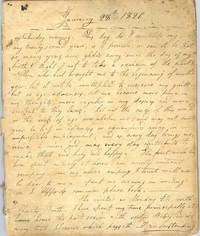
18300001523MIDDLETOWNE NEW JERSEY MONMOUTH CTY NEW YORK CITY. Good. 1830. On offer is a fascinating massive archive of letters notes diaries and some ephemera of particular interest to researchers historians and collectors of mid 19th century New York City and New Jersey and religion of the day. The archive is made up of two 2 main components: 1 approximately 50 diaries and notebooks and 2 approximately 69 letters of inter-family correspondence dated from the 1830s through to the late 1870s they are mostly by and between three people; James Hoagland of Jersey City New Jersey; Lavinia Murray of NYC and her brother George C. Murray of Middletowne New Jersey. Lavinia is the main recipient receiving letters though some are in her hand from her brother George her cousin and one day husband James Hoagland her mother and father and some cousins and friends. The diaries are unusual and unique as the author George Crawford the books are unsigned but the handwriting is assuredly the same as George's letters to Lavinia kept 'double' books; one set of books are diary like entries describing his life and times travel and business dealings but also a real picture of New York City of the era as George was in love with the city and he seemed to have a number of real estate holdings perhaps he moved a lot that he wrote from many different addresses. He would delight in describing the color of the sun as it came up over a particular street or intersection. George also must have had a touch of obsessive compulsive behaviour as is evident in his writings. He is incredibly detailed and a keen observer. The other side of the diaries is his obsession with religion. He keeps a diary of his devotions the many different Churches he goes to the sermons and lectures heard the speakers . He expostulates in essay form and writes detailed descriptions of the sermons and sometimes point form notes. We have never seen anything quite like the breadth and depth of this man's writings. The books themselves are mostly coverless or perhaps handmade mostly 8 x 5.5 inches with a few smaller and a couple larger. Some are about 25 - 27 pages some a few pages and the odd one or two are triple thick but there are approximately 1000 pages from 1851 to 1881. Historians and researchers will find a treasure trove of Christian activity thought and devotion regarding New York City in this group. This archive was once held by Milton Wyatt of NYC a long time ephemera dealer in Greenwich Village NYC and was purchased from his estate. HISTORICAL NOTES from several online sources: 1 Murray George Crawford Ideal Citizen Legislator. The late George Crawford Murray of Middletown Monmouth County New Jersey was one of those men whose lives and characters are of inestimable value as exemplars of what worthy lives should be. His ambition was ever along the worthiest lines and his whole life was devoted to the highest and best ideals. His nature was of singular sweetness openness and sincerity. He had a profound knowledge of human nature and was ever thoughtful for the welfare of his fellow beings. His family which was of Scotch descent was resident in New Jersey from about the middle of the eighteenth century. 2 Lavinia Murray born December 17th 1818 died 1876 married August 26th 1847 James M. Hoagland a merchant of New York City whom she survived; resided in Jersey City and New York City; no issue. 3 James M. Hoagland Birth 13 Sep 1818 Father Nathan Hoagland 1778-1848 Mother Elizabeth Bird 1782-1847 Spouses 1 Lavinia Murray Birth about 1820. Overall G.; 8vo - over 7¾" - 9¾" tall; KEYWORDS: HISTORY OF GEORGE CRAWFORD MURRAY LAVINIA MURRAY JAMES M. HOAGLAND MIDDLETOWN MONMOUTH COUNTY NEW JERSEY MILTON WYATT CHRISTIANITY RELIGION ECCLESIASTICAL ECUMENICAL EPISCOPALIAN BAPTIST EPHEMERA HANDWRITTEN MANUSCRIPT DOCUMENT LETTER AUTOGRAPH DIARY JOURNAL LOG KEEPSAKE WRITER HAND WRITTEN DOCUMENTS SIGNED LETTERS MANUSCRIPTS HISTORICAL HOLOGRAPH WRITERS DIARIES JOURNALS LOGS AUTOGRAPHS PERSONAL MEMOIR MEMORIAL PERSONAL HISTORY TRAVEL 19TH CENTURY antiquité contrat vélin document manuscrit papier Antike Brief Pergament Dokument Manuskript Papier oggetto d'antiquariato atto velina documento manoscritto carta antigüedad hecho vitela documento manuscrito Papel . unknown
18350002083JAPAN IZU NIKKI HACHIJO-ISLAND IZU OSHIMA. Good. 1835. On offer is an original circa 1830s manuscript relic of early 19th Century travel being a travel diary handwritten by an unknown Japanese traveler to Hachijo-Island the southernmost of the Izu Seven Islands Izu Oshima The Seven Island Chain and area. Off the coast of south eastern Japan the islands are uniquely situated where the Pacific Ocean meets the Philippine Sea. Hand stitched paper covers title states "complete" save for worm damage general light soiling the 6½ x 9¼ inch 100 page book is overall G. ; Manuscript; 8vo - over 7¾" - 9¾" tall; KEYWORDS: HISTORY OF JAPANESE TRAVEL DIARY IZU NIKKI HACHIJO-ISLAND IZU OSHIMA THE SEVEN ISLAND CHAIN THE RISING SUN NIPPON EARLY 19TH CENTURY TRAVEL EXOTIC TRAVEL HANDWRITTEN MANUSCRIPT DOCUMENT LETTER AUTOGRAPH DIARY JOURNAL LOG KEEPSAKE WRITER HAND WRITTEN DOCUMENTS SIGNED LETTERS MANUSCRIPTS HISTORICAL HOLOGRAPH WRITERS DIARIES JOURNALS LOGS AUTOGRAPHS PERSONAL MEMOIR MEMORIAL PERSONAL HISTORY ANTIQUITÉ CONTRAT VÉLIN DOCUMENT MANUSCRIT PAPIER ANTIKE BRIEF PERGAMENT DOKUMENT MANUSKRIPT PAPIER OGGETTO D'ANTIQUARIATO ATTO VELINA DOCUMENTO MANOSCRITTO CARTA ANTIGÜEDAD HECHO VITELA DOCUMENTO MANUSCRITO PAPEL . unknown
1831000106DENMARK. Very Good. 1831. ABOUT 7 1/4" X 4 1/2". ABOUT 30 HANDWRITTEN PAGES. CARDBOARD COVERS ARE ORIGINAL BUT CLOTH SPINE IS IN SUCH EXCELLENT CONDITION WE BELIEVE IT MAY BE A REPLACEMENT. A LITTLE BIT OF INK STAINING ON COVER AND PAGE CORNERS. ALMANAC IN DANISH PRINTED IN COPENHAGEN IS BOUND WITHIN. THE UNIDENTIFIED WRITER OF THE DIARY APPEARS TO BE A YOUNG DANISH MAN WHO IS WRITING IN ENGLISH - PERHAPS LIVING ELSEWHERE HE RETURNS TO THE HOME COUNTRY TO PURCHASE SUPPLIES AS HE SEEMS TO BE ENGAGED IN BUYING WHEAT BARLEY OATS RAPESEED ETC. FOR A FAMILY BUSINESS WHICH APPEARS TO BE A BREWERY. THE WEATHER PRICES OF CROPS POLITICAL NEWS FANCY BALLS GIRLS ETC. ARE DISCUSSED. VARIOUS PLACES/EVENTS ARE MENTIONED; THE ISLANDS WARS BETWEEN FRANCE BELGIUM HOLLAND RUSSIA POLAND AND BATTLES ARE MENTIONED AS WELL. VERY WELL WRITTEN AND MOST INTERESTING PERSPECTIVE COMING FROM A YOUNG DANISH MAN IN THE EARLY 19TH CENTURY AND WITH OPINIONS AND COMMENTARY ON EUROPE OF THE DAY.; Manuscript; 12mo - over 6¾" - 7¾" tall; HANDWRITTEN MANUSCRIPT DOCUMENT LETTER AUTOGRAPH DIARY JOURNAL LOG KEEPSAKE WRITER HAND WRITTEN DOCUMENTS SIGNED LETTERS MANUSCRIPTS HISTORICAL HOLOGRAPH WRITERS DIARIES JOURNALS LOGS AUTOGRAPHS PERSONAL MEMOIR MEMORIAL PERSONAL HISTORY Travel Denmark Low Countries Brewing Beer Ale Stout Farming Politics Steamship Travel European History . hardcover
18900002302MOBILE OWENTON ELYTON ALABAMA AL. Very Good. 1890. On Offer is an original 140 page copy of a typed manuscript with holograph corrections by author and Methodist Preacher the Reverend Francis Mitchell Grace whose father was noted for making the first iron from Red Mountain Alabama ore. This is a significant personal memoir about his early life in Alabama the Civil War Methodist Conferences in Mobile slavery plantation life etc. Please note: This was acquired directly from a family descendent. BIO NOTES Aug. 13 1904 Owenton Jefferson County Alabama USA: From "History of Alabama and dictionary of Alabama biography Volume 3" By Thomas McAdory Owen Marie Bankhead Owen: GRACE FRANCIS MITCHELL Methodist minister teacher and editor was born February 28 1832 at Elyton and died August 13 1904 at Ownenton; son of Baylis Earle and Ann Mitchell Grace q. v. He received his early education at Elyton academy 1837-46; graduated at East Tennessee university 1849 with the degree of M. A. and later received the honorary degree of D. D. from Hiwassee college. He entered the Methodist ministry and served the following pastorates: Newbern 1853; Eufaula 1854; Demopolis 1855-56; Talladega 1857-58; Tuscaloosa 1859-60; Newbern 1861-65. He edited the "Daily messenger" of Selma 1866 and the following year he became professor of languages in the University of Tennessee holding the position for three years. In 1871 he was made president of Hiwassee college Tenn. From 1883 to 1888 he was president of Mansfield college La.; professor in Hiwassee college 1890-99; professor in Owenton college 1900-02. Author: contributor to "North American review" "Methodist review" and leading church papers; editor "Alabama Christian Advocate" 1902. He was a fine Latin and Greek scholar. He was a Democrat. Married: 1 April 3 1854 at Newbern Hale County to Mary Jane daughter of David Wallace and Hope Ward Borden of Beaufort N.C. of Revolutionary ancestry; granddaughter of Joseph and Esther Borden the former a member of the North Carolina convention that framed the constitution of that state of the Quaker faith whose six of seven sons migrated to Hale County in 1836 founded the town of Newbern and helped to develop the canebrake by building roads schools churches and digging artesian wells; 2 to Ida Hoskins of Tennessee. Children: by the first wife 1. David Borden q. v.; 2. Bettie Pearce Grace Burwell Birmingham; 3. Annie Grace Drake Weatherford Texas; by the second wife 4. William; 5. Francis; 6. Janie; 7. Judith. Last residence: Owenton. ; Manuscript; 4to - over 9¾" - 12" tall; KEYWORDS: HISTORY OF REV FRANCIS MITCHELL GRACE BIOGRAPHY RED MOUNTAIN IRON MILLS MOBILE ALABAMA CIVIL WAR METHODIST CONFERENCES OWENTON JEFFERSON COUNTY SELMA TUSCALOOSA BIRMINGHAM THE DEEP SOUTH CIVIL WAR SOUTHERN AMERICANAHANDWRITTEN MANUSCRIPT AUTOGRAPHED AUTHORS DOCUMENT LETTER AUTOGRAPH KEEPSAKE WRITER HAND WRITTEN DOCUMENTS SIGNED LETTERS MANUSCRIPTS HISTORICAL HOLOGRAPH WRITERS AUTOGRAPHS PERSONAL MEMOIR MEMORIAL PERSONAL HISTORY ARCHIVE DIARY DIARIES JOURNAL LOG PRIMARY SOURCE FIRST HAND ACCOUNT SOCIAL HISTORY PERSONAL STORIES LIVING HISTORY ANTIQUITÉ CONTRAT VÉLIN DOCUMENT MANUSCRIT PAPIER ANTIKE BRIEF PERGAMENT DOKUMENT MANUSKRIPT PAPIER OGGETTO D'ANTIQUARIATO ATTO VELINA DOCUMENTO MANOSCRITTO CARTA ANTIGÜEDAD HECHO VITELA DOCUMENTO MANUSCRITO PAPELBIOGRAPHY BIOGRAPHICAL AUTOBIOGRAPHICAL AUTOBIOGRAPHY PERSONAL NARRATIVES . unknown
18330002344SHIP MCLELLAN MAZATLAN TO NEW YORK. Good. 1833. On offer is a fascinating original 1833 logbook for the Ship McLellan later purchased in 1846 and refitted as a whaling ship from Mazatlan on the Pacific coast of Mexico to New York City. The volume is dated March 6 1833 to August 8th 1833. The 8 x 13 inch book produced specifically for the trade states: "Published and Sold by E. & G. W. Blunt 154 Water-street corner of Maiden-lane where is constantly for sale a complete assortment of the most approved Charts Nautical Books and Instruments. Nautical instruments Repaired. / June 1827". A lovely woodcut illustration of an American Clipper Ship under full sail graces the cover. While unknown the author the log has 74 pre-printed pages of charts to be filled in and all 74 pages have been used with a loose leaf tucked in at the end for August 4th through August 8th thus completing the entire journey from Mazatlan to New York. Typical of a log kept by the First Mate or Captain the log details all the technical data; daily charts contain information on positions weather currents longitude and latitude wind direction and force and the various sails used. Fairly extensive use is also made of the blank space provided to make longhand notations regarding the passage of the McLellan. The writer also uses this space to note both the daily and whole "distance run". The odd note regarding particular currents off the River Plata or meetings with other vessels and the gossip punctuate the journal. Here are some snippets: On March 6 1833 The Ship McLellan departs Mazatlan bound for New York. ".with the assistance of the Ship of War Rattlesnake crew got our anchor without difficulty. The three Marias Isles at meridian were to the northward of us from 15 to 25 miles." Distance run the first day: 100 miles. On April 7 1833: ".spoke whaling ship Amethist of Nantucket - 70 days out with 300 blls. of sperm oil - reports 80 ships in the neighborhood upon the same business but with indifferent success." On June 20 1833: ".unusual quantities of whales seen for these 2 days." and on July 4th the McLellan crosses the equator having been out for 121 days and run 11262 miles. On Thursday August 7 1833 ".at 6 took a pilot at 10 came to anchor outside the bar - at 8 a.m. wind N.W. weigh anchor and made sail - Friday at 1 p.m. having worked almost up to the narrows was taken in tow by a steam boat and came to anchor at Querantine at 4; Subjected to 48 hours Querantine". This ends the 155 day 14038 mile voyage of the McLellan." The covers are intact and are comprised of marbled paperboard. Overall VG. HISOTRICAL NOTES: one online source provides: Samuel W. Comstock started in the trading business in 1833 on the Ship McLellan with a cargo shipped by G. G . & S. Howland later Howland & Aspinwall consigned to S.W. Comstock supercargo on board "for Valparaiso and a market." The value of the cargo was $121435.38 and it comprised: "Satin crepe and Florentine shawls ribbons of all descriptions satins for dresses foulard silks horseskin gloves open worked white silk hose ladies' and men's white kid cloves handkerchiefs Irish linens Russia sheetings printed Jaconets and muslins fancy prints striped seersucker ginghams burlaps letter paper scissors guns gunpowder assorted marbles Richmond flour Havana wax Russia wax fancy and yellow soap English iron steel Spanish lead old Holland gin wine cordials Havana tobacco Kentucky tobacco manufactured tobacco snuff pepper pimento sperm candles cream of tartar pilot bread white lead paint turpentine rope yarns crockery German tumblers mahogany veneers mahogany plank rosewood cane seat chairs Malaga raisins."; Manuscript; Folio - over 12" - 15" tall; KEYWORDS: HISTORY OF SAMUEL W. COMSTOCK SHIP MCLELLAN MAZATLAN TO NEW YORK NAUTICAL AMERICAN CLIPPER SHIP COMSTOCK FAMILY BUSINESS BAKER LIBRARY HARVARD BUSINESS SCHOOL G. G . & S. HOWLAND HOWLAND & ASPINWALL SHIP OF WAR RATTLESNAKE MARINE MARITIME OCEAN GOING COMMERCE MERCHANT VESSELS CARGO SHIPS AMERICANA HANDWRITTEN MANUSCRIPT AUTOGRAPHED AUTHORS DOCUMENT LETTER AUTOGRAPH KEEPSAKE WRITER HAND WRITTEN DOCUMENTS SIGNED LETTERS MANUSCRIPTS HISTORICAL HOLOGRAPH WRITERS AUTOGRAPHS PERSONAL MEMOIR MEMORIAL PERSONAL HISTORY ARCHIVE DIARY DIARIES JOURNAL LOG PRIMARY SOURCE FIRST HAND ACCOUNT SOCIAL HISTORY PERSONAL STORIES LIVING HISTORY ANTIQUITÉ CONTRAT VÉLIN DOCUMENT MANUSCRIT PAPIER ANTIKE BRIEF PERGAMENT DOKUMENT MANUSKRIPT PAPIER OGGETTO D'ANTIQUARIATO ATTO VELINA DOCUMENTO MANOSCRITTO CARTA ANTIGÜEDAD HECHO VITELA DOCUMENTO MANUSCRITO PAPELBIOGRAPHY BIOGRAPHICAL AUTOBIOGRAPHICAL AUTOBIOGRAPHY PERSONAL NARRATIVES . unknown
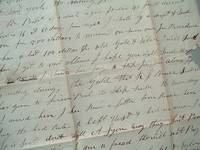
18350009044BALTIMORE MARYLAND MD CAMPBELL VIRGINA VA. Good. 1835. On offer is a letter written from Baltimore in 1835 by John Wheeler Rutledge to his loving wife and friend Julia Ann Rutledge in Virginia. The letter is sweet and obviously shows a deep devotion to his wife. As to why they are apart it does not say but it seems that Julia is with her family in Virginia. Theyre home seems to be in Baltimore as John speaks of their children and of his work most probably as a farmer. The letter touches on a number of subjects but mostly family friends and some gossip. It was written in Baltimore on October 20th 1834. It begins My Dear Julia Ann and after some words about receiving her last letter he writes about his great satisfaction to hear of your safe arrival and good health and of Martha Ganes being so much pleased with her board. It also gives me great pleasure to inform you that my health is much better than it was when you left home. He believes the main cause is that preacher is gone.which I now think was a great drain back on my health. He lets her know that his children are doing well in good health and very fond of her and often asking me question about going to Virginia for you and about Grand Ma and sister. He mentions that his son Randolph has fattened like a little pig and become very fond of me. His son Randolph was born in 1834 and is one year old. He then tells her of their cousin Jane who is visiting and seems quite low spirited at times complains very much of being so lonesome. John may be a farmer in Baltimore as he tells Julia that he has got a lot of corn by the Spring House pulled shucked and lofted and of the pumpkins gathered. John says he is very sorry to hear D. Rutledges health is likely to be so delicated tell John to write me soon and let me know if he has seen a John Lynch and as well that he is very sorry to hear that you did not get in soon enough for Martha Dollards wedding as I have no doubt you would have enjoyed yourself very much. He then informs her that Abraham Amos negro woman Easter and her husband Wm. Bosley had Runaway last saturday night. He makes no further comment on this. Finally he finishes with pleasantries and implores her to give my love to Mother and all inquirious friends tell Martha Jane to behave pretty and be good girl and believe me to be your affectionate Husband. John W. Rutledge. The letter is 4 pages in length one long sheet folded in half and written on both sides. The front cover has the letter address written: Ms. Julia Ann Rutledge Moormans Campbell County Virginia It is in a very legible handwriting black ink with minimal smudging. The letter shows a good bit of wear from aging and folding and there is a good deal of discoloration of the paper but this does not impede any legibility of the handwriting. There are also a few small holes in the paper but only one hole is in the place of a word and that word can easily be assumed. This is a lovely document. Background: John Wheeler Rutledge was born May 7 1800 in Harford Maryland and his wife Julia Ann Rutledge née Ward was born May 2 1808 in Campbell Virginia. They were married September 30 1826. John died in 1873 and Julia in 1889. They had six children together born between 1828 and 1843.; Manuscript; Folio - over 12" - 15" tall; KEYWORDS: KEYWORDS: ANTE BELLUM ERA HISTORY OF JOHN WHEELER RUTLEDGE JULIA ANN WARD RUTLEDGE BALTIMORE HARFORD MARYLAND CAMPBELL VIRGINIA PRE CIVIL WAR ERA LOVE OF A HUSBAND 19TH CENTURY AMERICA FIRST 100 YEARS OF THE UNITED STATES AMERICANA HANDWRITTEN MANUSCRIPT DOCUMENT LETTER AUTOGRAPH WRITER HAND WRITTEN DOCUMENTS SIGNED LETTERS MANUSCRIPTS HISTORICAL HOLOGRAPH WRITERS AUTOGRAPHS PERSONAL MEMOIR MEMORIAL ANTIQUITÉ CONTRAT VÉLIN DOCUMENT MANUSCRIT PAPIER ANTIKE BRIEF PERGAMENT DOKUMENT MANUSKRIPT PAPIER OGGETTO DANTIQUARIATO ATTO VELINA DOCUMENTO MANOSCRITTO CARTA ANTIGÜEDAD HECHO VITELA DOCUMENTO MANUSCRITO PAPEL . unknown
18360002182ABOARD THE USS SHARK MEDITERRANEAN 1836. On offer is a super original 19th Century manuscript relic of United States post Barbary Wars naval actions in the Mediterranean handwritten by an unidentified naval officer serving on the U.S.S. SHARK which was part of the Mediterranean Squadron protecting American commerce in 1836. The four page tightly written abstract log dated August 12th through September 29th details a trip up the Adriatic Sea to anchor off Trieste wherein they are quarantined for 14 days as there was Cholera ashore. Despite the quarantine the log records that Cholera broke out after they left Trieste and the loss of three crew on the passage from Trieste to Milos Greece where they again were quarantined. From there sailed to Jaffa Israel where they joined the squadron consisting of the ships and frigates: USS CONSTITUTION 'OLD IRONSIDES' USS UNITED STATES USS JOHN ADAMS and USS POTOMAC. The writer goes to Jerusalem during this time while the fleet is quarantined. After the quarantine they made repairs and during that time the log records that guns were fired and her flag was hoisted at half staff in memory President James Madison who had died in June. At Jaffa he and other officers are ordered to the U.S.S CONSTITUTION. Our author loved the SHARK as he writes in conclusion: "Good-bye Shark - After nine months close acquaintance I love thee no better than at the first interview albeit thou hast the Kentuckians mark of diving down deeper and staying under longer than any other craft which I remember to have encountered in my nautical career - then coming up dryer is quite another sort o' thing. Again farewell Shark -- Farewell". The SHARK was built in 1821 as a topsail schooner. It was involved in the suppression of the Slave Trade and in the 1840s was ordered to the Pacific. She was lost at the mouth of the Columbia River in 1846 and today several artefacts from the Shark are preserved in museums on the Northwest coast. Some chipping to the edges a small inconsequential dampstain but overall G. Good. 4to - over 9¾" - 12" tall. Manuscript. unknown
18370009111BOSTON TO KRONSTADT TO BRAZIL STATION. Good. 1837. On offer is a journal recorded during a fascinating time in General American and U.S. Naval History. The journal is written on the U.S.S. Independence as she travels from Boston to Portsmouth England onto Copenhagen and Kronstadt to receive a visit from Russian Emperor Nicholas I. The Independence then leaves Russia for Rio de Janeiro where she becomes the Flagship of the Brazil Station tasked with the duty to guard American commerce along the eastern seaboard of South America during the war between France and Argentina. A page in the very beginning of the book states Private Journal of A Cruise in U.S. Ship Independence During the years 1837 1838 1839 and 1840 Under Commo. John B. Nicolson On the Brazilian Station. Another a bit later states Cyrus E. Joy. U.S. Ship Independence. Cyrus Joy is presumably the author of the journal. The ship leaves Boston on May 20th 1837 in presence of thousands of spectators who crowded the adjacent wharves to witness our departure. On board the ship is the Honorable George M. Dallas who at that time had served as Mayor of Philadelphia U.S. Senator from Pennsylvania 183133 and would eventually become the 11th Vice President of the United States in 1845 under President James K. Polk. According to the journal author he is said to be a man of exalting talents sound discriminating judgements. At the time Mr. Dallas had been recently appointed Minister to Russia. The ship crosses the Atlantic in what a soldier would call quickest time and the ship reaches Portsmouth England after 22 days. On the 20th of June the King of England William IV dies and the next day Queen Victoria his niece ascends the throne. All colours in the harbors and most likely in the kingdom were displayed at half mast and we fired guns in honour of the deceased. Soon after this firing ceased we manned the rigging cheered ship and fired a Royal Salute on the occasion of Queen Victoria's daughter of the Duke of Kent and niece to the late Sovereign. The ship moves on to Copenhagen then Kronstadt situated at the head of the gulf of Finland. The ship is visited by the Emperor Nicholas and wife. We were by no means in condition for such a visit. We had been up the greater part of the preceding night and after coming to anchor pulling sail &c. We proceeded to holy-stone the decks washed and dried them down in the neatest manner. After this we ___ our topmast rigging in afresh and the utmost exertions were used by all hands to put the ship in the best order for the expected visit though she was after all very far from being in first-rate condition. The author describes the Emperor as a tall stout well made man with light reddish hair blue eyes high forehead and high cheek bones and has a remarkably loft and commanding appearance. The author speaks very highly of Nicholas and the visit goes smoothly and enjoyably. The whole event is a thoroughly enjoyable portion of the journal. The author spends time comparing the Danes and the Russians before the ship leaves again this time heading for Rio de Janeiro. This section of the journal ends as the ship reaches Portsmouth England again. The journal begins again in 1839 as the ship is in South America protecting American commerce. Feb. 9th 1839. Here we found our presence much needed for the protection of American property. When we left the first time the French had nothing like a respectable force on the station.Their forces however have been increased but are also too weak for the a blockade of more than the port of Buenos Aires. The entries in this portion are spread out with long periods in between each entry. The ship seems to go between Rio and Montevideo providing protection of American trading ships in the area. The author also speaks of the reasons for the war and the Independences role in helping mediate the conflict as well as thoughts on the role of the American Navy in the formations of a character abroad as well as at home. The soldiers also seem fairly unhappy on the ship after a while. Jan 1st 1840. At Montevideo and little prospect of leaving soon. More than 100 of the men have completed the full term for which they entered the services and are clamorous to be sent home.Under these circumstances no ship can hardly be deemed fit for actual service. The ship finally leaves the Brazil Station after being thirty five months on this cruise. I think I shall stop at home a few months at least. The journal continues with the next entry explaining that after three months of doing nothing Mr. Joy joins the Montezuma Capt. Christiansen bound to Liverpool. Having heard of such a thing as Happy England he is struck all aback to see the number of prostitutes beggars ballad singers &c. I do believe that in this single place there is more persons of the above description than in the whole of the U.S. You can not walk from the docks up in the city without being accosted every two or three minutes by a female with I say Jack wont you treat us or Shipmate give us a chew tobacco will ye or God bless your honour you havnt got never a penny for a poor fellow have ye. The entry ends with a list entitled U.S. Ship Independence. List of Officers 20th May 1837. John B. Nicolson. The list contains more than 3 dozen names of all the men on board including midshipman on the ship. There is also a list of Salutes fired during the years 1837 38 39 & 40. with the columns Date No. of guns Quantity of powder and When and on the opposite page On What occasion. The list is 12 pages long and provides a fantastic and comprehensive list of where the Independence was during the years of the authors journal and the special occasions on which it fired salutes. The journal also contains a hand drawn portrait of the face of Emperor Nicholas I with the date July 29th 1837 written underneath. The drawing is amateur but very well done in a number of colors. The book is roughly 220 pages in which there is writing in approximately 70 or 80 pages. The handwriting is easy to read and legible throughout in black ink which is rarely faded. The pages show some discoloration and wear but nothing that affects the legibility of the writing. The cover shows a good deal of wear and age damage but is still very structurally sound. A number of the pages with writing have come loose from the binding but are still gathered together so they are not loose from each other. There are two major gatherings detached and the rest of the book is still in the binding. Overall: G. Sample Text: May 19th 1837. All ready for sea and people in crowds visiting our ship. Some probably to see and be seen but many very many to take leave of friends and comrades dear bound on a long and tiresome cruise. Such numbers came off in boats that it was impossible to admit all and numbers were compelled to return without bidding their friends farewell as gratifying their curiosity by inspecting our kindly beautiful ship.; July 4th. We fired a National Salute but had no merry making on the occasion. It was in fact the dullest Fourth I have ever witnessed.; June 23rd 1839. We have been nearly 18 months from Boston before we were allowed to go on shore and many of us have been almost two years on board without having been out of the ship.I am of opinion the men should have had liberty much oftener: and I believe they might have had it without detriment to the service or themselves. Background: The USS Independence was a wooden-hulled three-masted ship originally a ship of the line and the first to be commissioned by the United States Navy. Originally a 90-gun ship in 1836 she was cut down by one deck and re-rated as a 54-gun frigate. Independence recommissioned on 26 March 1837 and sailed from Boston on 20 May 1837 as flagship of Commodore John B. Nicholson. On board for her record passage across the Atlantic Ocean to England was the Honorable George Dallas Minister to Russia. She arrived at Portsmouth England 13 June called at Copenhagen; then proceeded into Kronstadt 29 July 1837 to receive a visit from the Emperor Nicholas I of Russia. Two days later a steam boat arrived to transport Mr. Dallas and his family to St. Petersburg. Having received marked social courtesies from the Russian government Independence departed Kronstadt on 13 August 1837 for Rio de Janeiro where she became flagship of the Brazil Squadron to guard American commerce along the eastern seaboard of South America. This duty continued into the spring of 1839 when Commodore Nicholson attempted mediation to end the war between France and Argentina. The Independence returned north to New York on 30 March 1840. She was laid up in ordinary until 14 May 1842 when she became flagship of Commodore Charles Stewart in the Home Squadron. Based at Boston and New York she continued as his flagship until laid up in ordinary on 3 December 1845.; Manuscript; 8vo - over 7¾" - 9¾" tall; KEYWORDS: HISTORY OF CYRUS E. JOY U.S.S. INDEPENDENCE FLAGSHIP THREE MASTED SHIP SHIP OF THE LINE UNITED STATES NAVY U.S. NAVAL HISTORY RUSSIAN EMPEROR NICHOLAS I COMMANDANT JOHN B. NICHOLSON HONORABLE GEORGE M. DALLAS MINISTER TO RUSSIA DEATH OF WILLIAM IV KING OF ENGLAND DIPLOMACY FOREIGN SERVICE ASCENSION TO THE THRONE OF QUEEN VICTORIA PRE CIVIL WAR ERA UNITED STATES U.S. FOREIGN POLICY FLAGSHIP BRAZIL STATION WAR OF THE CONFEDERATION FRENCH BLOCKADE OF THE RIO DE LA PLATA AMERICAN COMMERCE IN THE 19TH CENTURY AMERICANA HANDWRITTEN MANUSCRIPT DOCUMENT LETTER AUTOGRAPH WRITER HAND WRITTEN DOCUMENTS SIGNED LETTERS MANUSCRIPTS HISTORICAL HOLOGRAPH WRITERS AUTOGRAPHS PERSONAL MEMOIR MEMORIAL ANTIQUITÉ CONTRAT VÉLIN DOCUMENT MANUSCRIT PAPIER ANTIKE BRIEF PERGAMENT DOKUMENT MANUSKRIPT PAPIER OGGETTO D'ANTIQUARIATO ATTO VELINA DOCUMENTO MANUSCRITTO CARTA ANTIGÜEDAD HECHO VITELA DOCUMENTO MANUSCRITO PAPEL . unknown
1837000755IOWA. Good. 1837. On offer is a super archive of five writing tablets of which two 2 tablets contain an autobiography and the other three 3 contain historical/diary notes and observations and original poems all handwritten by noted Iowa poet Rev. Francis Emerson Judd dating from 1837 to 1887. The Rev. Judd is listed under Iowa Authors at the University of Iowa as well as in Des Moines. We believe he was originally from Quebec Canada and immigrated to Brooklyn Iowa where he served as a minister. Research suggests the poems from these tablets do not appear in the published works. The five tablets are full and all painstakingly handwritten with penciled corrections etc. There are a few pages dedicated to his vocation as a minister meeting the bishop traveling to Mt. Pleasant and a very special poem dedicated to the Bishop on his 25th Wedding Anniversary. Included is the inside Title Page from his published work: "The Owls Eve and Other Poems" published in 1888 by Webster & Burkart Marshalltown. VG. ; Manuscript; 4to - over 9¾" - 12" tall; Hand Written Personal Americana Memoir Handwritten hand written autograph autographs signed letters document documents manuscript manuscripts writers writer author Holograph personal Americana IOWA POET POETRY IA DES MOINES BIOGRAPHY AUTOBIOGRAPHY . unknown
18370009161SIX MILE RIVER NEW JERSEY to ILLINOIS and Back. Good. 1837. On offer is a fascinating diary of one mans 3-month trip from New Jersey to Illinois and back in 1837. The content in this journal is unique; an early 19th Century 'Planes Trains and Automobiles'. The unnamed man travels from Six Mile River New Jersey with a group of people across 5 states finally ending in Liverpool Illinois on the banks of the Illinois River. This part of the trip is accomplished through the only means of over land transportation available at the time: horseback wagon and foot. A few days later he boards a steamboat and sails back home on the Illinois and Ohio River most of the way back finally taking a stagecoach at the end of the trip. The last day of his diary shows that he is just outside of Philadelphia and it is now January 11th 1838; one day shy of 3 months. The journey is a fascinating look at travel and life in pre-civil war America. The man describes a tremendous amount of what he sees hears and does during the three month journey including descriptions of many of the towns and cities themselves many of which no longer exist. As well there are mentions of the historical movement of people going West known as movers as well as a mention of Joseph Smith and the Mormon religion slowly making their way west. There is also a passage about time spent digging in Indian burial mounds and finding bones and trinkets of Native Americans buried there. The book consists of 52 handwritten pages in a handsewn journal. The author is a fairly detached narrator of his life not putting much emotion into the words but presenting a fairly straightforward view of what he sees and does. The sample text below will illustrate what I mean. The pages are frayed at the end and a few pages at the beginning and end are slightly detached from the binding. There are also a few pages in which foxing has occurred. However for the most part the book is in good structural shape. The handwriting is mostly in pencil though with some passages written in pen and is legible and easily readable. The pages in which there is more foxing make the words harder to read but still legible with slight effort. The journal entries continue to about halfway through the book and then the reader must turn the diary around and start at the other end in order to continue reading. The journal measures about 4 x 6 1/4. TEXT: October 12th 1837. Left Six Mile River for the West. Lodged at Lambertville New Jersey. 13th Rainy morning. Bill at L. Carharts N. Hope $1.06. N. Hope Bridge .18 ¾. 7 miles to Wilkinson 4 to Doylestown. Doylestown has the appearance of Princeton. Good Country. Apples plenty. Good S. Clover.Pleasant day. Finest corn I ever saw. Fine Country. Altho we saw log houses and log barns. Crossed one branch of the Brandywine at Downington and the second branch.To Lancaster fine corn and plenty of apples. Crossed the Conestoga larger than Milltown few churches.Lancaster County fine. Saw water reservoir. Butter and bread scarce. Fine day. Log houses in Lancaster. Population 8 or 9000.To Gettysburg.Has 6 churches 2000 inhabitants. Land not so good from Abbottstown.To Fairfield South Mountain. Scrubs and barren. Good corn in valley. We are surrounded by ridges which appear to be with the clouds. 6 Rail R. 12 R. Stake fence.; October 19th Hancock. The Potomac appears to have forced its way through the mountains. The mountains in Maryland has pine upon them. Timber stunted and Virginia shore appears to be one continuous scene of bluffs. Hancock has 12 or 7500. 2 churches. It lays between the hills and canal. Chesapeake Ohio bill .44 Black drinking out of the Potomac full at the first house at Hancock the 2nd no great ketch. A few bed bugs. Saw dog houses one old fashion roof all mountains. Pine on them. Look back saw three mountains we crossed South North and written on a rock Conclover Hill.; October 21st We crossed the line of Maryland into Pennsylvania. To Smithfield or Somersfield has 30 houses.It is surrounded by hills which is full of coal. Crossed Barren ____ and Laurel Ridges. Laurel ridge solid stone. Natural bridge cave &c. To Union Town passing through Monroe a small village 3 miles east of Union.Warm day almost suffocating. Building mostly brick yet the village is filthy. Owing the manure. Rested on Sunday.; To Wheeling inhabitants 7000 passing a monument to Henry Clay by Moses and Lydde Sheppard in 1820.;At Zanesville we crossed the Muskingum River a fair stream. Log houses plenty. Snow laid yet since day before yesterday. All these villages have sprung up in a few years and mostly lie too low. At Hebron I think a chance for speculation as a depot on the canal. All in Licking north of us good land.; October 29th. Columbus on the Scioto River. A lovely place wide streets and elegant buildings. It is the Capital of Franklin. Seat of State. Large penitentiary. 5 deep 380. Hold 700. Lunatic Asylum deaf and dumb institution. Also institution for educating the blind.; November 5th Bad road. Mare fell in ditch heavy wood. Distressing Sunday. Good land yet very slippery. People moving from York 8 children. No eats. Two more for dinner. Movers name Samuel Richards.; November 19th Sunday dull. Prayer meeting at P. Davis. Its affects my own feelings as regarded my duty for moving to the west are open door for usefulness .Monday dull day. John G. Daniel brought Abner Williamson also F. Traded blacks for lots.; November 23rd.To Liverpool. Many in number. Hard to find lodging and provisions. Slept on floor house open .Crossed in canoe 15 in a log. A lake before us come to the river 1 ½ miles wide. Antiquities.This island 1000 acres. Clear and cool day. Beds for keeping mosquitoes but gauze. My whole expenses to Illinois was 41.81. deduct 25.00.; Fine day. Spent some time in digging in mound. Found Indian bones. Saw kettle dug out of landlords cellar. Graves 18 deep. Landlord told of big skull in Missouri. Time tedious. Took turns at night to watch. My turn came from 12 to 2. Boat came ¼ after 12. On board ½ after 12 oclock. On board the steamboat Tide. Berths full double decker. Havana.; November 25th Seven oclock at Beardstown. Indian mound dug down. Found Indian trinkets.Passed by Naples a small town on the East of Illinois River as the others were also. High and sandy banks. Steam saw mill one fine house. A healthy looking place. Passed Philips Ferry an island. An unhealthy place. River in two. High bluffs on the west river but little bottoms on east side much bottoms.;.St. Louis 11 oclock. Did not see the mouth of Missouri River. Nov. 26th Bill 1.00. Passage to Louisville 12.00. Sabbath fine. Disappointed in Presbyterian Church. Went to Catholic church. Their church likes their doctrine kept dark a heartless form of worship. On Sunday in St. Louis along the docks. All week day saw a bible on our boat the first I saw. River water was as thick as mud. God forgive this day. Oh how I long to sit in my own seat in church and hear Mr. ____. Afternoon steam boat St. Louis for N. Orleans left. Crowded and hurried on shore to witness her departure while in the evening few had time to go to church. This the largest and finest I ever saw. Fine Day.; November 27th. Streets in St. Louis narrow sidewalks also. No posts in the streets but rings in the stones to tie on docks. 209 miles from Fairview to St. Louis. Saw one Indian but he was dressed in English stile and so he attracted no attention. Half after 4 oclock a sudden shock. Main shaft broke quite a consternation. We drifted ashore. Bless the Lord for his preserving care. This accident took place 25 miles below St. Louis. Passage money refunded. A rainy dark night. Altho disappointed still my trust is in the Lord.; December 6th To Frankfort. Fine day. Rolling land and some good roads outside the stage. Passed Simpsonville and Shelbyville. This is a pleasant place and fine situations. Frankfort capital of Kentucky. It lies below the hills and you cant see it till you are close by it. Legislature in session. Came by railroad to Lexington. Bill 1.50. Saw Henry Clays plantation and stock. Delightful place. By stage to Frankfort fine country. Rolling land and natural grass. December 11th Fine morning. Moderate. Four oclock left Middletown. Louisville. Cool day. Came on board L. B. Reliance 4.00. Fine boat cabin 125 ft. long. 11 ½ A.M. left for Cincinnati. Louisville a pretty place. Fine buildings and a place for business. Streets wide and square. Building a fine courthouse a fine tavern. Creek canal and rapids. Boat on rapids. Jeffersonville opposite Indiana.; January 11 1838. Cold. R. Road. Scared horses. Fine buildings and land. 62 miles from Lancaster to Philadelphia. Eagle Tavern. OVERALL: G; Manuscript; 16mo - over 5¾" - 6¾" tall; KEYWORDS: HISTORY OF 19TH CENTURY TRAVEL SIX MILE RIVER NEW JERSEY LIVERPOOL ILLINOIS ILLINOIS RIVER OHIO RIVER PHILADELPHIA STAGECOACH TRAVEL RIVER STEAMBOAT JOSEPH SMITH MORMON MIGRATION NATIVE AMERICAN BURIAL GROUNDS 19TH CENTURY MIGRATIONS PRE-CIVIL WAR AMERICA OVERLAND TRANSPORTATION AMERICANA HANDWRITTEN MANUSCRIPT DOCUMENT LETTER AUTOGRAPH WRITER HAND WRITTEN DOCUMENTS SIGNED LETTERS MANUSCRIPTS HISTORICAL HOLOGRAPH KEEPSAKE WRITERS AUTOGRAPHS PERSONAL MEMOIR MEMORIAL ARCHIVE DIARY DIARIES JOURNAL LOG ANTIQUITÉ CONTRAT VÉLIN DOCUMENT MANUSCRIT PAPIER ANTIKE BRIEF PERGAMENT DOKUMENT MANUSKRIPT PAPIER OGGETTO DANTIQUARIATO ATTO VELINA DOCUMENTO MANUSCRITTO CARTA ANTIGÜEDAD HECHO VITELA DOCUMENTO MANUSCRITO PAPEL . hardcover
18380002214HONDURAS 1838. On offer is a fascinating original significant 1838 - 1840 manuscript diary of an unidentified Englishman in the Central American country of Honduras. While the author is unidentified we believe that there is a familial connection to Lt.-Col. Hugh Guin Macdonnel also spelled Macdonald along other connected family lines whose later 1870s diary while he was a diplomat in Argentina we list separately. Both diaries came from the same estate. The family connection would appear to fit well with his time spent in Honduras with the MacDonalds. Using a 7½ x 9 inch coverless sewn ream of paper he begins writing 21 pages from November 28th 1838 through to January 19th 1840 the author details his times living and traveling in Honduras. Historians and researchers of the Central American country recognize by the dates that the writer has arrived in Honduras at a key moment in the country's history as mere days earlier Honduras had left the Central American Federation after 17 years and becoming an independent and sovereign state in October. While the country's evolving independence is the backdrop the diary reveals a man in turmoil struggling to reconcile his deep feelings and sometimes innermost thoughts with his religious beliefs making for an unusual sharing of those emotions with pen to paper: writing about his frequent companions the Colonel and Mrs. Macdonald: "I rode with Mrs Macd' in the morning.some impure thoughts. I confessed the sin on uncleanliness and prayed for forgiveness.Vanity - I felt sorry that no one witnessed me giving an old man a flannel frock". Casual research reveals this to be Colonel Alexander Macdonald of the Royal Artillery her majesty's Superintendent in Honduras. He writes of his day to day life "Went to the hospital in the morning to visit a sick man. I am afraid he will die. What an awful consideration as I fear he was an habitual drunkard. I prayed for him with Mr Newport who seems to have been the settlements chaplain in his boat.I dined at the barracks.sent a letter about coming home by Patsy Blount.a great deal of work in the office.on Christmas day I rowed poor Ed Strangeways on board the schooner in a little boat to make the men on board a present of two bibles. I observed something very odd in his manner and on landing begged Mr Newport to observe him.We both agreed he was not right in the mind.the most alarming symptoms; on Monday he was bled in both arms.Determined on going home on the Guatemala packet.today the packet has bought me accounts from home and of my brother Neil." He then travels on the Nina and stops briefly in New Orleans. He writes of going to the Theatre there and being "much disquieted with the constant use off the name of God" before returning to England where he states that he has been found a place a Magdalen College Cambridge by his uncle Edward. Overall G. Very Good. 8vo - over 7¾" - 9¾" tall. Manuscript. unknown
18380002349GREENWICH VILLAGE NEW YORK CITY NY. Fair. 1838. On offer is a super original 1838 manuscript diary handwritten by Theophilus Tappin who lived in New York City's Greenwich Village. He states: "The undersigned respectfully communicates that this is the commencement of his journal. Theophilus Tappin 26th Jan 1838 with the final entry on May 20th 1838 108 Waverly Place New York I shall strive to continue it until the day of my death." Historians and researchers of 'the Village' will understand that the young likely a teenager Mr. Tappin's diary places him in the Village at a formative and historic time called the Empire Period. Newgate Hospital had closed a mere two years before. New York University would come in their stead. Other charitable and beneficial groups opened their doors in Greenwich Village at the time our author writes. It appears he works in a retail store. Living close to the North River and obviously attuned to what occurs on the river he writes much of what goes on. He mentions the packet ships coming to port; a fire and criminality: 'A very large fire in Avenue D between 4th and 5th streets and an attempt to forge notes on the Kentucky Bank by a few rouges". He mentions a wind storm that blows a ship out of the bay and leaves only one boy onboard who is rescued; riding sleighs though New York City during snow storms; ships coming into port his first trip aboard a sailing ship; his family the struggles of work and his mother catching some illness. There is also mention of politics regarding the Whig party and elections. Towards the end of the diary some issues arise and Tappin remarks he is looking for a place over and over and seems to be depressed. This 7.5 x 6 inch 85 page or so diary makes for a fascinating look at the man and his times in mid 19th Century Greenwich Village and the backdrop of historic changes in the making for the area. Boards are detached and while he didn't write each day he writes paragraphs when he does write. There is an account section at the back. Overall Fair.; Manuscript; 12mo - over 6¾" - 7¾" tall; KEYWORDS: HISTORY OF GREENWICH VILLAGE NEW YORK CITY THEOPHILUS TAPPIN EARLY 19TH CENTURY 108 WAVERLY PLACE WASHINGTON SQUARE PARK NEW YORK UNIVERSITY THE ORPHAN ASYLUM SOCIETY OAS RAISIN STREET THE SOCIETY FOR THE BENEFIT OF HALF-ORPHANS AND DESTITUTE CHILDREN SRHO ASSOCIATION FOR THE BENEFIT OF COLORED ORPHANS EMPIRE PERIOD NEWGATE HOSPITALAMERICANA HANDWRITTEN MANUSCRIPT AUTOGRAPHED AUTHORS DOCUMENT LETTER AUTOGRAPH KEEPSAKE WRITER HAND WRITTEN DOCUMENTS SIGNED LETTERS MANUSCRIPTS HISTORICAL HOLOGRAPH WRITERS AUTOGRAPHS PERSONAL MEMOIR MEMORIAL PERSONAL HISTORY ARCHIVE DIARY DIARIES JOURNAL LOG PRIMARY SOURCE FIRST HAND ACCOUNT SOCIAL HISTORY PERSONAL STORIES LIVING HISTORY ANTIQUITÉ CONTRAT VÉLIN DOCUMENT MANUSCRIT PAPIER ANTIKE BRIEF PERGAMENT DOKUMENT MANUSKRIPT PAPIER OGGETTO D'ANTIQUARIATO ATTO VELINA DOCUMENTO MANOSCRITTO CARTA ANTIGÜEDAD HECHO VITELA DOCUMENTO MANUSCRITO PAPELBIOGRAPHY BIOGRAPHICAL AUTOBIOGRAPHICAL AUTOBIOGRAPHY PERSONAL NARRATIVES . hardcover
18400007018BARCELONA MADRID SEVILLE SPAIN. Fair. 1840. On offer is an original historically significant and absolutely superb first-hand account of an army officer travelling in 1840s Europe. Was he a tourist or was he a spy His journal takes the form of a pocket notebook measuring 7.25 inches by 4.75 inches. There are 54 pages and they are 100% complete. The handwriting is copperplate. It is hard but not impossible to read. The journal's contents more than make up for its condition. The covers have separated from the book. The pages themselves have separated into their several sections but all are present. The pages are not numbered but there are dates entered in places in his narration. It is the contents though that captures the imagination. Captain H. Herman is a British Army officer. In 1840 he travels from the northeast to the southwest of Spain. Visiting major centres such as Barcelona Seville and Cadiz he paints a detailed picture of the countryside its inhabitants and the customs he encounters. As befits a military person he has a sharp eye for detail and his notes are accompanied by a number of finely-executed ink line drawings. He notes other officers that he meets regiments including one that we would refer to today as 'off-the books' and notable personages. These were tumultuous times in Spain. Ferdinand VII died without a male heir. Prior to his death he changed the succession laws to enable his young 3 years old daughter Isabella to assume the throne instead of his more reactionary brother Carlos. This set off the Carlist wars that raged for years. Isabella's mother ruled as regent and eventually she found a winning general - Baldemero Espartero to help her drive back the Carlists. The country already devastated by the Napoleonic Wars sank further into poverty and destitution. The British government supported Isabella in her endeavours and indeed assisted in raising a regiment for her. The British Legion was a force of 10000 British military volunteers funded and paid by the Spanish crown. These British soldiers were placed under the command of Espartero. Espartero went on to become Prime Minister of Spain in 1840 and ruled the country with an iron fist for two years. Having a British officer travelling throughout Spain either on a personal trip or to report back to Whitehall was of clear benefit to Britain. He travels to Barcelona from Toulouse France in September of 1840. There he meets a Colonel Clarke of the British Legion who has with him 150 Dragoons and a brigade of legionnaires. He makes reference to Espartero receiving a civic crown: Espartero received a civic crown of delicately wrought gold and placed it on the colours of the 'Esparterists' present - 13000 men of his army they are all well made muscular fine men fit for army service. He dines with a newspaperman commenting: Moor who writes for the morning chronicle has £5.00 - he accompanied the army - as a favourite of Espartero often dined with him - has been in some actions with him and has decorations displayed - has seven or eight but the Major of one of the Reg'ts has some 13 I think !!! He met others in positions of authority or influence as well: the American Consul in Barcelona Mr McCulloch - splendid house dining bad champagne tolerable sherry bad port. At Taragonna he sketches the harbour including a ship under sail. notes crops grown in areas along coast. He describes one village as a vile place. Another area is described as : A dusty bad road - no view - no beauty. The populace poor ragged and ugly - not one good-looking woman . terribly dull place cheap houses. There is a 2-page ink and pencil sketch of Alicante with the Santa Barbara Castle on the cliff above and a description of the harbour. He refers to Sir John Murray and his defeat of the French General Suchet at the battle of Castallia Apr 1813 and then goes on to comment on Murray's disastrous attempt to take Tarragonna in June of that same year. He comments on the quality of Spanish troops he encounters - very poor. His journey takes him south to Cartagena and Almeria - and includes 2 excellent ink and pencil sketches. His descriptions of these cities are detailed but quite disparaging - possibly reflecting both his class origins in Britain and his rank as a British officer travelling in country won by Wellington in the Peninsular War. There are 2 excellent drawings of the port of Malaga. He provides a detailed description of what he sees and experiences in Grenada the Generalife and the stunning Alhambra palace: "The whole is beyond all description". There are drawings of a number of notable locations in Granada. he frequently notes formations of Spanish troops: 10th Cordova Regiment review 3000 national guard . some fine men . well skilled . Captain Jml Llamos reviews From Grenada he carries on inland: the approach to Jaen is most beautiful lengthy gentle slopes covered with superb hues. Further west he passes villages where battles were fought in the Peninsular Campaign: The French General was a coward. He surrendered to half his number In Cordova he mentions of Espartero again: Espartero began his influence successfully by shooting half a dozen colonels for cowardice. In Cadiz he noted that Espartero was present for a review of 2500 troops accompanied by a few well mounted well looking lancers and about 40 lancers of the Horse Volunteers Also in Cadiz in December of 1840 he notes the arrival of the Captain General of Andalusia: Captain General of Andalusia here from Sevilla in anticipation of some disturbances of the Election which begins tomorrow. He noted as well that a French frigate came in to the harbour during the election. This is an utterly fascinating first-hand account of travels during the turbulent 1840's in Spain. It is a gold mine for historians especially those studying the Napoleonic Wars or Spain and Britain in the 1840s. Whether from a military or social history perspective Hermans' notebook offers a rich source of first-hand observations. The ink and pencil drawings carry an evocative power of their own. There is a sense of places frozen in place giving them a timeless existence. The constant revolutions and struggles between the traditional forces that supported an authoritarian government and a growing liberal faction were of keen interest to Britain as she had a long-standing ally in neighbouring Portugal. This turmoil was to continue in one form or another into the 20th century culminating with the brutal dictator Francisco France. It wouldn't be until the late 20th century that Spain and the Spanish people would see true democratic freedom.; Manuscript; 12mo - over 6¾" - 7¾" tall; KEYWORDS: HISTORY OF CAPTAIN H. HERMAN; NAPOLEONIC WARS; PENINSULAR WAR; DUKE OF WELLINGTON; ESPIONAGE BALDEMERO ESPATERO; CARLIST WARS; ISABELLA II; FRANCISCO FRANCO; BRITISH LEGION; BARCELONA; SEVILLE; CADIZ ESPANIA SPANISH PENINSULA ENGLAND POST TRAFALGER ESPANOL PORTUGAL HANDWRITTEN MANUSCRIPT DOCUMENT LETTER AUTOGRAPH WRITER HAND WRITTEN DOCUMENTS SIGNED LETTERS MANUSCRIPTS DIARY DIARIES JOURNALS PERSONAL HISTORY SOCIAL HISTORY HISTORICAL HOLOGRAPH WRITERS AUTOGRAPHS PERSONAL MEMOIR MEMORIAL ANTIQUITÉ CONTRAT VÉLIN DOCUMENT MANUSCRIT PAPIER ANTIKE BRIEF PERGAMENT DOKUMENT MANUSKRIPT PAPIER OGGETTO D'ANTIQUARIATO ATTO VELINA DOCUMENTO MANOSCRITTO CARTA ANTIGÜEDAD HECHO VITELA DOCUMENTO MANUSCRITO PAPEL . unknown
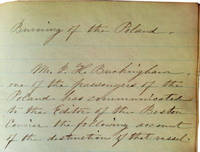
1840000234025 MILES SOUTH OF NANTUCKET SHOALS. Good. 1840. On offer is a sensational original 38 page manuscript account dated Boston 1840 of the ill-fated voyage of the packet ship 'Poland' which caught fire on May 16 en route from New York to Le Havre in France her passengers being rescued two days later by Captain J.B. Ingersoll with the Clifton. The narrator and survivor was Mr. J.H. Buckingham a descendent of Thomas Tinker one of the Pilgrim Fathers on the Mayflower his father being Hon. Joseph Tinker Buckingham 1771-1861 politician journalist and founder of the Boston Courier in 1824. J.H. Buckingham is also associated with the Boston Courier for many years serving his father's enterprise as editor publisher and reporter. Before this voyage he had just resigned as publisher of the Boston Courier in 1939 but would return as a reporter shortly thereafter. In July 1847 he made a stage-coach trip to Chicago and throughout Illinois as a delegate to the River and Harbor Convention and as a reporter for his father's paper accompanying none other than later President Abraham Lincoln. The actual writer appears to be Elizabeth Elise Russell Tyson daughter of George Tyson a railroad official and former merchant in the China trade and Sarah Anthony Tyson. She lived with her family at 314 Dartmouth Street in Boston and in 1915 married attorney and fox hunting aficionado George D. Vaughan. The detailed account of Poland's final voyage interrupted and ended by a lightning induced fire about 25 miles south of Nantucket Shoals leaves little to the imagination as Buckingham describes all: the beginning of the journey the devastating storm and subsequent fire to the cotton and flour in the cargo hold measures taken by crew and passengers for survival the struggles and the collaborative efforts the slowly passing and uncertain hours are recounted in detail until the final rescue. Luckily for historians and researchers the witness to these events was one of the few who remained on the vessel after most were placed on longboats. Not knowing if he would survive at all his observations are recalled in a calm stoic manner his recollections vivid and clear. We quote from the Sydney Gazette: "No language" says the writer of narrative. "can tell of the sufferings of that night which was far more dreadful than the previous night." After a variety of the most agonizing apprehensions and sufferings during which the mothers who had been compelled to hold their youngest children in their arms were well nigh exhausted the ship was put before the wind in the hope of falling in with some sail and as the vessel leaked the men were put to the pump and the water first pumped up was hot. At two o'clock on the afternoon of Monday a sail was discovered from the mast-head. It proved to be the Clifton Captain J. B. Ingersoll bound from Liverpool to New York with two hundred and fifty steerage passengers. The transfer of the crew and passengers of the Poland to the Clifton was effected. At the time the last boat's load left the former her decks had become too hot to stand upon and as she rolled in the sea the water ran from her reeking sides as from hot iron. On board the Clifton every attention was paid to these who had escaped such extreme danger and in due time they were landed safely in New York." Overall G. HISTORICAL NOTES: On 11 May 1840 she left New York with a total of 63 persons on board 24 being cabin passengers. On the 16th she was struck by lightning a disastrous event which resulted in a fire being sparked onboard creating a desperate situation which just in time ended in a rescue. On the 18th the Boston built 'Clifton' commanded by Captain J. B. Ingersoll bound from Liverpool to New York with two hundred and fifty steerage passengers came upon the Poland with her passengers sequestered to the vessel's bow. She took all persons onboard along with any salvageable provisions until the Captain deemed it unsafe to continue. At the time of the last load being removed Poland's decks had become too hot to stand upon. The deeply grateful group watched the Poland burned into the sea knowing that they had so narrowly escaped the same end. The loss of property to the Poland was estimated at $150000. The captain crew and all passengers were saved - within only hours of the ship's sinking. ; Manuscript; 8vo - over 7¾" - 9¾" tall; KEYWORDS: HISTORY OF ELISE R. TYSON BURNING OF THE POLAND LIGHTNING STRIKE AT SEA ATLANTIC COTTON TRADE DISASTER SURVIVOR ACCOUNT AMERICAN PACKET SHIP POLAND SHIPWRECK BOSTON MASSACHUSETTS CAPTAIN J.B. INGERSOLL SHIP CLIFTON J.H. BUCKINGHAM THOMAS TINKER PILGRIM FATHERS MAYFLOWER HON. JOSEPH TINKER BUCKINGHAM BOSTON COURIER ELIZABETH ELISE RUSSELL TYSON GEORGE TYSON GEORGE D. VAUGHAN MARINE NAUTICAL MERCHANT SHIP DANGER AT SEA ATLANTIC COTTON ROUTE AMERICANA HANDWRITTEN MANUSCRIPT AUTOGRAPHED AUTHORS DOCUMENT LETTER AUTOGRAPH KEEPSAKE WRITER HAND WRITTEN DOCUMENTS SIGNED LETTERS MANUSCRIPTS HISTORICAL HOLOGRAPH WRITERS AUTOGRAPHS PERSONAL MEMOIR MEMORIAL PERSONAL HISTORY ARCHIVE DIARY DIARIES JOURNAL LOG PRIMARY SOURCE FIRST HAND ACCOUNT SOCIAL HISTORY PERSONAL STORIES LIVING HISTORY ANTIQUITÉ CONTRAT VÉLIN DOCUMENT MANUSCRIT PAPIER ANTIKE BRIEF PERGAMENT DOKUMENT MANUSKRIPT PAPIER OGGETTO D'ANTIQUARIATO ATTO VELINA DOCUMENTO MANOSCRITTO CARTA ANTIGÜEDAD HECHO VITELA DOCUMENTO MANUSCRITO PAPELBIOGRAPHY BIOGRAPHICAL AUTOBIOGRAPHICAL AUTOBIOGRAPHY PERSONAL NARRATIVES . unknown
18420008000London England. Very Good. 1842. This super original diary written by 24-year old George Canning Backhouse gives an excellent insight into a life of a young man from the upper-middle class starting his diplomatic career and living in London during the early Victorian era. His father John Backhouse 1784-1845 was a noted British politician who served as a Permanent Under-secretary of State for Foreign Affairs and who retired the same year when the diary was written. One of the first records is a memo regarding his father's papers. In 1838 George Canning graduated from the Christ Church College in Oxford and started working at the Secretary of State's Office as a clerk at the Foreign Department. The diary contains about 50 entries some mentioning his work at the office but mostly documenting his social life consisting of parties visits balls horse rides skating in High Park and Kensington Gardens attending cricket games. He was an active theatergoer and his diary contains names of actors and mentions many cultural events - he visits Lyceum and Drury Lane theaters pantomime in Covent Garden with William Payne who was known as "the king of pantomime" Van Amburgh's performance with wild animals he mentions Bouffe a French actor extremely popular at that time: "Dined with Turner at Windham and went with him to a French play last night - Bouffe wonderful in "Le Gamin de Paris" after which he made farewell adieux in verse". Another favorite activity of his was horse riding: "Rode in the morning to Lymm with Elizabeth who lost her stirrup and fell off when near home." On February 18th he lost his dog: "Walked with Catty in the Park with Brisk whom I lost by great carelessness when near home on our return: looked for Brisk on my way to the Office but could not find him. Went to the French play having a stall alongside with Blackburn - Very good". Backhouse refers to significant events like Prince of Wales christening and also mentions many names including clerks from the Foreign Department with whom he socializes and names of notable persons of that time like Under Secretary Addington Ashburton Stopford Lady Murray. It also contains some of his expenses including rent. On July 28th George's father with other family members sailed to Europe: "My father and all sailed from Blackwall by the "Rainbow" for Antwerp." and the archive includes a letter from John Backhouse written in Berne and dated September 20th and a bill for books on Italy bought from Henry George Bohn a prominent publisher and rare books dealer from London with a letter to George asking to settle accounts with Bohn: "Bohn is a man of such perfect respectability that you will get a correct answer if you ask for a statement of my account" The diary: a pocket-size book with leather cover Peacock's Historical Almanack for 1842. Text is faded at few pages. Otherwise in very good condition. Size: 2.8'x4.1 Letter from Berne dated September 20 1942: A leaf folded into an envelope and sealed with a black seal a copy of a bill for books on Italy with a letter with explanations on the other side.; The letter has tears on creases. Size: 6.3'x8.3' 4 watercolor paintings depicting sailing ships: three of them - 7.1'x3' one - 5'x3.3' all in excellent condition.; Manuscript; KEYWORDS: HISTORY OF BACKHOUSE BRITAIN ENGLAND LONDON HANS PLACE EARLY VICTORIAN ERA SECRETARY OF STATE'S OFFICE FOREIGN DEPARTMENT BRITISH POLITICIANS SOCIAL LIFE HISTORY OF ENGLAND 19TH CENTURY NINETEENTH CENTURY VICTORIAN LONDON JOHN BACKHOUSE LONDON THEATER AMERICANA HANDWRITTEN MANUSCRIPT DOCUMENT LETTER AUTOGRAPH WRITER HAND WRITTEN DOCUMENTS SIGNED LETTERS MANUSCRIPTS HISTORICAL HOLOGRAPH WRITERS AUTOGRAPHS PERSONAL MEMOIR MEMORIAL BRITANNICA ANTIQUITÉ CONTRAT VÉLIN DOCUMENT MANUSCRIT PAPIER ANTIKE BRIEF PERGAMENT DOKUMENT MANUSKRIPT PAPIER OGGETTO D'ANTIQUARIATO ATTO VELINA DOCUMENTO MANOSCRITTO CARTA ANTIGÜEDAD HECHO VITELA DOCUMENTO MANUSCRITO PAPEL . hardcover
18430001723HANOVER NEW HAMPSHIRE NH ST. LOUIS MISSOURI MO. Fair. 1843. On offer is an original manuscript diary dated 1843 and 1849 handwritten by an unidentified man attending Dartmouth College in the 1843 part which covers 26 pages wherein we find he is married appears to be a Divinity student describes his lessons and waxes philosophical regarding the plight of man and how he longs for letters from home. He also notes attending Church in the home of Reverend Cutter. Later in 1849 he writes 13 pages of entries from St. Louis Missouri where he is apparently teaching at a boys' school. On Oct. 15th he writes: "Today is a great day for St. Louis. The National Railroad Convention met here today to deliberate on the momentous subject on constructing a railroad to the Pacific Ocean." The beautiful old book with leather spine and marbled boards some scuffing on corners and edges and there is some brittleness with the initial text block pulled away from the spine. He writes in a graceful script. Overall Fair.; Manuscript; 12mo - over 6¾" - 7¾" tall; KEYWORDS: HISTORY OF DARTMOUTH COLLEGE DIVINITY STUDENT ST. LOUIS MISSOURI RELIGION RELIGIOUS STUDIES HANOVER NEW HAMPSHIRE EDUCATION TEACHING HANDWRITTEN HANDWRITTEN MANUSCRIPT DOCUMENT LETTER AUTOGRAPH DIARY JOURNAL LOG KEEPSAKE WRITER HAND WRITTEN DOCUMENTS SIGNED LETTERS MANUSCRIPTS HISTORICAL HOLOGRAPH WRITERS DIARIES JOURNALS LOGS AUTOGRAPHS PERSONAL MEMOIR MEMORIAL PERSONAL HISTORY AMERICANA ANTIQUITÉ CONTRAT VÉLIN DOCUMENT MANUSCRIT PAPIER ANTIKE BRIEF PERGAMENT DOKUMENT MANUSKRIPT PAPIER OGGETTO D'ANTIQUARIATO ATTO VELINA DOCUMENTO MANOSCRITTO CARTA ANTIGÜEDAD HECHO VITELA DOCUMENTO MANUSCRITO PAPEL . hardcover
18430002312MOBILE ALABAMA AL 1843. On offer is an interesting original manuscript relic of North-South trade being an 1843 handwritten letter dated Mobile Alabama as field representative A.C. Mathewson writes his head office of jewellers Mathewson Allen and Co. of Rhode Island. Addresses to the company his correspondent was likely his relation Nathan Fuller Mathewson born: 7 Sep 1814 Warren RI Marriage: Susan Green Wightman about 1840 in Providence RI Died: 27 May 1901 Jeweler and partner from circa 1835 to 1848 with Bradford Allen in Providence RI as MATHEWSON & ALLEN listed in the 1836 city directory with a shop on the corner of Pine and Rhodes Streets regarding the state of his gold and silver trade dealings. He reports he has had almost no business in Mobile but frequently mentions he expects better in New Orleans. He also notes business dealings between Rhode Island New York and Charleston South Carolina too. Some small loss from opening at the seal and a mouse has done some nibbling. Overall G. Good. 8vo - over 7¾" - 9¾" tall. Manuscript. unknown
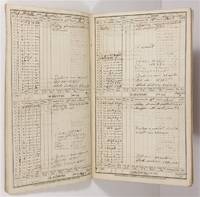
18440001300LONG RIGGING LUDDENDEN BRADFORD SALTERE HALIFAX. Very Good. 1844. On offer is the super original manuscript diary handwritten by Richard Sutcliff Thomas b. May 25th 1844 - . Mr. Thomas draws his life in exceptional detail from his birth until 1911. This diary stands unique as an epic story of a man the youngest of ten of a below middle class family who left school at age eleven and a sign of his character: he appreciated that his parents could give him that much education as many a lad started working at age seven or eight but through work education religion and determination Mr. Thomas bettered himself to a significant degree. Even the book proper is small testament being a near two and a half inch thick cloth cover whose spine plainly yet elegantly states in gild "RECOLLECTIONS - R.S.T." In the Preface Thomas who writes in a strong sound hand lays out the foundation: "My sons Milton and Ernest ask me to put on record the story of my earlier life. In my 67th year compelled to relinquish regular employment and being as Ernest put it 'a retired gentleman of some means' and having time on my hands my mind inclines to the doing of which they desire. Hence the following pages .I have been waiting till now Oct. 1910 ." What follows over 667 pages is his life story but moreso the history and genealogy of his family and the history of business and commerce throughout Middle England. Collectors and historians of trade and commerce will be overwhelmed by the intimate detail Thomas provides as he climbs the business ladder as he names his associates partners their character and the background of their business. Visitors travel hosts church relations politics and all manner of life are named and detailed. Rarely have we seen so thorough a diary that explores so thoroughly one man's progress: from child to boy to man; from child laborer to captain of industry; from hard-scrap beginnings to an old age of comfort and grace and satisfaction. One other area that is noteworthy throughout his adult life is his relationship which Freemasonry and he was a noted speaker lecturing on Good Templarism. A bastion of his local Church many times referring to Bishops and Priests of note whose circles he is a constant we believe he also preaches in his later years. The diary is headed by six chapters by locale: I. Long Rigging 1844-1851 II Luddenden Foot 1851-1867 III Bradford 1867-1869 IV Bradford Lightcliffe 1870-1874 V Saltere 1875-1879 and finally VI Halifax 1879. The last entry reads: Completed on July 30th 1911 and signed by the author. Also bound into the book is a pamphlet: 'In Memoriam Alfred Nicholl' published in Halifax in 1885. The pamphlet notes the songs sung by a Miss Thomas and that Thomas was himself a main speaker. Save for splitting to the spine the book is overall VG.; 8vo - over 7¾" - 9¾" tall; WEST YORKSHIRE LEEDS SALTAIRE LUDDENDENFOOT LONG RIGGING LUDDENDEN FOOT BRADFORD LIGHTCLIFFE SALTERE HALIFAX FREEMASONRY MASONS TEMPLARS TEMPLARISM ENGLAND HANDWRITTEN MANUSCRIPT DOCUMENT LETTER AUTOGRAPH DIARY JOURNAL LOG KEEPSAKE WRITER HAND WRITTEN DOCUMENTS SIGNED LETTERS MANUSCRIPTS HISTORICAL HOLOGRAPH WRITERS DIARIES JOURNALS LOGS AUTOGRAPHS PERSONAL MEMOIR MEMORIAL PERSONAL HISTORY AMERICANA Als antiquité contrat vélin document manuscrit papier Antike Brief Pergament Dokument Manuskript Papier oggetto d'antiquariato atto velina documento manoscritto carta antigüedad hecho vitela documento manuscrito Papel . hardcover
18450001065Providence Rhode Island RI. Good. 1845. On offer is a remarkable historic handwritten manuscript relic of Rhode Island's involvement in the Mexican War and regional commerce being the journal and ledger of George W. Guild who was a soldier in the Mexican War a merchant and a Justice of the Peace in Providence Rhode Island. This 266 page hand numbered book was used from 1845 - 1850 as a ledger for Mr. Guild's prosperous business. He tended to do most of his invoices notes sales and orders on the right side of the open book. The left side was saved for other notes relating to store operations. It is here on these mostly blank pages than George Guild wrote his Mexican War travels and adventures very soon upon his return from service. There are about a dozen pages of written narrative detailing travel vessels conditions battles brothers-in-arms etc and then more pages of point form notes possible chapter headings etc. It seems without doubt that Guild is documenting his immediate memories with an intent to later flesh out for either a book or memoir. A noted dated 1850 in the book confirms this as Guild makes mention of the cost of publishing 100 copies of a 100 page book at a cost of $1.00 per book. Students of the time period will know that when Congress declared war against Mexico on May 13 1846 volunteers in large numbers enlisted to fight against her. About this period the movement of General Taylor or "Old Rough and Ready" as his men called him from Corpus Christi to the relief of Fort Brown on the Rio Grande River was the theme of general conversation throughout the state. Meetings were called by the commanders of the various military companies after the battles of "Palo Alto" and "Resaca-de-la-Palma" for the purpose of offering their services to the government. The act passed by Congress to increase the strength of the army by adding ten additional regiments to be enlisted for the war defined the "quota" of Rhode Island to be one company of infantry. Now there were four companies in process of organization at this time but only one could be mustered into service. In January 1847 the Legislature of Rhode Island made an appropriation of $2500.00 for volunteers for the Mexican War. To Captain Joseph S. Pitman and Lieutenant John S. Slocum was assigned the duty of preparing the company intended for the field. The Second-Lieutenancy was subsequently filled by the appointment of John Glackin of Woonsocket R. I. George W. Guild was appointed First Sergeant. Frequent changes were made in the "non-commissioned" officers as their various qualifications developed. The following is the "roster" after entering the valley of Mexico. His narrative is first hand and well expressed. This was a fascinating time in Rhode Island history and this rare journal is a unique first hand original relic of that time. Overall G. ; 24mo - over 5" - 5¾" tall; MEXICAN-AMERICAN WAR TEXAS REVOLUTION MEXICAN WAR MEXICO VOLUNTEERS RHODE ISLAND HANDWRITTEN MANUSCRIPT DOCUMENT LETTER AUTOGRAPH DIARY JOURNAL LOG KEEPSAKE WRITER HAND WRITTEN DOCUMENTS SIGNED LETTERS MANUSCRIPTS HISTORICAL HOLOGRAPH WRITERS DIARIES JOURNALS LOGS AUTOGRAPHS PERSONAL MEMOIR MEMORIAL PERSONAL HISTORY AMERICANA ECONOMY COMMERCE MERCHANTILE; Signed by Autograph . unknown
18450002116London England. Good. 1845. On offer is a sensational original manuscript relic of Victorian times being the 1845 - 1855 handwritten diary and journal of a British officer as he settles in to retirement in London something he has wished for and who details his life and times with family and friends in great detail. Lt. Col H. Mitchell as stated on a front cover sticker 'Diary of Lt. Col. H. Mitchell 1845-1855' appears to be an old India hand keeping up with the gossip writing letters to Government meeting boats with friends and acquaintances returning from India. This intelligent and observant man a Senior Officer with a hint of the rogue allows the reader to see the elements of his life: family politics friends relations all the while there is a back drop of tensions; from the first pages about finances gone wrong especially with the Bank of Australia and how the impact of world politics would also affect his pocket book and also his seemingly unending interest in India. He also copies some verse and there is a most interesting letter copy to the Earl of Ripond regarding India. Here are some snippets: "Jan 1846 How little I have written in 1845! It has not been a fertile year of events it is true beyond the birth of our daughter. The one we are entering upon with I fear be more eventful for it can hardly fail deeply to affect my money affairs either for good or for ill. I find my incomes amount to 1200 pounds; were misfortunes to befall them I may be reduced to 500 pounds! Were the bank of Australia to recover its prosperity .and should we be forced into a war with America and it seems difficult to see how the Oregon question can be settled without war so overbearing are the pretensions and the conduct of the Americans my income may be reduced to less than 500 pounds without the house!" He notes in one of the last entries how the Queen saw fit to raise his rank to Colonel and while mostly ceremonial he was quite pleased. The 9½ x 7¾ inch half calf marbled boards contains 59 pages of narrative is overall G.; Manuscript; 8vo - over 7¾" - 9¾" tall; KEYWORDS: HISTORY OFLT. COL. H. MITCHELL 19TH CENTURY VICTORIAN ERA VICTORIAN GENTLEMAN LONDON ENGLAND INDIA EAST INDIA COMPANY THE AUSTRALIAN BANK BANK OF AUSTRALIA BRITAIN BRITANNICA UNITED KINGDOM COLONIAL INDIA HANDWRITTEN MANUSCRIPT AUTOGRAPHED AUTHORS DOCUMENT LETTER AUTOGRAPH KEEPSAKE WRITER HAND WRITTEN DOCUMENTS SIGNED LETTERS MANUSCRIPTS HISTORICAL HOLOGRAPH WRITERS AUTOGRAPHS PERSONAL MEMOIR MEMORIAL PERSONAL HISTORY ARCHIVE DIARY DIARIES JOURNAL LOG PRIMARY SOURCE FIRST HAND ACCOUNT SOCIAL HISTORY PERSONAL STORIES LIVING HISTORY ANTIQUITÉ CONTRAT VÉLIN DOCUMENT MANUSCRIT PAPIER ANTIKE BRIEF PERGAMENT DOKUMENT MANUSKRIPT PAPIER OGGETTO D'ANTIQUARIATO ATTO VELINA DOCUMENTO MANOSCRITTO CARTA ANTIGÜEDAD HECHO VITELA DOCUMENTO MANUSCRITO PAPEL . hardcover
18450001583New Bedford Massachusetts MA. Good. 1845. On offer is the original 1845 manuscript diary of the very busy wife of a religious figure Chapin was a circuit-rider in south-eastern Massachusetts Mrs. Chapin details a daily life from March 6th 1845 through March 1st 1846 that typically consists of a round of "calls" made or received. On some days she sees six or seven visitors mostly in small groups each of whom she carefully and fully names. She also seems regularly to host sometimes for weeks an inordinate number of Chapin family members: Samuel Mary and George William C. G.W. Sarah Laura. Elizabeth Aunt Betsy Amory who dies in the course of the diary Seth Maria and she also pays them frequent visits. She regularly attends "female prayer meetings" "Maternal meetings" and meetings of societies such as the "C.F. Society" where she serves on the Board and which sometimes meets in Providence and the "F.M. Society" as well as the Seaman s Friend Society. One of these the C.F. Society clearly seems to deal with social issues and in January of 1846 the group meets to decide whether "we give Mrs. Cockran her children." The churchwomen voted to "relinquish our claim" on the youngsters after hearing testimonials about their good character. The same group also decides "to send John Ryan to sea sailing May 1 from New Bedford in a whaling ship" entry of April 1. Another unnamed group of women that she belongs to decides "to form an association to promote education at the West" and our author is appointed "Collector for High Street" Church. Her other duties include regular visits to the sick and as soon as there is an accident such as Sarah C. being thrown from her carriage and badly hurt or a deathbed scene she and Mr. Chapin rush to the spot. On October 4 for instance they were "awaked this morn at 1 o clock by Sanford s coming to tell us that brother Amory lay at the point of death." Mr. Chapin goes but is too late. They also attend over the course of the year a number of funerals including those of children. The writer also has a housewifely side. She mentions hiring a succession of women to help in the house her own visits to a dressmaker for a "bombazine" dress the fact that she and her circle "have quilted 3 bed quilts made 2 comforters and quilted 4 skirts this autumn" Nov. 11 entry and that she and Mary Ann "made a carpet for my room." She also mentions S. Chapin's "machine" several times which seems to be a washing machine "price $10". On October 3rd she notes that it is her 53rd birthday and that she "spent the day mostly by myself I have renewedly dedicated myself to God and pray that I may spend the few remaining days allotted me here in his service and to his glory." She also does a super job with births deaths marriages etc. plus she mentions Boston Fall River Pawtuxet Warwick Uxbridge Tiverton Carbonville and Providence. The 43pp book is handwritten in a tight legible hand on lined paper dates captioned in the left margins. Bound in original flexible calf. 6.25" x 4". Overall G. ; English Language; 32mo - over 4" - 5" tall; KEYWORDS: HISTORY OF RELIGION BAPTISTS MISSIONARIES ITINERANT PREACHERS BOSTON FALL RIVER CHAPIN C.F. SOCIETY MATERNAL MEETINGS HANDWRITTEN MANUSCRIPT DOCUMENT LETTER AUTOGRAPH WRITER HAND WRITTEN DOCUMENTS SIGNED LETTERS MANUSCRIPTS HISTORICAL HOLOGRAPH WRITERS AUTOGRAPHS PERSONAL AMERICANA PERSONAL HISTORY MEMOIR MEMORIAL DIARY JOURNAL DIARIES JOURNALS LOG LOGS AMERICANA antiquité contrat vélin document manuscrit papier Antike Brief Pergament Dokument Manuskript Papier oggetto d'antiquariato atto velina documento manoscritto carta antigüedad hecho vitela documento manuscrito papel. . unknown