783 résultats
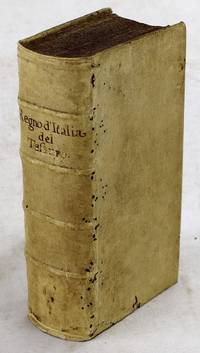
1771C05844 books in 2 volumes: 8xvi255 pages with frontispiece; 205 pages with index and errata. Octavo 8" x 5 3/4 bound in stiff wrappers with lables to spines and deckle edges. This edition not in Bibliotheca Van der Linde-Niemeijeriana; however there are a number of listings for this title in the bibliography 4315 through 4330 listing 16 editions of various dates and publishers. First published in 1528.<br /><br />Baldassare Castiglione count of Novilara was an Italian courtier diplomat soldier and a prominent Renaissance author. He was born into an illustrious Lombard family at Casatico near Mantua. In 1494 at the age of sixteen Castiglione began his humanist studies in Milan which would eventually form his future writings. However in 1499 after the death of his father Castiglione left his studies and Milan to succeed his father as the head of their noble family. Soon his duties seem to have included representative offices for the Gonzaga court. For the Gonzaga he traveled quite often; during one of his missions to Rome he met Guidobaldo da Montefeltro duke of Urbino. Urbino was at that time the most refined and elegant among Italian courts a meeting point of culture ably directed and managed by duchess Elisabetta Gonzaga and her sister-in-law Maria Emilia Pia. The most constant guests included: Pietro Bembo Giuliano de' Medici Cardinal Bibbiena Ottaviano and Federigo Fregoso and Cesare Gonzaga a cousin of both Castiglione and the duke. The hosts and guests organized intellectual competitions which resulted in an interesting stimulating cultural life producing brilliant literary activity. Castiglione wrote about his works and of those of other guests in letters to other princes maintaining an activity very near to diplomacy though in a literary form. In 1516 Castiglione was back in Mantua where he married Ippolita Torelli descendant of another ancient noble family; two passionate letters he wrote to her expressing deep sentiment have survived but she unfortunately died only four years later. At that time Castiglione was in Rome again as an ambassador this time for the Duke of Mantua. In 1521 Pope Leo X conceded to him the tonsura first sacerdotal ceremony and thereupon began Castiglione's second ecclesiastical career. In 1528 the year before his death the book by which he is most famous The Book of the Courtier Il Libro del Cortegiano was published in Venice by the Aldine Press run by Andrea d'Asolo father-in-law of Aldus Manutius. The book is based on a nostalgic recreation of Castiglione's experience at the court of Duke Guidobaldo da Montefeltro of Urbino at the turn of the sixteenth century. It describes the ideal court and courtier going into great detail about the philosophical and cultured and lively conversations that occurred at Urbino presided over by Elisabetta Gonzaga. Castiglione himself does not contribute to the discussion the book is his tribute to his friendship with the participants of the discussion all of whom went on to have important positions. The Book of the Courtier caught the "spirit of the times" and was soon translated into Spanish German French and English. One hundred and eight editions were published between 1528 and 1616 alone. Pietro Aretino's La cortigiana is a parody of this famous work. Castiglione's depiction of how the ideal gentleman should be educated and behave remained for better or for worse the touchstone for all the upper classes of Europe for next five centuries. The work on chess is in the second book of this work.<br /><br />Condition:<br /><br />Old stamps to title of volume two and first un-numbered page of volume one Spine ends chipped with loss to heal corners bumped wrappers rubbed else a good copy of scarce title. Vendramini Mosca hardcover books
166814426Milano: Giovanni Battista Ferrari 1668. Esemplare privo dell’antiporta allegorica ma ben completo di tutte le carte inclusa quella bianca all’inizio della seconda opera e l’ultima col registro. Piccolo lavoro di tarlo va a ledere qualche parola sulle ultime carte del De Spiritibus dedica moderna sulla prima carta bianca. Legatura d’epoca in pergamena rigida in quarto cm 30 x 20.5 pp 24 438 2 8 102 ma 94 per errore tipografico la numerazione delle pagine salta da 80 a 89 2. Esemplare privo dell’antiporta allegorica ma ben completo di tutte le carte inclusa quella bianca all’inizio della seconda opera e l’ultima col registro. Piccolo lavoro di tarlo va a ledere qualche parola sulle ultime carte del De Spiritibus dedica moderna sulla prima carta bianca. Prima edizione della celebre farmacopea milanese stampata per generazioni dalla famiglia Branda Castiglioni che ne mantenne il privilegio fino agli anni ’30 del secolo XVIII; Giovanni Onorato Castiglione iscritto al Collegio dei Medici di Padova nel 1633 fu Regio Protomedico di Milano. Dedica titolo e alcune parti del testo sono in latino ma il ricettario vero è proprio è in italiano. L’antidotario illustra diverse preparazioni farmaceutiche vini medicali pillole cerotti ecc; la seconda opera con proprio frontespizio il saggio sugli spiriti e i semplici tratta fra la l’altro di preparazioni cosmetiche profumi e saponi delle spezie dell’imbalsamazione e varie altre curiosità. Krivatsky n. 2597; Vinciana 1872: «Edizione originale di quest’unica opera dell’Autore il quale ebbe per essa molto onore». Giovanni Battista Ferrari unknown
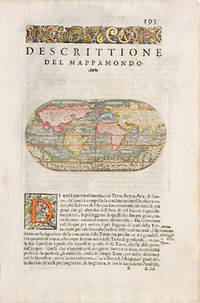
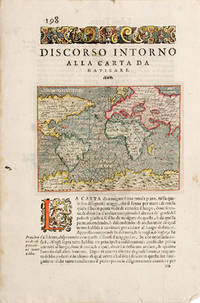
159053261Venice: L'Isole Piu Famoso del Mondo. Simon Galignani. 1590. Oval map of the world. The maps for this atlas were engraved by Girolamo Porro from Padua and are set within a page of text with engraved headpiece and decorated initial. There were many editions of this popular atlas between 1576 and 1713. Size:197 x 297 mm. Copper engraving. Hand coloured. A fine crisp impression. Fine condition. Moreland and Bannister p.68 unknown
a78943Bergamo 1759 1st Appresso Pietro Lancellotti. In Italian. Hardcover. Sm.4to. xii 220pp. vignette on title page impressive and fine full page copperplate portrait of St. Charles Borromeo as frontis errata page lovely hand stamped red and green floral paper covered boards with 3/4 vellum. Owner signed on top corner of title page and two lines of old ink notation on rear end paper no other ownership marks. VG ink spine label mostly faded away faint rippling throughout text. . hardcover
1901539159New York: Charles Scribner's Sons 1901. Softcover. Near Fine. First edition thus. Translated from the Italian and annotated by Leonard Eckstein Opdycke. With seventy one portraits and fifteen autographs reproduced by Edward Bierstadt. Large quarto. Japon vellum gilt. Boards a trifle soiled from handling very near fine. Copy number 454 of 500 numbered copies. Charles Scribner's Sons unknown
2009Adhya-9780387751146SPRINGER 2009. Hardcover. New. SPRINGER hardcover
2009Adhya-9780387751146SPRINGER 2009. Hardcover. New. SPRINGER hardcover
Veduta generale della città
1771C0584<br />4 books in 2 volumes: 8xvi255 pages with frontispiece; 205 pages with index and errata. Octavo 8" x 5 3/4 bound in stiff wrappers with labels to spines and deckle edges. This edition not in <i>Bibliotheca Van der Linde-Niemeijeriana</i>; however there are a number of listings for this title in the bibliography 4315 through 4330 listing 16 editions of various dates and publishers. First published in 1528.<br /><br />Baldassare Castiglione count of Novilara was an Italian courtier diplomat soldier and a prominent Renaissance author. He was born into an illustrious Lombard family at Casatico near Mantua. In 1494 at the age of sixteen Castiglione began his humanist studies in Milan which would eventually form his future writings. However in 1499 after the death of his father Castiglione left his studies and Milan to succeed his father as the head of their noble family. Soon his duties seem to have included representative offices for the Gonzaga court. For the Gonzaga he traveled quite often; during one of his missions to Rome he met Guidobaldo da Montefeltro duke of Urbino. Urbino was at that time the most refined and elegant among Italian courts a meeting point of culture ably directed and managed by duchess Elisabetta Gonzaga and her sister-in-law Maria Emilia Pia. The most constant guests included: Pietro Bembo Giuliano de' Medici Cardinal Bibbiena Ottaviano and Federigo Fregoso and Cesare Gonzaga a cousin of both Castiglione and the duke. The hosts and guests organized intellectual competitions which resulted in an interesting stimulating cultural life producing brilliant literary activity. Castiglione wrote about his works and of those of other guests in letters to other princes maintaining an activity very near to diplomacy though in a literary form. In 1516 Castiglione was back in Mantua where he married Ippolita Torelli descendant of another ancient noble family; two passionate letters he wrote to her expressing deep sentiment have survived but she unfortunately died only four years later. At that time Castiglione was in Rome again as an ambassador this time for the Duke of Mantua. In 1521 Pope Leo X conceded to him the tonsura first sacerdotal ceremony and thereupon began Castiglione's second ecclesiastical career.<br /><br />In 1528 the year before his death the book by which he is most famous <i>The Book of the Courtier Il Libro del Cortegiano</i> was published in Venice by the Aldine Press run by Andrea d'Asolo father-in-law of Aldus Manutius. The book is based on a nostalgic recreation of Castiglione's experience at the court of Duke Guidobaldo da Montefeltro of Urbino at the turn of the sixteenth century. It describes the ideal court and courtier going into great detail about the philosophical and cultured and lively conversations that occurred at Urbino presided over by Elisabetta Gonzaga. Castiglione himself does not contribute to the discussion the book is his tribute to his friendship with the participants of the discussion all of whom went on to have important positions. <i>The Book of the Courtier</i> caught the "spirit of the times" and was soon translated into Spanish German French and English. One hundred and eight editions were published between 1528 and 1616 alone. Pietro Aretino's La cortigiana is a parody of this famous work. Castiglione's depiction of how the ideal gentleman should be educated and behave remained for better or for worse the touchstone for all the upper classes of Europe for next five centuries. <b>The work on chess is in the second volume of this work</b>.<br /><br /><b>Condition:</b><br /><br />Old stamps to title of volume two and first un-numbered page of volume one Spine ends chipped with loss to heal corners bumped wrappers rubbed else a good copy of scarce title. Vendramini Mosca hardcover
17691231I006Padova Padua: Presso Giuseppe Comino 1769-1771. 1st Edition . Hardback. Printed pages: 4to. xiv 222 2; xii 384. Very Good. 7 x 9.5 inches 18 x 24 cm. Complete two volume set. Contemporary full vellum bindings. Volume I has wear to head of spine and top edge of front board. Red mottled page edges. Foxing to endpapers browning to some pages. A few pencilled notes to margins text is otherwise clean throughout. Scribbled out contemporary ownership inscription to the blank facing title page in both volumes. Vignette to both title pages. Several woodcut initials headpieces and tailpieces within the text. Italian language. Provenance: From the library of John Lambton 1st Earl of Durham with Durham's bookplate to front pastedown endpaper in both volumes. Volume I also has a label for the library at Lambton Castle the ancestral seat of the Earls of Durham. Pencilled notes of front pastedown endpaper in Volume I states that this set was sold at the Lambton Castle book auction 19-22 April 1932 lot 634. Also states that the notes within the books are by E.R.Vincent 1894-1978 Chair of Italian at Cambridge University. Overall condition is Very Good. Size: 7 x 9.5 inches 18 x 24 cm. Presso Giuseppe Comino hardcover
159053262Venice: L'Isole Piu Famoso del Mondo. Simon Galignani. 1590. Attractive world map a mariner's map with rhumb lines emanating from 16 points. The maps for this atlas were engraved by Girolamo Porro from Padua and are set within a page of text with engraved headpiece and decorated initial. There were many editions of this popular atlas between 1576 and 1713. Size:197 x 297 mm. Copper engraving. Hand coloured. Closed tear on lower margin of leaf not affecting map. Very good condition. Moreland and Bannister p.68 unknown
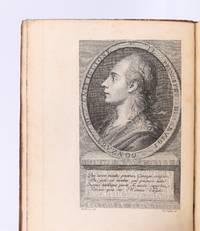
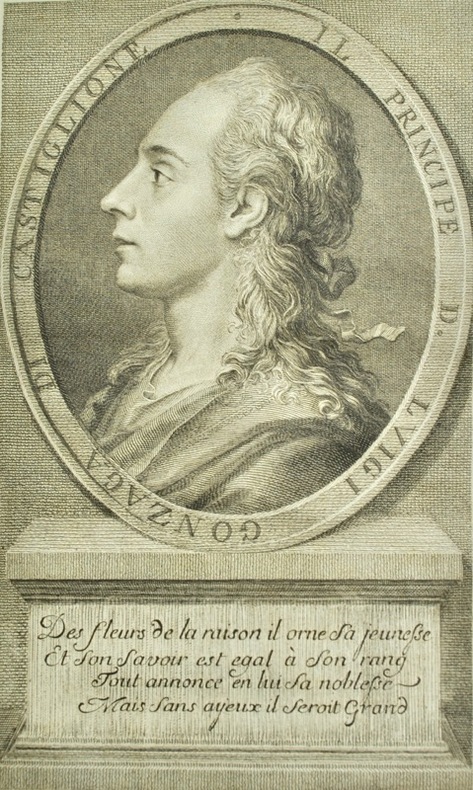
177791097n. l.: s. n. 1777. Fine. s. n. n. l. Lu à la Royal Society de Londres 1777 18.1 x 22.9 cm Relié An intriguing first edition complete with its engraved frontispiece of the author by Giovanni Volpato after Domenico Corvi and its introductory poem by the Abbé Luigi Godard. A copy unrecorded in non-European libraries according to WorldCat. Contemporary binding of fawn mottled calf smooth spine divided into five gilt compartments by gilt rolls brown morocco lettering-piece triple gilt fillet framing the boards double gilt fillet on the board edges blue speckled edges and shell-pattern marbled pastedowns and endpapers. The lower cap lacking some surface wear to the spine and corners the upper joint slightly split for several centimetres a few discreet wormholes and small areas of loss to the leather on the boards light rubbing to the edges; the interior in very good condition. A marginal tear to p. 51 very slightly affecting the text and a marginal stain to p. 47. The spirit of the Enlightenment is vividly reflected in this essay on the achievements of the human mind by an enlightened princethe last descendant of the cadet branch of the Gonzaga dynastywho sold his lands in exchange for an annual life annuity; an eloquent writer and admirer of English and French philosophers notably Montesquieu whom he cites repeatedly in this volume; and very much a libertine of his age the lover of the poet Maria Maddalena Morelli. s. n. hardcover
17771921A Genève, , 1777. In-4 de CXXIV pp., veau havane marbré, dos lisse orné, pièce de titre en maroquin rouge, filet et frise dorés d'encadrement sur les plats, tranches dorées (reliure de l'éditeur).
2939World Celestial & Curiosities: Venice Gorgio Angeliera a instantia de gli Herede di Simone Galignani de Karera 1590. Copper engraved maritime map of the World by Girolamo Porro from Porcacchi's " L'Isole piu Famose del Mondo" Set in a page of descriptive Italian text page 198 with decorative woodcut headpiece and historiated initial. Single page. folio text to verso. The decorative miniature sea chart is criss-crossed with rhumb lines; South America somewhat distorted; Alaska named as India Superior joined to Asia perhaps; large land mass Terra Incognita to the South. Dark Impression; light soiling to edges. Tomasso Porcacchi da Castiglione first published his Isolario in 1572 in Venice The maps were engraved by Girolamo Porro. whilst Porcacchi provided the descriptions. The "Isolario" follows the tradition started by Sonetti and Bordone of "Island "books Shirley World 128. Sabin 64151;Adams P-1906; Alden and Landis 590/54; BMC Italian p.534; World Celestial & Curiosities World Carta Maretime Carta da Navigare Venice Gorgio Angeliera a instantia de gli Herede di Simone Galignani de Karera 1590 unknown
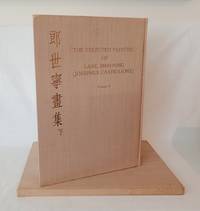
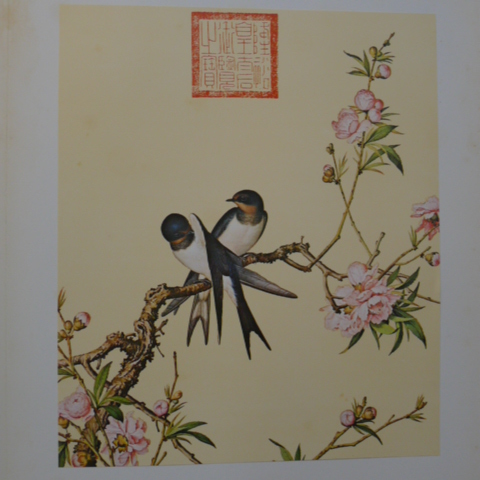
1971F7176Hong Kong: The Arts and Literature Press. 1971. First Edition. Hardcover. Very Good. Cloth lightly foxed occasional mild blemish small nick to spine hinge on volume two. One gathering slightly protruding in vol. 2. Internally excellent.; Complete with 77 plates; 4to 11" - 13" tall; "One of the key figures in establishing the new aesthetic at the Qing court was the Italian Jesuit Giuseppe Castiglione 1688-1766 whose illusionist approach to painting revolutionized Qing court art. Castiglione served at the Qing court for fifty years working under the Chinese name Lang Shining. A master of vividly naturalistic draftsmanship and large-scale compositions in Italy and Portugal he had worked as a muralist Castiglione successfully combined Western realism with traditional Chinese conventions of brushwork in a manner that suited the imperial taste. Descriptively complex technically finished and monumental in scale Castiglione's vividly realistic painting style perfectly served the emperor's documentary purposes as well as his predilection for self-promotion on a grandiose scale". Asia for Educators Columbia University . The Arts and Literature Press hardcover
134456aafFribourg (Suisse), Fondation Marcello. 1980, in-4to, (35 x 25 cm), 6 ff. de texte (12 p. non chiffr.) + 9 gravures sur planches, l’édition de tête à 20 ex. sur papier vélin de Georges Duchêne, au Moulin de Larroque, comprenant neuf eaux-fortes, num. 5/100, En feuilles, non reliées. Emboitâge exécuté par l’Industrielle à Fribourg. (CAFAG),
173717028London : Olive Payne, 1737. 2. Edition ; (60 unnum. S.) 508 S. : Mit 1 Frontispiz und Kapitelvignetten ; teilw. im zweispaltigen Druck; 26x21 cm , brauner Org.-Leder mit 5 Bünden und rötlichem Vollschnitt / Orig.-Leather, coloured edges, five raised bands [2 Warenabbildungen]
Acquaforte misure: mm 239 x 192 Pittore e incisore italiano fra i massimi esponenti della scuola barocca genovese. La prima formazione avviene a Genova presso la bottega di G. B. Paggi, Giovanni Andrea de Ferrari e Sinibaldo Scorza. A Genova si confronta anche con gli artisti fiamminghi presenti in città quali Jan Roos, pittore di animali, e Antoon Van Dyck (Anversa 1599-Londra 1641) dai quali mutua un cromatismo caldo e vibrate. A 25 anni è a Roma, è un artista già apprezzato tanto da poter accedere all’Accademia di San Luca. Lavorerà tra Roma e Genova, quindi a Mantova dove presterà i suoi servizi per il Duca Carlo II Gonzaga. É importante ricordare che egli ebbe un ruolo decisivo nell’affermazione e nello sviluppo dell'incisione d’invenzione -quale strumento di espressione con un linguaggio proprio- sia nel contesto genovese, sia in quello romano dove è sicuramente entrato in contatto con un altro noto incisore: Pietro Testa detto Il Lucchesino (Lucca 1612-Roma 1650). Il Grechetto è stato un grande sperimentatore animato dallo spirito di ricerca di effetti tonali in fase di stampa. Ha spesso ambientato le sue composizioni di notte per incrementare gli effetti di chiaroscuro. E inoltre ad oggi considerato l'inventore del monotipo. I temi più cari che ha affrontato sia in pittura che nelle incisioni sono temi a soggetto biblico o mitologico, spesso le scene sono affollate da animali. Inizialmente considerato come un baccanale davanti alla statua del dio Pan, a partire dal 1677 (Indice dello stampatore De Rossi) viene invece riconosciuta come la statua del dio Termine, divinità sabina protettrice dei confini nazionali e delle proprietà private. All'interno di una paesaggio bucolico caratterizzato da arbusti e alberi dalle ricche fronde, un satiro viene rappresentato semi sdraiato sotto la statua di Termine avvolta da corone. Ad osservare la scena altri due personaggi, una donna nell'angolo a destra seduta con un tamburo in mano e un uomo con un vaso tra le mani. In basso a destra quasi abraso G. BENE.. e in basso Jo. Jac. Rossi form Romae 1642 alla Pace. Il soggetto è stato più volte affrontato da Castiglione: ricordiamo per esempio un disegno conservato a Milano presso il Castello Sforzesco, Gabinetto dei Disegni dove in controparte si può riconoscere la donna con lo strumento musicale in mano. Esemplare nel III/III stato con l'aggiunta dell'indirizzo "alla Pace" dopo il nome dello stampatore G. G. De Rossi. Gian Giacomo de Rossi, forse il maggiore stampatore attivo a Roma fra l 1627 e il 1691, proprietario di moltissimi rami ed erede di una fiorente attività, aggiunge l'indirizzo "alla Pace" negli anni ottanta. Impressione eccellente, leggermente tarda, con pregevoli effetti di pulitura visibili nella zona bianca del cielo. Ottimo stato di conservazione. Minimi margini oltre la battuta del rame. Filigrana: Scritta AMG Serafini Fabriano (Heawood, 3323). Cartiera attiva a Fabriano già nel XVII secolo. Un altro esemplare è conservato presso la Raccolta delle Stampe Achille Bertarelli. Bibliografia: Bartsch 16; T.I.B. .016; Bellini 10
177791097s. n. | s. l. [Lu à la Royal Society de Londres, 1777] | 18.1 x 22.9 cm | Relié
STLX0021Padua Giuseppe Comino 1733 in fine 1732. 4°. Tit. 14 Bll. Widm. XXXII 436 S. Mit 1 gest. Front.Portr. d. Verf. I.B. Cromer del. u. M. Francia sc. 1 Tit.vign. 1 Kopfleiste u. 1 Init. in Kupferst. sowie 2 Druckermarken u. einigen Zierrat in Holzschnitt. Pergamentbd. d. Zt. m. goldgepr. Rü.tit. auf mont. Rüschi. Einbd. etw. angeschmutzt fl. u. stellenw. m. unscheinbaren Kratzspuren ersten Bll. finger- u. braunfl. BBKL XXIX 267-282; Brunet I 1628. Schöne dem italienischen Kardinal Guido Bentivoglio d'Aragona 1668-1732 gewidmete Ausgabe der Werke des bedeutenden Schriftstellers Diplomaten und Höflings Baldassare Castiglione 1478-1529. Neu herausgegeben durch die Brüder Volpi in der 'Edizione Cominiana'. In der 'Edizione Cominiana' veranstaltete Ausgaben erschienen in dem von dem Drucker und Buchhändler Giuseppe Comino zusammen mit Gianantonio und Gaetano Volpi 1717 in Padua gegründeten Verlag der sich der Herstellung im Text möglichst verlässlicher und kommentierter Ausgaben klassischer Autoren verschrieb. Die 'Edizione Cominiane' erschienen bis 1782 sie sind mit Viten versehen enthalten Zeugnisse zu den Autoren und zuweilen Bibliographien. - Mit einer für die Editionsgeschichte von Castigliones Werken nützlichen Übersicht Catalogo di molte delle principali edizioni del Cortegiano S.417-422. ""Bonne édition peu commune"" Brunet. Padua, Giuseppe Comino 1733 (in fine 1732). unknown
16802010140055Venetia : Gio. Giacomo Hertz 1680. Hardcover. Very Good. History of Italy under Barbarian rule Early Venetian imprint in a contemporary binding vellum binding. Some worming to vellum but doesn't effect text. Pages are general sound and clean. 24 732 72 p. Engraved frontispiece; engraved vignette on title; 64 of 66 plates; 3 folding maps. Brunet V 730 Graesse VI 2 72 for the 1667 edition. Venetia : Gio. Giacomo Hertz hardcover
1680000806Venetia Venice: Giacomo Hertz 1680. Hardcover. Very Good. 12mo. 24 732 pp 72 unpaginated index. 58 engraved plates 3 folding maps. Libreria Vinciana Autori Italiani del 1600 499. History of Italian monarchs during darkest of the Dark Ages or the period following the fall of the Roman Empire til around 1000 A.D. a period obscure to even most ardent history buffs and scholars. Consulted by Manzoni in his research of Longobardi or the Lombards. Each of the plates of ancient kings decorated with emblems and baroque ornamentation. Contemporary vellum attractive. Binding tight. Light soilage at most to leaves -- mostly just age toning. Discreet very old writing below half title plate and backside of same leaf. A small wormhole in upper left affecting pages in the 200s but only a few pages where actual letters are lost and even these pages reading loss is insignificant. Overall a very good copy. <br/><br/> Giacomo Hertz hardcover books
1680000806Venetia Venice: Giacomo Hertz 1680. Hardcover. Very Good. 12mo. 24 732 pp 72 unpaginated index. 58 engraved plates 3 folding maps. Libreria Vinciana Autori Italiani del 1600 499. History of Italian monarchs during darkest of the Dark Ages or the period following the fall of the Roman Empire til around 1000 A.D. a period obscure to even most ardent history buffs and scholars. Consulted by Manzoni in his research of Longobardi or the Lombards. Each of the plates of ancient kings decorated with emblems and baroque ornamentation. Contemporary vellum attractive. Binding tight. Light soilage at most to leaves -- mostly just age toning. Discreet very old writing below half title plate and backside of same leaf. A small wormhole in upper left affecting pages in the 200s but only a few pages where actual letters are lost and even these pages reading loss is insignificant. Overall a very good copy. Giacomo Hertz hardcover
13240Taibei Shi: Guo li gu gong bo wu yuan, Minguo 60 [1971]. 1 large in-plano (50*36 cm) portfolio, silk-covered hard boards, [2] folded leaves, [16] folded leaves of mounted plates, illustrated by sixteen large size flower paitings by Castiglione, a very good copy L'album se compose de 16 peintures (feuilles) représentant des fleurs de saison, souvent accompagnées d'oiseaux ou de rochers
6390Taibei Shi: Guo li gu gong bo wu yuan, Minguo 60 [1971]. 1 large in-plano (50*36 cm) portfolio, silk-covered hard boards, [2] folded leaves, [16] folded leaves of mounted plates, illustrated by sixteen large size flower paitings by Castiglione, a very good copy. Very heavy, extra-postage required.