17 036 résultats
1922109822ABBerlin, Pantheon-Verlag, (1922). Gr.8°. 134 S. Original-Halbpergamentband mit Kopfgoldschnitt.
17809Amsterdam, Pierre Mortier, 1750. 3 parties en 1 petit in-4, XX-144-[10]-168-[2]-788-[56] pp., basane mouchetée brune de l'époque, dos à nerfs orné de caissons dorés, pièce de titre rouge, tranches mouchetées (manques, accidents, épidermures, rousseurs).
Litografia animata impreziosita da coloritura coeva.
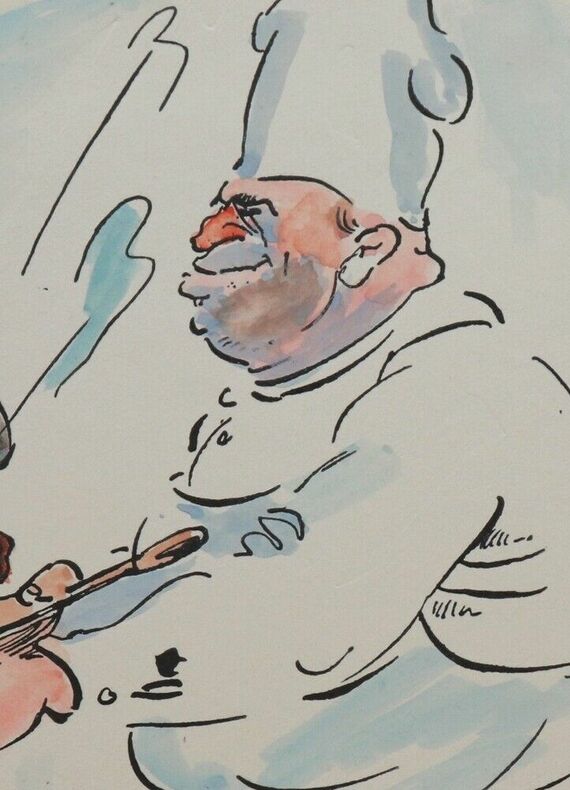
1940AMO-4517Vers 1945 Voici la liste et la taille des dessins : - Mon curé dans les bois (environ 24 x 22,5 cm) - Mon curé chez les riches (environ 19 x 19 cm) - [Les gymnastes] (avec légende que nous ne comprenons pas) (environ 23 x 18,5 cm) - [Enculine Paris] (texte dans le dessins) (environ 21 x 20 cm) * ce dessin n'est pas montré dans cette fiche - Derrière la scène (environ 19 x 18,5 cm) - L'affaire ... légendée au crayon en dessous La vengeance du juif (environ 21 x 19,5 cm) ** ce dessin daterait la série de l'année 1945 - Cuisine bourgeoise (environ 18 x 16 cm) - Education spirituelle (environ 17,5 x 15 cm) - ... du nègre (environ 16,5 x 16 cm) *** nous ne lisons pas le premier mot avec certitude - Vive la lieberté (environ 17,5 x 17,5 cm) ** ce dessin daterait la série de l'année 1945 - Mon curé chez les pauvres (environ 21,5 x 19,5 cm) * ce dessin n'est pas montré dans cette fiche - Séduction (environ 25 x 20 cm) * ce dessin n'est pas montré dans cette fiche Chaque dessin a une forme différente, soit rectangulaire, soit carré, soit avec des pans coupés. Ces dessins sont sur papier bristol blanc. Excellent état de l'ensemble des dessins. Ces dessins se trouvaient depuis tout ce temps conservés dans une enveloppe de papier kraft accompagnés d'un billet autographe de l'éditeur parisien René Kieffer. Dans ce billet d'instruction René Kieffer s'adresse à son photograveur en ces termes : "Toute la série. Des dessins au crayon doit être en simili détourée comme vous avez fait le dernier. Signé René Kieffer. Même réduction. Très soigné (au crayon). [un mot illisible à droite]. Ce billet est rédigé au verso d'une photogravure d'un dessin par Jacques Touchet.
17493988B[Offenbach am Mayn, MDCCXLIX, 1749]. Kl.8°. 236 S. HLeder (um 1900), Rotschnitt.
8007Ao.J. Blattgröße: 12 x 16 cm. Radierung: 5,5 x 11 cm.
1907904576BG[Wien]:, [1907]. -. Blattmaß: 33,5 x 28 cm. Plattenmaß: 25,5 x 24 cm.
1971045949Frankfurt a. M., März Verlag, 1971. EA, 8°, Lwd. m. OSU., 220 S. - gutes Exemplar
1780910816CG[Um 1780]. Kupferstich 7 x 8,5 cm, Blattgröße 51,5 x 33 cm. [2 Warenabbildungen]
Very Good Turkish, Ottoman (1500-1928) Contemporary cloth bdg. Rebacked spine. Roy. 8vo. (23 x 14 cm). In Ottoman script (Old Turkish with Arabic letters). 143 p. Slight tear on two leaves, wear on extremities of original marbled boards, otherwise a good copy. Early printed edition of this exceedingly rare collection of early Ottoman erotic poems of homosexuality and bisexuality, of the 18th century including the multiple works of Enderunlu Fazil and Sünbülzâde Vehbi. This book includes five works originally: Defter-i ask [i.e. The book of love] (pp. 1-21); Hubannâme [i.e. The book of male lovers] (pp. 22-55); Zenannâme [i.e. The book of beautiful women] (as well as "Çenginâme" of Fazil Bey in Zenannâme, pp. 102-111); and Sevkengiz [i.e. Inspiring] (pp. 112-143). "Defter-i ask" [i.e. The book of love] by Fazil, in which he tells about his own romances, is a mathnavi of 438 couplets. It begins with a description of divine love and tells the story of the poet's romances, which he fell into only to regret and repent afterward. "Hubannâme" [i.e. The book of male lovers] consists of 796 couplets with various titles and it has a mystical analysis of beauty in the first chapter. After an introduction that gives geographical information that may be considered novel for its period, it describes the beauties of male bodies in many countries from India to America. This style is unique and the first in Turkish / Ottoman literature. In the work titled "Zenannâme" [i.e. The book of beautiful women], which is a mathnavi of 1101 couplets, women of various nations are described. The poet indicated in the introduction of his work that he does not want to talk about women, and that he has no orientation towards women. Enderunlu Fazil was an Ottoman poet who depicted the beauty of men from various lands of the Ottoman Empire. He achieved fame through his erotic works, which were published posthumously. Among his most famous works is The Book of Women, which was banned in the Ottoman Empire. The book describes the advantages and disadvantages of women from different nations. Fazil was born in Acre into an Arab family originally from Medina. He spent his early years in Safed in Ottoman Palestine. His grandfather Zahir al-Umar and his father Ali Tâhir were both executed (in 1775 and 1776, respectively ) for participating in a rebellion. After his father's death, Fazil moved to Istanbul. There, he was admitted to the Enderun palace school (thus taking on the name Enderuni or Enderûnlu) but was expelled in 1783 as a result of his love affairs with other men there. In 1799, he was exiled to Rhodes because of his satirical writings and was only allowed to return to Istanbul after becoming blind. He spent the rest of his life there, ill and bedridden. Sümbülzâde's "Sevkengiz" [i.e. The Inspiring] is an erotic and mystical poem in which heterosexual and bisexual narratives compare male and female beauties and eventually turn to divine love. It has 770 couplets in the "münâzara" genre. Özege 7711.
Very Good Turkish, Ottoman (1500-1928) Contemporary quarter leather binding with gilt decorations without title lettering. Demy 8vo. (22 x 14 cm). In Ottoman script (Old Turkish with Arabic letters). Seven different books and tractates (nine works) in one volume: (235, [1] p., 24 p., 143 p., 80 p., [6], 71 p., 84 p., 22 p.). Two leaves are torn from the hinge in the first book but not missing, one tractate is trimmed by margins, the board's extremities are worn, overall a good volume including multiple books. First editions (except for one) of these exceedingly rare poetic tractates collected together contemporarily in one handsome volume, reflecting early Ottoman poetic pleasure, including thematic mystic and erotic poetry mostly printed in the early 19th century. This volume includes the multiple works of Enderunlu Fazil and Sünbülzâde Vehbi, which are the earliest erotic and homosexual poems that seem to have been concealed by adding Keçecizâde's works to the beginning and the end of the volume. "Defter-i ask" [i.e. The book of love] by Fazil, in which he tells about his own romances, is a masnavi of 438 couplets. It begins with a description of divine love and tells the story of the poet's romances, which he fell into only to regret and repent afterward. "Hubannâme" [i.e. The book of beautiful young men] consists of 796 couplets with various titles and it has a mystical analysis of beauty in the first chapter. After an introduction that gives geographical information that may be considered novel for its period, it describes the beauties of male bodies of many countries from India to America. This style is unique and the first in Turkish / Ottoman literature. In the work titled "Zenannâme" [i.e. The book of women], which is a masnavi of 1101 couplets, women of various nations are described. The poet indicated in the introduction of his work that he does not want to talk about women, and that he has no orientation towards women. Enderunlu Fazil was an Ottoman poet who depicted the beauty of men from various lands of the Ottoman Empire. He achieved fame through his erotic works, which were published posthumously. Among his most famous works is The Book of Women, which was banned in the Ottoman Empire. The book describes the advantages and disadvantages of women from different nations. Fazil was born in Acre into an Arab family originally of Medina. He spent his early years in Safed in Ottoman Palestine. His grandfather Zahir al-Umar and father Ali Tâhir were both executed (in 1775 and 1776, respectively ) for participating in a rebellion. After his father's death, Fazil moved to Istanbul. There, he was admitted to the Enderun palace school (thus taking on the name Enderuni or Enderûnlu), but was expelled in 1783 as a result of his love affairs with other men there. In 1799, he was exiled to Rhodes because of his satirical writings and was only allowed to return to Istanbul after becoming blind. He spent the rest of his life there, ill and bedridden. Other books in the volume: Manzumetü'l-müsemma be-mihnet-kesan, Ceride-i Havadis Matbaasi, Ist., AH 1269 = AD 1853. 235 p., 1 portrait of Keçecizâde. Lithography. Özege 13354.; Two copies are located in OCLC 57242940 - 51281526. This work is a social satire type masnavi in which Izzet Molla was exiled to Kesan, telling of the troubles he suffered there, and his pardon and returns to Istanbul. Destar-i hayâl., Osman Nevres Efendi (1820-1876), Matbaa-i Âmire, Ist., AH 1289 = AD 1872. 24 p., Özege 3899. First and Only Edition. This rare work is a masnavi consisting of six stories. Defter-i ask, Hubannâme, Zenânnâme and Sevkengîz., Enderuni Fazil (1757-1810) and Sümbülzâde [or Sünbülzâde] Vehbi, (1718-1809)., Darü't-Tibaatü'l-Âmire, Ist., AH 1253 = AD 1837., 143 p. (pp. 1-20 Defter-i ask; pp. 22-55 Hubânnâme; pp. 56-111 Zenânnâme; pp. 112-143 Sevkengîz.). Özege 18902. First Edition. Tuhfe-i Dilkes Nâli, Yusuf Nabi [sic] [Nâlî, Muhammed b. Osman el-Konevî, (For more info please visit our website)
Book has been rebound in 1/2 brown cloth binding with marbled boards and typed lettering to spine. L Corners are edgeworn. Ffep has been excised. Scholar's stamp to titlepage (William Harris). From the library of G. P. Goold. Light age-toning to pages. Book still solid. Else VG. ; Preface in Latin; text in Greek. Lxviii, 612pp. Chariton of Aphrodisias, Eustathius Macrembolitas, Theodorus Prodromus, Nicetas Eugenianus, Constantinus Manasses; Bibliotheca Scriptorum Graecorum Et Romanorum Teubneriana TEUBNER; Vol. 2; 612 pages
19914723A1991. 22x15 cm. Lithographie.
192014171[Um 1920]. 77 x 52 mm. Heliogravüre.
1912160244[1912]. 155 x 120 mm. Heliogravüre.
192014169[Um 1920]. 129 x 79 mm. Heliogravüre.
191016560[Ca. 1910]. 120 x 102 mm. Heliogravüre.
1880904577BG[1880?] -. Blattmaß: 46 x 31 cm. Plattenmaß: 19 x 15,5 cm. [2 Warenabbildungen]
19922502090109xbvkKyoto, Gakken, 1991/1992. 2 japanese- and english-titled matted cardboard-boxes, each containing a heavy gently illustrated colour-cloth box, which again contain 4 cardboard folders with a total of 99 tipped-in colour-plates and an illustrated clothbound textbook of 70 unnumbered pages each; large-Folio (ca. 48 x 36 x 14 cm; ca. 12,7 kg.).
199110744ACarmel, Coast Publishing, 1991. 8°. 14 S. Geklammerte illustrierte Broschur.
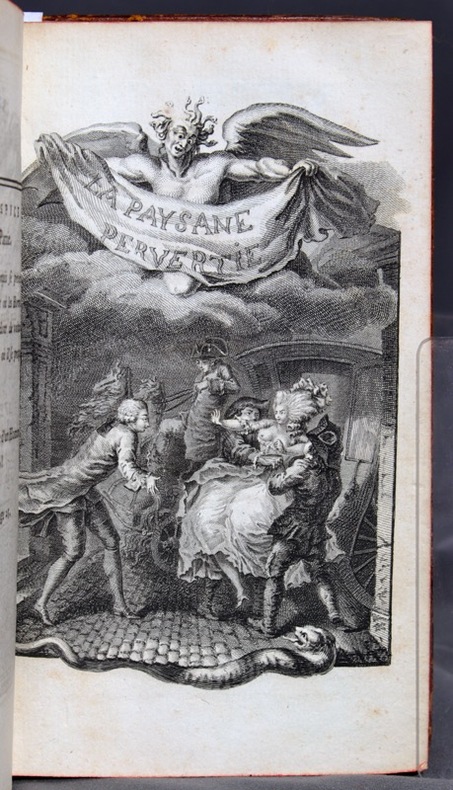
17859431Imprimé à La Haie, sans nom, 1784 /1785. 4 volumes in-12 de [2] pour l'Avis des libraires, 344; 320; 320; 344 - [72] pages chiffrées de clxix à ccxliv pour la revue des ouvrages de l'auteur- [12] pour le catalogue des ouvrages du même auteur, plein veau marbré, dos à nerfs ornés de filets et fleurons dorés, pièces de titre et tomaison beiges, tranches rouges, coins et mors frottés, deux feuillets légèrement déboîtés. Reliure de l'époque.
19699041ADarmstadt, Melzer Verlag, 1969. 4°. 149 nn. teils farbige Doppelseiten mit zahlreichen, teils farbigen Illustrationen. Als Blockbuch gebunden in silberfarbenen Pappdeckeln mit blind geprägtem Titel.
198110742AReinbek, Rowohlt Verlag, rororo, 1967. Und Frankfurt, Fischer, 1981. Taschenbücher. 179 S. u. 369 S.
1890904336BG[Um 1890]?. Blattmaß: 39 x 29 cm. Plattenmaß: 24 x 17,5 cm.
19208008AUm 1920. Blattgröße: 15,5 x 13 cm. Radierung: 8,5 x 6,5 cm.