458 résultats
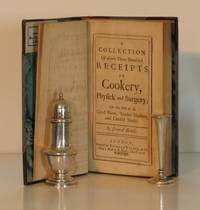
17147280London: For Richard Wilkin 1714. Octavo 19 x 12.5 cm. 16 218 13 pages. FIRST EDITION. "Mary Kettilby's collection of cookery recipes and medicinal and home remedies from a tasty "green-pease soop without meat" to gooseberry wine. Households that could not afford French cooks or French cooking came to form a growing audience for books by women that contained unpretentious recipes cut to suit a less costly cloth for pickling and collaring rather than ragouts. Where Hannah Woolley had led plenty of female cooks with their eye on the profitable middle market followed with books like Mary Kettilby's collection of recipes 1714 and Eliza Smith's Compleat Housewife 1734" Colquhoun Taste: The Story of Britain through its Cookery 2015. Kettilby's book purported to be a collective effort: the preface stating that 'a Number of very Curious and Delicate House-wives Club'd to furnish out this Collection'. Maclean however pages 79-82 doubts this and notes that evidence from later editions indicate Kettilby to be the main author. Apart from the Preface there is no introduction of any sort: the recipes follow immediately after the chapter headings. The book is clearly divided into chapters of recipes for food and for remedies but within the chapters there is no definite structure. For example the first chapter begins with six recipes for soups followed by recipes for collared beef 'French-Cutlets' collared mutton stewed pigeons broiled pigeons dressed turbot and then patties 'for a Dish of Fish'. The recipes are given either as goals as 'To make Hogs-Puddings' or as titles sometimes with descriptions as 'A very good Tansy'. Quantities are given in whichever units are convenient as 'a Gallon of grated Bread' 'three Pounds of Currants' or 'nine Eggs'. Often quantities rely on the cook's judgment as 'as much Sugar as will make it very sweet'. Temperatures and timings are given when necessary as 'a cool Oven: Half an Hour bakes it'. Later binding in 19th century style. Half-calf gilt-decorated spine marbled endpapers. The front paste-down contains the bookplates of two significant culinary collections: Thomas Scruggs & Margaret Cook and Marian Hatch. The Hatch bookplate was designed and engraved by British engraver Alfred J. Downey. With the bookseller's ticket of Philip C. Duschnes to the rear pastedown. Ink ownership mark to half-title "1718 Eliseab; and inscription on final page of text "illeg. near New College Oxford". OCLC locates eighteen copies; Bitting page 258; Cagle 789; Maclean pages 79-82; Oxford page 54; Wellcome II page 389. For Richard Wilkin hardcover books
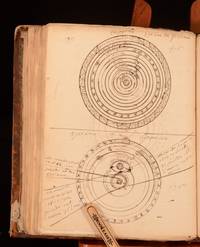
1780EXP2-F-7Anon: Anon c1780. Leather. Good. 9" by 7". Anon. A unique handwritten volume covering predominantly Astronomy and the Use of Globes. Handwritten in a neat and legible hand across 400 pages numbered 1-90 and 1-300. Occasionally with blank page breaks but continuous numbering. An interesting specimen this volume contains exercises diagrams and notes on science geography and astronomy. Primarily focusing on the Use of Globes it contains four diagrams of celestial movements and pages of charts and lists relating to the planets and stars. Written in French with one passage in English describing the fixed stars of the Lion's Tale and Virgin's Spike. The first 90 pages are concerned with broader geography and written in a question and answer style. The second section contains explanations on the use of Globes both terrestrial and celestial and the information that can be gleaned from a practical application of this knowledge. Similar in style to 'Introduction to the Use of Globes' by W Field the text follows an instructive pattern whereby the information is transcribed and then applied to a series of problems. The author seems to have been working through Thomas Hood's 'The Use of both the Globes Celestial and Terrestrial' and making a practical collection of notes for personal or educational use. One section is titled 'Responses aux Questions de ''appendix qui est a la suite de l'introduction a l'usage des Globes par mr Molineux' that is 'responses to questions in the appendix to the introduction of the use of Globes by Molyneux'. Emery Molyneux was an English Elizabethan maker of Globes and his terrestrial and celestial globes were the first to be made in England. Though Molyneux published his own treatise on Globes entitled 'The Globes Celestial and Terrestrial Set Forth in Plano' it has now been lost. In the same year Thomas Hood published 'The Use of Both the Globes' which referenced Molyneux's works. Because of this we believe it is Hood's work to which the author of this manuscript is referring. The work has been dated based on the predictions of celestial movements made in the text up to the year 1800. In a full mottled calf binding wiith gilt detailing. Externally worn with loss to leather at extremities and spine. Worn spine label reading 'usage de globes'. Front pastedown with ridge as quirk of binding. Marbled endpapers and pastedowns. Personal label to front pastedown. Internally generally firmly bound. Approx 100 smaller pages bound in to front and 304 full sized pages follwoing 300 numbered. 2 pages loosening to rear block. Pages bright generally clean with marginal age toning and handling marks. Occasional scattered spots. Creasing to foredge. Good Anon hardcover
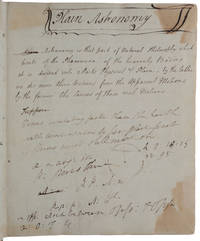
17805309N.p.: N.p. 1780. <p>A fascinating manual of astronomy particularly as it relates to the form of the motions of the heavens. The manuscript is in three parts: the first part covers the elementary parts of 'spherical astronomy' the second and third parts are more advanced covering sections of the Principia dealing with lunar theory and the inverse-square law of attraction. </p>. EIGHTEENTH-CENTURY MANUSCRIPT NOTEBOOK ON ASTRONOMY. <p>A fascinating manual of astronomy particularly as it relates to the form of the motions of the heavens dating from the period 1780-1825 probably from the beginning of that range. It is in a single hand with the exception of one page though with some variations indicating that different parts of the MS were written at different times. The MS could have been prepared for personal use or as part of public tuition probably the former. The writer summarizes the subject matter of the manual on the first leaf: 'Astronomy is that part of Natural Philosophy which treats of the Phenomena of the heavenly Bodies. It is divided into 2 Parts Physical and Plain: by the latter we discover their Motions from the Apparent Motions; by the former the Causes of these real Motions.' The MS is in three parts which are distinct in terms of subject matter. The first part covers the motion of the Earth around the Sun and its rotation about its axis with the consequences for the apparent motions of the Sun and the heavens; with the Moon and its phases and motion; and with lunar and solar eclipses. There are several references to John Keill's An Introduction to the True Astronomy London 1721 and subsequent editions. The second part principally consists of a discussion of section 11 of Newton's Principia 1713 or later editions in particular as it relates to the motion of the moon. This part ends with a short section on algebra particularly polynomials which seems to have been composed more haphazardly than the remainder of the text. The third part which runs backwards starting from the end of the notebook gives demonstrations of various results in Book I of Principia notably the theorem that the orbits of the bodies in the solar system do not precess if and only if the central attractive force operating on them is exactly inverse-square. This is an important result not only for Newton's system of universal gravitation but also for the observational astronomy of the solar system which is discussed in the opening section of the book. Between the end of the second part and that of the third there are a few blank leaves and others have been torn out but the text appears complete.</p> <br /> <p>The MS appears to be a working through of at least two different texts beginning with Keill's on astronomy. The first part of the MS refers particularly to the material in chapters 7-14 of Keill. It begins with the geometry of the sphere of the Earth and its orbit great circles and poles the plane of the ecliptic equinoctial points and the Tropics of Cancer and Capricorn. Then comes a section on the different systems of the world Ptolemaic Tychonic and Copernican illustrated by a diagram. The arguments supporting each system are given including the aberration of the fixed stars discovered by James Bradley in 1729 which supports Copernicus. It is noted that the Sun's apparent diameter varies according to the time of year which is explained by the fact that the Earth's distance from the Sun is not constant. Kepler's laws are stated with a long discussion of the area law and a statement that the Earth's orbit is an ellipse. The consequences of the fact that the plane of the Earth's orbit is inclined at an angle to the plane of the ecliptic are discussed the seasons. There is a section devoted to the precession of the equinoxes - the author notes that "Sir Isaac Newton has demonstrated that it arises from the broad spheroidal figure of the Earth." The author then turns to sunspots and the arguments for and against their being on the surface of the Sun. Then comes a long discussion of the planets: the planes and periods of their orbits phases conjunctions retrograde motions apparent brightness and their distances from the Sun. Special attention is given to the phases of Venus the varying appearances of Mars and Saturn's rings. This is followed by an extensive discussion of the Moon: its phases and motion and the fact that the same face is always turned to the Earth which implies that the Moon turns on its axis in the same time as it takes to orbit the Earth. This first part concludes with a fairly detailed account of lunar and solar eclipses.</p> <br /> <p>The second and third parts are notably more mathematical in nature than the first. The second works through Section 11 Prop. 66 of Principia and its corollaries which presents the perturbations of a remote body on a two-body system such as the Sun on the Earth-Moon system. This is one of the most difficult parts of Principia and one with which Newton was never completely happy and which is not entirely correct. The language used by the author of the notebook is reminiscent of the Principia but is primarily directed at following through Newton's working. There is a reference to a numbered figure '80' which does not appear to be numbered in any edition of the Principia. But it seems likely that the language and form of this discussion derives from familiarity with Robert Thorp's edition of Book 1 of the Principia 1777; cf. the notes published in Latin in 1765: pp. 266-90 in 1777 although Thorp is not referenced explicitly as Keill is. Thorp does have a figure 80 but it is not clear that he is the author being used at that particular point. There is then a discussion of algebra and the solution of equations which is fragmentary and incomplete followed by a number of blank and torn-out pages.</p> <br /> <p>The third part of the manuscript consists of a reading of various sections of Newton's Principia 1713 or later editions. Again it appears to take the form of working through and in some cases repeating the proofs of Newton's work rather than representing a translation or paraphrase. It is not based on Motte's translation nor does it correspond with the partial translation and edition of Thorp. It does not appear to be based on any other intermediary between Newton and the writer e.g. Pemberton but to rely on Newton's Latin original here rendered in places pretty exactly into English. It renders propositions 43 to 59 of section 9 of book 1 of the Principia which concern the motion of bodies in moveable orbits and the motion of the apsides. This is a topic which is still of some considerable interest to astronomers and historians of astronomy. Here Newton introduces what has come to be called Newton's 'rotating ellipse proposition' in which a rotating or precessing ellipse is described by a body for which the central force includes a term proportional to the cube of the distance from the focus; this rotating ellipse is compared with a similar stationary ellipse in which another similar body rotates about the same centre of force. Careful analysis leads to expressions for the extra inverse cube force depending on the number of upper and lower apses found in the moving ellipse. This part of the notebook includes the demonstration of the important proposition that the extra inverse cube force is absent i.e. the central force is exactly inverse-square if and only if the orbits of the bodies in the solar system do not precess.</p> <br /> <p>From the hand which seems constant throughout the book although with some considerable variation which might indicate a second writer or more likely the same writer at a different time or with a different pen and the paper we can with some confidence date the notebook to the period 1750-1825. If our supposition that it was Thorp's edition of Principia which was being used we might be able to narrow its date down to 1780-1825. The section of the planets in the first part does not mention Uranus Georgium sidus discovered by William Herschel in 1781 which appears to place this as an upper bound. This would therefore suggest a composition date in the late 1770s.</p> <br /> <p>We are indebted to Scott Mandelbrote for his assistance with the description of this notebook.</p> <br/> <br/> 4to 196 x 162 mm manuscript in ink on Dutch paper with Maid of Dort watermark without countermark. 101 and 26 leaves of text and diagrams 39 blank leaves in the middle last 26 leaves reversed illustrated with several astronomical and mathematical diagrams including one of a solar system. Late 18th century half calf marbled sides. N.p. unknown
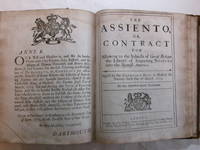
1713148771London : John Baskett 1713. 1st Edition . Hardcover. Good/No Jacket Issued. 4to - over 9¾ - 12" tall. FIVE WORKS IN ONE VOLUME original full leather hardcover with initials in gilt to front and rear cover Assiento double column Spanish and English privilege leaf 2 1-48pp some old staining to upper margins pages browned last page more so otherwise very good and complete. Treaty of Peace and Friendship84pp tear to margins of title page and first page without loss of text pages browned otherwise very good. Treaty of Navigation and Commerce 115pp pages browned otherwise very good.Treaty of Peace and Friendship Between The Most Serene and Most Potent Princess Anne and Most Potent Prince Philip the VTH.115 pppages browned otherwise very good. The Treatise of Peace and Commerce 40pp pages browned otherwise very good. Unusual illuminated inscription to flyleaf COVERS DETACHED In need of rebinding. WE CAN ONLY SHIP THIS ITEM WITHIN THE UNITED KINGDOM. We are a real bookshop with real books situated in and shipping from the United Kingdom. <br/> <br/> John Baskett hardcover
1799641Venice: Appresso Giovanni di Antonio Zatta librajo all'insegna of Providence in Frezzaria 1799. Very Good. Bookplate of prior owner and also a signature of another owner on inside front cover. VERY GOOD condition wear to corners and edges some soiling. VERY RARE collection of political caricatures with French and Italian language. Appresso Giovanni di Antonio Zatta librajo all'insegna of Providence in Frezzaria unknown
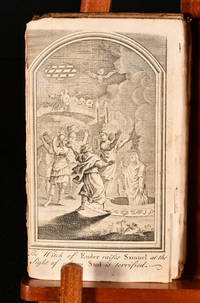
1772678L3Berwick: R Taylor c1772. First edition. Leather. Good Only. 7" by 4". Not Stated. A vanishingly scarce first edition of this occult work discussing first-hand accounts of witches ghosts and seers. Undated the ESTC reference T60882 speculates a publication date of 1775. However the front endpaper of this copy has a contemporary ownership inscription dated 1772. The prior owner's inscription is in neat copperplate and states a riddle that spells the name William. William Workman the prior owner has his stamp to the front endpaper and his monograph initials. 20th century inscription 'Geoffrey S Glover 1940' to the front free endpaper. With an engraved frontispiece. With the signatures: a6 A-L12 A very scarce work which is a collection of first-hand accounts of witches ghost encounters and tales of seers. These include an account of Rebecca Jones a witch an apparition to King James IV and his couriers the discovery of murder by an apparition and an account of a magician at Antwerp. There is also an eighteenth century account of the Pied Piper of Hamelin under the title of 'A marvellous prank played by the Devil at Hemelen a town in Germany'. In addition there is a short biography of John Faustus or Johann Faust the German magician and alchemist during the Renaissance. A fascinating collection of occult accounts. Published after the final execution for witchcraft in Britain and the implementation of the Witchcraft Act of 1735. Extremely scarce and in a bright condition. In a contemporary calf binding. Externally heavily rubbed to the spine and to the boards. Small loss to the head and tail of spine. Front board is detached but present. Rear hinge and joint are tender. Front endpapers and frontispiece are detached but present. Otherwise this work is generally firmly bound. Bottom outer corners of E2 and E3 have been removed by a prior owner only affecting the margin. Pages are generally bright. Occasional scattered spots to pages. Good Only R Taylor hardcover
176876335Annual Register. 1768. Hardcover. Very Good. Volumes 11 - 107 1768 to 1865 An unbroken run including Index for 1758-1819 98 books 2 sm lib stamps to prelims bound in contemporary uniform calf binding except vol 14 gilt cover edges spines with raised bands gilt motifs leather spine labels. A few hinges sl tender otherwise a lovley run in nice bright condition. ; Octavo . Annual Register hardcover
1720135019Leipzig: in der Missisippischen Staats-Druckerey 1720. John Law and the Mississippi Company Rare first edition of this anonymous account of the State of France under Louis XIV and under the Regent who "under the clever guidance of Mr. Law has to the amazement of all fortunately improved it" our translation. Dedicated to "Mons. Law" who "der Welt bey anderthalb Jahren so viel zu reden gemacht hat" the stubbornly anonymous author he signs himself so gives an account of the rise and decline of France under Louis XIV the state of France following his death its subsequent recovery under the Prince Regent and an account of Law's activities and Mississippi Company. Bound after this work is a copy of the life of Cardinal Giulio Alberoni prime minister of Anjou a German translation apparently from the Italian published in 1718. The work is attributed in WorldCat to Jean Rousset de Missy. Octavo 163 x 100 mm. With engraved portrait frontispiece of John Law. Bound with another work in contemporary speckled paste paper boards paper spine label lettered in manuscript. Housed in a dark brown flat-back cloth box by the Chelsea Bindery. Spine ends joints and corners rubbed with some flaking of sprinkled paper coverning paper stock lightly browned with occasional spotting; a very good copy. Alden 720/58; Goldsmiths' 5608; Kress 3185; Sabin 39308. hardcover