[ANON]Biblio.com
6 956 résultats
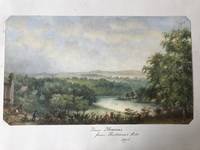
187629631876. Lovely original watercolour painting of the view across the River Swale in North Yorkshire from Richmond Castle Hill - with a couple in the foreground. The painting is signed but we cannot agree and the signature. At some point a previous owner was told it was a painting of the river at Richmond Castle and assumed it was Richmond in Surrey when in fact Richmond Castle is in Richmond in Yorkshire and looks over the River Swale not the Thames! Tipped on to white card corners cut to resemble being in an album. Watercolour measures: 205 x 350 mm 8 x 13¾ inches. Whole on backing: 400 x 495 mm unknown
1843222806Providence RI Geo. P. Daniels 1843. 1843. 12mo. Illustrated with drawings. 24 pages; stitched. Publisher’s advertisements on back cover. Original pictorial tan wrappers. Very good light soiling. No signatures or bookplates. Soft cover. Providence, RI, Geo. P. Daniels, 1843. paperback
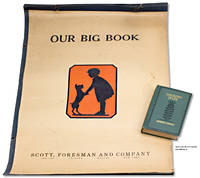
3731978<p>Chicago Atlanta Dallas and New York: Scott Foresman and Company ca. 1920s–1930s. 2 39 1 pp. Bound by two large rings along top. One sheet with small crayoned area all cloth reinforcement strips very rubbed; scattered stains and toning; overall very good.</p> <p>Rare. Our Big Book is catalogued by Princeton as a Dick and Jane precursor; a series of wall charts issued ca. 1920. The stories are displayed in strong colors across twenty-one large sheets each 30 x 22 inches. They feature the soon-to-be ubiquitous Dick and Jane Baby Spot and Little Mew later Puff.</p> <p>The Dick and Jane primers had a landmark impact upon the millions of children that were taught to read by using the look-and-say method. In the classroom setting Our Big Book would have educated that very first wave of American children to “See Spot run†and to learn a host of other catchphrases —phrases now engrained burned into the subconscious minds of literate Americans everywhere.</p> <p>Outside of Princeton’s copy we find only one other example in the Osborne Collection. They date the text to the 1930s. Not to be confused with much later common and smaller Dick and Jane charts/posters.</p> unknown
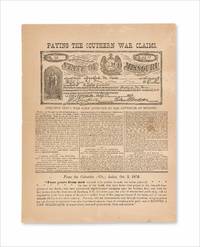
3734344<p>America. np.1876. 12¼ by 9½ inches. Tanning; minor staining and margin wear; very good.</p> <p>This rare anonymous broadside from 1876 attacks Governor Samuel J. Tilden the Democratic Party’s presidential candidate by citing excerpts from Southern newspapers in Alabama Georgia and Virginia.</p> <p>Popular argument at the time stated if the Democrats should come into power that they would spend two billion dollars in Southern war claims which would ruin the credit of the United States abroad. </p> <p>Northern voters would likely be outraged by the broadside’s illustration which shows a Missouri governor’s scrip for thirty-five dollars payable to one Woodford M. Paris for losses attributed to “the cotton tax damages to land and property during the war the emancipation of slaves†among other claims.</p> <p>The 1876 presidential election was highly contentious. Although Tilden won the popular vote he ultimately lost to Rutherford B. Hayes in the electoral college. The Hayes-Tilden Compromise led to the removal of federal troops from the South diminishing the hopes of African Americans in their struggle for civil rights and equality. The Reconstruction Era came to a close.</p> unknown
1846957511846. David Bogue London. 1846. Bound in half tan calf raised bands to spine marbled boards. All page edges marbled marbled end-papers. Frontis. xii 275 pages. Exterior sl. rubbed esp. extremities upper hinge split for 2 cm from head but sound; spine lacks title-piece. Inscriptions to front end-papers. hardcover
18205661Paris: Librairie d'eÌducation de Pierre Blanchard 1820. Second edtion. Educational work encouraging children of the time to be curious about how things they use every day are made. Illustrated with six pages of copper engravings including frontispiece. The engravings apart from frontis are presented as four engravings per page and show artisans at work - printer at a press winegrower labourer etc. Contemporary full leather binding. Spine with faded gilt and a red label with gilt title. Mildly rubbed boards. Marbled endpapers. Very clean and fresh inside. 238 pages with a four page catalogue of other works from Librairie de Pierre Blanchard bound before the title page. 170 x 100 mm 6¾ x 4 inches. . Deuxième édition. Ouvrage pédagogique visant à éveiller la curiosité des enfants de l'époque quant à la fabrication des objets qu'ils utilisent au quotidien. Illustré de six pages de gravures sur cuivre frontispice compris. Les gravures à l'exception du frontispice sont présentées à raison de quatre par page et représentent des artisans au travail : imprimeur à la presse vigneron ouvrier etc. Reliure d'époque en cuir pleine peau. Dos avec dorures estompées et étiquette rouge avec titre doré. Couverture légèrement frottée. Pages de garde marbrées. Intérieur très propre et frais. 238 pages avec un catalogue de quatre pages d'autres ouvrages de la Librairie de Pierre Blanchard relié avant la page de titre. 170 x 100 mm Librairie d'eÌducation de Pierre Blanchard hardcover
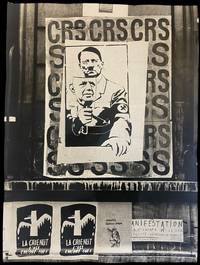
19684701Paris: NP 1968. A large 40 cm x 29.5cm black and white silver print / silver gelatin photograph of a Paris wall in May 1968. The photograph shows a poster of Hitler hiding behind a mask of Charles de Gaulle. He is wearing the Cross of Lorraine as his armband. The Free French forces in world war 2 under de Gaulle had used this symbol. This is pinned over a background which states "CRS SS" multiple times. The CRS compagnies républicaines de sécurité was the National Reserve Force to deal with strikes and demonstrations. In fact this slogan dates back to 1948 when the CRS was first formed. The wall also shows a hand written sign for a manifestation in the evening of the 19th at St Lazare. Public demonstrations were often and are still often held in the space in front of the St Lazare station. This is almost certainly a large print of a reportage / press photograph of the time. In red ink to the reverse is written "68." The central poster was used in the 1968 student riots and although we have been unable to trace this photograph there is an "internet ghost" of it which states it was taken in May 1968. Condition is excellent with no significant marks or dirt to it. . Grande photographie argentique noir et blanc 40 cm x 295 cm d'un mur de Paris en mai 1968. La photographie montre une affiche d'Hitler cachée derrière un masque de Charles de Gaulle qui porte la Croix de Lorraine en guise de brassard. Ce dernier porte la Croix de Lorraine en guise de brassard les forces françaises libres de la Seconde Guerre mondiale sous la direction de de Gaulle avaient utilisé ce symbole. Le tout est épinglé sur un fond où l'on peut lire plusieurs fois « CRS SS ». Les CRS compagnies républicaines de sécurité étaient la force de réserve nationale chargée de gérer les grèves et les manifestations. En fait ce slogan remonte à 1948 date de la création des CRS. Le mur montre également une pancarte écrite à la main pour une manifestation dans la soirée du 19 à St Lazare. Les manifestations publiques étaient souvent et sont encore souvent organisées dans l'espace devant la gare St Lazare. Il s'agit très certainement d'un grand tirage d'un reportage ou d'une photographie de presse de l'époque. Au verso on peut lire « 68 » à l'encre rouge. L'affiche centrale a été utilisée lors des émeutes étudiantes de 1968 et bien que nous n'ayons pas été en mesure de retrouver cette photographie il existe un « fantôme internet » de celle-ci qui indique qu'elle a été prise en mai 1968. L'état de l'affiche est excellent elle ne présente aucune marque ou salissure significative. NP unknown
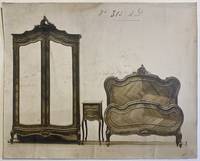
18805134Paris: NP C1880. An attractive photograph of three pieces of Rococo furniture. Numbered by hand #385 N.D. There is no indication what this means it could be a furniture seller's reference or a photo library archive. We suspect the former the temptation to assume that N.D. is no date should be resisted as in French this would be S.D. The photograph has some light creasing and marking to it. The furniture set in the image is in the French Louis XV Rococo style characterized by its ornate carvings cabriole legs and shell motifs all hallmarks of mid-18th-century French decorative arts. 24cm x 29cm. . Une belle photographie de trois meubles rococo. Numérotée à la main #385 N.D. Il n'y a pas d'indication sur ce que cela signifie il pourrait s'agir d'une référence d'un vendeur de meubles ou d'une archive d'une photothèque. Nous pensons qu'il s'agit de la première hypothèse il faut résister à la tentation de supposer que N.D. est sans date car en français il s'agirait de S.D. La photographie présente quelques plis et marques légères. L'ensemble de meubles figurant sur l'image est de style Louis XV rococo caractérisé par des sculptures ornementales des pieds cabriole et des motifs de coquilles autant de caractéristiques des arts décoratifs français du milieu du XVIIIe siècle. 24cm x 29cm. NP unknown
18805438France: S.P. C1880. First edition. An attractive original albumen photograph of the château de Chenonceau. Good clean attractive print. Laid onto a grey paper background with title to the bottom edge. The grey paper has a little nicking and chipping to the edges. The print is in excellent condition. The photograph is 25cm x 36.5cm. The sheet is 30cm x 41.5cm. The Château de Chenonceau often called the "Ladies' Château" is a stunning 16th-century Renaissance masterpiece in France's Loire Valley uniquely spanning the River Cher on a bridge-like structure. Built primarily between 1514 and 1522 by Thomas Bohier and his wife Catherine Briçonnet it replaced an earlier medieval fortress. It is called the Ladies Château as successive women shaped its legacy including Diane de Poitiers who added the river-spanning bridge 1556–1559 and created extensive gardens and Catherine de Médicis who built the grand gallery 1570–1576. . Première édition. Une jolie photographie originale au papier albuminé du château de Chenonceau. Bon tirage net et attrayant. Collée sur un fond en papier gris avec le titre en bas. Le papier gris présente quelques petites entailles et éraflures sur les bords. Le tirage est en excellent état. La photographie mesure 25 cm x 365 cm. La feuille mesure 30 cm x 415 cm. Le château de Chenonceau souvent appelé le « château des dames » est un magnifique chef-d'œuvre de la Renaissance du XVIe siècle situé dans la vallée de la Loire en France qui enjambe de manière unique le Cher sur une structure en forme de pont. Construit principalement entre 1514 et 1522 par Thomas Bohier et son épouse Catherine Briçonnet il a remplacé une ancienne forteresse médiévale. Il est appelé le château des dames car ce sont des femmes qui ont façonné son héritage notamment Diane de Poitiers qui a ajouté le pont enjambant la rivière 1556-1559 et créé de vastes jardins et Catherine de Médicis qui a construit la grande galerie 1570-1576. S.P. unknown
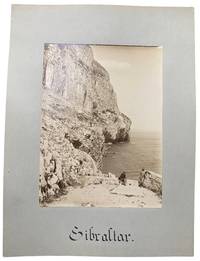
18803726Gibraltar: NA 1880. An attractive photograph of two gentleman posing for a photograph at the base of the rock of Gibraltar at a point to the South East called Europa Advance Road by an unknown photographer. Circa 1880-1890. Pasted onto a stiff grey mounting card with title written in calligraphy. The photograph is in good condition with tiny imperfections only. The mounting card is in good clean condition. Dating from this period it is difficult to distinguish between and albumen print and an early silver gelatin card mounted photograph. We lean towards the latter. Photograph size is 210mm x 155mm. The mount size is 33omm x 245mm . Jolie photographie de deux hommes posant pour une photo à la base du rocher de Gibraltar à un point au sud-est appelé Europa Advance Road par un photographe inconnu. Vers 1880-1890. Collée sur une carte de montage rigide de couleur grise avec le titre écrit en calligraphie. La photographie est en bon état avec seulement de petites imperfections. La carte de montage est en bon état de propreté. Datant de cette période il est difficile de faire la distinction entre un tirage à l'albumine et une photographie montée sur carte à la gélatine argentique. Nous penchons pour cette dernière. Les dimensions de la photographie sont de 210 mm x 155 mm. Le format du montage est de 33 mm x 245 mm. NA unknown
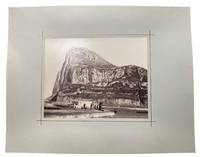
18803725Gibraltar: NA 1880. An attractive photograph of the rock of Gibraltar by an unknown photographer. Circa 1880-1890. Pasted onto a stiff grey mounting card with gilt border. The photograph is in good condition with a slight marking to the top left corner of the sky. The mounting card is in good clean condition. Dating from this period it is difficult to distinguish between and albumen print and an early silver gelatin card mounted photograph. We lean towards the latter. Photograph size is 160mm x 205mm. The mount size is 290mm x 370mm. NA unknown
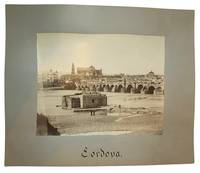
18803744Cordoba Spain: NA 1880. An attractive photograph of the river Guadalqivir and the Roman Bridge in Cordoba with the Molino de St Antonio in the foreground. By an unknown photographer. Circa 1880-1890. Pasted onto a stiff grey mounting card with calligraphic title beneath Spelt Cordova. The photograph is in good condition with a slight fading to the left edge. The mounting card is in good clean condition. Dating from this period it is difficult to distinguish between and albumen print and an early silver gelatin card mounted photograph. We lean towards the latter. Photograph size is 220mm x 275mm. The mount size is 345mm x 410mm . Jolie photographie du fleuve Guadalqivir et du pont romain de Cordoue avec le Molino de St Antonio au premier plan. Par un photographe inconnu. Vers 1880-1890. Collée sur une carte de montage rigide de couleur grise avec le titre calligraphié en dessous orthographié Cordova. La photographie est en bon état avec une légère décoloration sur le bord gauche. La carte de montage est en bon état de propreté. Datant de cette période il est difficile de faire la distinction entre un tirage à l'albumine et une photographie montée sur carte à la gélatine argentique. Nous penchons pour cette dernière. La taille de la photographie est de 220 mm x 275 mm. Le format du montage est de 345 mm x 410 mm. NA unknown
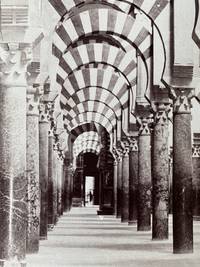
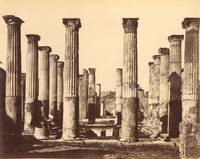
18803768Cordoba Spain: NA 1880. An attractive photograph of the pillars inside the Mezquita de Córdoba The mosque. By an unknown photographer. Circa 1880-1890. Pasted onto a stiff grey mounting card with calligraphic title beneath "Del inre af Kathedralen i Cordova". It bears the number 8 in the negative so may be a tourist photograph. The photograph is in good condition with a couple of small nicks to the edges. The mounting card is in good clean condition. Dating from this period it is difficult to distinguish between and albumen print and an early silver gelatin card mounted photograph. We lean towards the latter. Photograph size is 220mm x 280mm. The mount size is 345mm x 410mm. NA unknown
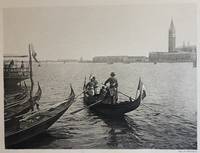
18964248Paris : Ch. Wittmann 1896. Lovely example of a photogravure showing gondolas on the Grand Canal and San Giorgio Island in distance Venice. B/ w image size: 150 x 200 mm 6 x 7¾ inches. Full item including border: 250 x 330 mm. Very clean and fresh. Perfect for framing. Blank to verso. . Bel exemple de photogravure montrant des gondoles sur le Grand Canal et l'île de San Giorgio au loin Venise. Taille de l'image en noir et blanc : 150 x 200 mm 6 x 7¾ inches. Image complète y compris la bordure : 250 x 330 mm. Très propre et frais. Parfait pour l'encadrement. Le verso est vierge. Ch. Wittmann unknown
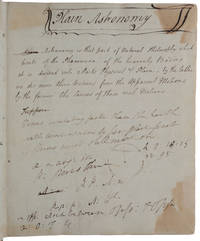
17805309N.p.: N.p. 1780. <p>A fascinating manual of astronomy particularly as it relates to the form of the motions of the heavens. The manuscript is in three parts: the first part covers the elementary parts of 'spherical astronomy' the second and third parts are more advanced covering sections of the Principia dealing with lunar theory and the inverse-square law of attraction. </p>. EIGHTEENTH-CENTURY MANUSCRIPT NOTEBOOK ON ASTRONOMY. <p>A fascinating manual of astronomy particularly as it relates to the form of the motions of the heavens dating from the period 1780-1825 probably from the beginning of that range. It is in a single hand with the exception of one page though with some variations indicating that different parts of the MS were written at different times. The MS could have been prepared for personal use or as part of public tuition probably the former. The writer summarizes the subject matter of the manual on the first leaf: 'Astronomy is that part of Natural Philosophy which treats of the Phenomena of the heavenly Bodies. It is divided into 2 Parts Physical and Plain: by the latter we discover their Motions from the Apparent Motions; by the former the Causes of these real Motions.' The MS is in three parts which are distinct in terms of subject matter. The first part covers the motion of the Earth around the Sun and its rotation about its axis with the consequences for the apparent motions of the Sun and the heavens; with the Moon and its phases and motion; and with lunar and solar eclipses. There are several references to John Keill's An Introduction to the True Astronomy London 1721 and subsequent editions. The second part principally consists of a discussion of section 11 of Newton's Principia 1713 or later editions in particular as it relates to the motion of the moon. This part ends with a short section on algebra particularly polynomials which seems to have been composed more haphazardly than the remainder of the text. The third part which runs backwards starting from the end of the notebook gives demonstrations of various results in Book I of Principia notably the theorem that the orbits of the bodies in the solar system do not precess if and only if the central attractive force operating on them is exactly inverse-square. This is an important result not only for Newton's system of universal gravitation but also for the observational astronomy of the solar system which is discussed in the opening section of the book. Between the end of the second part and that of the third there are a few blank leaves and others have been torn out but the text appears complete.</p> <br /> <p>The MS appears to be a working through of at least two different texts beginning with Keill's on astronomy. The first part of the MS refers particularly to the material in chapters 7-14 of Keill. It begins with the geometry of the sphere of the Earth and its orbit great circles and poles the plane of the ecliptic equinoctial points and the Tropics of Cancer and Capricorn. Then comes a section on the different systems of the world Ptolemaic Tychonic and Copernican illustrated by a diagram. The arguments supporting each system are given including the aberration of the fixed stars discovered by James Bradley in 1729 which supports Copernicus. It is noted that the Sun's apparent diameter varies according to the time of year which is explained by the fact that the Earth's distance from the Sun is not constant. Kepler's laws are stated with a long discussion of the area law and a statement that the Earth's orbit is an ellipse. The consequences of the fact that the plane of the Earth's orbit is inclined at an angle to the plane of the ecliptic are discussed the seasons. There is a section devoted to the precession of the equinoxes - the author notes that "Sir Isaac Newton has demonstrated that it arises from the broad spheroidal figure of the Earth." The author then turns to sunspots and the arguments for and against their being on the surface of the Sun. Then comes a long discussion of the planets: the planes and periods of their orbits phases conjunctions retrograde motions apparent brightness and their distances from the Sun. Special attention is given to the phases of Venus the varying appearances of Mars and Saturn's rings. This is followed by an extensive discussion of the Moon: its phases and motion and the fact that the same face is always turned to the Earth which implies that the Moon turns on its axis in the same time as it takes to orbit the Earth. This first part concludes with a fairly detailed account of lunar and solar eclipses.</p> <br /> <p>The second and third parts are notably more mathematical in nature than the first. The second works through Section 11 Prop. 66 of Principia and its corollaries which presents the perturbations of a remote body on a two-body system such as the Sun on the Earth-Moon system. This is one of the most difficult parts of Principia and one with which Newton was never completely happy and which is not entirely correct. The language used by the author of the notebook is reminiscent of the Principia but is primarily directed at following through Newton's working. There is a reference to a numbered figure '80' which does not appear to be numbered in any edition of the Principia. But it seems likely that the language and form of this discussion derives from familiarity with Robert Thorp's edition of Book 1 of the Principia 1777; cf. the notes published in Latin in 1765: pp. 266-90 in 1777 although Thorp is not referenced explicitly as Keill is. Thorp does have a figure 80 but it is not clear that he is the author being used at that particular point. There is then a discussion of algebra and the solution of equations which is fragmentary and incomplete followed by a number of blank and torn-out pages.</p> <br /> <p>The third part of the manuscript consists of a reading of various sections of Newton's Principia 1713 or later editions. Again it appears to take the form of working through and in some cases repeating the proofs of Newton's work rather than representing a translation or paraphrase. It is not based on Motte's translation nor does it correspond with the partial translation and edition of Thorp. It does not appear to be based on any other intermediary between Newton and the writer e.g. Pemberton but to rely on Newton's Latin original here rendered in places pretty exactly into English. It renders propositions 43 to 59 of section 9 of book 1 of the Principia which concern the motion of bodies in moveable orbits and the motion of the apsides. This is a topic which is still of some considerable interest to astronomers and historians of astronomy. Here Newton introduces what has come to be called Newton's 'rotating ellipse proposition' in which a rotating or precessing ellipse is described by a body for which the central force includes a term proportional to the cube of the distance from the focus; this rotating ellipse is compared with a similar stationary ellipse in which another similar body rotates about the same centre of force. Careful analysis leads to expressions for the extra inverse cube force depending on the number of upper and lower apses found in the moving ellipse. This part of the notebook includes the demonstration of the important proposition that the extra inverse cube force is absent i.e. the central force is exactly inverse-square if and only if the orbits of the bodies in the solar system do not precess.</p> <br /> <p>From the hand which seems constant throughout the book although with some considerable variation which might indicate a second writer or more likely the same writer at a different time or with a different pen and the paper we can with some confidence date the notebook to the period 1750-1825. If our supposition that it was Thorp's edition of Principia which was being used we might be able to narrow its date down to 1780-1825. The section of the planets in the first part does not mention Uranus Georgium sidus discovered by William Herschel in 1781 which appears to place this as an upper bound. This would therefore suggest a composition date in the late 1770s.</p> <br /> <p>We are indebted to Scott Mandelbrote for his assistance with the description of this notebook.</p> <br/> <br/> 4to 196 x 162 mm manuscript in ink on Dutch paper with Maid of Dort watermark without countermark. 101 and 26 leaves of text and diagrams 39 blank leaves in the middle last 26 leaves reversed illustrated with several astronomical and mathematical diagrams including one of a solar system. Late 18th century half calf marbled sides. N.p. unknown
61506Naples 1889. . Albumen print. Very good rich tones and in fine condition. Photographer's title credit and number in negative; Dimensions: 190 x 240mm. 7.5 x 9.5 inches.<br /> <br /> Naples 1889. unknown
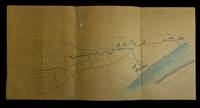
18534056Indre-Loire: Service Hydraulique 1853. A folding manuscript map / cadastral plan of the commune of Ports and the surrounding area. 8 pages folded and pasted together drawn to one side only. The first pate is the text / permissions and authorisations signed and dated with official stamp by individuals involved with the project. 4 different individuals have written comments and signed the plan. This seems to have been drawn up to accompany a cleaning / repair project for the roads and bridges of the area. Attractive hand coloured plan of the area with extra section added on paper see photos showing the whole of the commune of Ports including sections of the river Vienne. The plan is drawn on tracing paper / glassine pasted to stiff card. This is a little darkened but without significant flaws. Nice detailing and quality of work. Despite the title there are no bridges in this commune. 290 by 1820mm 11½ by 71¾ inches. . Plan manuscrit dépliant de la commune de Ports et de ses environs. 8 pages pliées et collées dessinées d'un seul côté. La première page est le texte / permissions et autorisations signées et datées avec cachet officiel par les personnes impliquées dans le projet. 4 personnes différentes ont écrit des commentaires et signé le plan. Ce plan semble avoir été établi pour accompagner un projet de nettoyage / réparation des routes et des ponts de la région. Joli plan de la région colorié à la main avec une section supplémentaire ajoutée sur papier voir photos montrant l'ensemble de la commune de Ports y compris des sections de la rivière Vienne. Le plan est dessiné sur du papier calque / glassine collé sur une carte rigide. Ce dernier est un peu assombri mais sans défauts significatifs. Les détails et la qualité du travail sont agréables. Malgré le titre il n'y a pas de pont dans cette commune. 290 par 1820mm Service Hydraulique unknown
61569. Silver Gelatin Print; Dimensions: 260 x 200mm. 10 x 8 inches.<br /> <br /> unknown
1854146631London: Religious Tract Society 1854. 1st edition. Very Good. 16mo. stiff wrappers 96pp. frontis. illusts. Very copy in rather worn blind-stamped linen boards. British Library System number: 002996007. Very scarce Religious Tract Society hardcover
18195561Paris: Langlume et Peltier 1819. A scarce early edition published by Langlume et Peltier. This is not the book but 12 of the plates plus engraved title with vignette. Gumuchian 4641 has the same uncoloured version of the plates as found here. Early Edition engraved with a small frontispiece and several engraved plates signed by Saint-Claude Claronne Saint-Denis Chareton Sarene Versailles etc. Included here is the illustration of the family eating dinner in the tree-tops of le Poirier sans pareil. This pear tree could apparently accommodate up to a dozen diners. Commonly said to be burned by Allied troops in 1814 evidence from an 1822 engraving of places to visit in Paris suggest that it survived longer. The plates are in decent condition with a little marking only. Nice examples of children's activities. Although this is not a complete copy the plates have been removed from WorldCat / OCLC: 460892067. . Une édition rare publiée par Langlume et Peltier. Il ne s'agit pas du livre mais de 12 planches plus un titre gravé avec vignette. Il manque donc une planche. Gumuchian 4641 présente la même version non colorée des planches que celle présentée ici. Édition ancienne gravée avec un petit frontispice et plusieurs planches gravées signées par Saint-Claude Claronne Saint-Denis Chareton Sarene Versailles etc. On y trouve l'illustration de la famille prenant son dîner dans les branches du Poirier sans pareil. Ce poirier pouvait apparemment accueillir jusqu'à une douzaine de convives. On dit généralement qu'il a été brûlé par les troupes alliées en 1814 mais une gravure de 1822 représentant les lieux à visiter à Paris suggère qu'il a survécu plus longtemps. Les planches sont en bon état avec seulement quelques marques. Belles illustrations des activités des enfants. Bien qu'il ne s'agisse pas d'un exemplaire complet les planches ont été retirées de WorldCat / OCLC : 460892067. Langlume et Peltier unknown
18674245New York : McLoughlin Bro's 1867. Small scarce ten page soft back book. Chromolithograph illustrations are well preserved and show colours vividly. Conforms to OCLC Number / Unique Identifier: 635881091. Circa 1867. Soft cover front illustration signed Cogger sc. to the bottom right. Perhaps Edward P. Cogger Sewn binding has been crudely renewed. Covers and pages handled and lightly soiled. Back cover - and last page - are same thing and have an area of loss plus creases / edgewear. 170 x 130 mm 6¾ x 5 inches. . McLoughlin Bro's paperback
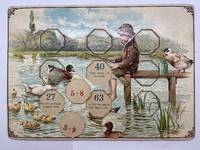
190033701900. Nice lithographed illustration of a boy fishing with his duck! Nine jigsaw cut outs hide numbers with mathematical solutions. To the back of the pieces are the questions. For example: 9 x 7 has the number 63 on the board. Excellent condition. Complete. 280 x 200 mm 11 x 7¾ inches. Jolie illustration lithographiée d'un garçon pêchant avec son canard! 9 découpes de puzzle cachaient des nombres avec des solutions mathématiques. Au dos des pièces se pose la question. Donc 9 x 7 porte le numéro 63 au tableau. Condition excellente. Complet. 280 x 200 mm. unknown
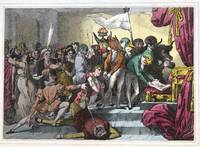
3068Paris: Lemercier / Martinet. Rare hand coloured lithograph - showing actors on a stage in masks and costumes. On a banner being held up it reads: Toujours du paté d'anguille. Perhaps this is a reference to Contes et Nouvelles de Jean de la Fontaine Blank verso. Corners a little creased. 260 x 315 mm 10¼ x 12½ inches. Rare lithographie coloriée à la main - montrant des acteurs sur une scène en masques et costumes. Sur une banderole brandie il est écrit : Toujours du paté d'anguille. Peut-être est-ce une référence aux Contes et Nouvelles de Jean de la Fontaine Verso vierge. Coins un peu froissés. 260 x 315 mm 10¼ x 12½ pouces. Lemercier / Martinet unknown
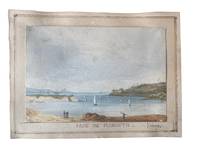
18293342Plymouth: n/a 1829. An attractive original watercolour of the beach and harbour at Plymouth with title and date of 1829. By unknown French artist. Mounted on white card somewhat darkened. The picture itself is in very good bright condition. Held in a later mid 20th century wooden frame. Watercolour is 13.5cm x 9cm Frame is 22cm x 18cm. Une jolie aquarelle française de la plage et du port de Plymouth avec titre et date de 1829. Montée sur carton blanc un peu assombri. L'image elle-même est en très bon état lumineux. Tenu dans un cadre en bois plus tard milieu du XXe siècle. L'aquarelle mesure 135 cm x 9 cm. Le cadre mesure 22 cm x 18 cm. n/a unknown
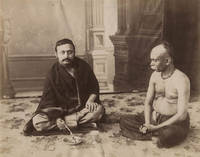
60246c.1880. . Albumen print. Good tonal range and in good condition ink title on verso. 3mm tear to top edge otherwise good rich print in good condition; Dimensions: 237 x 187mm.<br /> <br /> [c.1880]. unknown