AnonBiblio.com
6 953 résultats
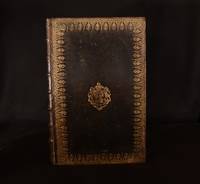
1617659L6Oxford: John Baskett 1716-1717. First edition. Fine Binding. Very Good. 21" by 14". None. A beautiful set of the famed 'Vinegar Bible' published by John Baskett of Oxford. Dibdin notes this Bible as 'the most magnificent' of the Oxford Bibles. A handsome edition with this set bound in a binding with George III's monogram to the boards. The first edition of the 'Vinegar Bible' which is known as such due to the erroneous 'The parable of the vinegar' instead of 'vineyard' above Luke XX the verso of G6 to the New Testament. This variant has the 1717 imprint to the Old Testament and the 1716 imprint to the New Testament. Printed by John Baskett who was the King's printer. Baskett held a reputation for purchasing competing Bible printing business and absorbing them into his own. He wished to produce a high quality Bible in a folio edition that would become a presentation piece used in churches and aristocrats. This Bible was therefore produced. A scarce edition of The Bible which holds important stature in the history of print and in the bibliography of The Bible. Particularly scarce in this contemporary Royal binding which is possibly a presentation binding produced for this work. This edition has the red-ruling throughout both volumes. The 'Vinegar Bible' is noted for its beautiful head and tail pieces throughout. Harry Carter in 'The History of the Oxford University Press' notes that 'only Baskerville's Bible is its equal among English Bibles for beauty of type impression and paper' Carter p.171. This copy has been skillfully rebacked to both volumes with the original spines laid down and boards preserved. With a Sotheran stamp to the verso of front endpaper. With the vignette title page depicting the Clarendon Building to the Old Testament. To the New Testament there is a vignette title page depicting the Annunciation. Sumptuously illustrated throughout with head and tail pieces in addition to engraved ornamental letters. With the signatures: 1 a-b2 c1 2 A-4P6 4Q3; 1 A-X6 Y4 Collated without additional engraved title page. Blank 4Q4 to the Old Testament and Apocrypha is not present. Gathering is bound after c1 rather than preceding a-b2 as it is found in the ESTC signatures. Another nickname for this edition was 'A Baskett-ful of Errors' due to the numerous misprints Herbert 942; Darlow & Moule 735. A very smart copy of this work in an important contemporary binding. In uniform contemporary black morocco bindings with the monogram of George III to the front boards. 'GR' Monogram to the spines. Rebacked with the original spines laid down and boards preserved. Externally generally smart. Light marks to boards and minor fading to the gilt. Internally both volumes are firmly bound. Small loss to the dedication leaf from chipping with repairs to the dedication leaf at the gutter. Minor chips to first few leaves to the Old Testament at the extremities. Tiny worm holes to 1 of Old Testament. Occasional tape repairs to the margins of leaves to both volumes noticeably to the bottom margin of E1 to the outer margin of E5 and to 2L3 which affects the occasional word to the left hand column. R6 has slight creasing and some minor closed tears to the gutter not affecting text. Small loss to the bottom margin of 2B2. Small loss to the extremities of 4C2. 'New Testament' also has repairs to the bottom margin several leaves including the title page C5 & 6 N2 and T2. To H3 there is a repair to a closed tear at the bottom of the page not affecting the text. Tape repairs to the text of K4 to the New Testament obscuring the occasional word. Pages are unusually bright. The majority of leaves to this work are clean however 4F2 and 4F5 to the Old Testament are spotted. Very Good John Baskett unknown
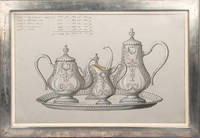
89944South Germany late 19th century. . 9 watercolours each framed and glazed overall size: 440 x 633mm 17¼ x 25 inches.<br /> Attractive collection of unusual drawings for silverware items most probably made by the prestigious WMF factory. Württembergische Metallwarenfabrik better known as the WMF factory has been a tableware manufacturer since 1853. By 1900 the firm had become the world's first producer and exporter of metallic products mainly inspired by the style of Jugendstil and Art nouveau. Their 3-letter logo has since been associated with refined silverware and premium cutlery.<br /><br />These charming watercolours include drawings of champagne flutes trays teapots gravy boats plates coffee pots and sugar bowls. All the drawings use a base of various shades of black white and grey to represent the bulk of the piece. The smaller details are vividly coloured such as the gilt tint of the inner parts the light blue reflection of crystal the brown of teapot handles and the pink green and yellow of the refined and lively motives covering one of the tea sets. Each has a caption written in German giving a description of the item including its weight and series number. All of the pieces are adorned with beautiful motives representing flowers curved lines laurels and ancient patterns.<br /> [South Germany, late 19th century]. unknown
1720135019Leipzig: in der Missisippischen Staats-Druckerey 1720. John Law and the Mississippi Company Rare first edition of this anonymous account of the State of France under Louis XIV and under the Regent who "under the clever guidance of Mr. Law has to the amazement of all fortunately improved it" our translation. Dedicated to "Mons. Law" who "der Welt bey anderthalb Jahren so viel zu reden gemacht hat" the stubbornly anonymous author he signs himself so gives an account of the rise and decline of France under Louis XIV the state of France following his death its subsequent recovery under the Prince Regent and an account of Law's activities and Mississippi Company. Bound after this work is a copy of the life of Cardinal Giulio Alberoni prime minister of Anjou a German translation apparently from the Italian published in 1718. The work is attributed in WorldCat to Jean Rousset de Missy. Octavo 163 x 100 mm. With engraved portrait frontispiece of John Law. Bound with another work in contemporary speckled paste paper boards paper spine label lettered in manuscript. Housed in a dark brown flat-back cloth box by the Chelsea Bindery. Spine ends joints and corners rubbed with some flaking of sprinkled paper coverning paper stock lightly browned with occasional spotting; a very good copy. Alden 720/58; Goldsmiths' 5608; Kress 3185; Sabin 39308. hardcover
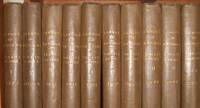
176876335Annual Register. 1768. Hardcover. Very Good. Volumes 11 - 107 1768 to 1865 An unbroken run including Index for 1758-1819 98 books 2 sm lib stamps to prelims bound in contemporary uniform calf binding except vol 14 gilt cover edges spines with raised bands gilt motifs leather spine labels. A few hinges sl tender otherwise a lovley run in nice bright condition. ; Octavo . Annual Register hardcover
160914228London; Printed by Thomas Purfoot for Clement Knight 1609. 1609. Quarto sig. A-K4 L1 lacks the final blank. Later spotted full calf blind double fillets to boards titles gilt to spine all edges speckled red. An early English account of Morocco by an anonymous pamphleteer sometimes called 'Robert Cottingham'. This volume gives an account of the privateer and adventurer Sir Anthony Sherley's 1565-1636 ambassadorships from Rudolf II Holy Roman Emperor to Mowlai Abd-el-Aziz son of Ahmed II Sultan of the Ottoman Empire. These accounts were made famous in Samuel Purchas's influential 'Purchas his Pilgrimmes' 1614 which is a rather more robust volume. Sherley was a remarkably well travelled Elizabethan gentleman beginning his career as a captain in Robert Dudley's forces before becoming a knight of Henri IV and then launching military expeditions to West Africa Sao Tome and Jamaica. Sherley journeyed to Persia where he became the representative of the Shah in Moscow Prague and Rome. Effectively exiled from his own country Sherley went to Prague where he became emissary of the Holy Roman Emperor to Morocco. He would later became an admiral of the Spanish fleet in the Levant. He died in 1635 penniless and obscure. This pamphlet presents Sherley's experiences in Morocco as well as accounts from other travellers like him as it would have appeared to the English reading public for the first time. Slight nicks to boards joints beginning to crack. First and final leaves a little soiled and small contemporary ink numeral to title-page. Modest paper repair to margin of C4 and occasional light spots of soiling to margins only. A very good copy. Rare in commerce we can locate one copy only at auction in the last 70 years. ESTC S107368. Playfair & Brown 'A Bibliography of Morocco' 124. ODNB. London; Printed by Thomas Purfoot for Clement Knight, 1609. hardcover
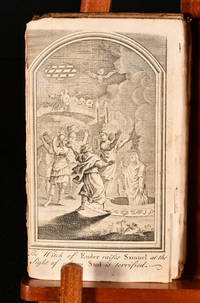
1772678L3Berwick: R Taylor c1772. First edition. Leather. Good Only. 7" by 4". Not Stated. A vanishingly scarce first edition of this occult work discussing first-hand accounts of witches ghosts and seers. Undated the ESTC reference T60882 speculates a publication date of 1775. However the front endpaper of this copy has a contemporary ownership inscription dated 1772. The prior owner's inscription is in neat copperplate and states a riddle that spells the name William. William Workman the prior owner has his stamp to the front endpaper and his monograph initials. 20th century inscription 'Geoffrey S Glover 1940' to the front free endpaper. With an engraved frontispiece. With the signatures: a6 A-L12 A very scarce work which is a collection of first-hand accounts of witches ghost encounters and tales of seers. These include an account of Rebecca Jones a witch an apparition to King James IV and his couriers the discovery of murder by an apparition and an account of a magician at Antwerp. There is also an eighteenth century account of the Pied Piper of Hamelin under the title of 'A marvellous prank played by the Devil at Hemelen a town in Germany'. In addition there is a short biography of John Faustus or Johann Faust the German magician and alchemist during the Renaissance. A fascinating collection of occult accounts. Published after the final execution for witchcraft in Britain and the implementation of the Witchcraft Act of 1735. Extremely scarce and in a bright condition. In a contemporary calf binding. Externally heavily rubbed to the spine and to the boards. Small loss to the head and tail of spine. Front board is detached but present. Rear hinge and joint are tender. Front endpapers and frontispiece are detached but present. Otherwise this work is generally firmly bound. Bottom outer corners of E2 and E3 have been removed by a prior owner only affecting the margin. Pages are generally bright. Occasional scattered spots to pages. Good Only R Taylor hardcover
117084Schottland Gdansk district 1822. . 8vo; Hebrew manuscript on vellum in square Ashkenazi script; modern marbled half-calf spine with raised bands and blind-tooled ornaments; one half-page colour illustration; 10 ll pp.<br /> A unique Selichoth manuscript on vellum 'Belonging to the heroes of the Chevra Kadisha on the holy community of Schottland'. A rare relic from a 19th-century Jewish community in northern Poland.<br /><br />During the time when Jews were banned from settling in the city of Danzig Gdansk they lived in the small towns of Schottland Weinberg and Langfur which together formed the 'Shul' community an abbreviation of these towns' names in Hebrew. Two important figures served as Rabbis of this small community: Rabbi Meir Posner author of 'Beit Meir' a phenomenal Torah scholar who was in contact with Rabbi Akiva Eiger and the Chatam Sofer as well as Rabbi Elchanan Ashkenazi author of 'Sidrei Taharah' a student of Rabbi Ya'akov Popresh and Rabbi Zvi Hirsch Charif.<br /><br />The fasting day of K"A Kislev for which the Selichoth were written is not marked by the Ashkenazi Jewish communities of our times and very little is known about it. The little information in existence relates to the city of Prague where the Jews used to observe this day of fasting to commemorate the many Jews who were tragically killed in 1744 by the Austrians presumably around the time when Empress Maria Theresa signed an edict ordering the expulsion of all Jews. This might also explain the only colour illustration in the manuscript which depicts the tomb of the Maharal of Prague. It is presumed that this fasting day was also observed by other Jewish communities in Poland.<br /> Schottland (Gdansk district), 1822. hardcover
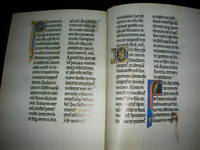
19851907Graz: Akademische Druck- u. Verlagsanstalt 1985. Hardcover. Fine. Fine condition two volumes in slipcase. Complete color facsimile edition of the 394 pages 197 folios in original size 304 x 204 mm. The manuscript contains 51 full page miniatures with rich gold ornaments and numerous splendid initial letters. The binding is an all leather binding with all pages hand cut according to the original. The commentary volume has a detailed scholarly commentary. Limited and numbered edition limited to 500 copies with each volume numbered by hand this is volume 194. The codex dates from about 1200 Northern France. Undeniably the greatest painting to employ ridged drapery is in the Psalter Chantilly Musee Conde Ms. 1695; ills. 190-193 made for Queen Ingeborg of France. The standard of the manuscripts illumination is such as can only be described by epithets of superlatives. Its full page miniatures are by two illuminators one working in an older tradition than the other but throughout there is a stylistic development which ignores this division and is presumably due to the common enterprise. The earlier miniatures by the older master have flatter Byzantinesque folds akin to those in Salzburg illumination but these soon sharpen into ridges and troughs and the newer technique dominates the work of the younger master being developed to its furthest extent in his miniature of Pentecost. In all the Ingeborg miniatures faces are particularly plastic and rounded but always with a certain pathos or strain in their expressions; they never exhibit the calm observable in the Westminster Psalter. Only the younger master however manages to give a convincing plasticity to covered bodies. As might be expected of a book of this importance much discussion has raged about the date and provenance of the Ingeborg Psalter. The most recent definitive suggestion is circa 1195 in north-eastern France possibly in the diocese of Noyon; but the debate continues. Akademische Druck- u. Verlagsanstalt hardcover
5000201161111. First. . Folded. Poor. Folio. A folded map possibly 17thC could be the Nicholls map. Possibly only part of the map. This measures 11" by 18". No idea of the price Open to offers perhaps. <br/> <br/> unknown
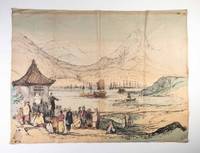
46516London : The Working Men's Educational Union King William Street Trafalgar Square 1854. Coloured lithographic wall hanging printed on calico 880 x 1160 mm; original brass eyelets at each corner; numbered 'LM No. 12' lower left; slightly creased but a well preserved example the hand colouring still strong and vibrant. The Working Men's Educational Union was a philanthropic organisation founded in London in 1852. One of its aims was to provide free education for the working classes through public lectures at numerous venues across the city. During the 1850s it published at least 400 different large format lithographic wall hangings which it called 'Diagrams' that were designed to illustrate lectures on a wide variety of subjects. They were produced on calico inexpensive unprocessed cotton - apparently to avoid paper duty - and were available for purchase at the Union's premises in Skinner Street Clerkenwell and King William Street near London Bridge. In 1854 the Union advertised a series of these Diagrams titled Missionary Scenes 'Being twenty coloured Diagrams upon Missionary Trials Perils and Insults Heathen Superstitions Cruelties etc. ; suited for Missionary Lectures. Price to subscribers £1 10s. to non-subscribers £2 5s' advertisement contained within the pamphlet The progress of locomotion; being two lectures on the advances made in artificial locomotion in Great Britain by Benjamin Scott. London Published by F. Baron for the Working Men's Educational Union 1854. It is likely that the present Diagram of which we can trace no other extant example formed part of this Missionary series. Indeed it seems reasonable to posit that the 'LM' preceding the sequence number '12' at lower left refers to 'Lectures on Missions' or similar. Although its artist is unidentified the image is possibly after a published lithograph perhaps one which appeared in a journal such as the Illustrated London News. The Alexander Turnbull Library National Library of New Zealand holds in its collection fifteen lithographic Diagrams produced by the Working Men's Educational Union. These depict scenes in New Zealand Australia the Torres Strait the Pacific Islands and South Africa. unknown
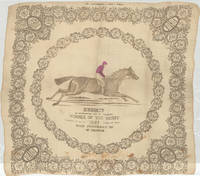
768401867 and 1866. . A pair of engravings on silk tears to lower right corner of second item. Framed.<br /> <br /> [1867 and 1866]. unknown
1799641Venice: Appresso Giovanni di Antonio Zatta librajo all'insegna of Providence in Frezzaria 1799. Very Good. Bookplate of prior owner and also a signature of another owner on inside front cover. VERY GOOD condition wear to corners and edges some soiling. VERY RARE collection of political caricatures with French and Italian language. Appresso Giovanni di Antonio Zatta librajo all'insegna of Providence in Frezzaria unknown
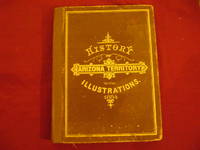
1884232632San Francisco. : Wallace W. Elliott & Co. 1884. First edition. . Gilt decorated hard cover. . Very good copy. Light shelf wear. Rebacked with book binding tape. One page taped. Inner gutters split. 2 owner names on front end paper old library book plate. Interior tight. Folio. . Howes A310. Illustrated. This rare first edition from 1884 offers a detailed historical and promotional account of the Arizona Territory during its formative years. Aimed at encouraging settlement and investment it highlights the region’s natural resources economic opportunities climate and infrastructure development. Richly illustrated with period engravings and maps the book provides valuable insights into territorial life before Arizona achieved statehood. A significant historical document especially for collectors and scholars of the American West.Lithographed plates. Important reference work. Very scarce in this condition. Wallace W. Elliott & Co. hardcover
1926012809London 1926. Size. Folio/Quarto. A run from 1926 to 1980. lacking 1942 107 volumes. 66 volumes bound in quater calf. 41 volumes bound in cloth. Bindings lightly rubbed some scuff marking some fading occasional library number. Generally all bindings in good clean firm condition. Internally about 7 volumes have some water staining heavier to two volumes some pages stuck together other volumes have some intermittant lightly rippling. Generally pages in good clean condition. Overall a very nice run in good clean sturdy bindings. . Hardcover. Near Very Good. Folio. Hardcover
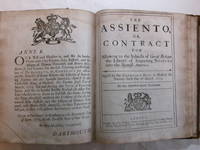
1713148771London : John Baskett 1713. 1st Edition . Hardcover. Good/No Jacket Issued. 4to - over 9¾ - 12" tall. FIVE WORKS IN ONE VOLUME original full leather hardcover with initials in gilt to front and rear cover Assiento double column Spanish and English privilege leaf 2 1-48pp some old staining to upper margins pages browned last page more so otherwise very good and complete. Treaty of Peace and Friendship84pp tear to margins of title page and first page without loss of text pages browned otherwise very good. Treaty of Navigation and Commerce 115pp pages browned otherwise very good.Treaty of Peace and Friendship Between The Most Serene and Most Potent Princess Anne and Most Potent Prince Philip the VTH.115 pppages browned otherwise very good. The Treatise of Peace and Commerce 40pp pages browned otherwise very good. Unusual illuminated inscription to flyleaf COVERS DETACHED In need of rebinding. WE CAN ONLY SHIP THIS ITEM WITHIN THE UNITED KINGDOM. We are a real bookshop with real books situated in and shipping from the United Kingdom. <br/> <br/> John Baskett hardcover
1840772L6London: James Nisbett and Co 1840. First edition. Paperback. Near Fine. 8" by 5.5". None. An extremely scarce account of the great landslip of Christmas Day 1839 on the East Devon coastline which created what is now known as 'the undercliff'. An extremely scarce work with no other copy seen in commerce. The only institutional copy is held at the British library.The great landslip saw fifty acres of land breaking away from the cliffs and crash onto the beach. There were reports of fire and the sulphuric fumes led people to believe there had been an earthquake or volcanic eruption. The chasm left from the landslip was over three quarters of a mile long and presented new cliff faces over 150 feet high. The landslip piqued the interest of scientists worldwide and Queen Victoria travelled to the site in the yacht. The author of this work quotes from a friend residing in the vicinity of Axmouth who describes the events leading up to the creation of a 'monstrous ravine' calling the incident 'the remarkable visitation of the Most High God of this land by an earthquake'. Following the disastrous event a dance called 'the Landslips Quadrille' was sold in London and engravings of the scene were made. This is a contemporary account of the event which was preached to be a warning from God. A fascinating contemporary account of this disaster. In paper wraps. Externally excellent with minor shelfwear. Internally firmly bound. Pages are bright. Occasional light spots to the first and last few pages. Near Fine James Nisbett and Co paperback
3735287<p>Germany: “betreffend Vorerinnerung geschrieben im Jahre 1817.†1817. 53 1 pages. Manuscript comprising 14 untrimmed sheets and one final half-sheet on laid paper most sheets watermarked either a fleur-de-lis or the initials “F H F.†Not recorded in Gravell 2nd ed.; the paper’s characteristics and appear consistent with early 19th-century American manufacture. Sheets measure approximately 25 cm × 40 cm 9.84 × 15.75 in and are each folded once along the vertical axis to form bifolia likely gathered into a fascicle. The half-sheet has corner loss with word loss and tape repairs; its heavy embrowning and staining indicate it served as the rear wrapper while the first leaf’s matching wear suggests it was the front wrapper. Embrowning stains and foxing throughout with scattered minor paper defects; darkly engrossed and housed in an archival four-flap enclosure.</p> <p>Original and extensive 1817 manuscript anonymous and apparently unpublished offering a candid outsider’s view of the early United States written in Germany by an author who had traveled in America.</p> <p>“The wish to be useful to my German compatriots is what led me to undertake this work†the author writes. Across more than fifty pages the manuscript presents an ambitious loosely organized yet intellectually rigorous survey of American society combining political philosophy practical emigration and economic advice and cultural observation drawn from both firsthand impressions and secondhand reports. It describes what a newly arrived traveler to America might expect and serves as a “proto-guide†written before the emigrant’s handbook had emerged as a distinct genre.</p> <p>While the author’s identity is unknown he clearly traveled in America describing in wonderment his visit to Peale’s Philadelphia Museum:</p> <p>"“The portraits are largely painted by Rembrandt Peale a skilled American artist. They notably include several prominent Frenchmen; among them I also noticed our own Gall Franz Joseph Gall d. 1828 German neuroanatomist phrenologist. Franklin is depicted with spectacles resting on his nose. While viewing the mammoth bones which are displayed in a separate hall—one that also contains most known mammals and birds preserved in lifelike taxidermy—I found myself overcome by the following reflections that arose unbidden in my thoughts: Could the Creator have granted existence to such a monstrous being…â€"</p> <p>References to Mathew Carey’s 1812 stereotype Bible a visit to Peale’s Museum while Rembrandt Peale was still in Philadelphia the yet-unprinted Lewis and Clark expedition report and mention of a quarto edition of Brewster’s Edinburgh Encyclopaedia being prepared in Philadelphia likely the American edition in early production circa 1810–1811 together suggest the author’s presence in America around 1810–1812.</p> <p>Written “purely from memory†the work unfolds as a discursive yet sharply observant collection of chapters. It presents a wide-ranging survey of the United States beginning with the continent’s geography natural resources and Indigenous peoples followed by a demographic overview of its population. It explores agriculture in depth contrasting it with manufacturing and links economic development to trade banking and fiscal policy. The author offers critical reflections on the U.S. Constitution and the U.S. federal model including law enforcement and jurisprudence and the role of English influence. Social institutions such as poor relief education religion and print culture are considered alongside American values like thrift and self-reliance. The text offers extended views on the communal society of Harmony advice for German emigrants and concludes with a candid discussion of slavery.</p> <p>The manuscript is the author’s working copy. It is heavily marked up annotated and repeatedly revised throughout. Pagination proceeds without interruption and there are no physical signs of missing text or structural loss. While some chapter titles listed in the table of contents do not appear in the manuscript itself their absence does not necessarily indicate an incomplete or fragmentary state. Rather the manuscript may reflect a complete version as the author conceived it—or as complete as he could bring it before abandoning the project or composing a revised draft elsewhere. </p> <p>Manuscripts from this period that present German views of the United States let alone offer detailed guidance for prospective emigrants are exceptionally rare. For context this example dates to 1817 the same year the Zoar community was founded in Ohio—one of several German emigration movements shaped by broader economic and cultural motivations. Written at a formative moment in German-American engagement the manuscript provides a clear record of how one early observer interpreted and conveyed the realities of American life to a German-speaking audience.</p> <p>Note: The manuscript comprises approximately 15000 words. A 45-page transcription is provided though given the extensive emendations and extensive untranslated marginalia this should be regarded as an informed approximation.</p> <p>Select Transcriptions:</p> <p>From Chapter I. General Physiognomy of North America<br /> Since the entire landmass by its very formation is mainly attached to its mountain ranges one must expect only a few significant plains especially on the eastern side. The land undulates in wave-like fashion alternating between hills and valleys. This area lying east of the high mountain chains which in regard to soil quality products and population shows the greatest variety is crossed by substantial navigable rivers on which the products of the fertile land can easily be transported to the coastal cities.</p> <p>These respectable coastal and trading cities some of which are quite large lie on convenient harbors and bays so that ships of considerable size can reach them. The location of the United States for global trade is so excellent that it would be difficult to find a better one. Through this trade and especially through the industriousness of its inhabitants the United States has already achieved a high level of prosperity. The price of land in the fertile regions has risen very high which has prompted owners to sell in order to emigrate to the western regions beyond the mountains to Ohio Kentucky and Louisiana where they can acquire land of equal quality at a much lower price.</p> <p>From Chapter II. The North American Indians or Original Inhabitants of the Continent <br /> Since the method of warfare practiced by the Indians violates all principles of military and international law—laying waste to everything murdering indiscriminately regardless of age or sex and often slowly torturing their captives to death—the government of the United States made the generous proposal that both nations i.e. Britain and the U.S. refrain from employing these undisciplined hordes in military service. However this suggestion has so far been rejected by the British side.</p> <p>Planters living near the borders are therefore exposed to great danger at the outbreak of war and usually flee into the interior or take refuge in forts that have been erected along the frontier for protection and equipped with defensive garrisons.</p> <p>The lands that the United States recently purchased from various Indian tribes are of exceptional quality. However private individuals and corporations are currently prohibited from entering into negotiations or purchase agreements with the tribes.</p> <p>President Thomas Jefferson made the proposal which was approved by Congress in 1796 to undertake an expedition to explore the vast region located southwest of the United States. Captains Lewis and Clark along with one hundred carefully selected men and the necessary arms and provisions were ordered to depart from Fort St. Louis at the mouth of the Missouri River where it meets the Mississippi and to follow the river’s course deep into the interior. Their goal was to cross the western mountain ranges and reach the source of the Columbia River. This was accomplished with great effort.</p> <p>The travelers encountered many unfamiliar nations who had never before seen a white man. From some they acquired horses to transport their supplies across snow-covered mountains. After an arduous journey they finally reached a branch of the Columbia River that was navigable. This eased their travel to the river’s mouth at the Pacific Ocean. They returned by the same route.</p> <p>It is said they encountered little resistance from the Indians during their journey. The Sioux tribes reportedly made hostile demonstrations but Captain Lewis finding himself surrounded is said to have deterred them through the following ruse.</p> <p>He knew how greatly all Indians feared smallpox since this virulent disease had already wiped out entire nations and it was known among the Indians that the contagion could be deliberately spread by artificial means. So when the warlike Sioux tribe sought to halt his progress and capture him Captain Lewis drew out a vial and told the Indians that upon opening it the smallpox poison would unfailingly be released among them spread rapidly and wipe them out. This persuaded the Indians to retreat swiftly and trouble the party no further.</p> <p>The public long awaited the journal of this expedition which had been announced in various newspapers. However I was never able to obtain a copy despite considerable effort as I was eager to read such an interesting travel account. Whether the entire story is a fabrication or whether the travel journal was deliberately withheld from the public I cannot say. But one thing is certain: if the expedition was carried out as reported then President Jefferson by recommending it; Congress by providing the means; and the expedition team by carrying it out so purposefully all rendered a great service to their country.</p> <p>From Chapter III. The Population of the United States<br /> Since the epoch in which the colonies severed themselves from the mother country— namely from the year 1774 to the year 1817 a period of 43 years—the population of the United States rose from 3 million to 81â„2 million. Thus one may assume that even without accounting for immigration from Europe the population would double every thirty years corresponding roughly to the span of a single generation.</p> <p>Side Note: Besides immigration the following causes may also be noted particularly in towns and small rural settlements such as those…</p> <p>The causes of this nearly incredible growth in the human population may be summarized as follows: just as in large cities like London and Paris or in factory and manufacturing towns where people live in crowded conditions and the population either stagnates or declines—due to unhealthy air and numerous other causes of illness so that deaths outnumber births—so in contrast the population of a country will grow where the majority of inhabitants live according to nature as farmers. This is especially the case in the countless small rural towns spread across North America where most residents engage in gardening and agriculture. These occupations expose them constantly to fresh air and accustom them to a frugal natural lifestyle.</p> <p>Another contributing factor is the early marriages of young men and women owing to the ease with which marital unions are contracted. In America marriage is viewed primarily as a civil contract and ideas of a moral-religious ceremony or sacrament have no significant influence on the process. For that reason a marriage is legally binding not only when performed by an ordained clergyman or preacher of the Gospel but also when solemnized by any justice of the peace.</p> <p>Many are being drawn westward from the eastern states seeking to obtain land in places like Ohio and Kentucky which they cannot afford in the East where the price of land in the older settlements has risen to enormous and exaggerated levels.</p> <p>From Chapter IV XVI. Sound Advice for Germans Wishing to Immigrate to the United States of North America<br /> I am told that just now in the spring of 1817 following several years of poor harvests in Germany many inhabitants are resolved to emigrate to America. For thoughtful travelers it will be extremely welcome to hear information concerning the new country and the conditions in the place to which they intend to emigrate.</p> <p>Shipping agents commonly employ emissaries in the interior of Germany who encourage people with persuasive words and sometimes even offer a small amount of travel money to bring them to the seaports. These vessels typically do not require prepayment of the passage fare. However when the passengers arrive at their destination no one is permitted to disembark until the fare has been paid in full. The passengers are then sold to planters craftsmen or other private individuals who are willing to cover the debt the passenger has incurred.</p> <p>Such a purchased person is referred to as a servant and a formal contract is drawn up between master and servant before a justice of the peace. In this contract the servant typically agrees to serve faithfully for a fixed number of years and to assist willingly in all assigned work. In return the master promises to provide food and clothing and often offers a small sum of money upon the completion of the term as an incentive. Children must serve until they reach legal adulthood—that is until their twenty-first year.</p> <p>These contracts indentures are printed in English and executed in duplicate by the justice of the peace: one copy is given to the owner the other to the servant. If the servant is dissatisfied with his treatment he may file a complaint with a magistrate and in some cases may even be permitted by the ruling of a court to choose another master provided someone is found willing to pay the required sum on his behalf.</p> <p>If the master is dissatisfied he may have the delinquent servant imprisoned and the servant must then compensate for the lost time and incurred expenses as a penalty.</p> <p>In New York Philadelphia and Baltimore societies have been organized that upon proper petition will intervene in individual cases for those whose circumstances appear to require such assistance. There exist German Irish and Scottish benevolent societies each striving to support their respective…</p> <p>These ethnic societies aim to assist their countrymen at the very least by helping them find placements or opportunities to repay their passage debts affordably. Yet it is far too often the case that poor but diligent families who have sought refuge in America are sold off individually with children separated from their parents or husbands from their wives—sometimes across hundreds of miles.</p> <p>It is also advisable for every immigrant who is of modest means and intends to purchase land or other forms of real property to apply for naturalization immediately upon arrival. This must take place before a justice of the peace. Only after the lapse of seven years does he enter into full civic rights and only then can he legally transfer title to any acquired property or enter into binding contracts concerning it. This law which restricts foreigners in such a manner is known as the Alien Act. It was passed under President Adams in Congress to prevent foreign speculators—especially Dutch and French—from purchasing large tracts of land and after only a few years during which land values often quadrupled or quintupled selling them off for great profit.</p> <p>The foreigner or alien is however required to bear all the burdens of citizenship without enjoying any of its rights. He is subject to militia duty: after a ten-day stay in any locality he must report to the captain of the local militia brigade and his name is immediately entered into the militia rolls. He is liable for the same penalties imposed on any militiaman if he is absent from the required musters. And if the brigade to which he is assigned is called into actual military service he too must serve.</p> <p>He must of course also pay all direct taxes and levies just like a citizen though he does not have the right to vote in elections for public officials.</p> <p>If immigration is to be beneficial not only to individuals but especially to new settlers in general it must be carried out through organized societies. For instance if a number of diligent artisans and farmers were to band together a communal fund could be raised for the purchase of a tract of fertile land. Such a colony would also be entitled to petition the U.S. Congress for a land grant which would likely be approved allowing the colony to acquire the land on favorable repayment terms.</p> <p>By establishing a small town and immediately cultivating the surrounding area additional craftsmen and planters would soon be drawn in. The value of the acquired land would double year after year eventually yielding significant profit.</p> <p>When the colony is later expanded care should be taken to include only useful and essential tradesmen and agricultural workers or alternatively individuals of means who could advance funds on behalf of the poorer members—funds which could then be repaid through labor. The land must be developed at communal expense…</p> <p>The land was to be purchased at common expense for the collective benefit of the colony. It was to be divided into equal portions among the colonists so that even the poorest would receive the same share as the richest. Only after the lapse of a certain number of years would the communal interest be eligible for division.</p> <p>The idea for such a colony was first conceived by a man named Rapp from Württemberg. Through peculiar and enthusiastic religious ideas which he spread among a segment of the rural population in that kingdom he attracted a number of followers. He proposed a plan for emigration that found eager support among those already inclined to emigrate.</p> <p>He purchased a considerable tract of land in his own name about eight hours north of Pittsburgh and established a small town which was named Harmony—a name also given to his religious society. He introduced certain ordinances and regulations. All labor was carried out communally: much land was cleared orchards and vineyards were planted houses and public buildings were erected including a meeting hall inn storage facilities an oil press bakery gristmills tanneries and more. Various domestic manufactures were operated collectively in factory-like fashion and brought to a high degree of refinement. In short it quickly became apparent how much more effective a society working toward a shared purpose could be compared to isolated family-based industry.</p> <p>Rapp recently sold Harmony and relocated with his Swabian followers to the Wabash River where it flows into the Ohio. It is said that the climate near Pittsburgh was not favorable to viticulture and that they expect better conditions for wine-growing in their new settlement.</p> <p>From Chapter V. The Interests of Manufacturing and Industry Considered in Opposition to Agriculture<br /> The two main political parties that dominate in America—one the Federalists inclined toward England and the other the Democratic party sympathetic to France—will likely reflect on the lessons drawn from the recent European wars and the course of European politics. In the future for the people must inevitably be divided into parties the combined interests of commerce and agriculture will likely rise in opposition to large-scale manufacturing which the government to maintain popular favor will attempt to support—at least outwardly—through import bans tariffs and duties.</p> <p>If the kind of labor a nation pursues has a strong influence on its moral and physical condition and if a nation were to face the choice of either 1 fostering agriculture and the necessarily associated domestic manufacturing and artisan production—thereby providing suitable employment for shipping and commerce; or 2 promoting large- scale factories and manufacturing as the nation’s principal economic foundation with the aim of eliminating the need for imports—then trade and shipping would no longer enjoy their former vitality. In that case only as much land would be cultivated as needed to feed the industrial laborers and factory workers and the majority of bulky goods previously exported to foreign countries would no longer be produced.</p> <p>This question is important enough that it warrants close examination by the legislators of the nation.</p> <p>The results of such a study would serve as a guide for drafting the national tariff schedule and…</p> <p>The legislature should ensure that those goods which though not easily produced are nonetheless essential and indispensable be manufactured domestically wherever possible. By contrast luxury items and harmful or unnecessary beverages should be either eliminated through heavy import duties or transformed into beneficial sources of state revenue.</p> <p>All European nations are more or less nations of manufacturers and industrialists. In both areas they have reached a high degree of perfection. The population of their territories is so large and concentrated that they were compelled to pursue such occupations or to found colonies in order to rid themselves of surplus population. As such these nations must welcome the raw products of other countries and seek a favorable market for them in exchange for their manufactured goods.</p> <p>In contrast wages in America are high. It is difficult to hire a laborer for less than half a Thaler per day approximately 1 gulden 15 kreuzer while for heavier work the same laborer often earns a full Thaler about 2 gulden 30 kreuzer per day. Laborers are in demand and will remain in demand for centuries so long as there remains new land to cultivate.</p> <p>True national wealth consists of well-cultivated and populated lands. Thus a nation can never truly be called poor even if it lacks sufficient quantities of representative currency such as silver and gold so long as it maintains the land it inhabits in a flourishing state.</p> <p>For centuries Germany has supplied half the world with industrious and enterprising citizens without ever making claims to compensation for the cost of their upbringing. If we consider the United States of North America Pennsylvania stands out as one of the most highly cultivated states. Owing to its advanced culture dense population and generous sacrifices for the Union it is often called the keystone of the American federation. The ancestry of its inhabitants—largely German or of German descent— distinguishes itself through exceptional industry integrity deep knowledge of agriculture and the construction of durable and handsome buildings far surpassing that of the Scots and Irish.</p> <p>The homes of prosperous farmers in Pennsylvania are typically two-story structures of solid limestone. The barns in particular are so robust and enduring that one traveler describing them felt compelled to exclaim: “They build for the immortal gods!â€</p> <p>The most important and indispensable manufactures in the state consist of ironworks foundries and hammer mills. Excellent cast iron stoves are produced in every shape. Sheet iron is pressed through rollers and is especially used in nail-cutting mills.</p> <p>The manufactures of woolen cloth and cotton goods already produce items worth several million Thalers annually. Tanneries process not only all the hides produced domestically but also a significant quantity of hides imported from South America New Spain and the West Indies.</p> <p>From Chapter VI. Agriculture and Farming<br /> Wheat farming in Pennsylvania and the neighboring states has suffered significant damage from an insect that lays its eggs in the young stalk. The larva then consumes the pith of the stem preventing the ear from filling out. Numerous attempts have been made to eradicate this destructive pest but at least in the areas known to me none have yet succeeded.</p> <p>Distilleries are all too common across the country. Brandy is produced mainly from corn and rye. A promising beginning has been made in Pennsylvania with barley and hops cultivation. Since malt beverages are nourishing and healthful it is to be hoped that they will gradually displace the excessive consumption of strong spirits.</p> <p>Beekeeping is still not widely developed. Farmers tend to kill their swarms in the fall with sulfur keeping only as many as are needed for next summer’s brood. Systematic or magazine beekeeping has therefore not yet been introduced and is only rarely known.</p> <p>Several short treatises on this subject based on German guidelines have appeared in English.</p> <p>Viticulture has been attempted only by Germans especially Swabians and Swiss. Because establishing a vineyard demands intensive labor ongoing care and a wait of at least four years before yielding a profitable harvest—after which bad years may still occur—and because winemaking requires specialized knowledge the enterprise is generally too laborious for the American farmer. Moreover the climate not only of the Eastern states but also of Pennsylvania and Maryland is said to be unfavorable for grape cultivation despite the fact that several wild vine species grow abundantly and produce grapes in profusion as already noted.</p> <p>Animal husbandry is significant across all states. From New England many hundreds of mules and donkeys are driven westward. The New Englanders wisely took advantage of the recent war unrest in Spain and imported several shiploads of Spanish sheep. These Merino sheep are now widespread and through crossbreeding have significantly improved the quality of domestic wool. The price of common wool typically stood at $1.50 semi-pure at $4.60 and pure Merino wool at $2.30.</p> <p>From Chapter VII. The Passive and Active Trade of the United States<br /> Domestic trade among the various states as well as coastal commerce is likewise significant—the latter involving a great number of vessels.</p> <p>In this respect the Union may reasonably be divided into eastern middle and western states. While these are united by shared interests a common constitution government and language they nonetheless differ substantially in customs habits and various popular prejudices.</p> <p>For example the inhabitants of the eastern states—Massachusetts Connecticut Vermont and Rhode Island—commonly known as New Englanders or “Yankees†claim that they conduct more substantial trade and export more than the middle states —New York and Pennsylvania—or even more than the western states combined: Maryland Virginia Ohio Kentucky the Carolinas and Georgia.</p> <p>Upon closer examination however it becomes clear that New England’s exports roughly equal those of the western states but that a large portion consists of goods originally imported from the West and not native to New England itself—such as tobacco rice cotton and so forth.</p> <p>Therefore should the threats made by residents of those eastern states during the last war to secede from the Union ever be realized the advantage of such a separation would plainly lie with the western states which would then endeavor to ship their own products on their own vessels.</p> <p>From Chapter VIII. The political and financial state of the United States considered in general</p> <p>Under President Adams the majority of the people in the Northern States complained not only of political oppression and military despotism but also of the misuse of public funds and their allocation to purposes that at the time were far beyond the nation’s immediate concerns.</p> <p>Adams attempted to establish a standing army erected barracks for the troops expanded the navy by constructing warships and introduced taxes—some of which were expected to have a beneficial effect on public morality such as the tax on whiskey.</p> <p>The steps Adams took were those of a far-sighted statesman. He clearly recognized the unfolding European revolutions aligned himself with British interests and sought to elevate the American nation to a respectable position in global affairs.</p> <p>However he faced a nation that preferred the uncertainty of peace to a formal declaration of war and was unwilling to make sacrifices. It was a nation that falsely believed the French had freed it from British rule out of friendship and thus felt eternally indebted to France.</p> <p>They believed themselves obligated to France. The majority of the people saw in the French Revolution the dawn of a golden era for human welfare and civil rights and for this reason alone were opposed to any war with that nation. But when Adams finally struck at the people’s weak spot—when he imposed a tax on their favorite drink whiskey—public dissatisfaction broke out into open unrest. Though it was suppressed by military force the freedom of speech exercised by the Republicans soon brought about a change in the administration. Ambitious demagogues denounced Adams’ policies. The taxes were repealed. The warships were sold and replaced with gunboats for harbor defense; the national debt was reduced through fiscal restraint and President Jefferson’s economic administration and cost-saving policies became the order of the day. The people were content.</p> <p>Jefferson eventually recognized how difficult it would be to maintain a position of neutrality between warring nations. Yet through trade with both sides American commerce flourished. Their ships earned vast sums. Their ports open to all nations were full of vessels and their products—especially grain—fetched record prices. This state of affairs brought about during his administration was too gratifying for him to wish to remain at the helm of state should this favorable condition change—a possibility which seemed increasingly likely. So he withdrew into philosophical retirement.</p> <p>His former Secretary of State Madison—who had been privy to Jefferson’s plans and shared his political principles—assumed control of public affairs during a period in European revolutionary history that scarcely has its equal.</p> <p>Ships sailing under the flag of their homeland were stopped under the flimsy pretext that their crew were subjects of His Majesty the King of Great Britain. These men were taken aboard British warships and forced into service. Under various other pretenses the trade of the United States faced serious obstacles. England blockaded entire coastal regions by mere proclamation without possessing sufficient naval force to carry out such blockades. France on the other hand confiscated every American vessel and its cargo if it could be shown that any of its crew had previously served on an English ship.</p> <p>When the general embargo and Non-Intercourse Act which placed restrictions on all ships was announced by the United States it found ardent defenders as well as critics who condemned it as impractical. Many demanded that an armed neutrality be formally declared and so on.</p> <p>Meanwhile Napoleon’s fame and ambition had reached a height that made him appear to even the most distant nations as a kind of bronze colossus—one against whom all storms crashed in vain. He had raised the glory of the French Empire to an unprecedented brilliance. That brilliance dazzled even the political vision of the free citizens of a confederation of states whose founding institutions stood in stark contrast to the principles of the French Emperor.</p> <p>Despite the fact that trade between the United States and England amounted to nearly 30 million dollars and that all commerce with other nations France included scarcely totaled a quarter of that sum; despite the fact that the majority of the American people were of English descent and had retained English institutions customs religious ceremonies and language; despite the realization that England’s naval power could inflict deep wounds by destroying the open and undefended port cities of the United States whereas France’s land forces—lacking naval strength—could never come into contact with America in the event of a prolonged war declaration: even though all these reasons were plainly before the nation it nevertheless chose to side with France and against England.</p> <p>Should England ultimately emerge victorious from the conflict with France it was feared that vengeance would be exacted upon a republican state that was already the natural commercial rival of the island nation. To declare war simultaneously against both England and France raised even greater concerns—despite the fact that the United States had equally just grounds for declaring war on both.</p> <p>From Chapter IX. On Banking<br /> A defining feature in the character of the inhabitants of the United States is a commendable industriousness that extends across all classes of the nation along with a spirit of speculation and commerce that animates everyone. All work or trade—nearly all fixed property is for sale—since the owners always set such a high price on it convinced they can use the proceeds to buy a better piece of land or a more conveniently located house or to build one themselves. This is the source of the constant activity and migration westward.</p> <p>Since the citizens of the United States are owners of an extraordinarily vast expanse of land and innumerable movable assets they require a representative medium for such property without which business is inconceivable and commerce comes to a standstill. It was therefore quite natural that in the absence of precious metals—silver and gold— they resorted to paper money. In this case paper currency came to replace coined money. And since the U.S. government i.e. Congress among its other prerogatives had expressly reserved for itself the exclusive right to mint money it ought to have established a national bank and declared all other paper money invalid and worthless.</p> <p>But this did not occur. Instead corporations in every state were chartered by the respective legislatures to establish banks and—as previously mentioned—this led to an excessive amount of paper currency entering circulation. This medium was out of all proportion to the fixed and other forms of property which inevitably led to the condition already described: silver commanded a rapidly increasing premium and eventually disappeared entirely.</p> <p>These observations are of obvious value to anyone who at the present moment is considering emigrating to the United States. Such an individual will see that because the medium of exchange is disproportionate to the property it represents cultivated lands—especially on the western side of the mountains—are fetching inflated prices. For example in Franklin County Pennsylvania in a populated area of the state the price of the best farmland has risen from an average of 30 dollars per acre in 1809 to 200 dollars per acre by 1817.</p> <p>From Chapter X. England’s Influence on the United States of North America<br /> Since the revolution that began in 1774 and the peace subsequently brokered between England and the United States by France the North American Union has positioned itself among the ranks of sovereign and independent nations. Even amid the disputes and conflicts of the European powers in the past decades the Union has sought to maintain strict neutrality. Though as previously noted the will of the larger population tended toward France there exists a political faction within the country that while seemingly a minority in truth directs all public policy in ways it deems beneficial to its own purposes—without the broader population realizing it.</p> <p>This faction known as the Federalist Party consists of sympathizers with England to the extent that England’s interests coincide with or do not conflict with those of the Union.</p> <p>England’s keen statesmen are unlikely to idly allow Americans to begin processing their own raw materials and produce. England would thereby lose one of its most valuable sources of raw exports and manufacturing markets.</p> <p>By the end of 18— year obscured due to a shortage of raw cotton spinning machines in Pennsylvania were forced to shut down. The price of raw material had risen sharply— until it disappeared altogether. It is likely that England had quietly purchased all available reserves.</p> <p>During the most recent war the town of Machias—a strip of land in Massachusetts— was in English hands. It became the main depot for English goods. From there New Englanders distributed the wares to other parts of the Union. All transactions had to be settled in specie. Eastern banks drew bills of exchange in large sums on the banks of New York and Philadelphia; these in turn drew on the western banks Baltimore and others. In the end most of the hard currency flowed back to England and military operations had to be financed with paper money—whose issuance and loan arrangements encountered great difficulties.</p> <p>The New Englanders were publicly accused—though not without basis—of making no attempt to drive the English out of Maine. In order to deflect the bitterness of this accusation several prominent men from the eastern states convened in the city of Hartford Connecticut to deliberate on their interests and to discuss the grievances of this part of the Union particularly the lack of support from the federal government in defending the coastline and other matters.</p> <p>The broader goal of the entire project was also to heighten the people’s desire for peace to its peak. Once peace was concluded the Democratic Party celebrated the event with public festivals and illuminations. The newspapers glorified the perceived benefits and general rejoicing continued—until the Federalists again laid bare the bitter realities to the public.</p> <p>They exposed the drawbacks of the peace in the harshest light: the lost Newfoundland fisheries the unresolved revision of borders on the Canadian side the lack of compensation and the forfeiture of any redress for past wrongs. None of the original reasons for the war had been achieved or settled. Nothing further was said of the freedom of the seas the liberty of the flag sailors’ rights or paper blockades. England now remained silent on all these matters which were rendered moot with the end of the war with France.</p> <p>From Chapter XI. Constitution and Form of Government of the United States<br /> The Constitution of the United States is widely recognized as a philosophical masterpiece: a well-considered and practical republican framework of government.</p> <p>It cannot be denied that the republican-representative form of government is preferable to the purely democratic or aristocratic systems known to the ancients or to those formerly established in Switzerland and Venice. Through the election of representatives the integrity of popular sovereignty can be preserved without devolving into aristocracy. If the majority of the people consistently approves only those measures that aim at the general welfare of the state and seeks to implement them through the election of its representatives—without being misled by passions the lure of conquest or favoritism toward any particular nation—then such a constitution not only merits praise for its theoretical perfection but also proves itself in practice. One must admit that it adequately meets the demands made of a government designed for a nation composed of many peoples united by the shared labor and hardship of establishing and cultivating their new homeland.</p> <p>The desire that the conduct of public affairs—even in republican constitutions—should rest in the hands of the wisest and best does not contradict the theory of democratic representative forms of government so long as the representatives are elected only for a reasonably short term.</p> <p>From Chapter XII. Administration of Justice – Prisons and Poorhouses<br /> In criminal cases of all kinds after a preliminary hearing the justice of the peace may order the accused to be held in the county jail until the next court session during which time the county must bear the cost of detention. The presiding judge instructs the sheriff to announce the court date in public newspapers and to summon a jury composed of 24 men from the local community.</p> <p>This jury is then sworn in by the judge.</p> <p>Note: Trial by jury—decision by a panel of peers—was an ancient Germanic right brought to England by the Saxons and which still exists today in the English legal tradition.</p> <p>The jurors are properly instructed in their duties. The case—whether civil or criminal—is presented and the jury remains in court throughout the proceedings until the verdict is rendered.</p> <p>In criminal cases the accused is permitted to challenge any jurors whom he considers biased or otherwise objectionable in character. The court replaces these jurors with others. A panel of jurors then withdraws to a designated room to deliberate on the preliminary statements made by witnesses and the accused. Their task is solely to decide whether the accused is guilty of the alleged crime or not.</p> <p>The county jail is maintained by the county sheriff who is also responsible for the care of the prisoners supplying them at county expense with basic food such as porridge and occasional meat.</p> <p>Poorhouses usually own plots of land the income from which supports the institution. Alternatively they are funded by a poor tax levied on county residents. Each county elects three commissioners and one poorhouse superintendent. The commissioners review applications from those seeking admission to the poorhouse.</p> <p>Because anyone willing to work can easily find employment—and especially because farmers require laborers for a variety of tasks—and because no type of work is viewed as dishonorable begging is virtually nonexistent. Another factor that has eliminated idleness and mendicancy is a certain sense of honor that pervades even the lowest social classes. Additionally it is quite easy for parents to apprentice their children in trades in a profitable and advantageous way.</p> <p>Whereas in Europe particularly in Germany it is customary for a master craftsman to charge a fee for training an apprentice in the United States the custom is the opposite: the apprentice not only receives free room and board and clothing but—</p> <p>Even after completing their apprenticeship American apprentices receive a certificate of freedom and a sum of money in recognition of their loyal service and labor—an amount that can sometimes be quite substantial.</p> <p>To be sure the great shortage of laborers and their high wages help explain this arrangement. But it also seems that in Germany too little attention has been paid to properly valuing the services of apprentices. This imbalance may favor the master too heavily and may even explain why poor parents sometimes choose not to apprentice their children in a trade instead allowing them to remain idle rather than securing them a useful skill and a steady livelihood.</p> <p>Funds needed for public expenses are raised by a county tax which is assessed proportionally based on wealth. The county treasurer collects the tax revenues from the various township collectors and submits an annual accounting to the county commissioners which is published in all the local newspapers. Expenses typically include salaries of county officials maintenance of county buildings payment of court witnesses prisoner upkeep bounties for wolf and panther scalps stationery newspaper subscriptions and printing costs constable reimbursements and repairs to roads and bridges.</p> <p>To be sure craftsmen and artisans in the United States are not as thoroughly trained as those in Europe. Because guild systems do not exist and since neither artisans nor craftsmen travel to broaden their skills they usually begin working as independent masters or entrepreneurs immediately after their apprenticeships. They are not required to produce a masterwork to demonstrate their skill.</p> <p>Here people do not work to produce perfection. Speed and utility are the primary concerns.</p> <p>From Chapter XIII. Schools and Teaching Institutions — Arts and Sciences<br /> Public schools for the instruction of youth in reading writing and arithmetic are properly established throughout all the states.</p> <p>Several legislatures have allocated significant funds for the education of poor children and for Sunday schools and parents are free to take advantage of this benefit for their children. Many seminaries and Latin schools referred to as Collegia exist where future physicians theologians and lawyers receive their foundational education.</p> <p>In Philadelphia there is an institute for the study of theoretical and practical surgery and medical science under the guidance of skilled doctors. There is also a school for advanced midwifery an observatory and more.</p> <p>Educational institutions and schools for young women are quite common as can be seen from advertisements in public newspapers. One often finds announcements for political societies and humane organizations dedicated to supporting the poor under various names.</p> <p>Philadelphia also hosts a collection of natural specimens and other curiosities art objects Native American artifacts and oil portraits of various renowned men from many nations—along with some of the most remarkable American mammals birds amphibians and snakes displayed both as taxidermy and living specimens.</p> <p>Printing presses are widely distributed throughout the country; every county indeed every substantial inland town has at least one and some even have two or three printing establishments. In the coastal cities not insignificant literary enterprises are undertaken. In New York the British Classics have been printed on splendid paper very correctly and beautifully. A quarto edition of the Edinburgh Encyclopedia is being prepared in Philadelphia. Mathew Carey also there has published the Bible in several formats using entirely domestic typefaces.</p> <p>In addition to the daily and weekly newspapers—most of which are published in royal folio—there are various monthly journals issued in installments.</p> <p>Without harboring prejudice against European literature and while acknowledging the content of periodicals and journals one must admit that the gap remains considerable. Aside from political commentary which is their main strength little can be found that is as solid or intellectually developed as what German scientific education offers.</p> <p>This constant discussion of political matters in German slang: “tinkering talk†is the centerpiece of conversation across all social classes especially among the educated. As many subscribe to multiple newspapers that keep them well-supplied with material there is nothing easier to find than people who fancy themselves politically wise.</p> <p>There are several writers who combine originality with learning taste and wit. With the loss of Chief Justice Brackenridge both literature and public life lost an important pillar. An imitation of Chinese-styled letters in the manner of Goldsmith’s Citizen of the World or Montesquieu’s Lettres persanes—under the title Salmagundi by “Squire Langstaff†are works of a master’s hand. However one must have personal familiarity with local people and customs in order to fully understand and appreciate the work. It offers a witty critique and satire on the manners and behaviors that have emerged in America concerning moral and religious habits as well as general conduct. Novels are among the most frequently listed items in booksellers’ catalogs.</p> <p>From Chapter XIV. On Religiosity and the Various Sects of the Christian Religion<br /> Freedom of religion and conscience is guaranteed to all inhabitants in the Constitution of the United States.</p> <p>As a result a wide variety of religious sects conduct their ceremonies undisturbed in designated public meeting places and there is no evidence of religious persecution or intolerance in matters of faith.</p> <p>Each congregation of any given religious sect elects its own preacher and every member contributes annually to his support according to their means—usually between 3 10 and 20 thalers. The ministers of the German Reformed and Lutheran congregations hold yearly assemblies or synods at some location within the middle states. There they deliberate on important matters of faith consult one another regarding the state of religion in their congregations examine candidates and recommend them to known teaching posts among other things.</p> <p>The Moravian Brethren or Herrnhuter congregations have already done much for the education and instruction of the Indigenous people under their care and they have shown great zeal in their conversion to Christianity. They have also tried to introduce agriculture and domestic manufacturing among them.</p> <p>Several Bible societies exist in different states dedicated to the free distribution of Bibles to poor families.</p> <p>A society is said to have been formed which sends missionaries to Africa for the conversion of unenlightened rulers and the spread of the Gospel in that part of the world.</p> <p>From Chapter XV. Frugality and Economy as Characteristic Traits of the American Character.<br /> Diligence and industriousness are typically joined with frugality temperance and thrift and these as previously noted constitute a principal element not only of the national character but also of nearly every individual American. Just as thrift governs all branches of general government and state legislatures so too is strict economy found in the private household of every citizen. However in the former case this can sometimes become so excessive that it hinders important national operations especially in times of war.</p> <p>There is no formal distinction among social classes. Yet a divide emerges between the affluent and educated segment of the nation—those who hold public office engage in commerce or serve as doctors clergymen or legal professionals—and the working populace. This divide proves harder to bridge than the class distinctions of Europe.</p> <p>Training the young men of a nation in the use of arms gives them a certain strength natural confidence and masculine bearing—an air of dignity that is better felt than described. At the same time military institutions are all the more necessary in large and populous nations particularly where the broader masses remain coarse and unrefined.</p> <p>.or would degenerate into an effeminacy that would imprint on the character of the whole a weak or womanish stamp.</p> <p>This frugality is also the reason why Congress has not long since established measures to direct immigrants not only to land but also to other forms of support in their settlement efforts. This would not only bring a large number of industrious people into the country increasing national wealth but would also fulfill the goal of the emigrants themselves: the improvement of their condition. As things currently stand the majority of these unfortunate individuals exchange modest independence for bondage and poverty—benefiting only a few wealthy individuals who through their contracts in the transport business earn large sums.</p> <p>The larger the population the greater the productive power of a nation: more land is cultivated and more real national wealth is created. It must therefore be the desire of Congress to encourage immigration and to provide immigrants with the means to acquire land. Until now poor immigrants—without a trade who have barely paid their fare and have nothing left to buy land—have had to resign themselves to day labor. Given the exorbitant cost of all necessities in the United States even with good wages a day laborer cannot save anything and thus has no hope of ever becoming a landowner.</p> <p>The national festivals include the annual celebration of the day on which the United States declared its independence July 4 1776. On this day the people gather at selected locations—under groves of trees in gardens or in open fields. One clearly observes here the division of the populace into two parties since the Federalists and Democrats never celebrate the festival together. Instead each party gathers at its own designated place where a table lavishly set with food and drink awaits them. To the sound of music and cannon fire various toasts are made reflecting the general mood of the party and the individual. These toasts which are often quite original are usually preserved and published in the local newspapers.</p> <p>From Chapter XVII. On the Enslaved Black Population in the United States<br /> The Quakers or Friends in Pennsylvania have set a noble example for the inhabitants of other states: they granted freedom to their Black slaves. If the Society of Friends deserves any praise this act alone would speak for them. Yet men capable of such a deed have surely done even more good already.</p> <p>Whatever the condition may be of the Black population and the mulattoes born of their mixing with Whites in Maryland Virginia and the western territories the question remains whether it would be prudent for the planters in those states to follow the example of the Quakers. The number of Black people in those regions is so significant that emancipation could only occur under carefully managed conditions: either by allocating them a designated region and equipping them with the necessary tools and provisions or by guiding them through better education and gradually leading them into freedom.</p> <p>In Pennsylvania and the eastern states a slaveholder may only retain a slave until their twenty-eighth year; at that point the law grants the individual freedom. This also applies to all enslaved persons brought into these states from elsewhere even if they had been considered lifelong slaves in their original states.</p> <p>The legal rights of the planters must also be taken into account—many of them own hundreds of slaves through inheritance or other means. These enslaved people often constitute a considerable and at times the largest portion of the planter’s wealth. Slaveholders naturally grow accustomed to indolence or at least to not performing the labor that men of similar wealth and circumstances in the eastern states are willing to undertake. Black people are by nature considered indolent; and although they can endure significant physical hardship and strain it cannot reasonably be expected of them in their present condition to exert themselves in the same way that the free inhabitants of the middle and eastern states have done—those whose labor has enriched those regions.</p> <p>Virginia which has the largest population of Black people has nonetheless seen considerable progress in cultivation in recent times especially since many residents of Pennsylvania have purchased land in Virginia’s fertile valleys. By introducing enslaved labor along with their superior methods of agriculture and household economy they provided an example for the local slaveholders to follow.</p> <p>Indeed the treatment of Black people in Virginia has been portrayed to Europeans as exceptionally cruel. And while there may be cases where they are punished too harshly it appears to be in the planter’s own best interest to secure the love and trust of their laborers through gentle and humane treatment. These people are said to be very sensitive to insult or injustice but also never forget kindness and proven goodwill.</p> <p>As far as I know the Black population in the western states is not protected by law from cruel or arbitrary corporal punishment by their masters. This brings to mind a line from Pfeffel’s fables which may serve as a closing remark: “Bravely throw off the yoke of slaves Torn from the lion’s neck by Washington— Yet the hypocrite still holds tight / A thousand slaves beneath his heel.â€</p> unknown
1920012085League of Nations 1920. Near complete run with index. From 1920 to 1943. Numbered 1 to 205. 135 bound volumes plus 8 index volumes. Lacking treaties 595 to 600 inclusive & 2349 to 2368 inclusive. Index volumes numbered 1 to 193. Books measure 24x5x19.cm. Bound in cloth with gilt lettering. Cloth lightly dust marked library stamp and number. All bindings in very good clean firm condition. Internally occasional library stamp some light tanning. Pages in good clean condition. A very nice clean well bound run. . Cloth. Near Very Good. Large 8 Vo. League of Nations Hardcover
1652EXP3-F-4London: R. Ibbitson 1652. Leather. Good. 5.5" by 3.5". None. A scarce copy of this medical reference book. The like never published in English. With an Alphabetical Table of all the Vertues of each Herb and Simple. With a Table of Contents to the rear of the volume. This book was last seen at auction in 1998 and only one in the last 40 years. Very scarce. Re-bound in a contemporary calf leather binding preserving the original calf leather boards. Externally a trifle rubbed. Internally generally firmly bound. The hinges have been repaired. There is some evidence of previous worming. Pages are generally bright and clean with some minor browning and age-toning. There is a bookseller's label to the front pastedown. The front pastedowns are from another book. This copy is lacking A1 EE2 EE3 and EE4. Good R. Ibbitson hardcover
1890500051926unknown 1890. 1st Edition . Hardcover. Very Good. The 4 books are in a cardboard case held together with two pegs 4 Chinese concertina books on acupuncture Each has 10 leaves on thick cardboard with text and a diagram with an acupuncture point and a little diagram of a rabbit & a toad Late 19thC <br/> <br/> unknown hardcover
1930533Vienna: Druck und Verlag der Osterreichischen Staatsdruckerei 1930. Very Good. The Black Prayer Book of the Duke Galeazzo Maria Sforza Text is in GERMAN. Nationalbibliothek in Wien. Handschrift 1856: Das Schwarze Gebetbuch des Herzogs Galeazzo Maria Sforza miniaturen herausgegeben und erlautert von O. Smital. Faksimileband mit 61 farbtafeln und 15 lichtdrucktafeln im textband. Very Good condition volume in slipcase box box shows edge wear and rubbing marks Druck und Verlag der Osterreichischen Staatsdruckerei
19102810881910. Map. Original color lithograph. 25.5 x 34 inches. In very good condition. Paper mounted on linen.<br/><br/> Outstanding bird's-eye view of New York Harbor one of the largest natural harbors in the world. Includes the East River Bridge which was formally re-named the Brooklyn Bridge in 1915. The top of the Buttermilk channel is shown with wonderful detail on Governors Island including Fort Jay and Castle Williams which are considered among the best remaining examples of First System Fort Jay and Second System Castle Williams American coastal fortification. Jersey City and Hoboken are included as well as the beginning of the Long Island Sound labelled in the upper right of the East River. Atmospheric printing of this sophistication indicates the map was printed in Germany as well as the word 'und' included in the title runner below the image. Attributed to M. Molitor based in Leipzig who made school maps. Hard to find.<br/><br/> unknown books
19083046031908. Photographs measuring 2-3/4 x 3-3/4 in. some a little faded. Manuscript captions in white ink in an album with 12 leaves. 1 vols. 8vo. Contemporary black cloth album. Photographs measuring 2-3/4 x 3-3/4 in. some a little faded. Manuscript captions in white ink in an album with 12 leaves. 1 vols. 8vo. RARE PHOTOGRAPHS OF NORTH CHINA. An excellent group of images documenting a tour though the little known and rarely photographed mining districts of northern China. The photographer was likely attached to the Anglo-French Quicksilver and Mining Concession which had claims in the Guizhou province. Among the photographs is an image of Henry Brelich who was the chief engineer of the Concession.<br/><br/>Commencing at Kainsk the photographer travelled on the Trans-Siberian Railway to Lake Baikal Harbin then via Mukden to the coal mining towns of Fushun the coal capital Kang-shan and Tung-Hwa. There are shots of mines at Ta-miao-erh-kou Tung-hua Ta-maio-kou and Fushun as well as "Korean Miners at Chi-tao-kou" "Ta-miao-erh-kou Placer Washing Gold" and "Ssu-tao-chiang coal pits"<br/><br/>There are shots of the expedition in action: "Crossing the Hun - tributary of the Yalu" "The Expedition en route outside Mukden." "An accident en route" a group shot of the servants. Then some images of local interest such as street scenes at Mukden and Tung-hwa the "Shrine outside Ling-kai" "Inn at Kwei-tai-mao-tze" a Manchurian farm. Other images include the floating dock at Lake Baikal views of the Hun Valley the Kao-li-mutze-ling pass and the Loh chuen valley.<br/><br/>The group provides a fascinating insight into this remote part of China at the beginning of the twentieth century. The Anglo-Chinese Treaty of 1902 paved the way for English developers as it included a revision of existing mining regulations. However the new regulations which didn't come into effect until the end of 1907 were such that it proved nearly impossible for any foreign firm to gain a foothold making this expedition one of the very few to gain a concession. unknown books
49578Fourth Annual Publication. Hong Kong : A. Shorted & Co. 1863. Octavo gilt-illustrated black cloth spine expertly replaced contemporary ownership inscription for the company of Pedder & Co. of Tientsin dated 7th March1863 to front pastedown Pedder & Co. are listed in the Directory on p. 52 folding table 'Peninsular & Oriental S. N. Co.'s Time-Table for 1863' tape repair verso pp. viii; 95; 3' lxxvi Appendix; 14 advertisements text block cracked between pp. 48-49 a couple of spots of foxing a very good copy. First published in 1859 under the title “The Hongkong directory: with list of foreign residents in China.’ this rare work has detailed information about businesses professions and companies foreign residents and administrative and government offices military establishments etc. in Hong Kong Canton Whampoa Macao Swatow Formosa Amoy Foochow Shanghai Ningpo Kicking Chinking Hankow Cheefoo Newchwang Tientsin Peking Japan and Manila. Rare. A single example recorded on OCLC. hardcover
200848605London.: Susan Allix. 2008. Full burgundy crushed morocco excised sections with curvilinear edges reveal a checkerboard pattern of gilt pink and café crème paper front board with three applied sections of white paper with monochrome drawings and four colour paintings see below mounted to squares or rectangles of burgundy crushed morocco with magnetic fastenings single painting mounted to rectangle of burgundy morocco affixed to centre of rear board smooth spine with tooled title in black cream handmade patterned paper doublures bronze free endpapers burgundy velvet-lined oatmeal drop-back box with morocco label to spine with title in black. Folio. 290 x 230 mm. Printed text in various types and illustration in various media all on various paper stock in various formats final leaf with justification and colophon. The édition de tête in the deluxe magnetic binding of one of Susan Allix's most extraordinary inventive capricious and whimsical artist books.From the edition limited to 24 numbered copies signed and numbered by Allix in pencil with this one of 8 from the édition de tête in the deluxe binding.Allix's detail regarding the book taken from the colophon is instructive: 'Authors: old or unknown. / Typefaces: various but including Grotesque Gill Granby and Gallia with Caslon ENgravers Roman & altered and un-altered wood letter. / Papers: various including Arches Somerset Zerkall. / Printing: by hand by letterpress; with new intaglio plates and lino-cuts and old printer's blocks.'Also included inserted loose is the prospectus for the book a sheet folded in three 210 x 98 mm folded with printed text recto only together with the price list which also gives detail of the price for 'Pagoda Memories'. 'On a nonsensical scale this book is not deeply nonsensical. It looks like a book; it has pages that turn conventionally and its contents are not gibberish. Most of the words have been around for many years some so long their authors have been forgotten. But they are set in a variety of arrangements using more typefaces than are usually expected in one book. There is a new piece of punctuation I invented some woodletter I altered and some old printers' blocks reprinted . The initial idea . was for the reader to be able to do more than turn the pages; to be able to move or change images. Small pictures on the binding would be turned or re-located over others by the use of magnets. As the results of this were not intended to be serious they would be accompanied by some nonsensical words . The different sizes shapes and tones of the various papers used sustain a vitality in the flow of pages while the limited colour scheme of terracotta red and cream unifies the collection of odd puzzling or humorous verses and extracts.' From Susan Allix's text from the prospectus for the book. (Susan Allix). unknown