6 631 résultats
195269855New York / Los Angeles / Oxford Mississippi 1952. Some offset shadows from the copy letters to the original Faulkner letters; otherwise fine. 11 x 8-1/2 inches. Faulkner badly in need of funds and wishing to further the career of his protege/lover Joan Wiliams collaborated with her on a story for television at the behest of producer James Geller. Present is a letter from Geller to Faulkner; a contract for the sale signed by Faulkner; a letter from Faulkner to his agent Harold Ober whom he had not consulted in advance describing his relationships with Geller and Williams and acknowledging the his name will be exploited etc.; Ober's chiding response for arranging a bad deal; Faulkner's apologetic response mentioning additional possible deals which he says he referred to Ober and his need for money and other personal matters; a clarifying letter from Geller to Ober; plus two carbon copies of additional letters discussing the project. Superb content. unknown
19297160New York: Jonathan Cape and Harrison Smith 1929. First Edition. First Printing one of 1789 copies per Daniel. Octavo 19.75cm; patterned paper-covered boards and white cloth backstrip with titles stamped in black on spine; dark blue-gray topstain; patterned endpapers; dustjacket; vi4011pp. Spine ends gently nudged hint of sunning to heel and upper board edges with some trivial wear to lower board edges; contents fresh with topstain bold and unfaded; Near Fine. In the second state dustjacket with Maurice Hindus's Humanity Uprooted advertised at $3.50 on rear panel; dustjacket measures half a centimeter taller than the book; modest wear to extremities some tiny tears and shallow losses to spine ends and corners gentle sunning to spine with some scattered foxing and dust-soil and two tape mends at crown on verso; unlike most surviving examples the red panel on the spine remains bright virtually unfaded and without restoration; a Very Good example. Housed in a custom clamshell case.<br /> <br /> Faulkner's fourth novel set in Jefferson Mississippi during the first third of the 20th century charting "the decay of a Southern family of gentle blood and of its members who become drunkards suicides idiots and pathological perverts" Coan p.58. According to Peter Howard's catalog of the Petersen Collection only 300 copies at most of the jacket bear the corrected figure on the rear panel citing this state of the jacket being discovered only in the 1980s. Petersen A6b; Brodsky & Hamblin 130. Jonathan Cape and Harrison Smith unknown

1929338785New York: Jonathan Cape and Harrison Smith 1929. First edition first printing dust-jacket with no price on dust jacket and $3.00 price on rear panel for "Humanity Uprooted. 401 pp. 1 vols. 8vo. Original black and white boards with white cloth spine some fading to head and foot of spine and rubbing along bottom edge; unrestored dust-jacket with usual fading to spine two small chips to top of back panel and one to top of front panel small bit of loss to head of spine spine with visible crease. First edition first printing dust-jacket with no price on dust jacket and $3.00 price on rear panel for "Humanity Uprooted" 401 pp. 1 vols. 8vo. A pioneering work of American modernism Faulkner's fourth novel which employed a stream-of-consciousness technique and multiple narrators; the flap copy says it "suggests Joyce in its technique and the Russians - perhaps Dostoyevsky - in its theme" but in retrospect the work is purest Faulkner with multiple narrators and cascading layers of history telling the story of the fall of a grand Southern family through the generations. Peterson A6b Jonathan Cape and Harrison Smith unknown
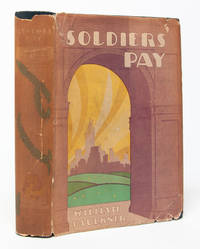
19265660New York: Boni & Liveright 1926. First edition. Near Fine/Very Good. A Near Fine copy of the book in Very Good only dust jacket. Book clean and fresh with a small Nashville bookseller's label on the rear paste-down. Dust jacket only Very Good on account of some moderate chipping at the spine ends and corners one inch tear near the crown repaired on the verso with tape. Flap folds starting to crack reinforced on the verso with archival binder's tape. Spine a bit toned. An uncommon book in dust jacket one of just 2500 copies originally printed. Housed in a custom black quarter-leather slipcase with chemise.<br /> <br /> "Soldier's Pay is William Faulkner's first published novel. It begins with a train journey on which two American soldiers Joe Gilligan and Julian Lowe are returning from the First World War. There they meet a scarred lethargic and withdrawn fighter pilot Donald Mahon who was presumed dead by his family. The novel continues to focus on Mahon and his slow deterioration and the various romantic complications that arise upon his return home.Though the novel was a commercial failure at the time of its publication Faulkner's subsequent fame has ensured its long-term success" Standard Books. Over time the themes of psychological damage and ideological disillusionment that were so uncomfortable to readers just emerging from the war came to be praised for their rawness and honesty. Near Fine in Very Good dust jacket. Boni & Liveright unknown
1929140938541New York: Jonathan Cape & Harrison Smith 1929. First Edition. Near Fine/Very Good. First edition first printing. Bound in publisher's black and white Art Deco style boards over white cloth spine lettered in black. Near Fine with toning to pages and top and bottom edges of covers. In a Very Good first issue dust jacket with Humanity Uprooted priced at $3.00 on the rear panel; toning to spine with fading to red print there light edge wear light soiling and erased pencil notation to rear flap corner. A fantastic copy in the scarce first issue dust jacket. Jonathan Cape & Harrison Smith unknown books
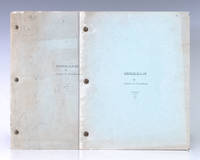
139485Three original typed drafts of William Faulkner's parodical short story "Afternoon of a Cow. By Ernest V. Trueblood." Two complete copies each 17 leaves; bound with brass clasps in green folders with the third copy lacking the first leaf; with 49 strikethroughs in Faulkner's hand throughout most excising a single word. When Faulkner returned to Oxford at the end of World War I he was writing poetry much of it under the influence of the French Symbolists. In the summer of 1919 he borrowed Mallarmé's title "L'Après-midi d'un Faune" for a 40-line poem of frustrated love. The poem appeared in The New Republicon 16 August was a revised version appeared in The Mississippian at Ole Miss in the fall. Early the next year he was to publish in Oxford a poem inviting comparison with François Villon "Une Ballade des Femmes Perdues." As Joseph Blotner says diplomatically "Such poetry unsurprisingly provoked various responses." Parodies began to appear in The Mississippian. One was "Une Ballade d'une Vache Perdue" signed by "Lordgreyson." The poem described the heifer Betsey lost and wandering far from home. "It was an amusing tour de force which Faulkner may have had in mind seventeen years later 'one afternoon' he recalled 'when I felt rotten with a terrible hangover.' He was then working unhappily at Twentieth Century-Fox" Blotner. "The story generates interest because it uses Faulkner himself as a character much in the manner of a post-modernist writer such as Paul Auster. The story reports on a frightened cow that has fallen into a ditch during a fire. The character Faulkner along with Oliver a black butler and Ernest V. Trueblood the first-person narrator of the tale rush to rescue the cow but they are at first unsuccessful. In its fear and distress the cow empties its bladder and bowels upon Faulkner shattering the dignity of the scene. The story ends with Faulkner stripping in the door of the stable and washing. Latter wrapped in a horse blanket he and his friends drink to the cow" Fargnoli & Golay. Faulkner was very fond of this story and thought it particularly funny. On 25 June 1937 he read the story to his guests after dinner in Los Angeles telling them it was the work of a talented boy named Ernest V. Trueblood. The only person who seemed to appreciate the story was his house guest and French translator Maurice Coindreau. The Frenchman was in Los Angeles to discuss his translation of The Sound and the Fury which became one of the most influential and celebrated literary translations of the century. Faulkner gave Coindreau a carbon typescript of the translation as a souvenir. In 1939 Faulkner was to appropriate elements of the story for the mock chivalric romantic treatment of Ike Snopes's love for Jack Houston's cow in The Hamlet. During the war Faulkner approved Coindreau's translation of the story published in the June/July number of Fontaine in Algiers. It first appeared in English in Furiosoin 1947 and was anthologized by Dwight Macdonald in a collection of parodies in 1950. In very good condition. unknown
1930140944636New York: Jonathan Cape & Harrison Smith 1930. First Edition. Fine/Near Fine. First edition first printing first issue text with "I" misaligned on page 11. Bound in publisher's original beige cloth stamped in brown. Fine with faint darkening to cloth at gutters light soiling to textblock edge and rear endsheet. In a Near Fine price-clipped dust jacket with slight soiling slight edge wear slight indentation along front spine fold along gutter. A beautiful bright and clean copy in much nicer condition than as normally found. Jonathan Cape & Harrison Smith unknown
192969733New York:: Harcourt Brace And Company 1929. First edition; first printing; one of only 1998 copies. Publisher's black cloth in dust jacket. Good to very good; with wear to the corners and the extremities of the spine. The jacket is chipped particularly at the backstrip and it has been neatly reinforced on the verso in several places with Japanese tissue. Sartoris is very seldom found with an inscription by Faulkner. 8vo. Inscribed on the front free endpaper: "To Frances Eubanks from Bill Faulkner 25 June 1929." Harcourt, Brace And Company, hardcover
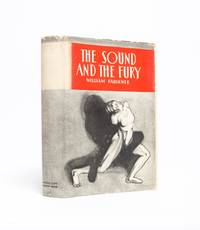
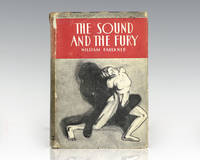
19295279New York: Jonathan Cape and Harrison Smith 1929. First edition. Near Fine/Very Good . A Near Fine copy of the book in a Very Good dust jacket. Book with a bright white spine previous owner's bookplate on the front paste-down and just slight toning and wear at extremities. Jacket with the spine well faded as usual and a small repair to the front lower corner replacing a small chip. Additional wear at the crown but no other repairs or restoration. First state jacket with "Humanity Uprooted" correctly priced at $3.00.<br /> <br /> Faulkner's masterpiece - and one of the towering classics of American literature. The Sound and the Fury follows the travails of the Compsons a once prominent family in Jefferson Mississippi. Originally Faulkner began the work as a group of short stories about the Compsons but decided it would be better suited as a novel - and a very experimental one at that. A contemporary review in the Nashville Tennessean described it: "Not an easy book. It cannot be read objectively; the reader if he is to savor the best in this book must surrender himself entirely. The story has much beauty but it is a beauty that hath terror in it the beauty of pathos and tragedy. Never had I adequately known the meaning of pathos until I read the first part of this book." Faulkner's style was too complex for the novel to be an immediate hit but in time it assumed an important place in the canon and was cited as one of the reasons Faulkner was awarded the Nobel Prize in 1949. The novel appears on Modern Library's 100 Best English Novels of the 20th century and Le Monde's list of the 100 Books of the Century. Near Fine in Very Good dust jacket. Jonathan Cape and Harrison Smith unknown
1929140938541New York: Jonathan Cape & Harrison Smith 1929. First Edition. Near Fine/Very Good. First edition first printing. Bound in publisher's black and white Art Deco style boards over white cloth spine lettered in black. Near Fine with toning to pages and top and bottom edges of covers. In a Very Good first issue dust jacket with Humanity Uprooted priced at $3.00 on the rear panel; toning to spine with fading to red print there light edge wear light soiling and erased pencil notation to rear flap corner. A fantastic copy in the scarce first issue dust jacket. Jonathan Cape & Harrison Smith unknown
193982215Ottawa:: W. L. Massiah December 1939. First separate published edition. original purple velour-finish wrappers stamped in gold. Preserved in a custom quarter morocco clamshell box. A very good copy. Peterson A21.2: "By far the rarest of Faulkner's published books.printed in Canada as an inspirational piece to be distributed at the Christmas season 1939 the first winter of World War II." W. L. Massiah, unknown
1929179027New York: Jonathan Cape and Harrison Smith 1929. First edition in the first issue dust jacket of the author's modernist masterpiece his favourite of his own works: "It's a real son-of-a-bitch. This one's the greatest I'll ever write" quoted in Churchwell. The Sound and the Fury is Faulkner's fourth novel and the second set in the fictional Yoknapatawpha Country Mississippi. Faulkner's first Yoknapatawpha story Flags in the Dust was initially turned down by his publishers and only published after heavy editing as Sartoris 1928. Out of this frustration came The Sound and the Fury: "I continued to shop Sartoris about for three years with a stubborn and fading hope perhaps to justify the time which I had spent writing it. This hope died slowly though it didn't hurt at all. One day I seemed to shut a door between me and all publishers' addresses and book lists. I said to myself Now I can write. Now I can make myself a vase like that which the old Roman kept at his bedside and wore the rim slowly away with kissing it. So I who had never had a sister and was fated to lose my daughter in infancy set out to make myself a beautiful and tragic little girl" Faulkner. Octavo. Original white quarter cloth spine lettered in black black-and-white patterned paper boards and endpapers top edge blue. With dust jacket. Spine ends and joints lightly toned superficial cracks to front inner hinge; jacket rubbed nicks and tears neatly repaired restoration to head of spine and rear panel with two small portions supplied in facsimile flaps unpriced as issued: a very good copy in very good jacket. Sarah Churchwell "Rereading The Sound and the Fury by William Faulkner" The Guardian 20 July 2012; William Faulkner "An Introduction for The Sound and the Fury" The Southern Review 1972 pp. 705-10. hardcover
1932207245New York: Harrison Smith & Robert Haas 1932. First Edition; First Printing. Hardcover. Very Good in a Very Good price clipped dust jacket. All 4 flap corners clipped. Small book store bookplate on bottom of FEP. First Issue with Jefferson' for 'Mottstown' on p340 line 1. Harrison Smith & Robert Haas hardcover
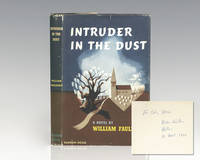
1948114816New York: Random House 1948. First edition of this classic Faulkner novel which explores the lives of a family of characters in the South. Octavo original cloth. Association copy inscribed by the author on the front free endpaper "For Sally Burns William Faulkner 16 April." The recipient Sallie Faulkner Burns was William <span class="match">Faulkner</span>'s first cousin and was a great friend to Maud <span class="match">William</span>'s mother. This was given to her by <span class="match">Faulkner</span> and has remained in the family until now. Near fine in a near fine dust jacket with a touch of rubbing. Jacket design by E. McKnight Kauffer. Housed in a custom half morocco clamshell box. Set in the deep south that provided the backdrop for all of Faulkner's finest fiction Intruder in the Dust is the novel that marks the final phase of its author's outstanding creative period. The chronicle of an elderly black farmer arrested for the murder of a white man and under threat from the lynch mob is a characteristically Faulknerian tale of dark omen its sole ray of hope the character of the young white boy who repays an old favour by proving the innocence of the man who saved him from drowning in an icy creek. Random House hardcover books
193111481JNew York: Jonathan Cape & Harrison Smith 1931. First Edition. Fine copy in a bright attractive dust jacket which has some tiny internal mends to the edges by an expert paper conservationist. Jonathan Cape & Harrison Smith unknown books
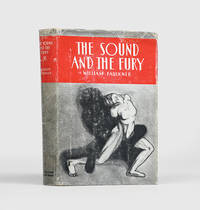
1929112328New York: Jonathan Cape and Harrison Smith 1929. First edition of Faulkner's masterpiece. Octavo original cloth black and white patterned paper boards. Near fine in a very good unrestored first-issue dust jacket with the iconic design by Kathe Kollwitz on the front panel and a price of $3.00 for the book Humanity Uprooted on the rear panel with a chip to the spine. Petersen A6.2a. Brucolli & Clark I:121. Housed in a custom half morocco clamshell box. Although The Sound and The Fury is now considered one of top one hundred novels of the 20th century it actually wasn't initially received well upon publication. This was mostly due to the fact that at the time Faulkner wasn't well-known as a novelist although this was his fourth published work. Because he had not had much commercial success with his first few novels it is believed that the publisher limited the initial printing run to 1789 copies. It wasn't until his novel Sanctuary was published in 1931 that he started being really noticed as a writer and more people started giving The Sound and The Fury more serious attention. The title of the book comes from the famous soliloquy of act 5 scene 5 of Shakespeare's Macbeth. Faulkner literally takes Shakespeare's words and writes a "tale told by an idiot". in this case from the point of view of the members of the Compson family who are former Mississippi aristocrats who fall into financial trouble and over a 30 year period many of whom die tragically in one way or another. Or as Shakespeare put it. "the way to dusty death". Faulkner used a stream of consciousness method conceived by other novelists such as James Joyce and Virginia Wolf. Although this narrative style and lack of regard for sentence structure can often alienate new readers it is considered a masterpiece by literary critics and scholars and played a large role in Faulkner's receiving the Nobel Prize in Literature in 1949. Jonathan Cape and Harrison Smith hardcover books
19291086618vo. New York: Jonathan Cape and Harrison Smith 1929. 8vo. iv 401 pp. Original quarter white cloth and black and white patterned paper boards backstrip lettered in black decorative endpapers that match the covers original pictorial dust-jacket fore-edge uncut. Dust-jacket has a few minor chips along the edges a very good copy. § First edition first printing first issue dust-jacket with “Humanity Uprooted†priced at $3.00. The Sound and the Fury was Faulkner’s fourth novel considered by many to be his masterpiece and a turning point in his work. Here he firmly plants himself however unintentionally in the Southern Renaissance and Modernist movements of the 20th century proving himself to be an uncompromising and distinct voice. Faulkner referred to heroine Caddy Compson as “the daughter of his mind†and regarded this work with the deepest of tenderness. This is the quintessential novel by Faulkner and the crown jewel of any collection. Jonathan Cape and Harrison Smith hardcover books
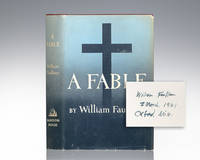
1954145440New York: Random House 1954. First edition of the first novel to win both Pulitzer and National Book Award. Octavo original cloth. Boldly signed by the author on the title page "William Faulkner 2 March 1961 Oxford Miss." Fine in a near fine dust jacket. Jacket design by Riki Levinson. Rare and desirable signed. The Fable won both the Pulitzer Prize and the National Book Award in 1955. An allegorical story of World War I set in the trenches in France and dealing ostensibly with a mutiny in a French regiment it was originally considered a sharp departure for Faulkner. Recently it has come to be recognized as one of his major works and an essential part of the Faulkner oeuvre. Faulkner himself fought in the war and his descriptions of it "rise to magnificence" according to The New York Times and include in Malcolm Cowley's words "some of the most powerful scenes he ever conceived." Petersen A31b Random House hardcover
1948114816New York: Random House 1948. First edition of this classic Faulkner novel which explores the lives of a family of characters in the South. Octavo original cloth. Association copy inscribed by the author on the front free endpaper "For Sally Burns William Faulkner 16 April." The recipient Sallie Faulkner Burns was William Faulkner‘s first cousin and was a great friend to Maud William‘s mother. This was given to her by Faulkner and has remained in the family until now. Near fine in a near fine dust jacket with a touch of rubbing. Jacket design by E. McKnight Kauffer. Housed in a custom half morocco clamshell box. Set in the deep south that provided the backdrop for all of Faulkner's finest fiction Intruder in the Dust is the novel that marks the final phase of its author's outstanding creative period. The chronicle of an elderly black farmer arrested for the murder of a white man and under threat from the lynch mob is a characteristically Faulknerian tale of dark omen its sole ray of hope the character of the young white boy who repays an old favour by proving the innocence of the man who saved him from drowning in an icy creek. Random House hardcover
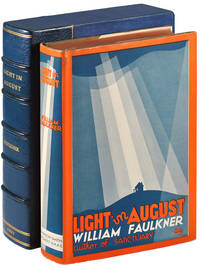
19325215New York: Harrison Smith and Robert Haas 1932. First Edition. Faulkner's seventh novel set in the American South during the days of Prohibition and Jim Crow exploring themes of race class sex and faith. "At its base this is a simple small-town idyll but in execution it becomes a complex novel packed with comedy violent misfortune and implicit moral and social commentary. Four major characters lead frustrated lives: a part-Negro who passes for white and finally ends the victim of a mob; a preacher whose religion doesn't meet reality; a lonely woman; a migratory worker" Coan America in Fiction p.58. One of the defining books of the 1930's and cited in The Modern Library's "100 Best Novels" list. Petersen A13a. First Printing one of 8500 copies. Octavo 21cm; coarse tan cloth with titles stamped in orange and blue on spine and front cover; orange topstain; dustjacket; iv480pp. Fine in a very Near Fine dustjacket unclipped priced $2.50 with some pinpoint wear to extremities and a single tiny tear to upper front joint - a vibrant example rich in color with the spine entirely unfaded. Lacking the original glassine overlay but housed in a custom half-morocco slipcase and chemise. Harrison Smith and Robert Haas unknown
193582231New York:: Harrison Smith and Robert Haas 1935. First edition. publisher's cloth in dust jacket. Usual darkening and partial flaking to the gold lettering on the binding; otherwise a very good copy in a very good jacket which has some fading and browning to the backstrip and back panel. . 8vo. Signed and inscribed by William Faulkner 12 Dec 1935 to Lawrence Edmunds the founder of the Lawrence Edmunds bookshop in Hollywood. Harrison Smith and Robert Haas, hardcover
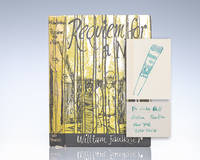
1953144084London: Chatto & Windus 1953. First British edition of the sequel to Faulkner's Sanctuary. Octavo original cloth. Association copy inscribed by the author on the front free endpaper in the year of publication on the title page and with an original drawing by Faulkner on the front free endpaper "For John Bott William Faulkner New York 3 Mar 1953." The recipient John Bott was the City Editor of the New York Post who wore leg braces his whole life due to polio. Bott's friend had just brought him the book from London. Near fine in a near fine dust jacket. Jacket design by Paul Hogarth. A unique example with a wonderful association and with a rare original drawing from the Nobel Prize-winning writer. The sequel to Faulkner's early novel Sanctuary Requiem for a Nun follows the previously introduced characters of Temple Drake her friend later husband Gowan Stevens and Gowan's uncle Gavin Stevens. The events in Requiem are set in Faulkner's fictional Yoknapatawpha County and Jackson Mississippi in November 1937 and March 1938 eight years after the events of Sanctuary. In Requiem Temple now married with a child must learn to deal with her violent turbulent past as related in Sanctuary. Chatto & Windus hardcover
1931140949374New York: Jonathan Cape & Harrison Smith 1931. First Edition. Fine/Near Fine. First edition first printing. iv 380 pp. Bound in publisher's burgundy paper-covered boards over gray spine cloth lettered in burgundy black topstain patterned endpapers matching jacket motif. Very light scuffing to rear board else Fine unread condition. In a Near Fine unclipped $2.50 dust jacket with sunned spine panel very light edgewear including soft horizontal crease near lower edge of front panel faint offsetting from endpapers to flaps and penciled bookseller inscription to rear flap.<br /> <br /> <p>A sensational copy of Faulkner's sensational breakthrough novel a Southern Gothic tale of rape incest and murder. When he first sent the manuscript to Harrison Smith in the summer of 1929 the publisher rejected it with: "Good God I can't publish this. We'll both be in jail." Smith changed his mind the following year after the onset of the Great Depression made him eager for anything that would sell. Sell it did: the book appeared in February 1931 and went through six printings in as many months. Stephen Roberts toned down his 1933 film adaptation The Story of Temple Drake but it was still salacious enough to horrify critics and do well at the box office. William H. Hays hated it. Jonathan Cape & Harrison Smith unknown
193111481JNew York: Jonathan Cape & Harrison Smith 1931. First Edition. Fine copy in a bright attractive dust jacket which has some tiny internal mends to the edges by an expert paper conservationist. Jonathan Cape & Harrison Smith unknown
1959146144New York: Random House 1959. First edition of the final novel in the Nobel Prize-winning author's classic The Snopes Trilogy. Octavo original cloth. Boldly signed and dated by the author on the title page "William Faulkner Oxford Miss 22 Dec 1961." Fine in a near fine dust jacket. Housed in a custom half morocco and chemise box. The Mansion completes Faulkner’s great trilogy of the Snopes family in the mythical county of Yoknapatawpha Mississippi which also includes The Hamlet and The Town. Beginning with the murder of Jack Houston and ending with the murder of Flem Snopes it traces the downfall of this indomitable post-bellum family who managed to seize control of the town of Jefferson within a generation. Random House hardcover