606 résultats
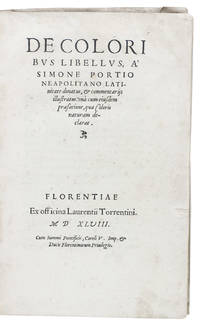
1548642CKI1RIA1QFlorence 1548. 4to. Lorenzo Torrentino Contemporary limp sheepskin parchment straight sewn on 3 wittawed thongs laced through the joints manuscript title down the spine with 4 fragments of a Latin manuscript in an upright humanistic hand on vellum used as spine lining. With 2 large woodcut historiated initials and a vine leaf ornament by Granjon Vervliet 178: 1st recorded in this year. Set in roman types with whole paragraphs in Greek 2 sizes and the dedication and some end matter in italic. 197 3 pp. First edition of one of the earliest printed books about colour translated from the Greek into Latin and with commentary by the Neapolitan physician and philosopher Simone Porzio 1497-1554. Usually attributed to Aristotle it is now thought to be the work of the peripatetic scholar and pupil of Aristotle Theophrastus.''As the author states at the end of the treatise it is intended rather to supply data for a detailed examination into the scientific theory of colour than to expound a complete thesis. He has realized that the development of colour in animals and plants depends to some extent on heat and he seems to suggest that heat and moisture are the controlling factors. It is of more value as a collection of observed facts than for any theory of the origin and development of colour in physical life'' Aristotle Minor Works Cambridge and London Loeb Classical Library 1936 p. 3.With some spotting on the title-page and some marginal tears not approaching the text but otherwise in very good condition and with large margins. Binding with the sewing supports broken a tear in the backstrip and some small stains. An important treatise on colour and one of the earliest.l Adams P1958; Caillet 8881; EDIT16 CNCE 16133; Hoffman I 289 "rare and very important"; Kemp The science of art p. 264; Schwab Bibliographie d'Aristotle 3503; USTC 803281. hardcover
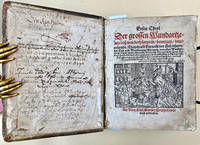
156245126Frankfurt: G. Raben & heirs of W. Hanen 1562. <p>Paracelsus Theophrastus Philippus Aureolus Bombastus von Hohenheim 1493-1541. Erster Ander; Dritter Theil der grossen Wundartzeney . . . von allen Wunden Stich Brendt Thierbissz Beinbrüch . . . 3 vols. in 1 4to. 12 115 1 blank; 12 129 1 colophon; 74ff. Titles in red and black. Large woodcut vignettes on the titles of each volume each illustrating a different medical or surgical procedure; woodcut illustration of surgical instruments on leaf 4 of the Erster Theil; astrological woodcut on f. 64 of the same volume. Frankfurt: G. Raben and the heirs of W. Hanen n.d. 1563. 198 x 150 mm. 16th-century blind-tooled pigskin over wooden boards brass clasps corners worn some age-darkening small wormhole in front cover. Light marginal dampstaining edges frayed some toning title of first part soiled but very good. One or two marginal annotations some notes in different hands on the front and rear pastedowns.</p> <p> Rare Early Illustrated Edition of Paracelsus's Der grossenn Wundartzney first ed. 1536 his first book on surgical technique and the only major book by him published during his lifetime. "Philippus Aureolus Theophrastus Bonbastus von Hohenheim also known as Paracelsus remains one of the most controversial and remarkable personalities of the Renaissance. He has been described as a quack a magician and astrologer and an alchemist as well as a brilliant physician prophet and genius. Sir William Osler called him the ‘Luther of medicine' and Fielding Garrison lauded him as ‘the most original medical thinker of the sixteenth century.' He was perhaps all of these . . . Unlike his contemporaries Paracelsus regarded surgery as no less worthy than medicine writing on both subjects and signing himself Doctor beider Arznei doctor of both medicines. As a surgeon he treated wounds successfully using conservative methods in contrast to the common practice of cauterization with boiling oil. He was the first to agree with the fourteenth-century surgeon Henri de Mondeville that wounds must be kept clean and Garrison described him as ‘almost the only asepsist between Mondeville and Lister'" Grolier Club One Hundred Books Famous in Medicine pp. 61-62.</p> <p> The Grosse Windartzeney provides comprehensive instructions in all areas of surgery and wound management. Treatments are described for wounds caused by arrows bullets burns including those caused by gunpowder and by freezing animal bites including poisoned ones cuts fractures etc. The second book discusses the treatment of open wounds and includes instructions for the preparation of chemical prescriptions for treating venereal diseases sores ulcers fistulae cancerous growths etc. The third book is on syphilis including hereditary syphilis its origin causes symptoms and cures.</p> <p> This edition appears to have been issued at the same time or before Sudhoff's nos. 49-51. The first and second volumes Erster and Ander Theil have the same collations as Sudhoff nos. 49-50 except that the preliminary gatherings are signed with typographical symbols instead of lower-case letters. The first signature of the third volume is the same as Sudhoff 51 with the remainder coming from Sudhoff 29 1553; the publishers Raben and Hanen had taken over the unsold copies from the original publisher Herman Gülfferich and printed new preliminary leaves. Sudhoff Bibliographia Paracelsica 52. </p> . G. Raben & heirs of W. Hanen unknown books
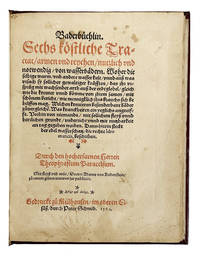
1562676901562. Franckfurt am Mayn bey Weygand Han und Georg Raben 1562. 4º. 3 Teile in 1 Band: Teil: 12 115 Bl.; Teil: 12 129 1 Bl.; Mühlhausen im oberen Elsaß durch Peter Schmid 1562. 4º. 32 Bl. Schweinsledereinband d.Zt. mit Schliessen. Paracelsus Theophrastus Philippus Aureolus Bombastus von Hohenheim. Erster - dritter Theil der grossen Wundartzney deß weitberhümpten bewerten vnd erfahrnen Theophrasti Paracelsi von Hohenheim der Leib vnd Wundartzney Doctoris. & Angebunden: Baderbüchlin. Sechs köstliche Tractat armen und reychen nutzlich und notwendig von wasserbädern . Mit fleyß und müe Doctor Adams von Bodenstein zu einem guten neuwen Jar publicirt. Die "Grosse Wundartzney" gehört zu den einflussreichsten chirurgischen Schriften der frühen Neuzeit und markiert einen Wendepunkt in der praktischen Wundbehandlung in der Ablehnung scholastischer Autoritäten und in der Hinwendung zu einer erfahrungsbasierten am Krankenbett gewonnenen Chirurgie. Der Frankfurter Druck von 1562 bietet in drei Teilen Paracelsus' Lehre von Wunden Schussverletzungen Brandwunden Knochenbrüchen Geschwülsten und anderen chirurgischen Erkrankungen dazu die ausführliche Abhandlung zur "Frantzosischen Kranckheit" Syphilis. Bei der vorliegenden Ausgabe handelt es sich um einen Nachdruck der zweibändigen "Grossen Wundartzney" nach der Augsburger Ausgabe von 1537. Den dritten Teil bildet die Schrift "Von der frantzosischen Kranckheit"; hierfür nutzten Weygand Han und Georg Raben den Nachdruck von 1553 als Vorlage und übernahmen Dessen Druckbogen aus dem Nachlass des Frankfurter Druckers Heinrich Gulfferich für einen Teil der Auflage sogar unverändert. Das angebundene "Baderbüchlin" in der Bearbeitung durch Adam von Bodenstein ist eine eigenständige sehr seltene Publikation über Wasser und Mineralbäder die Paracelsus' balneologische Vorstellungen popularisiert. In sechs "köstlichen Traktaten" richtet sich die Schrift ausdrücklich an "arme und reiche" um den Nutzen der Bäder für Prävention und Therapie verschiedenster Leiden darzulegen. Der Druck bei Peter Schmid in Mühlhausen im oberen Elsass ebenfalls 1562 steht in enger zeitlicher und inhaltlicher Nachbarschaft zur Wundartzney und ergänzt diese ideal um den Bereich der Badetherapie. Die Kombination von vollständiger Frankfurter Wundartzney alle drei Teile und dem zeitgleichen Mühlhauser Baderbüchlin in einem prachtvollen zeitgenössischen Schweinsledereinband mit Schnallen ist äußerst selten. VD16 P 458 Wundartzney; VD16 P 413 Baderbüchlin. Sudhoff Bibliographia Paracelsica Nr. 45 Baderbüchlin und Nr.49-51 Wundtarzney. Ferguson Bibliographia Paracelsica. Schubert Paracelsus Library Drexel Katalog Nr. 25. Fürberth Bäder-Bibliographie Nr. 37. unknown
352610<p>Baderbüchlin. Sechs köstliche Tractat armen und reychen nutzlich und notwendig von wasserbädern . Mit fleyß und müe Doctor Adams von Bodenstein zu einem guten neuwen jar publicirt. 4to 202 x 153 mm. 32 ff. A-H4 last blank title in red and black 2 fine woodcuts bathing scenes the larger one repeated printer's device. Modern red morocco 2 gilt fillets and fleurons on boards spine on raised bands decorated with gilt fleurons edges gilt. Small dampstain on the title page. Mülhausen Peter Schmid 1562.</p><p>The eminently rare first edition of one of the earliest works on hydrotherapy. The treatise is about water-baths thermal springs hot baths etc. and their uses — for rich and poor — describing how they are useful and necessary for health. Paracelsus discusses the therapeutic effects of bathing in water for various illnesses and includes treatments for gout gynaecological disorders paralysis leprosy etc. Some of the most famous health resorts and healing springs are described in: Baden in Aargau Pfäffers Leukerbad Bad Gastein Teplitz Plombières Göppingen and others. The work was published by Adam Bodenstein 1528-1577 who Studied medicine in Basel Freiburg im Breisgau Leipzig and Mainz. In 1553 he entered the service of Otto Heinrich Elector Palatine who urged him to study the Paracelsus manuscripts kept in Neuburg an der Donau. He edited more than forty works and to facilitate understanding of Paracelsus' unusual language wrote an Onomasticon.</p><p>Fine copy with ample margins one of the earliest book printed at Mulhouse.</p><p>Provenance: Dr Maurice Villaret 1877-1946 French neurologist known for his work on the localisation of cerebral vascular lesions; with his bookplate "Morte/ Vita engraved on wood.</p><p>References: Fürberth Bäder-Bibliographie Nr. 37. Sudhoff 45 ; Graesse V 127 ; VD16 P-413</p> Mülhausen, Peter Schmid, 1562.
148316243Treviso: Bartholomaeus Confalonerius 2 Feb 1483. First edition in Latin later issued in Greek with the Aldine Aristotle editions of 1497 and 1498. Folio 153 leaves lacks the front blank and 2 leaves of text supplied in clean facsimile. 28.4'x9.2 cm. Bound in later cloth backed boards some marginal waterstaining contemporary Italian marginalia some trimmed close throughout with a full page of contemporary notes on the verso of the final leaf. HC 15491; BMC VI 894; BM-Ital 668; Klebs 958.1; Garrison 1929 12; Castiglioni 1947 181-182; Stillwell T132; Goff T-155; Pritzel 9184;Osler 263; Stillwell The Awakening . 72; Procter 648; Dibner Heralds of Science 18; Norman 266. Rare this had not been to auction since December of 1967 when it sold for $75000 until it sold for $55200 at the Haskell Norman sale 3/18/1998. Stillwell notes that this is the earliest scientific botany. A study of about 5 plants described according to a rather primitive classification which held however until the mid-sixteenth century. Its ninth section on the medicinal properties of plants"the earliest extant herbal except for fragments of a Greek herbal c. 35 B.C."is believed to have been added somewhat after Theophrastus's time. Known as the founder of scientific botany Theophrastus was born in Lesbos and was Aristotle's most highly regarded student and succeeded Aristotle as head of the Lyceum in Athens. He was a prolific writer yet only these two works survive as major works. His De Historia Plantarum described and classifies several hundred plants while the De Causis Plantarum is a work of etiology: exploring a number of topics including generation seeds and the effects of cultivation on wild species. The Historia divides plants into four main divisions: trees shrubs undershrubs and herbs. The translation is by Theodoros Gaza a Greek who became a leading figure in the Italian Renaissance. This translation was commissioned by Pope Nicholas V 1448-1455 a patron of scholars who wished to set up a library that included Greek texts in Latin. Bartholomaeus Confalonerius 2 Feb unknown books
1589676841589. Conraf Waldkirch 1589-1599 4° mit 10 sich wiederholenden Portraits und Textholuschnitte im letzten Teil Astrologica. 5 geprägte Schweinsledereinbände d.Zt.; vereinzelt Wurmlöcher ohne Textverlust sehr geines Exemplar. Erster bis Zehender Theil der Bücher und Schrifften. Jetzt auffs new auß den Originalien und Theophrasti eigner Handschrifft an tag geben: durch Joh. Huserum. 10 Teile und die Appendices zu Teilen V und X letzterer in 2 Teilen in 5 Bänden. Mit 12 ganzseitigen wiederholten Porträtholzschnitten des Autors mehrfach wiederholten Wappenholzschnitten Druckermarken und 62 Textholzschnitten im Appendix zu Teil X. Titel in Rot und Schwarz. Reich blindgeprägtes Schweinsleder der Zeit Basel Conrad Waldkirch 1589-1591. Seltene erste deutsche Gesamtausgabe der Werke des Theophrast Bombast von Hohenheim genannt Paracelsus 1493-1541 die sog. "Huser'sche Quartausgabe" in der zahlreiche Schriften zum ersten Mal im Druck erschienen und deren Text für alle späteren Ausgaben maßgeblich wurde. Sie kam mit Unterstützung des Kurfürsten und Kölner Erzbischofs Ernst Prinz von Bayern zustande und wurde von dem Paracelsisten Johann Huser 1545-1600 Arzt aus Waldkirch im Breisgau und kurfürstlich-kölnischem Rat herausgegeben vgl. Hirsch-Hübotter III 350. "Wenn man ohne Voreingenommenheit diese Huser'schen Darlegungen über die bei der Sammelausgabe angewendeten Grundsätze und Massnahmen überblickt so kann man ihm die Anerkennung nicht versagen dass er mit Umsichte und Gründlichkeit an die Lösung seiner Aufgabe gegangen ist" Sudhoff S. 374. Die Ausgabe gliedert sich in medizinische Werke Teile I-VI dann die "Bücher in welchen fürnemlich die Kräfft Tugenden und Eigenschafften Natürlicher dingen auch derselben Bereitdungen betreffend die Artzeney beschriben werden neben eingemischten sachen zur Alchemey dienstlich" Teil VII. Es folgen die philosophischen Schriften Teile VIII-X. Der 5. Teil enthält ein Sudhoff unbekannt gebliebenes Sonderblatt eine "Schedula" zu S. 290 sowie einen 228 Seiten und 21 umfassenden Appendix. Mit der häufig fehlenden Foliotafel im 10. Teil zu S. 68 ferner dem Appendix und einem zweiten Anhang mit dem "Fasciculus Prognosticationum Astrologicarum". Zum Appendix gehören auch die Textfiguren und Holzschnitte davon 30 zur "Auslegung der Magisten Figuren im Carthäuser Kloster zu Nürnberg" und 32 "Figurae Magicae Theophrasti" zur "Prognostication auf XXIIII Jahr zukünfftig". Das vorliegende Exemplar enthält alle erschienenen Teile bis auf den Appendix zu Teil VIII jedoch die Appendices zu Teilen V und vor allem X mit dem genannten "Fasciculus prognosticationum astrologicarum". Kollation: Band I Teil I: 10 Bl. 426 S. 1 Bl.; Teil II: 342 S. 1 w. 28 Bl.; Teil III: 4 Bl. 420 S. 51 Bl.; Teil IV: 417 S. 53 Bl.; Teil V: 4 Bl. 332 S. 48 Bl.; 228 S. 21 Bl.; Teil VI: 4 Bl. 440 S. 12 Bl.; Teil VII: 6 Bl. 439 S. 4 Bl.; Teil VIII: 6 Bl. 363 S. 4 Bl. ohne S. 365-428 Appendix zu VIII; Teil IX: 4 Bl. 459 S. 4 Bl.; Teil X: 4 Bl. 491 S.; 275 S. 4 Bl. letztes weiß 106 S. 1 Bl. VD16 P 365 367 369 371 373 375-379. Mook 154-163. Sudhoff 216-225 220a und 225a. Hirsch-Hübotter IV 499. Garrison-Morton 57 Anm. Durling 3514 unvollständig. - Nicht bei Osler Wellcome Waller. Not in Neville Historical Library; not in Maggs 520 and Ferguson; Durling 3514 imperfect; Heirs of Hippocrates only later complete editions not in Osler Wellcome Waller. unknown