APOLLINAIRE (Pre Apollinaire Dellion).Biblio.com
1 004 résultats
1865118028Neuchtel : Lith. de H. Furrer 1865. 320x240mm. page de titre chromolithographie et 24 planches chromolithographies Avec Abbesses du Couvent de la Fille-Dieu en feuille sous cartable demi-toile avec plat cartonn. 548 Lith. de H. Furrer unknown
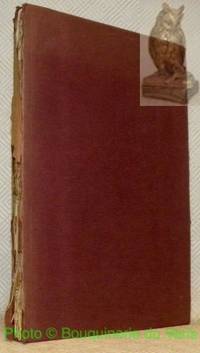
72718Neuchâtel Lith. de H. Furrer 1865. Halbleder gebunden; brauner Einband Rückengoldprägung / Anz. Seiten: 24 / 22 x 31 cm / mit 23 farbig lithografierten Tafeln / Zustand: gut leichte bis mässige Gebrauchsspuren; Buchblock angeplatzt Einband mässig berieben Rücken gebleicht Papier leicht gebräunt und teilweise etwas fleckig Bleistiftbearbeitungen Avec la collaboration de A. de Mandrot Lt. Colonel Fédéral; ohne Tafel 24 Familienwappen - Heraldik Neuchâtel, Lith. de H. Furrer, 1865 unknown
1865104837Neuch‰tel : Lith. de H. Furrer 1865. 300x210mm. page de titre chromolithographiÂŽe et 23 planches chromolithographiÂŽes la derniÂre planches 24 a ÂŽtÂŽ recopiÂŽe ˆ la main. Dos cassÂŽ ˆ faire relier. Rousseurs sur les serpentines planches chromolitographiÂŽes en bon ÂŽtat. 501 Lith. de H. Furrer unknown
0483214132.Gpaperback. Good. Access codes and supplements are not guaranteed with used items. May be an ex-library book. paperback
0483246573.Ghardcover. Good. Access codes and supplements are not guaranteed with used items. May be an ex-library book. hardcover
3388796335.Ghardcover. Good. Access codes and supplements are not guaranteed with used items. May be an ex-library book. hardcover
3388789371.Gpaperback. Good. Access codes and supplements are not guaranteed with used items. May be an ex-library book. paperback
0270566600.Ghardcover. Good. Access codes and supplements are not guaranteed with used items. May be an ex-library book. hardcover
Paris, René Julliard, Sequana, Etudes et Essais, 1945. In-12, broché, 241 pp. Edition originale sans grand papier.
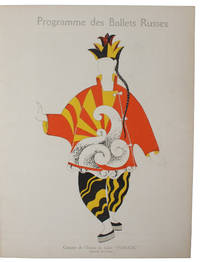
191760103Paris Mai 1917. Folio. Original illustrated extra wrappers with a picture by Picasso on the front and the décor for "Baba Iaga" on the back; original illustrated wrappers for "Théatre du Chatelet" drawing by André Marty on front and advertisements on back in grey and red; original illustrated coloured wrappers for "Programme des Ballets Russes" front wrapper illustrated by Picasso with the Chinaman-costume from "Parade". A bit of soiling to the extra-wrappers and small professional restorations to upper front cover and top of spine this barely noticeable as well as to blank margin of back wrapper. Apart from that an excellent and very well perserved copy with only slight browning to some leaves. Apart from the described wrappers and extra-wrappers there are in all 24 leaves with -mostly photographic- illustrations four of them with original hand-colouring on top and 6 leaves of text.With the original errata-leaf laid in loose stating also that the illustrations "Femmes de bonne humeaur" and "Parade" have been hand-painted by Carlos Socrate after the designs of Bakst and Picasso and that the front wrapper for "Parade" the Chinaman has been handpainted by Picasso himself. <br/><br/><em>Scarce original printing of this seminal avantgarde-publication the May 1917 "Théatre du Chatelet"- publication that presents Diaghilev's "Ballets Russes" in Paris - here containing the entire separate publication mainly devoted to Jean Cocteau's groundbreaking ballet "Parade" - being one of the most important publications in the history of modern art. It is here in his presentation-article to "Parade" that Apollinaire coins the term "surrealism" and thus lays the foundation for the seminal cultural movement that Bréton came to lead. Furthermore the ballet "Parade" represents a historical collaboration between several of the leading artistic minds of the early twentieth century: Erik Satie Jean Cocteau Pablo Picasso Léonide Massine and Serge Diaghilev and is famous not only for its contents and its music but also for its magnificent costumes designed by Picasso the drawings of which are presented in the present publication for the first time - most famously the front cover for the "Parade"-programme which depicts the "Costume de Chinois du ballet "PARADE"/ Aquarelle de Picasso" an etching with original stunning pochoir-colouring hand-painted by Picasso himself!.It is the 1917 ballet "Parade" - the first of the modern ballets - originally presented for the first time in the present publication that marks Picasso's entry into the public and bourgeois institutions of ballet and theatre and presents Cubism on the stage for the first time. The present publication constitutes an outright revolution in the history of art theatre and ballet.Several variants of this spectacular publication exist but the one we have here is as original and complete as it comes containing the entire contents of the different variants. We not only have the extremely scarce and fragile dust-wrapper and the equally scarce illustrated coloured double-wrappers front: "Peinture de Picasso"; back: Décor de Larionow pour le ballet "BABA IAGA"" but also the entire 1917 "Théatre du Chatelet"-programme in original illustrated wrappers with the entire separate "parade"-issue -also entitled "Programme des Ballets Russes"- also in original illustrated wrappers with more than 20 leaves of photographic illustrations containing pictures of the actors and actresses also in their spectacular avant-garde-costumes Bakst's portrait of Leonide Massine Picasso's portrait of Stavinski Bakst's portrait of Picasso Picasso and Massine in the ruins of Pompei Picasso's drawings of a scene from "Parade" and of Massine as well as several mostly humorous advertisements. But more importantly we have apart from the above-mentioned famous Chinaman by Picasso in original pochoir-colouring the other famous etching by Picasso "Costume d'acrobate du ballet "Parade"/ Aquarelle de Picasso" also in original pochoir-colouring bright blue the seminal presentation-article by Apollinaire which coins the term "surrealism" see bottom of description for full translation of this groundbreaking preface the two "Les Femmes de Bonne Humeur"-figures by Bakst Constanza and Battista printed and heightened in gold pochoir the printed costume by Larionow "Les contes russes" which is with original bright red and blue pochoir-colouring and the "Le Mendiant"-costume by Bakst for "Parade" and of course the texts by Bakst on choreography and décor Georges-Michel Ballets Russes after the War as well as the texts for the various ballets listing the actors and their rôles as well as a resume of the plot. " "Tact in audacity consists in knowing how far we may go too far." Jean Cocteau poet writer and arts advocate made this statement in his 1918 manifesto The Cock and Harlequin. Cocteau in collaboration with Erik Satie and Pablo Picasso discovered "how far" to "go too far" in the circus-like ballet Parade-one of the most revolutionary works of the twentieth century. Parade incorporates elements of popular entertainment and uses extra-musical sounds such as the typewriter lottery wheel and pistol combining them with the art of ballet. Cocteau wrote the scenario for the one-act ballet and contracted the other artists. Satie wrote the score to the ballet first in a piano four-hands version and then in full orchestration while Picasso designed the curtain set and costumes. Later Léonide Massine a dancer with the Ballet Russes was brought in as the choreographer. Serge Diaghilev's Ballet Russes premiered the ballet Parade on May 18 1917. The program notes for the ballet were written by the poet Apollinaire. They became a manifesto of l'esprit nouveau or "the new spirit" which was taking hold in Paris during the early twentieth-century. Apollinaire described the ballet Parade as "surrealistic" and in doing so created a term which would develop into an important artistic school." Tracy A. Doyle Erik Satie's ballet PARADE p. 1.When the French poet and army officer Guillaume Apollinaire wrote the program notes For "Parade" he created the manifesto of the "l'esprit nouveau" - "the new spirit". Cocteau had called the ballet "realistic" but Apollinaire took it an important step further and described it as "surrealistic" thus coining a term that would soon develop into an important artistic movement. With Picasso Apollinaire had established the aesthetic principals of Cubism and was considered a leader in the European avant-garde. ENGLISH TRANSLATION OF APOLLINAIRE'S PROGRAMME NOTES TO "PARADE": "Definitions of Parade are blossoming everywhere like the lilac bushes of this tardy spring.It is a scenic poem transposed by the innovative musician Erik Satie into astonishingly expressive music so clear and simple that it seems to reflect the marvelously lucid spirit of France. The cubist painter Picasso and the most daring of today's choreographers Léonide Massine have here consummately achieved for the first time that alliance between painting and dance between the plastic and mimetic arts that is a herald of the more comprehensive art to come. There is nothing paradoxical about this. The Ancients in whose lives music played such an important role were totally unaware of harmony which constitutes the very basis of modern music. This new alliance - I say new because until now scenery and costumes were linked only by factitious bonds - has given rise in Parade to a kind of surrealism which I consider to be the point of departure for a whole series of Manifestations of the New Spirit that is making itself felt today and that will certainly appeal to our best minds. We may expect it to bring about profound changes in our arts and manners through universal joyfulness for it is only natural after all that they keep pace with scientific and industrial progress. Having broken with the choreographic tradition cherished by those who used to be known in Russia under the strange name 'balletomanes' Massine has been careful not to yield to the temptation of pantomime. He has produced something totally new-a marvelously appealing kind of dance so true so lyrical so human and so joyful that it would even be capable if it were worth the trouble of illuminating the terrible black sun of Dürer's Melancholy. Jean Cocteau has called this a realistic ballet. Picasso's cubist costumes and scenery bear witness to the realism of his art. This realism - or this cubism if you will - is the influence that has most stirred the arts over the past ten years. The costumes and scenery in Parade show clearly that its chief aim has been to draw the greatest possible amount of aesthetic emotion from objects. Attempts have often been made to return painting to its barest elements. In most of the Dutch painters in Chardin in the impressionists one finds hardly anything but painting. Picasso goes further than any of them. This is clearly evident in Parade a work in which one's initial astonishment is soon replaced by admiration. Here the aim is above all to express reality. However the motif is not reproduced but represented-more precisely it is not represented but rather suggested by means of an analytic synthesis that embraces all the visible elements of an object and if possible something else as well: an integral schematization that aims to reconcile contradictions by deliberately renouncing any attempt to render the immediate appearance of an object. Massine has Adapted himself astonishingly well to the discipline of Picasso's art. He has identified himself with it and his art has become enriched with delightful inventions such as the realistic steps of the horse in Parade Formed by two dancers one of whom does the steps of the forelegs and the other those of the hind legs. The fantastic constructions representing the gigantic and surprising features of The Managers far from presenting an obstacle to Massine's imagination have one might say served to give it a liberating impetus. All in all Parade will change the ideas of a great many spectators. They will be surprised that is certain; but in a most agreeable way and charmed as well; Parade will reveal to them all the gracefulness of the Modern movements a gracefulness they never suspected. A magnificent vaudeville Chinaman will make their imaginations soar; the American Girl cranking up her imaginary car will express the magic of their daily lives whose wordless rites are celebrated with exquisite and astonishing agility by the acrobatin blue and white tights." </em> unknown
9788573210545ILUMINURAS. new. Esse livro do poeta modernista francs foi publicado em 1911 com xilogravuras de Raoul Dufy reproduzidas nesta edio. Nele o autor dialoga com a tradio os besti�rios medievais somados poesia emblem�tica da renascena e tamb�m retoma pelo vi�s humor�stico a poesia de circunstncia moda de Mallarm�. ILUMINURAS unknown
1978BN257000Frankfurt am Main : Suhrkamp 1978. 1978. Bestiarium oder das Gefolge des Orpheus. Mit Holzschnitte von Raoul Dufy. Ins Dt. übertr. von Karl Krolow / Bibliothek Suhrkamp ; Bd. 607 <br/><br/>Bestiarium oder das Gefolge des Orpheus. Mit Holzschnitte von Raoul Dufy. Ins Dt. übertr. von Karl Krolow / Bibliothek Suhrkamp ; Bd. 607 Guillaume Apollinaire Frankfurt am Main : Suhrkamp unknown
195911585Giessen, Walltor 1959. 1959. 30 ungez. S. m. Orig.-Linolschnitten von Flora Klee-Palyi, OKart.
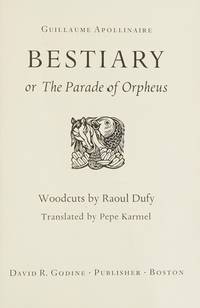
198382820David R Godine Publishers Inc U.S. As New. 1983. Hardcover. 0879233192 . FREE UPGRADE to Courier/Priority Shipping Upon Request - IN STOCK AND IMMEDIATELY AVAILABLE FOR SHIPMENT - AS NEW THE TEXT BLOCK IS PRISTINE CLEAN UNMARKED AND IN EXCELLENT CONDITION - - - Corresponds to ISBN: 0879233192.66 pages. -- with a bonus offer-- . David R Godine Publishers Inc, U.S. hardcover
198082819Godine. As New. 1980. Paperback. FREE UPGRADE to Courier/Priority Shipping Upon Request - IN STOCK AND IMMEDIATELY AVAILABLE FOR SHIPMENT - AS NEW THE TEXT BLOCK IS PRISTINE CLEAN UNMARKED AND IN EXCELLENT CONDITION - - 67 pages 30 illus. ; small 8vo. -- with a bonus offer-- . Godine paperback
Q-1567921426David R. Godine Publisher 2014-11-01. Paperback. New. In shrink wrap. Looks like an interesting title! David R. Godine, Publisher paperback
0879233591New. paperback. New. Satisfaction Guaranteed or your money back. paperback
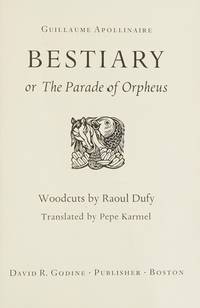
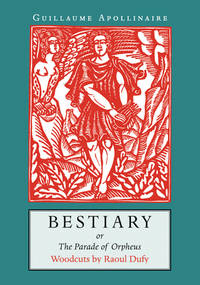
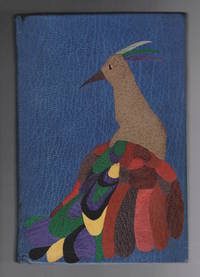
19801233Boston: David R. Godine. 1980. First Edition Thus. Hardcover. Fine. Spine has a slight vertical curve from the binding process. The clamshell box has Traces of glue on the underside of the tail at the hinge not visible unless viewed from the bottom and the cloth has a faint tiny lighter spot at the head of the spine.; This is a "bestiary" that begins with the likely-mythical ancient Greek poet and prophet Orpheus. Although Orpheus is granted only the first 4 lines in this collection of 30 tiny poems the following 29 describe the birds fish mammals insects and various living things that Orpheus was reputed to enthrall and control with the beauty of his music and singing. Bound in a stunning bespoke binding of multi-color Morocco goat leather onlay depicting a stylized male peacock with its feathers spilling down the front cover. The back cover is a multi-color onlay of a geometric design. Colors are vibrant hues with at least 10 different green blues reds burnt oranges and motley colors in the tail feathers. The large blue area of leather wraps from front around the spine and onto the back. Into that are pieced 60 pieces of dyed leather cut to fit together. The precision of the cuts and fitting is remarkable with no gaps visible. The title is blind stamped in gilt on the spine. The pastedowns and endpapers were marbled in-house by the bindery and the blues and browns complement the binding. Bound in the 1990s by Talin Bookbindery this is the second of only two unique copies not originally for sale but intended to be examples of the bindery's finest work. The first copy was sold when they were soliciting binding work as an exhibitor at a book fair. Later lacking an example to exhibit Jim Talin bound this second copy with an onlaid peacock in a different design and colors with a gilt title gilt text block edges and clamshell box. The bindery is no longer doing this type of work and will produce no more onlay bindings. The clamshell box by Talin is in fine blue cloth over boards and lined with blue honeycomb-grained French paper debossed "Canson Mi-Teintes". A title label is laid down to the spine with the title gilt a blind stamped device and two thin gilt rules. Before the bespoke binding this book started life as a well-designed 1980 David R. Godine edition in soft cover. Michael and Winifred Bixler set this book in Monotype Dante originally designed by Giovanni Mardersteig and the type would have been cast at The Bixler Press and Letterfoundry in Skaneateles New York. Printed on Mohawk Vellum paper. This 12mo book is 7 1/4" x 5" and is paginated 4vii-xiblank22-6616 blank for 80 pp. The last leaf is embossed at the tail "HAND BOUND BY / TALIN BOOKBINDERY / CAPE COD".A Talin binder's label is at the tail of the rear pastedown. First published in 1911 this Bestiary is a collaboration between author Guillaume Apollinaire and artist Raoul Dufy who contributed the 30 bold whimsical monochrome wood cuts to match the verses. Translated by Pepe Karmel who wrote the Translator's Note. All verses are presented in the original French and then the English translation. An unattributed Biographical Note about Apollinaire is included. Per Philip Hofer 1898-1984 book collector and founder of the Department of Printing and Graphic Arts Houghton Library Harvard University the 1911 bestiary was the "first monumental French illustrated book of the twentieth-century" and "Dufy's first published and most important illustrations." Talin's choice of a peacock binding is apt for representing the tone of Guillaume Apollinaire's translated verses: Le Paon / En faisant la roue cet oiseau / Dont le pennage traie à terre / Apparait encore plus beau / Mais se découvre le derrière. The Peacock / Whe he spreads his tail this bird / Who drags his plumage on the grass / May grow in beauty / But he also bares his ass. This is a clean sharp and unique example of the binder's art never to be reproduced. This is a Fine example in a Near Fine clamshell box.; Woodcuts; 12mo 7" - 7½" tall; 80 pages . David R. Godine hardcover
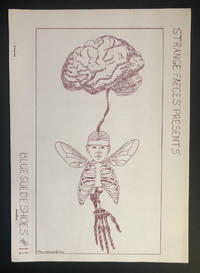
1972OLN394<p>London: The Strange Faeces Press 1972. 1st edition. Soft cover. Fine/No Jacket as issued. Near Fine. 4to 38pp mimeographed stapled wrappers. 1 of 200 copies. Scarce crossover issue with Strange Faeces of this experimental poetry magazine edited by Keith Abbott. Nice unmarked copy from the collection of publisher Opal Louis Nations minor wear.</p> London: The Strange Faeces Press paperback
Mm235x300 Volume rilegato di pp. 153+indice, con illustrazioni in bianco e nero e tavole a colori, privo di sovraccoperta editoriale. In buono stato. SPEDIZIONE IN 24 ORE DALLA CONFERMA DELL'ORDINE.
0365966304.Gpaperback. Good. Access codes and supplements are not guaranteed with used items. May be an ex-library book. paperback
0266703496.Gpaperback. Good. Access codes and supplements are not guaranteed with used items. May be an ex-library book. paperback