[BROADSIDE BALLAD]Biblio.com
57 résultats
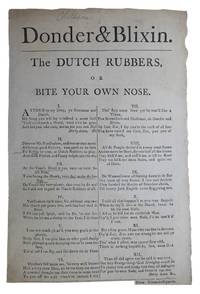
AQ25363London: Printed by W. & T. Bailey s.d. c.1785-1799 Single leaf broadside edges uncut. Shaving to foot with loss of imprint. A remarkably rare survival of 'three-half-pence' broadside verse satire in which a fight breaks out among a group of Dutchmen in a Chelsea tavern. The title of the bawdy ballad is a corruption of the Dutch expression 'donder en bliksem' meaning 'thunder and lightning'. ESTC records a single copy Oxford. ESTC N71592. Dimensions 200 x 290 mm. [Printed by W. & T. Bailey], [s.d., c.1785-1799] unknown
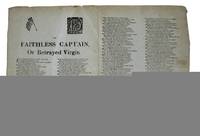
AQ31852London: J. Pitts s.d. c. 1820-44 Single leaf broadside edges uncut. Printed in four columns. With three woodcut vignettes. Old central vertical fold. A trifle creased and marked. A rare survival of a broadside ballad in which the captain of a ship bound for India discovers on board the young servant girl whom he had pledged to wed but then abandoned. He finds that she is carrying his child and though at first angered by her 'betrayal' agrees to marry. However 'fortune to them proves unkind' and a storm descends upon them sweeping the maiden into the sea. When the captain finds her body 'floating on the main' two days later he casts himself overboard to 'share the same fate'. The publishing house of John Pitts 1765-1844 was responsible for a prodigious output of cheap popular printing in the first half of the nineteenth-century. COPAC records copies at just two locations BL and Hull; OCLC adds two further Adelaide and Toronto. . Dimensions 360 x 250 mm. [J. Pitts], [s.d., c. 1820-44] unknown
183029079London: H. Disley 1830. Good overall. That's Where You're Wrong' includes references to emigration to Canada a spirited revolutionary song: "Rise Britons rise and ring your voices thro' the land…"<br /> <br /> This is a broadside ballad were sold for half a penny or penny on the streets in London Manchester and other British cities during the 19th century. Once newspapers became more widespread and cheaper they largely displaced this type of street literature. Printed on cheap tissue paper they included religious warnings political arguments satire comedy bawdy tales crime news fantastic tales love and relationship advice and calls for social reform. In some cases the printer would suggest a familiar tune that would fit the lyrics provided. Most had a woodcut illustration although it may have been unrelated to the subject matter. Many broadside ballads in London were printed in the Seven Dials district. They were sold in large numbers on street corners in squares and at fairs by travelling ballad singers and also pinned on the walls of alehouses where they were sung and read. However because they were meant to be disposable presaging both the consumer culture and mass media relatively few have survived. 7 1/2 by 9 1/2 inches toned edges chipped fold line repaired. H. Disley unknown
29078London. First line: "Have you heard of the rumpus there was I declare All the Popes in the world was in Belgrave Square…"<br /> With The Wonderful Crocodile. "Now list ye landmen all to me To tell you truth I'm bound What happen'd to me by going to sea…"<br /> <br /> According to Burl Ives this tune was based on an old Irish air. John and Alan Lomax collected it in Nova Scotia in 1921 from a man who said it was a song he'd known since he was a boy - "one of thoses that used to be roared out in the back rooms of taverns frequented by seamen forty or so years ago."<br /> <br /> This is a broadside ballad were sold for half a penny or penny on the streets in London Manchester and other British cities during the 19th century. Once newspapers became more widespread and cheaper they largely displaced this type of street literature. Printed on cheap tissue paper they included religious warnings political arguments satire comedy bawdy tales crime news fantastic tales love and relationship advice and calls for social reform. In some cases the printer would suggest a familiar tune that would fit the lyrics provided. Most had a woodcut illustration although it may have been unrelated to the subject matter. Many broadside ballads in London were printed in the Seven Dials district. They were sold in large numbers on street corners in squares and at fairs by travelling ballad singers and also pinned on the walls of alehouses where they were sung and read. However because they were meant to be disposable presaging both the consumer culture and mass media relatively few have survived. 7 1/2 by 10 inches. Edges slt ruffled o/w vgc. unknown
22259Printed by 'William Thomas Argraffydd Caerfyrddin.' No date late Vicvtorian. The title is 'Hanes alarus am 26 o golliers a gollasant eu bywydau yn pwll glo Bedwellty gerllaw Tredegar Dydd Gwener Mehefin 16 1865.' This may be translated as 'The woeful tale of 26 colliers who lost their lives in the Bedwellty coal mine near Tredegar Friday 16 June 1865. 4pp 16mo 15.5 x 9 cm. Paginated 1-4. Bifolium. Printer's slug at foot of last page. Disbound. A frail survival: aged and worn. Beneath the title and covering the rest of the first page is a list of 25 of the deceased their ages and dependents headed 'ENWAU Y PERSONAU.' The first entry in the list is 'Thomas Meredith 50 oed priod ac un plentyn'; and the fourth 'Lewis Lewis 40 gweddw a phump o blant'. The poem in sixteen four-line stanzas covers pp.2-4 and is headed 'HANES ALARUS.' No copy in the National Library of Wales. The only copy of this item located either on OCLC WorldCat or on COPAC is at Swansea University where it is bound with other pamphlets by Carmarthen printers. Printed by 'William Thomas, Argraffydd, Caerfyrddin.' No date [late Vicvtorian]. unknown
1860214168Glasgow: Printed for the Booksellers" 1860. No. 20 printed at foot of title. Title with woodcut vigentt of "Fair Rosanna". 8 pp. 1 vols. 12mo. Single sheet folded twice; unopened and unbound. A little dusty and wrinkled otherise very good. No. 20 printed at foot of title. Title with woodcut vigentt of "Fair Rosanna". 8 pp. 1 vols. 12mo. <br/><br/> Printed for the Booksellers" unknown
40506New York: H. De Marsan n.y. Broadside. 6¼" X 10". Very good. Numerous edge chips along right side and bit on lower edge only slightly encroaching on decorative border. This crudely printed broadside ballad undated but circa 1861 includes a thick decorative patriotic border featuring red and blue stars and stripes olive-branch clutching American Eagle etc. with publisher's data "H. De Marsan Publisher / 54 Chatham St. / N.Y." at bottom center of border. Sung to the tune of "Marshal Ney" a popular tune celebrating the Napoleonic figure this Civil War tune celebrates the 69th New York Infantry Regiment the "Fighting Irish" or "Fighting Sixty-Ninth." Two stanzas and one chorus are featured the chorus reading: "Right and left -- left and right: / We fought the Rebels with all our might; / Brave CORCORAN did wounded fall / And HAGGERTY died by a Traitor's ball." Irish-born Michael Corcoran 1827-63 led the 69th at the First Battle of Bull Run in July 1861 in which he was taken prisoner and Irish-born Captain James Haggerty the first member of the 69th to die was reportedly killed by a Louisiana Zouave which also included many Irishmen. These "penny ballads" were all the rage during much of the 19th century and were invariably printed on thin delicate stock and sold by street vendors. A quite attractive example of this rare survivor. Inkstamped on verso is "Geo. F. Hambrecht" -- a well-known Civil War collector and noted Lincoln scholar 1871-1943 who founded the Lincoln Fellowship of Wisconsin and served as director of the Wisconsin State Board of Vocational Education. H. De Marsan unknown