BROADSIDE BALLADBiblio.com
57 résultats
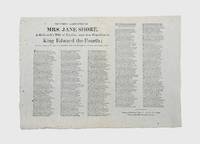
1810174973London: printed and sold by J. Pitts c.1810. An ephemeral broadside ballad detailing the story of Jane Shore a mistress of Edward IV and a popular cultural reference for many centuries. Shore's heavily fictionalized story featured many elements considered to have mass appeal in the era: a sexually voracious woman a relationship that transcended social hierarchies and an ending that punished transgressive behaviour. In Mrs. Jane Shore the eponymous character is described as a married woman who became King Edward's concubine and "lived in the court/With lords and ladies of great sort". Whilst she had influence over the King she ensured "to help the people that were poor" and "sav'd their lives condemned to die". Regardless her infidelity ultimately led to her social disgrace and she died in a ditch in East London. As detailed in the ballad urban mythology claimed that her unfortunate death gave the Shoreditch district its name. Ballads such as this were sung in a variety of communal spaces including pubs lodging houses and the streets and typically took criminal or socially deviant behaviour as their subject. In their own time broadside ballads were believed "to foster immorality and to glorify crime" O'Brien p. 16. More recent interpretations appreciate their literary and social value and consider that "their job was to voice tensions to work over the contradictions of human life" Gammon p. 237. Landscape single sheet 362 x 252 mm printed in columns. A little chipped at the edges but overall a well-preserved copy of a fragile publication. Vic Gammon "Song Sex and Society in England 1600-1850" Folk Music Journal vol. 4 no. 3 1982; Ellen L. O'Brien "'The Most Beautiful Murder': The Transgressive Aesthetics of Murder in Victorian Street Ballads" Victorian Literature and Culture vol. 28 no. 1 2000. unknown
19862111902153303475Kokusho Publishing Association 1986. Soft Cover. Fine. Number of books: 1 Kokusho Publishing Association paperback
40506New York: H. De Marsan n.y. Broadside. 6¼" X 10". Very good. Numerous edge chips along right side and bit on lower edge only slightly encroaching on decorative border. This crudely printed broadside ballad undated but circa 1861 includes a thick decorative patriotic border featuring red and blue stars and stripes olive-branch clutching American Eagle etc. with publisher's data "H. De Marsan Publisher / 54 Chatham St. / N.Y." at bottom center of border. Sung to the tune of "Marshal Ney" a popular tune celebrating the Napoleonic figure this Civil War tune celebrates the 69th New York Infantry Regiment the "Fighting Irish" or "Fighting Sixty-Ninth." Two stanzas and one chorus are featured the chorus reading: "Right and left -- left and right: / We fought the Rebels with all our might; / Brave CORCORAN did wounded fall / And HAGGERTY died by a Traitor's ball." Irish-born Michael Corcoran 1827-63 led the 69th at the First Battle of Bull Run in July 1861 in which he was taken prisoner and Irish-born Captain James Haggerty the first member of the 69th to die was reportedly killed by a Louisiana Zouave which also included many Irishmen. These "penny ballads" were all the rage during much of the 19th century and were invariably printed on thin delicate stock and sold by street vendors. A quite attractive example of this rare survivor. Inkstamped on verso is "Geo. F. Hambrecht" -- a well-known Civil War collector and noted Lincoln scholar 1871-1943 who founded the Lincoln Fellowship of Wisconsin and served as director of the Wisconsin State Board of Vocational Education. H. De Marsan unknown
29078London. First line: "Have you heard of the rumpus there was I declare All the Popes in the world was in Belgrave Square…"<br /> With The Wonderful Crocodile. "Now list ye landmen all to me To tell you truth I'm bound What happen'd to me by going to sea…"<br /> <br /> According to Burl Ives this tune was based on an old Irish air. John and Alan Lomax collected it in Nova Scotia in 1921 from a man who said it was a song he'd known since he was a boy - "one of thoses that used to be roared out in the back rooms of taverns frequented by seamen forty or so years ago."<br /> <br /> This is a broadside ballad were sold for half a penny or penny on the streets in London Manchester and other British cities during the 19th century. Once newspapers became more widespread and cheaper they largely displaced this type of street literature. Printed on cheap tissue paper they included religious warnings political arguments satire comedy bawdy tales crime news fantastic tales love and relationship advice and calls for social reform. In some cases the printer would suggest a familiar tune that would fit the lyrics provided. Most had a woodcut illustration although it may have been unrelated to the subject matter. Many broadside ballads in London were printed in the Seven Dials district. They were sold in large numbers on street corners in squares and at fairs by travelling ballad singers and also pinned on the walls of alehouses where they were sung and read. However because they were meant to be disposable presaging both the consumer culture and mass media relatively few have survived. 7 1/2 by 10 inches. Edges slt ruffled o/w vgc. unknown
1332211437.Gpaperback. Good. Access codes and supplements are not guaranteed with used items. May be an ex-library book. paperback
2014108521Museum. New. 2014. Paperback. 0942949382 . FREE UPGRADE to Courier/Priority Shipping Upon Request - IN STOCK AND IMMEDIATELY AVAILABLE FOR SHIPMENT - Flawless copy brand new pristine never opened - -- with a bonus offer-- . Museum paperback
20775Paperback. New. paperback