Ripa Cesare PeruginoMareMagnum

187 résultats
<p>23 cm, in 4°, rilegatura coeva in pergamena morbida a tre nervi, titolo manoscritto al dorso ed al taglio inferiore, p. (1),(48), 648,(1). Antiporta con grande marca tipografica, grande ritratto dell'autore a tutta pagina. Oltre trecento illusrtazioni xilografiche nel testo, sempre addornate da cornice tipografica. Restauro professionale al bordo bianco esterno delle prime 9 carte, alcuni aloni marginali, più evidenti nella parte finale del volume. Piccoli antichi tratti di inchiostro al frontespizio. Titolo esteso: Nova iconologia di Cesare Ripa perugino caualier de ss. Mauritio, & Lazzaro. Nella quale si descriuono diuerse imagini di virtu, vitij, affetti, passioni humane, arti, discipline, humori, elementi, corpi celesti, prouincie d'Italia, fiumi, tutte le parti del mondo, ed' altre infinite materie. Opera vtile ad oratori, predicatori, poeti, pittori, scultori, disegnatori, e ad'ogni studioso per inuentar concetti, emblemi, ed imprese, Per diuisare qualsiuoglia apparrato Nuttiale, Funerale, Trionfale. Per rappresentar Poemi Drammatici, e per figurare co`suoi propij simboli ciò, che può cadere in pensiero humano. Ampliata vltimamente dallo stesso auttore di trecento imagini, e arricchita di molti discorsi pieni di varia eruditione; con nuoui intagli, e con molti indici copiosi. Straordinario apparato iconografico nell'ultima edizione curata dal Ripa. Esemplare in eccellenti condizioni corredato dalle freschissime llustrazioni.</p>
0184-Bo.J. Radierung, 1811, nach Eberhard Waechter (1762-1852), auf festem Velin, 34,7:48,5 cm. Insgesamt nicht ganz frisch. Die Vorlage zu dieser Graphik bildet eine Kreidezeichnung Waechters, die im Mai 1833 auf der Kunstausstellung in Stuttgart ausgestellt und für die Verlosung angekündigt war. 1854 wurde sie auf der allgem. Kunstausstellung in München gezeigt. Literatur: Nagler 26. Vergleichsliteratur: Boetticher Bd. II, Teil II, S. 958, II. Cartons, Zeichnungen, Nr. 11; Ausst. Katalog: Allgemeine Deutsche Kunstausstellung München 1854, Nr. 445; Katalog: Die Zeichnungen und Aquarelle des 19. Jahrhunderts in der Graphischen Sammlung der Staatsgalerie Stuttgart. Bearb. von Ulrike Gauss. Stuttgart, 1976, Nr. 1584, Abb. Tafel CXCVIII. - Selten!
139-Do.J. Feder und Pinsel in Grau, grau laviert, über Skizze in schwarzer Kreide, auf Bütten mit Fragment des Wasserzeichens: großes bekröntes Lilienwappen; mit mehreren Beschriftungen innerhalb der Darstellung. 34,2 x 21,5 cm. Die Aufschriften in holländischer Sprache bedeuten: ?Een karans van moerbije..? = Ein Maulbeerkranz, ?Olijf krans? = Olivenkranz; ?Plutus beelt? = Plutus Statue. Die Allegorie bedeutet: Frieden bringt Wohlfahrt. Die Frauenfigur links trägt einen phrygischen Hut, Symbol der Freiheit. Der Caduceus in ihrer rechten Hand bedeutet Frieden. Die Frau mit dem Olivenkranz (auch ein Friedenssymbol) entzündet Waffen neben einer Figur mit einem Blasebalg und einer Flamme. In der Korngarbe befindet sich eine Skulptur des Plutus, Gott des Reichtums. Für den Hinweis auf den Künstler und die Bestimmung des Bildmotivs danken wir Dr.E.P. Löffler, Rijksbureau voor kunsthist. Documentatie, Den Haag (Brief vom 14.09.2004). Vergleichsliteratur: Ausst. Katalog: ?Götter und Helden für Berlin. Gemälde und Zeichnungen von Augustin und Matthäus Terwesten. Zwei niederländische Künstler am Hofe Friedrichs I. und Sophie Charlottes. Berlin-Brandenburg, Stiftung Preuss. Schlösser und Gärten, 1995, Nr. 7.1 f.). Wohl Entwurf für eine Dekorationsmalerei.
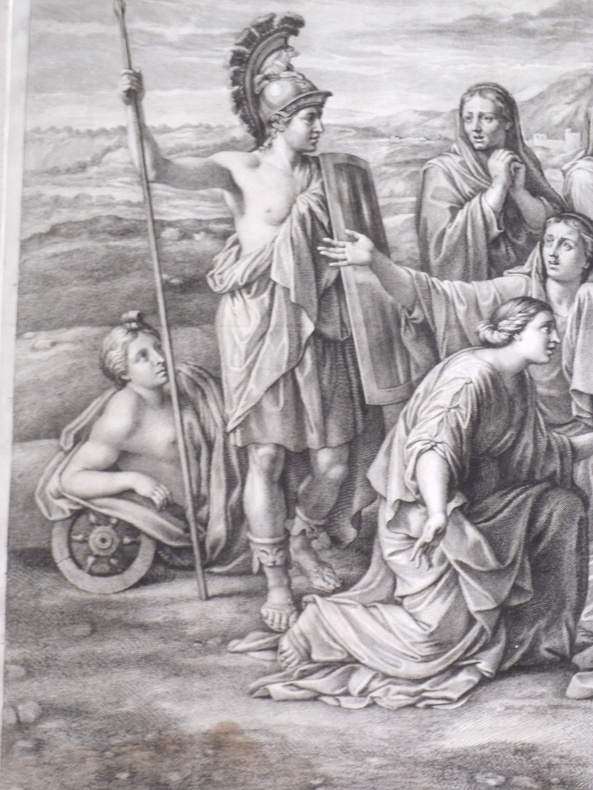
13375AUDRAN Gérard. CORIOLAN devant ROME AINSY SE DOIT FLECHIR LA COLERE ET L’ORGUEIL. CORIOLAN. Estampe gravée au burin, à l’eau forte et la pointe sèche, en deux feuilles, d’après le tableau de Nicolas POUSSIN. Format 992x663mm à la cuvette. 995x735mm .Marges courtes. Marge inférieure, et pliure, renforcées avec de pâles mouillures, surtout visibles au verso. En marge inférieure on peut lire : Caius Marcius Coriolan assiégea Rome irrité de ce que le peuple romain lui avoit refusé le consulat et l’avoit ensuite banni. I il rejeta toutes les propositions de paix qui lui furent proposées et ne se laissa fléchir qu’aux larmes de sa mère et de sa femme accompagnées des dames romaines qui lui montrèrent la fortune de Rome renversée. Nicolas POUSSIN pinxit en marge inférieure gauche gravée par AUDRAN Paris Rue St Jacques aux 2 piliers d’or, avec privilège du Roy « Alexandre vainqueur et maître du camp des perses après la bataille d’Issus, visite , accompagné seulement d’Ephestion, les princesses demeurée prisonnières. La Reine, épouse de Darius lui présente son fils. Statira et sa jeune sœur se jettent à ses pieds. Sisygalhis, mère du monarque vaincu, confuse d’avoir pris Ephestion pour Alexandre, reçoit du héros cette réponse : Non ma Mère, vous ne vous êtes pas trompée, celui-ci est un autre Alexandre. »
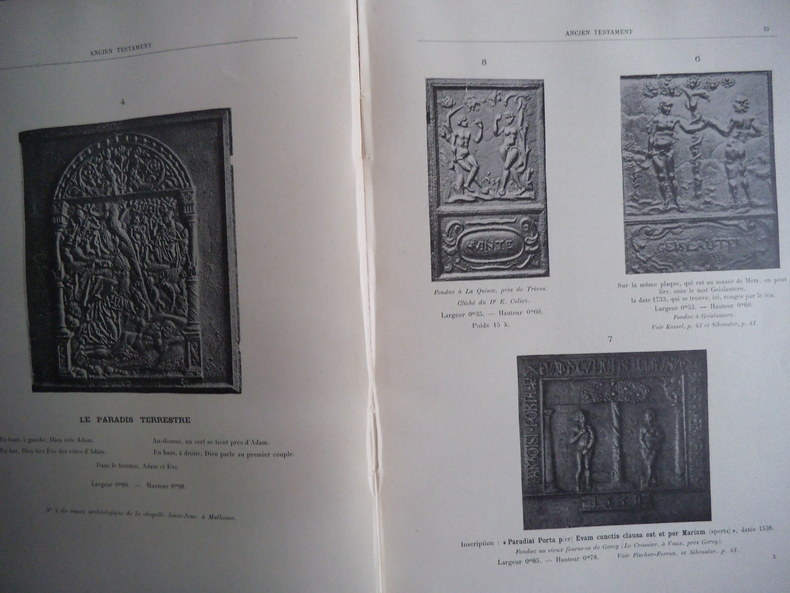
9197in 4 cartonné, premier de couverture avec titre, contrecollé. Faux-titre, titre, 474 pages, 1 page erratum, portrait de l’auteur, de profil 1912 en dernière page. 1290 plaques reproduites par la photo avec leurs descriptions, non rogné. Histoire des plaques- Ancien Testament-Nouveau Testament-Décor-allégories-divers-Armes de France-Armoiries déterminées-mythologie-histoire. En vente chez l’auteur. Chez J FLORANGE expert en médailles Paris 1912.Edition originale, numérotée et tirée à 225 exemplaires sur papier des papeteries du Marais. Tome 1er. Le second n’est jamais paru. Très bon état, pas de rousseurs. Fort rare
0407-Bo.J. Radierung mit zartem Plattenton, ?inv. 1824?, auf chamoisfarbenem Velin. 15,4:17 cm. Provenienz: Doublette Königliches Kupferstichkabinett, Berlin, mit Veräußerungsstempel, vgl. Lugt 1610. Literatur: Stoll 138. - Sehr guter Abdruck mit vollem Rand. Mehrere Feder- und Bleistiftstudien belegen, wie sich Ludwig Emil Grimm mit seiner Bildidee, die Vergänglichkeit alles Irdischen darzustellen, auseinandersetzte. Nach mehreren Entwicklungsstadien entstand schließlich die vorliegende Fassung, ein ?Memento mori?, ikonographisch eigenwillig und ungewohnt.
0124-Bo.J. 2 Aquatintaradierungen in Braundruck, 1816, Darstellungen im Hochoval, mit 3zeiligem Text unter den Darstellungen, auf cremefarbenem Velin. Je 24,1:18,4 cm. Literatur: Nagler 17 und 18. - Sehr gute Abdrucke mit Rändchen um die Plattenkanten, 1 Blatt mit sorgfältig restauriertem Einriß oben.
0809-Bo.J. Kupferstich, von Julius Theater (1804-1870), auf aufgewalztem China. 22:22,7 cm. Sehr guter Abdruck mit vollem Rand an drei Seiten, oben auf die Plattenkante geschnitten (es handelt sich um die untere Hälfte einer Seite, auf der sich zwei Kupferstiche befanden). Das Gemälde von L. Seidler war 1831 vom Sächsischen Kunstverein angekauft worden (vgl. Boetticher Bd. II, Tl. II (Seidler), I, 13).
In-8°; pp. (16), 174, (1), frontespizio illustrato inciso su legno; nel testo ritratto e 1 xilografia a piena pagina, 15 vignette incise su legno nel testo (tra cui una curiosa immagine i un giullare che cavalca un’aragosta; suddiviso in tre parti ciascuna con il titolo in cornice xilografica architettonica, all’ultima carta marca tipografica. LEgatura in piena pergamena unghiata. Un timbro a inchiostro al verso del frontespizio, un piccolo foto di tarlo alle ultime carte.
1659ALDR0606Amstelodami, Apud. Ioh. Ianßonium Iuniorem (Amsterdam, Jan Jansson) 1659. 12°. Gest. Titelbl., 11 nn. Bll., 831 S., 2 nn. Bll., mit 104 gestochenen Illustrationen. Pergamentband d. Zeit, mit Rückenbeschriftung von alter Hand, verfärbt und braunfleckig, Pergament entlang des hinteren Gelenkes aufgeplatzt, vorderer Innendeckel mit frischem Blatt, hinterer mit letztem bedruckten Blatt überklebt. Seiten nur wenig gebräunt, teilw. wasserrandig, einzelne tintenfleckig oder randrissig, mit etwas Wurmfraß in den Schlussblättern. Mit einem Siegelabdruck und Resten von Siegellack am Titelblatt, sowie e. Besitzvermerk von alter Hand (Jos. Sandor) auf der Rückseite des Titelblatts. Graesse 6,200. Vgl. Praz 483ff. Jöcher/Adelung 4,3 - lateinische Fassung des ursprünglich in spanischer Sprache verfassten, 1640 erstmals erschienenen 'emblematischen Fürstenspiegels' des spanischen Autors und Diplomaten Diego de Saavedra-Fajardo (1584-1648). Das über Jahrhunderte immer wieder neu aufgelegte, vielfach übersetzte Emblembuch - "Im thematischen Bereich der politischen Emblematik ist der Fürstenspiegel des spanischen Diplomaten Diego de Saavedra Fajardo ? keineswegs das erste, aber wohl doch das erfolgreichste Werk." - enthält 101 Text-Bild Kombinationen, welche die moralischen und politischen Ansprüche, die aus christlicher Sicht an einen idealtypischen Prinzen gestellt werden, veranschaulichen. Auch in dieser Ausgabe findet sich Saavedras mit 'Wien, 10 Juli ? 1640' datiertes, an den spanischen Prinzen gerichtetes, Vorwort zu seinem, nach eigenen Angaben in Intervallen auf seinen diplomatischen Reisen durch Deutschland, verfasstem Werk. (Vgl. auch Peil. Emblematische Fürstenspiegel im 17. u. 18. Jahrhundert. In: Frühmittelalterliche Studien. Jg. 20,55f.) [2 Warenabbildungen]
025-Ao.J. Vier Radierungen im Hochoval, nach Ann. Carracci (1560-1609), auf Bütten. 13,8:10 cm. Literatur: Bartsch 54-57. - Ausgezeichnete Abdrucke der 4-Blatt-Folge. Etwas stockfleckig und gebräunt, bei einem Blatt linke obere Ecke schräg geschnitten, bei zwei weiteren Blättern eine bzw. zwei Ecken mit Fehlstellen.
1645130667Ca. 1645. In der Platte signiert und bezeichnet. Ausgezeichneter Druck vor der Löschung der Widmung an Garbesi. Auf Bütten mit Wasserzeichen "Kreis mit Anker und Kleeblatt". Unregelmäßig bis auf die Einfassungslinie geschnitten. 39,2 x 49,3 cm. Papier: 39,6 x 50,1 cm.
18461006771846. Links unten signiert "J. Wagener", datiert "46" und mit "E" bezeichnet. 25,8 x 19,3 cm. Unterlage: 39,5 x 33,9 cm.
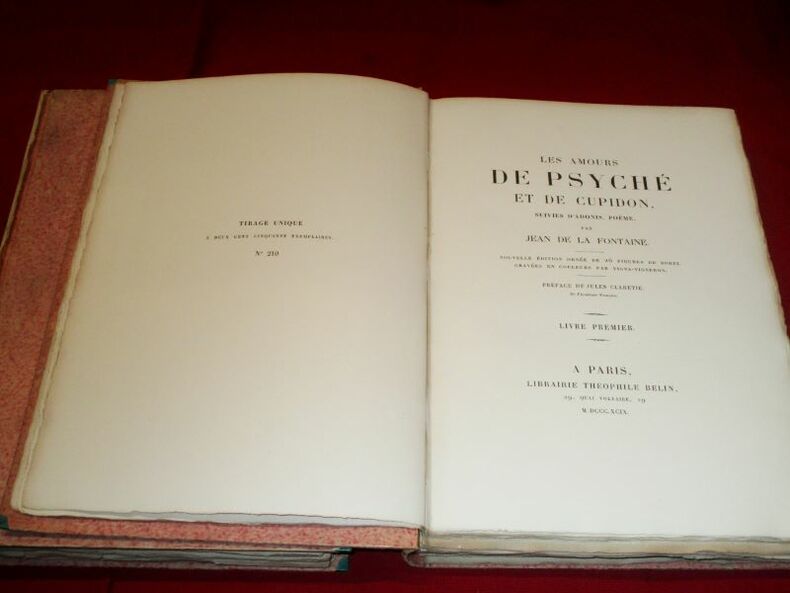
111298A Paris, Librairie Théophile Belin, 1899, 2 volumes in-4 de 310 x 220 mm environ, 2 ff. blancs, 2 ff. (faux-titre, titre), xxiv pages (Avant-propos, Epitre, Préface), 96 pages, 2ff. - 2 ff. blancs, 2 ff. ( faux-titre, titre), 144 pages, 2 ff. blancs. Cartonnages roses, dos bruns lisses portant titres dorés sur pièces de cuir bordeaux.Tirage unique à deux-cent-cinquante exemplaires, celui-ci porte le numéro 210. Complet des 26 figures sous serpente, en 3 états (avant la lettre, en noir, en couleurs), en sus chaque volume comprend in-fine une décomposition couleurs en 4 planches d'une figure reproduite dans l'ouvrage. Cartonnages solides mais peu esthétiques (dos griffés et salis, mors apparents), tranches et gardes brunies ainsi que des rousseurs sur les feuillets liminaires et en fin de volume, en revanche corps de texte en bon état et planches d'une grande fraîcheur.
Due volumi in 8° grande legati in mezza pelle con unghie, titolo ai tasselli ai dorsi (restauri), sguardie, occhielli, frontespizi incisi davvero molto animati, LX, 594 pp. in numerazione continua, 42 (di 43, manca un ritratto nel primo volume), tavole incise in rame, alcune ripiegate. Di questa raccolta s'ha solo da dir bene. L'insieme è fantasmagorico e gustoso quanto gli squisiti manicaretti fiorentini. Nei 341 canti di questa raccolta, tra cui la celeberrima "Quant'e" bella giovinezza" del Magnifico ed una canzone del Machiavelli pubblicata per la prima volta nel 1553. ve ne sono diversi che trattano di argomenti di caccia quasi tutti allegorici e con palesi doppi sensi, comunque importanti per la conoscenza del modo di cacciare di quell'epoca. E poi tutta la giocosa sfrontatezza fiorentina: esemplare in barbe, in bello stato, fresco malgrado qualche sporadica brunitura. Importante e raro a reperirsi
Illustrazione tratta dall'opera "The Gentlemans Recreation in Three Parts", di Richard Blome, pubblicata per la prima volta a Londra nel 1686. Le numerose iscrizioni descrivono l'arte e la tecnica dell'orologeria; in basso, due figure e un angelo con compassi, quadranti e altri strumenti di misura. Incisione in rame, colorata a mano, in buone condizioni. Taken from 'The Gentlemans Recreation in Three Parts' by Richard Blome, London: S. Roycroft, 1686. Large oval with inscriptions explaining the various parts of the art of horology; below, two figures and an angel with compasses, quadrant, and other measuring instruments. Copper engraving, hand-coloured, in very good conditions.
077-Ao.J. Kupferstich, auf Bütten. 9,6:6,5 cm. Ausgezeichneter Druck, bis über die Einfassungslinie geschnitten. Rückstände früherer Montierung verso.
Questo famoso ritratto di Ortelius, all'età di circa 50 anni, fu inciso da Philippe Galle e apparve nel Theatrum a partire dal 1579. Pochi altri ritratti del grande cartografo sono sopravvissuti. La traduzione latina del titolo è: "Guardando, Ortelius ha dato agli esseri mortali il mondo, guardando il suo volto, Galle ha dato loro Ortelius". Il ritratto è circondato da una cornice di cinghie e ghirlande. Senza dubbio il più famoso di tutti i ritratti di Ortelius. Abraham Ortelius è forse il più noto di tutti i cartografi del XVI secolo. Il 20 maggio 1570, il Theatrum Orbis Terrarum di Ortelius apparve per la prima volta in un'edizione di 70 mappe. Al momento della sua morte, nel 1598, erano state pubblicate un totale di 25 edizioni, incluse quelle in latino, italiano, tedesco, francese e olandese. Edizioni successive sarebbero state pubblicate anche in spagnolo e inglese dai successori di Ortelius, Vrients e Plantin, il primo dei quali aggiunse un certo numero di mappe all'atlante, la cui edizione finale fu pubblicata nel 1612. La maggior parte delle mappe del Theatrum di Ortelius furono tratte dai lavori di un certo numero di altri cartografi di tutto il mondo; una lista di 87 autori è data dallo stesso Ortelius. Incisione in rame con bel colore a mano più tardi, ottime condizioni. This famous portrait of Ortelius, at the age of about 50, was engraved by Philippe Galle and appeared in the Theatrum from 1579 onwards. Few other portraits of the great cartographer have survived. The Latin title translation is, "By looking, Ortelius gave to mortal beings the world, by looking at his face, Galleus gave them Ortelius." The portrait is surrounded in a strapwork and garland frame. Without question the most famous of all Ortelius portraits. Abraham Ortelius is perhaps the best known and most frequently collected of all sixteenth-century mapmakers. Ortelius started his career as a map colorist. On May 20, 1570, Ortelius’ Theatrum Orbis Terrarum first appeared in an edition of 70 maps. By the time of his death in 1598, a total of 25 editions were published including editions in Latin, Italian, German, French, and Dutch. Later editions would also be issued in Spanish and English by Ortelius’ successors, Vrients and Plantin, the former adding a number of maps to the atlas, the final edition of which was issued in 1612. Most of the maps in Ortelius' Theatrum were drawn from the works of a number of other mapmakers from around the world; a list of 87 authors is given by Ortelius himself Copper engraving with fine later hand colour, very good condition.
Galeone con vessillo recante il titolo “Idrografia”. Esemplare tratto dall’ Atlante Veneto, Nel quale si contiene la Descrittione Geografica, Storica, Sacra, Profana e Politica degli Imperi, Regni, Provincie, e Santi dell’Universo […] In Venetia MDCXC. Coronelli visse un periodo di straordinaria fecondità editoriale a partire dal 1689, quando ebbe la cattedra di geografia presso l'Università alle Procuratie, con la pubblicazione, nel 1690, del primo volume dell'Atlante Veneto. In effetti sotto il nome di Atlante Veneto va tutta la raccolta di tredici opere composte nell'arco del decennio successivo, dall'Isolario allo Specchio del mare. L'opera era intesa come un'estensione dell'Atlas Maior di Blaeu. Non è una semplice raccolta di mappe, ma piuttosto "un compendio di informazioni geografiche, cosmografiche e scientifiche... sulla scienza e la geografia italiana contemporanea" (Scammell). Oltre alle mappe, il primo volume include molte delle celebri tavole navali di Coronelli, molte con i bordi "farnesiani" stampati separatamente e commissionati appositamente dal patrono di Coronelli, Ranuccio II Farnese, duca di Parma. Incisione in rame, magnifica prova, con pieni margini, in perfetto stato di conservazione. Bibliografia Ermanno Armao, Vincenzo Coronelli (Firenze, 1944), nn.59-60, p.237. Galleon with banner with the title “Idrografia”. Example taken form Corenelli’s Atlante Veneto, Nel quale si contiene la Descrittione Geografica, Storica, Sacra, Profana e Politica degli Imperi, Regni, Provincie, e Santi dell’Universo […] In Venetia MDCXC. Coronelli lived a period of extraordinary editorial fecundity starting from 1689, when he had the chair of geography at the University at the Procuratie, with the publication, in 1690, of the first volume of the Atlante Veneto. Under the name of Atlante Veneto goes the entire collection of thirteen works composed over the next decade, from the Isolario to the Specchio del mare. The work was intended as an extension of Blaeu’s Atlas Maior. It is no mere collection of maps, but rather “a compendium of geographical, cosmographical, and scientific information... on contemporary Italian science and geography” (Scammell). As well as maps, the first volume includes several of Coronelli’s celebrated naval plates, many with the separately-printed “Farnese” borders especially commissioned by Coronelli’s patron, Ranuccio II Farnese, Duke of Parma. Copperplate, with full margins, very good condition. Very rare. Literature Ermanno Armao, Vincenzo Coronelli (Florence, 1944), no.59, no.60 and p.237.
18241000342AG[Paris, rue de Vaugirard no 15], [chez Brunet / Imp. Litho. de Langlume], [1824]. Grossformatige allegorische Lithographie von Maurin nach Prud'hon, am Bildrand Künstlerbezeichnungen Prud'hon pinx. ; Maurin del. Bildgröße 36 x 62 cm, alt montiert unter Passepartout 51 x 77 cm, *Thieme/Becker XXIV, 282.- [6 Warenabbildungen] geringe Bereibungen, schönes Exemplar,
In-24 p. (mm. 110x77), elegante legatura mod. in p. pelle stile seicentesco, decoraz. oro ai piatti e al dorso a cordoni, pp. 274 (mal num. 272, omesse nella numeraz. le pp. 193-194.), con un bel frontespizio figurato e 46 deliziose tavole di emblemi inc. in rame, eseguite da Carolus Blancus, tutte nel testo. L’opera è introdotta da una lettera dedicatoria alla Madre Angelica Lucrezia Maria Sfondrati (priora del Convento di S. Paolo) e a Papa Urbano VIII. Al colophon: “Mediolani, Typis Philippi Ghisulfij Anno 1633”. Cfr. Praz “Studies in 17th Century Imagery”, pp. 376-377: “Between 1624 and 1757 no less than 42 Latin editions are recorded” - De Backer “Bibliothèque des écrivains de la Compagnie des Jésus”,I, p. 407: “Herman Hugo (1588-1629), né a Bruxelles. Il fut d’abord professeur des humanités à Anvers, et préfet des études à Bruxelles. Plus tard, il suivit en Espagne le duc d’Arschot qui l’avait nommé son confesseur..”. Esempl. leggerm. rifilato; fori di tarlo margin. su circa 30 cc. (in alc. punti intaccano una o due lettere del testo) ma complessivam. ben conservato.
Ritratto di un giovane Vincenzo Maria Coronelli, inciso per il suo Corso geografico universale, o sia la terra divisa nelle sue parti e subdistinta ne' suoi gran regni. Esposta in tavole geografiche ricorrette et accresciute di tutte le nuove scoperte, ad uso dell'Accademia Cosmografica degli Argonauti dal Padre Maestro Vincenzo Coronelli M. C. Cosmografo della Serenissima Republica di Venetia. Dedicata alla Santità di Nostro Signore Innocenzo XII. P. I. In Venetia, a spese dell'autore. MDCXCII. Coronelli visse un periodo di straordinaria fecondità editoriale a partire dal 1689, quando ebbe la cattedra di geografia presso l'Università alle Procuratie, con la pubblicazione, nel 1690, del primo volume dell'Atlante Veneto. In effetti sotto il nome di Atlante Veneto va tutta la raccolta di tredici opere composte nell'arco del decennio successivo, dall'Isolario allo Specchio del mare. In realtà solo alcune di tali opere possono definirsi atlante, e sono di valore molto disuguale, dato che si passa da opere originali e fondamentali come quelle citate o il Corso Geografico ad opere di compilazione o semplici raccolte di vedute. Il Corso Geografico uscì in diverse edizioni con numeri diversi di carte - sessantotto tavole nel 1689-92; di centosettantatré tavole nel 1692; duecentosessanta tavole, nel 1694-97 - che venivano vendute anche separatamente, al ritmo di sei carte al mese per due anni. Le carte furono incise tra il 1688 e il 1692 nell'attrezzatissima officina cartografica del convento dei Frari, dove lavoravano anche incisori stranieri. Incisione in rame, in ottimo stato di conservazione. Scarce portrait of a young Vincenzo Maria Coronelli, engraved for his Corso geografico universale, o sia la terra divisa nelle sue parti e subdistinta ne' suoi gran regni. Esposta in tavole geografiche ricorrette et accresciute di tutte le nuove scoperte, ad uso dell'Accademia Cosmografica degli Argonauti dal Padre Maestro Vincenzo Coronelli M. C. Cosmografo della Serenissima Republica di Venetia. Dedicata alla Santità di Nostro Signore Innocenzo XII. P. I. In Venetia, a spese dell'autore. MDCXCII. Coronelli lived a period of extraordinary editorial fecundity starting from 1689, when he had the chair of geography at the University at the Procuratie, with the publication, in 1690, of the first volume of the Atlante Veneto. Under the name of Atlante Veneto goes the entire collection of thirteen works composed over the next decade, from the Isolario to the Specchio del mare. In reality, only some of these works can be defined as atlas, and are of very unequal value, since we go from original and fundamental works such as those mentioned or the Corso Geografico to works of compilation or simple collections of views. The Corso Geografico came out in several editions with different numbers of maps - sixty-eight maps in 1689-92; one hundred and seventy-three maps in 1692; two hundred and sixty maps in 1694-97 - which were also sold separately, at the rate of six a month for two years. The maps were alle engraved between 1688 and 1692 in the well-equipped cartographic workshop of the Frari convent, where foreign engravers also worked. Copperplate, very good condition.
Frontespizio dell' “Atlas” di Reiner e Joshua Ottens, pubblicato ad Amsterdam nel 1730.Incisione in rame, incisa da J. van Munnikhuysen e disegnata da L. Webbers. Title page from the "Atlas" by Reiner e Joshua ttens, published in Amsterdam in 1730.Copper engraving, engraved by J. van Munnikhuysen after L. Webbers.
033-Lo.J. Kreidelithographie 1806, auf cremefarbenem Velin. 35:25 cm. Nicht ganz frisch. Literatur: Nagler 15, 12; Dussler 9; Winkler 706 (!). 7 und Abb. 17.- Aus lithographische Kunstproducte, Lieferung 9, Blatt 2.
032-Lo.J. Kreidelithographie 1806, auf cremefarbenem Velin. 35:25 cm. Mit Flecken im Oberrand. Literatur: Nagler 15, 11; Aufseesser 275 (als Schiesel, Sommer und Herbst); Dussler 8; Winkler 706 (!). 6 und Abb. 16.- Aus lithographische Kunstproducte, Lieferung 9, Blatt 1.