[HOUBIGANT-PARFUMS]. BRISSAUD (Pierre).Livre Rare Book

3 966 résultats
192316834Paris 1923 1 Affichette P.L.V. signée et datée dans la planche, pochoir en couleur cartonné, Paris, 1923, 29,6 x 39,7 cm.
19319766London: Jonathan Cape 1931. First edition. 8vo 158pp. Signed in full by Mitchison on the ffep. Publisher's patterned cloth boards spine lettered in red. Former owner's bookplate to ffep spine toned. Very good. <br /> <br /> Early collaborative play co-written by socialist novelist and feminist thinker Naomi Mitchison and Lewis Gielgud writer and humanitarian worker. Set amid revolutionary tensions the play follows characters forced to choose between loyalty love and ideology where "freedom" comes at the expense of personal compromise and strained relationships. Mitchison's influence brings a notable emphasis on women as active participants in political life rather than bystanders and reflects her ongoing engagement with questions of political freedom socialism and gender. The book itself is unaccountably scarce in the trade and represents an early dramatic work from Mitchison written during her most politically engaged period. Jonathan Cape unknown
197932850Québec, Editions La Minerve sans date (1979?) In-4 à l’italienne, bien illustré de planches en noir et d’une reproduction en couleurs montée, n.p., 11f. et 61 planches de reproductions dont une en couleurs.
180014233Paris Denné jeune 1800
Very Good Turkish, Ottoman (1500-1928) Contemporary 1/3 leather bdg. made as original illustrated covers preserved inside. Foolscap 8vo. (18 x 12 cm). In Ottoman script (Old Turkish with Arabic letters). 221 p.; 291 p. Fourth Edition (both). Early editions of this bestseller novel(s) telling "the suffering of a woman who buried her forbidden love in her heart in a society where love is closed behind thick curtains, through the eyes of a woman", by Güzide Sabri (1886-1946). Güzide Sabri Aygün was a Turkish female writer known for her modern romances, which were published in multiple editions and several languages. She had two sisters, Fatma Aliye and Emine Semiye. She grew up in Çamlica neighborhood of Istanbul. In later years, she had to leave Istanbul and move to Anatolia with her family as her father was exiled, resulting from his opposition to the despotism of Ottoman Sultan Abdulhamid II (reigned 1876-1909). At a young age, she was married to Ahmet Sabri Aygün, the first notary of Beyoglu (Pera). She was educated at home by special tutors. She was interested in literature, inspired by her teacher Hodja Tahir Effendi, a dictionary writer. She started to write at a very young age. However, her teachers proposed she better deal with religious matters instead of poetry. Contrary to the pressures of her literature teacher, she wrote her first novel Münevver in her youth years in 1899. She wrote the novel in remembrance of her friend, who died from tuberculosis. It was serialized in the newspaper Hanimlara Mahsus ("For Ladies"), and won well recognition. In 1901, two years later, the novel was published as a book and was also translated into the Serbian language. Her husband felt discomfort by his wife's prominence. As her teachers' reaction was not enough, her husband also objected to her writing. However, her enthusiasm could not deter her from writing. It is understood that her husband tried to prevent her writing as he did not allow her to write already at the wedding. She was forced to continue writing at night or secretly. After a short time, her husband died. The unexpected death of her husband left deep traces in her. Güzide Sabri became a female writer, who remained lifelong unhappy having a sad life in literature history. During this time, the Servet-i Fünun ("Wealth of Knowledge") movement, formed by Recaizâde Mahmud Ekrem (1847-1914) and his students, left its mark on the literature. Güzide Sabri was one of the authors, who did not join the movement and remained on their own line. She is considered as one of the first female novelists among Turkish writers with widespread fame, even though she was not involved in the new literary movement. She published her works in the Servet-i Fünun and other journals of the "National Literature" without being a member of any literary community. Her novels, which were written in the early years of the Second Constitutional Era (1908-1918) and the Republican era (from 1922), and were subject of feeling, dream, blind love, and broken hearts, were very popular, and had multiple editions and were repeatedly filmed. Her second novel Ölmüs Bir Kadinin Evrak-i Metrûkesi ("Derelict Documents of a Dead For Woman") was a bestseller. It was first published in 1901, reprinted several times, and was filmed twice, in 1956 and then in 1969. The novel was translated into the Armenian language. She authored romance novels for simple readers. She is considered as the author writing the first examples of the so-called mass-market romance novels, and pioneer of the broken-hearts novels in her country. Her 1930-novel Hicran Gecesi ("Night of Sorrow") is about the forbidden love of a bad woman. This book takes the romance novel one step forward in a forbidden, impossible love story. Her novels, which take place in Istanbul, attracted the interest of readers outside of big cities like Istanbul and Izmir as well. First book: Özege 16077 (Özege has 4th edition, however page number: 221).; TBTK 5323.; Second one: Özege 15317.; TBTK 5
Petit in-8 (141 x 82 mm), plein veau moucheté de l'époque, dos à 5 nerfs orné de caissons fleuronnés et cloisonnés, pièce de titre de maroquin brun, roulette sur les coupes et coiffes, tranches mouchetées, (24), 281, (3) p. de catalogue éditeur. Nouvelle édition de ce roman qui se situe dans le courant de la littérature moraliste du Grand Siècle. L'auteure, Madame de Pringy, annonce dans sa préface un "roman de caractères" destiné à dépeindre "l'amour tel qu’il se pratique aujourd’hui (...) et rectifier s'il se peut la galanterie qui n'a presque plus d'autre nom que celui de la débauche". "Document d'une valeur sociologique indéniable, véritable contrepoids à l'oeuvre de Poullain de la Barre. Dans l'histoire des mentalités, le regard de Madame de Pringy, négligé par la critique littéraire, mérite d'être reconnu parce qu'il rétablit une vue plus équilibrée sur le bouillonnement social d'une fin de siècle" (Constant Venesoen, Classic Garnier, 2021). Jeanne-Michelle de Pringy née Hamonin de Maranville (1660-1709) composa une oeuvre destinée exclusivement à un public féminin. (Cf. 'Protestations et revendications féminines. Textes oubliés et inédits sur l'éducation féminine (XVIe-XVIIe siècles)', Classique Garnier, p. 254). Dos frotté, reliure présentant quelques traces de restauration éparses.
1699378911699 Petit in-8 (141 x 82 mm), plein veau moucheté de l'époque, dos à 5 nerfs orné de caissons fleuronnés et cloisonnés, pièce de titre de maroquin brun, roulette sur les coupes et coiffes, tranches mouchetées, (24), 281, (3) p. de catalogue éditeur. Paris, Au Palais, Guillaume Saugrain et Guillaume Cavelier, 1699.
2 tomes reliés en un volume in-8, demi-veau blond orné d'un décor de compartiments garnis de 3 différentes résilles dorées, filets et palettes dorées, pièce de titre de veau bronze, tomaison dans un médaillon havane, (4), iv, 376 p. et (4), 392 p., 2 planches gravées en frontispice. Edition originale. T. 1 : Le frontispice représente le Dauphin et sa soeur se promenant devant le Château des Tuileries avec leurs gouvernantes, surveillés par deux gardes. T. 2 : Le frontispice représente une scène horrifique d'initiation maçonnique. L'auteur avait été avocat à Épinal puis s'installa à Paris durant la Révolution. Il devint secrétaire de la Commission pour l'examen et l'inventaire des papiers des Tuileries, puis commissaire de police jusqu'en 1801. D'importantes pages sont consacrées à Marie-Antoinette, au rôle politique des femmes et aux clubs de citoyennes sous la révolution, ainsi que sur la marche des femmes du 4 octobre 1789 sur Versailles, hostiles au mouvement. Dans le tome I, p. 196, on trouve des détails sur le rôle du père de Balzac à la veille du 10 août : "portant le sabre pour mettre à bas les têtes du roi et de la reine". L'auteur connaissait parfaitement les lieux et les intervenants, par ses fonctions comme directement à travers son frère aîné qui était commissaire du Comité de surveillance des Tuileries. Il livre une relation romancée qui reste d'une grand intérêt pour l'histoire de Paris. (Monglond, V, 992). Petit accroc à la coiffe supérieure. Bel exemplaire, très frais, bien relié à l'époque.
GF270752 pages 1/2 in8 + enveloppe - trés bon état -
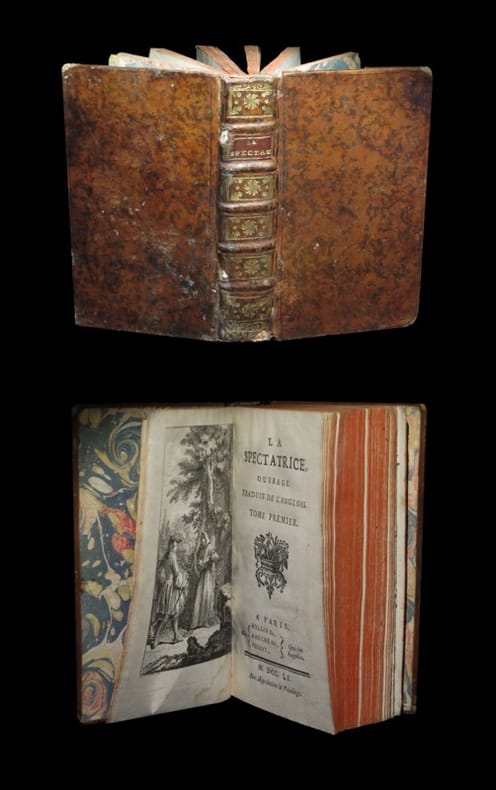
175126956A Paris, chez Rollin Fils / Bauche Fils / Pissot, 1751. 2 tomes reliés en un volume au format in-12 (172 x 104 mm) de 1 f. bl., 2 ff. n.fol., 1 frontispice gravé n.fol., viii - 241 pp. et 1 f. n.fol. ; 2 ff. n.fol., 1 frontispice gravé n.fol., 231 pp. et 1 f. bl. Reliure de l'époque de pleine basane marbré brune, filet à froid encadrant les plats, dos à nerfs orné de filets gras à froid, caissons d'encadrement dorés, fleurons dorés, semis d'étoiles dorées, pièce de titre de maroquin acajou, titre doré, palette dorée en tête et queue, roulette dorée sur les coupes.
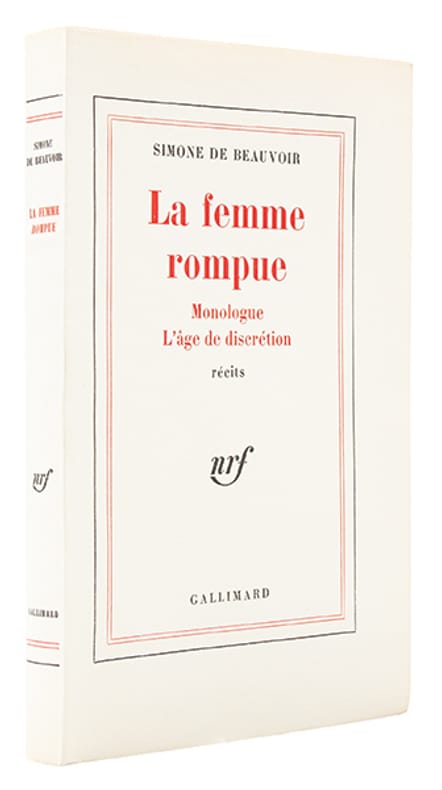
38890In-8 (215 x 145 mm), broché, couverture imprimée rempliée, 368, (10) p., non coupé. Paris, Gallimard, 1990 (Mesnil-sur-l'Estrée, Firmin-Didot, 8 février 1990).
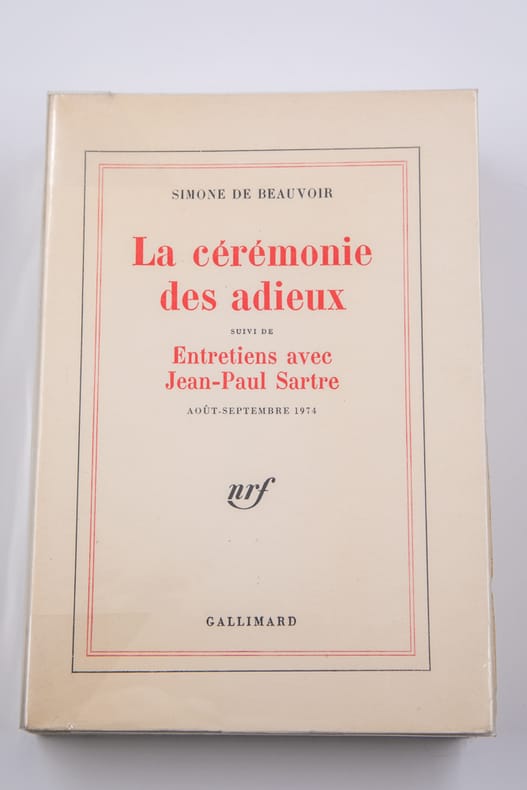
1967388851967 In-8 (192 x 125 mm), broché, couverture rempliée, 251 p., non coupé. Paris, Gallimard, 1967 (Lagny sur Marne, Emmanuel Grévin et fils, décembre 1967).
198126063Paris, Gallimard, 1981 In-8, broché, couverture rempliée, 559 pp., non coupé.
186523973Marseille, Chez M. Esparron, (1865). In-8 demi chagrin noisette, dos lisse, filets noirs et or, couverture conservée. 16 pp. (Reliure de l'époque).
1972106952Paris Alain Moreau 1972 1 vol. broché in-8, broché, couverture illustrée, 398 pp. Édition originale. Exemplaire enrichi d’un bel envoi autographe signé de la femme de lettres : "A vous ma chère Nathalie Sarraute dont l'exemple ne cessera jamais d'orner ma mémoire et de raffermir mes intentions". Dos légèrement gauchi.
1972106952Paris Alain Moreau 1972 1 vol. broché in-8, broché, couverture illustrée, 398 pp. Édition originale. Exemplaire enrichi d’un bel envoi autographe signé de la femme de lettres : "A vous ma chère Nathalie Sarraute dont l'exemple ne cessera jamais d'orner ma mémoire et de raffermir mes intentions". Dos légèrement gauchi.
ORD-12146Paris. Madame Plauzoles. Firmin Didot. Garnery. L'Auteur. An XI.-1803. 2 volumes in-8 (128 x 201mm) dos lisses basane brune richement et délicatement ornés or, pièces de titre et de tomaisons rouge vermillon, plats de papier rouge avec petits coins vélin, 2ff., XXII, (2), 248 pages et 2ff., XVI, (2), 296 pages (au total 12 cahiers). Mors des premiers plats un peu faibles, menus défauts sinon belles reliures, intérieur très piqué. Un 3e volume est annoncé et, peut-être, un quatrième avec des cartes géographiques, au début de chaque tome. Je n'en ai trouvé aucune trace. La BNF présente un exemplaire en 2 volumes ainsi décrit; Reinolds Jean-Baptiste (17.. - 18..) Le Classique des Dames ou Cahiers élémentaires... par J.B. Guinan Laoureins. Paris. Madame Plauzolles an XI. - 1803. Quérard III, 544 donne 3 volumes sans autres précisions. Certainement peu courants.
339412 pages petit in4 - trés bon état - Portraitiste et paysagiste post-impressionniste, Hermine David fut l'épouse du peintre Jules Pascin -
1196Librairie de la Bibliothèque Démocratique (Victor Poupin, directeur). 1874. In-16 broché. 191 pages. E.O. en volume. Quelques rousseurs sans gravité aux premières et dernières pages ; agréable exemplaire. Très rare.
1st edition. Original paper wrappers. 4to. Each issue is approximately 50 pages, 30 cm. In English. April, 1950 is a special issues celebrating the 7th Anniversary of the Warsaw Ghetto Uprising; May 1950 celebrates the second anniversaryof the founding of the State of Israel. From the height of the Cold War, Atom Spy, and Rosenbergs era. Jewish Life was a periodical that focused on the intersection of Jewish life and progressive politics. The periodical was under the auspices of the Communist Party until 1956. A notable contributor was Betty Friedan, whose 1963 "The Feminine Mystique" is credited with starting the modern feminist movement in the United States. (Horowitz, 2000) . SUBJECTS: Jewish way of life -- Periodicals. OCLC: 898470599. Very Good+ Condition. Stunning Copies(YID-33-75)
339023 pages in4 - bon état - râtures et corrections -
1st edition. Original paper wrappers. 4to. Each issue is approximately 50 pages, 30 cm. In English. August 1953 celebrates the "Legacy of the Rosenbergs." Nov 1953 features an essay by Charles Allen: "McCarthy--Enemy of the Negro People." April 1954 celebrates the 11th anniversary of the Warsaw Ghetto Uprising, with an illustration on the cover.May 1954 includes "The Jews and American Slavery,' by the editor, Morris U. Schappes, as well as reports on Jewish life in Eastern Europe. Aug 1954 Includes three essays on "Jews in Socialist Countries" as well as three essays on "The Jew in Fiction." Sept 1954 inclues two essays on McCarthyism, as well as "We were Always Part of America: Declaration of Committee for 300th Anniversary of Jews in USA." Oct 1954 includes "What to do About the H-Bomb?" as well as "Jewish Stake in the Elections," "Uriel Acosta: Unpublished Chapter by V.J. Jerome," and "An Interview with Ehrenburg" by Ben Cohen. From the height of the Cold War, Atom Spy, and Rosenbergs era. Jewish Life was a periodical that focused on the intersection of Jewish life and progressive politics. The periodical was under the auspices of the Communist Party until 1956. A notable contributor was Betty Friedan, whose 1963 "The Feminine Mystique" is credited with starting the modern feminist movement in the United States. (Horowitz, 2000) . SUBJECTS: Jewish way of life -- Periodicals. OCLC: 898470599. April 1954 issue is browning with some edgewear, all others are Very Good+ Condition. Stunning Copies (YID-33-75A)
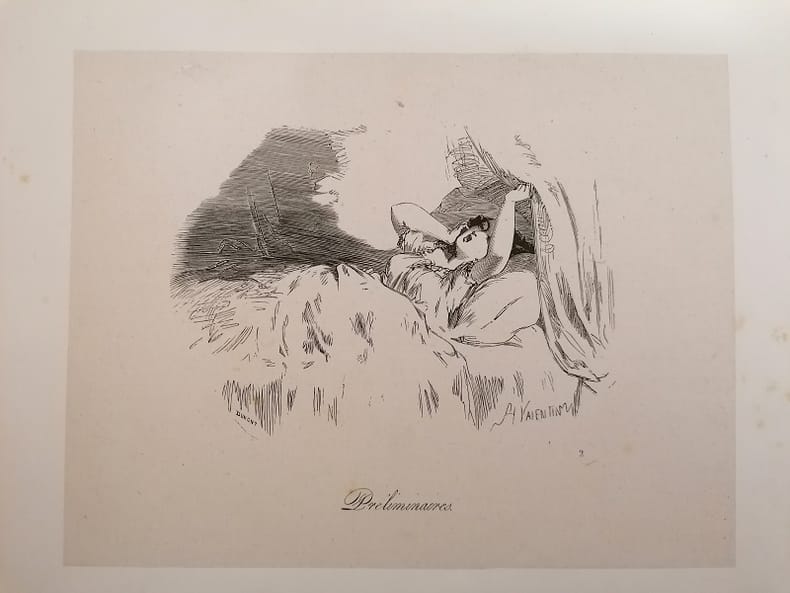
1854111005Paris Au bureau du Journal pour rire 1854 1 vol. Relié in-4 oblong, percaline bordeaux avec le titre doré sur le premier plat. Cette rare suite de 16 gravures sur bois exécutées par Dumont, légendées et tirées sur Chine collé, dénigre la paresse et la futilité des cocottes.
1854111005Paris Au bureau du Journal pour rire 1854 1 vol. Relié in-4 oblong, percaline bordeaux avec le titre doré sur le premier plat. Cette rare suite de 16 gravures sur bois exécutées par Dumont, légendées et tirées sur Chine collé, dénigre la paresse et la futilité des cocottes.
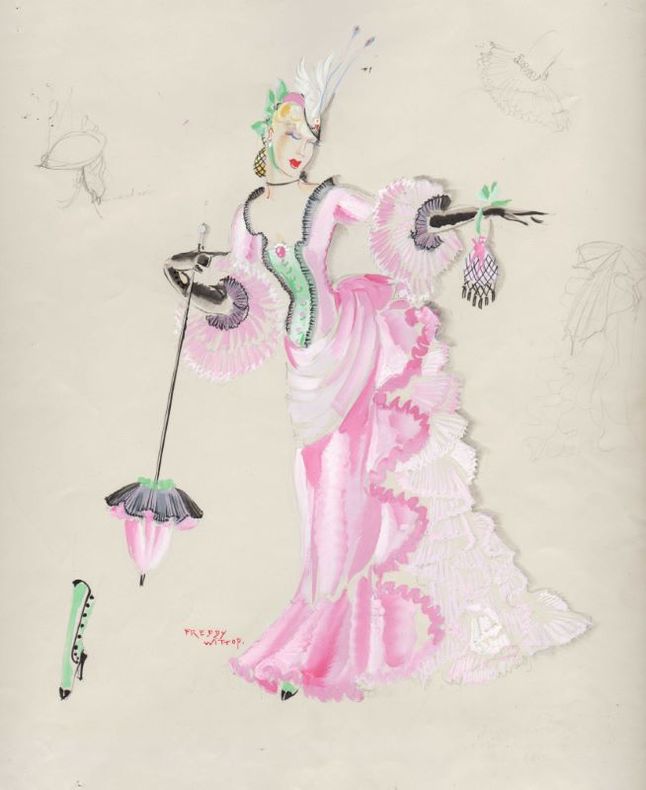
1940124831940 1 Gouache originale sur papier lisse, mine de plomb, rehauts de blanc et d'argent, signée en bas à gauche, (1930), 39 x 32 cm.