3 968 résultats
17376A Paris, chez Le Boucher, 1772, 1 plein veau marbré, dos à nerfs, orné (fleurons), tranches rouge, 2 coins légèrement émoussés, petite éraflure sur le premier plat, sans gravité. in-8, faux-titre, titre, 2 feuillets non chiffrés, 347-(5) pages ;
1830119896Paris Lebigre 1830 4 vol. reliés 4 vol. in 8, plein veau moucheté, dos lisses ornés de filets d'encadrement, fleurons et mosaïque doré, pièces de titre et de tomaison de maroquin rouge et noir, plats ornés d'un filet d'encadrement et d'une guirlande dorés avec superlibris gravé en lettres dorées au centre, tranches marbrées, VIII + 488, 512, 518 et 443 pp. Première édition de ce dictionnaire qui paraît après cinq références, le Dictionnaire historique portatif des femmes célèbres par de La Croix (1769), Vies des femmes illustres et célèbres de France (1768), Histoire littéraire des femmes françaises par l'abbé de La Porte (1769) et le Dictionnaire biographique des Françaises et Étrangères naturalisées en France, connues par leurs écrits par Mademoiselle Briquet (1804). Dos frottés, mais bon exemplaire en reliure d'époque avec dédicace gravée sur les plats supérieurs : "Hommage à Mme Coindon".
338952 pages 1/2 in4 - bon état - Le tapuscrit est signé Renée Dunan à la machine - râtures et corrections -
339013 pages in4 - bon état - Le tapuscrit est signé Renée Dunan à la machine - râtures et corrections -
32532In-8, broché, (2) f., 124 p. Sens, chez l'imprimeur de l'Archevêque, 1788.
In-8, broché, (2) f., 124 p. Edition originale de ce recueil de pamphlets politiques publié à l'occasion de l'Assemblée des Notables: "Les Quand, les Si, les Mais, les Car" – "Jeu de quilles" – "Mémoire des marchandes du Palais, à M. le Garde des sceaux" – "Lettre à Monsieur le Baron de P**, officier aux Gardes-françoises, sur les devoirs du militaire français" – "Les réflexions et la résolution d'un bon roi" – "Apologie de la Cour plénière, par M. l'Abbé Vélin" – "Requête de l'exécuteur des hautes-oeuvres, aux juges-consuls en entérinement de son contract d'union avec ses créanciers" – "Lettre à Monseigneur de Lamoignon, Garde des sceaux" – "Observations d'un homme impartial" – "Lettre d'un membre d'un grand-bailliage de ** à son cousin" – "Lettre du Prince de Guimenée, au roi" – "Arrest du Conseil d'Etat du peuple françois". Bon exemplaire, à toutes marges, tel que paru.
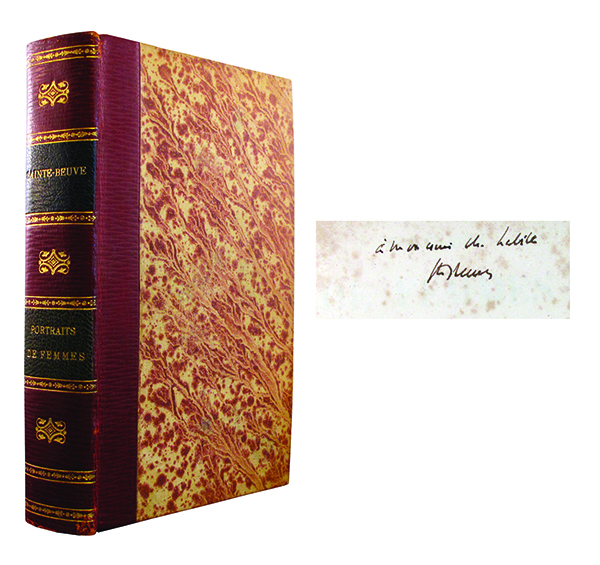
36734In-12, demi-maroquin rouge à grain long, dos lisse orné dun décor romantique de roulettes et fers spéciaux dorés, pièce de titre de maroquin vert, couvertures conservées (reliure signée de Franz vers 1920), (2) f., 505 p., (1) p. de table. Paris, Didier, 1844.
In-12, demi-maroquin rouge à grain long, dos lisse orné d’un décor romantique de roulettes et fers spéciaux dorés, pièce de titre de maroquin vert, couvertures conservées (reliure signée de Franz vers 1920), (2) f., 505 p., (1) p. de table. Edition en partie originale, largement augmentée. Mesdames de Sévigné, Souza, Duras, Staël, Roland, Guizot, La Fayette, La Rochefoucauld, Longueville, Des Houillères, Charrière, Rémusat, Pontivy, etc. Rousseurs et piqûres parfois soutenues. Les couvertures défraîchies sont conservées. Envoi autographe de Sainte-Beuve à Charles Labitte ("A mon ami..."). Historien et critique, né à Château-Thierry le 2 décembre 1816, Charles Labitte débuta dès 1835 dans la 'Revue des deux Mondes'. Ami et émule de Sainte-Beuve avec lequel il entretint une importante correspondance, choisi en 1842 pour suppléer Pierre-François Tissot dans sa chaire de littérature au Collège de France, il mourut prématurément à 29 ans. Et ex-libris de l'historien Georges Sangnier, enterré au cimetière de Blangermont ainsi que son épouse, aux côtés de Charles Labitte. Belle reliure de Franz Ostermann dit Franz, actif de 1872 à 1938.
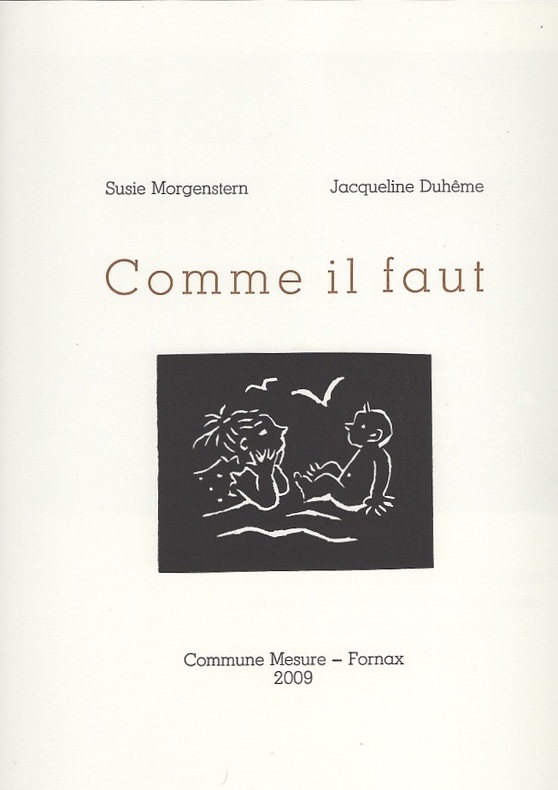
AMA-1090S.l., Commune Mesure — Fornax, 2009. In 4°, en feuilles, chemise. [12 ff.], 24 linogravures de Jacqueline Duhême.
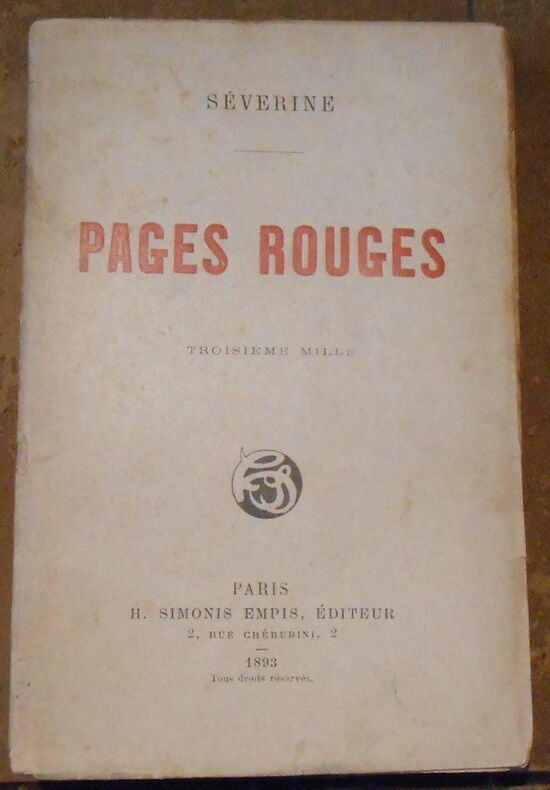
1893179731893. Paris Éditions H. Simonis Empis 1893 e.o. 3ème mille - Broché 12 cm x 18 5 cm 326 pages - Textes de Séverine portrait de l'auteur en frontispice - Dos restauré rousseurs état d'usage
19109296Paris E. SANSOT 1910 1 Paris, E. Sansot, 1910, broché, couverture illustrée d'une scène de bateaux, 103 pages.
212 pages. Footnotes. References. Many black and white illustrations. "A unique investigation of the mother-child relationship. It was originally conceived as an installation and has been exhibited widely in edited versions. Now for the first time the complete work is available in book form, providing an opportunity to re-view one of the major artworks of recent years." - from dust jacket. Moderate wear to clean and unmarked book. Binding tight. Average wear to price-clipped dust jacket which is now preserved in glossy new archival-grade Brodart. A sound copy of this fascinating work. Book
92 pages. Designed by Wendy Cadden and Karen Sjoholm. Primarily illustrated in black and white plus several color pages. "These poems, intended for reading out load, have cumulative power. Images of women in a range of forms - portraits, wildly imaginative fables, ironic parables, incantatory invocation - have a formal, ritual quality. My feeling when I read the final lines was as if a new Genesis, a strong myth of women, had begun." - back cover. Unmarked with average wear. Short opening between front cover and top of spine. A worthy copy of this treasured work. Book
2 ouvrages relies en 1 volume in-12, 240 + 255 pages, reliure demi-toile a la bradel, titre dore. Bon etat (mors fendu, coiffe supérieure us.). [BU-1]
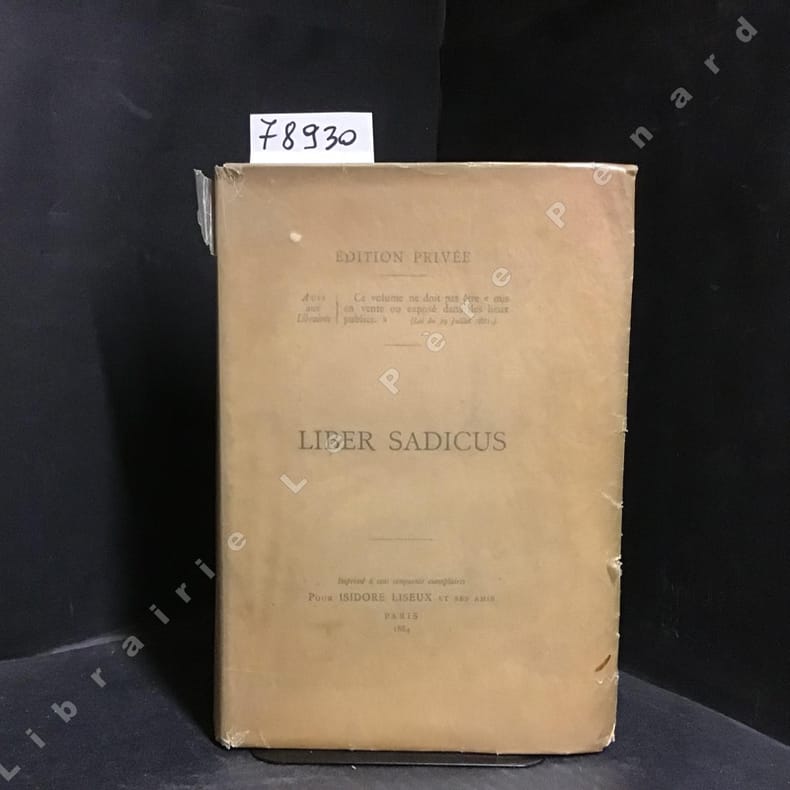
1884789301884 Pour Isidore Lisieux et ses Amis, Paris - Edition privée - 1884 - In-4 broché (25,5x17,5cm environ), couverture rempliée, frontispice gravé, ornements (lettrines, bandeaux & culs-de-lampe) - 337 pages - " Avis aux libraires : Ce volume ne doit pas être mis en vente ou exposé dans des lieux publics. ( loi du 29 juillet 1881 ) " - Ouvrage imprimé à cent cinquante exemplaires, celui-ci porte le numéro 29
1894221311894. Women's EmploymentLaborFeminism Collet Clara Elizabeth. Report by Miss Collet on the Statistics of Employment of Women and Girls. London: Her Majesty's Stationery Office 1894. First edition. 153 pages. Rebound with blue cardstock wrappers with blue cloth spine. A foundational document in the history of women's labor rights in the United Kingdom this government-commissioned report by feminist economist and civil servant Clara Collet presents a rigorously detailed statistical study of female employment across various industries and regions in late 19th-century Britain. The report was produced under the auspices of the Board of Trade's Labour Department and presented to both Houses of Parliament by command of Queen Victoria. Collet's work documents an early official recognition of gender disparities in wages labor conditions and occupational distribution.<br /> <br /> Clara Collet was a pioneering advocate for working-class women. In this report she compiles extensive census and wage data comparing the years 1881 and 1891 with particular focus on textile and manufacturing sectors including cotton wool and worsted mills. The report also explores regional patterns in employment rates of marriage and widowhood and the social consequences of low female wages. Appendices provide granular data segmented by occupation and geography highlighting for instance employment patterns among married women and child laborers. Of note is Collet's contextual analysis of women's roles in both domestic and industrial economies and her subtle but pointed criticism of systemic inequalities in pay and opportunity. Her work prefigures later feminist labor studies by over half a century and has been cited by scholars as foundational to the evolution of state labor policy in Britain. Pages toned with scattered foxing binding stable and professionally renewed; textblock complete. Overall good to very good condition. A landmark primary source in the history of women's labor advocacy and feminist economics and a rare survival in its first edition. unknown
18017Three Addresses to Girls at School" J.M Wilson. Percival and Co: London 1890. 7" x 5" inches. 74 pages. Soft cover pamphlet. A series of speeches delivered by the vice president of the Clifton High School for Girls in Covent Garden 1890. The speeches were given on "Education" "High School Education for Girls" and "Religion" in 1887 1889 and 1890 respectively. In them Wilson the school's vice president and late head master addresses the female students on the value of their education"You are living in a great age when changes of many kinds are in progress in our political and social and religious ideas. There never was a greater need of trained intelligence clear heads and earnest hearts. And the part that women play is not a subordinate one." Whereas in 1840 60% of British women were illiterate that number dropped dramatically to 40% by 1860 and the momentum for female education picked up considerably through the end of the nineteenth century into the twentieth. Wilson's speeches delivered to high school girls give fascinating insight into both the vision and anxiety bound up in educational reform during the time. "We earnestly desire that women should be highly educated" he writes. "And yet is there not a type of educated woman which we do not wholly admire I am not going to caricature a bluestocking but to point out one or two real dangers. Education is good; but perfect sanity is better still. Sanity is the most excellent of all women's excellences.It is a small matter that you should protest against some small maladjustment or folly; but it is a great matter that you should be perfectly sane and well-balanced. Now education helps sanity." The addresses both promote women's education and caution against radically upending existing social structures. Wilson advises the girls throughout to be gentle humble and sane and celebrates the role educated women play in supporting men in positions of power. Front soft cover detached. Textblock is partially detached. Text block clean and bright. Overall good condition. unknown
1890220271890. Women's Education Three lectures on women's education in Victorian England. Wilson J. M. Three Addresses to Girls at School. London: Percival & Co. 1890. First edition. Original printed brown paper wrappers stitched binding no dust jacket as issued. Delivered between 1887 and 1890 these addresses by Reverend J. M. Wilson-former Head Master of Clifton College and Vicar of Rochdale-offer a pointed reflection on the role of education and religion in shaping the intellectual lives of young women in late Victorian Britain. Each speech was delivered at a girls' high school: the first at Clifton High School 1887 the second at Bath and Clifton 1889 and the third at St. Leonard's School St. Andrews 1890. While framed within the conservative moral expectations of the period Wilson's lectures nonetheless emphasize the legitimacy and value of female academic achievement and make a case for structured standardized education for girls-a relatively progressive position for its time. Notably Wilson defends the Higher Certificate Examination as a measure of "absolute merit" asserting that these certificates serve as proof of both academic competence and institutional rigor.<br /> <br /> In one significant passage Wilson explains how girls at Clifton High School were permitted to pass examinations in stages-two subjects one year and two the next-unlike boys who were expected to complete all four at once. This practical concession reflects both the social constraints placed on girls and an evolving acknowledgment of their academic seriousness. His emphasis on certificates as both a pedagogical guide for teachers and a tool for public accountability is central to his educational philosophy: "They help to make your work definite and sound: and that if it is slipshod you shall at any rate know that it is slipshod." Though clearly reflective of the gendered assumptions of the time the text offers valuable insight into the advocacy for women's structured schooling during the late 19th century.<br /> <br /> Front cover moderately soiled with edge wear and a small numeric marking to the lower left corner. Front wrapper and end pages detached. Internal pages clean and unmarked aside from a faint institutional stamp on the title page. Overall fair condition. A scarce record of late Victorian attitudes toward women's education notable for its firsthand account of the evolving role of girls' high schools in Britain. unknown
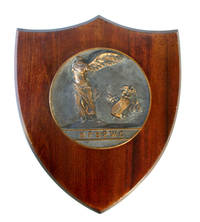
1919149951919. A large Wood Mounted 1919 NFBPWC Plaque The National Federation of Business and Professional Women's Clubs. Bronze embossed large seal. Dated one year Before National Suffrage. the National Federation of Business and Professional Women Clubs Inc. have been working to empower women through our mission which is to develop the business professional and leadership potential of all women through education advocacy mentoring networking skill building and economic empowerment programs and projects. unknown
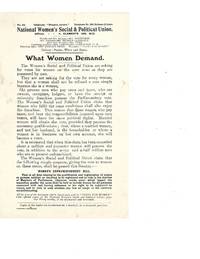
1908163971908. Women Suffrage National Women's Social & Political Union. No. 25. What Women Demand. 1908-1909. 1 page. 8 ½ x 5 ½ in. At the time that this description is being written no copies are recorded in American institutions. OCLC search results are at best an estimate and can vary over time. Handbill calls for voting rights for women on the "same terms" as men.<br /> <br /> The WSPU was a women's voting group that became famous for its radical and sometimes violent tactics. This leaflet outlines some of their demands in measured reasonable and language and emphasize that they believe "a woman shall not be refused a vote simply because she is a woman." They go on to list prerequisites for voting which men in the UK had to achieve & assert that there are over a million women who meet these same standards and would become enfranchised. Light scattered stains. Handling creases along left edge and crease in bottom right corner. unknown
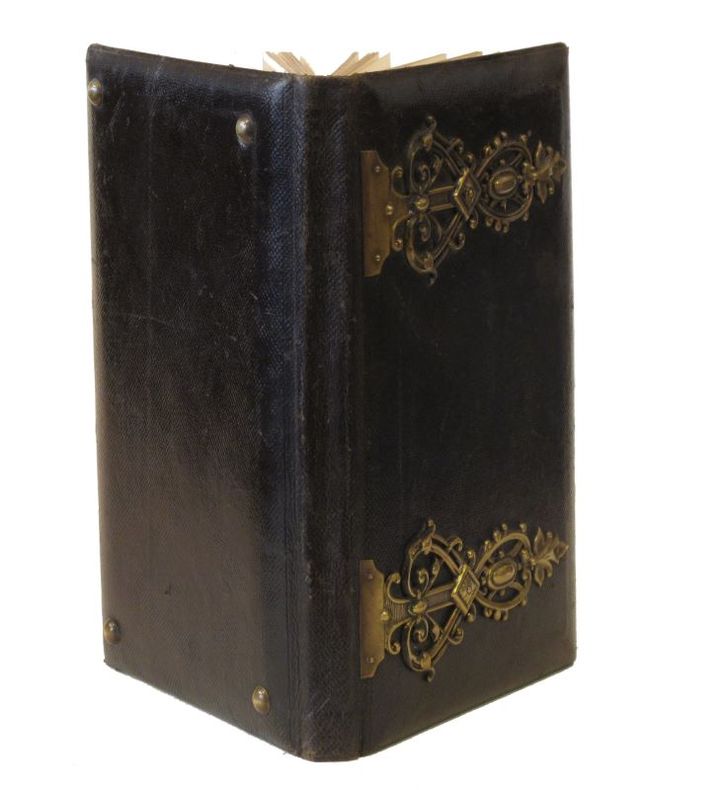
1890129111890 1 Bruxelles, 1884 à 1890. Textes en français et en anglais. In-12, reliure noire, ornée de ferrures plat supérieur, plat arrière clouté, tranches dorées.
182416660PARIS BAUDOUIN FRERES 1824 3 IN-12 Seconde édition, Ouvrage mis en ordre et publié avec une introduction par M. F. Barrière, Edition nouvelle augmentée de lettres et de morceaux inédits. Paris, Baudouin Frères, 1824, 3 volumes, in-12, cartonnage vert amande, dos doré, titre et tomaison dorés, xlviij-404, 352, 356 pp.
191012872Paris IMPRIMERIE BOUQUET 1910 1 Paris, Imprimerie Bouquet, (1910), in-folio, couverture cartonnée verte, demi-toile à coins.
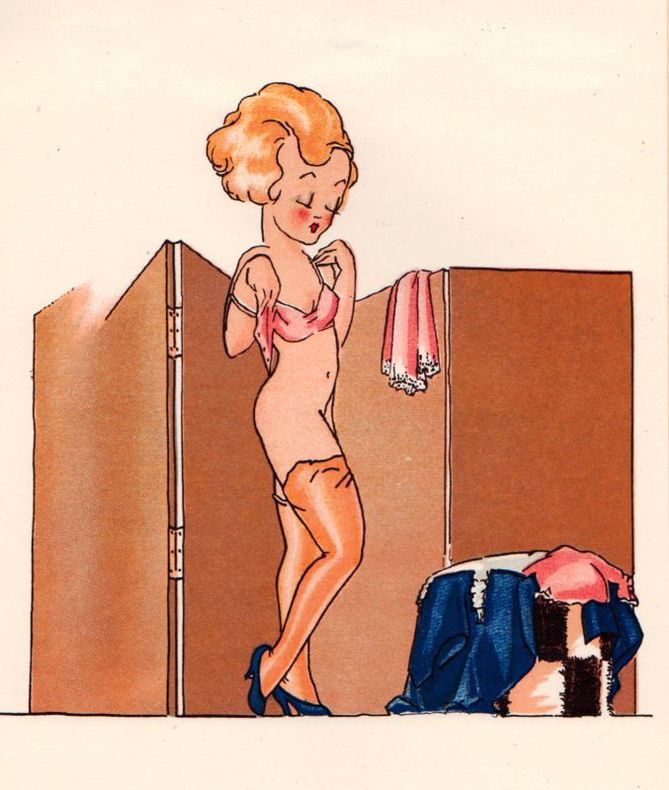
193619943SCANDALE 1936 1 Illustré de SAINT-PRIX. Paris, Scandale, 1936, in-4, broché, illustré de 14 estampes en couleur, 32 pages.