11 490 résultats
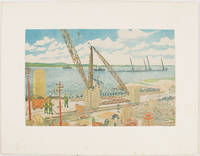
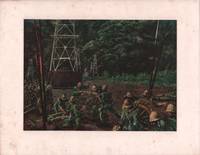
194657171Tokyo Japan: Eighth U.S. Army Printing Plant Boonjudo Printing Works 1946. Oblong folio. 15 x 10.75 in. 21 leaves unnumbered. with colour-illustrated title colour-illustrated preface and 24 illustrations several in colour tipped-in on 18 leaves all retaining tissue guards a couple w/ tears 1 w/ minor loss to tissue guard. Original blue boards white & black lettering on front cover punch-sewn in Japanese style at gutter margin w/ white silk braid minor scuffing edgewear very minor staining to lower front cover still VG- copy. First edition of this well-executed series of brush & ink paintings watercolours wash drawings and ink sketches of occupied Japan following World War II by American G.I. artists. While opening with a decidedly jingoistic preface no longer the slant-eyed many-headed yellow monster. . . bespectcacled buck-toothed enigma. . . the sketches reveal a quiet sympathy and influence of Japanese art techniques. The artists included Hoffmaster was a longtime commercial artist and illustrator for US News & World Report National Geographic and art instructor at the Corcoran School of Art who often contributed covers and illustrations to the Changing Times; MacKenzie 1924-2018 noted American craft potter who was heavily influenced by the aesthetic of Shoji Hamada and Korean ceramics often referred to as the “Mingei-sota style;†and Wolsky 1916-1981 noted commercial artist who later became noted illustrator with Woman’s Home Companion Collier’s McCall’s Redbook Esquire Time and Life and noted collector of Modernist art. Eighth U.S. Army Printing Plant, [Boonjudo Printing Works], hardcover
194143024Japan 1941. Loose in a black clamshell box. Very good copies with slight curl; some with small edge or corner tears; 23 have the name of the film or featured actors/actresses rubber-stamped on the back in Japanese. 47 b/w photos. Approximately 6 x 4 inches. One duplicate. Most are group scenes from dramas a few portraits a few without characters; subject matter ranges from early historical dramas to contemporary scenes to the war and its effects. The dates have been verified on a few and all fall during the years of the Pacific War including Tadashi Imai's Tanjiko-mura 1940 "Hanagoyomi hasshojin" 1940 based on the 19th century novel "Josei hongan" 1940 made in the same year as the novel by Kan Kikuchi Yasuki Chiba's "Kuso buraku" 1939. The balance of the stills appear to date within approximately the same period. unknown
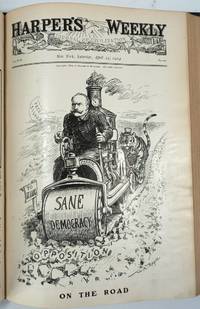
190428398New York: Harper's 1904. First printing. Hardcover. Otherwise very good condition. Lg 4to 994pp of bound weekly issues. This half year bound volume of Harper's Weekly January 2 1904 to June 25 1904 features the Russo-Japanese War double page War map p464; war images pp967-975; X Ray invention p49; Steamer "General Slocum" on p99; San Juan Hill p955; Walter Travers golf p931; St. Louis World Fair p677; Southern California The Story of Its Development. pp504-519. With woodblock illustrations on the covers of the weekly issues. Complete with the supplements.<br /> <br /> Weekly issues bound up into a large single volume with 3/4 leather and marbled boards. Leather spine chipped cracked along the hinges but the binding is holding. Internally bright & very clean. Harper's hardcover
1946140941066Washington D.C.: U.S. Government Printing Office 1946. First Edition. Good. First edition. iv 82 pp. Gray stapled wraps. Good with closed tear to top of front wrap and first page very slightly to following page; wraps toned and lightly worn; former owner's name written on front cover. A rare history of the War Relocation Authority which managed the forced confinement of people of Japanese ancestry in America during World War II as well as their return to civilian life with the commencement of the war. U.S. Government Printing Office unknown
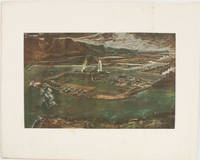
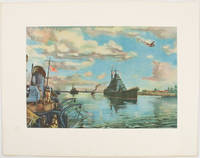
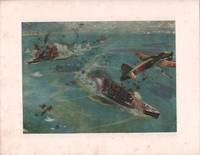
1819214637大日本海洋美術協会. Showa 18 1943. Coloured print 17.5 x 28cm. A clean image mounted on card with some discolouration on its margins. A captioned tissue-guard printed in Japanese is included. 大東亜戦争海軍美術. Daitōa sensō kaigun bijutsu. Art from the Naval Campaigns of the Greater East Asia War. . 大日本海洋美術協会. unknown
1819214636大日本海洋美術協会. Showa 18 1943. Coloured print 22 x 24cm. A lovely clean image but mounted on card with some discolouration to the margins. A captioned tissue-guard printed in Japanese is included. 大東亜戦争海軍美術. Daitōa sensō kaigun bijutsu. Art from the Naval Campaigns of the Greater East Asia War. . 大日本海洋美術協会. unknown
1819214635大日本海洋美術協会. Showa 18 1943. 18 x 28cm. A lovely clean colour image but mounted on card with some discolouration on the margins. A captioned tissue-guard printed in Japanese is included. 大東亜戦争海軍美術. Daitōa sensō kaigun bijutsu. Art from the Naval Campaigns of the Greater East Asia War. . 大日本海洋美術協会. unknown
1819218654大日本海洋美術協会. Showa 18 1943. Coloured print 17.5 x 28cm. A clean image mounted on card with some discolouration on card margins. A captioned tissue-guard printed in Japanese is included. 大東亜戦争海軍美術. Daitōa sensō kaigun bijutsu. Art from the Naval Campaigns of the Greater East Asia War. . 大日本海洋美術協会. unknown
1819218656大日本海洋美術協会. Showa 18 1943. Coloured print 22 x 24cm. A lovely clean image but mounted on card with some discolouration to the margins. A captioned tissue-guard printed in Japanese is included. 大東亜戦争海軍美術. Daitōa sensō kaigun bijutsu. Art from the Naval Campaigns of the Greater East Asia War. . 大日本海洋美術協会. unknown
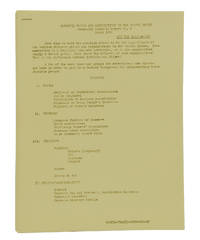
1943140940339Washington D.C: War Relocation Authority 1943. First Edition. Fine. First edition. 7 pp. single-sided. Yellow sheets corner staple bound. A Fine copy with faint rusting to staple and typical faint offsetting around mimeographed text. A very rare document in excellent condition.<br /> <br /> <p>A list of the different types of groups and associations people of Japanese descent might belong to compiled for the War Relocation Authority to aid in their internment of Japanese-Americans living on the West Coast. [War Relocation Authority] unknown
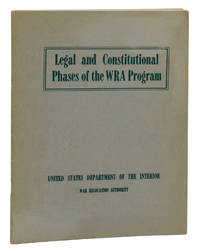
1946140941067Washington D.C.: U.S. Government Printing Office 1946. First Edition. Very Good. First edition. iv 59 pp. Gray stapled wraps. Very Good with light wear crease to final page. A rare legal history of the War Relocation Authority which managed the forced confinement of people of Japanese ancestry in America during World War II as well as their return to civilian life with the commencement of the war. It outlines the government response to the Korematsu case as well as the entire program's overall claims to constitutionality. U.S. Government Printing Office unknown
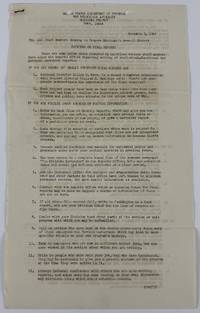
194513044Hunt ID: November 1 1945. 4pp. mimeographed text on tall folio sheets stapled at top left. Old folds light wear two holes punched in top margin. Very good. An informative document written by W.E. Rawlings the Project Director at the Minidoka Internment Camp in Idaho providing guidelines instructions pointers and so forth to staff members preparing final statistical functional and personal narrative reports. The camp closed a few days before this memo was written and final reports were prepared to provide "outside groups both public and private" about "the unique work of the WRA." Rawlings' advice here includes suggestions to refer back to monthly reports consult the "evacuee newspaper 'The Minidoka Irrigator'" confer with longtime employees at the camp and much more. He also suggests methods for addressing questions such as "If You Aren't Sure Washington Will Understand About Mistakes" "If You Are Unsure How Far to Go on Opinion in Personal Narratives" "If You Wonder How 'Personal' Your Personal Narrative Should Be" and so forth. Rawlings advises staff that reports need not be illustrated with photographs or they should be kept to a minimum given that the Denver Photo Unit was overworked at the present moment. In the end Rawlings stipulates that reports should be "clear reasonably complete and factually correct." A fairly sterile document considering the nature of the experiences on which the staff was reporting. November 1 unknown
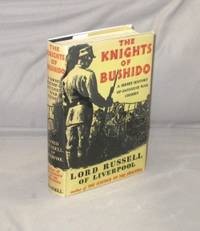
195829174London:: Cassell 1958. First Printing of the First UK Edition. A Near Fine copy with previous owner name on flyleaf in a Near Fine unclipped dust jacket with a small tear to the spine fold. The author has documented records of Japanese atrocities committed during the Second World War as given in evidence at the Japanese war crime trials after the war. He details the mass starvation and forced labor which took the lives of tens of thousands of healthy men.The rape orf women heinous torture and their animal lust for torture. The author's research starts with a brief history of Japanese Imperialism and culminates with the Japanese war of 1931-1945. Cassell, unknown
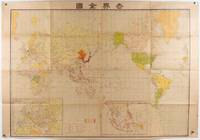
1942177779東京. Tokyo.: 盛文館. Seibunkan. Circa1942. Colour map 75 x 110cm folds to 28 x 19cm. Some light browning somewhat heavier along a few folds. A good copy. This map which was most likely published around 1942 or 1943 depicts the world during the global conflict. Japan is positioned in the centre and its territories are coloured in red. In Southeast Asia Japanese-occupied areas including Singapore the Philippines and the Dutch East Indies are marked with red. Two inset maps display Europe and the Japanese-occupied area to the south as the "Southern Co-Prosperity Sphere." The map is folded to 28 x 19 cm and its cover features the national flags of Japan Nazi Germany Italy the Soviet Union Britain and the United States arranged artistically. . 盛文館. [Seibunkan]. unknown
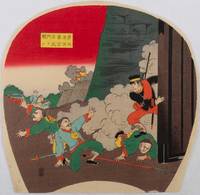
216197Japan. Early 20th Century. Colour woodblock fan print 24.5 x 25cm very good copy. This fan-shaped colour woodblock print features a 1894 battle scene from the Sino-Japanese War in Pyongyang. In order to break into the Chinese fortress a group of Japanese solders climbed over a wall opened the gate and led the Japanese troops in. Among the soldiers Harada Jukichi became well-known as one of the bravest returning home to hero's welcome after the war. However he was overwhelmed with numerous visitors which ended up forcing him into serious debt. In order to pay off this debt he travelled throughout Japan re-enacting the fighting and victorious scenes on stage. This print depicts courageous Harada single handed taking on his Chinese enemies who are falling or fleeing. . unknown
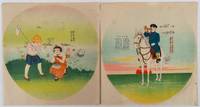
1940216176Japan. 1940. Two coloured fan prints 27.5 x 26cm. Occasional light marks a little light browning. Very good. These two propaganda prints were created to make children's paper fans each carrying patriotic messages and delicately rendered in bright colors.<br><br>The first sheet features a young boy on a white horse blowing a bugle. A Japanese warplane is seen flying in the sky with the rising sun in the background. The caption urges people not to disclose any military secrets even to close friends. Additionally the lyrics of the 1940 nationalistic song "Kokumin Shingunka" are printed on the sheet. <br><br>The second sheet depicts an idyllic scene of children playing by a lake catching dragonflies and fish. The boys are portrayed in more active roles while the girls hold a bucket or a cage. The message on this sheet reads "East Asia's Future is Bright and Children are Thriving." A warplane can be seen in the sky in the far distance subtly tying the peaceful scene to the wartime context. . unknown
1718159896Tokyo: Asahi shinbun. Showa 17. January 181942. 4 page broadsheet newspaper folded evenly browned. Maps black and white photographic illustrations very good copy. 54 x 41cm. Main headline: "Closing in on Singapore Vanguard: Rear-guard of Defeated British Army Cut Off; Battle of Annihilation in Johor". Other headlines include: "Occupation of Strategic Territory of Batu Anam; Australian 8th Division Crushed" followed by an account of fighting between Japanese and Australian forces in Malaya; "Main Enemy Position Cut Off: Battle of Annihilation on the Bataan Peninsula Heats Up"; "Steady Advance by Road: Imperial Army's Fierce Attack on West Coast" followed by account of Japanese advances in Malaya with map; "British Cabinet Restructured"; "US Said to Be Sending Troops to Northern Ireland". Front page has photos of Japanese soldiers standing in front of the monument to Jose Rizal in Manila and of a column of Japanese soldiers advancing by bicycle along a road on the Bataan Peninsula. Articles on the inside pages include discussions of plans to increase production of shipping to meet war needs and of a meeting of Latin American countries to discuss the world situation. Several articles on the back page emphasise material and spiritual preparations being made in Japan for a "long war". The back page also includes an interesting article criticizing US and British propaganda and "misreporting" of the war situation. All text in Japanese. . Asahi shinbun. unknown
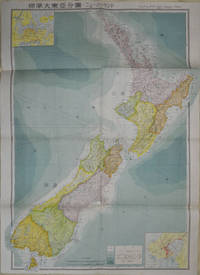
1572154080Tokyo: 統制社Tosei-sha. 昭和18 Showa1943. Folding colour map of New Zealand with inset of Auckland and Wellington top and bottom corners1:2000000 scale little light browning. Original envelope worn with closed tears. 54 x 76.5cm. Good copy. Scale plan of New Zealand printed by Tosei in 1943. The map legend shows infrastructure deemed important to the Land Survey Bureau of the General Staff Headquaters of the Imperial Japanese army such as boundaries powerlines quarries and mines; railroads sea-routes etc. . 統制社(Tosei-sha) unknown
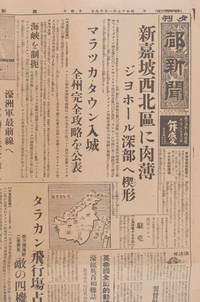
1572159803東京. Tokyo.: 都新聞社.Miyako shinbunsha. 昭和十七 1942. Double sided newsheet browned with a few small holes folded. Good copy. 54 x 40.2cm. WWII Japanese newspaper one sheet printed double side issued by Miyako Shinbunsha on January 18th 1942. Front page features latest military news including Japanese army's advances in Johore State and capture of Malacca town to the northwest of Singapore on January 15th. These is also a report on the capture of Tarakan airfield and on bombing raids launched against Rabaul. It also shows two maps one of Borneo and one of the war zone of southern Malaya Singapore and northern Sumatra. One article highlights the fact that Australian newspapers including Sydney's Daily Mirror have been critical of the failures of British Military strategy in Southeast Asia. Another entitled "Australian Army to the Front Line" describes the deployment of Australian forces to Southeast Asia to oppose Japan's southward advance. <br> <br>There is also an article on page 2 about marriages of Japanese military settlers in Manchuria. Not all of the reports are war related - the newsheet includes reports of sumo results and advertisments for patent medicines. Occasional closed tears at edges and trifle losses otherwise in good condition. Text in Japanese. . 都新聞社.[Miyako shinbunsha]. unknown
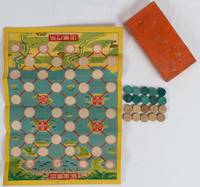
1940216804Japan. Circa 1940. Colour folding game sheet 36.5 x 26cm 10 wooden playing pieces each with embossed images in beige and blue complete original box 15.5 x 7.6 x 2.3cm considerably worn and soiled and corners reinforced the game itself is in very good bright condition. This is a two-player board game where air planes and war ships fight against each other. Fascinatingly the game sheet illustration shows the battle ground is in the Pacific where islands with palm tree are dotted. Consequently the game might be produced at the early stage of the Pacific War. The players attack each other after starting from a naval base and an air base. There are two islands each where they are safely protected from their enemies. The playing pieces are made out of paper with embossed images of war ships and air planes in beige air power and blue sea power colours. . unknown
197463561New York: William Morrow & Co. 1974. 4to. 63 1 pp. With colour plates 1 map. Gold library cloth publisher’s binding black lettering on spine scuffing and offsetting from jacket Brodart being glued securely originally to pastedowns ex-lib markings on endpapers w/ d.j. cover art by Takashima minor edgewear slight creasing partially removed spine label for “Library Edition†still a G/VG copy. First U.S. edition of this searing and poignant illustrated memoir of the artist’s experiences being stripped of their Canadian Civil Rights herded into railcars and shipped to New Denver Internment Camp on Slocam Lake Canada for over 3 years during World War II. Her watercolour paintings earned a Gold Medal from the Canadian Association of Children’s Librarians and was the first major publication to examine the Japanese-Canadian experience of illegal internment by a Japanese-Canadian writer. Takashima 1928-2005 studied at the Ontario College of Art following the War later taught there from 1976 to retirement in 1994 and also spent extensive time traveling in Mexico India New York and Japan. William Morrow & Co., hardcover
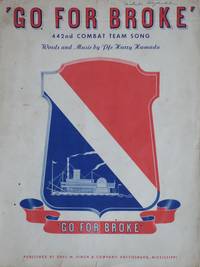
1944List2436Hattiesburg: Earl M. Finch 1944. Sheet music measuring 12 x 9 inches 4 pp. Signature of a Nabuko Hayashida on front cover. Slight tears at fold some toning two small pinholes very good overall quite attractive. Very Good. In Hawaii in May 1942 a battalion of Nisei volunteers was assembled for service in World War Two despite earlier failures of efforts to recruit Japanese-Americans due to the Army’s labeling of Nisei recruits as 4-C enemy aliens. Designated as the 100th Infantry Battalion they were deployed to North Africa in June 1943 integrating with the 34th Division in active combat. Their subsequent deployment to Italy in September 1943 exposed them to intense warfare earning them the moniker of the "Purple Heart Battalion" due to their notably high casualty rate.<br /> <br /> In January 1943 the U.S. War Department officially declared the establishment of the segregated 442nd Regimental Combat Team RCT which was comprised of Nisei volunteers originating from Hawaii and the mainland. The culmination of this initiative transpired in June 1944 when the 442nd RCT merged forces with the 100th Infantry Battalion in Europe subsequently absorbing the latter into its structure. The notable achievements of Nisei soldiers in combat operations prompted the reinstatement of the draft in January 1944 specifically targeting Nisei detainees to augment the ranks of the 442nd. Over time the 442nd RCT expanded to encompass the 2nd 3rd and 100th Battalions; the 522nd Field Artillery Battalion; the 232nd Engineering Company; the 206th Army Band; Anti-Tank Company; Cannon Company; and Service Company. <br /> <br /> Offered here is a very scarce piece of sheet music entitled “Go For Broke†which was written by the Hawaiian musician Harry Hamada reflecting the slogan of the 442nd and performed by Shelby and others during the war as part of efforts to boost morale. Hamada would feature in the 1951 movie “Go For Broke†as Masami alongside several other veterans of the 442nd. This publication of “Go For Broke†is from 1944 seven years before the movie’s release. The piece is dedicated to Colonel C.W. Pence. Hamada was a Hawaiian musician who performed with a band called the Shelby Hawaiians or the Shelby Serenaders. They performed as early as 1943. The Hattiesburg Mississippi merchant Earl M. Finch who ran an Army and Navy store close to Camp Shelby befriended Hamada and other members of the 442nd and acted as a sponsor for the group and eventually published this version despite his business being a dry goods merchant house and not a publishing house. The group with the support of Finch performed throughout the country to lift morale. At some point Hamada penned this composition likely in 1944 as we find no reference to it in 1943 articles and Finch published it - Hamada’s composition would become the theme song of the 442nd and Hamada would perform at the Halloran General Hospital in New York and the Walter Reed Hospital in Washington D.C. in 1944 likely performing this composition. Another composition called “Go For Broke†exists as well and it is unclear to what degree Hamada’s work caught on among the regiment. <br /> <br /> We find two records of Finch’s published version of the composition one listed as part of an online remembrance of the 442nd by the Smithsonian Institution https://americanhistory.si.edu/explore/stories/day-remembrance-70-years-after-executive-order-9066 which appears to have been on loan from the National Japanese American Historical Society and another copy held at Stanford though not listed in OCLC. Finch’s story is also interesting and is the subject of a remembrance on a 100th Battalion History page online https://www.100thbattalion.org/history/stories/earl-finch/. We find no copies listed in OCLC. Overall a very scarce piece of Japanese-American wartime history. Earl M. Finch unknown
1955479Branding Iron Press 1955. 2nd Edition . Soft cover. Very Good. Wrappers a very good copy. Reprint edition. Adams One-Fifty 86. Guns 1184: "This pamphlet rare in the original edition makes many serious accusations and calls names listing some of Wyoming's most prominent cattlemen. Every effort was made to destroy all the copies and was so successful that only a few copies are known to exist.In 1955 the Branding Iron Press of Evanston Illinois reprinted it in a limited edition of one thousand copies. The text is placed in a half-pocket of a stiff pictorial wrapper on the inside of which is an introduction giving the details about the origin of the pamphlet and the history of the period." Herd 1175. <br/> <br/> Branding Iron Press paperback
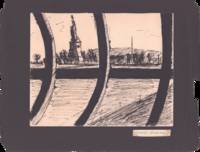
1941List2962New York City 1941. Thirty-three sketches mainly measuring 6 x 8 or 8 x 10 inches affixed to black construction paper. Sketches are pen and ink or pencil some with captions. With seventeen typed pages mainly measuring 6 ½ x 7 inches. In an 11 x 14 ½ inch portfolio. Spine of portfolio missing all pages separated; sketches excellent construction paper with much marginal chipping; typed pages with adhesive verso else excellent. Overall very good to excellent. Bitia Rosendor 1920–2011 was a Jewish artist born in Jerusalem and raised in Antwerp Belgium. Rosendor studied painting and sculpture at the Koninklijke Academie voor Schone Kunsten in Antwerp but her studies were interrupted by the outbreak of World War II. The Rosendor family fled Europe via Portugal in 1941 and were detained at Ellis Island where these sketches were produced.<br /> <br /> The sketches include portraits of other detainees and immigration employees and views from the island. Most have captions including brief notes about the subjects such as “She became hysterical and was taken to the hospital†“A little orphan going all alone to the Dominican Republic†and “‘Liberty’ through barsâ€â€”the latter on an illustration of the Statue of Liberty seen through the bars on the internment center’s windows.<br /> <br /> The typed text describes Rosendor’s experience waiting for the family’s Visa to be approved. The ordeal is mostly one of boredom; she writes:<br /> <br /> “Everyone had the same endless day to pass but everyone passed it differently. There was no possible way to be original but each of us retained her or his personality. The emptiness of the hours was heavy to bear.â€<br /> <br /> The boredom though is punctuated by “incidentsâ€; some negative as when “Once a Chinese girl wept for three days uninterrupted refused to eat refused everything†and some positive as when “A friend seen last time at the Antipodes†disembarks “from a newly entered ship . and suddenly: ‘YOU’! -’YOU’â€.<br /> <br /> Rosendor would live with her family in Brooklyn until the 1950s when she returned to Europe with her husband Jewish-American painter Martin Reisberg a fellow immigrant whom she met in the city. The pair returned to Belgium where they ran a gallery and created exhibitions together until Rosendor’s death in 2011.<br /> <br /> Of interest to scholars of the Holocaust American immigration and the Jewish immigrant experience in the 1940s. unknown
188734305New York: Press of Fleming Brewster & Alley 1887. First Edition. Wraps. Fair. String bound wraps with illustration on the front. 8 pages. Illustrated views of Kennesaw Mountain and Confederate troops digging in defensive positions on Kennesaw Mountain. The red string on the front cover is torn and the front cover is mostly detached. Covers have light to moderate soil. Light edge stains to the interior. Poem written in facsimile hand. A fair to good copy. Published the Western & Atlantic Railroad. Press of Fleming Brewster & Alley unknown